There are many definitions of a
  forest, based on the various
     criteria.[1] These plant
       communities cover
   approximately 9.4% of the
Earth's surface (or 30% of total
 land area) in many different
    regions and function as
           habitats for
  organisms, hydrologic f low
      modulators, and soil
conservers, constituting one of
the most important aspects of
     the Earth's biosphere.
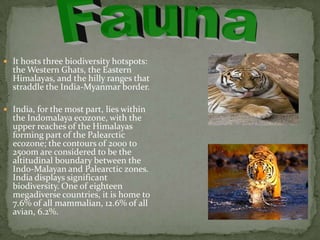
 It hosts three biodiversity hotspots:
  the Western Ghats, the Eastern
  Himalayas, and the hilly ranges that
  straddle the India-Myanmar border.

 India, for the most part, lies within
  the Indomalaya ecozone, with the
  upper reaches of the Himalayas
  forming part of the Palearctic
  ecozone; the contours of 2000 to
  2500m are considered to be the
  altitudinal boundary between the
  Indo-Malayan and Palearctic zones.
  India displays significant
  biodiversity. One of eighteen
  megadiverse countries, it is home to
  7.6% of all mammalian, 12.6% of all
  avian, 6.2%.
 It provide us medicinal plants.
 It protect us from global warming.
 It provides a better ecosystem.
 It provides habitat to various kinds of animals
 Medicinal plants (MP) are a
  vital component of non-timber
  forest products (NTFP) and
  play a significant role in the
  health care of rural people all
  over the world. Collection of
  MP is also making an important
  contribution to poor people’s
  livelihood, but in countries
  with high population density,
  like Bangladesh, the pressure
  on natural forests is hard.
 During the last year the
  awareness about the
  anthropogenic induced
  climate change due to
  increasing level of Green
  House Gases (GHGs), like for
  example carbon dioxide (CO2)
  has increased drastically. The
  atmospheric content of CO2
  which is the GHG that the
  forest sector mainly can
  influence has increased from
  280 ppm pre-industrial time
  (1750) to 379 ppm 2005.
 All humans everywhere
 depend on ecosystem
 products and services for
 their well-being. But what
 if the ecosystems are not
 able to provide all these
 products and services
 because of
 overexploitation? In bad
 cases this can, for
 example, lead to
 starvation.
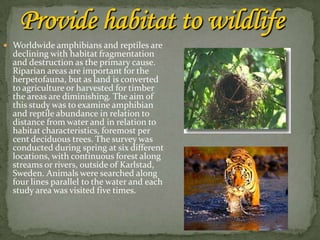
 Worldwide amphibians and reptiles are
  declining with habitat fragmentation
  and destruction as the primary cause.
  Riparian areas are important for the
  herpetofauna, but as land is converted
  to agriculture or harvested for timber
  the areas are diminishing. The aim of
  this study was to examine amphibian
  and reptile abundance in relation to
  distance from water and in relation to
  habitat characteristics, foremost per
  cent deciduous trees. The survey was
  conducted during spring at six different
  locations, with continuous forest along
  streams or rivers, outside of Karlstad,
  Sweden. Animals were searched along
  four lines parallel to the water and each
  study area was visited five times.
Tropical rainforests,
Tropical deciduous forests,
Thorn forests,
Tidal (mangrove forests) forests, and
Coniferous forests.
 A tropical rainforest is an ecosystem
  usually found around the equator.
  They are common in
  Asia, Australia, Africa, South
  America, Central America, Mexico and
  on many of the Pacific Islands. Within
  the World Wildlife Fund's biome
  classification, tropical rainforests are
  considered a type of tropical wet forest
  (or tropical moist broadleaf forest) and
  may also be referred to as lowland
  equatorial evergreen rainforest.
  Minimum normal annual rainfall
  between 1,750 millimetres (69 in) and
  2,000 millimetres (79 in) occurs in this
  climate region. Mean monthly
  temperatures exceed 18 °C (64 °F)
  during all months of the year.
 The newly bare trees open up
 the canopy layer, enabling
 sunlight to reach ground level
 and facilitate the growth of
 thick underbrush. Trees on
 moister sites and those with
 access to ground water tend to
 be evergreen. Infertile sites also
 tend to support evergreen trees.
 Deciduous trees predominate in
 most of these forests, and
 during the drought a leafless
 period occurs, which varies with
 species type.
 This vegetation covers a large part
  of southwestern North America
  and southwestern Africa and
  smaller areas in Africa, South
  America, and Australia. In South
  America, thorn forest is
  sometimes called caatinga. Thorn
  forest grades into savanna
  woodland as the rainfall increases
  and into desert as the climate
  becomes drier .These are
  dense, scrublike vegetation
  characteristic of dry subtropical
  and warm temperate areas with a
  seasonal rainfall averaging 250 to
  500 millimeters (about 10 to 20
  inches).
 Mangroves form a characteristic
  saline woodland or shrubland
  habitat, called mangrove swamp,
  mangrove forest, mangrove or
  mangal.

….. The saline conditions tolerated
   by various species range from
  brackish water, through pure
  seawater (30 to 40 ppt), to water of
  over twice the salinity of ocean
  seawater

 Mangroves are trees and shrubs that
  grow in saline coastal habitats in the
  tropics and subtropics – mainly
  between latitudes 25° N and 25° S.
 The temperate coniferous
  forest includes areas such as
  the Valdivian temperate rain
  forests of southwestern South
  America, the rain forests of
  New Zealand and Tasmania,
  northwest Europe (small
  pockets in Ireland)
 The Klamath-Siskiyou forests
  of northwestern California
  and southwestern Oregon is
  known for its rich variety of
  plant and animal species,
  including many endemic
  species.
 Protecting and improving the natural habitat of the plants and animals.
 Proper management of water resources in forests for animals.
 Creating national parks and wildlife sanctuaries for safe breeding of the
    endangered and other species. National parks are areas that are permanently
    reserved for conservation of natural resources. For example, Kanha national
    park known for tiger, leopards, etc.
   Sanctuaries are areas where protection is given chiefly to animals. Locals are
    allowed to come and collect fallen forest products like firewood.
   Species which may become extinct should be bred in captivity at zoological
    parks and released into the forests.
   Social forestry which encourages polyculture (planting of different species) of
    trees.
   Grazing should be controlled in such a way that it does not affect the habitat of
    the wildlife.
   Strict laws to be enacted and enforced.
   Public awareness to be create.
40402188 forest

40402188 forest

  • 2.
    There are manydefinitions of a forest, based on the various criteria.[1] These plant communities cover approximately 9.4% of the Earth's surface (or 30% of total land area) in many different regions and function as habitats for organisms, hydrologic f low modulators, and soil conservers, constituting one of the most important aspects of the Earth's biosphere.
  • 3.
     It hoststhree biodiversity hotspots: the Western Ghats, the Eastern Himalayas, and the hilly ranges that straddle the India-Myanmar border.  India, for the most part, lies within the Indomalaya ecozone, with the upper reaches of the Himalayas forming part of the Palearctic ecozone; the contours of 2000 to 2500m are considered to be the altitudinal boundary between the Indo-Malayan and Palearctic zones. India displays significant biodiversity. One of eighteen megadiverse countries, it is home to 7.6% of all mammalian, 12.6% of all avian, 6.2%.
  • 4.
     It provideus medicinal plants.  It protect us from global warming.  It provides a better ecosystem.  It provides habitat to various kinds of animals
  • 5.
     Medicinal plants(MP) are a vital component of non-timber forest products (NTFP) and play a significant role in the health care of rural people all over the world. Collection of MP is also making an important contribution to poor people’s livelihood, but in countries with high population density, like Bangladesh, the pressure on natural forests is hard.
  • 6.
     During thelast year the awareness about the anthropogenic induced climate change due to increasing level of Green House Gases (GHGs), like for example carbon dioxide (CO2) has increased drastically. The atmospheric content of CO2 which is the GHG that the forest sector mainly can influence has increased from 280 ppm pre-industrial time (1750) to 379 ppm 2005.
  • 7.
     All humanseverywhere depend on ecosystem products and services for their well-being. But what if the ecosystems are not able to provide all these products and services because of overexploitation? In bad cases this can, for example, lead to starvation.
  • 8.
     Worldwide amphibiansand reptiles are declining with habitat fragmentation and destruction as the primary cause. Riparian areas are important for the herpetofauna, but as land is converted to agriculture or harvested for timber the areas are diminishing. The aim of this study was to examine amphibian and reptile abundance in relation to distance from water and in relation to habitat characteristics, foremost per cent deciduous trees. The survey was conducted during spring at six different locations, with continuous forest along streams or rivers, outside of Karlstad, Sweden. Animals were searched along four lines parallel to the water and each study area was visited five times.
  • 9.
    Tropical rainforests, Tropical deciduousforests, Thorn forests, Tidal (mangrove forests) forests, and Coniferous forests.
  • 10.
     A tropicalrainforest is an ecosystem usually found around the equator. They are common in Asia, Australia, Africa, South America, Central America, Mexico and on many of the Pacific Islands. Within the World Wildlife Fund's biome classification, tropical rainforests are considered a type of tropical wet forest (or tropical moist broadleaf forest) and may also be referred to as lowland equatorial evergreen rainforest. Minimum normal annual rainfall between 1,750 millimetres (69 in) and 2,000 millimetres (79 in) occurs in this climate region. Mean monthly temperatures exceed 18 °C (64 °F) during all months of the year.
  • 11.
     The newlybare trees open up the canopy layer, enabling sunlight to reach ground level and facilitate the growth of thick underbrush. Trees on moister sites and those with access to ground water tend to be evergreen. Infertile sites also tend to support evergreen trees. Deciduous trees predominate in most of these forests, and during the drought a leafless period occurs, which varies with species type.
  • 12.
     This vegetationcovers a large part of southwestern North America and southwestern Africa and smaller areas in Africa, South America, and Australia. In South America, thorn forest is sometimes called caatinga. Thorn forest grades into savanna woodland as the rainfall increases and into desert as the climate becomes drier .These are dense, scrublike vegetation characteristic of dry subtropical and warm temperate areas with a seasonal rainfall averaging 250 to 500 millimeters (about 10 to 20 inches).
  • 13.
     Mangroves forma characteristic saline woodland or shrubland habitat, called mangrove swamp, mangrove forest, mangrove or mangal. ….. The saline conditions tolerated by various species range from brackish water, through pure seawater (30 to 40 ppt), to water of over twice the salinity of ocean seawater  Mangroves are trees and shrubs that grow in saline coastal habitats in the tropics and subtropics – mainly between latitudes 25° N and 25° S.
  • 14.
     The temperateconiferous forest includes areas such as the Valdivian temperate rain forests of southwestern South America, the rain forests of New Zealand and Tasmania, northwest Europe (small pockets in Ireland)  The Klamath-Siskiyou forests of northwestern California and southwestern Oregon is known for its rich variety of plant and animal species, including many endemic species.
  • 15.
     Protecting andimproving the natural habitat of the plants and animals.  Proper management of water resources in forests for animals.  Creating national parks and wildlife sanctuaries for safe breeding of the endangered and other species. National parks are areas that are permanently reserved for conservation of natural resources. For example, Kanha national park known for tiger, leopards, etc.  Sanctuaries are areas where protection is given chiefly to animals. Locals are allowed to come and collect fallen forest products like firewood.  Species which may become extinct should be bred in captivity at zoological parks and released into the forests.  Social forestry which encourages polyculture (planting of different species) of trees.  Grazing should be controlled in such a way that it does not affect the habitat of the wildlife.  Strict laws to be enacted and enforced.  Public awareness to be create.