FOD
FOD
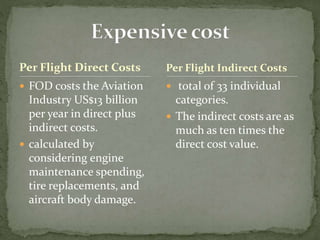
Per Flight Direct Costs
 FOD costs the Aviation
Industry US$13 billion
per year in direct plus
indirect costs.
 calculated by
considering engine
maintenance spending,
tire replacements, and
aircraft body damage.
 total of 33 individual
categories.
 The indirect costs are as
much as ten times the
direct cost value.
Per Flight Indirect Costs
 Airport efficiency losses
 Carbon / Environmental issues
 Change of aircraft
 Close airport
 Close runway
 Corporate manslaughter/criminal liability
 Cost of corrective action
 Cost of hiring and training replacement
 Cost of rental or lease of replacement
equipment
 Cost of restoration of order
 Cost of the investigation
 Delay for planes in air
 Delays at gate
 Fines and citations
 Fuel efficiency losses
 Hotels
 In-air go-around
 Increased insurance premiums
 Increased operating costs on remaining
equipment
 Insurance deductibles
 Legal fees resulting
 Liability claims in excess of insurance
 Loss of aircraft
 Loss of business and damage to
reputation
 Loss of productivity of injured
personnel
 Loss of spares or specialized equipment
 Lost time and overtime
 Missed connections
 Morale
 Reaction by crews leading to disruption
of schedule
 Replacement flights on other carriers
 Scheduled maintenance
 Unscheduled maintenance
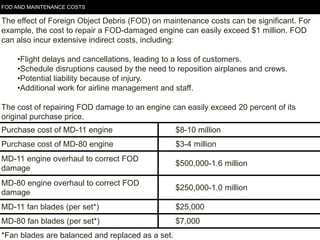
FOD AND MAINTENANCE COSTS
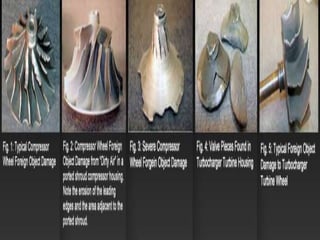
The effect of Foreign Object Debris (FOD) on maintenance costs can be significant. For
example, the cost to repair a FOD-damaged engine can easily exceed $1 million. FOD
can also incur extensive indirect costs, including:
•Flight delays and cancellations, leading to a loss of customers.
•Schedule disruptions caused by the need to reposition airplanes and crews.
•Potential liability because of injury.
•Additional work for airline management and staff.
The cost of repairing FOD damage to an engine can easily exceed 20 percent of its
original purchase price.
Purchase cost of MD-11 engine $8-10 million
Purchase cost of MD-80 engine $3-4 million
MD-11 engine overhaul to correct FOD
damage
$500,000-1.6 million
MD-80 engine overhaul to correct FOD
damage
$250,000-1.0 million
MD-11 fan blades (per set*) $25,000
MD-80 fan blades (per set*) $7,000
*Fan blades are balanced and replaced as a set.
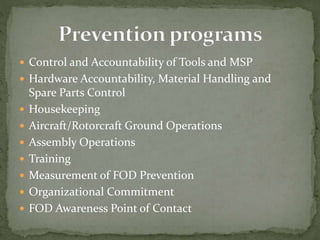
 Control and Accountability of Tools and MSP
 Hardware Accountability, Material Handling and
Spare Parts Control
 Housekeeping
 Aircraft/Rotorcraft Ground Operations
 Assembly Operations
 Training
 Measurement of FOD Prevention
 Organizational Commitment
 FOD Awareness Point of Contact
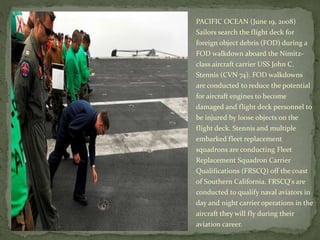
PACIFIC OCEAN (June 19, 2008)
Sailors search the flight deck for
foreign object debris (FOD) during a
FOD walkdown aboard the Nimitz-
class aircraft carrier USS John C.
Stennis (CVN 74). FOD walkdowns
are conducted to reduce the potential
for aircraft engines to become
damaged and flight deck personnel to
be injured by loose objects on the
flight deck. Stennis and multiple
embarked fleet replacement
squadrons are conducting Fleet
Replacement Squadron Carrier
Qualifications (FRSCQ) off the coast
of Southern California. FRSCQ's are
conducted to qualify naval aviators in
day and night carrier operations in the
aircraft they will fly during their
aviation career.
INDIAN OCEAN (May 4, 2009)
Sailors and Marines perform a
foreign object debris (FOD)
walk down after an all-hands
call aboard the amphibious
assault ship USS Boxer (LHD 4).
FOD walk downs help prevent
damage to aircraft from debris
on the flight deck which could
be ingested into a jet engine.
Boxer is deployed as part of the
Boxer Amphibious Readiness
Group/13th Marine
Expeditionary Unit supporting
maritime security operations in
the U.S. 5th fleet area of
responsibility.
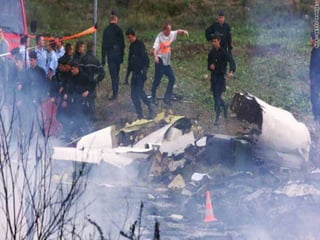
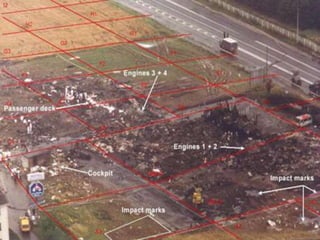
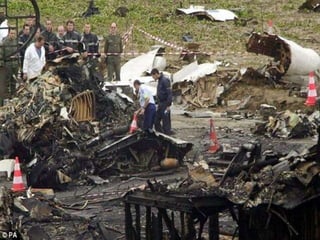
 Damage to aircraft will lead to death and injury which
will cause expensive cost.
 Control program for FOD must be functional with
efficiency.
 An effective debris-control program can greatly reduce
the high cost of FOD damage and the potential for
injury to personnel or passenger.
 FOD control is most effective when all affected parties
coordinate their efforts.
Foreign Object Damage/Debris

Foreign Object Damage/Debris

  • 1.
  • 4.
  • 14.
    Per Flight DirectCosts  FOD costs the Aviation Industry US$13 billion per year in direct plus indirect costs.  calculated by considering engine maintenance spending, tire replacements, and aircraft body damage.  total of 33 individual categories.  The indirect costs are as much as ten times the direct cost value. Per Flight Indirect Costs
  • 15.
    Per Flight IndirectCosts  Airport efficiency losses  Carbon / Environmental issues  Change of aircraft  Close airport  Close runway  Corporate manslaughter/criminal liability  Cost of corrective action  Cost of hiring and training replacement  Cost of rental or lease of replacement equipment  Cost of restoration of order  Cost of the investigation  Delay for planes in air  Delays at gate  Fines and citations  Fuel efficiency losses  Hotels  In-air go-around  Increased insurance premiums  Increased operating costs on remaining equipment  Insurance deductibles  Legal fees resulting  Liability claims in excess of insurance  Loss of aircraft  Loss of business and damage to reputation  Loss of productivity of injured personnel  Loss of spares or specialized equipment  Lost time and overtime  Missed connections  Morale  Reaction by crews leading to disruption of schedule  Replacement flights on other carriers  Scheduled maintenance  Unscheduled maintenance
  • 16.
    FOD AND MAINTENANCECOSTS The effect of Foreign Object Debris (FOD) on maintenance costs can be significant. For example, the cost to repair a FOD-damaged engine can easily exceed $1 million. FOD can also incur extensive indirect costs, including: •Flight delays and cancellations, leading to a loss of customers. •Schedule disruptions caused by the need to reposition airplanes and crews. •Potential liability because of injury. •Additional work for airline management and staff. The cost of repairing FOD damage to an engine can easily exceed 20 percent of its original purchase price. Purchase cost of MD-11 engine $8-10 million Purchase cost of MD-80 engine $3-4 million MD-11 engine overhaul to correct FOD damage $500,000-1.6 million MD-80 engine overhaul to correct FOD damage $250,000-1.0 million MD-11 fan blades (per set*) $25,000 MD-80 fan blades (per set*) $7,000 *Fan blades are balanced and replaced as a set.
  • 18.
     Control andAccountability of Tools and MSP  Hardware Accountability, Material Handling and Spare Parts Control  Housekeeping  Aircraft/Rotorcraft Ground Operations  Assembly Operations  Training  Measurement of FOD Prevention  Organizational Commitment  FOD Awareness Point of Contact
  • 19.
    PACIFIC OCEAN (June19, 2008) Sailors search the flight deck for foreign object debris (FOD) during a FOD walkdown aboard the Nimitz- class aircraft carrier USS John C. Stennis (CVN 74). FOD walkdowns are conducted to reduce the potential for aircraft engines to become damaged and flight deck personnel to be injured by loose objects on the flight deck. Stennis and multiple embarked fleet replacement squadrons are conducting Fleet Replacement Squadron Carrier Qualifications (FRSCQ) off the coast of Southern California. FRSCQ's are conducted to qualify naval aviators in day and night carrier operations in the aircraft they will fly during their aviation career.
  • 20.
    INDIAN OCEAN (May4, 2009) Sailors and Marines perform a foreign object debris (FOD) walk down after an all-hands call aboard the amphibious assault ship USS Boxer (LHD 4). FOD walk downs help prevent damage to aircraft from debris on the flight deck which could be ingested into a jet engine. Boxer is deployed as part of the Boxer Amphibious Readiness Group/13th Marine Expeditionary Unit supporting maritime security operations in the U.S. 5th fleet area of responsibility.
  • 21.
     Damage toaircraft will lead to death and injury which will cause expensive cost.  Control program for FOD must be functional with efficiency.  An effective debris-control program can greatly reduce the high cost of FOD damage and the potential for injury to personnel or passenger.  FOD control is most effective when all affected parties coordinate their efforts.