Aircraft Ground
Handling
SEATWORK (1/2 crosswise)
1. What do you mean by Ground handling?
2. Why do you think it is necessary to study this
subject?
3. Cite some importance of ground handling in the
airline operation.
 Aircraft ground
handling defines the
servicing of
an aircraft while it is on
the ground and (usually)
parked at a terminal
gate of an airport.
The major categories of
ground handling services
are described below.
1. Cabin Service
2. Catering
3. Ramp Service
4. Passenger Service
5. Field Operation
Cabin Service
 The primary aim of this service offering is to ensure
passenger comfort. While cabin cleaning
comprises the bulk of the effort, it also includes
tasks such as replenishing onboard consumables
(soap, tissues, toilet paper, reading materials) and
washable items like pillows and blankets.
Catering
Catering includes the unloading of unused food
and drink from the aircraft, and the loading of fresh
food and drink for passengers and crew. 
Airline meals are typically delivered in Airline service
trolleys. Empty or trash-filled trolley from the
previous flight are replaced with fresh ones.
Meals are prepared mostly on the ground in order
to minimize the amount of preparation (apart from
chilling or reheating) required in the air.
Ramp Service
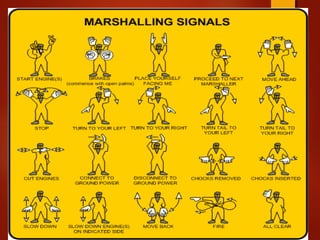
• Guiding the aircraft into and out of the parking position (by
way of aircraft marshalling),
• Towing with pushback tractors
• Lavatory drainage
• Water cartage (typically non-potable for lavatory sink use)
• Air conditioning (more common for smaller aircraft)
• Airstart units (for starting engines)
• Luggage handling, usually by means
of beltloaders and baggage carts
• Gate checked luggage, often handled on the tarmac as
passengers disembark
• Air cargo handling, usually by means of cargo dollies and
cargo loaders
• Catering trucks
• Refueling, which may be done with a refueling tanker
truck or refueling pumper
• Ground power (so that engines need not be running to
provide aircraft power on the ground)
• Passenger stairs (used instead of an aerobridge or airstairs,
some budget airlines use both to improve turnaround
speed)
• Wheelchair lifts, if required
• Hydraulic mules (units that provide hydraulic power to an
aircraft externally)
• Deicing
Passenger Service
This includes services inside the airport terminal such
as:
•Providing check-in counter services for the
passengers departing on the customer airlines.
•Providing gate arrival and departure services. The
agents are required to meet a flight on arrival as
well as provide departure services including
boarding passengers and closing the flight.
•Staffing the transfer counters, customer service
counters and airline lounges.
Field Operation
This service dispatches the aircraft, maintains communication
with the rest of the airline operation at the airport and with Air
Traffic Control.
Air traffic control 
Air traffic control (ATC) is a service provided by
ground-based controllers who direct aircraft on the
ground and through controlled airspace, and can
provide advisory services to aircraft in non-
controlled airspace.
The primary purpose of ATC worldwide is to prevent
collisions, organize and expedite the flow of traffic,
and provide information and other support
for pilots. In some countries, ATC plays a security or
defensive role, or is operated by the military.
Ground handling
operations
1. Overview
 We can distinguish two major types of ground
handling procedures which are designated as
either terminal or airside operations.
 First, we should define the whole range of
operations that ground handlers deal with. The
following list is an exhaustive for common
commercial flights:
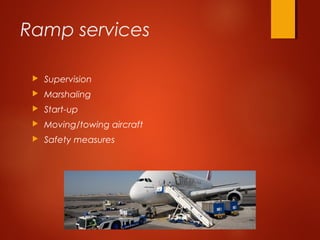
Ramp services
 Supervision
 Marshaling
 Start-up
 Moving/towing aircraft
 Safety measures
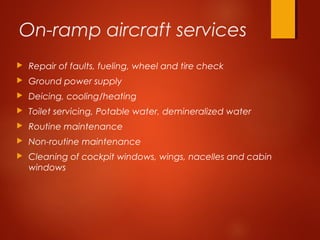
On-ramp aircraft services
 Repair of faults, fueling, wheel and tire check
 Ground power supply
 Deicing, cooling/heating
 Toilet servicing, Potable water, demineralized water
 Routine maintenance
 Non-routine maintenance
 Cleaning of cockpit windows, wings, nacelles and cabin
windows
Onboard servicing
 Cleaning
 Catering
 In-flight entertainment
 Minor servicing of cabin fittings
 Alteration of seat configuration
External ramp equipment
 Passenger steps
 Catering loaders
 Cargo loaders, mail and equipment loading
 Obviously, ground handling management has to deal with
very diverse tasks. Preferably, these operations are performed
simultaneously to decrease ground time and thus to increase
aircraft productivity. Airlines pay at the most part for the
delays that their aircrafts experience.
 Therefore, they strongly emphasizes the time-
efficiency of ground operations provided either
by themselves, or the airport authority or
independent companies. It makes the task even
tougher for ground handlers whose efficiency
relies on technology-advanced equipment,
coordination of staff and information support
systems.
2. Equipment
 In terms of ground handling equipment, we found out that
available products are numerous. It would not be very
relevant to analyze thoroughly every company with all their
products.
 The list below summarizes what equipment is
basically required:
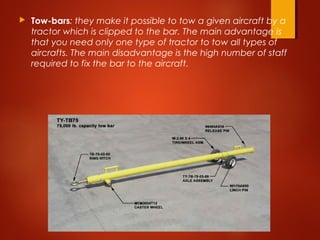
 Tow-bars: they make it possible to tow a given aircraft by a
tractor which is clipped to the bar. The main advantage is
that you need only one type of tractor to tow all types of
aircrafts. The main disadvantage is the high number of staff
required to fix the bar to the aircraft.
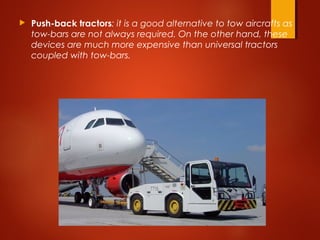
 Push-back tractors: it is a good alternative to tow aircrafts as
tow-bars are not always required. On the other hand, these
devices are much more expensive than universal tractors
coupled with tow-bars.
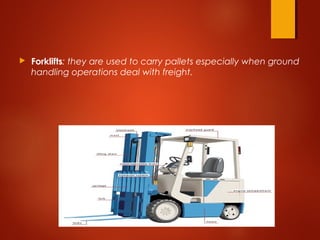
 Forklifts: they are used to carry pallets especially when ground
handling operations deal with freight.
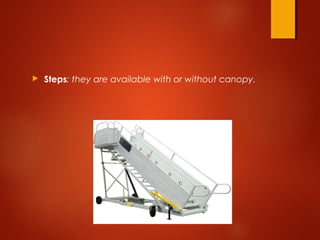
 Steps: they are available with or without canopy.
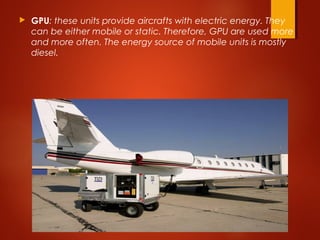
 GPU: these units provide aircrafts with electric energy. They
can be either mobile or static. Therefore, GPU are used more
and more often. The energy source of mobile units is mostly
diesel.
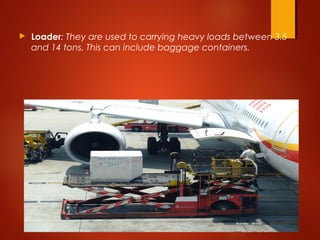
 Loader: They are used to carrying heavy loads between 3.5
and 14 tons. This can include baggage containers.
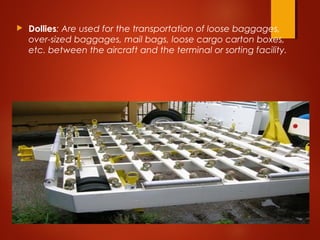
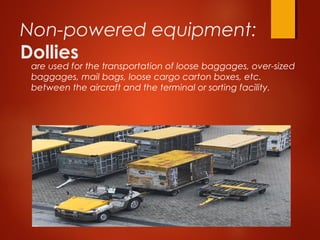
 Dollies: Are used for the transportation of loose baggages,
over-sized baggages, mail bags, loose cargo carton boxes,
etc. between the aircraft and the terminal or sorting facility. 
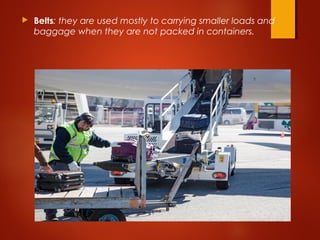
 Belts: they are used mostly to carrying smaller loads and
baggage when they are not packed in containers.
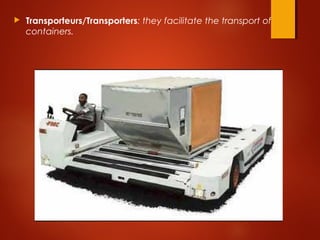
 Transporteurs/Transporters: they facilitate the transport of
containers.
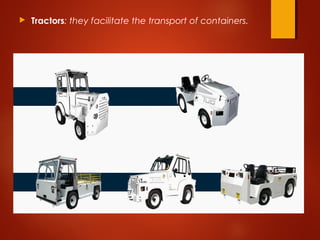
 Tractors: they facilitate the transport of containers.
3. Operational analysis
 a. Layout of operations
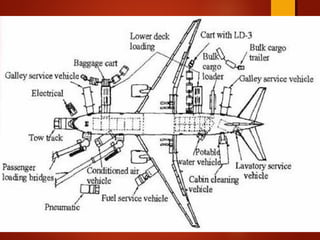
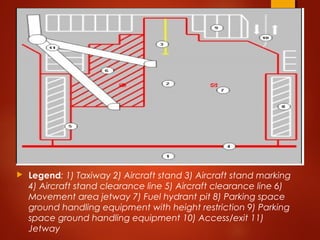
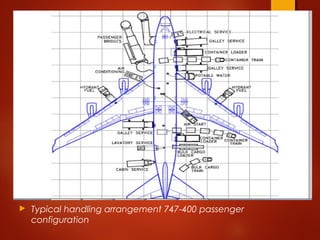
As we can see on figure 7, ground handling is a
multi-task procedure. Since managers want to
save some money for the airlines they work for,
they endeavor to perform simultaneously as
many operations as they can.
 Legend: 1) Taxiway 2) Aircraft stand 3) Aircraft stand marking
4) Aircraft stand clearance line 5) Aircraft clearance line 6)
Movement area jetway 7) Fuel hydrant pit 8) Parking space
ground handling equipment with height restriction 9) Parking
space ground handling equipment 10) Access/exit 11)
Jetway
 Typical handling arrangement 747-400 passenger
configuration
Non-powered equipment:
Dollies
are used for the transportation of loose baggages, over-sized
baggages, mail bags, loose cargo carton boxes, etc.
between the aircraft and the terminal or sorting facility. 
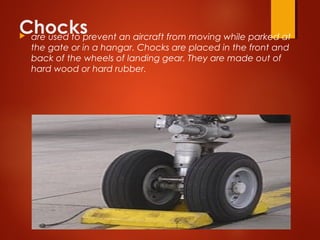
Chocks are used to prevent an aircraft from moving while parked at
the gate or in a hangar. Chocks are placed in the front and
back of the wheels of landing gear. They are made out of
hard wood or hard rubber.
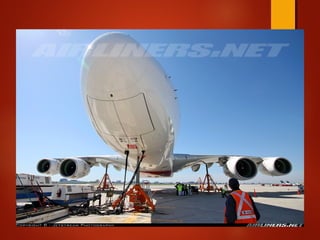
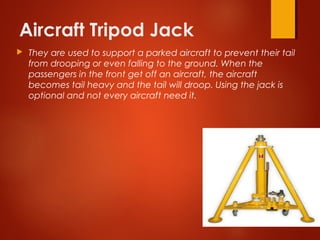
Aircraft Tripod Jack
 They are used to support a parked aircraft to prevent their tail
from drooping or even falling to the ground. When the
passengers in the front get off an aircraft, the aircraft
becomes tail heavy and the tail will droop. Using the jack is
optional and not every aircraft need it.
Powered equipment:
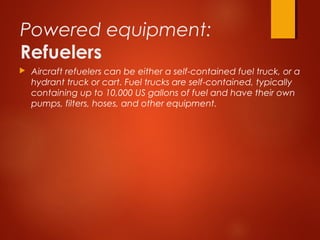
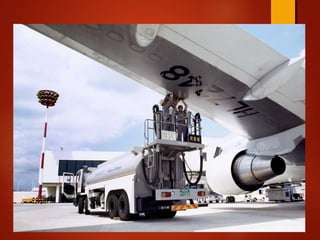
Refuelers
 Aircraft refuelers can be either a self-contained fuel truck, or a
hydrant truck or cart. Fuel trucks are self-contained, typically
containing up to 10,000 US gallons of fuel and have their own
pumps, filters, hoses, and other equipment.
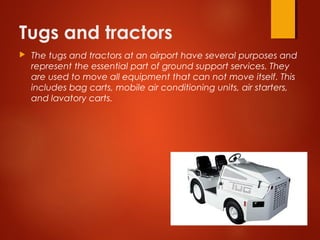
Tugs and tractors
 The tugs and tractors at an airport have several purposes and
represent the essential part of ground support services. They
are used to move all equipment that can not move itself. This
includes bag carts, mobile air conditioning units, air starters,
and lavatory carts.
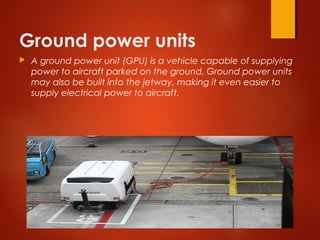
Ground power units
 A ground power unit (GPU) is a vehicle capable of supplying
power to aircraft parked on the ground. Ground power units
may also be built into the jetway, making it even easier to
supply electrical power to aircraft. 
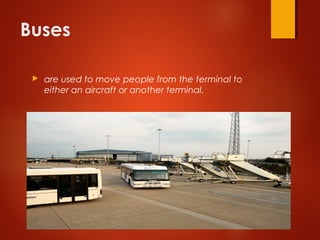
Buses
 are used to move people from the terminal to
either an aircraft or another terminal.
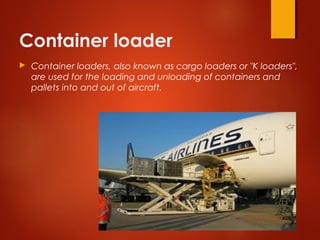
Container loader
 Container loaders, also known as cargo loaders or "K loaders",
are used for the loading and unloading of containers and
pallets into and out of aircraft.
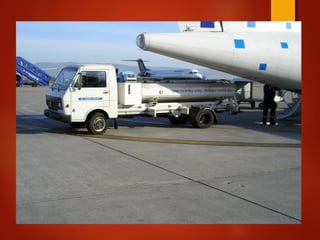
Potable water trucks
 Potable water trucks are special vehicles that
provide reliability and consistency in the delivery
of quality water to an aircraft. The water is filtered
and protected from the elements while being
stored on the vehicle. A pump in the vehicle
assists in moving the water from the truck to the
aircraft.
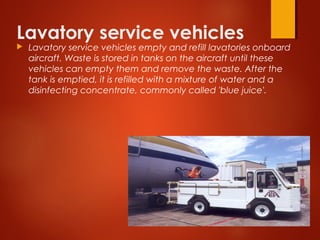
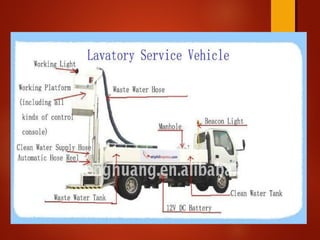
Lavatory service vehicles
 Lavatory service vehicles empty and refill lavatories onboard
aircraft. Waste is stored in tanks on the aircraft until these
vehicles can empty them and remove the waste. After the
tank is emptied, it is refilled with a mixture of water and a
disinfecting concentrate, commonly called 'blue juice'. 
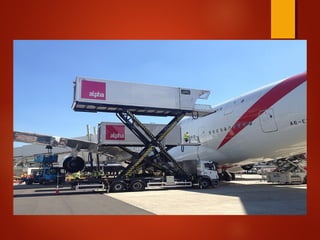
Catering vehicle
 Catering includes the unloading of unused food
and drink from the aircraft, and the loading of
fresh food and drinks for passengers and crew.
The meals are typically delivered in standardized
carts. Meals are prepared mostly on the ground in
order to minimize the amount of preparation
(apart from chilling or reheating) required in the
air.
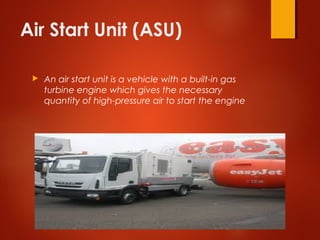
Air Start Unit (ASU)
 An air start unit is a vehicle with a built-in gas
turbine engine which gives the necessary
quantity of high-pressure air to start the engine
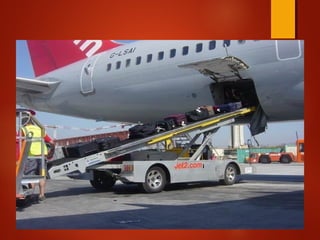
Belt loaders
 Belt loaders are vehicles with conveyor belts for
unloading and loading of baggage and cargo
onto aircraft. A belt loader is positioned at the
door sill of an aircraft hold (baggage
compartment) during operation. 
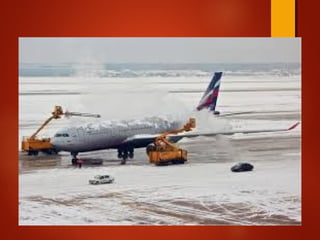
De/anti-icing vehicles
 The procedure of de/anti-icing, protection from
fluids freezing up on aircraft, is done from special
vehicles. A hose sprays a special mixture that
melts current ice on the aircraft and also prevents
some ice from building up while waiting on the
ground.
Ramp service
 This includes services on the ramp or apron, such as:
1. Guiding the aircraft into and out of the parking position (by
way of aircraft marshalling),
2. Towing with pushback tractors
3. Lavatory drainage
4. Water cartage (typically non-potable for lavatory sink use)
5. Air conditioning (more common for smaller aircraft)
6. Airstart units (for starting engines)
7. Luggage handling, usually by means
of beltloaders and baggage carts
8. Gate checked luggage
9. Air cargo handling, usually by means of cargo dollies and
cargo loaders
10. Catering trucks
11. Refueling, which may be done with a refueling tanker truck
or refueling pumper
12. Ground power (so that engines need not be running to
provide aircraft power on the ground)
13. Passenger stairs (used instead of an aerobridge or airstairs,
some budget airlines use both to improve turnaround speed)
14. Wheelchair lifts, if required
15. Hydraulic mules (units that provide hydraulic power to an
aircraft externally)
16. Deicing
List of notable handling
agents worldwide:
ASIA
 Hong Kong
- Hong Kong Airport Services
- Jardine Aviation Services
 Japan
- All Nippon Airways
- Japan Airport Ground Handling
- Japan Airport Service Co.,Ltd.
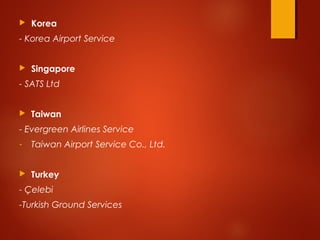
 Korea
- Korea Airport Service
 Singapore
- SATS Ltd
 Taiwan
- Evergreen Airlines Service
- Taiwan Airport Service Co., Ltd.
 Turkey
- Çelebi
-Turkish Ground Services
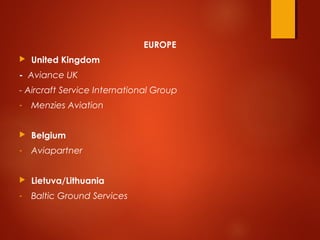
EUROPE
 United Kingdom
-  Aviance UK
- Aircraft Service International Group
- Menzies Aviation
 Belgium
- Aviapartner
 Lietuva/Lithuania
- Baltic Ground Services
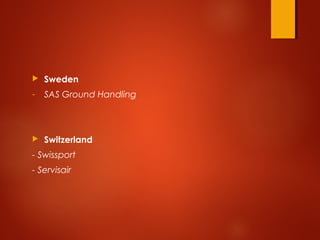
 Sweden
- SAS Ground Handling
 Switzerland
- Swissport
- Servisair
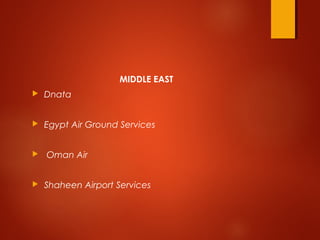
MIDDLE EAST
 Dnata
 Egypt Air Ground Services
  Oman Air
 Shaheen Airport Services
NORTH AMERICA
 Mexico
- Kion de Mexico
 United States
- DAL Global Services
- Envoy Air
- Regional Elite Airline Services
- Universal Aviation
- Worldwide Flight Services
NEXT TOPIC: GROUND
SAFETY PROCEDURES
 file:///E:/YOU%20IS%20JAY%20ARE/TOUR%20ELECT
%20(GROUND%20HANDLING)/pdf/843bd645-
0b8d-4671-a1ea-bfab376714ad-150701221047-
lva1-app6891.pdf
 http://www.safetypostershop.com/category/avia
tion-safety-posters/

Ground Handling

  • 1.
  • 2.
    SEATWORK (1/2 crosswise) 1.What do you mean by Ground handling? 2. Why do you think it is necessary to study this subject? 3. Cite some importance of ground handling in the airline operation.
  • 3.
     Aircraft ground handling defines the servicingof an aircraft while it is on the ground and (usually) parked at a terminal gate of an airport.
  • 4.
    The major categoriesof ground handling services are described below. 1. Cabin Service 2. Catering 3. Ramp Service 4. Passenger Service 5. Field Operation
  • 5.
    Cabin Service  Theprimary aim of this service offering is to ensure passenger comfort. While cabin cleaning comprises the bulk of the effort, it also includes tasks such as replenishing onboard consumables (soap, tissues, toilet paper, reading materials) and washable items like pillows and blankets.
  • 6.
    Catering Catering includes the unloadingof unused food and drink from the aircraft, and the loading of fresh food and drink for passengers and crew.  Airline meals are typically delivered in Airline service trolleys. Empty or trash-filled trolley from the previous flight are replaced with fresh ones. Meals are prepared mostly on the ground in order to minimize the amount of preparation (apart from chilling or reheating) required in the air.
  • 7.
    Ramp Service • Guidingthe aircraft into and out of the parking position (by way of aircraft marshalling), • Towing with pushback tractors • Lavatory drainage • Water cartage (typically non-potable for lavatory sink use) • Air conditioning (more common for smaller aircraft) • Airstart units (for starting engines) • Luggage handling, usually by means of beltloaders and baggage carts • Gate checked luggage, often handled on the tarmac as passengers disembark
  • 8.
    • Air cargo handling,usually by means of cargo dollies and cargo loaders • Catering trucks • Refueling, which may be done with a refueling tanker truck or refueling pumper • Ground power (so that engines need not be running to provide aircraft power on the ground) • Passenger stairs (used instead of an aerobridge or airstairs, some budget airlines use both to improve turnaround speed) • Wheelchair lifts, if required • Hydraulic mules (units that provide hydraulic power to an aircraft externally) • Deicing
  • 9.
    Passenger Service This includesservices inside the airport terminal such as: •Providing check-in counter services for the passengers departing on the customer airlines. •Providing gate arrival and departure services. The agents are required to meet a flight on arrival as well as provide departure services including boarding passengers and closing the flight. •Staffing the transfer counters, customer service counters and airline lounges.
  • 10.
    Field Operation This servicedispatches the aircraft, maintains communication with the rest of the airline operation at the airport and with Air Traffic Control.
  • 11.
    Air traffic control  Airtraffic control (ATC) is a service provided by ground-based controllers who direct aircraft on the ground and through controlled airspace, and can provide advisory services to aircraft in non- controlled airspace. The primary purpose of ATC worldwide is to prevent collisions, organize and expedite the flow of traffic, and provide information and other support for pilots. In some countries, ATC plays a security or defensive role, or is operated by the military.
  • 12.
    Ground handling operations 1. Overview We can distinguish two major types of ground handling procedures which are designated as either terminal or airside operations.
  • 13.
     First, weshould define the whole range of operations that ground handlers deal with. The following list is an exhaustive for common commercial flights:
  • 14.
    Ramp services  Supervision Marshaling  Start-up  Moving/towing aircraft  Safety measures
  • 16.
    On-ramp aircraft services Repair of faults, fueling, wheel and tire check  Ground power supply  Deicing, cooling/heating  Toilet servicing, Potable water, demineralized water  Routine maintenance  Non-routine maintenance  Cleaning of cockpit windows, wings, nacelles and cabin windows
  • 17.
    Onboard servicing  Cleaning Catering  In-flight entertainment  Minor servicing of cabin fittings  Alteration of seat configuration
  • 18.
    External ramp equipment Passenger steps  Catering loaders  Cargo loaders, mail and equipment loading
  • 19.
     Obviously, groundhandling management has to deal with very diverse tasks. Preferably, these operations are performed simultaneously to decrease ground time and thus to increase aircraft productivity. Airlines pay at the most part for the delays that their aircrafts experience.
  • 20.
     Therefore, theystrongly emphasizes the time- efficiency of ground operations provided either by themselves, or the airport authority or independent companies. It makes the task even tougher for ground handlers whose efficiency relies on technology-advanced equipment, coordination of staff and information support systems.
  • 21.
    2. Equipment  Interms of ground handling equipment, we found out that available products are numerous. It would not be very relevant to analyze thoroughly every company with all their products.
  • 22.
     The listbelow summarizes what equipment is basically required:
  • 23.
     Tow-bars: theymake it possible to tow a given aircraft by a tractor which is clipped to the bar. The main advantage is that you need only one type of tractor to tow all types of aircrafts. The main disadvantage is the high number of staff required to fix the bar to the aircraft.
  • 24.
     Push-back tractors:it is a good alternative to tow aircrafts as tow-bars are not always required. On the other hand, these devices are much more expensive than universal tractors coupled with tow-bars.
  • 25.
     Forklifts: theyare used to carry pallets especially when ground handling operations deal with freight.
  • 26.
     Steps: theyare available with or without canopy.
  • 27.
     GPU: theseunits provide aircrafts with electric energy. They can be either mobile or static. Therefore, GPU are used more and more often. The energy source of mobile units is mostly diesel.
  • 28.
     Loader: Theyare used to carrying heavy loads between 3.5 and 14 tons. This can include baggage containers.
  • 29.
     Dollies: Areused for the transportation of loose baggages, over-sized baggages, mail bags, loose cargo carton boxes, etc. between the aircraft and the terminal or sorting facility. 
  • 30.
     Belts: theyare used mostly to carrying smaller loads and baggage when they are not packed in containers.
  • 31.
     Transporteurs/Transporters: theyfacilitate the transport of containers.
  • 32.
     Tractors: theyfacilitate the transport of containers.
  • 33.
    3. Operational analysis a. Layout of operations As we can see on figure 7, ground handling is a multi-task procedure. Since managers want to save some money for the airlines they work for, they endeavor to perform simultaneously as many operations as they can.
  • 35.
     Legend: 1)Taxiway 2) Aircraft stand 3) Aircraft stand marking 4) Aircraft stand clearance line 5) Aircraft clearance line 6) Movement area jetway 7) Fuel hydrant pit 8) Parking space ground handling equipment with height restriction 9) Parking space ground handling equipment 10) Access/exit 11) Jetway
  • 36.
     Typical handlingarrangement 747-400 passenger configuration
  • 37.
    Non-powered equipment: Dollies are usedfor the transportation of loose baggages, over-sized baggages, mail bags, loose cargo carton boxes, etc. between the aircraft and the terminal or sorting facility. 
  • 38.
    Chocks are usedto prevent an aircraft from moving while parked at the gate or in a hangar. Chocks are placed in the front and back of the wheels of landing gear. They are made out of hard wood or hard rubber.
  • 39.
    Aircraft Tripod Jack They are used to support a parked aircraft to prevent their tail from drooping or even falling to the ground. When the passengers in the front get off an aircraft, the aircraft becomes tail heavy and the tail will droop. Using the jack is optional and not every aircraft need it.
  • 41.
    Powered equipment: Refuelers  Aircraftrefuelers can be either a self-contained fuel truck, or a hydrant truck or cart. Fuel trucks are self-contained, typically containing up to 10,000 US gallons of fuel and have their own pumps, filters, hoses, and other equipment.
  • 43.
    Tugs and tractors The tugs and tractors at an airport have several purposes and represent the essential part of ground support services. They are used to move all equipment that can not move itself. This includes bag carts, mobile air conditioning units, air starters, and lavatory carts.
  • 44.
    Ground power units A ground power unit (GPU) is a vehicle capable of supplying power to aircraft parked on the ground. Ground power units may also be built into the jetway, making it even easier to supply electrical power to aircraft. 
  • 45.
    Buses  are usedto move people from the terminal to either an aircraft or another terminal.
  • 46.
    Container loader  Containerloaders, also known as cargo loaders or "K loaders", are used for the loading and unloading of containers and pallets into and out of aircraft.
  • 47.
    Potable water trucks Potable water trucks are special vehicles that provide reliability and consistency in the delivery of quality water to an aircraft. The water is filtered and protected from the elements while being stored on the vehicle. A pump in the vehicle assists in moving the water from the truck to the aircraft.
  • 49.
    Lavatory service vehicles Lavatory service vehicles empty and refill lavatories onboard aircraft. Waste is stored in tanks on the aircraft until these vehicles can empty them and remove the waste. After the tank is emptied, it is refilled with a mixture of water and a disinfecting concentrate, commonly called 'blue juice'. 
  • 51.
    Catering vehicle  Cateringincludes the unloading of unused food and drink from the aircraft, and the loading of fresh food and drinks for passengers and crew. The meals are typically delivered in standardized carts. Meals are prepared mostly on the ground in order to minimize the amount of preparation (apart from chilling or reheating) required in the air.
  • 53.
    Air Start Unit(ASU)  An air start unit is a vehicle with a built-in gas turbine engine which gives the necessary quantity of high-pressure air to start the engine
  • 54.
    Belt loaders  Beltloaders are vehicles with conveyor belts for unloading and loading of baggage and cargo onto aircraft. A belt loader is positioned at the door sill of an aircraft hold (baggage compartment) during operation. 
  • 56.
    De/anti-icing vehicles  Theprocedure of de/anti-icing, protection from fluids freezing up on aircraft, is done from special vehicles. A hose sprays a special mixture that melts current ice on the aircraft and also prevents some ice from building up while waiting on the ground.
  • 58.
    Ramp service  Thisincludes services on the ramp or apron, such as: 1. Guiding the aircraft into and out of the parking position (by way of aircraft marshalling), 2. Towing with pushback tractors 3. Lavatory drainage 4. Water cartage (typically non-potable for lavatory sink use) 5. Air conditioning (more common for smaller aircraft)
  • 59.
    6. Airstart units(for starting engines) 7. Luggage handling, usually by means of beltloaders and baggage carts 8. Gate checked luggage 9. Air cargo handling, usually by means of cargo dollies and cargo loaders 10. Catering trucks 11. Refueling, which may be done with a refueling tanker truck or refueling pumper
  • 60.
    12. Ground power(so that engines need not be running to provide aircraft power on the ground) 13. Passenger stairs (used instead of an aerobridge or airstairs, some budget airlines use both to improve turnaround speed) 14. Wheelchair lifts, if required 15. Hydraulic mules (units that provide hydraulic power to an aircraft externally) 16. Deicing
  • 61.
    List of notablehandling agents worldwide: ASIA  Hong Kong - Hong Kong Airport Services - Jardine Aviation Services  Japan - All Nippon Airways - Japan Airport Ground Handling - Japan Airport Service Co.,Ltd.
  • 62.
     Korea - KoreaAirport Service  Singapore - SATS Ltd  Taiwan - Evergreen Airlines Service - Taiwan Airport Service Co., Ltd.  Turkey - Çelebi -Turkish Ground Services
  • 63.
    EUROPE  United Kingdom - Aviance UK - Aircraft Service International Group - Menzies Aviation  Belgium - Aviapartner  Lietuva/Lithuania - Baltic Ground Services
  • 64.
     Sweden - SASGround Handling  Switzerland - Swissport - Servisair
  • 65.
    MIDDLE EAST  Dnata Egypt Air Ground Services   Oman Air  Shaheen Airport Services
  • 66.
    NORTH AMERICA  Mexico -Kion de Mexico  United States - DAL Global Services - Envoy Air - Regional Elite Airline Services - Universal Aviation - Worldwide Flight Services
  • 67.
    NEXT TOPIC: GROUND SAFETYPROCEDURES  file:///E:/YOU%20IS%20JAY%20ARE/TOUR%20ELECT %20(GROUND%20HANDLING)/pdf/843bd645- 0b8d-4671-a1ea-bfab376714ad-150701221047- lva1-app6891.pdf
  • 68.