LEARNING & DEVELOPMENT MANAGEMENT  “ BASIC AIRPORTS OPERATIONS COURSE ” AIRSIDE  OPERATION  by HAJI YUSUFF JAMALULDDIN
COURSE OBJECTIVE By the end of the lecture, you will be able to understand the organization of Airside Operations, function and key responsibilities.
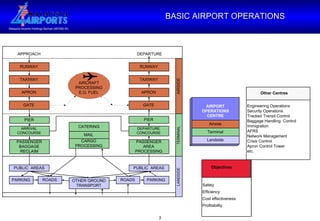
BASIC AIRPORT OPERATIONS ll AIRPORT OPERATIONS CENTRE Airside Landside Terminal RUNWAY ARRIVAL CONCOURSE PIER GATE APRON TAXIWAY RUNWAY GATE APRON TAXIWAY AIRCRAFT PROCESSING E.G. FUEL APPROACH PASSENGER BAGGAGE RECLAIM ROADS PARKING ROADS PARKING DEPARTURE CONCOURSE PIER PASSENGER AREA PROCESSING CATERING MAIL CARGO PROCESSING OTHER GROUND TRANSPORT DEPARTURE AIRSIDE LANDSIDE TERMINAL PUBLIC  AREAS PUBLIC  AREAS Safety Efficiency Cost effectiveness Profitability Objectives Engineering Operations Security Operations Tracked Transit Control Baggage Handling  Control Immigration AFRS Network Management Crisis Control Apron Control Tower etc. Other Centres
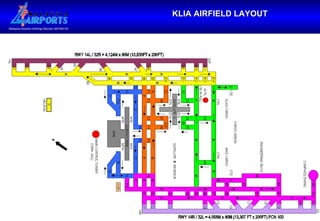
KLIA AIRFIELD LAYOUT
AIRSIDE OPERATIONS OBJECTIVES/ FUNCTIONS Maintain a high level of airfield and apron safety as per I.C.A.O standards Establish policies and procedures for safe airfield operations. Promotion of safety awareness through training, licensing and Safety Campaign. Enforce ramp safety policies and procedures. Develop and implement the ground incident and accident reporting and investigation system.
AIRSIDE OPERATIONS OBJECTIVES/ FUNCTIONS Carry out audits of airside operators. Identify potential incident and accident conditions, evaluate and implement preventive measure.  Dissemination of ramp incidents and accidents information. Coordinating airside Operations during emergencies.
AIRSIDE OPERATIONS KEY ACTIVITIES 1. Inspecting Movement area Issuance of Airside Permit (Driving, PLB & Vehicle Permit) 3. Ground Incidents and accidents investigation 4. Safety escort or follow -me service 5. Enforcement checks 6. Work in progress Coordination (WIP) 7. Initiation of NOTAM
AIRSIDE OPERATIONS KEY ACTIVITIES 8. Co-ordinations & Meetings with Airlines, Government Agencies etc. 9. Wildlife Hazard Study
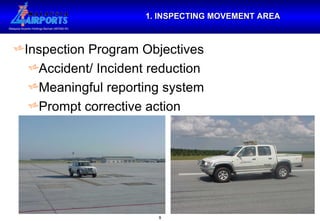
1. INSPECTING MOVEMENT AREA Inspection Program Objectives Accident/ Incident reduction Meaningful reporting system Prompt corrective action
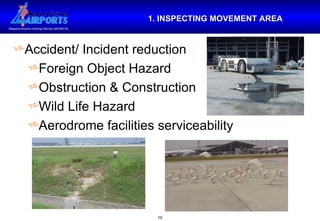
1. INSPECTING MOVEMENT AREA Accident/ Incident reduction Foreign Object Hazard Obstruction & Construction Wild Life Hazard Aerodrome facilities serviceability
1. INSPECTING MOVEMENT AREA Foreign Object Damage (F.O.D) FOD : any object that is found in the maneuvering area that can endanger aircraft (Metal, Paper, Plastic Sheets, Boxes, Parts, Tools etc.) Engine Ingestion on aircraft Velocity impact of debris launched by jet blast into other aircraft, personnel,(Ramp/ Passengers) and buildings Can contribute to in-flight engine failures Both Safety and economic issue
1. INSPECTING MOVEMENT AREA FOD prevention in KLIA Apron Sweeping Program Routine airfield inspection Pavement Inspection prior to each aircraft arrival/ departure. Training Maintenance activities  Communication/ coordination
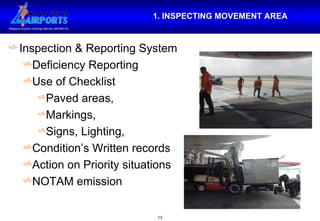
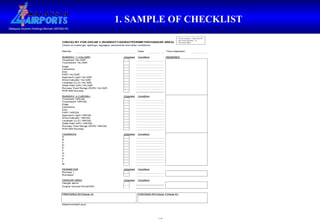
1. INSPECTING MOVEMENT AREA Inspection & Reporting System Deficiency Reporting Use of Checklist Paved areas,  Markings,  Signs, Lighting,  Condition’s Written records Action on Priority situations NOTAM emission
1. SAMPLE OF CHECKLIST
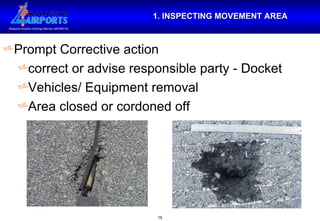
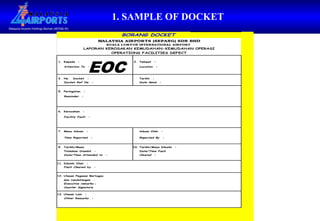
1. INSPECTING MOVEMENT AREA Prompt Corrective action correct or advise responsible party - Docket Vehicles/ Equipment removal Area closed or cordoned off
1. SAMPLE OF DOCKET
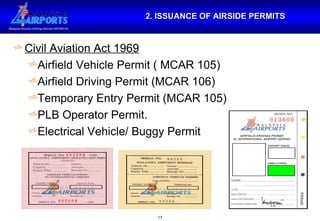
2. ISSUANCE OF AIRSIDE PERMITS Civil Aviation Act 1969 Airfield Vehicle Permit ( MCAR 105) Airfield Driving Permit (MCAR 106) Temporary Entry Permit (MCAR 105) PLB Operator Permit. Electrical Vehicle/ Buggy Permit
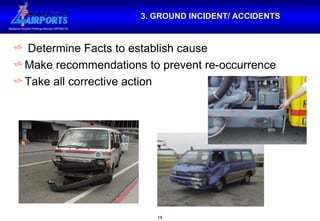
3. GROUND INCIDENT/ ACCIDENTS Determine Facts to establish cause Make recommendations to prevent re-occurrence Take all corrective action
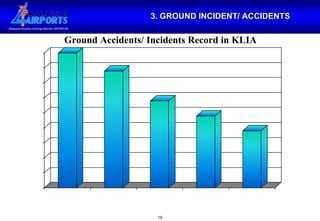
3. GROUND INCIDENT/ ACCIDENTS Ground Accidents/ Incidents Record in KLIA
3. GROUND INCIDENT/ ACCIDENTS 80% of ground accident in KLIA  involving collision between vehicles/ equipment or facilities. Apron accidents involving aircraft are frequently caused by equipment used for passenger handling, aircraft loading and servicing i.e. PLB, Loading Bridges, catering trucks, baggage carts)
4. SAFETY ESCORT AND FOLLOW-ME Provide safety escort for VVIP movements - vehicles on the aircraft maneuvering area Provide Follow-Me service to foreign aircraft - on request especially VVIP flights that requires special coordination Filming Safety Escort
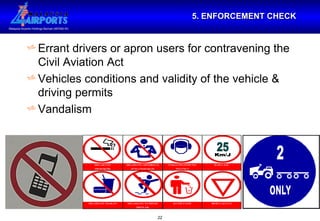
5. ENFORCEMENT CHECK Errant drivers or apron users for contravening the Civil Aviation Act Vehicles conditions and validity of the vehicle & driving permits Vandalism
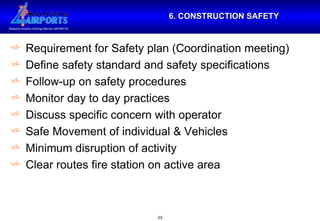
6. CONSTRUCTION SAFETY Requirement for Safety plan (Coordination meeting) Define safety standard and safety specifications Follow-up on safety procedures Monitor day to day practices Discuss specific concern with operator Safe Movement of individual & Vehicles Minimum disruption of activity Clear routes fire station on active area
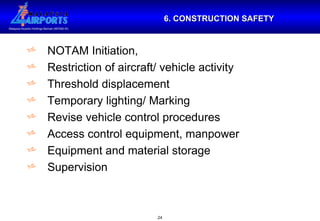
6. CONSTRUCTION SAFETY NOTAM Initiation, Restriction of aircraft/ vehicle activity Threshold displacement Temporary lighting/ Marking  Revise vehicle control procedures Access control equipment, manpower Equipment and material storage Supervision
6. CONSTRUCTION SAFETY Hazardous conditions Excavation near runways, taxiways, apron Construction materials, earth mounds or stockpiles Temporary structures Obstacles in operational areas or approach zones
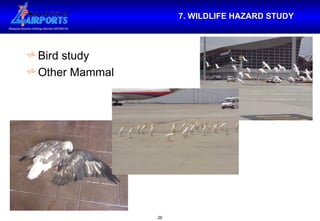
7. WILDLIFE HAZARD STUDY Bird study Other Mammal
8. RAMP SAFETY COMMITTEE Participants MA(Sepang), DCA, Air Carriers, Ground Services, Fuel Operators, Emergency Services Promote Safety Identify unsafe conditions and practices Develop improvement recommendations Ensure Corrective action Considers complaints
9. NOTAM Notice to Airmen- Shall be originated and issued promptly whenever the information to be disseminated is of a  Temporary nature and of short duration  Operationally significant permanent changes or temporary changes of long duration are made at short notice.
9. WHEN WE ISSUE NOTAM Establishment, closure or significant changes in operation of aerodrome or runways Establishment, withdrawal or changes in operation of aeronautical services (AGA,AIS, ATS, COM, MET, SAR etc.) Establishment, withdrawal or changes in visual aids Interruption of or return to operation of major components of aerodrome lighting system.
9. WHEN WE ISSUE NOTAM Occurrence or correction of major defect in the maneuvering area. Changes to and limitation on availability of fuel supply. Major changes to rescue facilities and services available. Presence of hazard which affect air navigation (including obstacle, air displays etc.)
9. GENERAL SPECIFICATION OF NOTAM Each NOTAM shall be allocated a serial number. NOTAM shall be as brief as possible. Each NOTAM shall be transmitted as a single telecommunication message. When NOTAM is issued which cancels or supersedes a previous NOTAM, the serial number of the previous NOTAM shall be indicated.
9. GENERAL SPECIFICATION OF NOTAM When error occur in a NOTAM, replacement NOTAM shall be issued. Location indicators included in the text of a NOTAM shall conform to ICAO list.
9. DISTRIBUTION OF NOTAM NOTAM shall be distributed to addressees to whom the information is of direct operational significance by AIS. Except as otherwise provided, each NOTAM shall contain the information in the order of NOTAM format.
9. WHO ISSUES NOTAMS NOTAM office is advised by responsible person from airport Person(s) responsible for inspecting the aerodromes and reporting aerodrome condition change Responsible person must be appropriately trained Fulfill and aerodrome operator’s duty of care and to avoid possible accusation of negligence
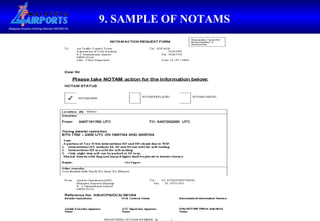
9. SAMPLE OF NOTAMS
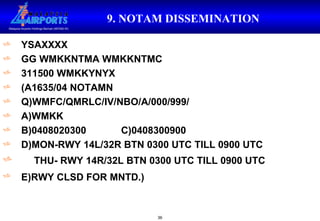
9. NOTAM DISSEMINATION   YSAXXXX GG WMKKNTMA WMKKNTMC 311500 WMKKYNYX (A1635/04 NOTAMN Q)WMFC/QMRLC/IV/NBO/A/000/999/ A)WMKK B)0408020300 C)0408300900 D)MON-RWY 14L/32R BTN 0300 UTC TILL 0900 UTC THU- RWY 14R/32L BTN 0300 UTC TILL 0900 UTC E)RWY CLSD FOR MNTD.)
Q & A Thank You
Thank you End of Presentation

AIRSEDE OPERATION

  • 1.
    LEARNING & DEVELOPMENTMANAGEMENT “ BASIC AIRPORTS OPERATIONS COURSE ” AIRSIDE OPERATION by HAJI YUSUFF JAMALULDDIN
  • 2.
    COURSE OBJECTIVE Bythe end of the lecture, you will be able to understand the organization of Airside Operations, function and key responsibilities.
  • 3.
    BASIC AIRPORT OPERATIONSll AIRPORT OPERATIONS CENTRE Airside Landside Terminal RUNWAY ARRIVAL CONCOURSE PIER GATE APRON TAXIWAY RUNWAY GATE APRON TAXIWAY AIRCRAFT PROCESSING E.G. FUEL APPROACH PASSENGER BAGGAGE RECLAIM ROADS PARKING ROADS PARKING DEPARTURE CONCOURSE PIER PASSENGER AREA PROCESSING CATERING MAIL CARGO PROCESSING OTHER GROUND TRANSPORT DEPARTURE AIRSIDE LANDSIDE TERMINAL PUBLIC AREAS PUBLIC AREAS Safety Efficiency Cost effectiveness Profitability Objectives Engineering Operations Security Operations Tracked Transit Control Baggage Handling Control Immigration AFRS Network Management Crisis Control Apron Control Tower etc. Other Centres
  • 4.
  • 5.
    AIRSIDE OPERATIONS OBJECTIVES/FUNCTIONS Maintain a high level of airfield and apron safety as per I.C.A.O standards Establish policies and procedures for safe airfield operations. Promotion of safety awareness through training, licensing and Safety Campaign. Enforce ramp safety policies and procedures. Develop and implement the ground incident and accident reporting and investigation system.
  • 6.
    AIRSIDE OPERATIONS OBJECTIVES/FUNCTIONS Carry out audits of airside operators. Identify potential incident and accident conditions, evaluate and implement preventive measure. Dissemination of ramp incidents and accidents information. Coordinating airside Operations during emergencies.
  • 7.
    AIRSIDE OPERATIONS KEYACTIVITIES 1. Inspecting Movement area Issuance of Airside Permit (Driving, PLB & Vehicle Permit) 3. Ground Incidents and accidents investigation 4. Safety escort or follow -me service 5. Enforcement checks 6. Work in progress Coordination (WIP) 7. Initiation of NOTAM
  • 8.
    AIRSIDE OPERATIONS KEYACTIVITIES 8. Co-ordinations & Meetings with Airlines, Government Agencies etc. 9. Wildlife Hazard Study
  • 9.
    1. INSPECTING MOVEMENTAREA Inspection Program Objectives Accident/ Incident reduction Meaningful reporting system Prompt corrective action
  • 10.
    1. INSPECTING MOVEMENTAREA Accident/ Incident reduction Foreign Object Hazard Obstruction & Construction Wild Life Hazard Aerodrome facilities serviceability
  • 11.
    1. INSPECTING MOVEMENTAREA Foreign Object Damage (F.O.D) FOD : any object that is found in the maneuvering area that can endanger aircraft (Metal, Paper, Plastic Sheets, Boxes, Parts, Tools etc.) Engine Ingestion on aircraft Velocity impact of debris launched by jet blast into other aircraft, personnel,(Ramp/ Passengers) and buildings Can contribute to in-flight engine failures Both Safety and economic issue
  • 12.
    1. INSPECTING MOVEMENTAREA FOD prevention in KLIA Apron Sweeping Program Routine airfield inspection Pavement Inspection prior to each aircraft arrival/ departure. Training Maintenance activities Communication/ coordination
  • 13.
    1. INSPECTING MOVEMENTAREA Inspection & Reporting System Deficiency Reporting Use of Checklist Paved areas, Markings, Signs, Lighting, Condition’s Written records Action on Priority situations NOTAM emission
  • 14.
    1. SAMPLE OFCHECKLIST
  • 15.
    1. INSPECTING MOVEMENTAREA Prompt Corrective action correct or advise responsible party - Docket Vehicles/ Equipment removal Area closed or cordoned off
  • 16.
  • 17.
    2. ISSUANCE OFAIRSIDE PERMITS Civil Aviation Act 1969 Airfield Vehicle Permit ( MCAR 105) Airfield Driving Permit (MCAR 106) Temporary Entry Permit (MCAR 105) PLB Operator Permit. Electrical Vehicle/ Buggy Permit
  • 18.
    3. GROUND INCIDENT/ACCIDENTS Determine Facts to establish cause Make recommendations to prevent re-occurrence Take all corrective action
  • 19.
    3. GROUND INCIDENT/ACCIDENTS Ground Accidents/ Incidents Record in KLIA
  • 20.
    3. GROUND INCIDENT/ACCIDENTS 80% of ground accident in KLIA involving collision between vehicles/ equipment or facilities. Apron accidents involving aircraft are frequently caused by equipment used for passenger handling, aircraft loading and servicing i.e. PLB, Loading Bridges, catering trucks, baggage carts)
  • 21.
    4. SAFETY ESCORTAND FOLLOW-ME Provide safety escort for VVIP movements - vehicles on the aircraft maneuvering area Provide Follow-Me service to foreign aircraft - on request especially VVIP flights that requires special coordination Filming Safety Escort
  • 22.
    5. ENFORCEMENT CHECKErrant drivers or apron users for contravening the Civil Aviation Act Vehicles conditions and validity of the vehicle & driving permits Vandalism
  • 23.
    6. CONSTRUCTION SAFETYRequirement for Safety plan (Coordination meeting) Define safety standard and safety specifications Follow-up on safety procedures Monitor day to day practices Discuss specific concern with operator Safe Movement of individual & Vehicles Minimum disruption of activity Clear routes fire station on active area
  • 24.
    6. CONSTRUCTION SAFETYNOTAM Initiation, Restriction of aircraft/ vehicle activity Threshold displacement Temporary lighting/ Marking Revise vehicle control procedures Access control equipment, manpower Equipment and material storage Supervision
  • 25.
    6. CONSTRUCTION SAFETYHazardous conditions Excavation near runways, taxiways, apron Construction materials, earth mounds or stockpiles Temporary structures Obstacles in operational areas or approach zones
  • 26.
    7. WILDLIFE HAZARDSTUDY Bird study Other Mammal
  • 27.
    8. RAMP SAFETYCOMMITTEE Participants MA(Sepang), DCA, Air Carriers, Ground Services, Fuel Operators, Emergency Services Promote Safety Identify unsafe conditions and practices Develop improvement recommendations Ensure Corrective action Considers complaints
  • 28.
    9. NOTAM Noticeto Airmen- Shall be originated and issued promptly whenever the information to be disseminated is of a Temporary nature and of short duration Operationally significant permanent changes or temporary changes of long duration are made at short notice.
  • 29.
    9. WHEN WEISSUE NOTAM Establishment, closure or significant changes in operation of aerodrome or runways Establishment, withdrawal or changes in operation of aeronautical services (AGA,AIS, ATS, COM, MET, SAR etc.) Establishment, withdrawal or changes in visual aids Interruption of or return to operation of major components of aerodrome lighting system.
  • 30.
    9. WHEN WEISSUE NOTAM Occurrence or correction of major defect in the maneuvering area. Changes to and limitation on availability of fuel supply. Major changes to rescue facilities and services available. Presence of hazard which affect air navigation (including obstacle, air displays etc.)
  • 31.
    9. GENERAL SPECIFICATIONOF NOTAM Each NOTAM shall be allocated a serial number. NOTAM shall be as brief as possible. Each NOTAM shall be transmitted as a single telecommunication message. When NOTAM is issued which cancels or supersedes a previous NOTAM, the serial number of the previous NOTAM shall be indicated.
  • 32.
    9. GENERAL SPECIFICATIONOF NOTAM When error occur in a NOTAM, replacement NOTAM shall be issued. Location indicators included in the text of a NOTAM shall conform to ICAO list.
  • 33.
    9. DISTRIBUTION OFNOTAM NOTAM shall be distributed to addressees to whom the information is of direct operational significance by AIS. Except as otherwise provided, each NOTAM shall contain the information in the order of NOTAM format.
  • 34.
    9. WHO ISSUESNOTAMS NOTAM office is advised by responsible person from airport Person(s) responsible for inspecting the aerodromes and reporting aerodrome condition change Responsible person must be appropriately trained Fulfill and aerodrome operator’s duty of care and to avoid possible accusation of negligence
  • 35.
  • 36.
    9. NOTAM DISSEMINATION YSAXXXX GG WMKKNTMA WMKKNTMC 311500 WMKKYNYX (A1635/04 NOTAMN Q)WMFC/QMRLC/IV/NBO/A/000/999/ A)WMKK B)0408020300 C)0408300900 D)MON-RWY 14L/32R BTN 0300 UTC TILL 0900 UTC THU- RWY 14R/32L BTN 0300 UTC TILL 0900 UTC E)RWY CLSD FOR MNTD.)
  • 37.
    Q & AThank You
  • 38.
    Thank you Endof Presentation