
1
 What is “Airport FOD” 
 Definitions 
 The Airport Role 
 The Airline Role 
 How is Airside FOD Generated 
 How to Control the FOD Problem 
 Conclusions 
2
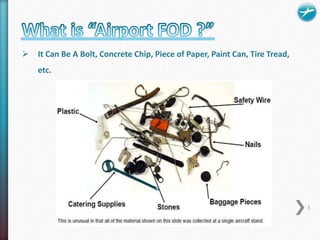
 It Can Be A Bolt, Concrete Chip, Piece of Paper, Paint Can, Tire Tread, 
etc. 
3
 A substance, debris, or article alien to a vehicle or system which would 
potentially cause damage 
 Any damage attributed to a foreign object that can be expressed in physical or 
economic terms which may or may not degrade the products safety and/or 
performance characteristics 
4
 Engine Ingestion on the Aircraft 
 Aircraft damage 
 Velocity Impact of Debris Launched by Jet Blast Into Other Aircraft, 
Personnel (Ramp/Passengers) and Buildings 
5
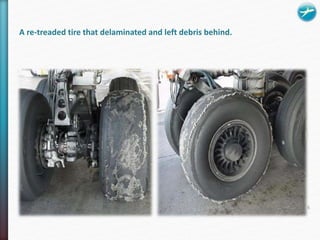
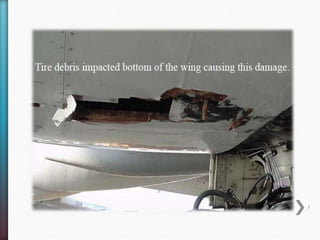
A re-treaded tire that delaminated and left debris behind. 
6
7
The Responsibility for Cleanliness by Airports Serving Scheduled Airlines is as Follows: 
 International Civil Aviation Organization - Annex 14 – Standard 
• The surface of a paved runway shall be maintained in a condition so as to provide 
good friction characteristics and low rolling resistance. 
• Snow, slush, ice, standing water, mud, dust, sand, oil, rubber deposits and other 
contaminants shall be removed as rapidly and completely as possible to minimize 
accumulation. 
8
9
• Airlines Generate Much of the FOD Found on the Airside Through Their Operations 
and Those of their Support Functions User Agreements Typically Identify the Agency 
Responsible for Cleaning Various Areas. 
10
 Infrastructure 
– Physical Degradation of the Airport Surfaces and Facilities 
– Airside Maintenance/Construction Activities 
 Operational Activities 
– Servicing & Maintenance of Aircraft 
– Windborne Debris from Adjacent Areas 
– Operation of Aircraft (Jet Blast) 
 Personnel 
 Weather Phenomena 
11
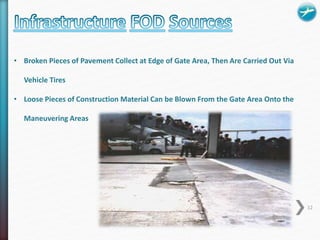
• Broken Pieces of Pavement Collect at Edge of Gate Area, Then Are Carried Out Via 
Vehicle Tires 
• Loose Pieces of Construction Material Can be Blown From the Gate Area Onto the 
Maneuvering Areas 
12
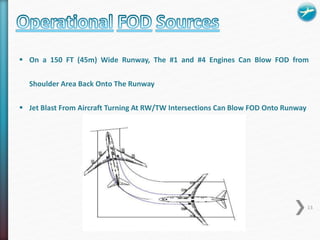
 On a 150 FT (45m) Wide Runway, The #1 and #4 Engines Can Blow FOD from 
Shoulder Area Back Onto The Runway 
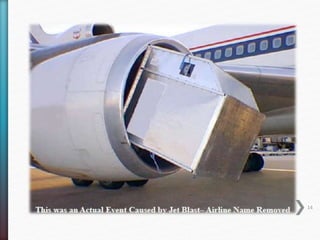
 Jet Blast From Aircraft Turning At RW/TW Intersections Can Blow FOD Onto Runway 
13
14
 Training 
 Inspection by Airline and Airport Personnel 
 Maintenance Activities 
 Communication/Coordination 
 New Technology Opportunities 
15
 Both Airline and Airport Personnel Need Training to: 
– Identify FOD 
– Know the Potential Results of Ignoring FOD 
– Know How to Eliminate FOD 
– Recurrent Training 
 Key to This Effort Is the ACTIVE Participation of All Personnel, Especially Airline 
Station Management and Flight Crews 
16
 Airline Personnel Should Participate, When Able, With the Airport Staff During the 
Daily Airside Inspections (This Will Ensure That the Local Airline Staff Know What Is 
Happening on the Airfield) 
 FOD Inspections Must Be Carried Out at Regular Intervals 
 Airlines Should Designate Individuals to Ensure That the Gate Areas Are Acceptable 
Prior to the Aircraft Operating There 
17
 Sweeping Operations Should Be Scheduled And Available On An “As Needed” Basis. 
Airlines Need To Provide Access To Gate Areas 
 Capability Must Exist to Respond to Repair Problem Areas (Hole in Taxiway, Etc.) So 
As To Minimize the FOD Potential 
 Funding Must Exist to Maintain Paved Surfaces In Good Condition 
 Procedures Must Be In Place (Airport & Airline) For Weather/Disaster Recovery, To 
Include FOD Removal 
18
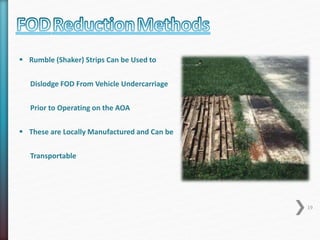
 Rumble (Shaker) Strips Can be Used to 
Dislodge FOD From Vehicle Undercarriage 
Prior to Operating on the AOA 
 These are Locally Manufactured and Can be 
Transportable 
19
TOW-BEHIND AIRPORT SWEEPER 
 Hitched to a tow vehicle, such as pickup truck or baggage tug, tow-behind airport 
sweepers are popular with budget-conscious facilities seeking to maximize their 
capital purchases. Depending upon the model and its condition, advantages can 
include better sweeping efficiency among the more innovative designs, increased 
portability, and lower purchase and maintenance costs. 
AIRPORT SWEEPER TRUCK 
 As a self-contained vehicle, airport sweeper trucks are popular with facilities seeking 
convenience of use; also with commercial sweeping contractors. Depending upon the 
model and its condition, advantages can include less work for the operator, the 
ability collect both liquid and solid foreign object debris (in some models), and 
20 
improved operability during severe weather.
MAGNETIC AIRPORT SWEEPER 
 Built with powerful magnetized bars, magnetic airport sweepers are popular at 
facilities where metallic foreign object debris is a major problem. Since the bar is 
usually attached just below the bumper of a motor vehicle, the major advantage is 
the ability to collect FOD passively while performing other functions, such as driving 
a squad car on a security 
HUMAN AIRPORT SWEEPER 
 Not all sweepers are machines. The “FOD Walk”, for instance, is an established and 
colorful military tradition, during which a line of personnel walks the entire length of 
the flight area in search of foreign object debris. FOD Walks are especially popular 
aboard aircraft carriers, where crowded and windy flight decks are too unstable for 
most airport sweepers. 
21
 Notification of Airside Construction Activities and Scheduled Maintenance Must Be 
Disseminated to the Airport Users 
 Airport Pre-Construction Planning Must Include the Methodology to Control and 
Contain FOD Generated by the Construction Activity 
 Airlines Need an Active Airport Users Committee to Coordinate Their FOD Control 
Efforts With the Airport and Other Tenants 
22
AC 150/5220-24, Airport Foreign Object Debris (FOD) Detection Equipment describes: 
• Stationary Radar - 
A radar detection system, able to detect a metallic cylindrical target measuring 1.2 in. (3.0 
cm) high and 1.5 in. (3.8 cm) in diameter at ranges of up to 0.6 mile (1 km). Sensors are 
located 165 ft (50.0 m) or more from the runway center line. 
• Stationary Electro-Optical – 
An electro-optical detection system, able to detect a 0.80 in. (2.0 cm) object target at 
ranges of up to 985 ft (300. m) using only ambient lighting. Sensors are located 490 ft (150 
m) or more from the runway center line. 
23
• Stationary Hybrid – 
Uses both an electro-optical and radar sensor in a unit collocated with the runway edge 
lights. The system is able to detect a 0.8 in. (2 cm) target on the runway. 
• Mobile Radar - 
A radar detection system mounted on top of a vehicle that scans the surface in front of the 
vehicle when moving. The radar scans an area 600. ft by 600. ft (183 m by 183 m) to detect 
FOD items measuring 1.2 in (3.0 cm) high and 1.5 in (3.8 cm) in diameter. The system can 
operate at speeds of up to 30 mph (50km/h), supplementing human/visual inspections. 
24
25
26 
 Control FOD Through a Combination of the Following: 
– Training 
– Inspection 
– Maintenance 
– Communication/Coordination 
– New Technology Opportunities 
 Airlines Need an Active Airport Users Committee To Coordinate Their FOD Control 
Efforts With the Airport And Other Tenants 
 FOD Is Everyone’s Responsibility and by Teamwork It Can Be Controlled!
27

Challenges to airport

  • 1.
  • 2.
     What is“Airport FOD”  Definitions  The Airport Role  The Airline Role  How is Airside FOD Generated  How to Control the FOD Problem  Conclusions 2
  • 3.
     It CanBe A Bolt, Concrete Chip, Piece of Paper, Paint Can, Tire Tread, etc. 3
  • 4.
     A substance,debris, or article alien to a vehicle or system which would potentially cause damage  Any damage attributed to a foreign object that can be expressed in physical or economic terms which may or may not degrade the products safety and/or performance characteristics 4
  • 5.
     Engine Ingestionon the Aircraft  Aircraft damage  Velocity Impact of Debris Launched by Jet Blast Into Other Aircraft, Personnel (Ramp/Passengers) and Buildings 5
  • 6.
    A re-treaded tirethat delaminated and left debris behind. 6
  • 7.
  • 8.
    The Responsibility forCleanliness by Airports Serving Scheduled Airlines is as Follows:  International Civil Aviation Organization - Annex 14 – Standard • The surface of a paved runway shall be maintained in a condition so as to provide good friction characteristics and low rolling resistance. • Snow, slush, ice, standing water, mud, dust, sand, oil, rubber deposits and other contaminants shall be removed as rapidly and completely as possible to minimize accumulation. 8
  • 9.
  • 10.
    • Airlines GenerateMuch of the FOD Found on the Airside Through Their Operations and Those of their Support Functions User Agreements Typically Identify the Agency Responsible for Cleaning Various Areas. 10
  • 11.
     Infrastructure –Physical Degradation of the Airport Surfaces and Facilities – Airside Maintenance/Construction Activities  Operational Activities – Servicing & Maintenance of Aircraft – Windborne Debris from Adjacent Areas – Operation of Aircraft (Jet Blast)  Personnel  Weather Phenomena 11
  • 12.
    • Broken Piecesof Pavement Collect at Edge of Gate Area, Then Are Carried Out Via Vehicle Tires • Loose Pieces of Construction Material Can be Blown From the Gate Area Onto the Maneuvering Areas 12
  • 13.
     On a150 FT (45m) Wide Runway, The #1 and #4 Engines Can Blow FOD from Shoulder Area Back Onto The Runway  Jet Blast From Aircraft Turning At RW/TW Intersections Can Blow FOD Onto Runway 13
  • 14.
  • 15.
     Training Inspection by Airline and Airport Personnel  Maintenance Activities  Communication/Coordination  New Technology Opportunities 15
  • 16.
     Both Airlineand Airport Personnel Need Training to: – Identify FOD – Know the Potential Results of Ignoring FOD – Know How to Eliminate FOD – Recurrent Training  Key to This Effort Is the ACTIVE Participation of All Personnel, Especially Airline Station Management and Flight Crews 16
  • 17.
     Airline PersonnelShould Participate, When Able, With the Airport Staff During the Daily Airside Inspections (This Will Ensure That the Local Airline Staff Know What Is Happening on the Airfield)  FOD Inspections Must Be Carried Out at Regular Intervals  Airlines Should Designate Individuals to Ensure That the Gate Areas Are Acceptable Prior to the Aircraft Operating There 17
  • 18.
     Sweeping OperationsShould Be Scheduled And Available On An “As Needed” Basis. Airlines Need To Provide Access To Gate Areas  Capability Must Exist to Respond to Repair Problem Areas (Hole in Taxiway, Etc.) So As To Minimize the FOD Potential  Funding Must Exist to Maintain Paved Surfaces In Good Condition  Procedures Must Be In Place (Airport & Airline) For Weather/Disaster Recovery, To Include FOD Removal 18
  • 19.
     Rumble (Shaker)Strips Can be Used to Dislodge FOD From Vehicle Undercarriage Prior to Operating on the AOA  These are Locally Manufactured and Can be Transportable 19
  • 20.
    TOW-BEHIND AIRPORT SWEEPER  Hitched to a tow vehicle, such as pickup truck or baggage tug, tow-behind airport sweepers are popular with budget-conscious facilities seeking to maximize their capital purchases. Depending upon the model and its condition, advantages can include better sweeping efficiency among the more innovative designs, increased portability, and lower purchase and maintenance costs. AIRPORT SWEEPER TRUCK  As a self-contained vehicle, airport sweeper trucks are popular with facilities seeking convenience of use; also with commercial sweeping contractors. Depending upon the model and its condition, advantages can include less work for the operator, the ability collect both liquid and solid foreign object debris (in some models), and 20 improved operability during severe weather.
  • 21.
    MAGNETIC AIRPORT SWEEPER  Built with powerful magnetized bars, magnetic airport sweepers are popular at facilities where metallic foreign object debris is a major problem. Since the bar is usually attached just below the bumper of a motor vehicle, the major advantage is the ability to collect FOD passively while performing other functions, such as driving a squad car on a security HUMAN AIRPORT SWEEPER  Not all sweepers are machines. The “FOD Walk”, for instance, is an established and colorful military tradition, during which a line of personnel walks the entire length of the flight area in search of foreign object debris. FOD Walks are especially popular aboard aircraft carriers, where crowded and windy flight decks are too unstable for most airport sweepers. 21
  • 22.
     Notification ofAirside Construction Activities and Scheduled Maintenance Must Be Disseminated to the Airport Users  Airport Pre-Construction Planning Must Include the Methodology to Control and Contain FOD Generated by the Construction Activity  Airlines Need an Active Airport Users Committee to Coordinate Their FOD Control Efforts With the Airport and Other Tenants 22
  • 23.
    AC 150/5220-24, AirportForeign Object Debris (FOD) Detection Equipment describes: • Stationary Radar - A radar detection system, able to detect a metallic cylindrical target measuring 1.2 in. (3.0 cm) high and 1.5 in. (3.8 cm) in diameter at ranges of up to 0.6 mile (1 km). Sensors are located 165 ft (50.0 m) or more from the runway center line. • Stationary Electro-Optical – An electro-optical detection system, able to detect a 0.80 in. (2.0 cm) object target at ranges of up to 985 ft (300. m) using only ambient lighting. Sensors are located 490 ft (150 m) or more from the runway center line. 23
  • 24.
    • Stationary Hybrid– Uses both an electro-optical and radar sensor in a unit collocated with the runway edge lights. The system is able to detect a 0.8 in. (2 cm) target on the runway. • Mobile Radar - A radar detection system mounted on top of a vehicle that scans the surface in front of the vehicle when moving. The radar scans an area 600. ft by 600. ft (183 m by 183 m) to detect FOD items measuring 1.2 in (3.0 cm) high and 1.5 in (3.8 cm) in diameter. The system can operate at speeds of up to 30 mph (50km/h), supplementing human/visual inspections. 24
  • 25.
  • 26.
    26  ControlFOD Through a Combination of the Following: – Training – Inspection – Maintenance – Communication/Coordination – New Technology Opportunities  Airlines Need an Active Airport Users Committee To Coordinate Their FOD Control Efforts With the Airport And Other Tenants  FOD Is Everyone’s Responsibility and by Teamwork It Can Be Controlled!
  • 27.