DEFINITION, PURPOSE & NATURE
TYPES OF FORECASTING
FORECASTING TIME HORIZONS
7 STEPS - FORECASTING
FORECASTING
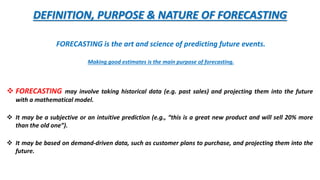
FORECASTING is the art and science of predicting future events.
Making good estimates is the main purpose of forecasting.
 FORECASTING may involve taking historical data (e.g. past sales) and projecting them into the future
with a mathematical model.
 It may be a subjective or an intuitive prediction (e.g., “this is a great new product and will sell 20% more
than the old one”).
 It may be based on demand-driven data, such as customer plans to purchase, and projecting them into the
future.
DEFINITION, PURPOSE & NATURE OF FORECASTING
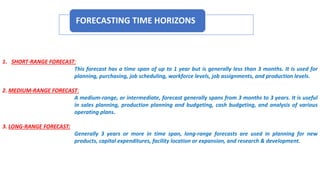
FORECASTING TIME HORIZONS
1. SHORT-RANGE FORECAST:
This forecast has a time span of up to 1 year but is generally less than 3 months. It is used for
planning, purchasing, job scheduling, workforce levels, job assignments, and production levels.
2. MEDIUM-RANGE FORECAST:
A medium-range, or intermediate, forecast generally spans from 3 months to 3 years. It is useful
in sales planning, production planning and budgeting, cash budgeting, and analysis of various
operating plans.
3. LONG-RANGE FORECAST:
Generally 3 years or more in time span, long-range forecasts are used in planning for new
products, capital expenditures, facility location or expansion, and research & development.
1. ECONOMIC FORECASTS :
Addresses the business cycle by predicting inflation rates, money supplies, housing starts,
and other planning indicators.
2. TECHNOLOGICAL FORECASTS:
Are concerned with rates of technological progress, which can result in the birth of
exciting new products, requiring new plants and equipment.
3. DEMAND FORECASTS:
Are projections of demand for a company’s products or services.
Demand-driven forecasts
drive a company’s production, capacity, and scheduling systems and serve as inputs to
financial, marketing, and personnel planning.
TYPES OF FORECASTING
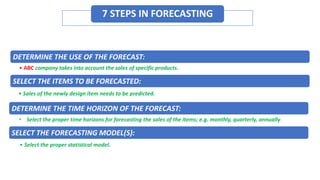
7 STEPS IN FORECASTING
• ABC company takes into account the sales of specific products.
SELECT THE ITEMS TO BE FORECASTED:
• Sales of the newly design item needs to be predicted.
DETERMINE THE TIME HORIZON OF THE FORECAST:
• Select the proper time horizons for forecasting the sales of the items; e.g. monthly, quarterly, annually.
SELECT THE FORECASTING MODEL(S):
• Select the proper statistical model.
DETERMINE THE USE OF THE FORECAST:
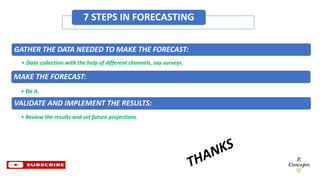
GATHER THE DATA NEEDED TO MAKE THE FORECAST:
• Data collection with the help of different channels, say surveys.
MAKE THE FORECAST:
• Do it.
VALIDATE AND IMPLEMENT THE RESULTS:
• Review the results and set future projections.
7 STEPS IN FORECASTING
For complete video lecture on this ppt in Hindi/Urdu,
Go on the below mentioned link
https://www.youtube.com/watch?v=mblS9J-pyMg

Forecasting , it's types, Time horizons and 7 basic steps.pptx

  • 1.
    DEFINITION, PURPOSE &NATURE TYPES OF FORECASTING FORECASTING TIME HORIZONS 7 STEPS - FORECASTING FORECASTING
  • 2.
    FORECASTING is theart and science of predicting future events. Making good estimates is the main purpose of forecasting.  FORECASTING may involve taking historical data (e.g. past sales) and projecting them into the future with a mathematical model.  It may be a subjective or an intuitive prediction (e.g., “this is a great new product and will sell 20% more than the old one”).  It may be based on demand-driven data, such as customer plans to purchase, and projecting them into the future. DEFINITION, PURPOSE & NATURE OF FORECASTING
  • 3.
    FORECASTING TIME HORIZONS 1.SHORT-RANGE FORECAST: This forecast has a time span of up to 1 year but is generally less than 3 months. It is used for planning, purchasing, job scheduling, workforce levels, job assignments, and production levels. 2. MEDIUM-RANGE FORECAST: A medium-range, or intermediate, forecast generally spans from 3 months to 3 years. It is useful in sales planning, production planning and budgeting, cash budgeting, and analysis of various operating plans. 3. LONG-RANGE FORECAST: Generally 3 years or more in time span, long-range forecasts are used in planning for new products, capital expenditures, facility location or expansion, and research & development.
  • 4.
    1. ECONOMIC FORECASTS: Addresses the business cycle by predicting inflation rates, money supplies, housing starts, and other planning indicators. 2. TECHNOLOGICAL FORECASTS: Are concerned with rates of technological progress, which can result in the birth of exciting new products, requiring new plants and equipment. 3. DEMAND FORECASTS: Are projections of demand for a company’s products or services. Demand-driven forecasts drive a company’s production, capacity, and scheduling systems and serve as inputs to financial, marketing, and personnel planning. TYPES OF FORECASTING
  • 5.
    7 STEPS INFORECASTING • ABC company takes into account the sales of specific products. SELECT THE ITEMS TO BE FORECASTED: • Sales of the newly design item needs to be predicted. DETERMINE THE TIME HORIZON OF THE FORECAST: • Select the proper time horizons for forecasting the sales of the items; e.g. monthly, quarterly, annually. SELECT THE FORECASTING MODEL(S): • Select the proper statistical model. DETERMINE THE USE OF THE FORECAST:
  • 6.
    GATHER THE DATANEEDED TO MAKE THE FORECAST: • Data collection with the help of different channels, say surveys. MAKE THE FORECAST: • Do it. VALIDATE AND IMPLEMENT THE RESULTS: • Review the results and set future projections. 7 STEPS IN FORECASTING
  • 7.
    For complete videolecture on this ppt in Hindi/Urdu, Go on the below mentioned link https://www.youtube.com/watch?v=mblS9J-pyMg