
CRITICAL RATIO
IN JOB SEQUENCING
JOB DUE DATE WORKDAYS REMAINING
A 30 4
B 28 5
C 27 2
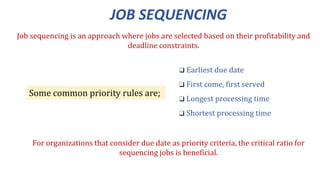
JOB SEQUENCING
For organizations that consider due date as priority criteria, the critical ratio for
sequencing jobs is beneficial.
Job sequencing is an approach where jobs are selected based on their profitability and
deadline constraints.
❑ Earliest due date
❑ First come, first served
❑ Longest processing time
❑ Shortest processing time
Some common priority rules are;
CRITICAL RATIO FOR JOB SEQUENCING
CR is easy to calculate and performs better than other priority rules (FCFS, SPT, LPT, EDD)
when it comes to dealing with job lateness criteria.
The critical ratio (CR) is an index number computed by dividing the time remaining
until due date by the work time remaining.
𝐶𝑅 =
𝑇𝐼𝑀𝐸 𝑅𝐸𝑀𝐴𝐼𝑁𝐼𝑁𝐺
𝑊𝑂𝑅𝐾𝐷𝐴𝑌𝑆 𝑅𝐸𝑀𝐴𝐼𝑁𝐼𝑁𝐺
=
𝐷𝑢𝑒 𝐷𝑎𝑡𝑒 − 𝑇𝑜𝑑𝑎𝑦′𝑠 𝐷𝑎𝑡𝑒
𝑊𝑜𝑟𝑘 𝑇𝑖𝑚𝑒 𝑅𝑒𝑚𝑎𝑖𝑛𝑖𝑛𝑔
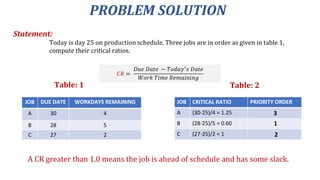
PROBLEM SOLUTION
JOB DUE DATE WORKDAYS REMAINING
A 30 4
B 28 5
C 27 2
JOB CRITICAL RATIO PRIORITY ORDER
A (30-25)/4 = 1.25
B (28-25)/5 = 0.60
C (27-25)/2 = 1
Statement:
Today is day 25 on production schedule. Three jobs are in order as given in table 1,
compute their critical ratios.
Table: 1 Table: 2
3
1
2
A CR greater than 1.0 means the job is ahead of schedule and has some slack.
𝐶𝑅 =
𝐷𝑢𝑒 𝐷𝑎𝑡𝑒 − 𝑇𝑜𝑑𝑎𝑦′𝑠 𝐷𝑎𝑡𝑒
𝑊𝑜𝑟𝑘 𝑇𝑖𝑚𝑒 𝑅𝑒𝑚𝑎𝑖𝑛𝑖𝑛𝑔
Here is the video link of complete lecture of this
presentation for full understanding
https://youtu.be/7cFTAZFg3Do?si=Axi70CI_oz-GLpam
Or write critical ratio explained with examples E-concepts on YouTube

Critical ratio explained with example.pptx

  • 1.
    CRITICAL RATIO IN JOBSEQUENCING JOB DUE DATE WORKDAYS REMAINING A 30 4 B 28 5 C 27 2
  • 2.
    JOB SEQUENCING For organizationsthat consider due date as priority criteria, the critical ratio for sequencing jobs is beneficial. Job sequencing is an approach where jobs are selected based on their profitability and deadline constraints. ❑ Earliest due date ❑ First come, first served ❑ Longest processing time ❑ Shortest processing time Some common priority rules are;
  • 3.
    CRITICAL RATIO FORJOB SEQUENCING CR is easy to calculate and performs better than other priority rules (FCFS, SPT, LPT, EDD) when it comes to dealing with job lateness criteria. The critical ratio (CR) is an index number computed by dividing the time remaining until due date by the work time remaining. 𝐶𝑅 = 𝑇𝐼𝑀𝐸 𝑅𝐸𝑀𝐴𝐼𝑁𝐼𝑁𝐺 𝑊𝑂𝑅𝐾𝐷𝐴𝑌𝑆 𝑅𝐸𝑀𝐴𝐼𝑁𝐼𝑁𝐺 = 𝐷𝑢𝑒 𝐷𝑎𝑡𝑒 − 𝑇𝑜𝑑𝑎𝑦′𝑠 𝐷𝑎𝑡𝑒 𝑊𝑜𝑟𝑘 𝑇𝑖𝑚𝑒 𝑅𝑒𝑚𝑎𝑖𝑛𝑖𝑛𝑔
  • 4.
    PROBLEM SOLUTION JOB DUEDATE WORKDAYS REMAINING A 30 4 B 28 5 C 27 2 JOB CRITICAL RATIO PRIORITY ORDER A (30-25)/4 = 1.25 B (28-25)/5 = 0.60 C (27-25)/2 = 1 Statement: Today is day 25 on production schedule. Three jobs are in order as given in table 1, compute their critical ratios. Table: 1 Table: 2 3 1 2 A CR greater than 1.0 means the job is ahead of schedule and has some slack. 𝐶𝑅 = 𝐷𝑢𝑒 𝐷𝑎𝑡𝑒 − 𝑇𝑜𝑑𝑎𝑦′𝑠 𝐷𝑎𝑡𝑒 𝑊𝑜𝑟𝑘 𝑇𝑖𝑚𝑒 𝑅𝑒𝑚𝑎𝑖𝑛𝑖𝑛𝑔
  • 5.
    Here is thevideo link of complete lecture of this presentation for full understanding https://youtu.be/7cFTAZFg3Do?si=Axi70CI_oz-GLpam Or write critical ratio explained with examples E-concepts on YouTube