TYPES OF INFORMATION
SYSTEM
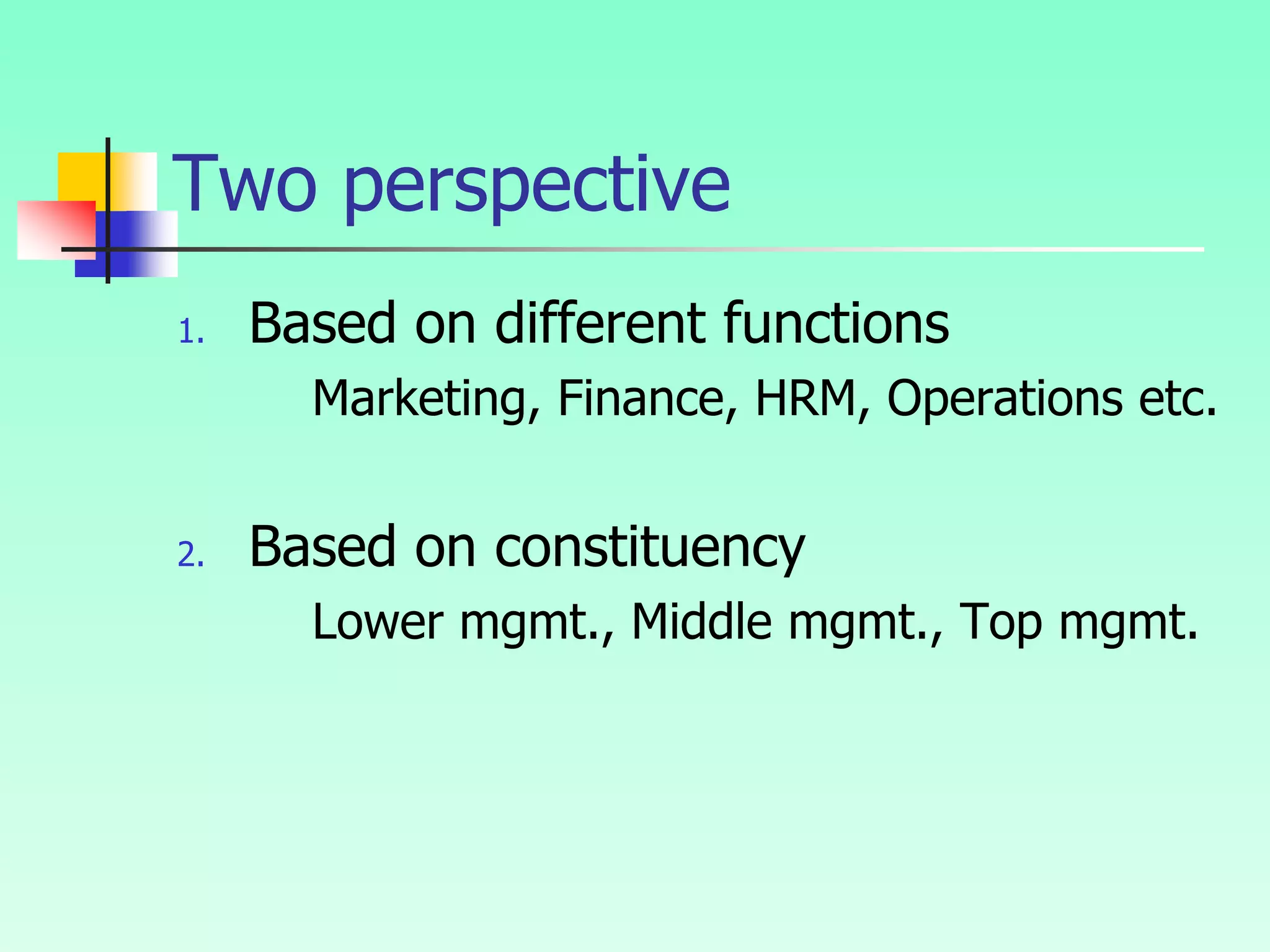
Two perspective
1. Based on different functions
Marketing, Finance, HRM, Operations etc.
2. Based on constituency
Lower mgmt., Middle mgmt., Top mgmt.
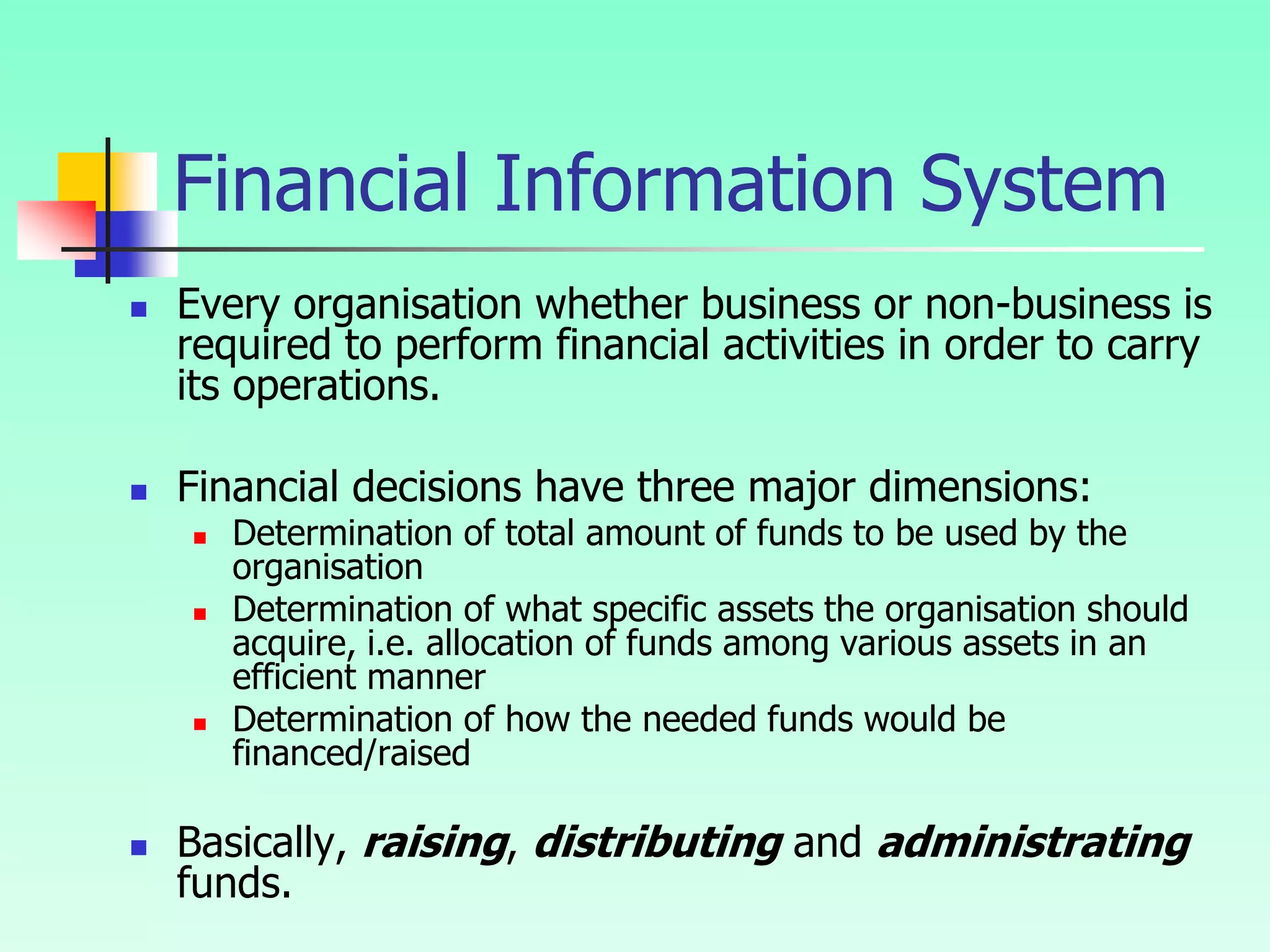
Financial Information System
 Every organisation whether business or non-business is
required to perform financial activities in order to carry
its operations.
 Financial decisions have three major dimensions:
 Determination of total amount of funds to be used by the
organisation
 Determination of what specific assets the organisation should
acquire, i.e. allocation of funds among various assets in an
efficient manner
 Determination of how the needed funds would be
financed/raised
 Basically, raising, distributing and administrating
funds.
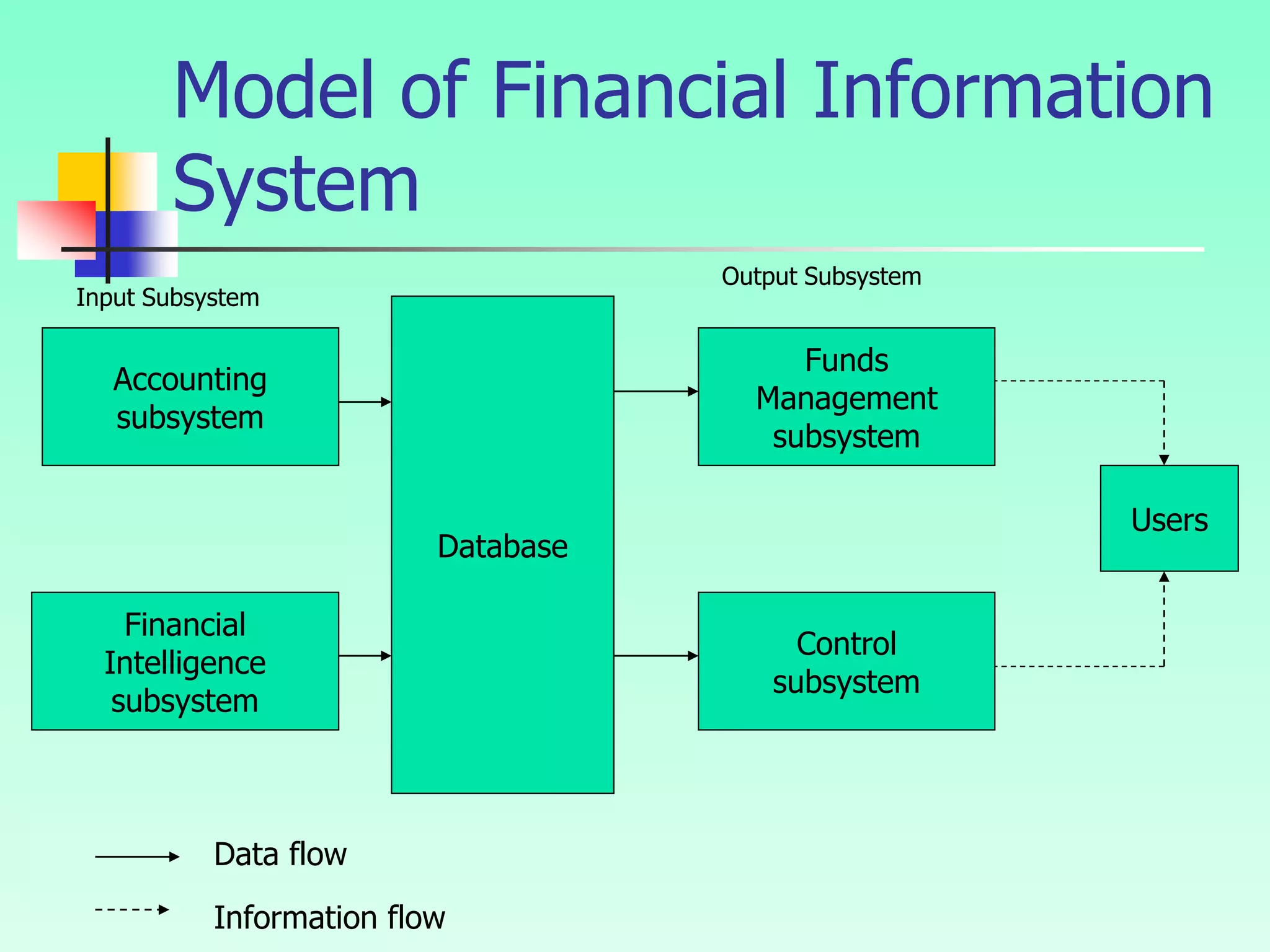
Model of Financial Information
System
Accounting
subsystem
Financial
Intelligence
subsystem
Database
Users
Funds
Management
subsystem
Control
subsystem
Data flow
Information flow
Output Subsystem
Input Subsystem
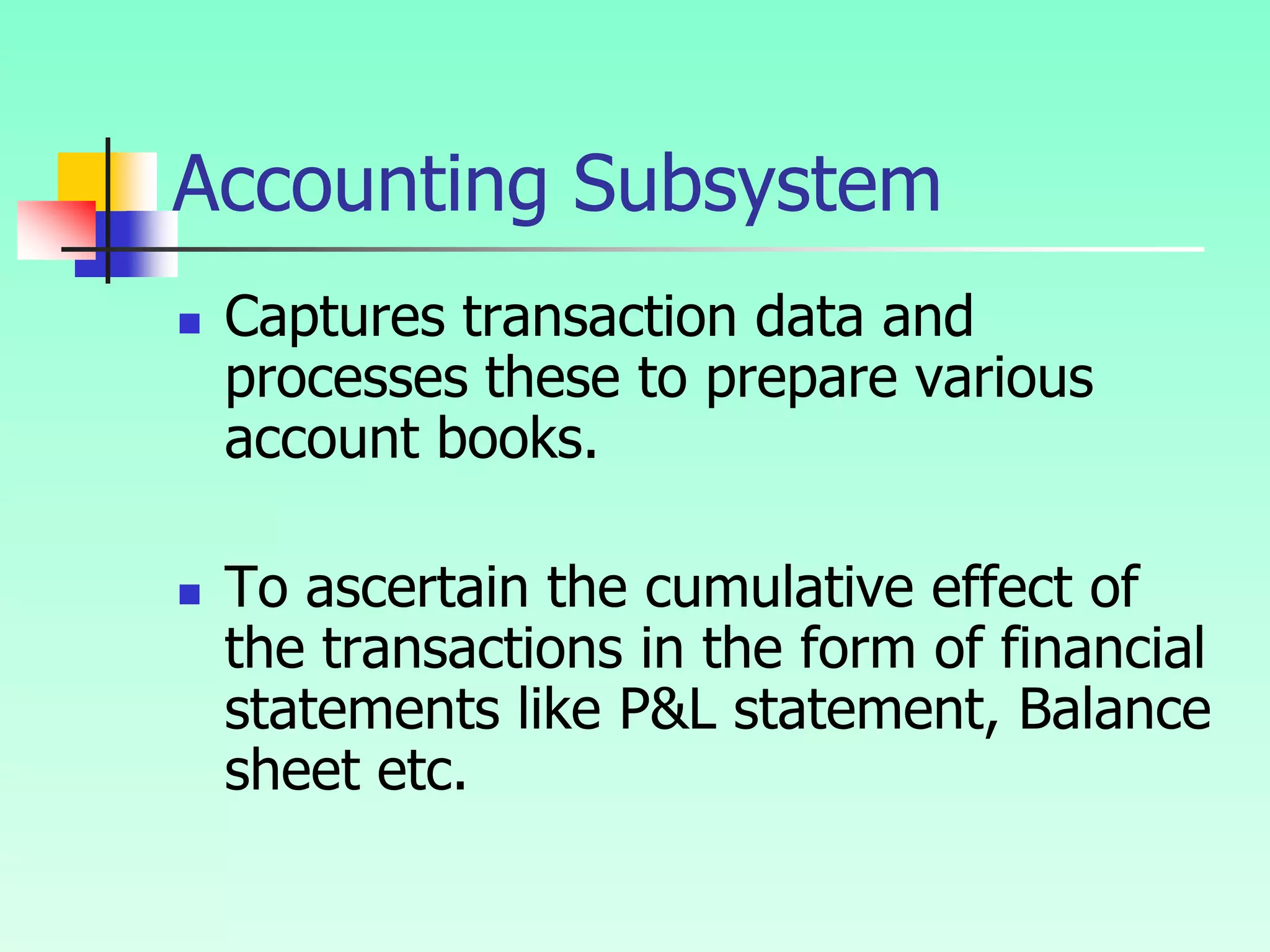
Accounting Subsystem
 Captures transaction data and
processes these to prepare various
account books.
 To ascertain the cumulative effect of
the transactions in the form of financial
statements like P&L statement, Balance
sheet etc.
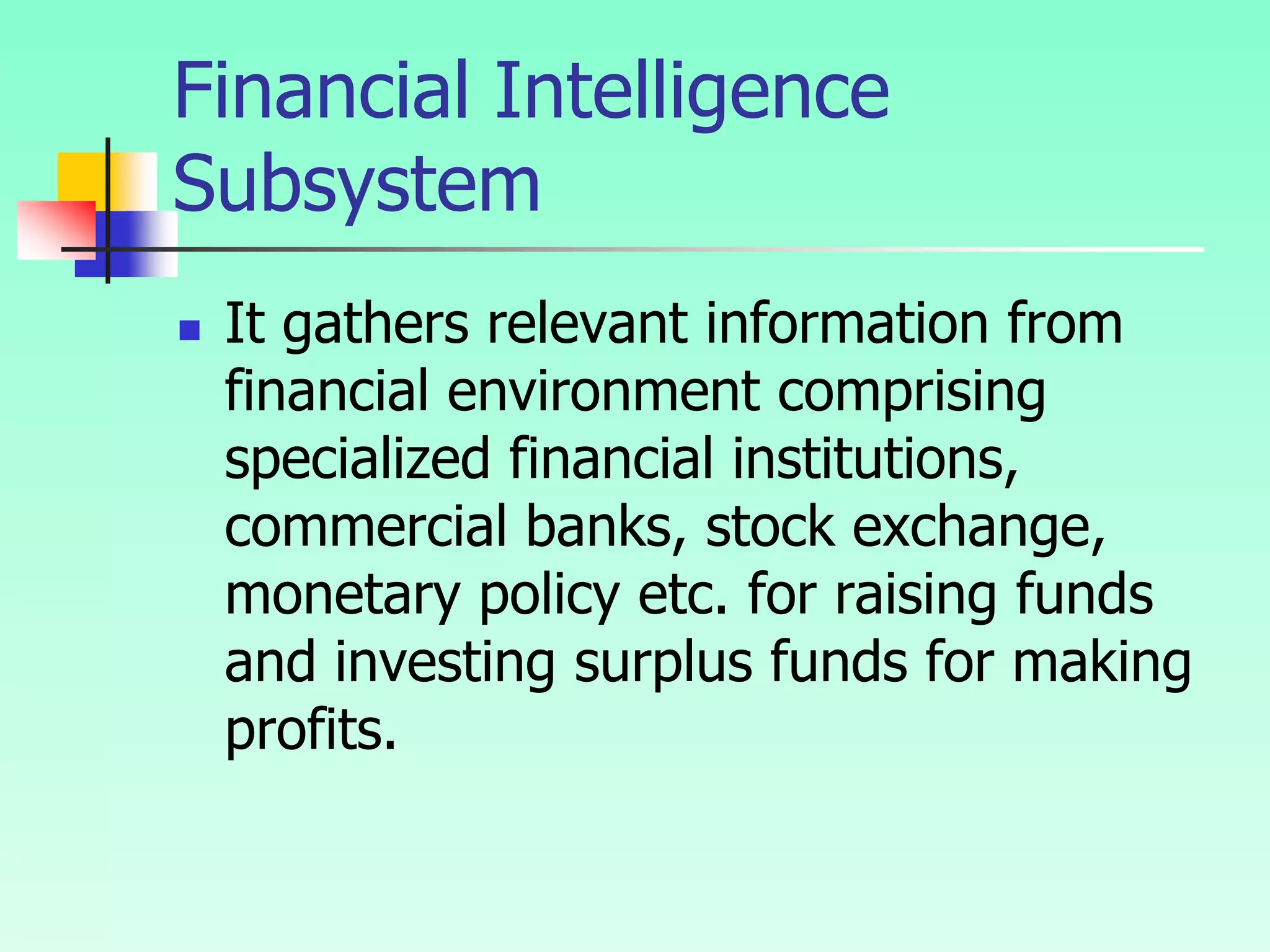
Financial Intelligence
Subsystem
 It gathers relevant information from
financial environment comprising
specialized financial institutions,
commercial banks, stock exchange,
monetary policy etc. for raising funds
and investing surplus funds for making
profits.
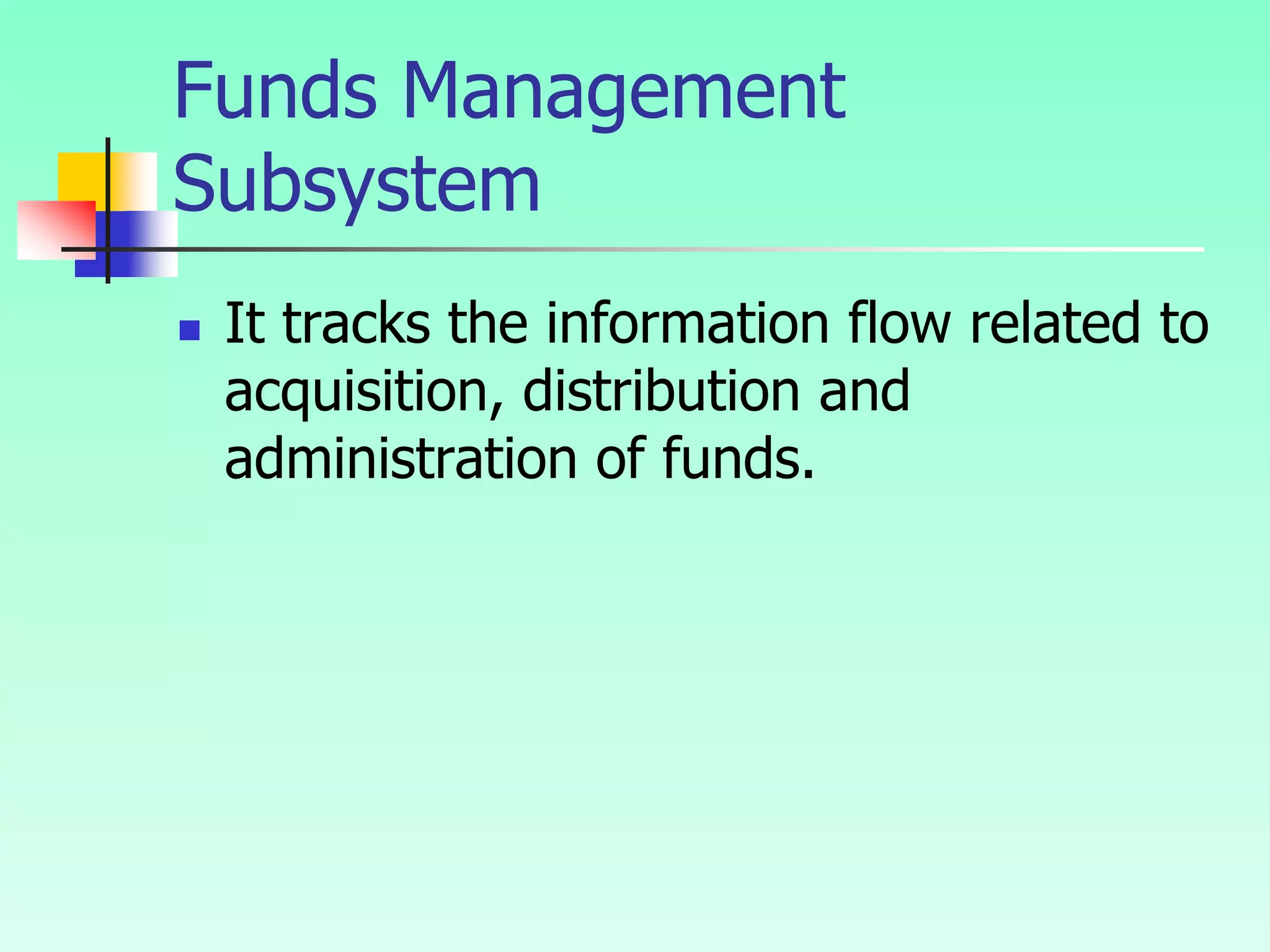
Funds Management
Subsystem
 It tracks the information flow related to
acquisition, distribution and
administration of funds.
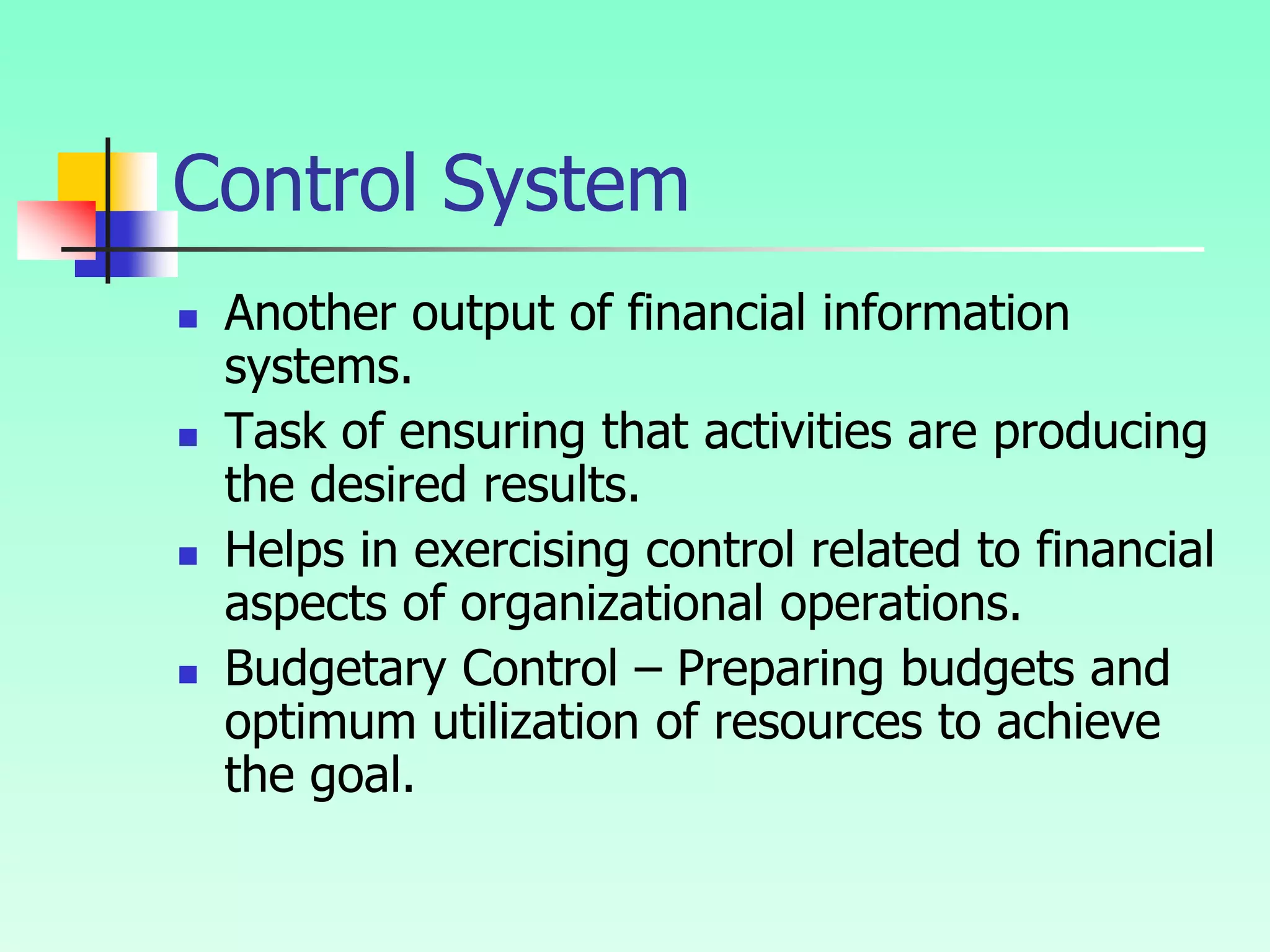
Control System
 Another output of financial information
systems.
 Task of ensuring that activities are producing
the desired results.
 Helps in exercising control related to financial
aspects of organizational operations.
 Budgetary Control – Preparing budgets and
optimum utilization of resources to achieve
the goal.
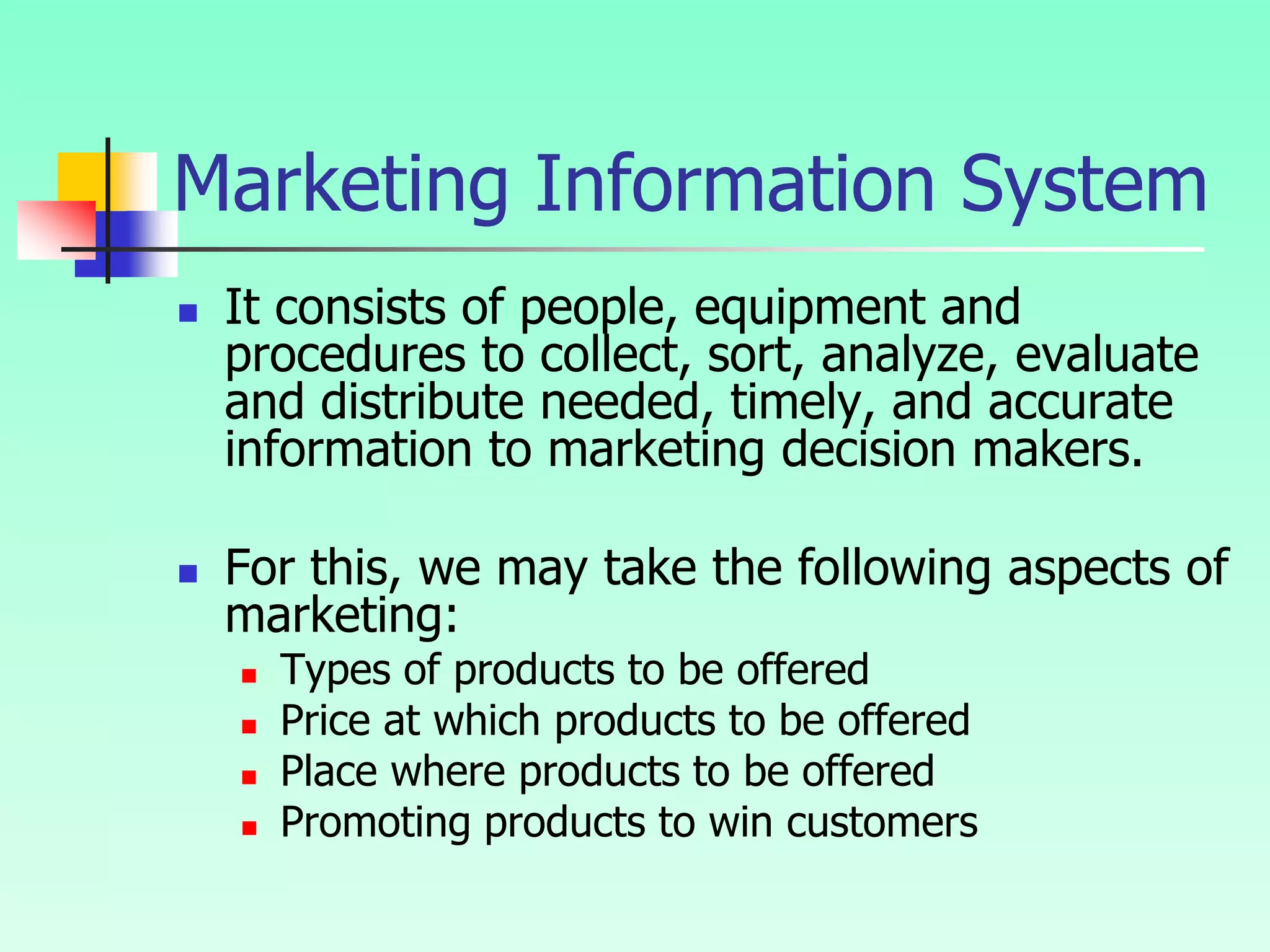
Marketing Information System
 It consists of people, equipment and
procedures to collect, sort, analyze, evaluate
and distribute needed, timely, and accurate
information to marketing decision makers.
 For this, we may take the following aspects of
marketing:
 Types of products to be offered
 Price at which products to be offered
 Place where products to be offered
 Promoting products to win customers
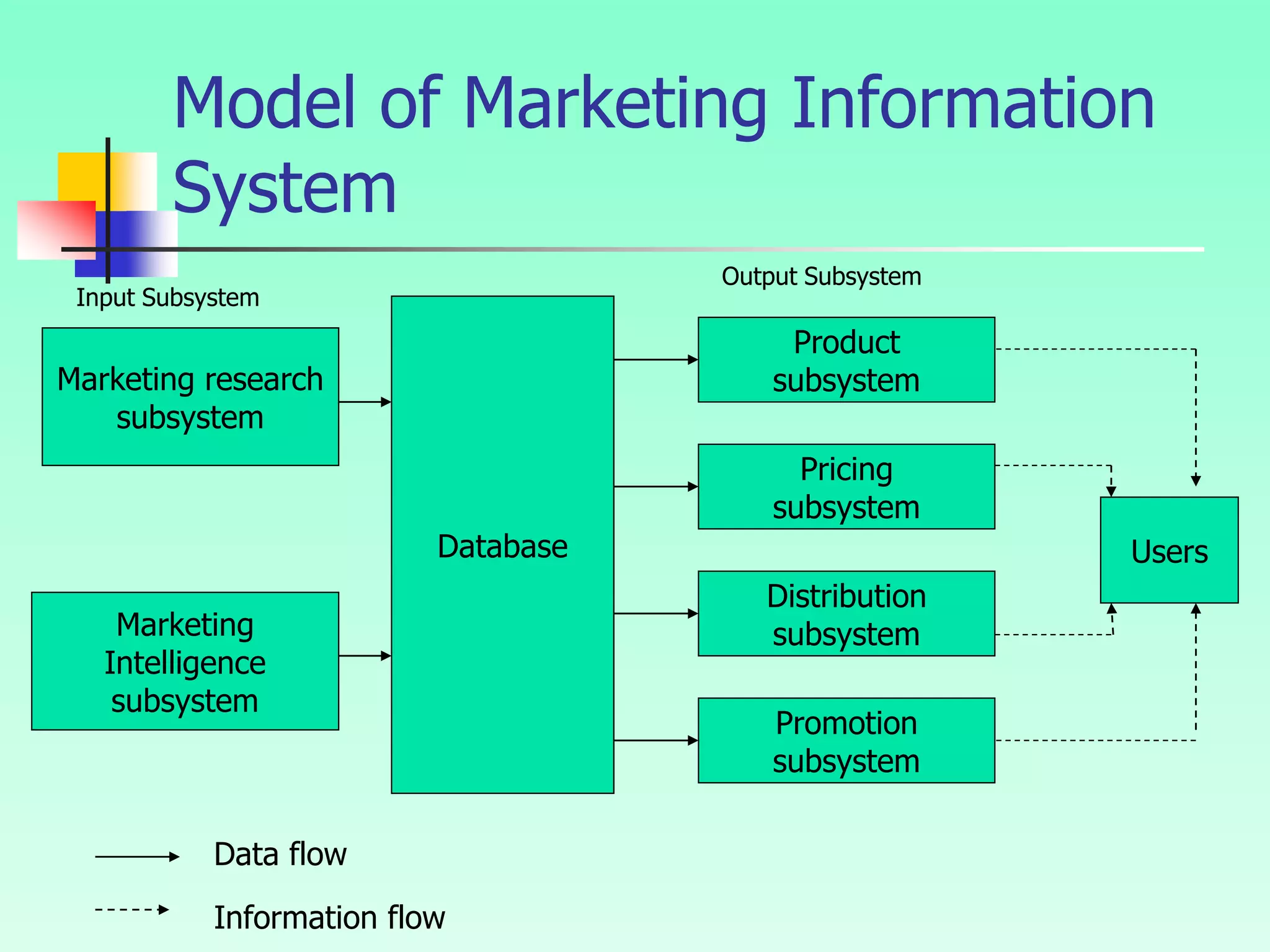
Model of Marketing Information
System
Marketing research
subsystem
Marketing
Intelligence
subsystem
Database Users
Product
subsystem
Pricing
subsystem
Distribution
subsystem
Promotion
subsystem
Data flow
Information flow
Output Subsystem
Input Subsystem
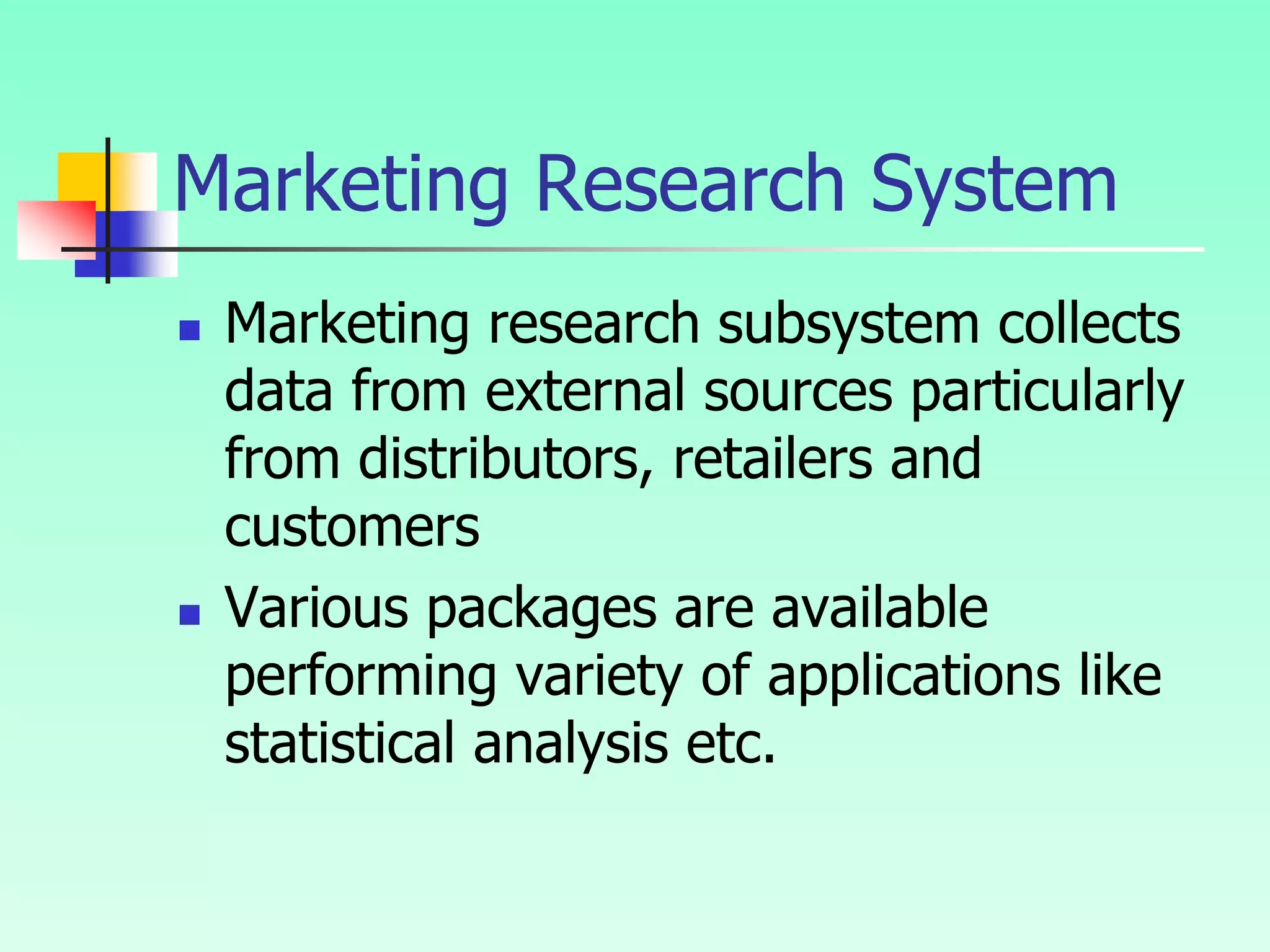
Marketing Research System
 Marketing research subsystem collects
data from external sources particularly
from distributors, retailers and
customers
 Various packages are available
performing variety of applications like
statistical analysis etc.
Marketing Intelligence System
 Concerned with appraising total
marketing environment for assessing
opportunities & threats.
 Product Subsystem:
 Product subsystem collects information
that helps in determining product features,
market segmentation, product positioning
and branding.
 Pricing System:
 Traces information related to price fixation
and price change.
 Distribution subsystem:
 Traces information for selecting distribution
channel and managing supply chain/
distribution.
 Promotion Subsystem:
 Traces information to design promotion
mix and various promotional efforts that
can be undertaken.
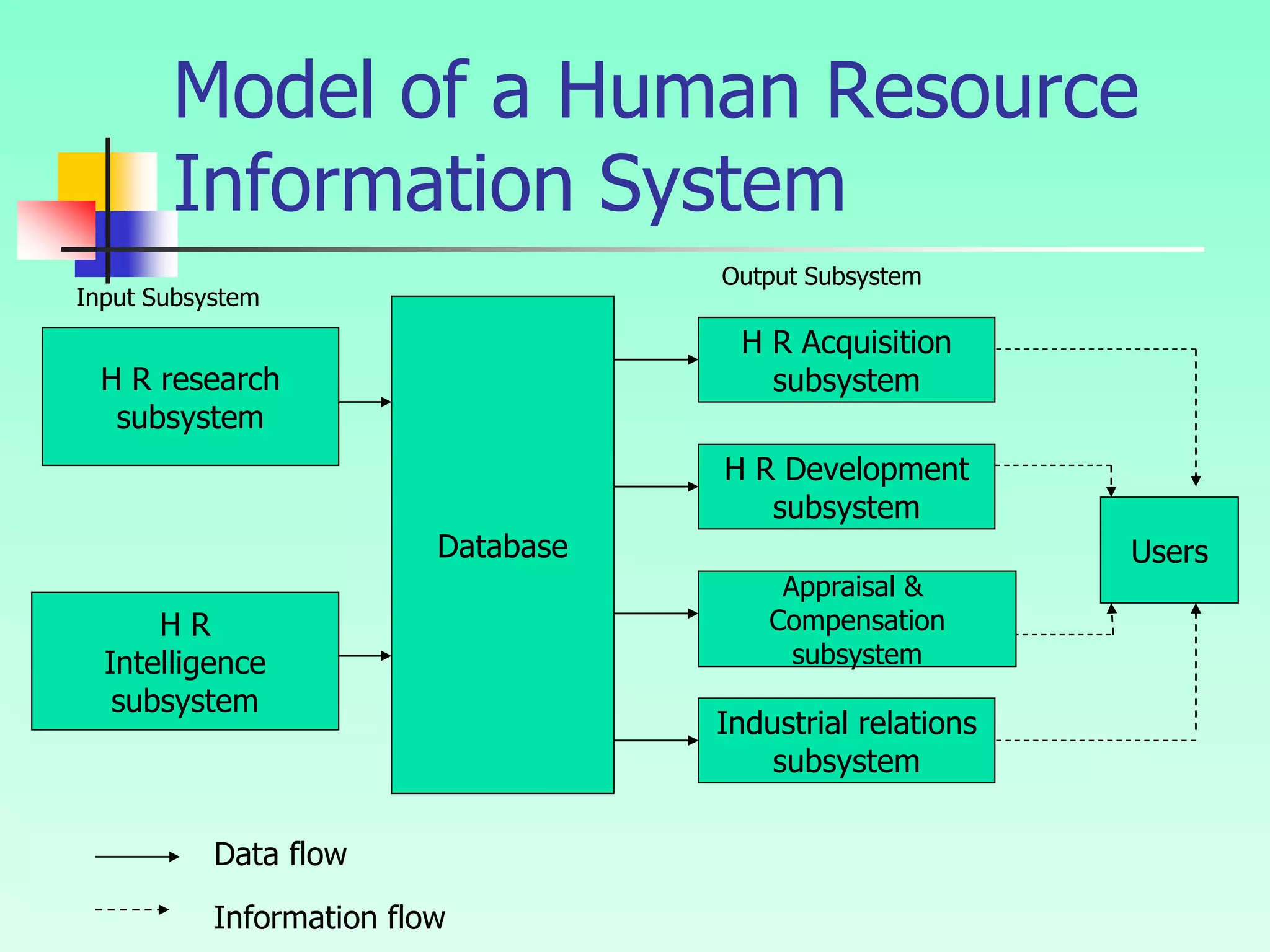
HRM Information System
Model of a Human Resource
Information System
H R research
subsystem
H R
Intelligence
subsystem
Database Users
H R Acquisition
subsystem
H R Development
subsystem
Appraisal &
Compensation
subsystem
Industrial relations
subsystem
Data flow
Information flow
Output Subsystem
Input Subsystem
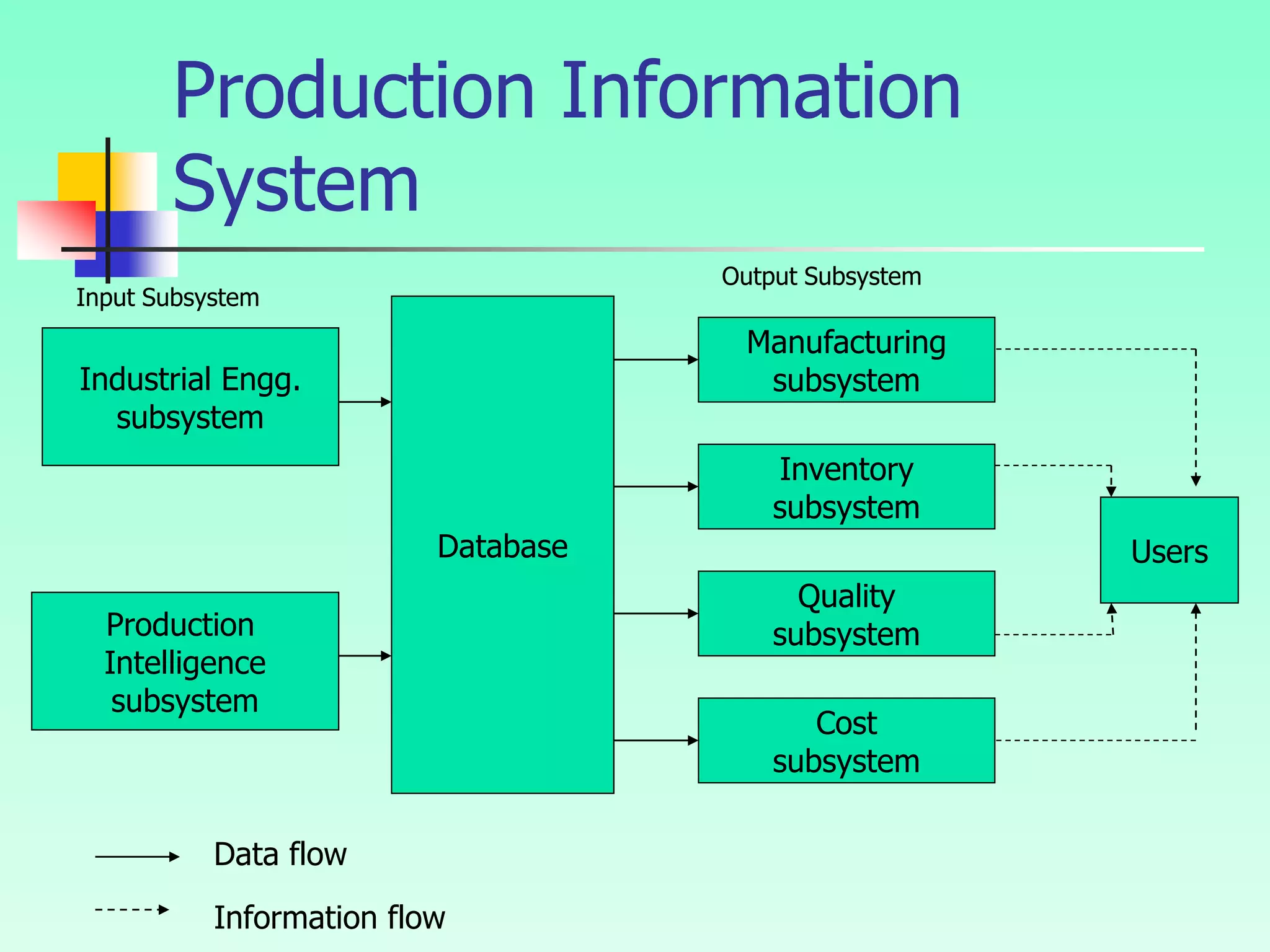
Production Information System
Production Information
System
Industrial Engg.
subsystem
Production
Intelligence
subsystem
Database Users
Manufacturing
subsystem
Inventory
subsystem
Quality
subsystem
Cost
subsystem
Data flow
Information flow
Output Subsystem
Input Subsystem
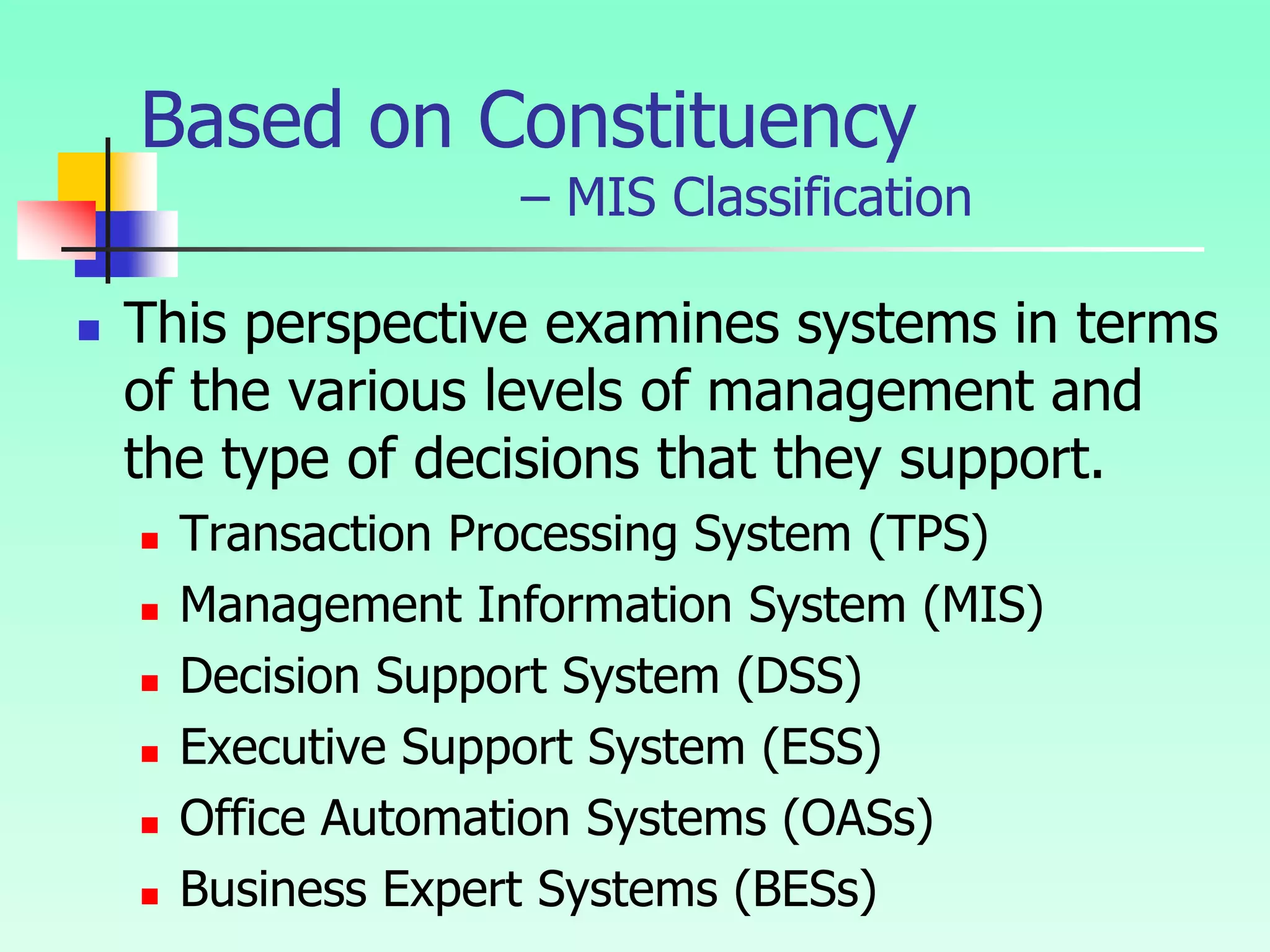
Based on Constituency
– MIS Classification
 This perspective examines systems in terms
of the various levels of management and
the type of decisions that they support.
 Transaction Processing System (TPS)
 Management Information System (MIS)
 Decision Support System (DSS)
 Executive Support System (ESS)
 Office Automation Systems (OASs)
 Business Expert Systems (BESs)
Transaction Processing
System
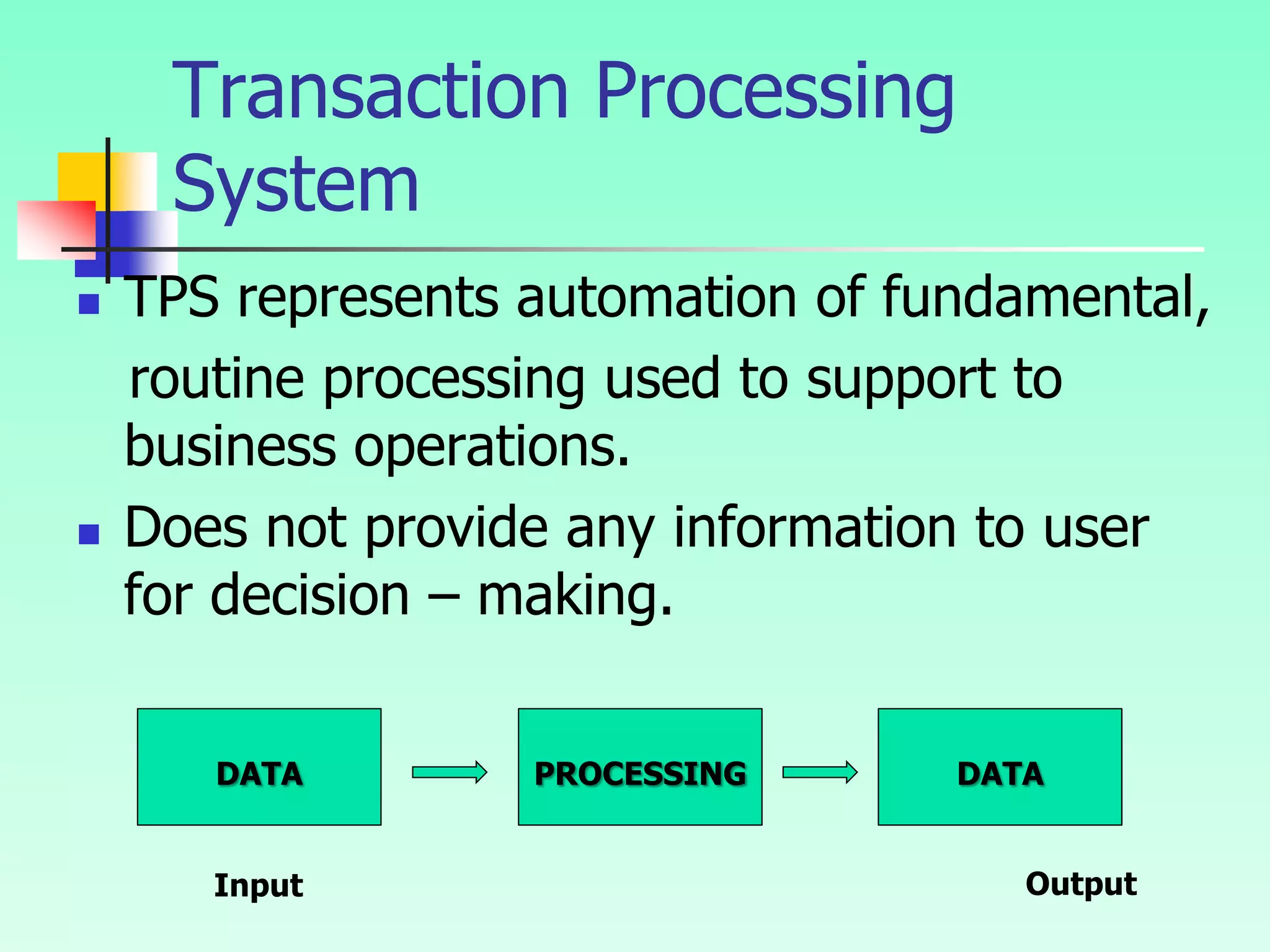
 TPS represents automation of fundamental,
routine processing used to support to
business operations.
 Does not provide any information to user
for decision – making.
DATA PROCESSING DATA
Input Output
 It is also known as Data Processing System.
 It is restricted to the lowest level of
management hierarchy.
 Transaction may be
 External (from customers, suppliers etc.)
 Internal ( transferring work in process from one
stage to the next, recording depreciation on
equipment)
Transaction Processing
System
Management Information
System
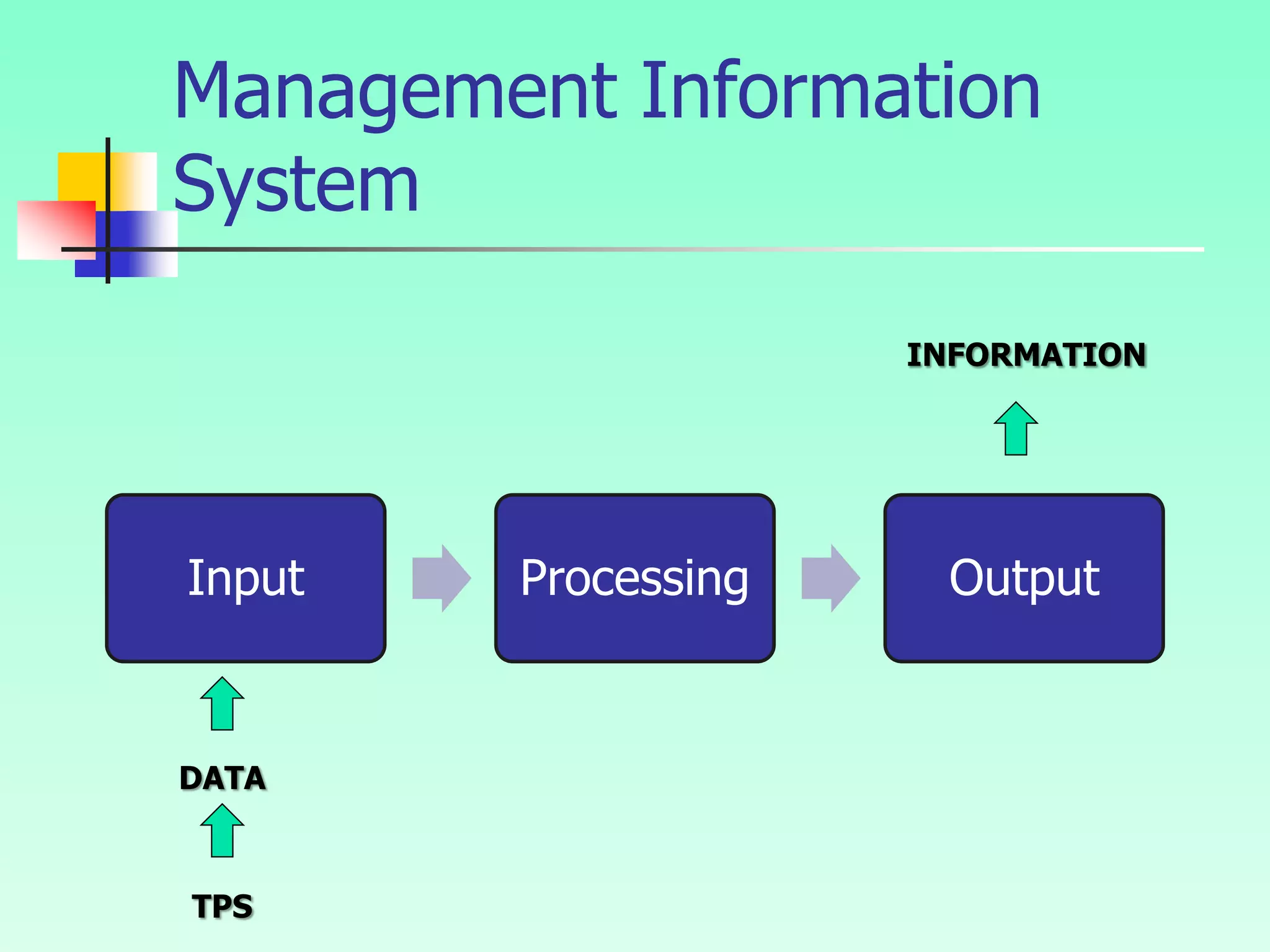
Input Processing Output
TPS
DATA
INFORMATION
Management Information
System
 MIS uses TPS as its input
 Information generated may be used for
control of operations
 Strategic and long-range planning
 Short-range planning
 Management control
 Other managerial problem solving
Management Information
System
 The domain of MIS is management level
control of management hierarchy.
 MIS is more comprehensive as compared to
TPS.
 MIS is capable of providing analysis,
planning and decision-making support.
 As MIS is an integrated system, it caters to
information needs for managers in all
functional areas.
 The functional areas of a business may
be
 Marketing
 Production
 Human resource
 Finance etc.
Management Information
System
Decision Support System (DSS)
 Decision support system is tailored to
specific managerial task or specific problem.
 It is designed primarily to serve
management control and strategic planning
level managers.
 Comprises of three components :
 Database
 Model base
 User Interface
Decision Support System (DSS)
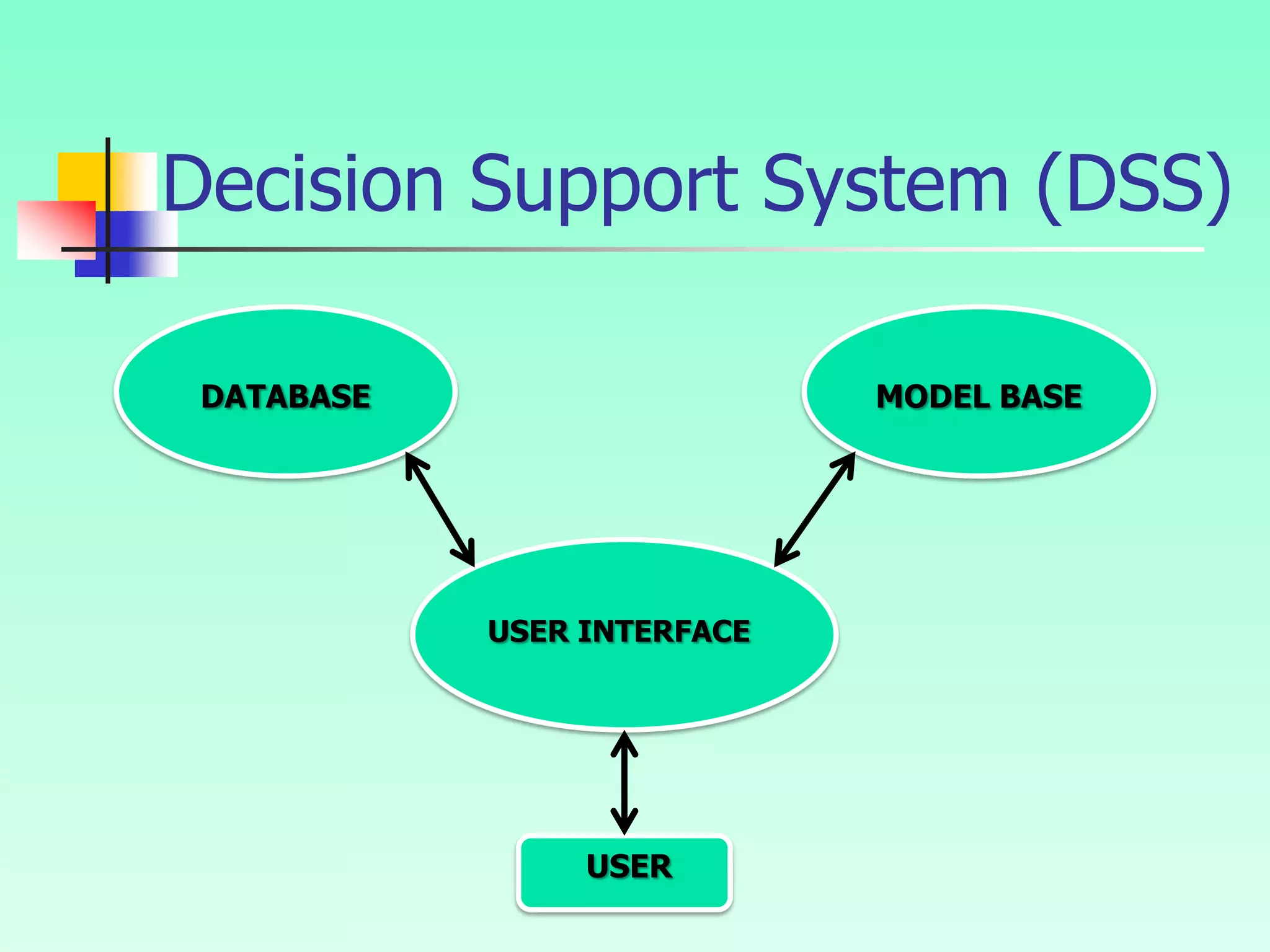
DATABASE MODEL BASE
USER INTERFACE
USER
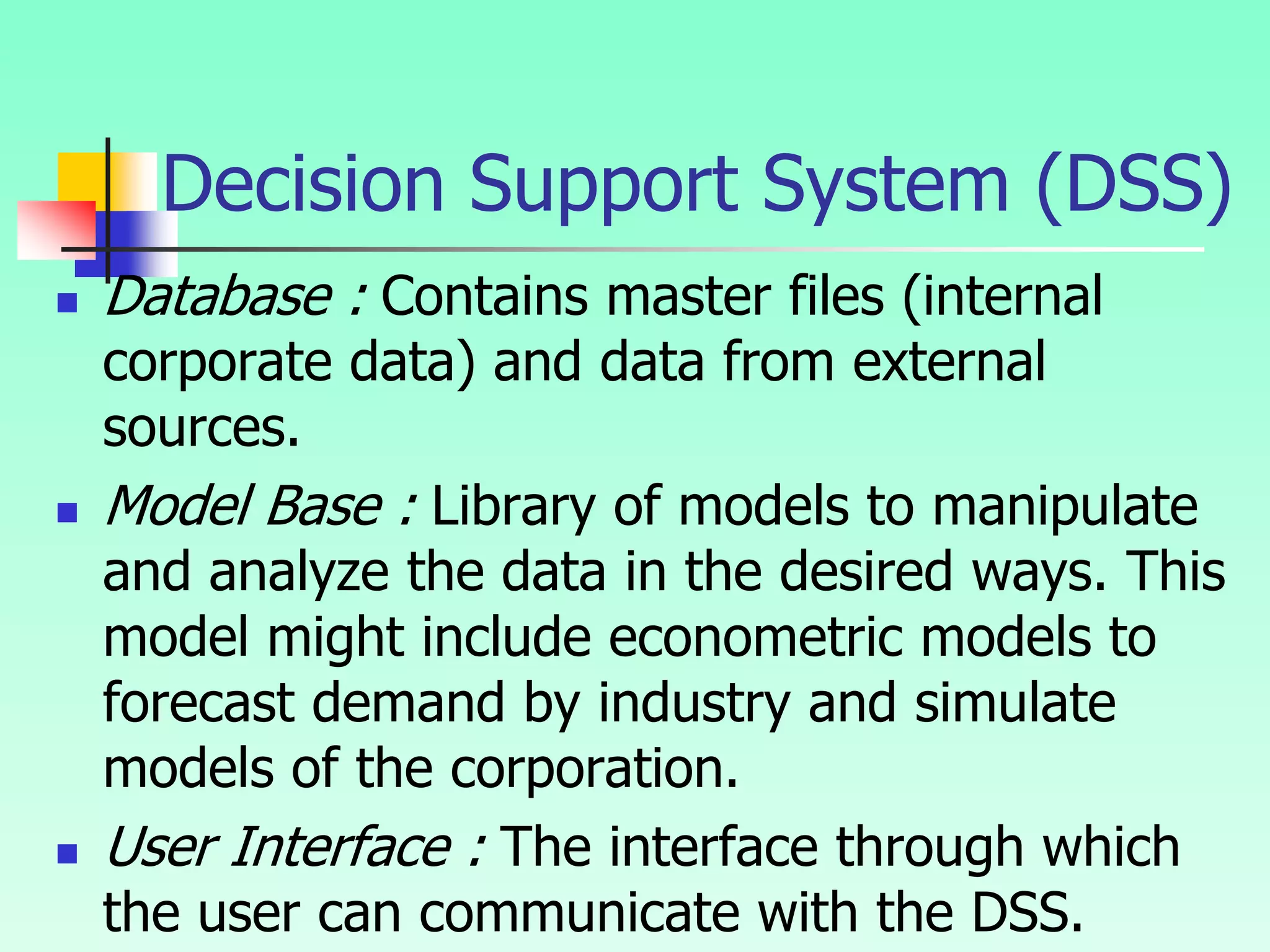
 Database : Contains master files (internal
corporate data) and data from external
sources.
 Model Base : Library of models to manipulate
and analyze the data in the desired ways. This
model might include econometric models to
forecast demand by industry and simulate
models of the corporation.
 User Interface : The interface through which
the user can communicate with the DSS.
Decision Support System (DSS)
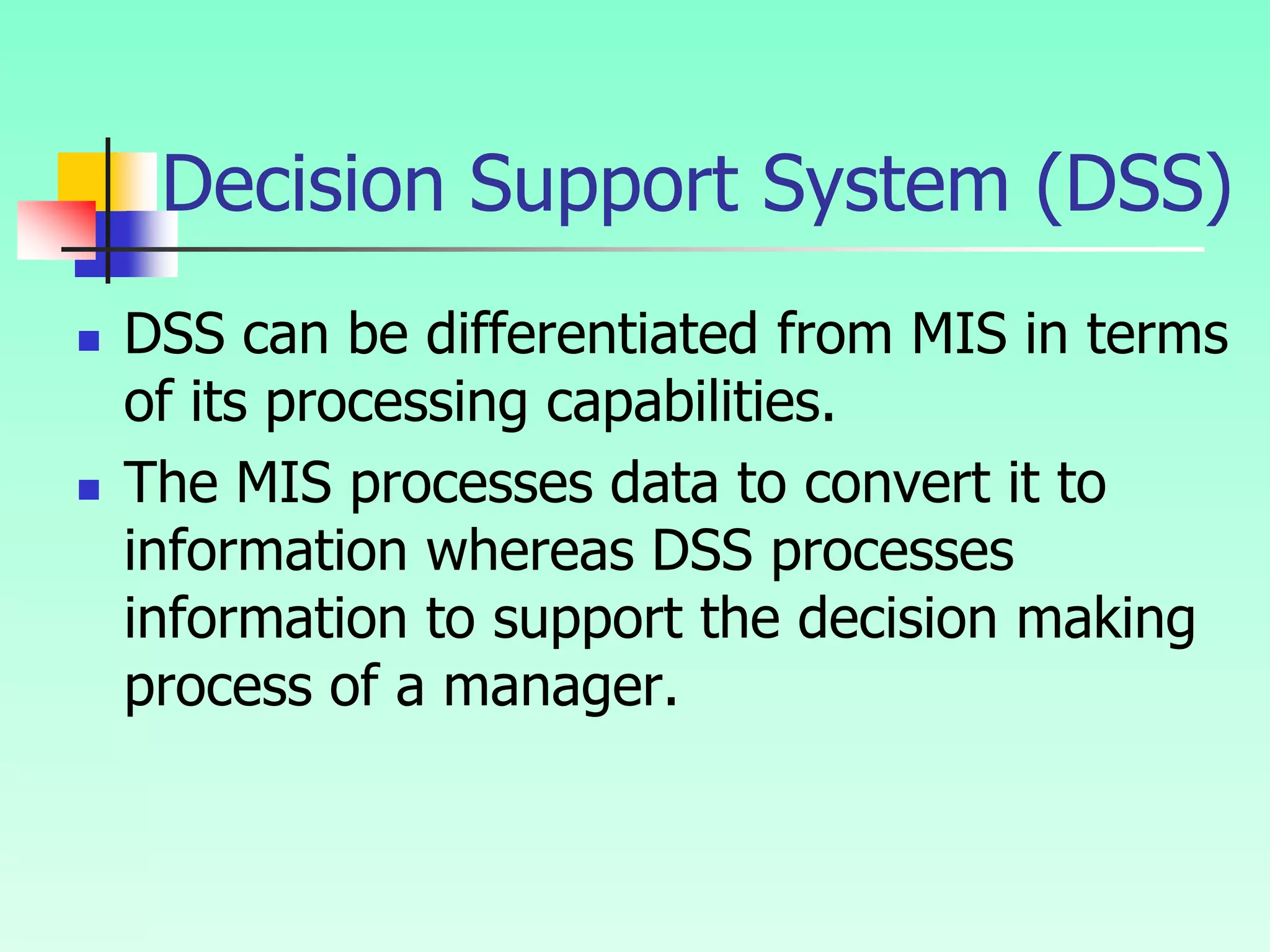
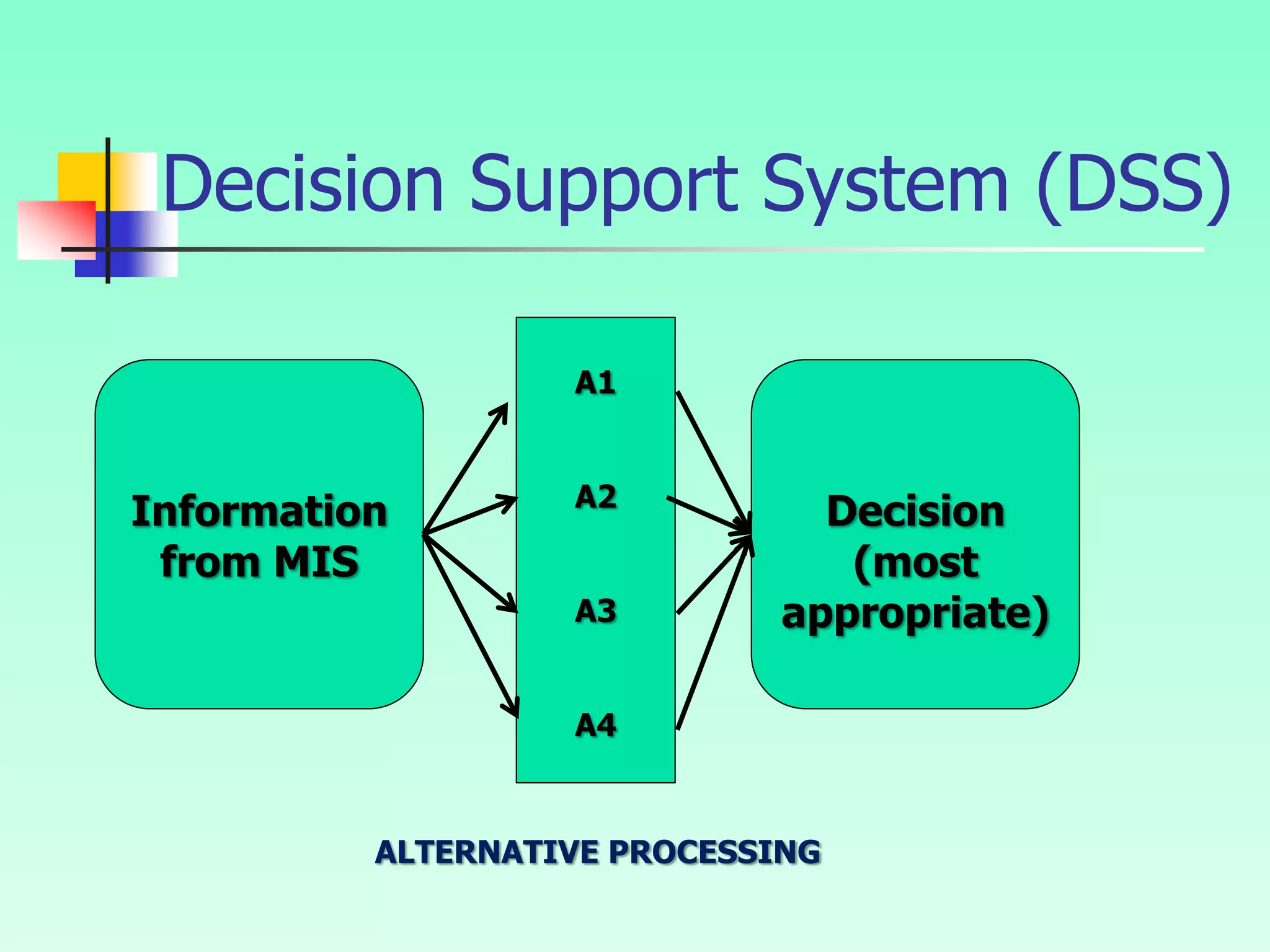
 DSS can be differentiated from MIS in terms
of its processing capabilities.
 The MIS processes data to convert it to
information whereas DSS processes
information to support the decision making
process of a manager.
Decision Support System (DSS)
Information
from MIS
Decision
(most
appropriate)
A1
A2
A3
A4
ALTERNATIVE PROCESSING
Decision Support System (DSS)
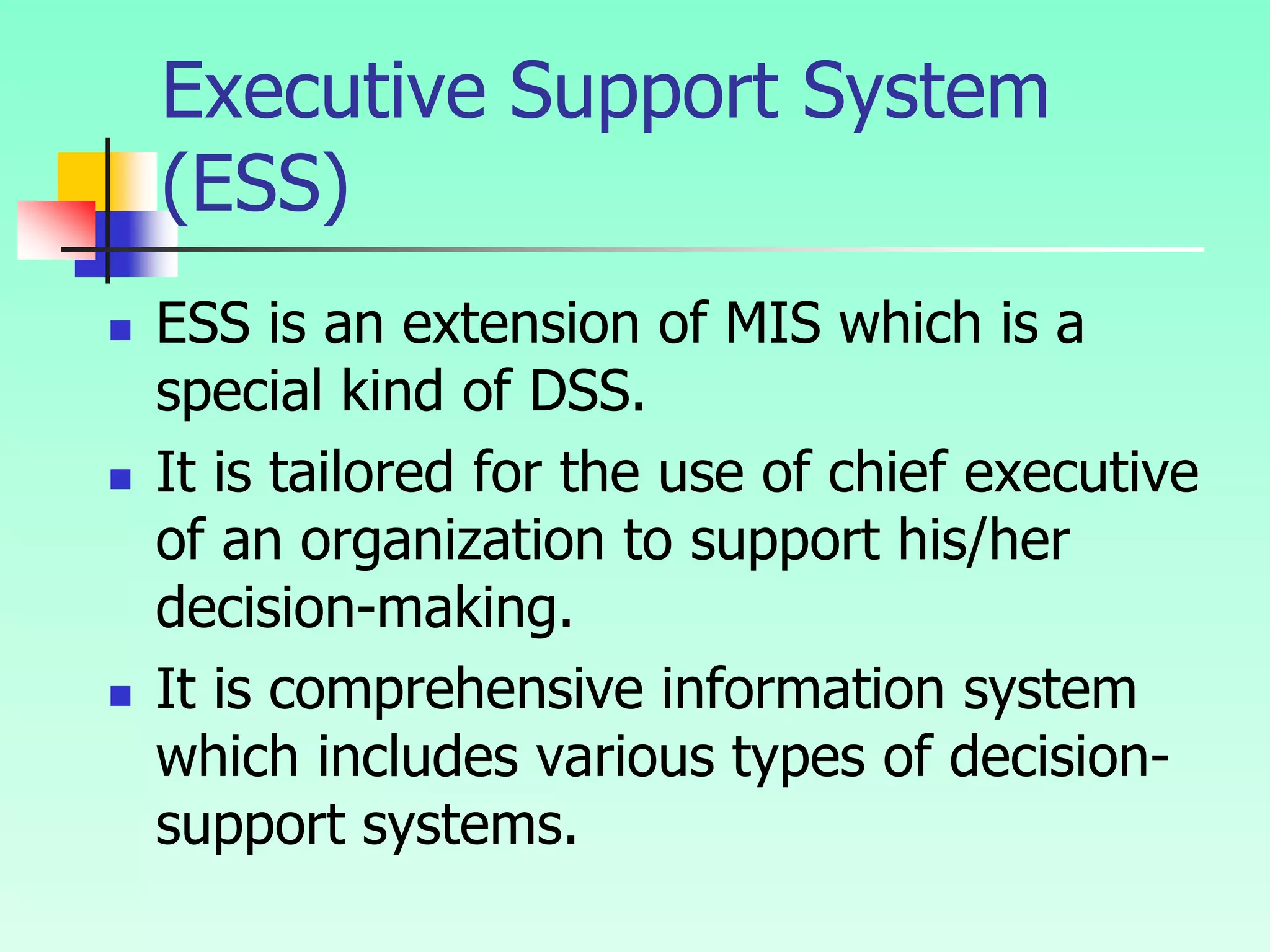
 ESS is an extension of MIS which is a
special kind of DSS.
 It is tailored for the use of chief executive
of an organization to support his/her
decision-making.
 It is comprehensive information system
which includes various types of decision-
support systems.
Executive Support System
(ESS)
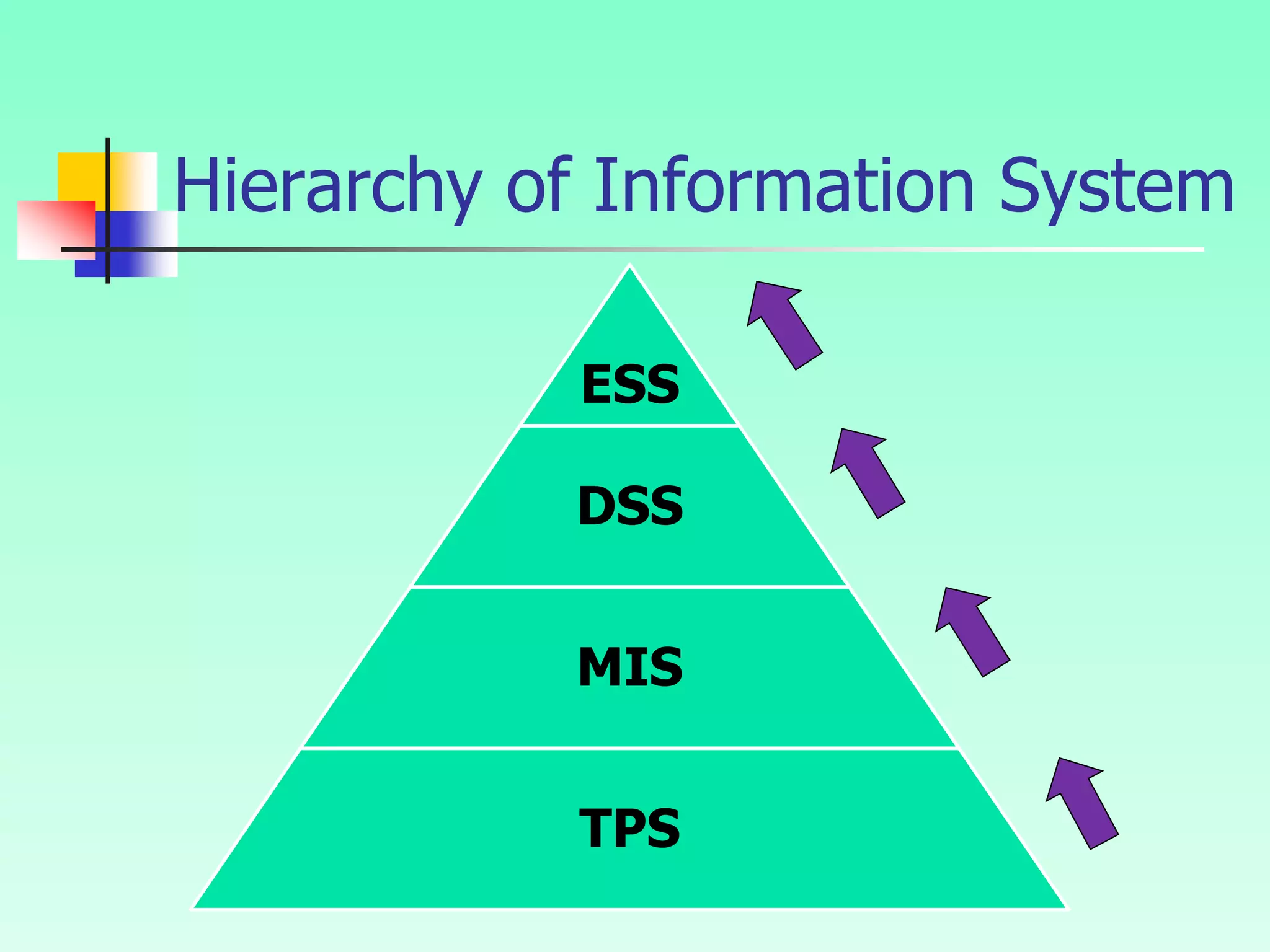
Hierarchy of Information System
ESS
DSS
MIS
TPS
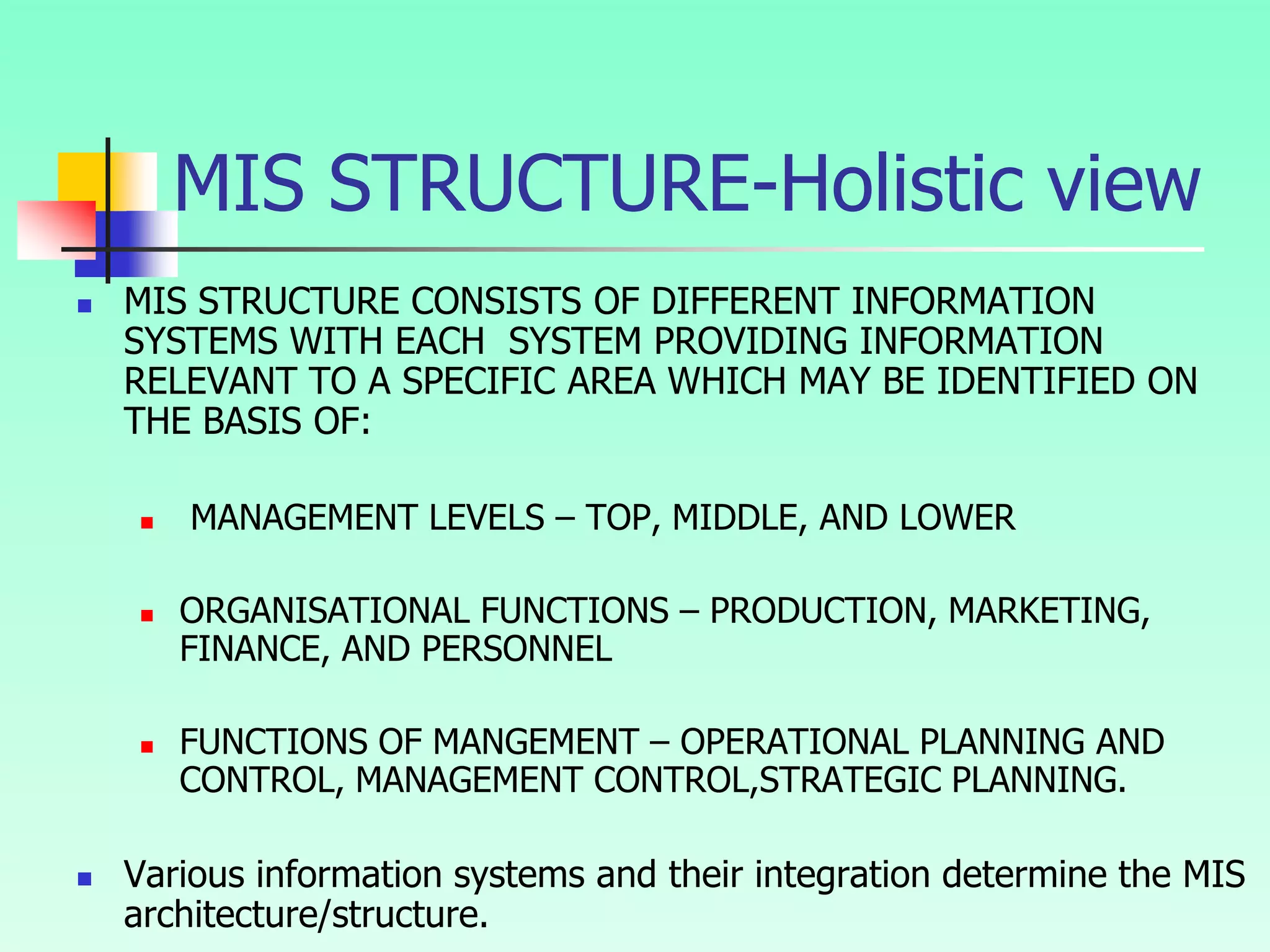
MIS STRUCTURE-Holistic view
 MIS STRUCTURE CONSISTS OF DIFFERENT INFORMATION
SYSTEMS WITH EACH SYSTEM PROVIDING INFORMATION
RELEVANT TO A SPECIFIC AREA WHICH MAY BE IDENTIFIED ON
THE BASIS OF:
 MANAGEMENT LEVELS – TOP, MIDDLE, AND LOWER
 ORGANISATIONAL FUNCTIONS – PRODUCTION, MARKETING,
FINANCE, AND PERSONNEL
 FUNCTIONS OF MANGEMENT – OPERATIONAL PLANNING AND
CONTROL, MANAGEMENT CONTROL,STRATEGIC PLANNING.
 Various information systems and their integration determine the MIS
architecture/structure.
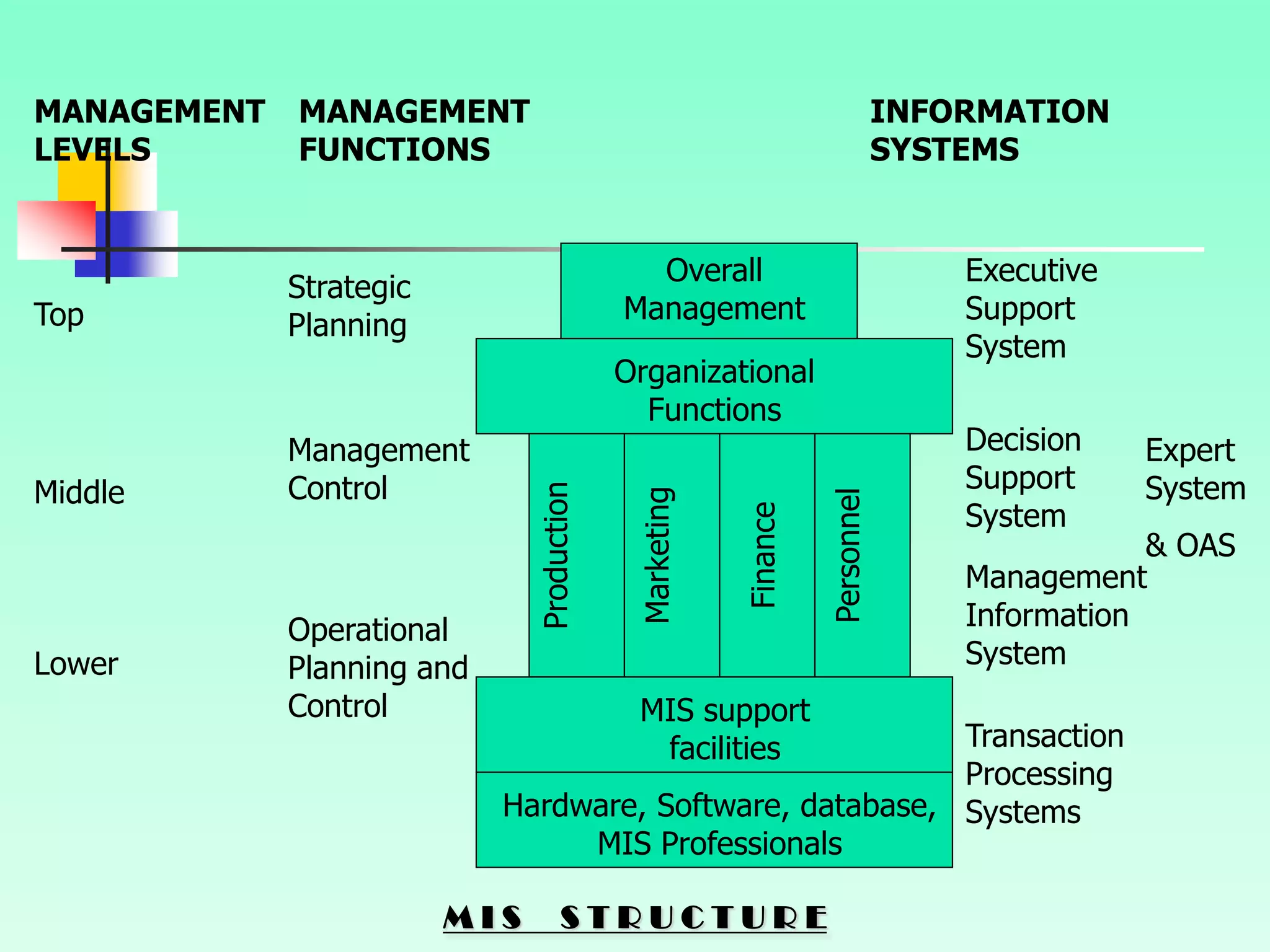
MANAGEMENT
LEVELS
MANAGEMENT
FUNCTIONS
INFORMATION
SYSTEMS
Top
Middle
Lower
Strategic
Planning
Management
Control
Operational
Planning and
Control
Overall
Management
Organizational
Functions
Production
Marketing
Finance
Personnel
MIS support
facilities
Hardware, Software, database,
MIS Professionals
Executive
Support
System
Decision
Support
System
Expert
System
& OAS
Management
Information
System
Transaction
Processing
Systems
M I S S T R U C T U R E
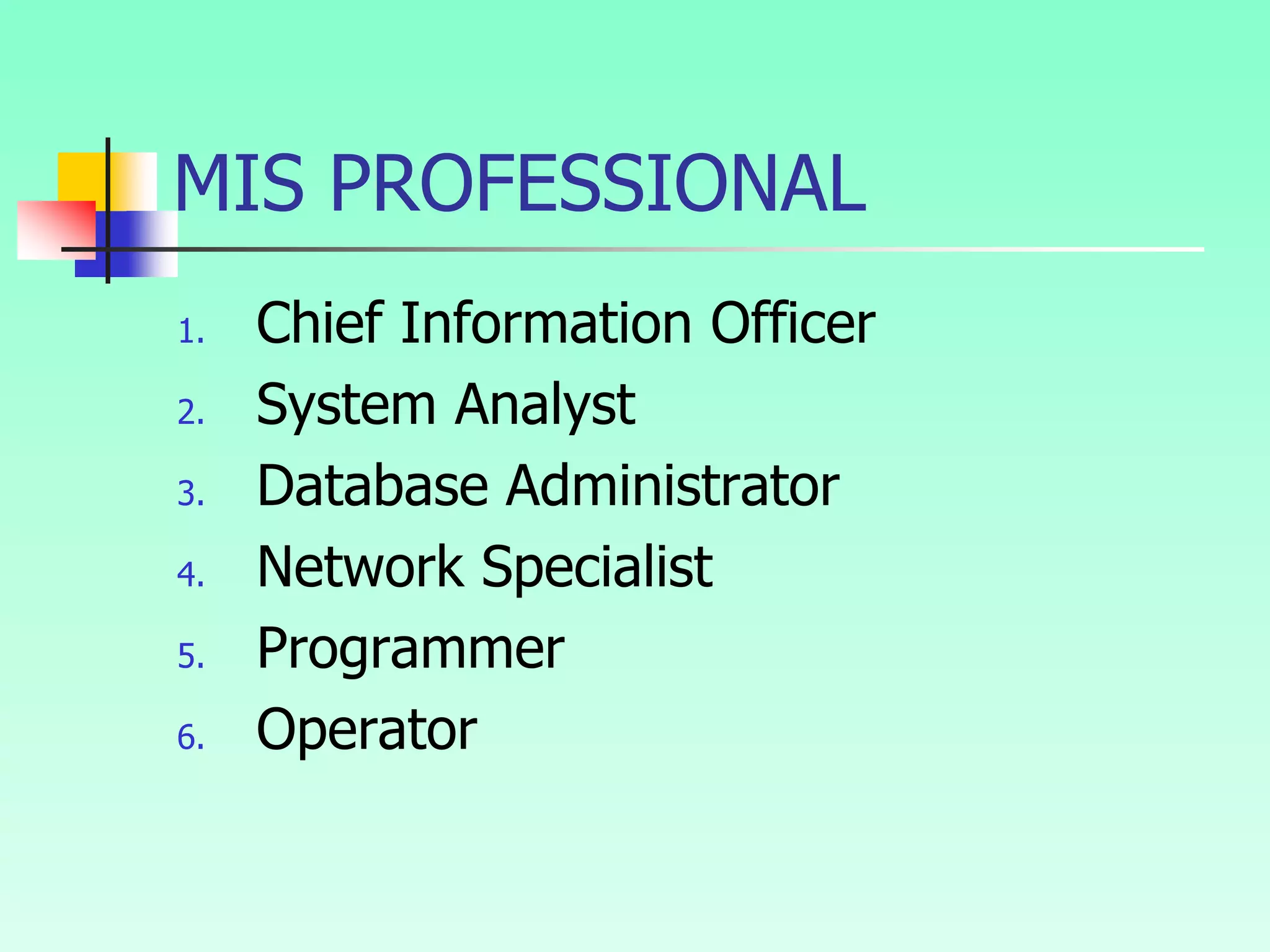
MIS PROFESSIONAL
1. Chief Information Officer
2. System Analyst
3. Database Administrator
4. Network Specialist
5. Programmer
6. Operator
CONCLUSION
 To understand information system, one
must understand
 Organization goals/objectives
 The problem they are designed to solve
 Their architectural and design elements
 The organizational process that lead to
these solutions.

3 mis & business functions

  • 1.
  • 2.
    Two perspective 1. Basedon different functions Marketing, Finance, HRM, Operations etc. 2. Based on constituency Lower mgmt., Middle mgmt., Top mgmt.
  • 3.
    Financial Information System Every organisation whether business or non-business is required to perform financial activities in order to carry its operations.  Financial decisions have three major dimensions:  Determination of total amount of funds to be used by the organisation  Determination of what specific assets the organisation should acquire, i.e. allocation of funds among various assets in an efficient manner  Determination of how the needed funds would be financed/raised  Basically, raising, distributing and administrating funds.
  • 4.
    Model of FinancialInformation System Accounting subsystem Financial Intelligence subsystem Database Users Funds Management subsystem Control subsystem Data flow Information flow Output Subsystem Input Subsystem
  • 5.
    Accounting Subsystem  Capturestransaction data and processes these to prepare various account books.  To ascertain the cumulative effect of the transactions in the form of financial statements like P&L statement, Balance sheet etc.
  • 6.
    Financial Intelligence Subsystem  Itgathers relevant information from financial environment comprising specialized financial institutions, commercial banks, stock exchange, monetary policy etc. for raising funds and investing surplus funds for making profits.
  • 7.
    Funds Management Subsystem  Ittracks the information flow related to acquisition, distribution and administration of funds.
  • 8.
    Control System  Anotheroutput of financial information systems.  Task of ensuring that activities are producing the desired results.  Helps in exercising control related to financial aspects of organizational operations.  Budgetary Control – Preparing budgets and optimum utilization of resources to achieve the goal.
  • 9.
  • 10.
    Marketing Information System It consists of people, equipment and procedures to collect, sort, analyze, evaluate and distribute needed, timely, and accurate information to marketing decision makers.  For this, we may take the following aspects of marketing:  Types of products to be offered  Price at which products to be offered  Place where products to be offered  Promoting products to win customers
  • 11.
    Model of MarketingInformation System Marketing research subsystem Marketing Intelligence subsystem Database Users Product subsystem Pricing subsystem Distribution subsystem Promotion subsystem Data flow Information flow Output Subsystem Input Subsystem
  • 12.
    Marketing Research System Marketing research subsystem collects data from external sources particularly from distributors, retailers and customers  Various packages are available performing variety of applications like statistical analysis etc.
  • 13.
    Marketing Intelligence System Concerned with appraising total marketing environment for assessing opportunities & threats.
  • 14.
     Product Subsystem: Product subsystem collects information that helps in determining product features, market segmentation, product positioning and branding.  Pricing System:  Traces information related to price fixation and price change.
  • 15.
     Distribution subsystem: Traces information for selecting distribution channel and managing supply chain/ distribution.  Promotion Subsystem:  Traces information to design promotion mix and various promotional efforts that can be undertaken.
  • 16.
  • 17.
    Model of aHuman Resource Information System H R research subsystem H R Intelligence subsystem Database Users H R Acquisition subsystem H R Development subsystem Appraisal & Compensation subsystem Industrial relations subsystem Data flow Information flow Output Subsystem Input Subsystem
  • 18.
  • 19.
    Production Information System Industrial Engg. subsystem Production Intelligence subsystem DatabaseUsers Manufacturing subsystem Inventory subsystem Quality subsystem Cost subsystem Data flow Information flow Output Subsystem Input Subsystem
  • 20.
    Based on Constituency –MIS Classification  This perspective examines systems in terms of the various levels of management and the type of decisions that they support.  Transaction Processing System (TPS)  Management Information System (MIS)  Decision Support System (DSS)  Executive Support System (ESS)  Office Automation Systems (OASs)  Business Expert Systems (BESs)
  • 21.
    Transaction Processing System  TPSrepresents automation of fundamental, routine processing used to support to business operations.  Does not provide any information to user for decision – making. DATA PROCESSING DATA Input Output
  • 22.
     It isalso known as Data Processing System.  It is restricted to the lowest level of management hierarchy.  Transaction may be  External (from customers, suppliers etc.)  Internal ( transferring work in process from one stage to the next, recording depreciation on equipment) Transaction Processing System
  • 23.
  • 24.
    Management Information System  MISuses TPS as its input  Information generated may be used for control of operations  Strategic and long-range planning  Short-range planning  Management control  Other managerial problem solving
  • 25.
    Management Information System  Thedomain of MIS is management level control of management hierarchy.  MIS is more comprehensive as compared to TPS.  MIS is capable of providing analysis, planning and decision-making support.  As MIS is an integrated system, it caters to information needs for managers in all functional areas.
  • 26.
     The functionalareas of a business may be  Marketing  Production  Human resource  Finance etc. Management Information System
  • 27.
    Decision Support System(DSS)  Decision support system is tailored to specific managerial task or specific problem.  It is designed primarily to serve management control and strategic planning level managers.  Comprises of three components :  Database  Model base  User Interface
  • 28.
    Decision Support System(DSS) DATABASE MODEL BASE USER INTERFACE USER
  • 29.
     Database :Contains master files (internal corporate data) and data from external sources.  Model Base : Library of models to manipulate and analyze the data in the desired ways. This model might include econometric models to forecast demand by industry and simulate models of the corporation.  User Interface : The interface through which the user can communicate with the DSS. Decision Support System (DSS)
  • 30.
     DSS canbe differentiated from MIS in terms of its processing capabilities.  The MIS processes data to convert it to information whereas DSS processes information to support the decision making process of a manager. Decision Support System (DSS)
  • 31.
  • 32.
     ESS isan extension of MIS which is a special kind of DSS.  It is tailored for the use of chief executive of an organization to support his/her decision-making.  It is comprehensive information system which includes various types of decision- support systems. Executive Support System (ESS)
  • 33.
    Hierarchy of InformationSystem ESS DSS MIS TPS
  • 34.
    MIS STRUCTURE-Holistic view MIS STRUCTURE CONSISTS OF DIFFERENT INFORMATION SYSTEMS WITH EACH SYSTEM PROVIDING INFORMATION RELEVANT TO A SPECIFIC AREA WHICH MAY BE IDENTIFIED ON THE BASIS OF:  MANAGEMENT LEVELS – TOP, MIDDLE, AND LOWER  ORGANISATIONAL FUNCTIONS – PRODUCTION, MARKETING, FINANCE, AND PERSONNEL  FUNCTIONS OF MANGEMENT – OPERATIONAL PLANNING AND CONTROL, MANAGEMENT CONTROL,STRATEGIC PLANNING.  Various information systems and their integration determine the MIS architecture/structure.
  • 35.
    MANAGEMENT LEVELS MANAGEMENT FUNCTIONS INFORMATION SYSTEMS Top Middle Lower Strategic Planning Management Control Operational Planning and Control Overall Management Organizational Functions Production Marketing Finance Personnel MIS support facilities Hardware,Software, database, MIS Professionals Executive Support System Decision Support System Expert System & OAS Management Information System Transaction Processing Systems M I S S T R U C T U R E
  • 36.
    MIS PROFESSIONAL 1. ChiefInformation Officer 2. System Analyst 3. Database Administrator 4. Network Specialist 5. Programmer 6. Operator
  • 37.
    CONCLUSION  To understandinformation system, one must understand  Organization goals/objectives  The problem they are designed to solve  Their architectural and design elements  The organizational process that lead to these solutions.