Forecasting
1
What is forecasting?
Forecasting is a tool used for predicting
future demand based on
past demand information.
Why is forecasting important?
Demand for products and services is usually uncertain.
Forecasting can be used for…
• Strategic planning (long range planning)
• Finance and accounting (budgets and cost controls)
• Marketing (future sales, new products)
• Production and operations
2
Some general characteristics of forecasts
• Forecasts are always wrong
• Forecasts are more accurate for groups or families of
items
• Forecasts are more accurate for shorter time periods
• Every forecast should include an error estimate
• Forecasts are no substitute for calculated demand.
3
4
Principles of Forecasting
Many types of forecasting models that differ in
complexity and amount of data & way they
generate forecasts:
1. Forecasts are rarely perfect
2. Forecasts are more accurate for grouped
data than for individual items
3. Forecast are more accurate for shorter than
longer time periods
Applications of Forecasting
• Marketing: Reliable forecasts of market size, market characteristics, market
share, trends in prices, new product development and promotion, e-business
strategies, global competition strategies and so on.
• Finance and Accounting: Projection of cash flows and the rates of various
expenses and revenues, new capital acquisitions, new product/process cost
estimates, cash management, timing and amount of funding or borrowing
needs and so on.
• Operations: Scheduling, capacity planning, work assignments and workloads,
inventory planning, make-or-buy decisions, outsourcing, project management.
• Personnel: Forecasting of number of workers; turn- over in each category,
etc.
• Human resources: Hiring activities, including recruitment, interviewing, and
training, layoff planning, including outplacement counseling.
Types of sales forecasting
Two types of sales forecasting
• 1. Forecasting for new product:
– Direct survey method
– Indirect survey method
– Comparing with established product
– Limited market trial
• 2. Forecasting for establish product:
– Projection method
– Related information method
– Market research
– Jury of executive opinion method
– Sales force composite method
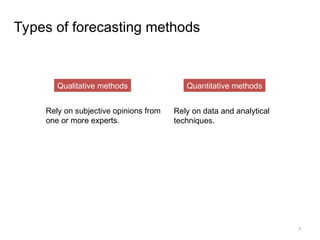
Types of forecasting methods
Rely on data and analytical
techniques.
Rely on subjective opinions from
one or more experts.
Qualitative methods Quantitative methods
7
8
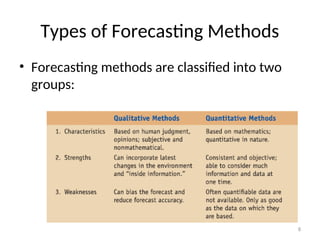
Types of Forecasting Methods
• Forecasting methods are classified into two
groups:
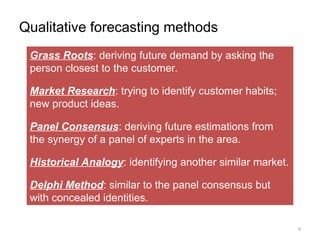
Qualitative forecasting methods
Grass Roots: deriving future demand by asking the
person closest to the customer.
Market Research: trying to identify customer habits;
new product ideas.
Panel Consensus: deriving future estimations from
the synergy of a panel of experts in the area.
Historical Analogy: identifying another similar market.
Delphi Method: similar to the panel consensus but
with concealed identities.
9
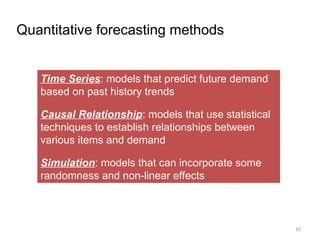
Quantitative forecasting methods
Time Series: models that predict future demand
based on past history trends
Causal Relationship: models that use statistical
techniques to establish relationships between
various items and demand
Simulation: models that can incorporate some
randomness and non-linear effects
10
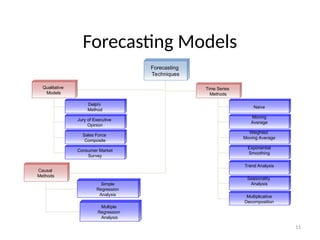
Forecasting Models
Forecasting
Techniques
Qualitative
Models
Time Series
Methods
Causal
Methods
Delphi
Method
Jury of Executive
Opinion
Sales Force
Composite
Consumer Market
Survey
Naive
Moving
Average
Weighted
Moving Average
Exponential
Smoothing
Trend Analysis
Seasonality
Analysis
Simple
Regression
Analysis
Multiple
Regression
Analysis
Multiplicative
Decomposition
11
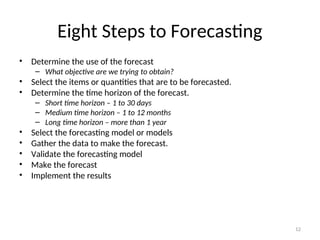
Eight Steps to Forecasting
• Determine the use of the forecast
– What objective are we trying to obtain?
• Select the items or quantities that are to be forecasted.
• Determine the time horizon of the forecast.
– Short time horizon – 1 to 30 days
– Medium time horizon – 1 to 12 months
– Long time horizon – more than 1 year
• Select the forecasting model or models
• Gather the data to make the forecast.
• Validate the forecasting model
• Make the forecast
• Implement the results
12
11-13
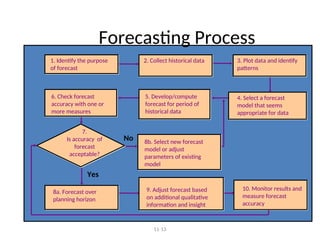
Forecasting Process
6. Check forecast
accuracy with one or
more measures
4. Select a forecast
model that seems
appropriate for data
5. Develop/compute
forecast for period of
historical data
8a. Forecast over
planning horizon
9. Adjust forecast based
on additional qualitative
information and insight
10. Monitor results and
measure forecast
accuracy
8b. Select new forecast
model or adjust
parameters of existing
model
7.
Is accuracy of
forecast
acceptable?
1. Identify the purpose
of forecast
3. Plot data and identify
patterns
2. Collect historical data
No
Yes
PPC_Lec_3 Forecasting on how we do it.ppt

  • 1.
  • 2.
    What is forecasting? Forecastingis a tool used for predicting future demand based on past demand information. Why is forecasting important? Demand for products and services is usually uncertain. Forecasting can be used for… • Strategic planning (long range planning) • Finance and accounting (budgets and cost controls) • Marketing (future sales, new products) • Production and operations 2
  • 3.
    Some general characteristicsof forecasts • Forecasts are always wrong • Forecasts are more accurate for groups or families of items • Forecasts are more accurate for shorter time periods • Every forecast should include an error estimate • Forecasts are no substitute for calculated demand. 3
  • 4.
    4 Principles of Forecasting Manytypes of forecasting models that differ in complexity and amount of data & way they generate forecasts: 1. Forecasts are rarely perfect 2. Forecasts are more accurate for grouped data than for individual items 3. Forecast are more accurate for shorter than longer time periods
  • 5.
    Applications of Forecasting •Marketing: Reliable forecasts of market size, market characteristics, market share, trends in prices, new product development and promotion, e-business strategies, global competition strategies and so on. • Finance and Accounting: Projection of cash flows and the rates of various expenses and revenues, new capital acquisitions, new product/process cost estimates, cash management, timing and amount of funding or borrowing needs and so on. • Operations: Scheduling, capacity planning, work assignments and workloads, inventory planning, make-or-buy decisions, outsourcing, project management. • Personnel: Forecasting of number of workers; turn- over in each category, etc. • Human resources: Hiring activities, including recruitment, interviewing, and training, layoff planning, including outplacement counseling.
  • 6.
    Types of salesforecasting Two types of sales forecasting • 1. Forecasting for new product: – Direct survey method – Indirect survey method – Comparing with established product – Limited market trial • 2. Forecasting for establish product: – Projection method – Related information method – Market research – Jury of executive opinion method – Sales force composite method
  • 7.
    Types of forecastingmethods Rely on data and analytical techniques. Rely on subjective opinions from one or more experts. Qualitative methods Quantitative methods 7
  • 8.
    8 Types of ForecastingMethods • Forecasting methods are classified into two groups:
  • 9.
    Qualitative forecasting methods GrassRoots: deriving future demand by asking the person closest to the customer. Market Research: trying to identify customer habits; new product ideas. Panel Consensus: deriving future estimations from the synergy of a panel of experts in the area. Historical Analogy: identifying another similar market. Delphi Method: similar to the panel consensus but with concealed identities. 9
  • 10.
    Quantitative forecasting methods TimeSeries: models that predict future demand based on past history trends Causal Relationship: models that use statistical techniques to establish relationships between various items and demand Simulation: models that can incorporate some randomness and non-linear effects 10
  • 11.
    Forecasting Models Forecasting Techniques Qualitative Models Time Series Methods Causal Methods Delphi Method Juryof Executive Opinion Sales Force Composite Consumer Market Survey Naive Moving Average Weighted Moving Average Exponential Smoothing Trend Analysis Seasonality Analysis Simple Regression Analysis Multiple Regression Analysis Multiplicative Decomposition 11
  • 12.
    Eight Steps toForecasting • Determine the use of the forecast – What objective are we trying to obtain? • Select the items or quantities that are to be forecasted. • Determine the time horizon of the forecast. – Short time horizon – 1 to 30 days – Medium time horizon – 1 to 12 months – Long time horizon – more than 1 year • Select the forecasting model or models • Gather the data to make the forecast. • Validate the forecasting model • Make the forecast • Implement the results 12
  • 13.
    11-13 Forecasting Process 6. Checkforecast accuracy with one or more measures 4. Select a forecast model that seems appropriate for data 5. Develop/compute forecast for period of historical data 8a. Forecast over planning horizon 9. Adjust forecast based on additional qualitative information and insight 10. Monitor results and measure forecast accuracy 8b. Select new forecast model or adjust parameters of existing model 7. Is accuracy of forecast acceptable? 1. Identify the purpose of forecast 3. Plot data and identify patterns 2. Collect historical data No Yes