Business forecasting 9th,intern. Edition Hanke
pdf download
https://ebookmass.com/product/business-forecasting-9th-intern-
edition-hanke/
Explore and download more ebooks at ebookmass.com
2.
Here are somerecommended products for you. Click the link to
download, or explore more at ebookmass.com
Business Forecasting Michael Gilliland
https://ebookmass.com/product/business-forecasting-michael-gilliland/
The Intern Michele Campbell
https://ebookmass.com/product/the-intern-michele-campbell/
Business Communication: Process & Product 9th edition
Edition Mary Ellen Guffey
https://ebookmass.com/product/business-communication-process-
product-9th-edition-edition-mary-ellen-guffey/
Economics for Business 9th Edition John Sloman
https://ebookmass.com/product/economics-for-business-9th-edition-john-
sloman/
3.
Crescent Hill -Im Schatten des Mondes Annika Hanke
https://ebookmass.com/product/crescent-hill-im-schatten-des-mondes-
annika-hanke/
(eBook PDF) Employment Law for Business 9th Edition
https://ebookmass.com/product/ebook-pdf-employment-law-for-
business-9th-edition/
eTextbook 978-9814738255 Global Business Today 9th Edition
https://ebookmass.com/product/etextbook-978-9814738255-global-
business-today-9th-edition/
Managerial Economics & Business Strategy 9th Edition Jeff
Prince
https://ebookmass.com/product/managerial-economics-business-
strategy-9th-edition-jeff-prince/
eTextbook 978-1305957961 Business Communication: Process &
Product 9th Edition
https://ebookmass.com/product/etextbook-978-1305957961-business-
communication-process-product-9th-edition/
Table of Contents
PE A R S O N C U S T O M L I B R A R Y
I
1. Introduction to Forecasting
1
John E. Hanke/Dean Wichern
2. Exploring Data Patterns and an Introduction to Forecasting Techniques
15
John E. Hanke/Dean Wichern
3. Moving Averages and Smoothing Methods
61
John E. Hanke/Dean Wichern
4. Time Series and Their Components
119
John E. Hanke/Dean Wichern
5. Simple Linear Regression
175
John E. Hanke/Dean Wichern
6. Multiple Regression Analysis
235
John E. Hanke/Dean Wichern
7. Regression with Time Series Data
295
John E. Hanke/Dean Wichern
8. The Box-Jenkins (ARIMA) Methodology
355
John E. Hanke/Dean Wichern
9. Judgmental Forecasting and Forecast Adjustments
437
John E. Hanke/Dean Wichern
10. Managing the Forecasting Process
459
John E. Hanke/Dean Wichern
Appendix: Tables
477
John E. Hanke/Dean Wichern
Appendix: Data Sets and Databases
487
John E. Hanke/Dean Wichern
501
Index
Introduction to Forecasting
1Arecent review of the current state of forecasting is available in a special issue of the International Journal
of Forecasting, edited by R. J. Hyndman and J. K. Ord (2006).
New forecasting procedures continue to be developed as the need for accurate
forecasts accelerates.1 Particular attention is being paid to the forecasting process
in organizations with the need to coordinate objectives, methods, assessment, and
interpretation.
IS FORECASTING NECESSARY?
In spite of the inherent inaccuracies in trying to predict the future, forecasts necessar-
ily drive policy setting and planning. How can the Federal Reserve Board realistically
adjust interest rates without some notion of future economic growth and inflationary
pressures? How can an operations manager realistically set production schedules with-
out some estimate of future sales? How can a company determine staffing for its call
centers without some guess of the future demand for service? How can a bank make
realistic plans without some forecast of future deposits and loan balances? Everyone
requires forecasts. The need for forecasts cuts across all functional lines as well as all
types of organizations. Forecasts are absolutely necessary to move forward in today’s
ever-changing and highly interactive business environment.
This text discusses various ways of generating forecasts that rely on logical meth-
ods of manipulating data that have been generated by historical events. But it is our
belief that the most effective forecaster is able to formulate a skillful mix of quantita-
tive forecasting and good judgment and to avoid the extremes of total reliance on
either.At one extreme, we find the executive who, through ignorance and fear of quan-
titative techniques and computers, relies solely on intuition and feel. At the other
extreme is the forecaster skilled in the latest sophisticated data manipulation tech-
niques but unable or unwilling to relate the forecasting process to the needs of the
organization and its decision makers. We view the quantitative forecasting techniques
discussed in most of this text to be only the starting point in the effective forecasting of
outcomes important to the organization: Analysis, judgment, common sense, and busi-
ness experience must be brought to bear on the process through which these important
techniques have generated their results.
Another passage from Bernstein (1996) effectively summarizes the role of fore-
casting in organizations.
You do not plan to ship goods across the ocean, or to assemble merchandise
for sale, or to borrow money without first trying to determine what the future
may hold in store. Ensuring that the materials you order are delivered on time,
seeing to it that the items you plan to sell are produced on schedule, and get-
ting your sales facilities in place all must be planned before that moment when
the customers show up and lay their money on the counter. The successful
business executive is a forecaster first; purchasing, producing, marketing, pric-
ing, and organizing all follow.
TYPES OF FORECASTS
When managers are faced with the need to make decisions in an atmosphere of uncer-
tainty, what types of forecasts are available to them? Forecasting procedures might
first be classified as long term or short term. Long-term forecasts are necessary to set
2
12.
Introduction to Forecasting
thegeneral course of an organization for the long run; thus, they become the particular
focus of top management. Short-term forecasts are needed to design immediate strate-
gies and are used by middle and first-line management to meet the needs of the imme-
diate future.
Forecasts might also be classified in terms of their position on a micro–macro
continuum, that is, in terms of the extent to which they involve small details versus
large summary values. For example, a plant manager might be interested in forecasting
the number of workers needed for the next several months (a micro forecast), whereas
the federal government is forecasting the total number of people employed in the
entire country (a macro forecast). Again, different levels of management in an organi-
zation tend to focus on different levels of the micro–macro continuum. Top manage-
ment would be interested in forecasting the sales of the entire company, for example,
whereas individual salespersons would be much more interested in forecasting their
own sales volumes.
Forecasting procedures can also be classified according to whether they tend to be
more quantitative or qualitative. At one extreme, a purely qualitative technique is one
requiring no overt manipulation of data. Only the “judgment” of the forecaster is used.
Even here, of course, the forecaster’s “judgment” may actually be the result of the men-
tal manipulation of historical data.At the other extreme, purely quantitative techniques
need no input of judgment; they are mechanical procedures that produce quantitative
results. Some quantitative procedures require a much more sophisticated manipulation
of data than do others, of course.This text emphasizes the quantitative forecasting tech-
niques because a broader understanding of these very useful procedures is needed in
the effective management of modern organizations. However, we emphasize again that
judgment and common sense must be used along with mechanical and data-manipula-
tive procedures. Only in this way can intelligent forecasting take place.
Finally, forecasts might be classified according to the nature of the output. One
must decide if the forecast will be a single number best guess (a point forecast), a range
of numbers within which the future value is expected to fall (an interval forecast), or an
entire probability distribution for the future value (a density forecast). Since unpre-
dictable “shocks” will affect future values (the future is never exactly like the past),
nonzero forecast errors will occur even from very good forecasts. Thus, there is some
uncertainty associated with a particular point forecast. The uncertainty surrounding
point forecasts suggests the usefulness of an interval forecast. However, if forecasts
are solely the result of judgment, point forecasts are typically the only recourse. In
judgmental situations, it is extremely difficult to accurately describe the uncertainty
associated with the forecast.
MACROECONOMIC FORECASTING CONSIDERATIONS
We usually think of forecasting in terms of predicting important variables for an indi-
vidual company or perhaps for one component of a company. Monthly company sales,
unit sales for one of a company’s stores, and absent hours per employee per month in a
factory are examples.
By contrast, there is growing interest in forecasting important variables for the
entire economy of a country. Much work has been done in evaluating methods for
doing this kind of overall economic forecasting, called macroeconomic forecasting.
Examples of interest to the federal government of the United States are the unemploy-
ment rate, gross domestic product, and prime interest rate. Economic policy is based, in
part, on projections of important economic indicators such as these. For this reason,
3
13.
Introduction to Forecasting
thereis great interest in improving forecasting methods that focus on overall measures
of a country’s economic performance.
One of the chief difficulties in developing accurate forecasts of overall economic
activity is the unexpected and significant shift in a key economic factor. Significant
changes in oil prices, inflation surges, and broad policy changes by a country’s govern-
ment are examples of shifts in a key factor that can affect the global economy.
The possibility of such significant shifts in the economic scene has raised a key
question in macroeconomic forecasting: Should the forecasts generated by the fore-
casting model be modified using the forecaster’s judgment? Current work on forecast-
ing methodology often involves this question.
Theoretical and practical work on macroeconomic forecasting continues.
Considering the importance of accurate economic forecasting to economic policy for-
mulation in this country and others, increased attention to this kind of forecasting can
be expected in the future.A good introductory reference for macroeconomic forecast-
ing is Pindyck and Rubinfeld (1998).
CHOOSING A FORECASTING METHOD
The preceding discussion suggests several factors to be considered in choosing a fore-
casting method.The level of detail must be considered.Are forecasts of specific details
needed (a micro forecast)? Or is the future status of some overall or summary factor
needed (a macro forecast)? Is the forecast needed for some point in the near future
(a short-term forecast) or for a point in the distant future (a long-term forecast)? To
what extent are qualitative (judgment) and quantitative (data-manipulative) methods
appropriate? And, finally, what form should the forecast take (point, interval, or den-
sity forecast)?
The overriding consideration in choosing a forecasting method is that the results
must facilitate the decision-making process of the organization’s managers. Rarely
does one method work for all cases. Different products (for example, new versus estab-
lished), goals (for example, simple prediction versus the need to control an important
business driver of future values), and constraints (for example, cost, required expertise,
and immediacy) must be considered when selecting a forecasting method. With the
availability of current forecasting software, it is best to think of forecasting methods as
generic tools that can be applied simultaneously. Several methods can be tried in a
given situation. The methodology producing the most accurate forecasts in one case
may not be the best methodology in another situation. However, the method(s) chosen
should produce a forecast that is accurate, timely, and understood by management so
that the forecast can help produce better decisions.
The additional discussion available in Chase (1997) can help the forecaster select
an initial set of forecasting procedures to be considered.
FORECASTING STEPS
All formal forecasting procedures involve extending the experiences of the past
into the future. Thus, they involve the assumption that the conditions that gener-
ated past relationships and data are indistinguishable from the conditions of the
future.
A human resource department is hiring employees, in part, on the basis of a com-
pany entrance examination score because, in the past, that score seemed to be an impor-
tant predictor of job performance rating. To the extent that this relation continues to
4
14.
Introduction to Forecasting
hold,forecasts of future job performance—hence hiring decisions—can be improved by
using examination scores. If, for some reason, the association between examination
score and job performance changes, then forecasting job performance ratings from
examination scores using the historical model will yield inaccurate forecasts and poten-
tially poor hiring decisions. This is what makes forecasting difficult. The future is not
always like the past. To the extent it is, quantitative forecasting methods work well. To
the extent it isn’t, inaccurate forecasts can result. However, it is generally better to have
some reasonably constructed forecast than no forecast.
The recognition that forecasting techniques operate on the data generated by histor-
ical events leads to the identification of the following five steps in the forecasting process:
1. Problem formulation and data collection
2. Data manipulation and cleaning
3. Model building and evaluation
4. Model implementation (the actual forecast)
5. Forecast evaluation
In step 1, problem formulation and data collection are treated as a single step
because they are intimately related.The problem determines the appropriate data. If a
quantitative forecasting methodology is being considered, the relevant data must be
available and correct. Often accessing and assembling appropriate data is a challenging
and time-consuming task. If appropriate data are not available, the problem may have
to be redefined or a nonquantitative forecasting methodology employed. Collection
and quality control problems frequently arise whenever it becomes necessary to obtain
pertinent data for a business forecasting effort.
Step 2, data manipulation and cleaning, is often necessary. It is possible to have too
much data as well as too little in the forecasting process. Some data may not be rele-
vant to the problem. Some data may have missing values that must be estimated. Some
data may have to be reexpressed in units other than the original units. Some data may
have to be preprocessed (for example, accumulated from several sources and
summed). Other data may be appropriate but only in certain historical periods (for
example, in forecasting the sales of small cars, one may wish to use only car sales data
since the oil embargo of the 1970s rather than sales data over the past 60 years).
Ordinarily, some effort is required to get data into the form that is required for using
certain forecasting procedures.
Step 3, model building and evaluation, involves fitting the collected data into a
forecasting model that is appropriate in terms of minimizing forecasting error.The sim-
pler the model is, the better it is in terms of gaining acceptance of the forecasting
process by managers who must make the firm’s decisions. Often a balance must be
struck between a sophisticated forecasting approach that offers slightly more accuracy
and a simple approach that is easily understood and gains the support of—and is
actively used by—the company’s decision makers. Obviously, judgment is involved in
this selection process. Since this text discusses numerous forecasting models and their
applicability, the reader’s ability to exercise good judgment in the choice and use of
appropriate forecasting models will increase after studying this material.
Step 4, model implementation, is the generation of the actual model forecasts once
the appropriate data have been collected and cleaned and an appropriate forecasting
model has been chosen. Data for recent historical periods are often held back and later
used to check the accuracy of the process.
Step 5, forecast evaluation, involves comparing forecast values with actual his-
torical values. After implementation of the forecasting model is complete, forecasts
5
15.
Visit https://ebookmass.com todayto explore
a vast collection of ebooks across various
genres, available in popular formats like
PDF, EPUB, and MOBI, fully compatible with
all devices. Enjoy a seamless reading
experience and effortlessly download high-
quality materials in just a few simple steps.
Plus, don’t miss out on exciting offers that
let you access a wealth of knowledge at the
best prices!
16.
Introduction to Forecasting
aremade for the most recent historical periods where data values were known but
held back from the data set being analyzed. These forecasts are then compared with
the known historical values, and any forecasting errors are analyzed. Some forecast-
ing procedures sum the absolute values of the errors and may report this sum, or
they divide this sum by the number of forecast attempts to produce the average
forecast error. Other procedures produce the sum of squared errors, which is then
compared with similar figures from alternative forecasting methods. Some proce-
dures also track and report the magnitude of the error terms over the forecasting
period. Examination of error patterns often leads the analyst to modify the
forecasting model.
MANAGING THE FORECASTING PROCESS
The discussion in this chapter serves to underline our belief that management ability
and common sense must be involved in the forecasting process. The forecaster should
be thought of as an advisor to the manager rather than as a monitor of an automatic
decision-making device. Unfortunately, the latter is sometimes the case in practice,
especially with the aura of the computer. Again, quantitative forecasting techniques
must be seen as what they really are, namely, tools to be used by the manager in arriv-
ing at better decisions.According to Makridakis (1986):
The usefulness and utility of forecasting can be improved if management
adopts a more realistic attitude. Forecasting should not be viewed as a substi-
tute for prophecy but rather as the best way of identifying and extrapolating
established patterns or relationships in order to forecast. If such an attitude is
accepted, forecasting errors must be considered inevitable and the circum-
stances that cause them investigated.
Given that, several key questions should always be raised if the forecasting process is
to be properly managed:
• Why is a forecast needed?
• Who will use the forecast, and what are their specific requirements?
• What level of detail or aggregation is required, and what is the proper time horizon?
• What data are available, and will the data be sufficient to generate the needed
forecast?
• What will the forecast cost?
• How accurate can we expect the forecast to be?
• Will the forecast be made in time to help the decision-making process?
• Does the forecaster clearly understand how the forecast will be used in the
organization?
• Is a feedback process available to evaluate the forecast after it is made and to
adjust the forecasting process accordingly?
FORECASTING SOFTWARE
Today, there are a large number of computer software packages specifically designed
to provide the user with various forecasting methods.Two types of computer packages
are of primary interest to forecasters: (1) general statistical packages that include
regression analysis, time series analysis, and other techniques used frequently by
6
17.
Introduction to Forecasting
2Atthe time this text was written, the Institute for Forecasting Education provided reviews of
forecasting software on its website. These reviews can be accessed at www.forecastingeducation.com/
forecastingsoftwarereviews.asp.
forecasters and (2) forecasting packages that are specifically designed for forecasting
applications. In addition, some forecasting tools are available in Enterprise Resource
Planning (ERP) systems.
Graphical capabilities, interfaces to spreadsheets and external data sources, numeri-
cally and statistically reliable methods, and simple automatic algorithms for the selection
and specification of forecasting models are now common features of business forecasting
software. However, although development and awareness of forecasting software have
increased dramatically in recent years, the majority of companies still use spreadsheets
(perhaps with add-ins) to generate forecasts and develop business plans.
Examples of stand-alone software packages with forecasting tools include
Minitab, SAS, and SPSS. There are many add-ins or supplemental programs that pro-
vide forecasting tools in a spreadsheet environment. For example, the Analysis
ToolPak add-in for Microsoft Excel provides some regression analysis and smoothing
capabilities. There are currently several more comprehensive add-ins that provide a
(almost) full range of forecasting capabilities.2
It is sometimes the case, particularly in a spreadsheet setting, that “automatic”
forecasting is available. That is, the software selects the best model or procedure for
forecasting and immediately generates forecasts. We caution, however, that this con-
venience comes at a price. Automatic procedures produce numbers but rarely provide
the forecaster with real insight into the nature and quality of the forecasts.The genera-
tion of meaningful forecasts requires human intervention, a give and take between
problem knowledge and forecasting procedures (software).
Many of the techniques in this text will be illustrated with Minitab 15 and
Microsoft Excel 2003 (with the Analysis ToolPak add-in). Minitab 15 was chosen for its
ease of use and widespread availability. Excel, although limited in its forecasting func-
tionality, is frequently the tool of choice for calculating projections.
ONLINE INFORMATION
Information of interest to forecasters is available on the World Wide Web. Perhaps the
best way to learn about what’s available in cyberspace is to spend some time searching for
whatever interests you, using a browser such as Netscape or Microsoft Internet Explorer.
Any list of websites for forecasters is likely to be outdated by the time this text
appears; however, there are two websites that are likely to remain available for some
time. B&E DataLinks, available at www.econ-datalinks.org, is a website maintained
by the Business and Economic Statistics Section of the American Statistical Association.
This website contains extensive links to economic and financial data sources of interest
to forecasters. The second site, Resources for Economists on the Internet, sponsored
by theAmerican EconomicAssociation and available at rfe.org,contains an extensive set
of links to data sources, journals, professional organizations, and so forth.
FORECASTING EXAMPLES
Discussions in this chapter emphasize that forecasting requires a great deal of judg-
ment along with the mathematical manipulation of collected data.The following exam-
ples demonstrate the kind of thinking that often precedes a forecasting effort in a real
7
18.
Introduction to Forecasting
firm.Notice that the data values that will produce useful forecasts, even if they exist,
may not be apparent at the beginning of the process and may or may not be identified
as the process evolves. In other words, the initial efforts may turn out to be useless and
another approach required.
The results of the forecasting efforts for the two examples discussed here are not
shown, as they require topics that are described throughout the text. Look for the tech-
niques to be applied to these data. For the moment, we hope these examples illustrate
the forecasting effort that real managers face.
Example 1 Alomega Food Stores
Alomega Food Stores is a retail food provider with 27 stores in a midwestern state. The
company engages in various kinds of advertising and, until recently, had never studied the
effect its advertising dollars have on sales, although some data had been collected and
stored for 3 years.
The executives at Alomega decided to begin tracking their advertising efforts along
with the sales volumes for each month. Their hope was that after several months the col-
lected data could be examined to possibly reveal relationships that would help in determin-
ing future advertising expenditures.
The accounting department began extending its historical records by recording the
sales volume for each month along with the advertising dollars for both newspaper ads and
TV spots.They also recorded both sales and advertising values that had been lagged for one
and two months. This was done because some people on the executive committee thought
that sales might depend on advertising expenditures in previous months rather than in the
month the sales occurred.
The executives also believed that sales experienced a seasonal effect. For this reason, a
dummy or categorical variable was used to indicate each month. In addition, they wondered
about any trend in sales volume.
Finally, the executives believed that Alomega’s advertising dollars might have an effect
on its major competitors’ advertising budgets the following month. For each following
month, it was decided that competitors’ advertising could be classified as a (1) small amount,
(2) a moderate amount, or (3) a large amount.
After a few months of collecting data and analyzing past records, the accounting
department completed a data array for 48 months using the following variables:
• Sales dollars
• Newspaper advertising dollars
• TV advertising dollars
• Month code where January ⫽ 1, February ⫽ 2, through December ⫽ 12
• A series of 11 dummy variables to indicate month
• Newspaper advertising lagged one month
• Newspaper advertising lagged two months
• TV advertising lagged one month
• TV advertising lagged two months
• Month number from 1 to 48
• Code 1, 2, or 3 to indicate competitors’ advertising efforts the following month
Alomega managers, especially Julie Ruth, the company president, now want to learn
anything they can from the data they have collected. In addition to learning about
the effects of advertising on sales volumes and competitors’ advertising, Julie wonders
about any trend and the effect of season on sales. However, the company’s production
manager, Jackson Tilson, does not share her enthusiasm. At the end of the forecasting
planning meeting, he makes the following statement: “I’ve been trying to keep my
mouth shut during this meeting, but this is really too much. I think we’re wasting a lot of
people’s time with all this data collection and fooling around with computers. All you have
to do is talk with our people on the floor and with the grocery store managers to understand
what’s going on. I’ve seen this happen around here before, and here we go again. Some
of you people need to turn off your computers, get out of your fancy offices, and talk with a
few real people.”
8
19.
Introduction to Forecasting
Example1.2 Large Web-based Retailer
One of the goals of a large Internet-based retailer is to be the world’s most consumer-
centric company. The company recognizes that the ability to establish and maintain long-
term relationships with customers and to encourage repeat visits and purchases depends, in
part, on the strength of its customer service operations. For service matters that cannot be
handled using website features, customer service representatives located in contact centers
are available 24 hours a day to field voice calls and emails.
Because of its growing sales and its seasonality (service volume is relatively low in the
summer and high near the end of the year), a challenge for the company is to appropriately
staff its contact centers. The planning problem involves making decisions about hiring and
training at internally managed centers and about allocating work to outsourcers based on
the volume of voice calls and emails.The handling of each contact type must meet a targeted
service level every week.
To make the problem even more difficult, the handling time for each voice call and
email is affected by a number of contact attributes, including type of product, customer, and
purchase type. These attributes are used to classify the contacts into categories: in this case,
one “primary” category and seven “specialty” categories. Specific skill sets are needed to
resolve the different kinds of issues that arise in the various categories. Since hiring and
training require a 6-week lead time, forecasts of service contacts are necessary in order to
have the required number of service representatives available 24 hours a day, 7 days a week
throughout the year.
Pat Niebuhr and his team are responsible for developing a global staffing plan for the
contact centers. His initial challenge is to forecast contacts for the primary and specialty cat-
egories. Pat must work with monthly forecasts of total orders (which, in turn, are derived
from monthly revenue forecasts) and contacts per order (CPO) numbers supplied by the
finance department. Pat recognizes that contacts are given by
Contacts ⫽ Orders ⫻ CPO
For staff planning purposes, Pat must have forecasts of contacts on a weekly basis.
Fortunately, there is a history of actual orders, actual contacts, actual contacts per order, and
other relevant information, in some cases, recorded by day of the week. This history is
organized in a spreadsheet. Pat is considering using this historical information to develop
the forecasts he needs.
Summary
The purpose of a forecast is to reduce the range of uncertainty within which manage-
ment judgments must be made. This purpose suggests two primary rules to which the
forecasting process must adhere:
1. The forecast must be technically correct and produce forecasts accurate enough to
meet the firm’s needs.
2. The forecasting procedure and its results must be effectively presented to manage-
ment so that the forecasts are used in the decision-making process to the firm’s
advantage; results must also be justified on a cost-benefit basis.
Forecasters often pay particular attention to the first rule and expend less effort on the
second. Yet if well-prepared and cost-effective forecasts are to benefit the firm, those
who have the decision-making authority must use them. This raises the question of
what might be called the “politics” of forecasting. Substantial and sometimes major
expenditures and resource allocations within a firm often rest on management’s view
of the course of future events. Because the movement of resources and power within
an organization is often based on the perceived direction of the future (forecasts), it is
not surprising to find a certain amount of political intrigue surrounding the forecasting
process. The need to be able to effectively sell forecasts to management is at least as
important as the need to be able to develop the forecasts.
9
20.
Introduction to Forecasting
Theremainder of this text discusses various forecasting models and procedures.
First, we review basic statistical concepts and provide an introduction to correlation
and regression analysis.
CASES
CASE 1 MR. TUX
John Mosby owns several Mr. Tux rental stores, most
of them in the Spokane, Washington, area.3 His
Spokane store also makes tuxedo shirts, which he dis-
tributes to rental shops across the country. Because
rental activity varies from season to season due to
proms, reunions, and other activities, John knows that
his business is seasonal.He would like to measure this
seasonal effect, both to assist him in managing his
business and to use in negotiating a loan repayment
with his banker.
Of even greater interest to John is finding a way
of forecasting his monthly sales. His business contin-
ues to grow, which, in turn, requires more capital and
3We are indebted to John Mosby, the owner of Mr.Tux rental stores, for his help in preparing this case.
4We are indebted to Marv Harnishfeger, executive director of Consumer Credit Counseling of Spokane, and
Dorothy Mercer, president of its board of directors, for their help in preparing the case. Dorothy is a former
M.B.A. student of JH who has consistently kept us in touch with the use of quantitative methods in the real
world of business.
long-term debt. He has sources for both types of
growth financing, but investors and bankers are
interested in a concrete way of forecasting future
sales. Although they trust John, his word that the
future of his business “looks great” leaves them
uneasy.
As a first step in building a forecasting model,
John directs one of his employees, McKennah Lane,
to collect monthly sales data for the past several
years. Various techniques are used to forecast these
sales data for Mr. Tux and John Mosby attempts to
choose the forecasting technique that will best meet
his needs.
CASE 2 CONSUMER CREDIT
COUNSELING
Consumer Credit Counseling (CCC), a private, non-
profit corporation, was founded in 1982.4 The pur-
pose of CCC is to provide consumers with assistance
in planning and following budgets, with assistance in
making arrangements with creditors to repay delin-
quent obligations, and with money management
education.
Private financial counseling is provided at no
cost to families and individuals who are experiencing
financial difficulties or who want to improve their
money management skills. Money management
educational programs are provided for schools, com-
munity groups, and businesses. A debt management
program is offered as an alternative to bankruptcy.
Through this program, CCC negotiates with credi-
tors on behalf of the client for special payment
arrangements. The client makes a lump-sum pay-
ment to CCC that is then disbursed to creditors.
10
21.
Introduction to Forecasting
MinitabApplications
Minitab is a sophisticated statistical program that improves with each release.
Described here is Release 15.
Figure 1 shows you four important aspects of Minitab. The menu bar is where you
choose commands. For instance, click on Stat and a pull-down menu appears that con-
tains all of the statistical techniques available. The toolbar displays buttons for com-
monly used functions. Note that these buttons change depending on which Minitab
window is open. There are two separate windows on the Minitab screen: the data win-
dow, where you enter, edit, and view the column data for each worksheet; and the ses-
sion window, which displays text output, such as tables of statistics.
Specific instructions will be given to enable you to enter data into the Minitab
spreadsheet and to activate forecasting procedures to produce needed forecasts.
CCC has a blend of paid and volunteer staff; in
fact, volunteers outnumber paid staff three to one.
Seven paid staff provide management, clerical sup-
port, and about half of the counseling needs for
CCC. Twenty-one volunteer counselors fulfill the
other half of the counseling needs of the service.
CCC depends primarily on corporate funding to
support operations and services. The Fair Share
Funding Program allows creditors who receive pay-
ments from client debt management programs to
donate back to the service a portion of the funds
returned to them through these programs.
A major portion of corporate support comes
from a local utility that provides funding to support
a full-time counselor position as well as office space
for counseling at all offices.
In addition, client fees are a source of funding.
Clients who participate in debt management pay a
monthly fee of $15 to help cover the administrative
cost of this program. (Fees are reduced or waived
for clients who are unable to afford them.)
This background will be used as CCC faces diffi-
cult problems related to forecasting important
variables.
Menu bar
Toolbar
Session
window
Data
window
FIGURE 1 Basic Minitab Screen
11
22.
Introduction to Forecasting
Menubar
Toolbar
Formula
bar
Worksheet
FIGURE 2 Basic Excel Screen
Excel Applications
Excel is a popular spreadsheet program that is frequently used for forecasting. Figure 2
shows the opening screen of Version 2003. Data are entered in the rows and columns of
the spreadsheet, and then commands are issued to perform various operations on the
entered data.
For example, annual salaries for a number of employees could be entered into col-
umn A and the average of these values calculated by Excel. As another example,
employee ages could be placed in column B and the relationship between age and
salary examined.
There are several statistical functions available on Excel that may not be on the
drop-down menus on your screen.To activate these functions, click on the following:
Tools>Add-Ins
The Add-Ins dialog box appears. Select Analysis ToolPak and click on OK.
It is strongly recommended that an Excel add-in be used to help with the multi-
tude of statistical computations required by the forecasting techniques discussed in
this text.
References
Bernstein, P. L. Against the Gods:The Remarkable
Story of Risk. New York:Wiley, 1996.
Carlberg, C.“Use Excel’s Forecasting to Get
Terrific Projections.” Denver Business Journal 47
(18) (1996): 2B.
Chase, C.W., Jr.“Selecting the Appropriate
Forecasting Method.” Journal of Business
Forecasting 15 (Fall 1997): 2.
Diebold, F. X. Elements of Forecasting, 3rd ed.
Cincinnati, Ohio: South-Western, 2004.
12
23.
Introduction to Forecasting
Georgoff,D. M., and R. G. Mardick.“Manager’s
Guide to Forecasting.” Harvard Business Review
1 (1986): 110–120.
Hogarth, R. M., and S. Makridakis.“Forecasting and
Planning:An Evaluation.” Management Science
27 (2) (1981): 115–138.
Hyndman, R. J., and J. K. Ord, eds.“Special Issue:
Twenty Five Years of Forecasting.” International
Journal of Forecasting 22 (2006): 413–636.
Levenbach, H., and J. P. Cleary. Forecasting Practice
and Process for Demand Management. Belmont,
Calif.:Thomson Brooks/Cole, 2006.
Makridakis, S.“The Art and Science of Forecasting.”
International Journal of Forecasting 2 (1986): 15–39.
Newbold, P., and T. Bos. Introductory Business and
Economic Forecasting, 2nd ed. Cincinnati, Ohio:
South-Western, 1994.
Ord, J. K., and S. Lowe.“Automatic Forecasting.”
American Statistician 50 (1996): 88–94.
Perry, S.“Applied Business Forecasting.”
Management Accounting 72 (3) (1994): 40.
Pindyck, R. S., and D. L. Rubinfeld. Econometric
Models and Economic Forecasts, 4th ed. New
York: McGraw-Hill, 1998.
Wright, G., and P.Ayton, eds. Judgemental
Forecasting. New York:Wiley, 1987.
13
Visit https://ebookmass.com todayto explore
a vast collection of ebooks across various
genres, available in popular formats like
PDF, EPUB, and MOBI, fully compatible with
all devices. Enjoy a seamless reading
experience and effortlessly download high-
quality materials in just a few simple steps.
Plus, don’t miss out on exciting offers that
let you access a wealth of knowledge at the
best prices!
of fruits; openedeager mouths that drank in the heat and light
pouring in a cascade from the newly-risen sun.
Every moment more of these seed coats ruptured, and even as they
did so the swelling pioneers overflowed their rent-distended seed-
cases, and passed into the second stage of growth. With a steady
assurance, a swift deliberation, these amazing seeds thrust a rootlet
downward to the earth and a queer little bundle-like bud into the air.
In a little while the whole slope was dotted with minute plantlets
standing at attention in the blaze of the sun.
They did not stand for long. The bundle-like buds swelled and
strained and opened with a jerk, thrusting out a coronet of little
sharp tips, spreading a whorl of tiny, spiky, brownish leaves, that
lengthened rapidly, lengthened visibly even as we watched. The
movement was slower than any animal’s, swifter than any plant’s I
have ever seen before. How can I suggest it to you—the way that
growth went on? The leaf tips grew so that they moved onward
even while we looked at them. The brown seed-case shrivelled and
was absorbed with an equal rapidity. Have you ever on a cold day
taken a thermometer into your warm hand and watched the little
thread of mercury creep up the tube? These moon plants grew like
that.
In a few minutes, as it seemed, the buds of the more forward of
these plants had lengthened into a stem and were even putting forth
a second whorl of leaves, and all the slope that had seemed so
recently a lifeless stretch of litter was now dark with the stunted
olive-green herbage of bristling spikes that swayed with the vigour
of their growing.
I turned about, and behold! along the upper edge of a rock to the
eastward a similar fringe in a scarcely less forward condition swayed
and bent, dark against the blinding glare of the sun. And beyond this
fringe was the silhouette of a plant mass, branching clumsily like a
cactus, and swelling visibly, swelling like a bladder that fills with air.
29.
Then to thewestward also I discovered that another such distended
form was rising over the scrub. But here the light fell upon its sleek
sides, and I could see that its colour was a vivid orange hue. It rose
as one watched it; if one looked away from it for a minute and then
back, its outline had changed; it thrust out blunt congested branches
until in a little time it rose a coralline shape of many feet in height.
Compared with such a growth the terrestrial puff-ball, which will
sometimes swell a foot in diameter in a single night, would be a
hopeless laggard. But then the puff-ball grows against a gravitational
pull six times that of the moon. Beyond, out of gullies and flats that
had been hidden from us, but not from the quickening sun, over
reefs and banks of shining rock, a bristling beard of spiky and fleshy
vegetation was straining into view, hurrying tumultuously to take
advantage of the brief day in which it must flower and fruit and seed
again and die. It was like a miracle, that growth. So, one must
imagine, the trees and plants arose at the Creation and covered the
desolation of the new-made earth.
Imagine it! Imagine that dawn! The resurrection of the frozen air,
the stirring and quickening of the soil, and then this silent uprising of
vegetation, this unearthly ascent of fleshiness and spikes. Conceive
it all lit by a blaze that would make the intensest sunlight of earth
seem watery and weak. And still around this stirring jungle,
wherever there was shadow, lingered banks of bluish snow. And to
have the picture of our impression complete, you must bear in mind
that we saw it all through a thick bent glass, distorting it as things
are distorted by a lens, acute only in the centre of the picture, and
very bright there, and towards the edges magnified and unreal.
31.
IX
PROSPECTING BEGINS
We ceasedto gaze. We turned to each other, the same thought, the
same question in our eyes. For these plants to grow, there must be
some air, however attenuated, air that we also should be able to
breathe.
“The manhole?” I said.
“Yes!” said Cavor, “if it is air we see!”
“In a little while,” I said, “these plants will be as high as we are.
Suppose—suppose after all—Is it certain? How do you know that
stuff is air? It may be nitrogen—it may be carbonic acid even!”
“That is easy,” he said, and set about proving it. He produced a big
piece of crumpled paper from the bale, lit it, and thrust it hastily
through the manhole valve. I bent forward and peered down
through the thick glass for its appearance outside, that little flame
on whose evidence depended so much!
I saw the paper drop out and lie lightly upon the snow. The pink
flame of its burning vanished. For an instant it seemed to be
extinguished. And then I saw a little blue tongue upon the edge of it
that trembled, and crept, and spread!
Quietly the whole sheet, save where it lay in immediate contact with
the snow, charred and shrivelled and sent up a quivering thread of
smoke. There was no doubt left to me; the atmosphere of the moon
was either pure oxygen or air, and capable therefore—unless its
tenuity was excessive—of supporting our alien life. We might emerge
—and live!
I sat down with my legs on either side of the manhole and prepared
to unscrew it, but Cavor stopped me. “There is first a little
32.
precaution,” he said.He pointed out that although it was certainly an
oxygenated atmosphere outside, it might still be so rarified as to
cause us grave injury. He reminded me of mountain sickness, and of
the bleeding that often afflicts aeronauts who have ascended too
swiftly, and he spent some time in the preparation of a sickly-tasting
drink which he insisted on my sharing. It made me feel a little numb,
but otherwise had no effect on me. Then he permitted me to begin
unscrewing.
Presently the glass stopper of the manhole was so far undone that
the denser air within our sphere began to escape along the thread of
the screw, singing as a kettle sings before it boils. Thereupon he
made me desist. It speedily became evident that the pressure
outside was very much less than it was within. How much less it was
we had no means of telling.
I sat grasping the stopper with both hands, ready to close it again if,
in spite of our intense hope, the lunar atmosphere should after all
prove too rarified for us, and Cavor sat with a cylinder of
compressed oxygen at hand to restore our pressure. We looked at
one another in silence, and then at the fantastic vegetation that
swayed and grew visibly and noiselessly without. And ever that shrill
piping continued.
My blood-vessels began to throb in my ears, and the sound of
Cavor’s movements diminished. I noted how still everything had
become, because of the thinning of the air.
As our air sizzled out from the screw the moisture of it condensed in
little puffs.
Presently I experienced a peculiar shortness of breath, that lasted
indeed during the whole of the time of our exposure to the moon’s
exterior atmosphere, and a rather unpleasant sensation about the
ears and finger-nails and the back of the throat grew upon my
attention, and presently passed off again.
But then came vertigo and nausea that abruptly changed the quality
of my courage. I gave the lid of the manhole half a turn and made a
33.
hasty explanation toCavor; but now he was the more sanguine. He
answered me in a voice that seemed extraordinarily small and
remote, because of the thinness of the air that carried the sound. He
recommended a nip of brandy, and set me the example, and
presently I felt better. I turned the manhole stopper back again. The
throbbing in my ears grew louder, and then I remarked that the
piping note of the outrush had ceased. For a time I could not be
sure that it had ceased.
“Well?” said Cavor in the ghost of a voice.
“Well?” said I.
“Shall we go on?”
I thought. “Is this all?”
“If you can stand it.”
By way of answer I went on unscrewing. I lifted the circular
operculum from its place and laid it carefully on the bale. A flake or
so of snow whirled and vanished as that thin and unfamiliar air took
possession of our sphere. I knelt, and then seated myself at the
edge of the manhole, peering over it. Beneath, within a yard of my
face, lay the untrodden snow of the moon.
There came a little pause. Our eyes met.
“It doesn’t distress your lungs too much?” said Cavor.
“No,” I said. “I can stand this.”
He stretched out his hand for his blanket, thrust his head through its
central hole and wrapped it about him. He sat down on the edge of
the manhole, he let his feet drop until they were within six inches of
the lunar ground. He hesitated for a moment, then thrust himself
forward, dropped these intervening inches, and stood upon the
untrodden soil of the moon.
As he stepped forward he was refracted grotesquely by the edge of
the glass. He stood for a moment looking this way and that. Then he
drew himself together and leapt.
34.
The glass distortedeverything, but it seemed to me even then to be
an extremely big leap. He had at one bound become remote. He
seemed twenty or thirty feet off. He was standing high upon a rocky
mass and gesticulating back to me. Perhaps he was shouting—but
the sound did not reach me. But how the deuce had he done this? I
felt like a man who has just seen a new conjuring trick.
In a puzzled state of mind I too dropped through the manhole. I
stood up. Just in front of me the snowdrift had fallen away and
made a sort of ditch. I made a step and jumped.
I found myself flying through the air, saw the rock on which he stood
coming to meet me, clutched it and clung in a state of infinite
amazement.
I gasped a painful laugh. I was tremendously confused. Cavor bent
down and shouted in piping tones for me to be careful.
I had forgotten that on the moon, with only an eighth part of the
earth’s mass and a quarter of its diameter, my weight was barely a
sixth what it was on earth. But now that fact insisted on being
remembered.
“We are out of Mother Earth’s leading-strings now,” he said.
With a guarded effort I raised myself to the top, and moving as
cautiously as a rheumatic patient, stood up beside him under the
blaze of the sun. The sphere lay behind us on its dwindling snowdrift
thirty feet away.
As far as the eye could see over the enormous disorder of rocks that
formed the crater floor, the same bristling scrub that surrounded us
was starting into life, diversified here and there by bulging masses of
a cactus form, and scarlet and purple lichens that grew so fast they
seemed to crawl over the rocks. The whole area of the crater
seemed to me then to be one similar wilderness up to the very foot
of the surrounding cliff.
This cliff was apparently bare of vegetation save at its base, and
with buttresses and terraces and platforms that did not very greatly
35.
attract our attentionat the time. It was many miles away from us in
every direction, we seemed to be almost at the centre of the crater,
and we saw it through a certain haziness that drove before the wind.
For there was even a wind now in the thin air, a swift yet weak wind
that chilled exceedingly but exerted little pressure. It was blowing
round the crater, as it seemed, to the hot illuminated side from the
foggy darkness under the sunward wall. It was difficult to look into
this eastward fog; we had to peer with half-closed eyes beneath the
shade of our hands, because of the fierce intensity of the motionless
sun.
“It seems to be deserted,” said Cavor, “absolutely desolate.”
I looked about me again. I retained even then a clinging hope of
some quasi-human evidence, some pinnacle of building, some house
or engine, but everywhere one looked spread the tumbled rocks in
peaks and crests, and the darting scrub and those bulging cacti that
swelled and swelled, a flat negation as it seemed of all such hope.
“It looks as though these plants had it to themselves,” I said. “I see
no trace of any other creature.”
“No insects—no birds—no! Not a trace, not a scrap nor particle of
animal life. If there was—what would they do in the night?... No;
there’s just these plants alone.”
I shaded my eyes with my hand. “It’s like the landscape of a dream.
These things are less like earthly land plants than the things one
imagines among the rocks at the bottom of the sea. Look at that
yonder! One might imagine it a lizard changed into a plant. And the
glare!”
“This is only the fresh morning,” said Cavor.
He sighed and looked about him. “This is no world for men,” he said.
“And yet in a way—it appeals.”
He became silent for a time, then commenced his meditative
humming.
36.
I started ata gentle touch, and found a thin sheet of livid lichen
lapping over my shoe. I kicked at it and it fell to powder, and each
speck began to grow.
I heard Cavor exclaim sharply, and perceived that one of the fixed
bayonets of the scrub had pricked him.
He hesitated, his eyes sought among the rocks about us. A sudden
blaze of pink had crept up a ragged pillar of crag. It was a most
extraordinary pink, a livid magenta.
“Look!” said I, turning, and behold Cavor had vanished!
For an instant I stood transfixed. Then I made a hasty step to look
over the verge of the rock. But in my surprise at his disappearance I
forgot once more that we were on the moon. The thrust of my foot
that I made in striding would have carried me a yard on earth; on
the moon it carried me six—a good five yards over the edge. For the
moment the thing had something of the effect of those nightmares
when one falls and falls. For while one falls sixteen feet in the first
second of a fall on earth, on the moon one falls two, and with only a
sixth of one’s weight. I fell, or rather I jumped down, about ten
yards I suppose. It seemed to take quite a long time, five or six
seconds, I should think. I floated through the air and fell like a
feather, knee-deep in a snowdrift in the bottom of a gully of blue-
grey, white-veined rock.
I looked about me. “Cavor!” I cried; but no Cavor was visible.
“Cavor!” I cried louder, and the rocks echoed me.
I turned fiercely to the rocks and clambered to the summit of them.
“Cavor!” I cried. My voice sounded like the voice of a lost lamb.
The sphere, too, was not in sight, and for a moment a horrible
feeling of desolation pinched my heart.
Then I saw him. He was laughing and gesticulating to attract my
attention. He was on a bare patch of rock twenty or thirty yards
away. I could not hear his voice, but “jump” said his gestures. I
37.
hesitated, the distanceseemed enormous. Yet I reflected that surely
I must be able to clear a greater distance than Cavor.
I made a step back, gathered myself together, and leapt with all my
might. I seemed to shoot right up in the air as though I should
never come down....
It was horrible and delightful, and as wild as a nightmare, to go
flying off in this fashion. I realised my leap had been altogether too
violent. I flew clean over Cavor’s head and beheld a spiky confusion
in a gully spreading to meet my fall. I gave a yelp of alarm. I put out
my hands and straightened my legs.
38.
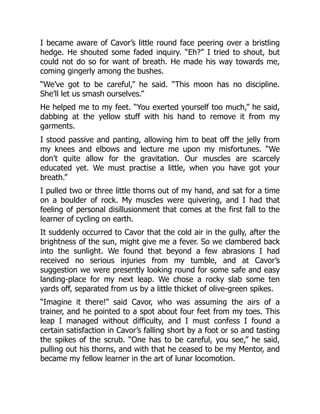
“I realised myleap had been too
violent”
I hit a huge fungoid bulk that burst all about me, scattering a mass
of orange spores in every direction, and covering me with orange
powder. I rolled over spluttering, and came to rest convulsed with
breathless laughter.
39.
I became awareof Cavor’s little round face peering over a bristling
hedge. He shouted some faded inquiry. “Eh?” I tried to shout, but
could not do so for want of breath. He made his way towards me,
coming gingerly among the bushes.
“We’ve got to be careful,” he said. “This moon has no discipline.
She’ll let us smash ourselves.”
He helped me to my feet. “You exerted yourself too much,” he said,
dabbing at the yellow stuff with his hand to remove it from my
garments.
I stood passive and panting, allowing him to beat off the jelly from
my knees and elbows and lecture me upon my misfortunes. “We
don’t quite allow for the gravitation. Our muscles are scarcely
educated yet. We must practise a little, when you have got your
breath.”
I pulled two or three little thorns out of my hand, and sat for a time
on a boulder of rock. My muscles were quivering, and I had that
feeling of personal disillusionment that comes at the first fall to the
learner of cycling on earth.
It suddenly occurred to Cavor that the cold air in the gully, after the
brightness of the sun, might give me a fever. So we clambered back
into the sunlight. We found that beyond a few abrasions I had
received no serious injuries from my tumble, and at Cavor’s
suggestion we were presently looking round for some safe and easy
landing-place for my next leap. We chose a rocky slab some ten
yards off, separated from us by a little thicket of olive-green spikes.
“Imagine it there!” said Cavor, who was assuming the airs of a
trainer, and he pointed to a spot about four feet from my toes. This
leap I managed without difficulty, and I must confess I found a
certain satisfaction in Cavor’s falling short by a foot or so and tasting
the spikes of the scrub. “One has to be careful, you see,” he said,
pulling out his thorns, and with that he ceased to be my Mentor, and
became my fellow learner in the art of lunar locomotion.
40.
We chose astill easier jump and did it without difficulty, and then
leapt back again, and to and fro several times, accustoming our
muscles to the new standard. I could never have believed had I not
experienced it, how rapid that adaptation would be. In a very little
time indeed, certainly after fewer than thirty leaps, we could judge
the effort necessary for a distance with almost terrestrial assurance.
And all this time the lunar plants were growing around us, higher
and denser and more entangled, every moment thicker and taller,
spiked plants, green cactus masses, fungi, fleshy and lichenous
things, strangest radiate and sinuous shapes. But we were so intent
upon our leaping, that for a time we gave no heed to their
unfaltering expansion.
An extraordinary elation had taken possession of us. Partly, I think, it
was our sense of release from the confinement of the sphere.
Mainly, however, the thin sweetness of the air, which I am certain
contained a much larger proportion of oxygen than our terrestrial
atmosphere. In spite of the strange quality of all about us, I felt as
adventurous and experimental as a cockney would do placed for the
first time among mountains; and I do not think it occurred to either
of us, face to face though we were with the Unknown, to be very
greatly afraid.
We were bitten by a spirit of enterprise. We selected a lichenous
kopje perhaps fifteen yards away, and landed neatly on its summit
one after the other. “Good!” we cried to each other; “good!” and
Cavor made three steps and went off to a tempting slope of snow a
good twenty yards and more beyond. I stood for a moment struck
by the grotesque effect of his soaring figure—his dirty cricket cap,
and spiky hair, his little round body, his arms and his
knickerbockered legs tucked up tightly—against the weird
spaciousness of the lunar scene. A gust of laughter seized me, and
then I stepped off to follow. Plump! I dropped beside him.
We made a few gargantuan strides, leapt three or four times more,
and sat down at last in a lichenous hollow. Our lungs were painful.
We sat holding our sides and recovering our breath, looking
41.
appreciation at oneanother. Cavor panted something about
“amazing sensations.” And then came a thought into my head. For
the moment it did not seem a particularly appalling thought, simply
a natural question arising out of the situation.
“By the way,” I said, “where exactly is the sphere?”
Cavor looked at me. “Eh?”
The full meaning of what we were saying struck me sharply.
“Cavor!” I cried, laying a hand on his arm, “where is the sphere?”
43.
X
LOST MEN INTHE MOON
His face caught something of my dismay. He stood up and stared
about him at the scrub that fenced us in and rose about us, straining
upward in a passion of growth. He put a dubious hand to his lips. He
spoke with a sudden lack of assurance. “I think,” he said slowly, “we
left it ... somewhere ... about there.”
He pointed a hesitating finger that wavered in an arc.
“I’m not sure.” His look of consternation deepened. “Anyhow,” he
said, with his eyes on me, “it can’t be far.”
We had both stood up. We made unmeaning ejaculations, our eyes
sought in the twining, thickening jungle round about us.
All about us on the sunlit slopes frothed and swayed the darting
shrubs, the swelling cactus, the creeping lichens, and wherever the
shade remained the snowdrifts lingered. North, south, east, and
west spread an identical monotony of unfamiliar forms. And
somewhere, buried already among this tangled confusion, was our
sphere, our home, our only provision, our only hope of escape from
this fantastic wilderness of ephemeral growths into which we had
come.
“I think, after all,” he said, pointing suddenly, “it might be over
there.”
“No,” I said. “We have turned in a curve. See! here is the mark of my
heels. It’s clear the thing must be more to the eastward, much more.
No!—the sphere must be over there.”
“I think,” said Cavor, “I kept the sun upon my right all the time.”
“Every leap, it seems to me,” I said, “my shadow flew before me.”
44.
We stared intoone another’s eyes. The area of the crater had
become enormously vast to our imaginations, the growing thickets
already impenetrably dense.
“Good heavens! What fools we have been!”
“It’s evident that we must find it again,” said Cavor, “and that soon.
The sun grows stronger. We should be fainting with the heat already
if it wasn’t so dry. And ... I’m hungry.”
I stared at him. I had not suspected this aspect of the matter before.
But it came to me at once—a positive craving. “Yes,” I said with
emphasis. “I am hungry too.”
He stood up with a look of active resolution. “Certainly we must find
the sphere.”
As calmly as possible we surveyed the interminable reefs and
thickets that formed the floor of the crater, each of us weighing in
silence the chances of our finding the sphere before we were
overtaken by heat and hunger.
“It can’t be fifty yards from here,” said Cavor, with indecisive
gestures. “The only thing is to beat round about until we come upon
it.”
“That is all we can do,” I said, without any alacrity to begin our hunt.
“I wish this confounded spike bush did not grow so fast!”
“That’s just it,” said Cavor. “But it was lying on a bank of snow.”
I stared about me in the vain hope of recognising some knoll or
shrub that had been near the sphere. But everywhere was a
confusing sameness, everywhere the aspiring bushes, the distending
fungi, the dwindling snow banks, steadily and inevitably changed.
The sun scorched and stung, the faintness of an unaccountable
hunger mingled with our infinite perplexity. And even as we stood
there, confused and lost amidst unprecedented things, we became
aware for the first time of a sound upon the moon other than the stir
of the growing plants, the faint sighing of the wind, or those that we
ourselves had made.
45.
Boom ... Boom... Boom ...
It came from beneath our feet, a sound in the earth. We seemed to
hear it with our feet as much as with our ears. Its dull resonance
was muffled by distance, thick with the quality of intervening
substance. No sound that I can imagine could have astonished us
more, or have changed more completely the quality of things about
us. For this sound, rich, slow, and deliberate, seemed to us as
though it could be nothing but the striking of some gigantic buried
clock.
Boom ... Boom ... Boom ...
Sound suggestive of still cloisters, of sleepless nights in crowded
cities, of vigils and the awaited hour, of all that is orderly and
methodical in life, booming out pregnant and mysterious in this
fantastic desert! To the eye everything was unchanged: the
desolation of bushes and cacti waving silently in the wind, stretched
unbroken to the distant cliffs, the still dark sky was empty overhead,
and the hot sun hung and burned. And through it all, a warning, a
threat, throbbed this enigma of sound.
Boom ... Boom ... Boom ...
We questioned one another in faint and faded voices. “A clock?”
“Like a clock!”
“What is it?”
“What can it be?”
“Count,” was Cavor’s belated suggestion, and at that word the
striking ceased.
The silence, the rhythmic disappointment of the silence, came as a
fresh shock. For a moment one could doubt whether one had ever
heard a sound. Or whether it might not still be going on. Had I
indeed heard a sound?
I felt the pressure of Cavor’s hand upon my arm. He spoke in an
undertone, as though he feared to wake some sleeping thing. “Let
46.
us keep together,”he whispered, “and look for the sphere. We must
get back to the sphere. This is beyond our understanding.”
“Which way shall we go?”
He hesitated. An intense persuasion of presences, of unseen things
about us and near us, dominated our minds. What could they be?
Where could they be? Was this arid desolation, alternately frozen
and scorched, only the outer rind and mask of some subterranean
world? And if so, what sort of world? What sort of inhabitants might
it not presently disgorge upon us?
And then, stabbing the aching stillness as vivid and sudden as an
unexpected thunderclap, came a clang and rattle as though great
gates of metal had suddenly been flung apart.
It arrested our steps. We stood gaping helplessly. Then Cavor stole
towards me.
“I do not understand!” he whispered close to my face. He waved his
hand vaguely skyward, the vague suggestion of still vaguer
thoughts.
“A hiding-place! If anything came....”
I looked about us. I nodded my head in assent to him.
We started off, moving stealthily with the most exaggerated
precautions against noise. We went towards a thicket of scrub. A
clangour like hammers flung about a boiler hastened our steps. “We
must crawl,” whispered Cavor.
The lower leaves of the bayonet plants, already overshadowed by
the newer ones above, were beginning to wilt and shrivel so that we
could thrust our way in among the thickening stems without serious
injury. A stab in the face or arm we did not heed. At the heart of the
thicket I stopped, and stared panting into Cavor’s face.
“Subterranean,” he whispered. “Below.”
“They may come out.”
47.
“We must findthe sphere!”
“Yes,” I said; “but how?”
“Crawl till we come to it.”
“But if we don’t?”
“Keep hidden. See what they are like.”
“We will keep together,” said I.
He thought. “Which way shall we go?”
“We must take our chance.”
We peered this way and that. Then very circumspectly, we began to
crawl through the lower jungle, making, so far as we could judge, a
circuit, halting now at every waving fungus, at every sound, intent
only on the sphere from which we had so foolishly emerged. Ever
and again from out of the earth beneath us came concussions,
beatings, strange, inexplicable, mechanical sounds; and once, and
then again, we thought we heard something, a faint rattle and
tumult, borne to us through the air. But fearful as we were we dared
essay no vantage-point to survey the crater. For long we saw
nothing of the beings whose sounds were so abundant and insistent.
But for the faintness of our hunger and the drying of our throats that
crawling would have had the quality of a very vivid dream. It was so
absolutely unreal. The only element with any touch of reality was
these sounds.
Figure it to yourself! About us the dreamlike jungle, with the silent
bayonet leaves darting overhead, and the silent, vivid, sun-splashed
lichens under our hands and knees, waving with the vigour of their
growth as a carpet waves when the wind gets beneath it. Ever and
again one of the bladder fungi, bulging and distending under the
sun, loomed upon us. Ever and again some novel shape in vivid
colour obtruded. The very cells that built up these plants were as
large as my thumb, like beads of coloured glass. And all these things
were saturated in the unmitigated glare of the sun, were seen
against a sky that was bluish black and spangled still, in spite of the
48.
sunlight, with afew surviving stars. Strange! the very forms and
texture of the stones were strange. It was all strange, the feeling of
one’s body was unprecedented, every other movement ended in a
surprise. The breath sucked thin in one’s throat, the blood flowed
through one’s ears in a throbbing tide—thud, thud, thud, thud....
And ever and again came gusts of turmoil, hammering, the clanging
and throb of machinery, and presently—the bellowing of great
beasts!
50.
XI
THE MOONCALF PASTURES
Sowe two poor terrestrial castaways, lost in that wild-growing moon
jungle, crawled in terror before the sounds that had come upon us.
We crawled, as it seemed, a long time before we saw either Selenite
or mooncalf, though we heard the bellowing and gruntulous noises
of these latter continually drawing nearer to us. We crawled through
stony ravines, over snow slopes, amidst fungi that ripped like thin
bladders at our thrust, emitting a watery humour, over a perfect
pavement of things like puff-balls, and beneath interminable thickets
of scrub. And ever more hopelessly our eyes sought for our
abandoned sphere. The noise of the mooncalves would at times be a
vast flat calf-like sound, at times it rose to an amazed and wrathy
bellowing, and again it would become a clogged bestial sound, as
though these unseen creatures had sought to eat and bellow at the
same time.
Our first view was but an inadequate transitory glimpse, yet none
the less disturbing because it was incomplete. Cavor was crawling in
front at the time, and he first was aware of their proximity. He
stopped dead, arresting me with a single gesture.
A crackling and smashing of the scrub appeared to be advancing
directly upon us, and then, as we squatted close and endeavoured
to judge of the nearness and direction of this noise, there came a
terrific bellow behind us, so close and vehement that the tops of the
bayonet scrub bent before it, and one felt the breath of it hot and
moist. And, turning about, we saw indistinctly through a crowd of
swaying stems the mooncalf’s shining sides, and the long line of its
back loomed out against the sky.
51.
Of course itis hard for me now to say how much I saw at that time,
because my impressions were corrected by subsequent observation.
First of all impressions was its enormous size; the girth of its body
was some fourscore feet, its length perhaps two hundred. Its sides
rose and fell with its laboured breathing. I perceived that its
gigantic, flabby body lay along the ground, and that its skin was of a
corrugated white, dappling into blackness along the backbone. But
of its feet we saw nothing. I think also that we saw then the profile
at least of the almost brainless head, with its fat-encumbered neck,
its slobbering omnivorous mouth, its little nostrils, and tight shut
eyes. (For the mooncalf invariably shuts its eyes in the presence of
the sun.) We had a glimpse of a vast red pit as it opened its mouth
to bleat and bellow again; we had a breath from the pit, and then
the monster heeled over like a ship, dragged forward along the
ground, creasing all its leathery skin, rolled again, and so wallowed
past us, smashing a path amidst the scrub, and was speedily hidden
from our eyes by the dense interlacings beyond. Another appeared
more distantly, and then another, and then, as though he was
guiding these animated lumps of provender to their pasture, a
Selenite came momentarily into ken. My grip upon Cavor’s foot
became convulsive at the sight of him, and we remained motionless
and peering long after he had passed out of our range.
By contrast with the mooncalves he seemed a trivial being, a mere
ant, scarcely five feet high. He was wearing garments of some
leathery substance, so that no portion of his actual body appeared,
but of this, of course, we were entirely ignorant. He presented
himself, therefore, as a compact, bristling creature, having much of
the quality of a complicated insect, with whip-like tentacles and a
clanging arm projecting from his shining cylindrical body case. The
form of his head was hidden by his enormous many-spiked helmet—
we discovered afterwards that he used the spikes for prodding
refractory mooncalves—and a pair of goggles of darkened glass, set
very much at the side, gave a bird-like quality to the metallic
apparatus that covered his face. His arms did not project beyond his
body case, and he carried himself upon short legs that, wrapped
52.
though they werein warm coverings, seemed to our terrestrial eyes
inordinately flimsy. They had very short thighs, very long shanks,
and little feet.
In spite of his heavy-looking clothing, he was progressing with what
would be, from the terrestrial point of view, very considerable
strides, and his clanging arm was busy. The quality of his motion
during the instant of his passing suggested haste and a certain
anger, and soon after we had lost sight of him we heard the bellow
of a mooncalf change abruptly into a short, sharp squeal, followed
by the scuffle of its acceleration. And gradually that bellowing
receded, and then came to an end, as if the pastures sought had
been attained.
We listened. For a space the moon world was still. But it was some
time before we resumed our crawling search for the vanished
sphere.
When next we saw mooncalves they were some little distance away
from us in a place of tumbled rocks. The less vertical surfaces of the
rocks were thick with a speckled green plant growing in dense
mossy clumps, upon which these creatures were browsing. We
stopped at the edge of the reeds amidst which we were crawling at
the sight of them, peering out at them and looking round for a
second glimpse of a Selenite. They lay against their food like
stupendous slugs, huge, greasy hulls, eating greedily and noisily,
with a sort of sobbing avidity. They seemed monsters of mere
fatness, clumsy and overwhelmed to a degree that would make a
Smithfield ox seem a model of agility. Their busy, writhing, chewing
mouths, and eyes closed, together with the appetising sound of their
munching, made up an effect of animal enjoyment that was
singularly stimulating to our empty frames.
“Hogs!” said Cavor with unusual passion. “Disgusting hogs!” and
after one glare of angry envy crawled off through the bushes to our
right. I stayed long enough to see that the speckled plant was quite
hopeless for human nourishment, then crawled after him, nibbling a
quill of it between my teeth.
53.
Presently we werearrested again by the proximity of a Selenite, and
this time we were able to observe him more exactly. Now we could
see that the Selenite covering was indeed clothing, and not a sort of
crustacean integument. He was quite similar in his costume to the
former one we had glimpsed, except that ends of something like
wadding were protruding from his neck, and he stood on a
promontory of rock and moved his head this way and that, as
though he was surveying the crater. We lay quite still, fearing to
attract his attention if we moved, and after a time he turned about
and disappeared.
We came upon another drove of mooncalves bellowing up a ravine,
and then we passed over a place of sounds, sounds of beating
machinery, as if some huge hall of industry came near the surface
there. And while these sounds were still about us we came to the
edge of a great open space, perhaps two hundred yards in diameter,
and perfectly level. Save for a few lichens that advanced from its
margin this space was bare, and presented a powdery surface of a
dusty yellow colour. We were afraid to strike out across this space,
but as it presented less obstruction to our crawling than the scrub,
we went down upon it and began very circumspectly to skirt its
edge.
For a little while the noises from below ceased, and everything, save
for the faint stir of the growing vegetation, was very still. Then
abruptly there began an uproar, louder, more vehement, and nearer
than any we had so far heard. Of a certainty it came from below.
Instinctively we crouched as flat as we could, ready for a prompt
plunge into the thicket beside us. Each knock and throb seemed to
vibrate through our bodies. Louder grew this throbbing and beating,
and that irregular vibration increased until the whole moon world
seemed to be jerking and pulsing.
“Cover,” whispered Cavor, and I turned towards the bushes.
At that instant came a thud like the thud of a gun, and then a thing
happened—it still haunts me in my dreams. I had turned my head to
look at Cavor’s face, and thrust out my hand in front of me as I did
54.
so. And myhand met nothing! Plunged suddenly into a bottomless
hole!
My chest hit something hard, and I found myself with my chin on
the edge of an unfathomable abyss that had suddenly opened
beneath me, my hand extended stiffly into the void. The whole of
that flat circular area was no more than a gigantic lid, that was now
sliding sideways from off the pit it had covered into a slot prepared
for it.
Had it not been for Cavor I think I should have remained rigid,
hanging over this margin and staring into the enormous gulf below,
until at last the edges of the slot scraped me off and hurled me into
its depths. But Cavor had not received the shock that had paralysed
me. He had been a little distance from the edge when the lid had
first opened, and perceiving the peril that held me helpless, gripped
my legs and pulled me backward. I came into a sitting position,
crawled away from the edge for a space on all fours, then staggered
up and ran after him across the thundering, quivering sheet of
metal. It seemed to be swinging open with a steadily accelerated
velocity, and the bushes in front of me shifted sideways as I ran.
I was none too soon. Cavor’s back vanished amidst the bristling
thicket, and as I scrambled up after him, the monstrous valve came
into its position with a clang. For a long time we lay panting, not
daring to approach the pit.
But at last very cautiously and bit by bit we crept into a position
from which we could peer down. The bushes about us creaked and
waved with the force of a breeze that was blowing down the shaft.
We could see nothing at first except smooth vertical walls
descending at last into an impenetrable black. And then very
gradually we became aware of a number of very faint and little lights
going to and fro.
For a time that stupendous gulf of mystery held us so that we forgot
even our sphere. In time, as we grew more accustomed to the
darkness, we could make out very small, dim, elusive shapes moving
55.
about among thoseneedle-point illuminations. We peered amazed
and incredulous, understanding so little that we could find no words
to say. We could distinguish nothing that would give us a clue to the
meaning of the faint shapes we saw.
“What can it be?” I asked; “what can it be?”
“The engineering!... They must live in these caverns during the
night, and come out during the day.”
“Cavor!” I said. “Can they be—that—it was something like—men?”
“That was not a man.”
“We dare risk nothing!”
“We dare do nothing until we find the sphere!”
“We can do nothing until we find the sphere.”
He assented with a groan and stirred himself to move. He stared
about him for a space, sighed, and indicated a direction. We struck
out through the jungle. For a time we crawled resolutely, then with
diminishing vigour. Presently among great shapes of flabby purple
there came a noise of trampling and cries about us. We lay close,
and for a long time the sounds went to and fro and very near. But
this time we saw nothing. I tried to whisper to Cavor that I could
hardly go without food much longer, but my mouth had become too
dry for whispering.
“Cavor,” I said, “I must have food.”
He turned a face full of dismay towards me. “It’s a case for holding
out,” he said.
“But I must,” I said, “and look at my lips!”
“I’ve been thirsty some time.”
“If only some of that snow had remained!”
“It’s clean gone! We’re driving from arctic to tropical at the rate of a
degree a minute....”
56.
I gnawed myhand.
“The sphere!” he said. “There is nothing for it but the sphere.”
We roused ourselves to another spurt of crawling. My mind ran
entirely on edible things, on the hissing profundity of summer drinks,
more particularly I craved for beer. I was haunted by the memory of
a sixteen gallon cask that had swaggered in my Lympne cellar. I
thought of the adjacent larder, and especially of steak and kidney pie
—tender steak and plenty of kidney, and rich, thick gravy between.
Ever and again I was seized with fits of hungry yawning. We came to
flat places overgrown with fleshy red things, monstrous coralline
growths; as we pushed against them they snapped and broke. I
noted the quality of the broken surfaces. The confounded stuff
certainly looked of a biteable texture. Then it seemed to me that it
smelt rather well.
I picked up a fragment and sniffed at it.
“Cavor,” I said in a hoarse undertone.
He glanced at me with his face screwed up. “Don’t,” he said. I put
down the fragment, and we crawled on through this tempting
fleshiness for a space.
“Cavor,” I asked, “why not?”
“Poison,” I heard him say, but he did not look round.
We crawled some way before I decided.
“I’ll chance it,” said I.
He made a belated gesture to prevent me. I stuffed my mouth full.
He crouched watching my face, his own twisted into the oddest
expression. “It’s good,” I said.
“O Lord!” he cried.
He watched me munch, his face wrinkled between desire and
disapproval, then suddenly succumbed to appetite, and began to
tear off huge mouthfuls. For a time we did nothing but eat.
57.
The stuff wasnot unlike a terrestrial mushroom, only it was much
laxer in texture, and, as one swallowed it, it warmed the throat. At
first we experienced a mere mechanical satisfaction in eating; then
our blood began to run warmer, and we tingled at the lips and
fingers, and then new and slightly irrelevant ideas came bubbling up
in our minds.
“It’s good,” said I. “Infernally good! What a home for our surplus
population! Our poor surplus population,” and I broke off another
large portion.
It filled me with a curiously benevolent satisfaction that there was
such good food in the moon. The depression of my hunger gave way
to an irrational exhilaration. The dread and discomfort in which I had
been living vanished entirely. I perceived the moon no longer as a
planet from which I most earnestly desired the means of escape, but
as a possible refuge for human destitution. I think I forgot the
Selenites, the mooncalves, the lid, and the noises completely so
soon as I had eaten that fungus.
Cavor replied to my third repetition of my “surplus population”
remark with similar words of approval. I felt that my head swam, but
I put this down to the stimulating effect of food after a long fast.
“Ess’lent discov’ry yours, Cavor,” said I. “Se’nd on’y to the ’tato.”
“Whajer mean?” asked Cavor. “’Scovery of the moon—se’nd on’y to
the ’tato?”
I looked at him, shocked at his suddenly hoarse voice, and by the
badness of his articulation. It occurred to me in a flash that he was
intoxicated, possibly by the fungus. It also occurred to me that he
erred in imagining that he had discovered the moon; he had not
discovered it, he had only reached it. I tried to lay my hand on his
arm and explain this to him, but the issue was too subtle for his
brain. It was also unexpectedly difficult to express. After a
momentary attempt to understand me—I remember wondering if
the fungus had made my eyes as fishy as his—he set off upon some
observations on his own account.
58.
“We are,” heannounced with a solemn hiccup, “the creashurs o’
what we eat and drink.”
He repeated this, and as I was now in one of my subtle moods, I
determined to dispute it. Possibly I wandered a little from the point.
But Cavor certainly did not attend at all properly. He stood up as well
as he could, putting a hand on my head to steady himself, which
was disrespectful, and stood staring about him, quite devoid now of
any fear of the moon beings.
I tried to point out that this was dangerous for some reason that
was not perfectly clear to me, but the word “dangerous” had
somehow got mixed with “indiscreet,” and came out rather more like
“injurious” than either; and after an attempt to disentangle them, I
resumed my argument, addressing myself principally to the
unfamiliar but attentive coralline growths on either side. I felt that it
was necessary to clear up this confusion between the moon and a
potato at once—I wandered into a long parenthesis on the
importance of precision of definition in argument. I did my best to
ignore the fact that my bodily sensations were no longer agreeable.
In some way that I have now forgotten, my mind was led back to
projects of colonisation. “We must annex this moon,” I said. “There
must be no shilly-shally. This is part of the White Man’s Burthen.
Cavor—we are—hic—Satap—mean Satraps! Nempire Cæsar never
dreamt. B’in all the newspapers. Cavorecia. Bedfordecia. Bedfordecia
—hic—Limited. Mean—unlimited! Practically.”
Certainly I was intoxicated.
I embarked upon an argument to show the infinite benefits our
arrival would confer on the moon. I involved myself in a rather
difficult proof that the arrival of Columbus was, on the whole,
beneficial to America. I found I had forgotten the line of argument I
had intended to pursue, and continued to repeat “Simlar to
C’lumbus,” to fill up time.
From that point my memory of the action of that abominable fungus
becomes confused. I remember vaguely that we declared our
59.
intention of standingno nonsense from any confounded insects, that
we decided it ill became men to hide shamefully upon a mere
satellite, that we equipped ourselves with huge armfuls of the
fungus—whether for missile purposes or not I do not know—and,
heedless of the stabs of the bayonet scrub, we started forth into the
sunshine.
Almost immediately we must have come upon the Selenites. There
were six of them, and they were marching in single file over a rocky
place, making the most remarkable piping and whining sounds. They
all seemed to become aware of us at once, all instantly became
silent and motionless, like animals, with their faces turned towards
us.
For a moment I was sobered.
“Insects,” murmured Cavor, “insects! And they think I’m going to
crawl about on my stomach—on my vertebrated stomach!
“Stomach,” he repeated slowly, as though he chewed the indignity.
60.
“Insects,” murmured Cavor,“insects”
Then suddenly, with a shout of fury, he made three vast strides and
leapt towards them. He leapt badly; he made a series of somersaults
in the air, whirled right over them, and vanished with an enormous
splash amidst the cactus bladders. What the Selenites made of this
amazing, and to my mind undignified irruption from another planet,
I have no means of guessing. I seem to remember the sight of their
61.
backs as theyran in all directions, but I am not sure. All these last
incidents before oblivion came are vague and faint in my mind. I
know I made a step to follow Cavor, and tripped and fell headlong
among the rocks. I was, I am certain, suddenly and vehemently ill. I
seem to remember a violent struggle, and being gripped by metallic
clasps....
My next clear recollection is that we were prisoners at we knew not
what depth beneath the moon’s surface; we were in darkness amidst
strange distracting noises; our bodies were covered with scratches
and bruises, and our heads racked with pain.
63.
Welcome to ourwebsite – the perfect destination for book lovers and
knowledge seekers. We believe that every book holds a new world,
offering opportunities for learning, discovery, and personal growth.
That’s why we are dedicated to bringing you a diverse collection of
books, ranging from classic literature and specialized publications to
self-development guides and children's books.
More than just a book-buying platform, we strive to be a bridge
connecting you with timeless cultural and intellectual values. With an
elegant, user-friendly interface and a smart search system, you can
quickly find the books that best suit your interests. Additionally,
our special promotions and home delivery services help you save time
and fully enjoy the joy of reading.
Join us on a journey of knowledge exploration, passion nurturing, and
personal growth every day!
ebookmasss.com