Visit ebookmass.com todownload the full version and
explore more ebook or textbook
Business forecasting 9th, intern. Edition Hanke
_____ Click the link below to download _____
https://ebookmass.com/product/business-forecasting-9th-
intern-edition-hanke/
Explore and download more ebook or textbook at ebookmass.com
2.
Here are somerecommended products that we believe you will be
interested in. You can click the link to download.
Business Forecasting Michael Gilliland
https://ebookmass.com/product/business-forecasting-michael-gilliland/
The Intern Michele Campbell
https://ebookmass.com/product/the-intern-michele-campbell/
Business Communication: Process & Product 9th edition
Edition Mary Ellen Guffey
https://ebookmass.com/product/business-communication-process-
product-9th-edition-edition-mary-ellen-guffey/
Economics for Business 9th Edition John Sloman
https://ebookmass.com/product/economics-for-business-9th-edition-john-
sloman/
3.
Crescent Hill -Im Schatten des Mondes Annika Hanke
https://ebookmass.com/product/crescent-hill-im-schatten-des-mondes-
annika-hanke/
(eBook PDF) Employment Law for Business 9th Edition
https://ebookmass.com/product/ebook-pdf-employment-law-for-
business-9th-edition/
eTextbook 978-9814738255 Global Business Today 9th Edition
https://ebookmass.com/product/etextbook-978-9814738255-global-
business-today-9th-edition/
Managerial Economics & Business Strategy 9th Edition Jeff
Prince
https://ebookmass.com/product/managerial-economics-business-
strategy-9th-edition-jeff-prince/
eTextbook 978-1305957961 Business Communication: Process &
Product 9th Edition
https://ebookmass.com/product/etextbook-978-1305957961-business-
communication-process-product-9th-edition/
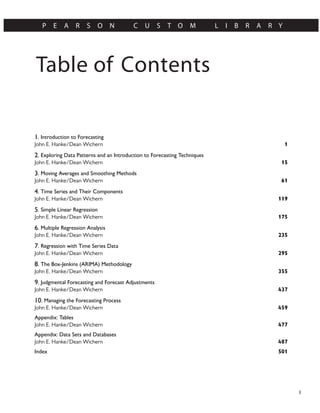
Table of Contents
PE A R S O N C U S T O M L I B R A R Y
I
1. Introduction to Forecasting
1
John E. Hanke/Dean Wichern
2. Exploring Data Patterns and an Introduction to Forecasting Techniques
15
John E. Hanke/Dean Wichern
3. Moving Averages and Smoothing Methods
61
John E. Hanke/Dean Wichern
4. Time Series and Their Components
119
John E. Hanke/Dean Wichern
5. Simple Linear Regression
175
John E. Hanke/Dean Wichern
6. Multiple Regression Analysis
235
John E. Hanke/Dean Wichern
7. Regression with Time Series Data
295
John E. Hanke/Dean Wichern
8. The Box-Jenkins (ARIMA) Methodology
355
John E. Hanke/Dean Wichern
9. Judgmental Forecasting and Forecast Adjustments
437
John E. Hanke/Dean Wichern
10. Managing the Forecasting Process
459
John E. Hanke/Dean Wichern
Appendix: Tables
477
John E. Hanke/Dean Wichern
Appendix: Data Sets and Databases
487
John E. Hanke/Dean Wichern
501
Index
Introduction to Forecasting
1Arecent review of the current state of forecasting is available in a special issue of the International Journal
of Forecasting, edited by R. J. Hyndman and J. K. Ord (2006).
New forecasting procedures continue to be developed as the need for accurate
forecasts accelerates.1 Particular attention is being paid to the forecasting process
in organizations with the need to coordinate objectives, methods, assessment, and
interpretation.
IS FORECASTING NECESSARY?
In spite of the inherent inaccuracies in trying to predict the future, forecasts necessar-
ily drive policy setting and planning. How can the Federal Reserve Board realistically
adjust interest rates without some notion of future economic growth and inflationary
pressures? How can an operations manager realistically set production schedules with-
out some estimate of future sales? How can a company determine staffing for its call
centers without some guess of the future demand for service? How can a bank make
realistic plans without some forecast of future deposits and loan balances? Everyone
requires forecasts. The need for forecasts cuts across all functional lines as well as all
types of organizations. Forecasts are absolutely necessary to move forward in today’s
ever-changing and highly interactive business environment.
This text discusses various ways of generating forecasts that rely on logical meth-
ods of manipulating data that have been generated by historical events. But it is our
belief that the most effective forecaster is able to formulate a skillful mix of quantita-
tive forecasting and good judgment and to avoid the extremes of total reliance on
either.At one extreme, we find the executive who, through ignorance and fear of quan-
titative techniques and computers, relies solely on intuition and feel. At the other
extreme is the forecaster skilled in the latest sophisticated data manipulation tech-
niques but unable or unwilling to relate the forecasting process to the needs of the
organization and its decision makers. We view the quantitative forecasting techniques
discussed in most of this text to be only the starting point in the effective forecasting of
outcomes important to the organization: Analysis, judgment, common sense, and busi-
ness experience must be brought to bear on the process through which these important
techniques have generated their results.
Another passage from Bernstein (1996) effectively summarizes the role of fore-
casting in organizations.
You do not plan to ship goods across the ocean, or to assemble merchandise
for sale, or to borrow money without first trying to determine what the future
may hold in store. Ensuring that the materials you order are delivered on time,
seeing to it that the items you plan to sell are produced on schedule, and get-
ting your sales facilities in place all must be planned before that moment when
the customers show up and lay their money on the counter. The successful
business executive is a forecaster first; purchasing, producing, marketing, pric-
ing, and organizing all follow.
TYPES OF FORECASTS
When managers are faced with the need to make decisions in an atmosphere of uncer-
tainty, what types of forecasts are available to them? Forecasting procedures might
first be classified as long term or short term. Long-term forecasts are necessary to set
2
12.
Introduction to Forecasting
thegeneral course of an organization for the long run; thus, they become the particular
focus of top management. Short-term forecasts are needed to design immediate strate-
gies and are used by middle and first-line management to meet the needs of the imme-
diate future.
Forecasts might also be classified in terms of their position on a micro–macro
continuum, that is, in terms of the extent to which they involve small details versus
large summary values. For example, a plant manager might be interested in forecasting
the number of workers needed for the next several months (a micro forecast), whereas
the federal government is forecasting the total number of people employed in the
entire country (a macro forecast). Again, different levels of management in an organi-
zation tend to focus on different levels of the micro–macro continuum. Top manage-
ment would be interested in forecasting the sales of the entire company, for example,
whereas individual salespersons would be much more interested in forecasting their
own sales volumes.
Forecasting procedures can also be classified according to whether they tend to be
more quantitative or qualitative. At one extreme, a purely qualitative technique is one
requiring no overt manipulation of data. Only the “judgment” of the forecaster is used.
Even here, of course, the forecaster’s “judgment” may actually be the result of the men-
tal manipulation of historical data.At the other extreme, purely quantitative techniques
need no input of judgment; they are mechanical procedures that produce quantitative
results. Some quantitative procedures require a much more sophisticated manipulation
of data than do others, of course.This text emphasizes the quantitative forecasting tech-
niques because a broader understanding of these very useful procedures is needed in
the effective management of modern organizations. However, we emphasize again that
judgment and common sense must be used along with mechanical and data-manipula-
tive procedures. Only in this way can intelligent forecasting take place.
Finally, forecasts might be classified according to the nature of the output. One
must decide if the forecast will be a single number best guess (a point forecast), a range
of numbers within which the future value is expected to fall (an interval forecast), or an
entire probability distribution for the future value (a density forecast). Since unpre-
dictable “shocks” will affect future values (the future is never exactly like the past),
nonzero forecast errors will occur even from very good forecasts. Thus, there is some
uncertainty associated with a particular point forecast. The uncertainty surrounding
point forecasts suggests the usefulness of an interval forecast. However, if forecasts
are solely the result of judgment, point forecasts are typically the only recourse. In
judgmental situations, it is extremely difficult to accurately describe the uncertainty
associated with the forecast.
MACROECONOMIC FORECASTING CONSIDERATIONS
We usually think of forecasting in terms of predicting important variables for an indi-
vidual company or perhaps for one component of a company. Monthly company sales,
unit sales for one of a company’s stores, and absent hours per employee per month in a
factory are examples.
By contrast, there is growing interest in forecasting important variables for the
entire economy of a country. Much work has been done in evaluating methods for
doing this kind of overall economic forecasting, called macroeconomic forecasting.
Examples of interest to the federal government of the United States are the unemploy-
ment rate, gross domestic product, and prime interest rate. Economic policy is based, in
part, on projections of important economic indicators such as these. For this reason,
3
13.
Introduction to Forecasting
thereis great interest in improving forecasting methods that focus on overall measures
of a country’s economic performance.
One of the chief difficulties in developing accurate forecasts of overall economic
activity is the unexpected and significant shift in a key economic factor. Significant
changes in oil prices, inflation surges, and broad policy changes by a country’s govern-
ment are examples of shifts in a key factor that can affect the global economy.
The possibility of such significant shifts in the economic scene has raised a key
question in macroeconomic forecasting: Should the forecasts generated by the fore-
casting model be modified using the forecaster’s judgment? Current work on forecast-
ing methodology often involves this question.
Theoretical and practical work on macroeconomic forecasting continues.
Considering the importance of accurate economic forecasting to economic policy for-
mulation in this country and others, increased attention to this kind of forecasting can
be expected in the future.A good introductory reference for macroeconomic forecast-
ing is Pindyck and Rubinfeld (1998).
CHOOSING A FORECASTING METHOD
The preceding discussion suggests several factors to be considered in choosing a fore-
casting method.The level of detail must be considered.Are forecasts of specific details
needed (a micro forecast)? Or is the future status of some overall or summary factor
needed (a macro forecast)? Is the forecast needed for some point in the near future
(a short-term forecast) or for a point in the distant future (a long-term forecast)? To
what extent are qualitative (judgment) and quantitative (data-manipulative) methods
appropriate? And, finally, what form should the forecast take (point, interval, or den-
sity forecast)?
The overriding consideration in choosing a forecasting method is that the results
must facilitate the decision-making process of the organization’s managers. Rarely
does one method work for all cases. Different products (for example, new versus estab-
lished), goals (for example, simple prediction versus the need to control an important
business driver of future values), and constraints (for example, cost, required expertise,
and immediacy) must be considered when selecting a forecasting method. With the
availability of current forecasting software, it is best to think of forecasting methods as
generic tools that can be applied simultaneously. Several methods can be tried in a
given situation. The methodology producing the most accurate forecasts in one case
may not be the best methodology in another situation. However, the method(s) chosen
should produce a forecast that is accurate, timely, and understood by management so
that the forecast can help produce better decisions.
The additional discussion available in Chase (1997) can help the forecaster select
an initial set of forecasting procedures to be considered.
FORECASTING STEPS
All formal forecasting procedures involve extending the experiences of the past
into the future. Thus, they involve the assumption that the conditions that gener-
ated past relationships and data are indistinguishable from the conditions of the
future.
A human resource department is hiring employees, in part, on the basis of a com-
pany entrance examination score because, in the past, that score seemed to be an impor-
tant predictor of job performance rating. To the extent that this relation continues to
4
14.
Introduction to Forecasting
hold,forecasts of future job performance—hence hiring decisions—can be improved by
using examination scores. If, for some reason, the association between examination
score and job performance changes, then forecasting job performance ratings from
examination scores using the historical model will yield inaccurate forecasts and poten-
tially poor hiring decisions. This is what makes forecasting difficult. The future is not
always like the past. To the extent it is, quantitative forecasting methods work well. To
the extent it isn’t, inaccurate forecasts can result. However, it is generally better to have
some reasonably constructed forecast than no forecast.
The recognition that forecasting techniques operate on the data generated by histor-
ical events leads to the identification of the following five steps in the forecasting process:
1. Problem formulation and data collection
2. Data manipulation and cleaning
3. Model building and evaluation
4. Model implementation (the actual forecast)
5. Forecast evaluation
In step 1, problem formulation and data collection are treated as a single step
because they are intimately related.The problem determines the appropriate data. If a
quantitative forecasting methodology is being considered, the relevant data must be
available and correct. Often accessing and assembling appropriate data is a challenging
and time-consuming task. If appropriate data are not available, the problem may have
to be redefined or a nonquantitative forecasting methodology employed. Collection
and quality control problems frequently arise whenever it becomes necessary to obtain
pertinent data for a business forecasting effort.
Step 2, data manipulation and cleaning, is often necessary. It is possible to have too
much data as well as too little in the forecasting process. Some data may not be rele-
vant to the problem. Some data may have missing values that must be estimated. Some
data may have to be reexpressed in units other than the original units. Some data may
have to be preprocessed (for example, accumulated from several sources and
summed). Other data may be appropriate but only in certain historical periods (for
example, in forecasting the sales of small cars, one may wish to use only car sales data
since the oil embargo of the 1970s rather than sales data over the past 60 years).
Ordinarily, some effort is required to get data into the form that is required for using
certain forecasting procedures.
Step 3, model building and evaluation, involves fitting the collected data into a
forecasting model that is appropriate in terms of minimizing forecasting error.The sim-
pler the model is, the better it is in terms of gaining acceptance of the forecasting
process by managers who must make the firm’s decisions. Often a balance must be
struck between a sophisticated forecasting approach that offers slightly more accuracy
and a simple approach that is easily understood and gains the support of—and is
actively used by—the company’s decision makers. Obviously, judgment is involved in
this selection process. Since this text discusses numerous forecasting models and their
applicability, the reader’s ability to exercise good judgment in the choice and use of
appropriate forecasting models will increase after studying this material.
Step 4, model implementation, is the generation of the actual model forecasts once
the appropriate data have been collected and cleaned and an appropriate forecasting
model has been chosen. Data for recent historical periods are often held back and later
used to check the accuracy of the process.
Step 5, forecast evaluation, involves comparing forecast values with actual his-
torical values. After implementation of the forecasting model is complete, forecasts
5
15.
Visit https://ebookmass.com todayto explore
a vast collection of ebooks across various
genres, available in popular formats like
PDF, EPUB, and MOBI, fully compatible with
all devices. Enjoy a seamless reading
experience and effortlessly download high-
quality materials in just a few simple steps.
Plus, don’t miss out on exciting offers that
let you access a wealth of knowledge at the
best prices!
16.
Introduction to Forecasting
aremade for the most recent historical periods where data values were known but
held back from the data set being analyzed. These forecasts are then compared with
the known historical values, and any forecasting errors are analyzed. Some forecast-
ing procedures sum the absolute values of the errors and may report this sum, or
they divide this sum by the number of forecast attempts to produce the average
forecast error. Other procedures produce the sum of squared errors, which is then
compared with similar figures from alternative forecasting methods. Some proce-
dures also track and report the magnitude of the error terms over the forecasting
period. Examination of error patterns often leads the analyst to modify the
forecasting model.
MANAGING THE FORECASTING PROCESS
The discussion in this chapter serves to underline our belief that management ability
and common sense must be involved in the forecasting process. The forecaster should
be thought of as an advisor to the manager rather than as a monitor of an automatic
decision-making device. Unfortunately, the latter is sometimes the case in practice,
especially with the aura of the computer. Again, quantitative forecasting techniques
must be seen as what they really are, namely, tools to be used by the manager in arriv-
ing at better decisions.According to Makridakis (1986):
The usefulness and utility of forecasting can be improved if management
adopts a more realistic attitude. Forecasting should not be viewed as a substi-
tute for prophecy but rather as the best way of identifying and extrapolating
established patterns or relationships in order to forecast. If such an attitude is
accepted, forecasting errors must be considered inevitable and the circum-
stances that cause them investigated.
Given that, several key questions should always be raised if the forecasting process is
to be properly managed:
• Why is a forecast needed?
• Who will use the forecast, and what are their specific requirements?
• What level of detail or aggregation is required, and what is the proper time horizon?
• What data are available, and will the data be sufficient to generate the needed
forecast?
• What will the forecast cost?
• How accurate can we expect the forecast to be?
• Will the forecast be made in time to help the decision-making process?
• Does the forecaster clearly understand how the forecast will be used in the
organization?
• Is a feedback process available to evaluate the forecast after it is made and to
adjust the forecasting process accordingly?
FORECASTING SOFTWARE
Today, there are a large number of computer software packages specifically designed
to provide the user with various forecasting methods.Two types of computer packages
are of primary interest to forecasters: (1) general statistical packages that include
regression analysis, time series analysis, and other techniques used frequently by
6
17.
Introduction to Forecasting
2Atthe time this text was written, the Institute for Forecasting Education provided reviews of
forecasting software on its website. These reviews can be accessed at www.forecastingeducation.com/
forecastingsoftwarereviews.asp.
forecasters and (2) forecasting packages that are specifically designed for forecasting
applications. In addition, some forecasting tools are available in Enterprise Resource
Planning (ERP) systems.
Graphical capabilities, interfaces to spreadsheets and external data sources, numeri-
cally and statistically reliable methods, and simple automatic algorithms for the selection
and specification of forecasting models are now common features of business forecasting
software. However, although development and awareness of forecasting software have
increased dramatically in recent years, the majority of companies still use spreadsheets
(perhaps with add-ins) to generate forecasts and develop business plans.
Examples of stand-alone software packages with forecasting tools include
Minitab, SAS, and SPSS. There are many add-ins or supplemental programs that pro-
vide forecasting tools in a spreadsheet environment. For example, the Analysis
ToolPak add-in for Microsoft Excel provides some regression analysis and smoothing
capabilities. There are currently several more comprehensive add-ins that provide a
(almost) full range of forecasting capabilities.2
It is sometimes the case, particularly in a spreadsheet setting, that “automatic”
forecasting is available. That is, the software selects the best model or procedure for
forecasting and immediately generates forecasts. We caution, however, that this con-
venience comes at a price. Automatic procedures produce numbers but rarely provide
the forecaster with real insight into the nature and quality of the forecasts.The genera-
tion of meaningful forecasts requires human intervention, a give and take between
problem knowledge and forecasting procedures (software).
Many of the techniques in this text will be illustrated with Minitab 15 and
Microsoft Excel 2003 (with the Analysis ToolPak add-in). Minitab 15 was chosen for its
ease of use and widespread availability. Excel, although limited in its forecasting func-
tionality, is frequently the tool of choice for calculating projections.
ONLINE INFORMATION
Information of interest to forecasters is available on the World Wide Web. Perhaps the
best way to learn about what’s available in cyberspace is to spend some time searching for
whatever interests you, using a browser such as Netscape or Microsoft Internet Explorer.
Any list of websites for forecasters is likely to be outdated by the time this text
appears; however, there are two websites that are likely to remain available for some
time. B&E DataLinks, available at www.econ-datalinks.org, is a website maintained
by the Business and Economic Statistics Section of the American Statistical Association.
This website contains extensive links to economic and financial data sources of interest
to forecasters. The second site, Resources for Economists on the Internet, sponsored
by theAmerican EconomicAssociation and available at rfe.org,contains an extensive set
of links to data sources, journals, professional organizations, and so forth.
FORECASTING EXAMPLES
Discussions in this chapter emphasize that forecasting requires a great deal of judg-
ment along with the mathematical manipulation of collected data.The following exam-
ples demonstrate the kind of thinking that often precedes a forecasting effort in a real
7
18.
Introduction to Forecasting
firm.Notice that the data values that will produce useful forecasts, even if they exist,
may not be apparent at the beginning of the process and may or may not be identified
as the process evolves. In other words, the initial efforts may turn out to be useless and
another approach required.
The results of the forecasting efforts for the two examples discussed here are not
shown, as they require topics that are described throughout the text. Look for the tech-
niques to be applied to these data. For the moment, we hope these examples illustrate
the forecasting effort that real managers face.
Example 1 Alomega Food Stores
Alomega Food Stores is a retail food provider with 27 stores in a midwestern state. The
company engages in various kinds of advertising and, until recently, had never studied the
effect its advertising dollars have on sales, although some data had been collected and
stored for 3 years.
The executives at Alomega decided to begin tracking their advertising efforts along
with the sales volumes for each month. Their hope was that after several months the col-
lected data could be examined to possibly reveal relationships that would help in determin-
ing future advertising expenditures.
The accounting department began extending its historical records by recording the
sales volume for each month along with the advertising dollars for both newspaper ads and
TV spots.They also recorded both sales and advertising values that had been lagged for one
and two months. This was done because some people on the executive committee thought
that sales might depend on advertising expenditures in previous months rather than in the
month the sales occurred.
The executives also believed that sales experienced a seasonal effect. For this reason, a
dummy or categorical variable was used to indicate each month. In addition, they wondered
about any trend in sales volume.
Finally, the executives believed that Alomega’s advertising dollars might have an effect
on its major competitors’ advertising budgets the following month. For each following
month, it was decided that competitors’ advertising could be classified as a (1) small amount,
(2) a moderate amount, or (3) a large amount.
After a few months of collecting data and analyzing past records, the accounting
department completed a data array for 48 months using the following variables:
• Sales dollars
• Newspaper advertising dollars
• TV advertising dollars
• Month code where January ⫽ 1, February ⫽ 2, through December ⫽ 12
• A series of 11 dummy variables to indicate month
• Newspaper advertising lagged one month
• Newspaper advertising lagged two months
• TV advertising lagged one month
• TV advertising lagged two months
• Month number from 1 to 48
• Code 1, 2, or 3 to indicate competitors’ advertising efforts the following month
Alomega managers, especially Julie Ruth, the company president, now want to learn
anything they can from the data they have collected. In addition to learning about
the effects of advertising on sales volumes and competitors’ advertising, Julie wonders
about any trend and the effect of season on sales. However, the company’s production
manager, Jackson Tilson, does not share her enthusiasm. At the end of the forecasting
planning meeting, he makes the following statement: “I’ve been trying to keep my
mouth shut during this meeting, but this is really too much. I think we’re wasting a lot of
people’s time with all this data collection and fooling around with computers. All you have
to do is talk with our people on the floor and with the grocery store managers to understand
what’s going on. I’ve seen this happen around here before, and here we go again. Some
of you people need to turn off your computers, get out of your fancy offices, and talk with a
few real people.”
8
19.
Introduction to Forecasting
Example1.2 Large Web-based Retailer
One of the goals of a large Internet-based retailer is to be the world’s most consumer-
centric company. The company recognizes that the ability to establish and maintain long-
term relationships with customers and to encourage repeat visits and purchases depends, in
part, on the strength of its customer service operations. For service matters that cannot be
handled using website features, customer service representatives located in contact centers
are available 24 hours a day to field voice calls and emails.
Because of its growing sales and its seasonality (service volume is relatively low in the
summer and high near the end of the year), a challenge for the company is to appropriately
staff its contact centers. The planning problem involves making decisions about hiring and
training at internally managed centers and about allocating work to outsourcers based on
the volume of voice calls and emails.The handling of each contact type must meet a targeted
service level every week.
To make the problem even more difficult, the handling time for each voice call and
email is affected by a number of contact attributes, including type of product, customer, and
purchase type. These attributes are used to classify the contacts into categories: in this case,
one “primary” category and seven “specialty” categories. Specific skill sets are needed to
resolve the different kinds of issues that arise in the various categories. Since hiring and
training require a 6-week lead time, forecasts of service contacts are necessary in order to
have the required number of service representatives available 24 hours a day, 7 days a week
throughout the year.
Pat Niebuhr and his team are responsible for developing a global staffing plan for the
contact centers. His initial challenge is to forecast contacts for the primary and specialty cat-
egories. Pat must work with monthly forecasts of total orders (which, in turn, are derived
from monthly revenue forecasts) and contacts per order (CPO) numbers supplied by the
finance department. Pat recognizes that contacts are given by
Contacts ⫽ Orders ⫻ CPO
For staff planning purposes, Pat must have forecasts of contacts on a weekly basis.
Fortunately, there is a history of actual orders, actual contacts, actual contacts per order, and
other relevant information, in some cases, recorded by day of the week. This history is
organized in a spreadsheet. Pat is considering using this historical information to develop
the forecasts he needs.
Summary
The purpose of a forecast is to reduce the range of uncertainty within which manage-
ment judgments must be made. This purpose suggests two primary rules to which the
forecasting process must adhere:
1. The forecast must be technically correct and produce forecasts accurate enough to
meet the firm’s needs.
2. The forecasting procedure and its results must be effectively presented to manage-
ment so that the forecasts are used in the decision-making process to the firm’s
advantage; results must also be justified on a cost-benefit basis.
Forecasters often pay particular attention to the first rule and expend less effort on the
second. Yet if well-prepared and cost-effective forecasts are to benefit the firm, those
who have the decision-making authority must use them. This raises the question of
what might be called the “politics” of forecasting. Substantial and sometimes major
expenditures and resource allocations within a firm often rest on management’s view
of the course of future events. Because the movement of resources and power within
an organization is often based on the perceived direction of the future (forecasts), it is
not surprising to find a certain amount of political intrigue surrounding the forecasting
process. The need to be able to effectively sell forecasts to management is at least as
important as the need to be able to develop the forecasts.
9
20.
Introduction to Forecasting
Theremainder of this text discusses various forecasting models and procedures.
First, we review basic statistical concepts and provide an introduction to correlation
and regression analysis.
CASES
CASE 1 MR. TUX
John Mosby owns several Mr. Tux rental stores, most
of them in the Spokane, Washington, area.3 His
Spokane store also makes tuxedo shirts, which he dis-
tributes to rental shops across the country. Because
rental activity varies from season to season due to
proms, reunions, and other activities, John knows that
his business is seasonal.He would like to measure this
seasonal effect, both to assist him in managing his
business and to use in negotiating a loan repayment
with his banker.
Of even greater interest to John is finding a way
of forecasting his monthly sales. His business contin-
ues to grow, which, in turn, requires more capital and
3We are indebted to John Mosby, the owner of Mr.Tux rental stores, for his help in preparing this case.
4We are indebted to Marv Harnishfeger, executive director of Consumer Credit Counseling of Spokane, and
Dorothy Mercer, president of its board of directors, for their help in preparing the case. Dorothy is a former
M.B.A. student of JH who has consistently kept us in touch with the use of quantitative methods in the real
world of business.
long-term debt. He has sources for both types of
growth financing, but investors and bankers are
interested in a concrete way of forecasting future
sales. Although they trust John, his word that the
future of his business “looks great” leaves them
uneasy.
As a first step in building a forecasting model,
John directs one of his employees, McKennah Lane,
to collect monthly sales data for the past several
years. Various techniques are used to forecast these
sales data for Mr. Tux and John Mosby attempts to
choose the forecasting technique that will best meet
his needs.
CASE 2 CONSUMER CREDIT
COUNSELING
Consumer Credit Counseling (CCC), a private, non-
profit corporation, was founded in 1982.4 The pur-
pose of CCC is to provide consumers with assistance
in planning and following budgets, with assistance in
making arrangements with creditors to repay delin-
quent obligations, and with money management
education.
Private financial counseling is provided at no
cost to families and individuals who are experiencing
financial difficulties or who want to improve their
money management skills. Money management
educational programs are provided for schools, com-
munity groups, and businesses. A debt management
program is offered as an alternative to bankruptcy.
Through this program, CCC negotiates with credi-
tors on behalf of the client for special payment
arrangements. The client makes a lump-sum pay-
ment to CCC that is then disbursed to creditors.
10
21.
Introduction to Forecasting
MinitabApplications
Minitab is a sophisticated statistical program that improves with each release.
Described here is Release 15.
Figure 1 shows you four important aspects of Minitab. The menu bar is where you
choose commands. For instance, click on Stat and a pull-down menu appears that con-
tains all of the statistical techniques available. The toolbar displays buttons for com-
monly used functions. Note that these buttons change depending on which Minitab
window is open. There are two separate windows on the Minitab screen: the data win-
dow, where you enter, edit, and view the column data for each worksheet; and the ses-
sion window, which displays text output, such as tables of statistics.
Specific instructions will be given to enable you to enter data into the Minitab
spreadsheet and to activate forecasting procedures to produce needed forecasts.
CCC has a blend of paid and volunteer staff; in
fact, volunteers outnumber paid staff three to one.
Seven paid staff provide management, clerical sup-
port, and about half of the counseling needs for
CCC. Twenty-one volunteer counselors fulfill the
other half of the counseling needs of the service.
CCC depends primarily on corporate funding to
support operations and services. The Fair Share
Funding Program allows creditors who receive pay-
ments from client debt management programs to
donate back to the service a portion of the funds
returned to them through these programs.
A major portion of corporate support comes
from a local utility that provides funding to support
a full-time counselor position as well as office space
for counseling at all offices.
In addition, client fees are a source of funding.
Clients who participate in debt management pay a
monthly fee of $15 to help cover the administrative
cost of this program. (Fees are reduced or waived
for clients who are unable to afford them.)
This background will be used as CCC faces diffi-
cult problems related to forecasting important
variables.
Menu bar
Toolbar
Session
window
Data
window
FIGURE 1 Basic Minitab Screen
11
22.
Introduction to Forecasting
Menubar
Toolbar
Formula
bar
Worksheet
FIGURE 2 Basic Excel Screen
Excel Applications
Excel is a popular spreadsheet program that is frequently used for forecasting. Figure 2
shows the opening screen of Version 2003. Data are entered in the rows and columns of
the spreadsheet, and then commands are issued to perform various operations on the
entered data.
For example, annual salaries for a number of employees could be entered into col-
umn A and the average of these values calculated by Excel. As another example,
employee ages could be placed in column B and the relationship between age and
salary examined.
There are several statistical functions available on Excel that may not be on the
drop-down menus on your screen.To activate these functions, click on the following:
Tools>Add-Ins
The Add-Ins dialog box appears. Select Analysis ToolPak and click on OK.
It is strongly recommended that an Excel add-in be used to help with the multi-
tude of statistical computations required by the forecasting techniques discussed in
this text.
References
Bernstein, P. L. Against the Gods:The Remarkable
Story of Risk. New York:Wiley, 1996.
Carlberg, C.“Use Excel’s Forecasting to Get
Terrific Projections.” Denver Business Journal 47
(18) (1996): 2B.
Chase, C.W., Jr.“Selecting the Appropriate
Forecasting Method.” Journal of Business
Forecasting 15 (Fall 1997): 2.
Diebold, F. X. Elements of Forecasting, 3rd ed.
Cincinnati, Ohio: South-Western, 2004.
12
23.
Introduction to Forecasting
Georgoff,D. M., and R. G. Mardick.“Manager’s
Guide to Forecasting.” Harvard Business Review
1 (1986): 110–120.
Hogarth, R. M., and S. Makridakis.“Forecasting and
Planning:An Evaluation.” Management Science
27 (2) (1981): 115–138.
Hyndman, R. J., and J. K. Ord, eds.“Special Issue:
Twenty Five Years of Forecasting.” International
Journal of Forecasting 22 (2006): 413–636.
Levenbach, H., and J. P. Cleary. Forecasting Practice
and Process for Demand Management. Belmont,
Calif.:Thomson Brooks/Cole, 2006.
Makridakis, S.“The Art and Science of Forecasting.”
International Journal of Forecasting 2 (1986): 15–39.
Newbold, P., and T. Bos. Introductory Business and
Economic Forecasting, 2nd ed. Cincinnati, Ohio:
South-Western, 1994.
Ord, J. K., and S. Lowe.“Automatic Forecasting.”
American Statistician 50 (1996): 88–94.
Perry, S.“Applied Business Forecasting.”
Management Accounting 72 (3) (1994): 40.
Pindyck, R. S., and D. L. Rubinfeld. Econometric
Models and Economic Forecasts, 4th ed. New
York: McGraw-Hill, 1998.
Wright, G., and P.Ayton, eds. Judgemental
Forecasting. New York:Wiley, 1987.
13
Visit https://ebookmass.com todayto explore
a vast collection of ebooks across various
genres, available in popular formats like
PDF, EPUB, and MOBI, fully compatible with
all devices. Enjoy a seamless reading
experience and effortlessly download high-
quality materials in just a few simple steps.
Plus, don’t miss out on exciting offers that
let you access a wealth of knowledge at the
best prices!
The Colonel regardedthe mystic figure, gigantic in the moonlight, a type
rather than an individual, with an interest that was half compassionate and
half satirical.
Yes. That was the feller! That was the chap who would take it in the
neck! That man with the silly smile—God help him!
"Come to look for it?" he said to the shadow, half to himself—"wiser
than your kind?"
"Look for what, sir?"
"The Creeping Death that's stealing across the sea to swallow you and
yours."
The shadow sidled towards him.
"Is that you, sir?" a voice said. "I thought it were."
The Colonel emerged from his dream.
"What, Caspar!" he replied. "What are you doing up here at this time of
night?"
"Just come up for a look round before turning in, me and my wife, sir,"
the other answered. "Ruth," he called, "it's the Colonel."
A young woman with an orange scarf about her hair issued from the
shadow of the coast-guard station and came forward slowly.
"I've heard a lot about you from Ern, sir," she said in a deep voice that
hummed like a top in the silvery silence. "When you commanded his
battalion in India and all."
The Colonel, standing in the dusk, listened with a deep content as to
familiar music, the player unseen; and was aware that his senses were
stirred by a beauty felt rather than seen...... Then he dropped down the hill
to the hostel twinkling solitary in the coombe beneath.
29.
"Your friend Caspar'smarried," he told his wife on joining her in the
loggia. The little lady scoffed.
"Married!" she cried. "He's been married nearly a year. They spent their
honeymoon on the hill at the back last autumn. I could see them from my
room."
"Why ever didn't you tell me?" asked the Colonel. "I'd have run em in
for vagrancy."
"No, you wouldn't," answered Mrs. Lewknor.
"Why not?"
"Because, my Jocko, she's a peasant Madonna. You couldn't stand up
against her. No man could."
"A powerful great creature from what I could see of her," the Colonel
admitted. "A bit of a handful for Master Ernie, I should guess."
Mrs. Lewknor's fine face became firm. She thought she scented a
challenge in the words and dropped her eyes to her work to hide the flash in
them.
"Ernie'll hold her," she said. "He could hold any woman. He's a
gentleman like his father before him."
He reached a long arm across to her as he sat and raised her fingers to
his lips.
Years ago a bird had flashed across the vision of his wife, coming and
going, in and out of the darkness, like the sparrow of the Saxon tale; but this
had been no sparrow, rather a bird of Paradise. The Colonel knew that; and
he knew that the fowler who had loosed the jewel-like bird was that baggy
old gentleman who lived across the golf links in the little house that
overlooked the Rectory. He knew and understood: for years ago the same
bird had flashed with radiant wings across the chamber of his life too,
swiftly coming, swiftly going.
30.
CHAPTER VI
THE COLONELLEARNS A SECRET
If the Colonel in his missionary efforts for the National Service League
made little impression on the masses in the East-end, he was astonishingly
successful with such labour as existed in Old Town; which in political
consciousness lagged fifty years behind its tumultuous neighbour on the
edge of the Levels, and retained far into this century much of the
atmosphere of a country village. There the Church was still a power
politically, and the workers disorganised. The Brewery in the Moot and the
Southdown Transport Company were the sole employers of labour in the
bulk; and Mr. Pigott the only stubborn opponent of the programme of the
League.
Archdeacon Willcocks backed the Colonel with whole-hearted ferocity,
and lent him the services of the Reverend Spink, who, flattered at working
with a Colonel D.S.O., showed himself keen and capable, and proposed to
run the Old Town branch of the League in conjunction with the Church of
England's Men's Society.
"I've got a first-rate secretary as a start," he told the Colonel importantly.
"Who's that?"
"Caspar."
"Ernest Caspar!" cried the Colonel. "The old Hammer-man!"
"No, his brother. Twice the man. Alfred—Mr. Trupp's chauffeur."
A few days later, when leaving the curate's lodgings, the Colonel ran up
against Ernie in Church Street.
31.
"Your brother's joinedus," he said. "Are you going to?"
Ernie's charming face became sullen at once.
"I would, sir," he said. "Only for that."
"Only for what?"
"Alf."
"You won't join because your brother has!" grinned the Colonel.
Ernie rolled a sheepish head.
"It's my wife, sir," he muttered. "See, he persecutes her somethink
shameful."
Next afternoon the Colonel was crossing Saffrons Croft on his way to
the Manor-house for tea, when a majestic young woman, a baby in her
arms, sauntering under the elms watching the cricket, smiled at him
suddenly.
He stopped, uncertain of her identity.
"I'm Mrs. Caspar, sir," she explained. "We met you the other night on the
Head—Ern and me."
"Oh, I know all about you!" replied the Colonel, glancing at the baby
who lifted to the sky a face like a sleeping rose. "My word!—she's a bonny
un."
"She grows, sir," replied Ruth, cooing and contented. "We gets her all
the air we can. So we come here with the children for a blow of the coolth
most in general Saraday afternoons. More air than in the Moot."
"Where's Caspar?" asked the Colonel.
"Yonder under the ellums, sir, along with a friend. Come about the
classes or something I did hear."
32.
"The class-war?" askedthe Colonel grimly.
"No, sir," answered Ruth. "Classes for learning you learning, I allow.
Man from the North, I yeard say. Talks funny—foreign talk I call it."
Just then the Colonel's glance fell on a child, slim as a daisy stalk, and
with the healthy pallor of a wood-anemone, hiding behind Ruth's skirt and
peeping at the stranger with fearless blue eyes that seemed somehow
strangely familiar.
"And what's your name, little Miss Hide-away?" he asked, delighted.
"Little Alice," the child replied, bold and delicate as a robin.
The fact that the child was obviously some four years old while Ernie
had not been married half that time did not occur to the Colonel as strange.
He glanced at the young mother, noble in outline, and in her black and red
beauty of the South so unlike the child.
"She doesn't take after her mother and father," he said, with the reckless
indiscretion of his sex.
Then he saw his mistake. Ruth has run up signals of distress. Ernie, who
had now joined them, as always at his best in an emergency, came quickly
to the rescue.
"Favours her grandmother, sir, I say," he remarked.
"Like my boy," commented the Colonel, recovering himself. "I don't
think anybody'd have taken our Jock for his father's son when he joined us
at Pindi in 1904—eh, Caspar?"
The two old Hammer-men chatted over days in India. Then the Colonel
went on up the hill, the eyes of the child still haunting him.
The Manor-house party were having tea on the lawn, under the
laburnum, looking over the sunk fence on to Saffrons Croft beyond, when
the Colonel joined them. Mrs. Lewknor was already there; and young
Stanley Bessemere, the Conservative candidate for Beachbourne East. He
33.
and Bess werewatching a little group of people gathered about a man who
was standing on a bench in Saffrons Croft haranguing.
"Lend me your bird-glasses, Miss Trupp," said her companion eagerly.
He stood up, a fine figure of a man, perfectly tailored,
"Yes," he said. "I thought so. It's my friend."
"Who's that?" asked the Colonel.
"Our bright particular local star of Socialism," the other answered. "The
very latest thing from Ruskin College. I thought he confined himself to the
East-end, but I'm glad to find he gives you Old Towners a turn now and
then, Miss Trupp. And I hope he won't forget you up at Meads, Colonel."
"What's his name?" asked Bess, amused.
"Burt," replied the other. "He comes from the North—and he's welcome
to go back there to-morrow so far as I'm concerned."
"You're from the North yourself, Mr. Bessemere," Mrs. Trupp reminded
him.
"I am," replied the young man, "and proud of it. But for political
purposes, I prefer the South. That's why I'm a candidate for Beachbourne
East."
A few minutes later he took his departure. The Colonel watched him go
with a sardonic grin. Philosopher though he might be, he was not above
certain of the prejudices common to his profession, and possessed in an
almost exaggerated degree the Army view of all politicians as the enemies
of Man at large and of the Services in particular.
Bess was still observing through her glasses the little group about the
man on the bench.
"There's Ruth!" she cried—"and Ernie!"
34.
"Listening to theorator?" asked the Colonel, joining her.
"Not Ruth!" answered Bess with splendid scorn. "No orators for her,
thank you!—She's listening to the baby. Ernie can listen to him."
The Colonel took the glasses and saw Ruth and Ernie detach themselves
from the knot of people and come slowly up the hill making for Borough
Lane.
"That really is a magnificent young woman of Caspar's," he said to his
host.
"She's one in a million," replied the old surgeon.
"William's always been in love with her," said his wife.
"All the men are," added Mrs. Lewknor, with a provocative little nod at
her husband.
"Where did he pick up his pearl?" asked the Colonel. "I love that droning
accent of hers. It's like the music of a rookery."
"She can ca-a-a away with the best of them when she likes," chuckled
Bess. "You should hear her over the baby!"
"An Aldwolston girl," said Mrs. Trupp. "She's Sussex to the core—with
that Spanish strain so many of them have." She added with extreme
deliberation,—"She was at the Hohenzollern for a bit one time o day, as we
say in these parts."
Mrs. Lewknor coloured faintly and looked at her feet. Next to her Jocko
and his Jock the regiment was the most sacred object in her world. But the
harm was done. The secret she had guarded so long even from her husband
was out. The word Hohenzollern had, she saw, unlocked the door of the
mystery for him.
Instantly the Colonel recalled Captain Royal's stay at the hotel on the
Crumbles a few years before ... Ernie Caspar's service there ... the clash of
the two men on the steps of the house where he was now having tea ...
35.
Royal's sudden flight,and the rumours that had reached him of the reasons
for it.
The eyes which had looked at him a few minutes since in Saffrons Croft
from beneath the fair brow of little Alice were the eyes of his old adjutant.
Then Mr. Trupp's voice broke in upon his reverie.
"Ah," said the old surgeon, "I see you know."
"And I'm glad you should," remarked Mrs. Trupp with the almost
vindictive emphasis that at times characterised this so gentle woman.
"Everybody does, mother," Bess interjected quietly...
As the Colonel and his wife walked home across the golf links he turned
to her.
"Did you know that, Rachel?" he inquired.
She looked straight in front of her as she walked.
"I did, my Jocko ... Mrs. Trupp told me."
The Colonel mused.
"What a change!—from Royal to Caspar!" he said.
She glanced up at him.
"You don't understand, Jocko," she said quietly. "Ruth was never Royal's
mistress. She was a maid on the Third Floor at the Hohenzollern when he
was there. He simply raped her and bolted."
The Colonel shrugged.
"Like the cad," he said.
36.
They walked onawhile. Then the Colonel said more to himself than to
his companion,
"I wonder if she's satisfied?"
The little lady at his side made a grimace that suggested—"Is any
woman?"
But all she said was,
"She's a good woman."
"She's come a cropper once," replied the Colonel.
"She was tripped," retorted the other almost tartly. "She didn't fall."
CHAPTER VII
THE MAN FROM THE NORTH
A few days later, on a Saturday afternoon, the Colonel was sitting in the
loggia of the hostel looking out over the sea when he saw two men coming
down the shoulder of Beau-nez along the coast-guard path.
The tall man in black with flying coat-tails he recognised at once. It was
Mr. Geddes, the one outstanding minister of the Gospel in Beachbourne: a
scholar, yet in touch with his own times, eloquent and broad, with a more
than local reputation as a Liberal leader. His companion was a sturdy fellow
in a cap, with curly black hair and a merry eye.
The Colonel, who never missed a chance, went out to waylay the pair.
Mr. Geddes introduced his friend—Mr. Burt, who'd come down recently
37.
from Mather andPlatt's in the North to act as foreman fitter at Hewson and
Clarke's in the East-end.
The Colonel reached out a bony hand, which the other gripped fiercely.
"I know you're both conspirators," he said with a wary smile. "What
troubles are you hatching for me now?"
Mr. Geddes laughed, and the engineer, surly a little from shyness and
self-conscious as a school-boy, grinned.
"Mr. Burt and I are both keen on education," said the minister. "He's
been telling me of Tawney's tutorial class at Rochdale. We're hatching a
branch of the W.E.A. down here. That's our only conspiracy."
"What's the W.E.A.?" asked the Colonel, always keen.
"It's the Democratic wing of the National Service League," the engineer
answered in broad Lancashire—"Workers' Education Association."
The Colonel nodded.
"He's getting at me!" he said. "I'm always being shot at. Will you both
come in to tea and talk?—I should like you to meet my wife, Burt. She'll
take you on. She's a red-hot Tory and a bonnie fighter."
But Mr. Geddes had a committee, and—"A must get on with the
Revolution," said Burt gravely.
"What Revolution's that?" asked the Colonel.
"The Revolution that begun in 1906—and that's been going on ever
since; and will go on till we're through!" He said the last words with a kind
of ferocity; and then burst into a sudden jovial roar as he saw the humour of
his own ultra-seriousness.
Mrs. Lewknor, who had been watching the interview from the loggia,
called to her husband as he returned to the house.
38.
"Who was thatman with Mr. Geddes?" she asked.
"Stanley Bessemere's friend," the Colonel answered. "A red
Revolutionary from Lancasheer—on the bubble; and a capital good fellow
too, I should say."
That evening the Colonel rang up Mr. Geddes to ask about the engineer.
"He's the new type of intellectual artizan," the minister informed him.
"The russet-coated captain who knows what he's fighting for and loves what
he knows. Unless I'm mistaken he's going to play a considerable part in our
East-end politics down here." He gave the other the engineer's address,
adding with characteristic breadth,
"It might be worth your while to follow him up perhaps, Colonel."
Joe Burt lodged in the East-end off Pevensey Road in the heart of the
new and ever-growing industrial quarter of Seagate, which was gradually
transforming a rather suburban little town of villas with a fishing-station
attached into a manufacturing city, oppressed with all the thronging
problems of our century. There the Colonel visited his new friend. Burt was
the first man of his type the old soldier, who had done most of his service in
India, had met. The engineer himself, and even more the room in which he
lived, with its obvious air of culture, was an eye-opener to the Colonel.
There was an old sideboard, beautifully kept, and on it a copper kettle
and spirit lamp; a good carpet, decent curtains. On the walls were Millais's
Knight Errant, Greiffenhagen's Man with a Scythe, and Clausen's Girl at the
Gate. But it was the books on a long deal plank that most amazed the old
soldier; not so much the number of them but the quality. He stood in front
of them and read their titles with grunts.
Alfred Marshall's Principles of Economics lolled up against the Webbs'
Industrial Democracy; Bradley's lectures on the tragedies of Shakespeare
hobnobbed with Gilbert Murray's translations from Euripides. Few of the
standard books on Economics and Industrial History, English or American,
were missing. And the work of the modern creators in imaginative
literature, Wells, Shaw, Arnold Bennett were mixed with Alton Locke,
39.
Daniel Deronda, Sybil,and the essays of Samuel Butler and Edward
Carpenter.
"You're not married then?" said the Colonel, throwing a glance round the
well-appointed room.
"Yes, A am though," the engineer answered, his black-brown eyes
twinkling. "A'm married to Democracy. She's ma first loov and like to be
ma last."
"What you doing down South?" asked the Colonel, tossing one leg over
the other as he sat down to smoke.
"Coom to make trouble," replied the other.
"Good for you!" said the Colonel. "Hotting things up for our friend Stan.
Well, he wants it. All the politicians do."
His first visit to Seagate Lane was by no means his last: for the
engineer's courage, his integrity, his aggressive tactics, delighted and
amused the scholarly old soldier; but when he came to tackle his man
seriously on the business of the National Service League he found he could
not move him an inch from the position he invariably took up: The Army
would be used by the Government in the only war that matters—the
Industrial war; and therefore the Army must not be strengthened.
"If the Army was used for the only purpose it ought to be used for—
defence—A'd be with you. So'd the boolk of the workers. But it's not. They
use it to croosh strikes!" And he brought his fist down on the table with a
characteristic thump. "That's to croosh us!—For the strike's our only
weapon, Colonel."
The power, the earnestness, even the savagery he displayed, amazed the
other. Here was a reality, an elemental force of which he had scarcely been
aware. This was Democracy incarnate. And whatever else he might think he
could not but admire the sincerity and strength of it. But he always brought
his opponent back to what was for him the only issue.
40.
"Germany!" he said.
"That'sblooff!" replied the other. "They'll get the machine-guns for use
against Germany, and when they've got em they'll use them against us.
That's the capitalists' game.—Then there's the officers."
"What about em?" said the Colonel cheerfully. "They're harmless
enough, poor devils."
"Tories to a man. Coom from the capitalist class."
"What if they do?"
"The Army does what the capitalist officer tells it. And he knows where
his interest lies aw reet."
"Well, of course you know the British officer better than I do, Burt,"
replied the Colonel, nettled for once.
His opponent was grimly pleased to have drawn blood.
"In the next few years if things go as they look like goin we shall see,"
was his comment. "Wait till we get a Labour Government in power!"
The Colonel knocked out his pipe.
"Well, Burt, I'll say this," he remarked. "If we could get half the passion
into our cause you do into yours, we should do."
"We're fighting a reality, Colonel," the other answered. "You're fighting a
shadow, that's the difference."
"I hope to God it may prove so!" said the Colonel, as they shook hands.
The two men thoroughly enjoyed their spars. And the battle was well
matched: for the soldier of the Old Army and the soldier of the New were
both scholars, well-read, logical, and fair-minded.
41.
On one ofhis visits the Colonel found Ernie Caspar in the engineer's
room standing before the book-shelf, handling the books. Ernie showed
himself a little shame-faced in the presence of his old Commanding Officer.
"How do they compare to your father's, Caspar?" asked the Colonel,
innocently unaware of the other's mauvaise honte and the cause of it.
"Dad's got ne'er a book now, sir," Ernie answered gruffly. "Only just the
Bible, and Wordsworth, and Troward's Lectures. Not as he'd ever anythink
like this—only Carpenter. See, dad's not an economist. More of a
philosopher and poet like."
"I wish they were mine," said the Colonel, turning over Zimmeni's Greek
Commonwealth.
"They're all right if so be you can afford em," answered Ernie shortly,
almost sourly.
"Books are better'n beer, Ernie," said Joe Burt, a thought maliciously;
and added with the little touch of priggishness that is rarely absent from
those who have acquired knowledge comparatively late in life—"They're
the bread of life and source of power."
"Maybe," retorted Ernie with a snort; "but they aren't the equal of wife
and children, I'll lay."
He left the room surlily.
Burt grinned at the Colonel.
"Ern's one o the much-married uns," he said.
"D'you know his wife?" the Colonel asked.
Joe shook his bull-head.
"Nay," he said. "And don't wish to."
"She's a fine woman all the same," replied the Colonel.
42.
"Happen so," theother answered. "All the more reason a should avoid
her. They canna thole me, the women canna. And A don't blame em."
"Why can't they thole you?" asked the Colonel curiously.
"Most Labour leaders rise to power at the expense of their wives," the
other explained. "They go on; but the wives stay where they are—at the
wash-tub. The women see that; and they don't like it. And they're right."
"What's the remedy?"
"There's nobbut one." Joe now not seldom honoured the Colonel by
relapsing into dialect when addressing him. "And that's for the Labour
leader to remain unmarried. They're the priests of Democracy—or should
be."
"You'll never make a Labour leader out of Caspar," said the Colonel
genially. "I've tried to make an N.C.O. of him before now and failed."
"A'm none so sure," Joe said, and added with genuine concern: "He's on
the wobble. Might go up; might go down. Anything might happen to yon
lad now. He's just the age. But he's one o ma best pupils—if he'll nobbut
work."
"Ah," said the Colonel with interest. "So he's joined your class at St.
Andrew's Hall, has he?"
"Yes," replied the other. "Mr. Chislehurst brought him along—the new
curate in Old Town. D'ye know him?"
"He's my cousin," replied the Colonel. "I got him here. He'd been
overworking in Bermondsey—in connection with the Oxford Bermondsey
Mission."
"Oh, he's one of them!" cried the other. "That accounts for it. A know
them. They were at Oxford when A was at Ruskin. They're jannock,—and
so yoong with it. They think they're going to convert the Church to
Christianity!" He chuckled.
43.
"In the courseof history," remarked the Colonel, "many Churchmen
have thought that. But the end of it's always been the same."
"What's that?" asked the engineer.
"That the Church has converted them."
CHAPTER VIII
THE CHERUB
The advent of Bobby Chislehurst to Old Town made a considerable
difference to Bessie Trupp. She was not at all in love with him and he only
pleasantly so with her; but as she told her friend the Colonel,
"He's the first curate we've ever had in Old Town you can be like that
with."
"Like that is good," said the Colonel. "Give me my tables. Meet it is I
write it down.—It says nothing and expresses everything."
Now if the clergy in Old Town with the exception of Bess's pet
antipathy, the Reverend Spink, were honest men worthy of respect, as
everybody admitted, they were also old-fashioned; and Bobby Chislehurst
was a new and disturbing element in their midst. Shy and unassuming
though he was, the views of the Cherub, as the Colonel called his cousin,
when they became known, created something of a mild sensation in the
citadel which had been held for Conservatism against all comers by the
Archdeacon and his lady for nearly forty years.
Even Mr. Pigott was shocked.
44.
"He's a Socialist!"he confided to Mr. Trupp at the Bowling Green
Committee.
The old Nonconformist had passed the happiest hours of a militant life in
battle with the Church as represented by his neighbour, the Archdeacon, but
of late it had been borne in upon him with increasing urgency that the time
might come when Church and Chapel would have to join forces and present
a common front against the hosts of Socialism which he feared more than
ever he had done the Tory legions.
But if the Church was going Socialist! ...
And Mr. Chislehurst said it was...
The new curate and Bess Trupp had much in common, especially Boy
Scouts, their youth and the outstanding characteristic of their generation—a
passionate interest and sympathy for their poorer neighbours. Both spent
laborious and happy hours in the Moot, listening a great deal, learning
much, even helping a little. Bess, who had known most of the dwellers in
the hollow under the Kneb all her life, had of course her favourites whom
she commended to the special care of Bobby on his arrival; and first of
these were the young Caspars.
She told him of Edward Caspar, her mother's old friend, scholar,
dreamer, gentleman, with the blood of the Beauregards in his veins, who
had married the daughter of an Ealing tobacconist, and lived in Rectory
Walk; of Anne Caspar, the harsh and devoted tyrant; of the two sons of this
inharmonious couple, and the antagonism between them from childhood; of
Alf's victory and Ernie's enlistment in the Army; his sojourn in India and
return to Old Town some years since; and she gave him a brief outline of
Ruth's history, not mentioning Royal's name but referring once or twice
through set teeth to "that little beast."
"Who's that?" asked the Cherub.
"Ernie's brother," she answered. "Alfred, who drives for dad."
"Not the sidesman?"
45.
"Yes."
Bobby looked surprised.
"Mr.Spink," Bess explained darkly. "He got him there."
Apart from Bess's recommendation, Mr. Chislehurst's contact with Ruth
was soon established through little Alice, who attended Sunday School.
Ruth, moreover, called herself a church-woman, and was sedately proud of
it, though the Church had no apparent influence upon her life, and though
she never attended services.
On the latter point, the Cherub, when he had rooted himself firmly in her
regard, remonstrated.
"See, I ca-a-n't, sir," said Ruth simply.
"Why not?" asked Bobby.
"He's always there," Ruth answered enigmatically.
Bobby was puzzled and she saw it.
"Alf," she explained. "See, he wanted me same as Ernie. Only not to
marry me. Just for his fun like and then throw you over. That's Alf, that is.
There's the difference atween the two brothers." She regarded the young
man before her with the lovely solicitude of the mother initiating a sensitive
son into the cruelties of a world of which she has already had tragic
experience. "Men are like that, sir—some men." She added with tender
delicacy, "Only you wouldn't know it, not yet."
The Cherub might be innocent, but no man has lived and worked in the
back-streets of Bermondsey without learning some strange and ugly truths
about life and human nature.
"He's not worrying you now?" he asked anxiously.
"Nothing to talk on," answered Ruth. "He wants me still, I allow. Only
he won't get me—not yet a bit anyways." She seemed quite casual about the
46.
danger that threatenedher, Bobby noticed; even, he thought, quietly
enjoying it.
That evening, when the Cherub touched on the point to his colleague,
Mr. Spink turned in his india-rubber lips.
"It's an honour to be abused by a woman like that," he said. "She's a bad
character—bad."
"She's not that, I swear!" cried Bobby warmly. "She may have
exaggerated, or made a mistake, but bad she's not."
"I believe I've been in the parish longer than you have, Chislehurst,"
retorted the other crisply. "And presumably I know something about the
people in it."
"You've not been in as long as Miss Trupp," retorted Bobby. "She's been
here all her life."
Mr. Spink puffed at his cigar with uplifted chin and smiled.
"How's it getting on?" he asked.
"Pah!" muttered Bobby—"Cad!" and went out, rather white.
That was not the end of the matter, however.
A few days later Joe Burt and Bobby had paused for a word at the Star
corner when Mr. Spink and Alf Caspar came down Church Street together.
"Birds of a feather," said Alf loudly, nudging his companion, just as they
passed the standing couple.
"That's not very courteous, Caspar," called Bobby quietly after him.
Mr. Spink walked on with a smirk; but Alf came back with hardly
dissimulated truculence.
47.
"Sorry you've beenspreading this about me, Mr. Chislehurst," he said,
his sour eyes blinking.
"What?" asked the Cherub, astonished.
"Dirt," Alf retorted. "And I know where you got it from too."
"I haven't," cried Bobby with boyish indignation. "What d'you mean?"
"I know you have though," retorted Alf. "So it's no good denying it." He
was about to move on with a sneer when Joe Burt struck in.
"That's a foonny way to talk," he said.
"Foonny it may be," mocked Alf. "One thing I'll lay: it's not so foonny as
your lingo."
The engineer shouldered a pace nearer.
"Throw a sneer, do you?"
"Ah," said Alf, secure in the presence of the clergyman. "I know all
about you."
"Coom to that," retorted the Northerner, "I know a little about you. One
o Stan's pups, aren't you?"
Bobby moved on and Alf at once followed suit.
"You keep down in the East-end, my lad!" he called over his shoulder.
"We don't want none of it in Old Town. Nor we won't have it, neether."
Joe stood four-square at the cross-roads, bristling like a dog.
"Called yourself a Socialist when yo were down, didn't you?" he
shouted. "And then turned Church and State when yo began to make. I
know your sort!"
48.
He dropped downBorough Lane, hackles still up, on the way to meet
Ernie by appointment in the Moot.
At the corner he waited, one eye on Ern's cottage, which he did not
approach. Then Ruth's face peeped round her door, amused and malicious,
to catch his dark head bobbing back into covert as he saw her. The two
played I spy thus most evenings to the amusement of one of them at least.
"He's there," she told Ernie in the kitchen—"Waitin at the corner.—
Keeps a safe distance, don't he?—What's he feared on?"
"You," answered Ernie, and rose.
Ruth snorted. The reluctance to meet her of this man with the growing
reputation as a fighter amused and provoked her. Sometimes she chaffed
with Ernie about it; but a ripple of resentment ran always across her
laughter.
Ern now excused his friend.
"He's all for his politics," he said. "No time for women."
"Hap, he'll learn yet," answered Ruth with a fierce little nod of her head.
CHAPTER IX
THE SHADOW OF ROYAL
That evening Alf called at Bobby's lodgings and apologised frankly.
"I know I said what I shouldn't, sir," he admitted. "But it fairly tortured
me to see you along of a chap like that Burt."
49.
"He's all right,"said Bobby coldly.
Alf smiled that sickly smile of his.
"Ah, you're innocent, Mr. Chislehurst," he said. "Only wish I knew as
little as you do."
Alf in fact was moving on and up again in his career; walking warily in
consequence, and determined to do nothing that should endanger his
position with the powers that be. This was the motive that inspired his
apology to Mr. Chislehurst and caused him likewise to make approaches to
his old schoolmaster, Mr. Pigott.
The old Nonconformist met the advances of his erstwhile pupil with
genial brutality.
"What's up now, Alf?" he asked. "Spreading the treacle to catch the flies.
Mind ye don't catch an hornet instead then!"
The remark may have been made in innocence, but Alf looked sharply at
the speaker and retired in some disorder. His new stir of secret busyness
was in fact bringing him into contact with unusual company, as Mrs. Trupp
discovered by accident. One evening she had occasion to telephone on
behalf of her husband to the garage. A voice that seemed familiar replied.
"Who's that?" she asked.
The answer came back, sharp as an echo,
"Who's that?"
"I'm Mrs. Trupp. I want to speak to Alfred Caspar."
Then the voice muttered and Alfred took the receiver.
Later Mrs. Trupp told her husband of the incident.
"I'm certain it was Captain Royal," she said with emphasis.
50.
The old surgeonexpressed no surprise.
"I daresay," he said. "Alf's raising money for some business scheme. He
told me so."
Now if Alf's attempts on Ruth in the days between the birth of the child
and her marriage to Ernie were known to Mrs. Trupp, the connection of the
little motor-engineer and Royal was only suspected by her. A chance word
of Ruth's had put her on guard; and that was all. Now with the swift natural
intuition for the ways of evil-doers, which the innocent woman, once
roused, so often reveals as by miracle, she flashed to a conclusion.
"Alf's blackmailing him!" she said positively.
"I shouldn't be surprised," her husband answered calmly.
His wife put her hand upon his shoulder.
"How can you employ a man like that, William?" she said, grave and
grieved.
It was an old point of dispute between them. Now he took her hand and
stroked it.
"My dear," he said, "when a bacteriologist has had a unique specimen
under the microscope for years he's not going to abandon it for a scruple."
A few days later Mrs. Trupp was walking down Borough Lane past the
Star when she saw Alf and Ruth cross each other on the pavement fifty
yards in front. Neither stopped, but Alf shot a sidelong word in the woman's
ear as he slid by serpent-wise. Ruth marched on with a toss of her head, and
Mrs. Trupp noted the furtive look in the eyes of her husband's chaffeur as he
met her glance and passed, touching his cap.
Mindful of her conversation with her husband, she followed Ruth home
and boarded her instantly.
"Ruth," she asked, "I want to know something. You must tell me for your
own good. Alfred's got no hold over you?"
51.
Ruth drew inher breath with the sound, almost a hiss, of a sword
snatched from its scabbard. Then slowly she relaxed.
"He's not got the sway over me not now," she said in a still voice, with
lowered eyes. "Only thing he's the only one outside who knaws Captain
Royal's the father of little Alice."
Mrs. Trupp eyed her under level brows.
"Oh, he does know that?" she said.
Ruth was pale.
"Yes, 'M," she said. "See Alf used to drive him that summer at the
Hohenzollern."
Mrs. Trupp was not entirely satisfied.
"I don't see how Alfred can hold his knowledge over you," she remarked.
"Not over me," answered Ruth, raising her eyes. "Over him."
"Over who?"
"Captain Royal," said Ruth; and added slowly—"And I'd be sorry for
anyone Alf got into his clutches—let alone her father."
Her dark eyes smouldered; her colour returned to her, swarthy and
glowing; a gleam of teeth revealed itself between faintly parted lips.
Mrs. Trupp not for the first time was aware of a secret love of battle and
danger in this young Englishwoman whose staid veins carried the wild
blood of some remote ancestress who had danced in the orange groves of
Seville, watched the Mediterranean blue flecked with the sails of Barbary
corsairs, and followed with passionate eyes the darings and devilries of her
matador in the ring among the bulls of Andalusia.
Mrs. Trupp returned home, unquiet at heart, and with a sense that
somehow she had been baffled. She knew Ruth well enough now to
52.
understand how thatyoung woman had fallen a prey to Royal. It was not
the element of class that had been her undoing, certainly not the factor of
money: it was the soldier in the man who had seized the girl's imagination.
And Mrs. Trupp, daughter herself of a line of famous soldiers, recognised
that Royal with all his faults, was a soldier, fine as a steel-blade, keen,
thorough, searching. It was the hardness and sparkle and frost-like quality
of this man with a soul like a sword which had set dancing the girl's hot
Spanish blood. Royal was a warrior; and to that fact Ruth owned her
downfall.
Was Ernie a warrior too?
Not for the first time she asked herself the question as she turned out of
the Moot into Borough Lane. And at the moment the man of whom she was
thinking emerged from the yard of the Transport Company, dusty, draggled,
negligent as always, and smiling at her with kind eyes—too kind, she
sometimes thought.
As she crossed the road to the Manor-house Joe Burt passed her and
gave his cap a surly hitch by way of salute. Mrs. Trupp responded
pleasantly. Her husband, she knew, respected the engineer. She herself had
once heard him speak and had admired the fire and fearlessness in him.
Moreover, genuine aristocrat that she was, she followed with sympathy his
lonely battle against the hosts of Toryism in the East-end, none the less
because she was herself a Conservative by tradition and temperament.
That man was a warrior to be sure....
That evening the old surgeon dropped his paper and looked over his
pince-nez at his wife and daughter.
"My dears," he said, "I've some good news for you."
"I know," replied Bess, scornfully. "Your Lloyd George is coming down
in January to speak on his iniquitous Budget. I knew that, thank you!"
"Better even than that," her father answered. "Alfred Caspar's leaving me
of his own accord."
53.
The girl tossedher skein of coloured silk to the ceiling with a splendid
gesture.
"Chuck-her-up!" she cried. "Do you hear, mother?"
"I do," answered Mrs. Trupp severely. "Better late than never."
"And I'm losing the best chauffeur in East Sussex," Mr. Trupp continued.
Alf, indeed, who had paddled his little canoe for so long and so
successfully on the Beachbourne mill-pond, was now about to launch a
larger vessel on the ocean of the world in obedience to the urge of that
ambition which, apart from a solitary lapse, had been the consuming
passion of his life. Unlike most men, however, who, as they become
increasingly absorbed in their own affairs, tend to drop outside interests, he
persisted loyally in old-time activities. Whether it was that his insatiable
desire for power forbade him to abandon any position, however modest,
which afforded him scope; or that he felt it more necessary than ever now,
in the interests of his expanding career, to maintain and if possible improve
his relations with the Church and State which exercised so potent a control
in the sphere in which he proposed to operate; or that the genuinely honest
workman in him refused to abandon a job to which he had once put his
hand, it is the fact that he continued diligent in his office at St. Michael's,
and manifested even increased zeal in his labours for the National Service
League.
Alf, indeed, so distinguished himself by his services to the League that at
the annual meeting at the Town Hall, he received public commendation
both from the Archdeacon and the Colonel, who announced that "the
admirable and indefatigable secretary of our Old Town branch, Mr. Alfred
Caspar, has agreed to become District Convener."
That meeting was a red-letter day in the history of the Beachbourne
National Service League, for at it the Colonel disclosed that Lord Roberts
was coming down to speak.
54.
CHAPTER X
BOBS
The oldField-Marshal, wise and anxious as a great doctor, was sitting
now at the bedside of the patient that was his country. His finger was on her
pulse, his eye on the hourglass, the sands of which were running out; and he
was listening always for the padding feet of that Visitor whose knock on the
door he expected momentarily.
After South Africa he had sheathed at last the sword which had not
rested in its scabbard for fifty years; and from that moment his eyes were
everywhere, watching, guiding, cherishing the movement to which he had
given birth.
He followed the activities and successes of Colonel Lewknor on the
South Coast with a close attention of which the old Hammer-man knew
nothing; and to show his appreciation of the Colonel's labours, he
volunteered to come down to Beachbourne and address a meeting.
The offer was greedily accepted.
Mrs. Lewknor, who, now that the hostel was in full swing, was more free
to interest herself in her husband's concerns, flung herself into the project
with enthusiasm. And the Colonel went to work with tact and resolution. On
one point he was determined: this should not be a Conservative
demonstration, run by the Tories of Old Town and Meads. Mr. Glynde, a
local squire, the member for Beachbourne West, might be trusted to behave
himself. But young Stanley Bessemere, who, as the Colonel truly said, was
for thrusting his toe into the crack of every door, would need watching—he
and his cohorts of lady-workers.
The Committee took the Town Hall for the occasion, and arranged for
the meeting to be at eight in the evening so that Labour might attend if it
55.
would.
The Colonel journeyeddown to the East-end to ask Joe Burt to take an
official part in the reception; but the engineer refused, to the Colonel's
chagrin.
"A shall coom though," said Joe.
"And bring your mates along," urged the Colonel. "The old gentleman's
worth seeing at all events. Mr. Geddes is coming."
"I was going to soop with Ernie Caspar and his missus," replied the
engineer, looking a little foolish. "And we were coomin along together
afterwards."
"Ah," laughed the Colonel, as he went out. "She's beat you!—I knew she
would. Back the woman!"
Joe grinned in the door.
"Yes," he said. "Best get it over. That's my notion of it."
Bobs was still the most popular of Englishmen, if no longer the figure of
romance he had been in the eyes of the British public for a few minutes
during the South African war. His name drew; and the Town Hall was
pleasantly full without being packed. Many came to see the old hero who
cared little for his subject. Amongst these was Ruth Caspar who at Ernie's
request for once had left her babes to the care of a friend. She stood at the
back of the hall with her husband amongst her kind. Mrs. Trupp, passing,
invited her to come forward; but Ruth had spied Alf at the platform end, a
steward with a pink rosette, very smart, and deep in secret counsel with the
Reverend Spink. Joe Burt, with critical bright eye everywhere, supported
the wall next to her. The Colonel, hurrying by, threw a friendly glance at
him.
"Ah," he said, "so you've found each other."
56.
"Yes, sir," repliedRuth mischievously. "He's faced me at last, Mr. Burt
has."
"And none the worse for it, I hope," said the Colonel.
"That's not for me to say, sir," answered Ruth, who was in gay mood.
Joe changed the subject awkwardly.
"A see young Bessemere's takin a prominent part in the proceedings," he
said, nodding towards the platform. "He's two oughts above nothing, that
young mon."
"Yes, young ass," replied the Colonel cheerfully. "Now if you'd come on
the Committee as I asked you, you'd be there to keep him in his place. You
play into the hands of your enemy!"
Then Bobby Chislehurst stopped for a word with Ruth and Ernie and
their friend.
"Coom, Mr. Chislehurst!" chaffed the engineer. "A'm surprised to see
you here. A thought you was a Pacifist."
"So I am," replied the other cheerily. "That's why I've come. I want to
hear both sides."
Joe shook his bullet-head gravely.
"There's nobbut two sides in life," he said. "Right and Wrong. Which
side is the Church on?"
Then the little Field-Marshal came on to the platform with the swift and
resolute walk of the old Horse-gunner. He was nearly eighty now, but his
figure was that of a youth, neat, slight, alert. Ruth remarked with interest
that the hero was bow-legged, which she did not intend her children to be.
For the rest, his kindly face of a Roman-nosed thoroughbred in training, his
deep wrinkles, and close-cropped white hair, delighted her.
57.
Welcome to ourwebsite – the ideal destination for book lovers and
knowledge seekers. With a mission to inspire endlessly, we offer a
vast collection of books, ranging from classic literary works to
specialized publications, self-development books, and children's
literature. Each book is a new journey of discovery, expanding
knowledge and enriching the soul of the reade
Our website is not just a platform for buying books, but a bridge
connecting readers to the timeless values of culture and wisdom. With
an elegant, user-friendly interface and an intelligent search system,
we are committed to providing a quick and convenient shopping
experience. Additionally, our special promotions and home delivery
services ensure that you save time and fully enjoy the joy of reading.
Let us accompany you on the journey of exploring knowledge and
personal growth!
ebookmass.com