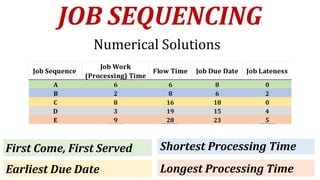

JOB SEQUENCING
Numerical Solutions
Earliest Due Date Longest Processing Time
First Come, First Served Shortest Processing Time
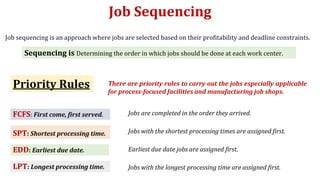
Job Sequencing
SPT: Shortest processing time.
Sequencing is Determining the order in which jobs should be done at each work center.
Job sequencing is an approach where jobs are selected based on their profitability and deadline constraints.
Priority Rules There are priority rules to carry out the jobs especially applicable
for process-focused facilities and manufacturing job shops.
LPT: Longest processing time.
FCFS: First come, first served. Jobs are completed in the order they arrived.
Jobs with the shortest processing times are assigned first.
EDD: Earliest due date. Earliest due date jobs are assigned first.
Jobs with the longest processing time are assigned first.
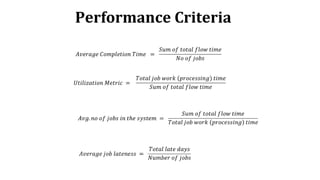
Performance Criteria
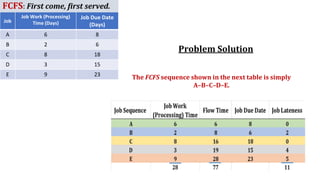
Problem Solution
Job
Job Work (Processing)
Time (Days)
Job Due Date
(Days)
A 6 8
B 2 6
C 8 18
D 3 15
E 9 23
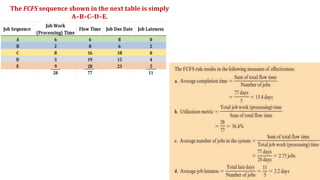
The FCFS sequence shown in the next table is simply
A–B–C–D–E.
FCFS: First come, first served.
The FCFS sequence shown in the next table is simply
A–B–C–D–E.
Job
Job Work (Processing)
Time (Days)
Job Due Date
(Days)
A 6 8
B 2 6
C 8 18
D 3 15
E 9 23
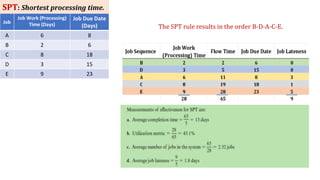
SPT: Shortest processing time.
The SPT rule results in the order B-D-A-C-E.
Job
Job Work
(Processing) Time
(Days)
Job Due Date
(Days)
A 6 8
B 2 6
C 8 18
D 3 15
E 9 23
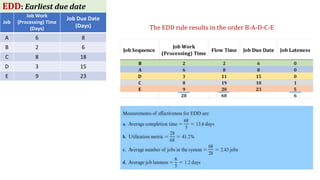
EDD: Earliest due date
The EDD rule results in the order B-A-D-C-E
Job
Job Work (Processing)
Time (Days)
Job Due Date
(Days)
A 6 8
B 2 6
C 8 18
D 3 15
E 9 23
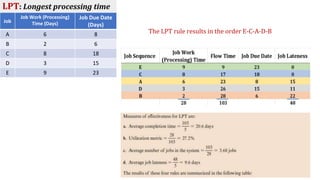
LPT: Longest processing time
The LPT rule results in the order E-C-A-D-B
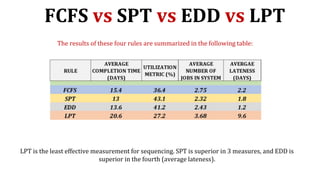
FCFS vs SPT vs EDD vs LPT
LPT is the least effective measurement for sequencing. SPT is superior in 3 measures, and EDD is
superior in the fourth (average lateness).
The results of these four rules are summarized in the following table:
https://youtu.be/uLmS2JO2580
For complete explanation in Hindi/Urdu,
Watch the lecture on YouTube
Click the link or visit (Job Sequencing E-Concepts) on YouTube

Jobs Sequencing with Priority Rules.pptx

  • 1.
    JOB SEQUENCING Numerical Solutions EarliestDue Date Longest Processing Time First Come, First Served Shortest Processing Time
  • 2.
    Job Sequencing SPT: Shortestprocessing time. Sequencing is Determining the order in which jobs should be done at each work center. Job sequencing is an approach where jobs are selected based on their profitability and deadline constraints. Priority Rules There are priority rules to carry out the jobs especially applicable for process-focused facilities and manufacturing job shops. LPT: Longest processing time. FCFS: First come, first served. Jobs are completed in the order they arrived. Jobs with the shortest processing times are assigned first. EDD: Earliest due date. Earliest due date jobs are assigned first. Jobs with the longest processing time are assigned first.
  • 3.
  • 4.
    Problem Solution Job Job Work(Processing) Time (Days) Job Due Date (Days) A 6 8 B 2 6 C 8 18 D 3 15 E 9 23 The FCFS sequence shown in the next table is simply A–B–C–D–E. FCFS: First come, first served.
  • 5.
    The FCFS sequenceshown in the next table is simply A–B–C–D–E.
  • 6.
    Job Job Work (Processing) Time(Days) Job Due Date (Days) A 6 8 B 2 6 C 8 18 D 3 15 E 9 23 SPT: Shortest processing time. The SPT rule results in the order B-D-A-C-E.
  • 7.
    Job Job Work (Processing) Time (Days) JobDue Date (Days) A 6 8 B 2 6 C 8 18 D 3 15 E 9 23 EDD: Earliest due date The EDD rule results in the order B-A-D-C-E
  • 8.
    Job Job Work (Processing) Time(Days) Job Due Date (Days) A 6 8 B 2 6 C 8 18 D 3 15 E 9 23 LPT: Longest processing time The LPT rule results in the order E-C-A-D-B
  • 9.
    FCFS vs SPTvs EDD vs LPT LPT is the least effective measurement for sequencing. SPT is superior in 3 measures, and EDD is superior in the fourth (average lateness). The results of these four rules are summarized in the following table:
  • 10.
    https://youtu.be/uLmS2JO2580 For complete explanationin Hindi/Urdu, Watch the lecture on YouTube Click the link or visit (Job Sequencing E-Concepts) on YouTube