TUMKUR UNIVERSITY
Department of studies and research in
library and information science
Tumkur University, Tumakuru
Forecasting Models
By
Mahesh V M
Student
Department of studies and research in
library and information science
Tumkur University,Tumakuru
 Introduction
 Forecasting
 Forecasting Techniques
 Application of Forecasting
 Conclusion
Content
• Business forecasting generally attempts to predict
future customer demand for a firm’s goods or services.
• Macroeconomic forecasting attempts to predict future
behavior of the economy and identify business cycle
turning points.
Introduction
• Forecasting is the process of making predictions of the
future based on past and present data and most
commonly by analysis of trends.
Forecasting
• 1. Qualitative methods
• 2. Quantitative methods
Forecasting Techniques
Qualitative methods
Qualitative methods
Executive
Opinion
Approach in which
a group of
managers meet
and collectively
develop a forecast
Market Survey
Approach that uses
interviews and
surveys to judge
preferences of
customer and to
assess demand
Sales Force
Composite
Approach in
which each
salesperson
estimates sales in
his or her region
Delphi
Method
Approach in
which
consensus
agreement is
reached among
a group of
expert
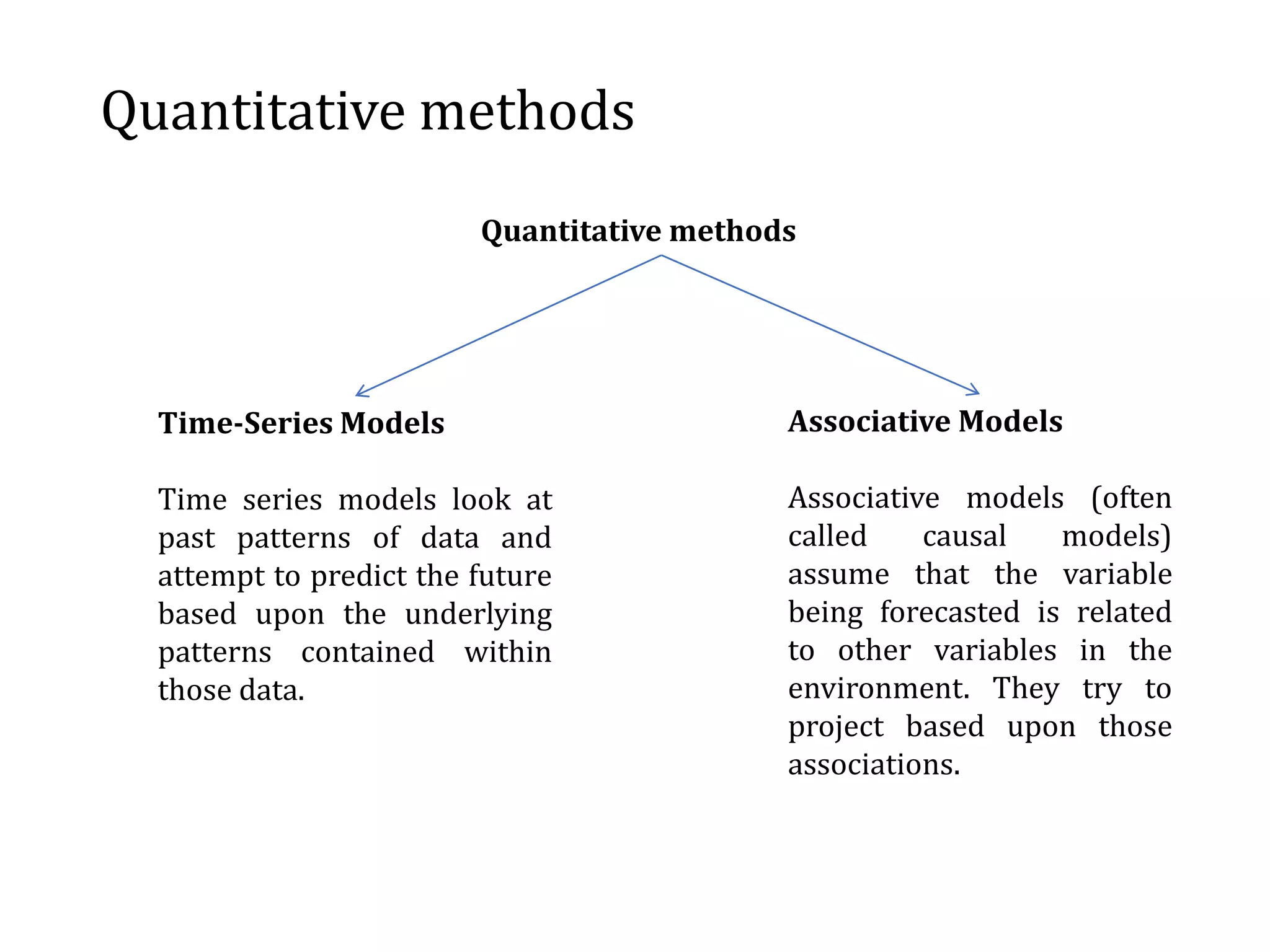
Quantitative methods
Time-Series Models
Time series models look at
past patterns of data and
attempt to predict the future
based upon the underlying
patterns contained within
those data.
Associative Models
Associative models (often
called causal models)
assume that the variable
being forecasted is related
to other variables in the
environment. They try to
project based upon those
associations.
I. Operations management: forecast of product sales; demand for
services.
II. Marketing: forecast of sales response to advertisement
procedures, new promotions etc.
III. Finance & Risk management: forecast returns from investments.
IV. Economics: forecast of major economic variables, e.g. GDP,
population growth, unemployment rates, inflation; useful for
monetary & fiscal policy; budgeting plans & decisions.
V. Industrial Process Control: forecasts of the quality characteristics
of a production process.
VI. Demography: forecast of population; of demographic events
(deaths, births, migration); useful for policy planning.
Applications of forecasting
• When the factors that lead to what is being forecast are not
known or well understood such as in stock and foreign exchange
markets forecasts are often inaccurate or wrong as there is not
enough data about everything that affects these markets for the
forecasts to be reliable, in addition the outcomes of the forecasts
of these markets change the behavior of those involved in the
market further reducing forecast accuracy.
Conclusion

Forecasting models

  • 1.
    TUMKUR UNIVERSITY Department ofstudies and research in library and information science Tumkur University, Tumakuru Forecasting Models By Mahesh V M Student Department of studies and research in library and information science Tumkur University,Tumakuru
  • 2.
     Introduction  Forecasting Forecasting Techniques  Application of Forecasting  Conclusion Content
  • 3.
    • Business forecastinggenerally attempts to predict future customer demand for a firm’s goods or services. • Macroeconomic forecasting attempts to predict future behavior of the economy and identify business cycle turning points. Introduction
  • 4.
    • Forecasting isthe process of making predictions of the future based on past and present data and most commonly by analysis of trends. Forecasting
  • 5.
    • 1. Qualitativemethods • 2. Quantitative methods Forecasting Techniques
  • 6.
    Qualitative methods Qualitative methods Executive Opinion Approachin which a group of managers meet and collectively develop a forecast Market Survey Approach that uses interviews and surveys to judge preferences of customer and to assess demand Sales Force Composite Approach in which each salesperson estimates sales in his or her region Delphi Method Approach in which consensus agreement is reached among a group of expert
  • 7.
    Quantitative methods Quantitative methods Time-SeriesModels Time series models look at past patterns of data and attempt to predict the future based upon the underlying patterns contained within those data. Associative Models Associative models (often called causal models) assume that the variable being forecasted is related to other variables in the environment. They try to project based upon those associations.
  • 8.
    I. Operations management:forecast of product sales; demand for services. II. Marketing: forecast of sales response to advertisement procedures, new promotions etc. III. Finance & Risk management: forecast returns from investments. IV. Economics: forecast of major economic variables, e.g. GDP, population growth, unemployment rates, inflation; useful for monetary & fiscal policy; budgeting plans & decisions. V. Industrial Process Control: forecasts of the quality characteristics of a production process. VI. Demography: forecast of population; of demographic events (deaths, births, migration); useful for policy planning. Applications of forecasting
  • 9.
    • When thefactors that lead to what is being forecast are not known or well understood such as in stock and foreign exchange markets forecasts are often inaccurate or wrong as there is not enough data about everything that affects these markets for the forecasts to be reliable, in addition the outcomes of the forecasts of these markets change the behavior of those involved in the market further reducing forecast accuracy. Conclusion