1
Staffing in Management
Objectives
2
• Haveknowledgeabout Staffingandits process.
• Learnabout recruitment , sourcesboth internal
&external with merits &demerits.
• Knowabout selection, its importance and
stages
• Understand about test its kind&the
advantages, disadvantages.
• knowabout promotion, the basisofit and
qualities ofgood promotion
Introduction
3
• Staffingfunction followsthe planning&
Organizing function.
• Thestaffingfunctionincludes recruitment
selection , training,
development,transfer,promotion &
compensation
• Staffinginvolvesproper classificationof
personnel &payfixed for them.
Definition
4
• Haimann : Themanagerialfunction ofstaffing
is“Concerned with the placement, &growth.”
• KoontzandO’Donnel:The managerialfunction
of staffing is “Managingthe organizational
structure through proper selection”
• S.Benjamin:Staffingfunctionisconcerned with
the placement ,growth,& development ofall
those members ofthe organization whose
function isto get thingsget done through
efforts of individuals.
Elements of staffing
5
• EffectiveSelection &recruitment.
• Proper classificationofpersonnel &payfixfor
them.
• Proper placement.
• Adequate&appropriate training for
development.
• Satisfactoryandfair transfer &promotion.
• Soundrelationship between managnent&
workers.
• Adequateprovisionfor retirement.
Functions of staffing
6
• Manpower planning.
• Development
• Fixingemployment standards
• Sources
• Selection&placement
• Training
• Other sources
Recruitment
7
• Recruitment meansthe findingofstaff
members for the present &future jobs.
• Accordingto Dalton E.McFarlandTheterm
recruitment applies to Process ofattracting
potential employees.
• EdwinB.Flippo“Recruitment isthe processof
searchingfor prospective employeesand
stimulating them to applyfor the jobsin the
organization.
Sources of Recruitment
8
• The source ofrecruitment isbasedon the
policyfollowed bythe company.
• Ifthe job isfilledup out of present employees
ofthe company,it issaidto be internal source
of company.
• Exampleare Transfer &promotion.
• Ifthe job isfilledup from out of candidates
availablein the society the ofthe companyit is
saidto be External source of company.
Internal Sources ofRecruitment
Advantage‐Disadvantage
9
Advantage
• It increasesmorale ofthe staffmembers of
company.
• It attracts efficientstaff members.
• Thetraining expenses are reduced to some
extent.
Disadvantage
• Ifthe higher position are filledinternally the
companywill not be ableto get fresh &original
idea&initiative from employees.
External Sources ofRecruitment
10
• There are variousexternal sourcesof
recruitment.
• Advertisement
• Recommendation
• Gate applicants
• Employment exchange
• Personal consultant
External Sources ofRecruitment
11
• Educational Institutions
• Waiting list
• Unsolicited applicants
• Jobbers &contractors
• Field trips
• Leasing
External Sources ofRecruitment
Merits
12
Merits
• Choice
• New outlook
• Wideexperience
External Sources ofRecruitment
Demerits
13
• Demerits
• Gaugingofold employment
• Lackofco-operation
• Expensive
• Trade union
• Danger ofnon adjustment
Selection
• Selection isthe deviceusein the organization
to select asuitable person whohasrequired
educational qualification, skills, abilities.
• Selection isthe processadopted bythe
organizationto select adequate number of
persons whoare fit for the job.
• Selection requires highcost but results in very
highreturns.
• 14
Stages of Selectionprocedure
15
• Receivingandscreeningof operations.
• Internal interview
• BlankApplication
•
Test
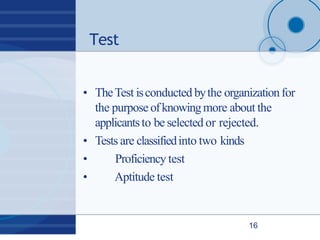
16
• TheTest isconducted bythe organizationfor
the purpose ofknowingmore about the
applicantsto be selected or rejected.
• Tests are classifiedinto two kinds
• Proficiency test
• Aptitude test
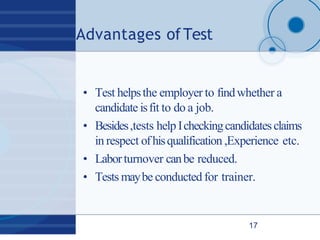
Advantages ofTest
17
• Test helpsthe employer to findwhether a
candidate isfit to do a job.
• Besides,tests help Icheckingcandidatesclaims
in respect ofhisqualification ,Experience etc.
• Laborturnover canbe reduced.
• Tests maybe conducted for trainer.
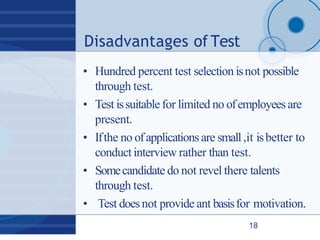
Disadvantages of Test
18
• Hundred percent test selection isnot possible
through test.
• Test issuitable for limited no ofemployeesare
present.
• Ifthe no ofapplications are small,it isbetter to
conduct interview rather than test.
• Somecandidate do not revel there talents
through test.
• Test doesnot provide ant basisfor motivation.
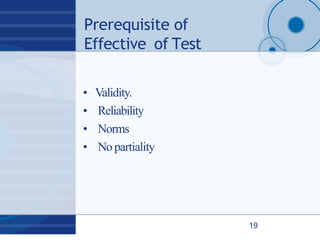
Prerequisite of
Effective of Test
19
• Validity.
• Reliability
• Norms
• No partiality
Prerequisite of Effective of Test
20
• Specialization
• Supplementary
• Checkingreferences
Interview
21
• Interview technique isamethod ofpersonal
appraisalthrough faceto faceconversation and
observation.
• Inanyinterview, the interviewer hasdominant
position over interviewee.
• Theinterview isdividedinto two i.e. primary
interview &finalinterview
Kinds ofInterview
22
• Direct Interview
• Indirect interview
• Patterned interview
Kinds ofInterview
23
• Stress Interview
• Systematicin depth interview
• Boardor panel interview
• Group interview
Principles of Interview
24
• Themanagement shoulddefine the specific
objectives of interview.
• The interviewer shouldaskquestionsrelated to
job.
• Theevaluationofthe performance shouldbe
done immediately after interview.
Process of Interview
25
• Reviewofbackground information.
• Preparation of questions
• Putting the applicantsat ease
• Drawingout the best applicant
• Concludingthe interview
Process of Interview
26
• Final Selection
• Medicalexamination
• Placement
• Orientation
Promotion
27
• Meaning:Placement ofaemployeefor better
job.
• BasisofPromotion
– Seniority
– Education
– Job knowledge
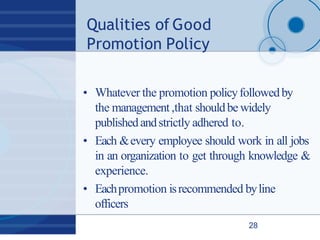
Qualities of Good
Promotion Policy
28
• Whatever the promotion policyfollowedby
the management,that shouldbe widely
publishedandstrictly adhered to.
• Each &every employee should work in all jobs
in an organization to get through knowledge &
experience.
• Eachpromotion isrecommended byline
officers
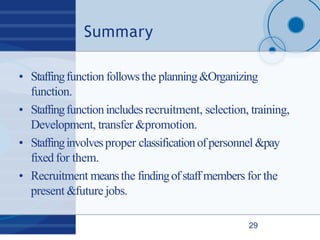
Summary
29
• Staffingfunction followsthe planning&Organizing
function.
• Staffingfunctionincludes recruitment, selection, training,
Development, transfer &promotion.
• Staffinginvolvesproper classificationofpersonnel &pay
fixed for them.
• Recruitment meansthe findingofstaffmembers for the
present &future jobs.

Staffing in Management

  • 1.
  • 2.
    Objectives 2 • Haveknowledgeabout Staffinganditsprocess. • Learnabout recruitment , sourcesboth internal &external with merits &demerits. • Knowabout selection, its importance and stages • Understand about test its kind&the advantages, disadvantages. • knowabout promotion, the basisofit and qualities ofgood promotion
  • 3.
    Introduction 3 • Staffingfunction followstheplanning& Organizing function. • Thestaffingfunctionincludes recruitment selection , training, development,transfer,promotion & compensation • Staffinginvolvesproper classificationof personnel &payfixed for them.
  • 4.
    Definition 4 • Haimann :Themanagerialfunction ofstaffing is“Concerned with the placement, &growth.” • KoontzandO’Donnel:The managerialfunction of staffing is “Managingthe organizational structure through proper selection” • S.Benjamin:Staffingfunctionisconcerned with the placement ,growth,& development ofall those members ofthe organization whose function isto get thingsget done through efforts of individuals.
  • 5.
    Elements of staffing 5 •EffectiveSelection &recruitment. • Proper classificationofpersonnel &payfixfor them. • Proper placement. • Adequate&appropriate training for development. • Satisfactoryandfair transfer &promotion. • Soundrelationship between managnent& workers. • Adequateprovisionfor retirement.
  • 6.
    Functions of staffing 6 •Manpower planning. • Development • Fixingemployment standards • Sources • Selection&placement • Training • Other sources
  • 7.
    Recruitment 7 • Recruitment meansthefindingofstaff members for the present &future jobs. • Accordingto Dalton E.McFarlandTheterm recruitment applies to Process ofattracting potential employees. • EdwinB.Flippo“Recruitment isthe processof searchingfor prospective employeesand stimulating them to applyfor the jobsin the organization.
  • 8.
    Sources of Recruitment 8 •The source ofrecruitment isbasedon the policyfollowed bythe company. • Ifthe job isfilledup out of present employees ofthe company,it issaidto be internal source of company. • Exampleare Transfer &promotion. • Ifthe job isfilledup from out of candidates availablein the society the ofthe companyit is saidto be External source of company.
  • 9.
    Internal Sources ofRecruitment Advantage‐Disadvantage 9 Advantage •It increasesmorale ofthe staffmembers of company. • It attracts efficientstaff members. • Thetraining expenses are reduced to some extent. Disadvantage • Ifthe higher position are filledinternally the companywill not be ableto get fresh &original idea&initiative from employees.
  • 10.
    External Sources ofRecruitment 10 •There are variousexternal sourcesof recruitment. • Advertisement • Recommendation • Gate applicants • Employment exchange • Personal consultant
  • 11.
    External Sources ofRecruitment 11 •Educational Institutions • Waiting list • Unsolicited applicants • Jobbers &contractors • Field trips • Leasing
  • 12.
    External Sources ofRecruitment Merits 12 Merits •Choice • New outlook • Wideexperience
  • 13.
    External Sources ofRecruitment Demerits 13 •Demerits • Gaugingofold employment • Lackofco-operation • Expensive • Trade union • Danger ofnon adjustment
  • 14.
    Selection • Selection isthedeviceusein the organization to select asuitable person whohasrequired educational qualification, skills, abilities. • Selection isthe processadopted bythe organizationto select adequate number of persons whoare fit for the job. • Selection requires highcost but results in very highreturns. • 14
  • 15.
    Stages of Selectionprocedure 15 •Receivingandscreeningof operations. • Internal interview • BlankApplication •
  • 16.
    Test 16 • TheTest isconductedbythe organizationfor the purpose ofknowingmore about the applicantsto be selected or rejected. • Tests are classifiedinto two kinds • Proficiency test • Aptitude test
  • 17.
    Advantages ofTest 17 • Testhelpsthe employer to findwhether a candidate isfit to do a job. • Besides,tests help Icheckingcandidatesclaims in respect ofhisqualification ,Experience etc. • Laborturnover canbe reduced. • Tests maybe conducted for trainer.
  • 18.
    Disadvantages of Test 18 •Hundred percent test selection isnot possible through test. • Test issuitable for limited no ofemployeesare present. • Ifthe no ofapplications are small,it isbetter to conduct interview rather than test. • Somecandidate do not revel there talents through test. • Test doesnot provide ant basisfor motivation.
  • 19.
    Prerequisite of Effective ofTest 19 • Validity. • Reliability • Norms • No partiality
  • 20.
    Prerequisite of Effectiveof Test 20 • Specialization • Supplementary • Checkingreferences
  • 21.
    Interview 21 • Interview techniqueisamethod ofpersonal appraisalthrough faceto faceconversation and observation. • Inanyinterview, the interviewer hasdominant position over interviewee. • Theinterview isdividedinto two i.e. primary interview &finalinterview
  • 22.
    Kinds ofInterview 22 • DirectInterview • Indirect interview • Patterned interview
  • 23.
    Kinds ofInterview 23 • StressInterview • Systematicin depth interview • Boardor panel interview • Group interview
  • 24.
    Principles of Interview 24 •Themanagement shoulddefine the specific objectives of interview. • The interviewer shouldaskquestionsrelated to job. • Theevaluationofthe performance shouldbe done immediately after interview.
  • 25.
    Process of Interview 25 •Reviewofbackground information. • Preparation of questions • Putting the applicantsat ease • Drawingout the best applicant • Concludingthe interview
  • 26.
    Process of Interview 26 •Final Selection • Medicalexamination • Placement • Orientation
  • 27.
    Promotion 27 • Meaning:Placement ofaemployeeforbetter job. • BasisofPromotion – Seniority – Education – Job knowledge
  • 28.
    Qualities of Good PromotionPolicy 28 • Whatever the promotion policyfollowedby the management,that shouldbe widely publishedandstrictly adhered to. • Each &every employee should work in all jobs in an organization to get through knowledge & experience. • Eachpromotion isrecommended byline officers
  • 29.
    Summary 29 • Staffingfunction followstheplanning&Organizing function. • Staffingfunctionincludes recruitment, selection, training, Development, transfer &promotion. • Staffinginvolvesproper classificationofpersonnel &pay fixed for them. • Recruitment meansthe findingofstaffmembers for the present &future jobs.