FOOD PROCESSING AND
PRESERVATION
PBS-FPP-311
SORTING AND GRADING
 Sorting and grading are terms which are frequently
used interchangeably in the food processing industry,
but strictly speaking they are distinct operations.
 Sorting is a separation based on a single measurable
property of raw material units, while grading is ‘‘the
assessment of the overall quality of a food using a
number of attributes’’.
 Grading of fresh produce may also be defined as
‘‘sorting according to quality,’’ as sorting usually
upgrades the product.
SORTING AND GRADING
 There are a number of benefits, including the need for
sorted units in weight filling operations, and the aesthetic
and marketing advantages in providing uniform-sized or
uniform-colored units.
 In addition, it is much easier to control processes such as
sterilization, dehydration, or freezing in sorted food units
 They are also better suited to mechanized operations such
as size reduction, pitting, or peeling.
SORTING
 Just like cleaning, sorting should be employed as early
as possible to ensure uniform product for subsequent
processing
 Sorting may therefore be used as part of grading but
not vice versa
 Sorting can be done manually or using automated
systems like conveyor belts with sensors, cameras, or
mechanical sorting machines.
SORTING
 The four main physical properties used to sort foods are
 Size – Ensures uniformity in products like fruits, vegetables, grains,
and nuts. using mechanical
 Shape -
 Weight -
 Color - Removes defective or discolored items, enhancing the overall
appearance of the product.
 Quality Sorting: Detects and removes damaged, rotten, or otherwise
unsuitable items from the production line
 Ripeness Sorting: Separates items based on their level of ripeness,
ensuring consistent quality in products like fruits and vegetables.
METHODS OF SORTING
1. Weight sorting
 This is usually the most precise method of sorting, as it is
not dependent on the geometry of the products.
 Eggs, fruit, or vegetables may be separated into weight
categories using spring-loaded, strain gauge, or electronic
weighing devices incorporated into conveying systems.
 Using a series of compressed air blowing mechanisms set to
trigger at progressively lesser weights, the heavier items are
removed first followed by the next weight category, and so
on.
 These systems are computer controlled and can additionally
provide data on quantities and size distributions from
different growers.
 A disadvantage of weight sorting is the relatively long time
required per unit
SORTING
2. Size sorting
 This is less precise than weight sorting, but is
considerably cheaper.
 The sizes and shapes of food units are difficult to define
precisely.
 Size categories could include a number of physical
parameters including diameter, length, or projected area.
 Diameter of spheroidal units such as tomatoes or citrus
fruits is conventionally considered to be orthogonal to the
fruit stem, while length is coaxial.
 Therefore rotating the units on a conveyor can make size
sorting more precise
SORTING AND GRADING
3. Shape sorting
 This is useful in cases where the food units are
contaminated with particles of similar size and weight.
 This is particularly applicable to grain which may contain
other seeds.
 The principle is that disks or cylinders with accurately
shaped indentations will pick up seeds of the correct
shape when rotated through the stock, while other shapes
will remain in the feed
SORTING AND GRADING
4. Sorting according to density
 This can be a marker of suitability for certain processes.
 The density of peas correlates well with tenderness and
sweetness, while the solids content of potatoes, which
determines suitability for manufacture of crisps and dried
products, relates to density.
 Sorting on the basis of density can be achieved using
flotation in brine at different concentrations.
SORTING AND GRADING
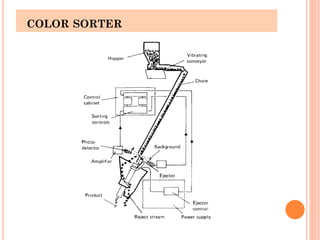
5. Color sorting
 Photometric properties (color) may be used as a basis for
sorting.
 Color is often a measure of maturity, presence of defects, or the
degree of processing.
 Manual color sorting is carried out widely on conveyor belts or
sorting tables, but is expensive.
 The process can be automated using highly accurate photocells
which compare reflectance of food units to preset standards,
and can eject defective or wrongly colored units,
 This system is used for small particulate foods such as navy
beans or maize kernels for canning, or nuts, rice, and small
 Color sorting can also be used to separate materials which are
to be processed separately such as red and green tomatoes.
COLOR SORTER
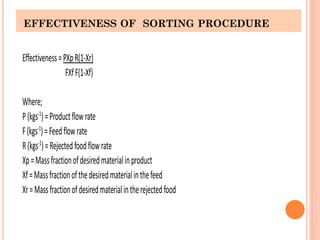
EFFECTIVENESS OF SORTING PROCEDURE
Effectiveness=PXpR(1-Xr)
FXfF(1-Xf)
Where;
P(kgs-1
)=Productflowrate
F(kgs-1
)=Feedflowrate
R(kgs-1
)=Rejectedfoodflowrate
Xp=Massfractionofdesiredmaterialinproduct
Xf=Massfractionofthedesiredmaterialinthefeed
Xr=Massfractionofdesiredmaterialintherejectedfood
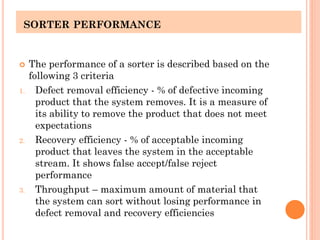
SORTER PERFORMANCE
 The performance of a sorter is described based on the
following 3 criteria
1. Defect removal efficiency - % of defective incoming
product that the system removes. It is a measure of
its ability to remove the product that does not meet
expectations
2. Recovery efficiency - % of acceptable incoming
product that leaves the system in the acceptable
stream. It shows false accept/false reject
performance
3. Throughput – maximum amount of material that
the system can sort without losing performance in
defect removal and recovery efficiencies
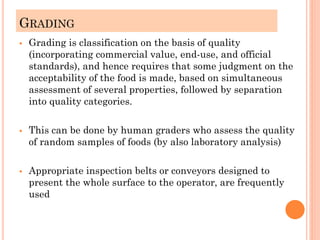
GRADING
▪ Grading is classification on the basis of quality
(incorporating commercial value, end-use, and official
standards), and hence requires that some judgment on the
acceptability of the food is made, based on simultaneous
assessment of several properties, followed by separation
into quality categories.
▪ This can be done by human graders who assess the quality
of random samples of foods (by also laboratory analysis)
▪ Appropriate inspection belts or conveyors designed to
present the whole surface to the operator, are frequently
used
GRADING
▪ Trained manual operators are frequently used to judge
the quality, and may use comparison to charted
standards, or even plastic models.
▪ For example, a fruit grader could simultaneously judge
shape, color, evenness of color, and degree of russeting
in apples. Egg ‘‘candling’’ involves inspection of eggs
spun in front of a light so that many factors, including
shell cracks, diseases, blood spots, or fertilization, can
be detected.
▪ Apparently, experienced candlers can grade thousands
of eggs per hour.
▪ Machine grading is only feasible where quality of a food
is linked to a single physical property, and hence a
sorting operation leads to different grades of material.
▪ Size of peas, for example, is related to tenderness and
sweetness, therefore size sorting results in different
quality grades

Food Processing and preservation 1b sorting.pdf

  • 1.
  • 2.
    SORTING AND GRADING Sorting and grading are terms which are frequently used interchangeably in the food processing industry, but strictly speaking they are distinct operations.  Sorting is a separation based on a single measurable property of raw material units, while grading is ‘‘the assessment of the overall quality of a food using a number of attributes’’.  Grading of fresh produce may also be defined as ‘‘sorting according to quality,’’ as sorting usually upgrades the product.
  • 3.
    SORTING AND GRADING There are a number of benefits, including the need for sorted units in weight filling operations, and the aesthetic and marketing advantages in providing uniform-sized or uniform-colored units.  In addition, it is much easier to control processes such as sterilization, dehydration, or freezing in sorted food units  They are also better suited to mechanized operations such as size reduction, pitting, or peeling.
  • 4.
    SORTING  Just likecleaning, sorting should be employed as early as possible to ensure uniform product for subsequent processing  Sorting may therefore be used as part of grading but not vice versa  Sorting can be done manually or using automated systems like conveyor belts with sensors, cameras, or mechanical sorting machines.
  • 5.
    SORTING  The fourmain physical properties used to sort foods are  Size – Ensures uniformity in products like fruits, vegetables, grains, and nuts. using mechanical  Shape -  Weight -  Color - Removes defective or discolored items, enhancing the overall appearance of the product.  Quality Sorting: Detects and removes damaged, rotten, or otherwise unsuitable items from the production line  Ripeness Sorting: Separates items based on their level of ripeness, ensuring consistent quality in products like fruits and vegetables.
  • 6.
    METHODS OF SORTING 1.Weight sorting  This is usually the most precise method of sorting, as it is not dependent on the geometry of the products.  Eggs, fruit, or vegetables may be separated into weight categories using spring-loaded, strain gauge, or electronic weighing devices incorporated into conveying systems.  Using a series of compressed air blowing mechanisms set to trigger at progressively lesser weights, the heavier items are removed first followed by the next weight category, and so on.  These systems are computer controlled and can additionally provide data on quantities and size distributions from different growers.  A disadvantage of weight sorting is the relatively long time required per unit
  • 7.
    SORTING 2. Size sorting This is less precise than weight sorting, but is considerably cheaper.  The sizes and shapes of food units are difficult to define precisely.  Size categories could include a number of physical parameters including diameter, length, or projected area.  Diameter of spheroidal units such as tomatoes or citrus fruits is conventionally considered to be orthogonal to the fruit stem, while length is coaxial.  Therefore rotating the units on a conveyor can make size sorting more precise
  • 8.
    SORTING AND GRADING 3.Shape sorting  This is useful in cases where the food units are contaminated with particles of similar size and weight.  This is particularly applicable to grain which may contain other seeds.  The principle is that disks or cylinders with accurately shaped indentations will pick up seeds of the correct shape when rotated through the stock, while other shapes will remain in the feed
  • 9.
    SORTING AND GRADING 4.Sorting according to density  This can be a marker of suitability for certain processes.  The density of peas correlates well with tenderness and sweetness, while the solids content of potatoes, which determines suitability for manufacture of crisps and dried products, relates to density.  Sorting on the basis of density can be achieved using flotation in brine at different concentrations.
  • 10.
    SORTING AND GRADING 5.Color sorting  Photometric properties (color) may be used as a basis for sorting.  Color is often a measure of maturity, presence of defects, or the degree of processing.  Manual color sorting is carried out widely on conveyor belts or sorting tables, but is expensive.  The process can be automated using highly accurate photocells which compare reflectance of food units to preset standards, and can eject defective or wrongly colored units,  This system is used for small particulate foods such as navy beans or maize kernels for canning, or nuts, rice, and small  Color sorting can also be used to separate materials which are to be processed separately such as red and green tomatoes.
  • 11.
  • 12.
    EFFECTIVENESS OF SORTINGPROCEDURE Effectiveness=PXpR(1-Xr) FXfF(1-Xf) Where; P(kgs-1 )=Productflowrate F(kgs-1 )=Feedflowrate R(kgs-1 )=Rejectedfoodflowrate Xp=Massfractionofdesiredmaterialinproduct Xf=Massfractionofthedesiredmaterialinthefeed Xr=Massfractionofdesiredmaterialintherejectedfood
  • 13.
    SORTER PERFORMANCE  Theperformance of a sorter is described based on the following 3 criteria 1. Defect removal efficiency - % of defective incoming product that the system removes. It is a measure of its ability to remove the product that does not meet expectations 2. Recovery efficiency - % of acceptable incoming product that leaves the system in the acceptable stream. It shows false accept/false reject performance 3. Throughput – maximum amount of material that the system can sort without losing performance in defect removal and recovery efficiencies
  • 14.
    GRADING ▪ Grading isclassification on the basis of quality (incorporating commercial value, end-use, and official standards), and hence requires that some judgment on the acceptability of the food is made, based on simultaneous assessment of several properties, followed by separation into quality categories. ▪ This can be done by human graders who assess the quality of random samples of foods (by also laboratory analysis) ▪ Appropriate inspection belts or conveyors designed to present the whole surface to the operator, are frequently used
  • 15.
    GRADING ▪ Trained manualoperators are frequently used to judge the quality, and may use comparison to charted standards, or even plastic models. ▪ For example, a fruit grader could simultaneously judge shape, color, evenness of color, and degree of russeting in apples. Egg ‘‘candling’’ involves inspection of eggs spun in front of a light so that many factors, including shell cracks, diseases, blood spots, or fertilization, can be detected. ▪ Apparently, experienced candlers can grade thousands of eggs per hour. ▪ Machine grading is only feasible where quality of a food is linked to a single physical property, and hence a sorting operation leads to different grades of material. ▪ Size of peas, for example, is related to tenderness and sweetness, therefore size sorting results in different quality grades