EXTRUSION COOKING
Shubham Nimbkar
I PhD FPE
INTRODUCTION
• Extrusion: (Latin word extrudere): Action of pushing out
• Forcing material out of narrow gap
• Extrusion Cooking: Thermomechanical process
• Heat transfer, mass transfer, pressure changes and shear
• Cooking, sterilization, drying, melting, cooling, texturizing, conveying, puffing, mixing,
kneading, forming, etc.
• Extrusion cooker is a combination of a pump, a heat exchanger, a continuous high-
pressure-high-temperature reactor
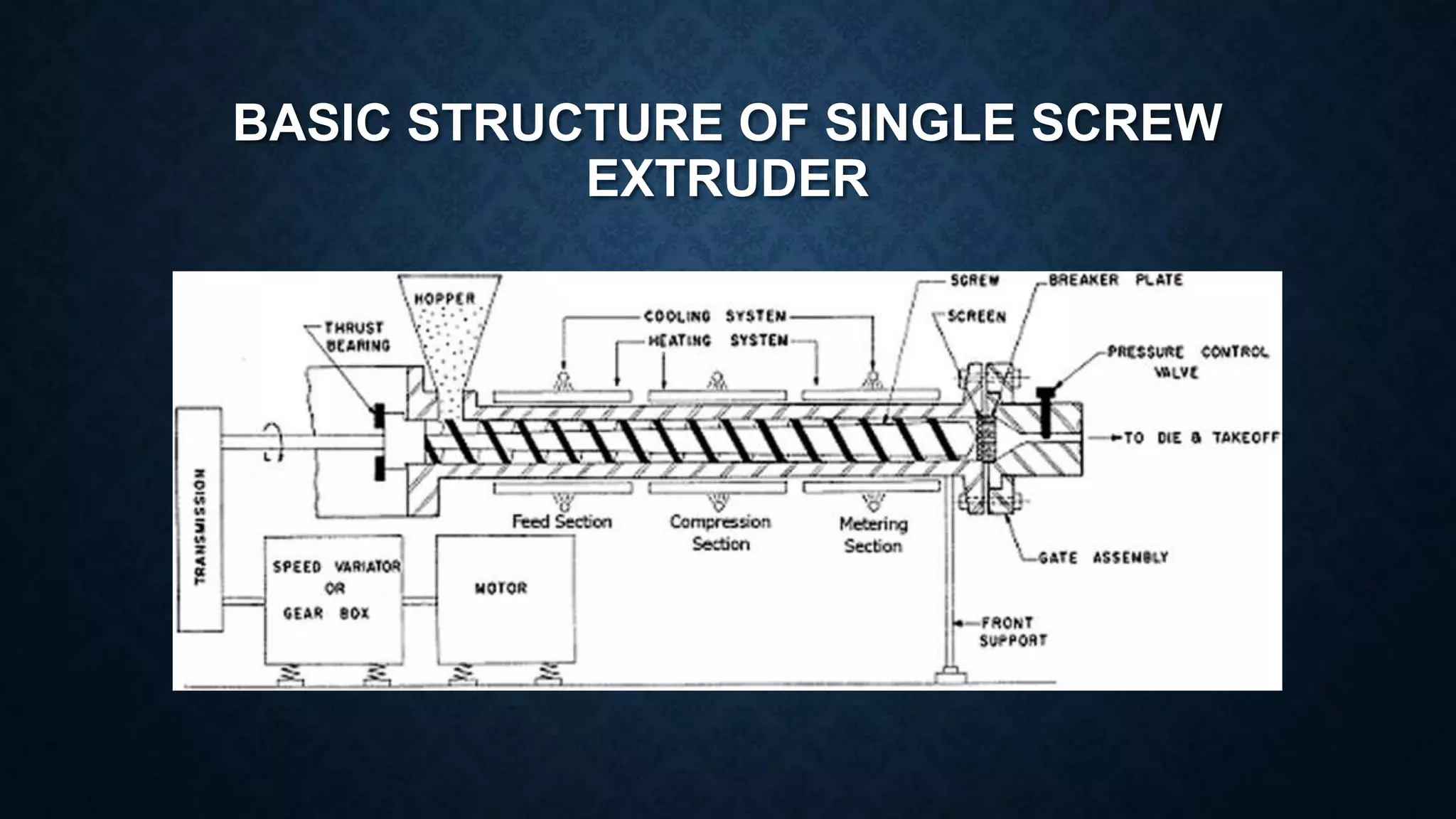
BASIC STRUCTURE OF SINGLE SCREW
EXTRUDER
COMPONENTS
• Barrel: Hollow cylindrical enclosure. Encloses screw
• Screw/worm: A helical part that conveys, works and forces the ingredients through the
die
• Die: Small opening at the end of the extruder to shape the products
• Breaker plate: A mechanical seal between die and end of extruder
• Jacket: For heating or cooling of barrel
• Hopper: For feeding of ingredients
Extrusion drive
• Function: rotation of screw
• Electric motor
• Size depends on capacity of extruder (can be as large as 300 kW)
• Screw speed: usually less than 500 rpm
Feeder:
• Uniform delivery of food ingredients to the extruder
• Regulates the pressure and flow of feed
• Auger feeder, hopper, vibratory feeder.
BARREL
• Hollow and cylindrical (in food industry)
• The internal surface can be smooth or grooved
Single screw barrel Twin screw barrel
SCREW
• Most important component
• Conveys, shears and plasticizes the mass
• Diameter of a screw of a single screw extruder normally varied between 2-15 cm
SOME IMPORTANT TERMS
Flight: A helical conveying surface of screw, which pushes raw material further
Flow channel: a helicoidal channel between screw root and barrel
Pitch: Distance between two consecutive flights
L/D ratio: Ratio of length to diameter of screw
Compression ratio: Ratio of volume of full flight at start and end of the extruder
DIE
• Two main functions: Give shape and promote resistance
• Increases internal pressure
• Various designs and number of orifices
• Designed to be highly restrictive, giving increased barrel fill, residence time and energy
input
OPERATION
• The raw material is fed to the barrel which is conveyed further by screw
• The screw configuration is such a way that the flow channel area is progressively
reduced causing compression of the fed material.
• As it moves forward, the screw kneads the material into a semi-solid, plasticized mass
SECTIONS OF EXTRUDER
• Feed Section: Acts as screw conveyor. No compression or modification occurs. Deep
flights so that feed falls easily between them.
• Compression Section: Food ingredients are compressed, sheared and heated.
Material is worked into viscous dough, partially cooked at elevated temperature and
pressure.
• Metering Section: Nearest to discharge. Very shallow flights leads to increased shear
and mixing causing melting, texturization, kneading, chemical reactions, etc.
• Heating: through friction, heated barrel surface, direct steam injection
• Due to higher pressure, higher temperature (180-200˚C) is achieved.
• The pressure is suddenly released at the exit from the die, some water is flash
evaporated and product is puffed.
• Two flows:
• Drag flow
• Pressure driven backflow
Temperature and pressure profile
CLASSIFICATION OF EXTRUDERS
Based on
operation
Hot extruders
(>100˚C)
Cold
extruders
(<100˚C)
Based on
construction
Single screw Twin screw
Co-rotating
Counter-
rotating
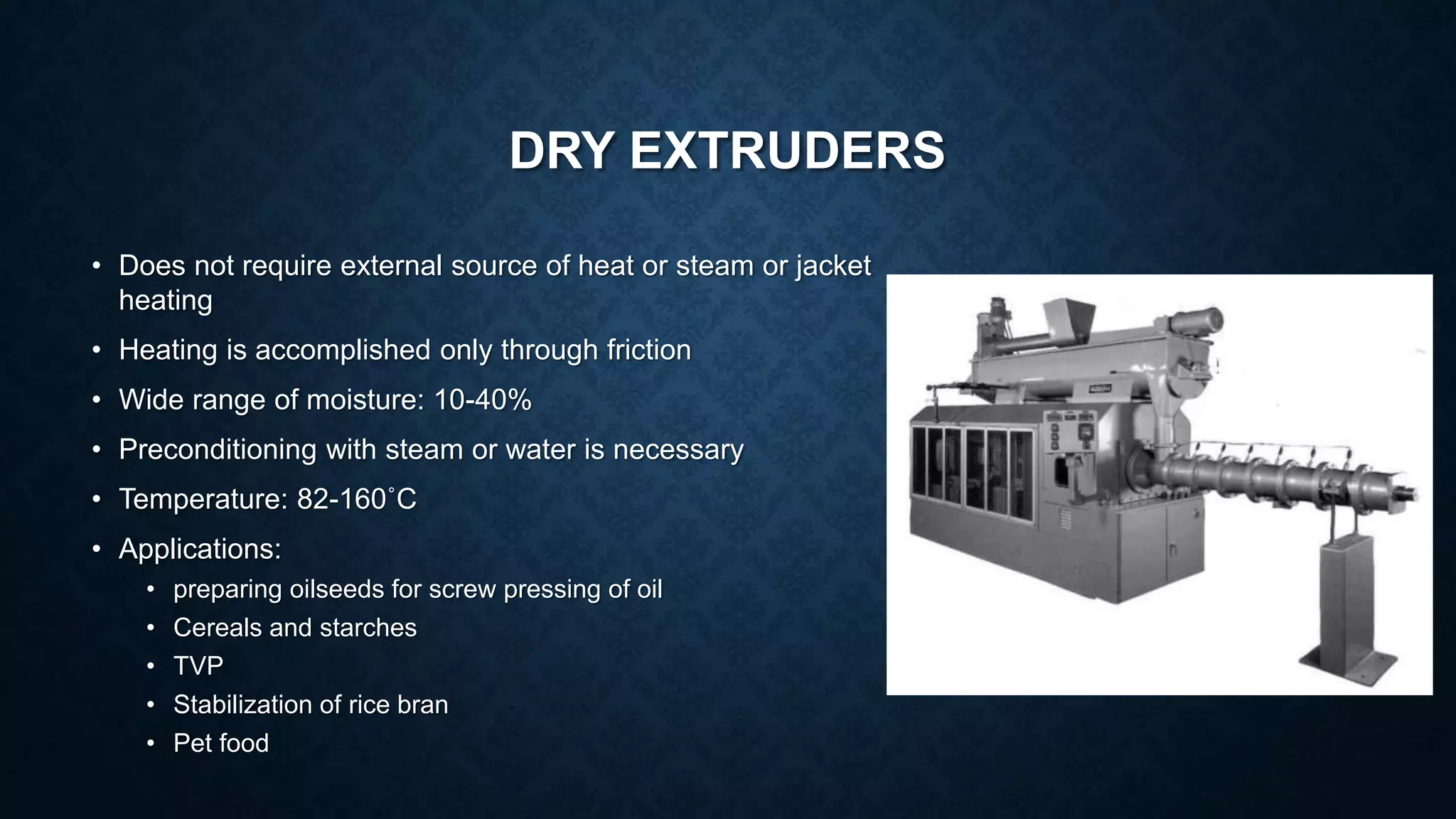
DRY EXTRUDERS
• Does not require external source of heat or steam or jacket
heating
• Heating is accomplished only through friction
• Wide range of moisture: 10-40%
• Preconditioning with steam or water is necessary
• Temperature: 82-160˚C
• Applications:
• preparing oilseeds for screw pressing of oil
• Cereals and starches
• TVP
• Stabilization of rice bran
• Pet food
INTERRUPTED FLIGHT EXTRUDER
• Also called as ‘expanders’
• Shaft with interrupted flights inside a smooth
barrel
• Removable stationary pins protruding from barrel
and intermeshing with interruptions
• Provides high shear, turbulent mixing action
which provides rapid and uniform absorption of
moisture.
• Temperature: 120-150˚C
• Applications:
• Processing of pet foods
• Preparing of oilseeds for solvent extraction
• Aquaculture feed
TWIN SCREW EXTRUDER
• A pair of parallel screws rotating inside a barrel with an 8
shaped cross section
• Rotation: Corotating, counter-rotating
• Position: Intermeshing, non-intermeshing
• Self wiping corotating twin screw extruder is most widely
used
• Applications:
• For processing of sticky products such as caramel, candies
• Cocoa and crumb
• Dairy products
• Instant noodles
MAJOR FEATURES
Versatility
Reduced Cost
High production
rate and
automated
production
Product quality
No process
effluents
THANK YOU!!!

extrusion cooking presentation.pptx

  • 1.
  • 2.
    INTRODUCTION • Extrusion: (Latinword extrudere): Action of pushing out • Forcing material out of narrow gap • Extrusion Cooking: Thermomechanical process • Heat transfer, mass transfer, pressure changes and shear • Cooking, sterilization, drying, melting, cooling, texturizing, conveying, puffing, mixing, kneading, forming, etc. • Extrusion cooker is a combination of a pump, a heat exchanger, a continuous high- pressure-high-temperature reactor
  • 3.
    BASIC STRUCTURE OFSINGLE SCREW EXTRUDER
  • 4.
    COMPONENTS • Barrel: Hollowcylindrical enclosure. Encloses screw • Screw/worm: A helical part that conveys, works and forces the ingredients through the die • Die: Small opening at the end of the extruder to shape the products • Breaker plate: A mechanical seal between die and end of extruder • Jacket: For heating or cooling of barrel • Hopper: For feeding of ingredients
  • 5.
    Extrusion drive • Function:rotation of screw • Electric motor • Size depends on capacity of extruder (can be as large as 300 kW) • Screw speed: usually less than 500 rpm Feeder: • Uniform delivery of food ingredients to the extruder • Regulates the pressure and flow of feed • Auger feeder, hopper, vibratory feeder.
  • 6.
    BARREL • Hollow andcylindrical (in food industry) • The internal surface can be smooth or grooved Single screw barrel Twin screw barrel
  • 7.
    SCREW • Most importantcomponent • Conveys, shears and plasticizes the mass • Diameter of a screw of a single screw extruder normally varied between 2-15 cm
  • 8.
    SOME IMPORTANT TERMS Flight:A helical conveying surface of screw, which pushes raw material further Flow channel: a helicoidal channel between screw root and barrel Pitch: Distance between two consecutive flights L/D ratio: Ratio of length to diameter of screw Compression ratio: Ratio of volume of full flight at start and end of the extruder
  • 10.
    DIE • Two mainfunctions: Give shape and promote resistance • Increases internal pressure • Various designs and number of orifices • Designed to be highly restrictive, giving increased barrel fill, residence time and energy input
  • 11.
    OPERATION • The rawmaterial is fed to the barrel which is conveyed further by screw • The screw configuration is such a way that the flow channel area is progressively reduced causing compression of the fed material. • As it moves forward, the screw kneads the material into a semi-solid, plasticized mass
  • 12.
    SECTIONS OF EXTRUDER •Feed Section: Acts as screw conveyor. No compression or modification occurs. Deep flights so that feed falls easily between them. • Compression Section: Food ingredients are compressed, sheared and heated. Material is worked into viscous dough, partially cooked at elevated temperature and pressure. • Metering Section: Nearest to discharge. Very shallow flights leads to increased shear and mixing causing melting, texturization, kneading, chemical reactions, etc.
  • 13.
    • Heating: throughfriction, heated barrel surface, direct steam injection • Due to higher pressure, higher temperature (180-200˚C) is achieved. • The pressure is suddenly released at the exit from the die, some water is flash evaporated and product is puffed. • Two flows: • Drag flow • Pressure driven backflow
  • 14.
  • 15.
    CLASSIFICATION OF EXTRUDERS Basedon operation Hot extruders (>100˚C) Cold extruders (<100˚C) Based on construction Single screw Twin screw Co-rotating Counter- rotating
  • 16.
    DRY EXTRUDERS • Doesnot require external source of heat or steam or jacket heating • Heating is accomplished only through friction • Wide range of moisture: 10-40% • Preconditioning with steam or water is necessary • Temperature: 82-160˚C • Applications: • preparing oilseeds for screw pressing of oil • Cereals and starches • TVP • Stabilization of rice bran • Pet food
  • 17.
    INTERRUPTED FLIGHT EXTRUDER •Also called as ‘expanders’ • Shaft with interrupted flights inside a smooth barrel • Removable stationary pins protruding from barrel and intermeshing with interruptions • Provides high shear, turbulent mixing action which provides rapid and uniform absorption of moisture. • Temperature: 120-150˚C • Applications: • Processing of pet foods • Preparing of oilseeds for solvent extraction • Aquaculture feed
  • 18.
    TWIN SCREW EXTRUDER •A pair of parallel screws rotating inside a barrel with an 8 shaped cross section • Rotation: Corotating, counter-rotating • Position: Intermeshing, non-intermeshing • Self wiping corotating twin screw extruder is most widely used • Applications: • For processing of sticky products such as caramel, candies • Cocoa and crumb • Dairy products • Instant noodles
  • 19.
    MAJOR FEATURES Versatility Reduced Cost Highproduction rate and automated production Product quality No process effluents
  • 20.