 Introduction
 Principle Process
 Equipment
 Food Applications
 Advantages & Disadvantages
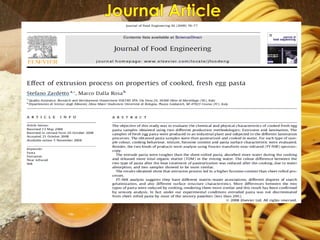
 Journal Article
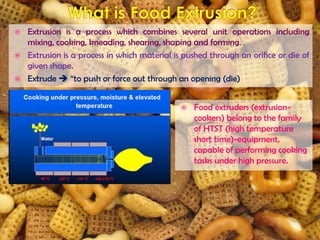
 Extrusion is a process which combines several unit operations including
mixing, cooking, kneading, shearing, shaping and forming.
 Extrusion is a process in which material is pushed through an orifice or die of
given shape.
 Extrude  “to push or force out through an opening (die)
 Food extruders (extrusion-
cookers) belong to the family
of HTST (high temperature
short time)-equipment,
capable of performing cooking
tasks under high pressure.
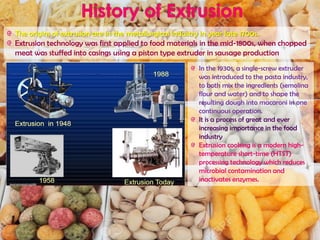
In the 1930s, a single-screw extruder
was introduced to the pasta industry,
to both mix the ingredients (semolina
flour and water) and to shape the
resulting dough into macaroni in one
continuous operation.
It is a process of great and ever
increasing importance in the food
industry
Extrusion cooking is a modern high-
temperature short-time (HTST)
processing technology which reduces
microbial contamination and
inactivates enzymes.
The origins of extrusion are in the metallurgical industry in year late 1700s.
Extrusion technology was first applied to food materials in the mid-1800s, when chopped
meat was stuffed into casings using a piston type extruder in sausage production
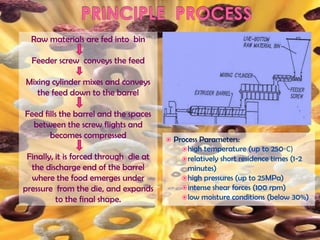
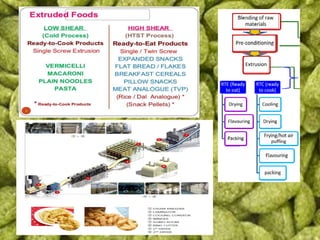
Raw materials are fed into bin
Feeder screw conveys the feed
Mixing cylinder mixes and conveys
the feed down to the barrel
Feed fills the barrel and the spaces
between the screw flights and
becomes compressed
Finally, it is forced through die at
the discharge end of the barrel
where the food emerges under
pressure from the die, and expands
to the final shape.
 Process Parameters:
high temperature (up to 250◦C)
relatively short residence times (1-2
minutes)
high pressures (up to 25MPa)
intense shear forces (100 rpm)
low moisture conditions (below 30%)
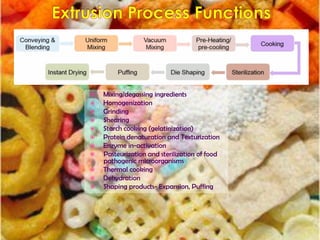
 Mixing/degassing ingredients
 Homogenization
 Grinding
 Shearing
 Starch cooking (gelatinization)
 Protein denaturation and Texturization
 Enzyme in-activation
 Pasteurization and sterilization of food
pathogenic microorganisms
 Thermal cooking
 Dehydration
 Shaping products- Expansion, Puffing
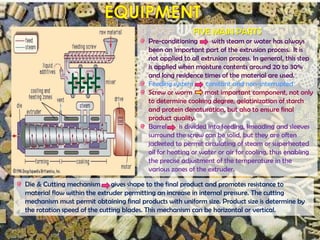
FIVE MAIN PARTS
Pre-conditioning with steam or water has always
been an important part of the extrusion process. It is
not applied to all extrusion process. In general, this step
is applied when moisture contents around 20 to 30%
and long residence times of the material are used.
Feeding system constant and non-interrupted
Screw or worm most important component, not only
to determine cooking degree, gelatinization of starch
and protein denaturation, but also to ensure final
product quality.
Barrel is divided into feeding, kneading and sleeves
surround the screw can be solid, but they are often
jacketed to permit circulating of steam or superheated
oil for heating or water or air for cooling, thus enabling
the precise adjustment of the temperature in the
various zones of the extruder.
Die & Cutting mechanism gives shape to the final product and promotes resistance to
material flow within the extruder permitting an increase in internal pressure. The cutting
mechanism must permit obtaining final products with uniform size. Product size is determine by
the rotation speed of the cutting blades. This mechanism can be horizontal or vertical.
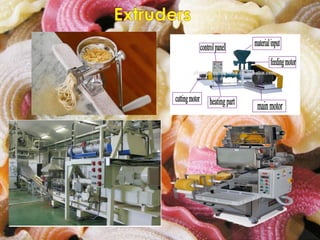
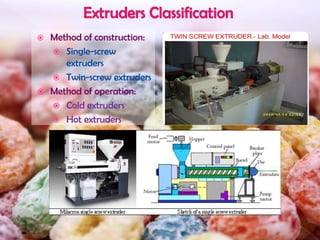
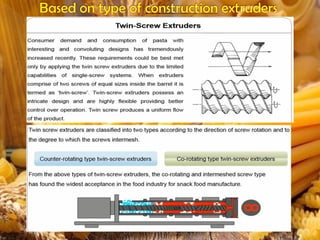
 Method of construction:
 Single-screw
extruders
 Twin-screw extruders
 Method of operation:
 Cold extruders
 Hot extruders
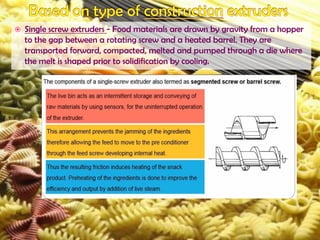
 Single screw extruders - Food materials are drawn by gravity from a hopper
to the gap between a rotating screw and a heated barrel. They are
transported forward, compacted, melted and pumped through a die where
the melt is shaped prior to solidification by cooling.
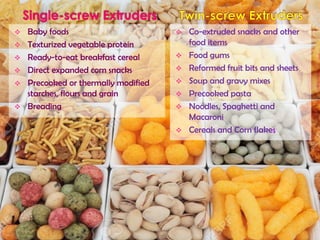
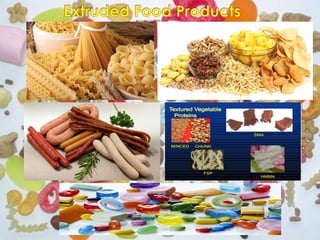
 Baby foods
 Texturized vegetable protein
 Ready-to-eat breakfast cereal
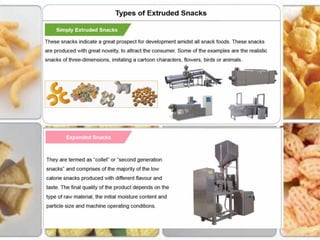
 Direct expanded corn snacks
 Precooked or thermally modified
starches, flours and grain
 Breading
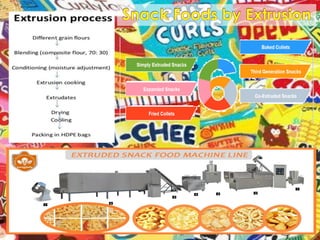
 Co-extruded snacks and other
food items
 Food gums
 Reformed fruit bits and sheets
 Soup and gravy mixes
 Precooked pasta
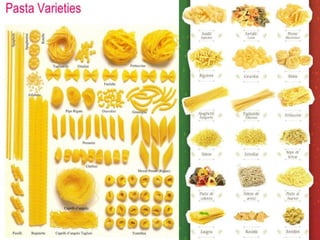
 Noodles, Spaghetti and
Macaroni
 Cereals and Corn flakes
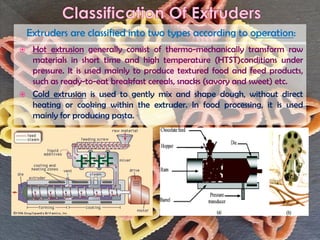
 Hot extrusion generally consist of thermo-mechanically transform raw
materials in short time and high temperature (HTST)conditions under
pressure. It is used mainly to produce textured food and feed products,
such as ready-to-eat breakfast cereals, snacks (savory and sweet) etc.
 Cold extrusion is used to gently mix and shape dough, without direct
heating or cooking within the extruder. In food processing, it is used
mainly for producing pasta.
Extruders are classified into two types according to operation:
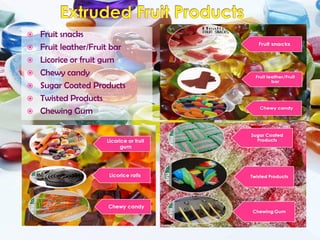
 Fruit snacks
 Fruit leather/Fruit bar
 Licorice or fruit gum
 Chewy candy
 Sugar Coated Products
 Twisted Products
 Chewing Gum
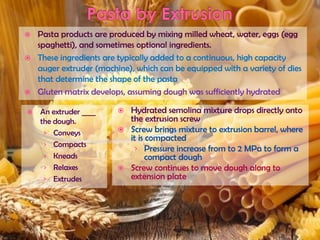
 Pasta products are produced by mixing milled wheat, water, eggs (egg
spaghetti), and sometimes optional ingredients.
 These ingredients are typically added to a continuous, high capacity
auger extruder (machine), which can be equipped with a variety of dies
that determine the shape of the pasta
 Gluten matrix develops, assuming dough was sufficiently hydrated
 An extruder ____
the dough.
› Conveys
› Compacts
› Kneads
› Relaxes
› Extrudes
 Hydrated semolina mixture drops directly onto
the extrusion screw
 Screw brings mixture to extrusion barrel, where
it is compacted
› Pressure increase from to 2 MPa to form a
compact dough
 Screw continues to move dough along to
extension plate
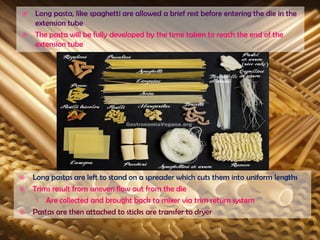
 Long pastas are left to stand on a spreader which cuts them into uniform lengths
 Trims result from uneven flow out from the die
› Are collected and brought back to mixer via trim return system
 Pastas are then attached to sticks are transfer to dryer
 Long pasta, like spaghetti are allowed a brief rest before entering the die in the
extension tube
 The pasta will be fully developed by the time taken to reach the end of the
extension tube
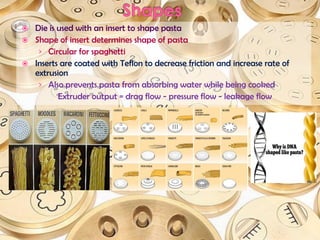
 Die is used with an insert to shape pasta
 Shape of insert determines shape of pasta
› Circular for spaghetti
 Inserts are coated with Teflon to decrease friction and increase rate of
extrusion
› Also prevents pasta from absorbing water while being cooked
Extruder output = drag flow - pressure flow - leakage flow
 Versatility – a wide range of products, many of which cannot be
produced easily by any other process, is possible by changing the
ingredients, extruder operating conditions and dies, any changes
can be made quickly during cooking.
 Cost - extrusion has lower processing costs and higher productivity
than other cooking and forming processes.
 Productivity - extruders can operate continuously with high
throughput
 Product Quality - extrusion cooking involves high temperatures
applied for a short time, retaining many heat sensitive
components of a food and minimizes nutrient and flavor losses.
 Environmentally_friendly - as a low-moisture process, extrusion
cooking does not produce significant process effluents, reducing
water treatment costs and levels of environmental pollution
 Fading of product color due to
expansion on excessive heat
 Loss of vitamins
 Mallard browning & Caramelization
 Loss of protein
 Loss of flavor
 Due to the elevated temperatures and low moisture conditions used, different
chemical reactions such as the non-enzymatic browning can take place.
Non-enzymatic browning includes Maillard reaction (MR) and caramelization.
 Temperature treatment of food material containing proteins and reducing sugars
usually leads to a deterioration of the nutritional characteristic of proteins (lysine).
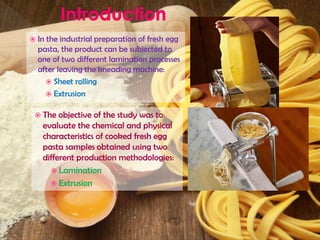
 In the industrial preparation of fresh egg
pasta, the product can be subjected to
one of two different lamination processes
after leaving the kneading machine:
 Sheet rolling
 Extrusion
 The objective of the study was to
evaluate the chemical and physical
characteristics of cooked fresh egg
pasta samples obtained using two
different production methodologies:
 Lamination
 Extrusion
 The samples were produced on the industrial production line.
 The fresh pasta was obtained by mixing durum wheat semolina (76% w/w; 12 ± 1%
w/w protein dry mass [dm]), pasteurized fresh egg (19% w/w), and water (5% w/w).
Its composition was: moisture 31.5 ± 0.5%; protein 13.29 ± 0.14%; ash 1.01 ± 0.007%; and
ether extract 3.76 ± 0.21%.
 The pasta was formed into a sheet in one or other of the following processes.
 (1) Extrusion was by continuous press (model K500, Monferrato, Asti, Italy), with
a bronze die with circular punctures of 19 cm diameter and 2.5 cm breadth,
using a partial vacuum (300 mmHg). The sheets were passed through the press
until they reached the sheet-rolling stage, at the end of which the thickness of
the product was 0.90 mm.
 (2) Lamination was performed where the pasta was rolled with four steel
cylinders to form a sheet of thickness 1 cm, then passed to a second cylinder (with
a cylinder diameter of 20 cm and rotation speed of 3.5 rpm), to produce a sheet
with a thickness of 0.90 mm.
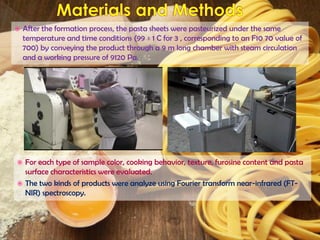
 After the formation process, the pasta sheets were pasteurized under the same
temperature and time conditions (99 ± 1 C for 3 , corresponding to an F10 70 value of
700) by conveying the product through a 9 m long chamber with steam circulation
and a working pressure of 9120 Pa.
 For each type of sample color, cooking behavior, texture, furosine content and pasta
surface characteristics were evaluated.
 The two kinds of products were analyze using Fourier transform near-infrared (FT-
NIR) spectroscopy.
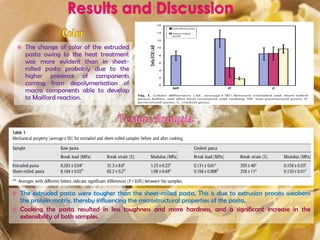
 The change of color of the extruded
pasta owing to the heat treatment
was more evident than in sheet-
rolled pasta probably due to the
higher presence of components
coming from depolymerisation of
macro components able to develop
to Maillard reaction.
 The extruded pasta were tougher than the sheet-rolled pasta. This is due to extrusion process weakens
the protein matrix, thereby influencing the microstructural properties of the pasta.
 Cooking the pasta resulted in less toughness and more hardness, and a significant increase in the
extensibility of both samples.
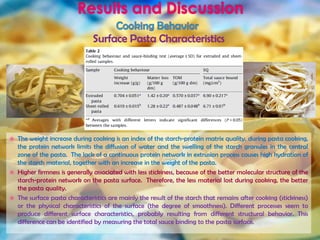
 The weight increase during cooking is an index of the starch-protein matrix quality, during pasta cooking,
the protein network limits the diffusion of water and the swelling of the starch granules in the central
zone of the pasta. The lack of a continuous protein network in extrusion process causes high hydration of
the starch material, together with an increase in the weight of the pasta.
 Higher firmness is generally associated with less stickiness, because of the better molecular structure of the
starch-protein network on the pasta surface. Therefore, the less material lost during cooking, the better
the pasta quality.
 The surface pasta characteristics are mainly the result of the starch that remains after cooking (stickiness)
or the physical characteristics of the surface (the degree of smoothness). Different processes seem to
produce different surface characteristics, probably resulting from different structural behavior. This
difference can be identified by measuring the total sauce binding to the pasta surface.
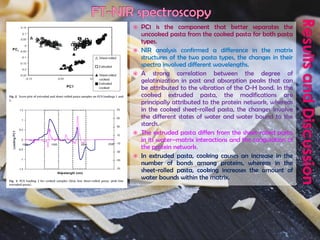
 PC1 is the component that better separates the
uncooked pasta from the cooked pasta for both pasta
types.
 NIR analysis confirmed a difference in the matrix
structures of the two pasta types, the changes in their
spectra involved different wavelengths.
 A strong correlation between the degree of
gelatinization in past and absorption peaks that can
be attributed to the vibration of the O-H bond. In the
cooked extruded pasta, the modifications are
principally attributed to the protein network, whereas
in the cooked sheet-rolled pasta, the changes involve
the different states of water and water bound to the
starch.
 The extruded pasta differs from the sheet-rolled pasta
in its water–matrix interactions and the coagulation of
the protein network.
 In extruded pasta, cooking causes an increase in the
number of bonds among proteins, whereas in the
sheet-rolled pasta, cooking increases the amount of
water bounds within the matrix.
 Differences in the structural properties of the two pasta, do not cause a strong
sensory difference and are probably not perceived by most consumer.
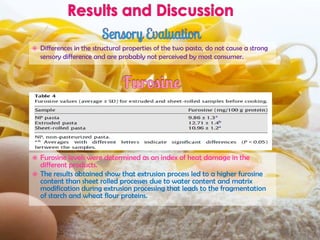
 Furosine levels were determined as an index of heat damage in the
different products.
 The results obtained show that extrusion process led to a higher furosine
content than sheet rolled processes due to water content and matrix
modification during extrusion processing that leads to the fragmentation
of starch and wheat flour proteins.
 In the study, the extruded were tougher than the sheet-rolled pasta,
absorbed more water during the cooking and released more total organic
matter in the rinsing water.
 Extruded pasta presents a furosine value higher than sheet roller pasta and
the difference was probably due to the formation of components coming
able to contribute to Maillard reaction.
 Extruded pasta have a different degree of surface smoothness that increase
the total sauce fastened on the product.
 The cooking processes reduced the differences between the two type of pasta
rendering them more similar particularly in its color difference.
 NIR analysis confirmed a difference in the matrix structures of the two pasta
types. In extruded pasta, cooking causes an increase in the number of bonds
among proteins, whereas in the sheet-rolled pasta, cooking increases the
amount of water bounds within the matrix.
 Differences in the structural properties of the two pasta, do not cause a
strong sensory difference and are probably not perceived by most consumers.
 http://www.wisegeek.com/what-is-extrusion-cooking.htm
 http://as.wiley.com/WileyCDA/WileyTitle/productCd-3527328882.html
 Anderson RA., Conway HF., Peplinski AK.: Gelatinization of corn grits by roll cooking,
extrusion cooking and steaming. Starch 1970;22 130-134.
 DEHGHAN-SHOAR, Z; HARDACRE, A.K. & BRENNAN, C.S. (2010). The physico-
chemical charecteristics of extruded snacks enriched with tomato lycopene.
Food chemistry, vol.123-no.4, (december 2010), pp.1117-1122, ISSN 0308-8146.
 Harper JM.: Extrusion of Foods. Boca Raton: CRC Press; 1981. Moscicki L., editor.
Extrusion-Cooking Techniques. Weinheim: Wiley-VCH Verlag GmbH; 2011.
 Moscicki L., editor. Extrusion-Cooking Techniques. Weinheim: Wiley-VCH Verlag
GmbH; 2011.
 Peighambardoust H., van Brenk S., van der Goot A., Hamer R., Boom R.: Dough
processing in a Couette-type device with varying eccentricity: effect on
glutenin macro polymer properties and dough micro-structure, Journal of
Cereal Science 2007;45(1) 34-48.
YAO, N., WHITE, P. &ALAVI, S. (2011). Impact of beta-glucan and other oat flour
components on physico-chemical and sensory properties of extruded oat
cereals. International Journal of Food Science and Technology, Vol.46, No.3,
(March 2011), pp.651-660, ISSN 0950-5423.
Extrusion Processing by Janice Laforteza

Extrusion Processing by Janice Laforteza

  • 2.
     Introduction  PrincipleProcess  Equipment  Food Applications  Advantages & Disadvantages  Journal Article
  • 3.
     Extrusion isa process which combines several unit operations including mixing, cooking, kneading, shearing, shaping and forming.  Extrusion is a process in which material is pushed through an orifice or die of given shape.  Extrude  “to push or force out through an opening (die)  Food extruders (extrusion- cookers) belong to the family of HTST (high temperature short time)-equipment, capable of performing cooking tasks under high pressure.
  • 5.
    In the 1930s,a single-screw extruder was introduced to the pasta industry, to both mix the ingredients (semolina flour and water) and to shape the resulting dough into macaroni in one continuous operation. It is a process of great and ever increasing importance in the food industry Extrusion cooking is a modern high- temperature short-time (HTST) processing technology which reduces microbial contamination and inactivates enzymes. The origins of extrusion are in the metallurgical industry in year late 1700s. Extrusion technology was first applied to food materials in the mid-1800s, when chopped meat was stuffed into casings using a piston type extruder in sausage production
  • 6.
    Raw materials arefed into bin Feeder screw conveys the feed Mixing cylinder mixes and conveys the feed down to the barrel Feed fills the barrel and the spaces between the screw flights and becomes compressed Finally, it is forced through die at the discharge end of the barrel where the food emerges under pressure from the die, and expands to the final shape.  Process Parameters: high temperature (up to 250◦C) relatively short residence times (1-2 minutes) high pressures (up to 25MPa) intense shear forces (100 rpm) low moisture conditions (below 30%)
  • 7.
     Mixing/degassing ingredients Homogenization  Grinding  Shearing  Starch cooking (gelatinization)  Protein denaturation and Texturization  Enzyme in-activation  Pasteurization and sterilization of food pathogenic microorganisms  Thermal cooking  Dehydration  Shaping products- Expansion, Puffing
  • 9.
    FIVE MAIN PARTS Pre-conditioningwith steam or water has always been an important part of the extrusion process. It is not applied to all extrusion process. In general, this step is applied when moisture contents around 20 to 30% and long residence times of the material are used. Feeding system constant and non-interrupted Screw or worm most important component, not only to determine cooking degree, gelatinization of starch and protein denaturation, but also to ensure final product quality. Barrel is divided into feeding, kneading and sleeves surround the screw can be solid, but they are often jacketed to permit circulating of steam or superheated oil for heating or water or air for cooling, thus enabling the precise adjustment of the temperature in the various zones of the extruder. Die & Cutting mechanism gives shape to the final product and promotes resistance to material flow within the extruder permitting an increase in internal pressure. The cutting mechanism must permit obtaining final products with uniform size. Product size is determine by the rotation speed of the cutting blades. This mechanism can be horizontal or vertical.
  • 10.
     Method ofconstruction:  Single-screw extruders  Twin-screw extruders  Method of operation:  Cold extruders  Hot extruders
  • 11.
     Single screwextruders - Food materials are drawn by gravity from a hopper to the gap between a rotating screw and a heated barrel. They are transported forward, compacted, melted and pumped through a die where the melt is shaped prior to solidification by cooling.
  • 14.
     Baby foods Texturized vegetable protein  Ready-to-eat breakfast cereal  Direct expanded corn snacks  Precooked or thermally modified starches, flours and grain  Breading  Co-extruded snacks and other food items  Food gums  Reformed fruit bits and sheets  Soup and gravy mixes  Precooked pasta  Noodles, Spaghetti and Macaroni  Cereals and Corn flakes
  • 15.
     Hot extrusiongenerally consist of thermo-mechanically transform raw materials in short time and high temperature (HTST)conditions under pressure. It is used mainly to produce textured food and feed products, such as ready-to-eat breakfast cereals, snacks (savory and sweet) etc.  Cold extrusion is used to gently mix and shape dough, without direct heating or cooking within the extruder. In food processing, it is used mainly for producing pasta. Extruders are classified into two types according to operation:
  • 18.
     Fruit snacks Fruit leather/Fruit bar  Licorice or fruit gum  Chewy candy  Sugar Coated Products  Twisted Products  Chewing Gum
  • 20.
     Pasta productsare produced by mixing milled wheat, water, eggs (egg spaghetti), and sometimes optional ingredients.  These ingredients are typically added to a continuous, high capacity auger extruder (machine), which can be equipped with a variety of dies that determine the shape of the pasta  Gluten matrix develops, assuming dough was sufficiently hydrated  An extruder ____ the dough. › Conveys › Compacts › Kneads › Relaxes › Extrudes  Hydrated semolina mixture drops directly onto the extrusion screw  Screw brings mixture to extrusion barrel, where it is compacted › Pressure increase from to 2 MPa to form a compact dough  Screw continues to move dough along to extension plate
  • 21.
     Long pastasare left to stand on a spreader which cuts them into uniform lengths  Trims result from uneven flow out from the die › Are collected and brought back to mixer via trim return system  Pastas are then attached to sticks are transfer to dryer  Long pasta, like spaghetti are allowed a brief rest before entering the die in the extension tube  The pasta will be fully developed by the time taken to reach the end of the extension tube
  • 22.
     Die isused with an insert to shape pasta  Shape of insert determines shape of pasta › Circular for spaghetti  Inserts are coated with Teflon to decrease friction and increase rate of extrusion › Also prevents pasta from absorbing water while being cooked Extruder output = drag flow - pressure flow - leakage flow
  • 28.
     Versatility –a wide range of products, many of which cannot be produced easily by any other process, is possible by changing the ingredients, extruder operating conditions and dies, any changes can be made quickly during cooking.  Cost - extrusion has lower processing costs and higher productivity than other cooking and forming processes.  Productivity - extruders can operate continuously with high throughput  Product Quality - extrusion cooking involves high temperatures applied for a short time, retaining many heat sensitive components of a food and minimizes nutrient and flavor losses.  Environmentally_friendly - as a low-moisture process, extrusion cooking does not produce significant process effluents, reducing water treatment costs and levels of environmental pollution
  • 30.
     Fading ofproduct color due to expansion on excessive heat  Loss of vitamins  Mallard browning & Caramelization  Loss of protein  Loss of flavor  Due to the elevated temperatures and low moisture conditions used, different chemical reactions such as the non-enzymatic browning can take place. Non-enzymatic browning includes Maillard reaction (MR) and caramelization.  Temperature treatment of food material containing proteins and reducing sugars usually leads to a deterioration of the nutritional characteristic of proteins (lysine).
  • 32.
     In theindustrial preparation of fresh egg pasta, the product can be subjected to one of two different lamination processes after leaving the kneading machine:  Sheet rolling  Extrusion  The objective of the study was to evaluate the chemical and physical characteristics of cooked fresh egg pasta samples obtained using two different production methodologies:  Lamination  Extrusion
  • 33.
     The sampleswere produced on the industrial production line.  The fresh pasta was obtained by mixing durum wheat semolina (76% w/w; 12 ± 1% w/w protein dry mass [dm]), pasteurized fresh egg (19% w/w), and water (5% w/w). Its composition was: moisture 31.5 ± 0.5%; protein 13.29 ± 0.14%; ash 1.01 ± 0.007%; and ether extract 3.76 ± 0.21%.  The pasta was formed into a sheet in one or other of the following processes.  (1) Extrusion was by continuous press (model K500, Monferrato, Asti, Italy), with a bronze die with circular punctures of 19 cm diameter and 2.5 cm breadth, using a partial vacuum (300 mmHg). The sheets were passed through the press until they reached the sheet-rolling stage, at the end of which the thickness of the product was 0.90 mm.  (2) Lamination was performed where the pasta was rolled with four steel cylinders to form a sheet of thickness 1 cm, then passed to a second cylinder (with a cylinder diameter of 20 cm and rotation speed of 3.5 rpm), to produce a sheet with a thickness of 0.90 mm.
  • 34.
     After theformation process, the pasta sheets were pasteurized under the same temperature and time conditions (99 ± 1 C for 3 , corresponding to an F10 70 value of 700) by conveying the product through a 9 m long chamber with steam circulation and a working pressure of 9120 Pa.  For each type of sample color, cooking behavior, texture, furosine content and pasta surface characteristics were evaluated.  The two kinds of products were analyze using Fourier transform near-infrared (FT- NIR) spectroscopy.
  • 35.
     The changeof color of the extruded pasta owing to the heat treatment was more evident than in sheet- rolled pasta probably due to the higher presence of components coming from depolymerisation of macro components able to develop to Maillard reaction.  The extruded pasta were tougher than the sheet-rolled pasta. This is due to extrusion process weakens the protein matrix, thereby influencing the microstructural properties of the pasta.  Cooking the pasta resulted in less toughness and more hardness, and a significant increase in the extensibility of both samples.
  • 36.
     The weightincrease during cooking is an index of the starch-protein matrix quality, during pasta cooking, the protein network limits the diffusion of water and the swelling of the starch granules in the central zone of the pasta. The lack of a continuous protein network in extrusion process causes high hydration of the starch material, together with an increase in the weight of the pasta.  Higher firmness is generally associated with less stickiness, because of the better molecular structure of the starch-protein network on the pasta surface. Therefore, the less material lost during cooking, the better the pasta quality.  The surface pasta characteristics are mainly the result of the starch that remains after cooking (stickiness) or the physical characteristics of the surface (the degree of smoothness). Different processes seem to produce different surface characteristics, probably resulting from different structural behavior. This difference can be identified by measuring the total sauce binding to the pasta surface.
  • 37.
     PC1 isthe component that better separates the uncooked pasta from the cooked pasta for both pasta types.  NIR analysis confirmed a difference in the matrix structures of the two pasta types, the changes in their spectra involved different wavelengths.  A strong correlation between the degree of gelatinization in past and absorption peaks that can be attributed to the vibration of the O-H bond. In the cooked extruded pasta, the modifications are principally attributed to the protein network, whereas in the cooked sheet-rolled pasta, the changes involve the different states of water and water bound to the starch.  The extruded pasta differs from the sheet-rolled pasta in its water–matrix interactions and the coagulation of the protein network.  In extruded pasta, cooking causes an increase in the number of bonds among proteins, whereas in the sheet-rolled pasta, cooking increases the amount of water bounds within the matrix.
  • 38.
     Differences inthe structural properties of the two pasta, do not cause a strong sensory difference and are probably not perceived by most consumer.  Furosine levels were determined as an index of heat damage in the different products.  The results obtained show that extrusion process led to a higher furosine content than sheet rolled processes due to water content and matrix modification during extrusion processing that leads to the fragmentation of starch and wheat flour proteins.
  • 39.
     In thestudy, the extruded were tougher than the sheet-rolled pasta, absorbed more water during the cooking and released more total organic matter in the rinsing water.  Extruded pasta presents a furosine value higher than sheet roller pasta and the difference was probably due to the formation of components coming able to contribute to Maillard reaction.  Extruded pasta have a different degree of surface smoothness that increase the total sauce fastened on the product.  The cooking processes reduced the differences between the two type of pasta rendering them more similar particularly in its color difference.  NIR analysis confirmed a difference in the matrix structures of the two pasta types. In extruded pasta, cooking causes an increase in the number of bonds among proteins, whereas in the sheet-rolled pasta, cooking increases the amount of water bounds within the matrix.  Differences in the structural properties of the two pasta, do not cause a strong sensory difference and are probably not perceived by most consumers.
  • 40.
     http://www.wisegeek.com/what-is-extrusion-cooking.htm  http://as.wiley.com/WileyCDA/WileyTitle/productCd-3527328882.html Anderson RA., Conway HF., Peplinski AK.: Gelatinization of corn grits by roll cooking, extrusion cooking and steaming. Starch 1970;22 130-134.  DEHGHAN-SHOAR, Z; HARDACRE, A.K. & BRENNAN, C.S. (2010). The physico- chemical charecteristics of extruded snacks enriched with tomato lycopene. Food chemistry, vol.123-no.4, (december 2010), pp.1117-1122, ISSN 0308-8146.  Harper JM.: Extrusion of Foods. Boca Raton: CRC Press; 1981. Moscicki L., editor. Extrusion-Cooking Techniques. Weinheim: Wiley-VCH Verlag GmbH; 2011.  Moscicki L., editor. Extrusion-Cooking Techniques. Weinheim: Wiley-VCH Verlag GmbH; 2011.  Peighambardoust H., van Brenk S., van der Goot A., Hamer R., Boom R.: Dough processing in a Couette-type device with varying eccentricity: effect on glutenin macro polymer properties and dough micro-structure, Journal of Cereal Science 2007;45(1) 34-48. YAO, N., WHITE, P. &ALAVI, S. (2011). Impact of beta-glucan and other oat flour components on physico-chemical and sensory properties of extruded oat cereals. International Journal of Food Science and Technology, Vol.46, No.3, (March 2011), pp.651-660, ISSN 0950-5423.