Restaurant Operations
BBAA-110
RESTAURANT OPERATIONS
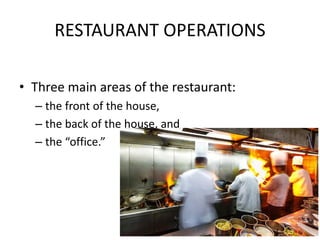
• Three main areas of the restaurant:
– the front of the house,
– the back of the house, and
– the “office.”
The Front of the House
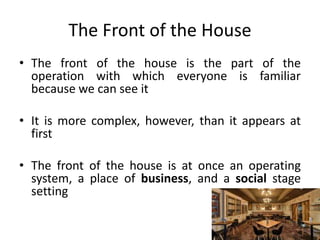
• The front of the house is the part of the
operation with which everyone is familiar
because we can see it
• It is more complex, however, than it appears at
first
• The front of the house is at once an operating
system, a place of business, and a social stage
setting
• As an operating system, it is laid out to provide
maximum efficiency to workers and ease of movement
to guests
• As a business, it is a marketplace that provides an
exchange of service for money, which requires
appropriate controls
• Finally, it is a social place where people not only enjoy
their meals but enjoy one another’s company, good
service, and a pleasing atmosphere
Responsibilities
• The key responsibility of the front of the house is guest
satisfaction, with particular emphasis on personal
service.
• The kind of service that should be delivered has a great
deal to do with what the guest wants and expects.
• In a quick-service restaurant (QSR), for example,
guests expect economy and speedy service at the
counter and self-service—even to the point of
discarding their own used disposables after they are
finished eating.
• Although there is emphasis on speed and
economy, the guest still expects a friendly
greeting, accuracy in order filling, and a
cheerful willingness to handle any problems
that occur.
• In midscale restaurants, the table service
provided raises the level of interaction with
the guest.
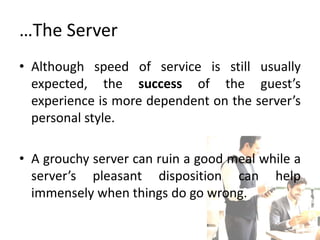
…The Server
• Although speed of service is still usually
expected, the success of the guest’s
experience is more dependent on the server’s
personal style.
• A grouchy server can ruin a good meal while a
server’s pleasant disposition can help
immensely when things do go wrong.
Price Paid vs. Expectations
• The higher price the guest raises the level of service he or
she expects
• A server in a coffee shop may serve from the improper side
or ask “who gets which sandwich” without arousing a
strong reaction
• Errors should not happen there, either, but when the price
is modest, guests’ expectations are usually modest.
• When people are paying more for a meal, however, they
expect professional service and a high degree of expertise
on the part of the staff.
Quality Products…
• Although service provision is the most obvious
job of the front of the house, those who work
there share in the responsibility for a quality food
product as well.
• This means that orders should be relayed
accurately to the kitchen.
• It also means food shouldn’t be left to get cold at
a kitchen pickup station.
…Dealing with Complaints
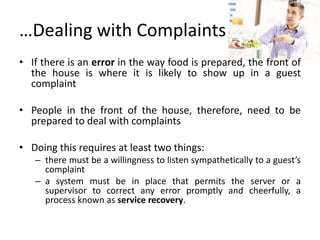
• If there is an error in the way food is prepared, the front of
the house is where it is likely to show up in a guest
complaint
• People in the front of the house, therefore, need to be
prepared to deal with complaints
• Doing this requires at least two things:
– there must be a willingness to listen sympathetically to a guest’s
complaint
– a system must be in place that permits the server or a
supervisor to correct any error promptly and cheerfully, a
process known as service recovery.
…The Money
• The front of the house is also the place where
the exchange of goods and services takes
place.
• As a result, a lot of money changes hands.
Thus, the “control” aspects of the operation,
such as check control, credit card control, and
cash control, are very important.
• Guest check control—being sure that every order is
recorded—prevents servers from going into business for
themselves. An unscrupulous server might take orders, serve
the food, and pocket some or all of the money. Today, point-
of-sale systems make this kind of scam much more difficult,
but there are ways around even the most scientific system.
• Because money is the most valuable commodity, ounce for
ounce, that a person can steal, extreme vigilance is called for
in controlling cash. Further, servers must take responsibility
for securing payment for meals served on behalf of the
restaurant. Everything that is ordered by customers must be
bought and paid for, or at least accounted for.
Tasks
• Greeting the guest
• Taking the order
• Serving the food
• Removing used tableware
• Accepting payment and accounting for sales,
charge as well as cash
• Thanking the guest and inviting comments
and return business
Key Roles
• The tasks are performed quite differently in different
levels of restaurants.
• The hostess or host (in more upscale operations, the
headwaiter or waitress) greets guests, shows them to
their table, and, often, supervises the service.
• Some large, very busy restaurants separate greeting
and seating, with hostesses or hosts from several
dining rooms (seaters) taking guests to their table after
the guests have been directed to them by the person at
the main entrance, sometimes called the greeter.
• At the opposite end of the scale, in QSRs
(Quick Service Restaurants), the counter
person is the greeter/order-taker and change-
maker.
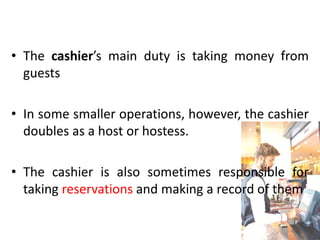
• The cashier’s main duty is taking money from
guests
• In some smaller operations, however, the cashier
doubles as a host or hostess.
• The cashier is also sometimes responsible for
taking reservations and making a record of them
• In table-service operations, the food server takes
the order and looks after the guest’s needs
• What the guest expects regarding service is
based on the type of operation
• At all levels of restaurant service, excellent
service is crucial to success in an increasingly
competitive market
• Servers are generally assigned to a specific group
of tables, called a station
• In some restaurants, servers work in teams to
cover a larger station
– For example, often with the understanding that only
one will be in the kitchen at a time so that at least one
of them will be in the dining room and available to the
guests at all times
Supervision
• The importance of having a management
presence cannot be overstated
• Front-of-the-house supervision ideally is
exercised by the senior manager on duty
• Most managers should be expected to devote the
majority of their time to the front of the house
during meal hours to ensure that guests are
served well
• Doing this enables the manager to greet and
speak with guests.
• At the same time, the manager can deal with
complaints, follow up on employee training,
and generally assess the quality of the
operation.
• In larger operations, the general manager
delegates responsibility to a dining room
manager to manage service in a specific area
or in the whole front of the house.
• In many operations, the job of host or hostess
includes supervisory responsibility for the
service in the room or rooms for which he or
she is responsible.
• In addition to supervising service, managers in
the front of the house have responsibility for
supervising cleaning staff and cashiers and for
opening and closing procedures in the
restaurant.
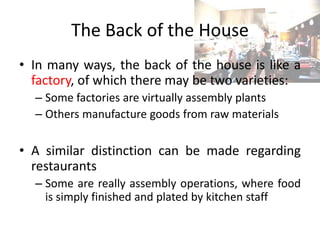
The Back of the House
• In many ways, the back of the house is like a
factory, of which there may be two varieties:
– Some factories are virtually assembly plants
– Others manufacture goods from raw materials
• A similar distinction can be made regarding
restaurants
– Some are really assembly operations, where food
is simply finished and plated by kitchen staff
– In others, the product is actually manufactured on
the premises or, as we more commonly say, cooked
from scratch.
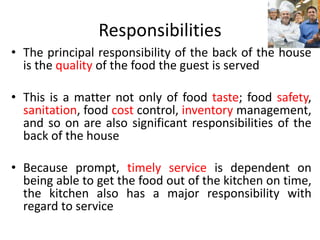
Responsibilities
• The principal responsibility of the back of the house
is the quality of the food the guest is served
• This is a matter not only of food taste; food safety,
sanitation, food cost control, inventory management,
and so on are also significant responsibilities of the
back of the house
• Because prompt, timely service is dependent on
being able to get the food out of the kitchen on time,
the kitchen also has a major responsibility with
regard to service
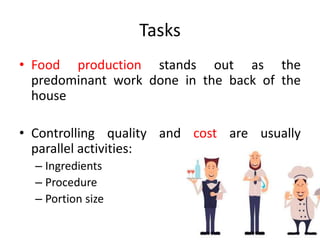
Tasks
• Food production stands out as the
predominant work done in the back of the
house
• Controlling quality and cost are usually
parallel activities:
– Ingredients
– Procedure
– Portion size
• Dishwashing and pot washing are not skilled jobs,
but they are certainly important work…
• Cleanup work is important in both the front and
back of the house, but because it is more clearly
related to sanitation, back-of-the-house cleanup
is especially significant
– Although in most operations workers clean up as they
go during the day, the heavy cleanup is usually done
at night, when the restaurant is closed
Roles
• Cooks and chefs come not only in all sizes and shapes
but also with varying skill levels
• In fine dining, cooking is generally done by people with
professional chef’s credentials, received only after
serving a lengthy apprenticeship or a combination of
formal education and on-the-job experience
• It is not surprising that the work that this group
performs can be learned quickly, because the
operation has been deliberately designed to reduce the
skill requirements
• In between these extremes lie the short-order
cook, the grill person, the salad preparation
person, and many others who have a
significant amount of skill but in a narrow
range of specialized activities
• Whatever the skill level, it is crucial to the
success of the operation that this work is done
well.
• Dishwashers are often people who have taken
the job on a short-term—and often part-
time—basis
• Because the job is repetitive, monotonous,
and messy, it is not surprising that it has a high
turnover
• The person (or persons) responsible for
receiving the shipments of food at the back
door as they are delivered
• It is the receiver’s responsibility to accept
shipments to the restaurant and to check
them for accuracy in weight or count as well
as quality.
• Food production is generally headed by a person
carrying the title of chef, executive chef, or food
production manager
• In smaller, simpler operations, the title may be head
cook or just cook
• In these latter operations, the general manager and her
or his assistants usually exercise some supervision over
cooks, so it is important that they have cooking
experience in their own backgrounds
• In fact, one of the trends in casual dining has
been to eliminate the position of chef and
replace it with several cooks and a kitchen
manager who is responsible for back-of-the-
house administrative duties
• Closing (cleaning up, shutting down, and locking
up) responsibility is very much related to food-
production activities but deserves separate
discussion because of its importance in relation
to sanitation and security
• The closing kitchen manager is responsible for
the major cleanup of the food production areas
each day (and probably has the same
responsibility in the front of the house)
• This person also oversees putting valuable food
and beverage products into secure storage at the
end of the day and locking up the restaurant itself
when all employees have left
• The job is not a very glamorous one, but it is
clearly important. In this day and age of security
concerns, the position takes on added
importance and responsibility.
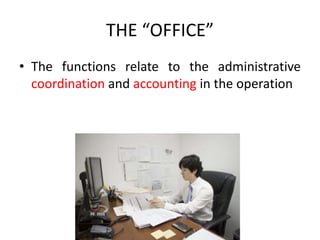
THE “OFFICE”
• The functions relate to the administrative
coordination and accounting in the operation
Responsibilities and Tasks
• The office has as its first task administrative assistance to
the general manager and his or her staff
• The office staff handles correspondence, phone calls, and
other office procedures
• These activities, although routine, are essential to
maintaining the image of the restaurant in the eyes of its
public
• Ideally, managers should not be bogged down in this time-
consuming work. It is essential to have office staff to free
managers to manage.
• A second major area of responsibility is
keeping the books. Often the actual books of
account are kept in some other place (a
chain’s home office or an accountant’s office
for an independent), but the preliminary
processing of cashier’s deposits, preparation
of payrolls, and approval of bills to be paid are
all included in this function.
Prompt payment of bills is very important to a
restaurant’s good name in the community; so
whether this is done in-house, at a home office, or
by a local bookkeeping service, it deserves careful
and prompt attention. Regular cost control reports
must be prepared, either on premises or off,
usually including the statement of income and
expenses (which is discussed later in this chapter).
Roles
The manager’s administrative assistant often
functions as office manager. Independent
operators commonly employ a bookkeeper or
accountant full or part time or use an outside
service. Often the secretary or office manager is
responsible for filling out forms that serve as the
basis for the more formal reports.
Supervision
•As noted previously, the person who supervises on-
premise clerical work usually reports to the general
manager, as does any in-house accountant. We should
note, however, that there are many smaller operations
whose low sales volume will not support clerical staff.
•In these cases, the clerical and accounting routines are
usually handled by the managers themselves. In chains,
particularly QSR chains, reporting systems have
become highly automated. Here, most reports are
prepared from routine entries made in the point-of-
sale register and automatically transmitted directly to
the central accounting office.
GENERAL MANAGEMENT
• It is essential that there be someone in charge
whenever an operation is open
– Includes general managers and their assistants
• A key point is that managers act as a team to
give direction to the unit, to maintain
standards (quality and cost), and to secure the
best possible experience for their guests
• One possible schedule (for a full-service casual
restaurant that is open for the lunch and dinner
periods) is:
– An assistant manager comes in before the restaurant
opens and oversees all the opening routines. These
include turning on equipment, unlocking storage
areas, and seeing to it that all of the crew has shown
up and that all the necessary stations are covered.
• The general manager arrives in midmorning and
stays at least through the evening meal rush.
• The closing manager arrives sometime in the
afternoon and is usually the last person to
leave, locking up for the night
• Effective managers, and restaurant
companies, often use checklists as reminders,
which are good ways to document tasks
DAILY ROUTINE
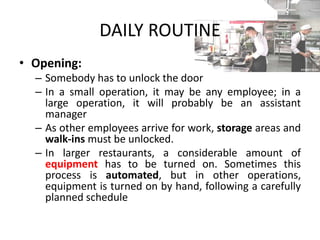
• Opening:
– Somebody has to unlock the door
– In a small operation, it may be any employee; in a
large operation, it will probably be an assistant
manager
– As other employees arrive for work, storage areas and
walk-ins must be unlocked.
– In larger restaurants, a considerable amount of
equipment has to be turned on. Sometimes this
process is automated, but in other operations,
equipment is turned on by hand, following a carefully
planned schedule
• Before and after the rush:
– The most important is “making your setup,” that
is, preparing the food before the next meal period
– In a full-menu operation, this will likely involve
roasting meat, chopping lettuce and other salad
ingredients, and performing other food
preparation tasks
– It is essential that safe food-handling procedures
always be followed to prevent food contamination
– Side work is another important activity done by
servers on a regular schedule. Side work includes
such tasks as cleaning and filling salt and pepper
shakers, cleaning the condiment stands, and, in many
restaurants, some cleaning of the dining room itself.
– Other routine work, such as calling in orders,
preparing cash deposits and reports on the previous
day’s business, and preparing and posting work
schedules, is tended to by management staff or
under their supervision.
– It is important that this routine work be done during
off-peak hours so that managers on duty can be
available during rush hours to greet guests, supervise
service, and help out if a worker gets stuck
• The meal periods:
– Not every meal is a rush in terms of the
restaurant’s seating capacity
– Breakfast, lunch, dinner…
• Closing:
– A great importance of the housekeeping,
sanitation, and security duties involved in closing
activities
– There is also guest contact work, that is, easing the
last few people out of the restaurant without
offending them or waiting until they’re ready to
leave, depending on house policy
THANK YOU!!

Restaurant operations

  • 1.
  • 2.
    RESTAURANT OPERATIONS • Threemain areas of the restaurant: – the front of the house, – the back of the house, and – the “office.”
  • 3.
    The Front ofthe House • The front of the house is the part of the operation with which everyone is familiar because we can see it • It is more complex, however, than it appears at first • The front of the house is at once an operating system, a place of business, and a social stage setting
  • 4.
    • As anoperating system, it is laid out to provide maximum efficiency to workers and ease of movement to guests • As a business, it is a marketplace that provides an exchange of service for money, which requires appropriate controls • Finally, it is a social place where people not only enjoy their meals but enjoy one another’s company, good service, and a pleasing atmosphere
  • 5.
    Responsibilities • The keyresponsibility of the front of the house is guest satisfaction, with particular emphasis on personal service. • The kind of service that should be delivered has a great deal to do with what the guest wants and expects. • In a quick-service restaurant (QSR), for example, guests expect economy and speedy service at the counter and self-service—even to the point of discarding their own used disposables after they are finished eating.
  • 6.
    • Although thereis emphasis on speed and economy, the guest still expects a friendly greeting, accuracy in order filling, and a cheerful willingness to handle any problems that occur. • In midscale restaurants, the table service provided raises the level of interaction with the guest.
  • 7.
    …The Server • Althoughspeed of service is still usually expected, the success of the guest’s experience is more dependent on the server’s personal style. • A grouchy server can ruin a good meal while a server’s pleasant disposition can help immensely when things do go wrong.
  • 8.
    Price Paid vs.Expectations • The higher price the guest raises the level of service he or she expects • A server in a coffee shop may serve from the improper side or ask “who gets which sandwich” without arousing a strong reaction • Errors should not happen there, either, but when the price is modest, guests’ expectations are usually modest. • When people are paying more for a meal, however, they expect professional service and a high degree of expertise on the part of the staff.
  • 9.
    Quality Products… • Althoughservice provision is the most obvious job of the front of the house, those who work there share in the responsibility for a quality food product as well. • This means that orders should be relayed accurately to the kitchen. • It also means food shouldn’t be left to get cold at a kitchen pickup station.
  • 10.
    …Dealing with Complaints •If there is an error in the way food is prepared, the front of the house is where it is likely to show up in a guest complaint • People in the front of the house, therefore, need to be prepared to deal with complaints • Doing this requires at least two things: – there must be a willingness to listen sympathetically to a guest’s complaint – a system must be in place that permits the server or a supervisor to correct any error promptly and cheerfully, a process known as service recovery.
  • 11.
    …The Money • Thefront of the house is also the place where the exchange of goods and services takes place. • As a result, a lot of money changes hands. Thus, the “control” aspects of the operation, such as check control, credit card control, and cash control, are very important.
  • 12.
    • Guest checkcontrol—being sure that every order is recorded—prevents servers from going into business for themselves. An unscrupulous server might take orders, serve the food, and pocket some or all of the money. Today, point- of-sale systems make this kind of scam much more difficult, but there are ways around even the most scientific system. • Because money is the most valuable commodity, ounce for ounce, that a person can steal, extreme vigilance is called for in controlling cash. Further, servers must take responsibility for securing payment for meals served on behalf of the restaurant. Everything that is ordered by customers must be bought and paid for, or at least accounted for.
  • 13.
    Tasks • Greeting theguest • Taking the order • Serving the food • Removing used tableware • Accepting payment and accounting for sales, charge as well as cash • Thanking the guest and inviting comments and return business
  • 14.
    Key Roles • Thetasks are performed quite differently in different levels of restaurants. • The hostess or host (in more upscale operations, the headwaiter or waitress) greets guests, shows them to their table, and, often, supervises the service. • Some large, very busy restaurants separate greeting and seating, with hostesses or hosts from several dining rooms (seaters) taking guests to their table after the guests have been directed to them by the person at the main entrance, sometimes called the greeter.
  • 15.
    • At theopposite end of the scale, in QSRs (Quick Service Restaurants), the counter person is the greeter/order-taker and change- maker.
  • 16.
    • The cashier’smain duty is taking money from guests • In some smaller operations, however, the cashier doubles as a host or hostess. • The cashier is also sometimes responsible for taking reservations and making a record of them
  • 17.
    • In table-serviceoperations, the food server takes the order and looks after the guest’s needs • What the guest expects regarding service is based on the type of operation • At all levels of restaurant service, excellent service is crucial to success in an increasingly competitive market
  • 18.
    • Servers aregenerally assigned to a specific group of tables, called a station • In some restaurants, servers work in teams to cover a larger station – For example, often with the understanding that only one will be in the kitchen at a time so that at least one of them will be in the dining room and available to the guests at all times
  • 19.
    Supervision • The importanceof having a management presence cannot be overstated • Front-of-the-house supervision ideally is exercised by the senior manager on duty • Most managers should be expected to devote the majority of their time to the front of the house during meal hours to ensure that guests are served well
  • 20.
    • Doing thisenables the manager to greet and speak with guests. • At the same time, the manager can deal with complaints, follow up on employee training, and generally assess the quality of the operation.
  • 21.
    • In largeroperations, the general manager delegates responsibility to a dining room manager to manage service in a specific area or in the whole front of the house. • In many operations, the job of host or hostess includes supervisory responsibility for the service in the room or rooms for which he or she is responsible.
  • 22.
    • In additionto supervising service, managers in the front of the house have responsibility for supervising cleaning staff and cashiers and for opening and closing procedures in the restaurant.
  • 23.
    The Back ofthe House • In many ways, the back of the house is like a factory, of which there may be two varieties: – Some factories are virtually assembly plants – Others manufacture goods from raw materials • A similar distinction can be made regarding restaurants – Some are really assembly operations, where food is simply finished and plated by kitchen staff
  • 24.
    – In others,the product is actually manufactured on the premises or, as we more commonly say, cooked from scratch.
  • 25.
    Responsibilities • The principalresponsibility of the back of the house is the quality of the food the guest is served • This is a matter not only of food taste; food safety, sanitation, food cost control, inventory management, and so on are also significant responsibilities of the back of the house • Because prompt, timely service is dependent on being able to get the food out of the kitchen on time, the kitchen also has a major responsibility with regard to service
  • 26.
    Tasks • Food productionstands out as the predominant work done in the back of the house • Controlling quality and cost are usually parallel activities: – Ingredients – Procedure – Portion size
  • 27.
    • Dishwashing andpot washing are not skilled jobs, but they are certainly important work… • Cleanup work is important in both the front and back of the house, but because it is more clearly related to sanitation, back-of-the-house cleanup is especially significant – Although in most operations workers clean up as they go during the day, the heavy cleanup is usually done at night, when the restaurant is closed
  • 28.
    Roles • Cooks andchefs come not only in all sizes and shapes but also with varying skill levels • In fine dining, cooking is generally done by people with professional chef’s credentials, received only after serving a lengthy apprenticeship or a combination of formal education and on-the-job experience • It is not surprising that the work that this group performs can be learned quickly, because the operation has been deliberately designed to reduce the skill requirements
  • 29.
    • In betweenthese extremes lie the short-order cook, the grill person, the salad preparation person, and many others who have a significant amount of skill but in a narrow range of specialized activities • Whatever the skill level, it is crucial to the success of the operation that this work is done well.
  • 30.
    • Dishwashers areoften people who have taken the job on a short-term—and often part- time—basis • Because the job is repetitive, monotonous, and messy, it is not surprising that it has a high turnover
  • 31.
    • The person(or persons) responsible for receiving the shipments of food at the back door as they are delivered • It is the receiver’s responsibility to accept shipments to the restaurant and to check them for accuracy in weight or count as well as quality.
  • 32.
    • Food productionis generally headed by a person carrying the title of chef, executive chef, or food production manager • In smaller, simpler operations, the title may be head cook or just cook • In these latter operations, the general manager and her or his assistants usually exercise some supervision over cooks, so it is important that they have cooking experience in their own backgrounds
  • 33.
    • In fact,one of the trends in casual dining has been to eliminate the position of chef and replace it with several cooks and a kitchen manager who is responsible for back-of-the- house administrative duties
  • 34.
    • Closing (cleaningup, shutting down, and locking up) responsibility is very much related to food- production activities but deserves separate discussion because of its importance in relation to sanitation and security • The closing kitchen manager is responsible for the major cleanup of the food production areas each day (and probably has the same responsibility in the front of the house)
  • 35.
    • This personalso oversees putting valuable food and beverage products into secure storage at the end of the day and locking up the restaurant itself when all employees have left • The job is not a very glamorous one, but it is clearly important. In this day and age of security concerns, the position takes on added importance and responsibility.
  • 36.
    THE “OFFICE” • Thefunctions relate to the administrative coordination and accounting in the operation
  • 37.
    Responsibilities and Tasks •The office has as its first task administrative assistance to the general manager and his or her staff • The office staff handles correspondence, phone calls, and other office procedures • These activities, although routine, are essential to maintaining the image of the restaurant in the eyes of its public • Ideally, managers should not be bogged down in this time- consuming work. It is essential to have office staff to free managers to manage.
  • 38.
    • A secondmajor area of responsibility is keeping the books. Often the actual books of account are kept in some other place (a chain’s home office or an accountant’s office for an independent), but the preliminary processing of cashier’s deposits, preparation of payrolls, and approval of bills to be paid are all included in this function.
  • 39.
    Prompt payment ofbills is very important to a restaurant’s good name in the community; so whether this is done in-house, at a home office, or by a local bookkeeping service, it deserves careful and prompt attention. Regular cost control reports must be prepared, either on premises or off, usually including the statement of income and expenses (which is discussed later in this chapter).
  • 40.
    Roles The manager’s administrativeassistant often functions as office manager. Independent operators commonly employ a bookkeeper or accountant full or part time or use an outside service. Often the secretary or office manager is responsible for filling out forms that serve as the basis for the more formal reports.
  • 41.
    Supervision •As noted previously,the person who supervises on- premise clerical work usually reports to the general manager, as does any in-house accountant. We should note, however, that there are many smaller operations whose low sales volume will not support clerical staff. •In these cases, the clerical and accounting routines are usually handled by the managers themselves. In chains, particularly QSR chains, reporting systems have become highly automated. Here, most reports are prepared from routine entries made in the point-of- sale register and automatically transmitted directly to the central accounting office.
  • 42.
    GENERAL MANAGEMENT • Itis essential that there be someone in charge whenever an operation is open – Includes general managers and their assistants • A key point is that managers act as a team to give direction to the unit, to maintain standards (quality and cost), and to secure the best possible experience for their guests
  • 43.
    • One possibleschedule (for a full-service casual restaurant that is open for the lunch and dinner periods) is: – An assistant manager comes in before the restaurant opens and oversees all the opening routines. These include turning on equipment, unlocking storage areas, and seeing to it that all of the crew has shown up and that all the necessary stations are covered. • The general manager arrives in midmorning and stays at least through the evening meal rush.
  • 44.
    • The closingmanager arrives sometime in the afternoon and is usually the last person to leave, locking up for the night • Effective managers, and restaurant companies, often use checklists as reminders, which are good ways to document tasks
  • 45.
    DAILY ROUTINE • Opening: –Somebody has to unlock the door – In a small operation, it may be any employee; in a large operation, it will probably be an assistant manager – As other employees arrive for work, storage areas and walk-ins must be unlocked. – In larger restaurants, a considerable amount of equipment has to be turned on. Sometimes this process is automated, but in other operations, equipment is turned on by hand, following a carefully planned schedule
  • 46.
    • Before andafter the rush: – The most important is “making your setup,” that is, preparing the food before the next meal period – In a full-menu operation, this will likely involve roasting meat, chopping lettuce and other salad ingredients, and performing other food preparation tasks – It is essential that safe food-handling procedures always be followed to prevent food contamination
  • 47.
    – Side workis another important activity done by servers on a regular schedule. Side work includes such tasks as cleaning and filling salt and pepper shakers, cleaning the condiment stands, and, in many restaurants, some cleaning of the dining room itself. – Other routine work, such as calling in orders, preparing cash deposits and reports on the previous day’s business, and preparing and posting work schedules, is tended to by management staff or under their supervision.
  • 48.
    – It isimportant that this routine work be done during off-peak hours so that managers on duty can be available during rush hours to greet guests, supervise service, and help out if a worker gets stuck
  • 49.
    • The mealperiods: – Not every meal is a rush in terms of the restaurant’s seating capacity – Breakfast, lunch, dinner…
  • 50.
    • Closing: – Agreat importance of the housekeeping, sanitation, and security duties involved in closing activities – There is also guest contact work, that is, easing the last few people out of the restaurant without offending them or waiting until they’re ready to leave, depending on house policy
  • 51.

Editor's Notes

  • #11 Because customers represent potential future sales and powerful word-of-mouth advertising, an unhappy guest is much more expensive than a lost meal
  • #27 Controlling quality and cost are usually parallel activities In other words, standardized recipes and carefully thought-out procedures, used consistently, will produce food that has the correct ingredients, thus ensuring both quality and cost. Portions should be the same for a guest at every visit—and they should be the same for every guest
  • #28 Anyone who has been in a restaurant that ran out of clean dishes in the middle of the meal or pots during a heavy preparation period can testify to this. These are activities that use a significant amount of labor in any operation that serves food on permanent ware and has a varied menu (i.e., most operations outside of quick service). Labor cost control is, therefore, an important element in planning ware washing. Because detergent is a commodity that restaurants use in large quantity, the cost of supplies is a significant concern. Quality work, which relates not only to the workers’ performance but also to adequate water temperatures and soap solutions, is absolutely essential.
  • #34 A casual dining restaurant is a restaurant that serves moderately-priced food in acasual atmosphere. Except for buffet-style restaurants, casual dining restaurants typically provide table service.
  • #38 bogged down is like stuck or prevented from making progress.