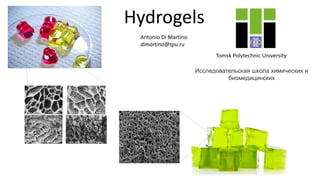
Hydrogels
Antonio Di Martino
dimartino@tpu.ru
Исследовательская школа химических и
биомедицинских
Tomsk Polytechnic University
Introduction
1949 = First ever hydrogel for biomedical implant – PVA crosslinked with formaldehyde - IVALON
1960 = synthesis of poly (2-hydroxyethyl methacrylate) (pHEMA) gel for contact lenses by Witcherle and Lim
pHEMA
Revolution for present day hydrogels
 Cross-linked networks
 Swelling without dissolution
 Shape retain
1970 = hydrogels for biomedical applications gained popularity – particularly stimuli responsive hydrogels
Hydrogel Classifications
1st Generation (cc 1960) = cross-linked hydrogels with high swelling and good mechanical properties
2nd Generation (cc 1970) = responsive by swelling to defined stimuli such as pH, temperature, biological compounds
3rd Generation (cc 1980 to present) = stereo complexed materials (e.g. PEG-PLA cross-linked by cyclodextrin)
Present = Smart hydrogels with stimuli sensitive tunable properties
Great attention in the use for organ, tissue regeneration and regenerative medicine
What make hydrogels interesting?
 Soft and rubbery
 Low interfacial tension with water and biological fluids –> reduced cell adhesion -> Less negative immune response
 Natural hydrogels – similar to extracellular matrix (ECM) in living tissues
 Mucoadhesive and Bioadhesive properties
 Enhanced tissue permeability and drug residence
Bioadhesion = mechanism by which two biological materials are held together by interfacial forces
Mucoadhesion = refers to the attractive forces between a biological material and mucous membrane
 Membrane = barrier
 Mucus = Mucins + salts + enzymes+ immunoglobuline + glycoprotein + lactoferrin
 Mucins = family o high molecular weight glycosylated proteins
 Glycosylated proteins = carbohydrate covalently linked to proteins
Glycoconjugate
Hydrogels
3D materials able to adsorb large amounts of water while maintaining their dimension stability
Water permeability
Crosslinking point => SOLUBILITY IS BALANCED BY THE RETRACTIVE FORCE OF ELASTICITY
Crosslinking points : to maintain the 3D integrity of the hydrogel in the swollen state
-COOH
-OH
-CONH2
CONH-
-SO3H
 Limited use = > cannot be reshaped and/or resized
 Some of the crosslinking agents are toxic (e.g.
glutaraldehyde)
 Unreacted components have to be removed
• Chain entanglements
• Hydrophobic interaction
• Hydrogen bonds
• Ion complexation
• Reversible crosslinking point
• Weak mechanical properties in the swollen state
Photochemically crosslinkable hydrogels and potential applications
Gelatin methacryloyl- Chitosan
UV-light
Tissue engineering
Chitosan/methacrylated/PVA
Guar gum–methacrylate
Methacrylated glycol chitosan/hyaluronic acid
Cartilage tissue engineering
Tissue Engineering Scaffolds
Cartilage tissue engineering
Chitosan
Poly(ethylene glycol)
Cartilage regeneration
Riboflavin –UV light
Stimuli responsive hydrogels – Smart hydrogels
Stimuli responsive hydrogels undergo relatively large changes in their swelling behavior, network structure, permeability
and/or mechanical strength in response to small environmental changes
Temperature
Shift in temperature changes polymer-polymer and polymer-
water interaction responsible for swelling
Chitosan-Poly(acrylamide)
Pressure
Swelling under increased pressure and vice versa. This fact is
due to an increase in lower critical solution temperature (LCST)
value of hydrogels with pressure. LCST is the temperature below
which negative thermoresponsive hydrogels swell.
Poly(N-isopropylacrylamide) (PNIPAM)
Poly(N,N-diethylacrylamide) (PNDAC)
PNIPAM PNDAC
Light
Exposure to light (UV and visible light) reversibly changes the
hydrogel from its flowable (moving in one direction) form to
non-flowable form and vice versa.
Poly(trimethylenium iminium trifluorosulfonimide)
2,6-bis(benzoxal-2-yl)pyridine
Physical Stimuli
Electric field
Changes in electrical charge distribution within the hydrogels
matrix on the application of electric field cause swelling–
deswelling
Polythiophene (PTs) Polypyrrole (PPy)
Magnetic Field When a magnetic field is applied, it causes pores in the gel to
swell
Composite of magnetite nanoparticles and
Poly(acrylamide)
Ultrasound irradiation Exposure to ultrasound temporarily breaks the ionic cross-links
in the hydrogels but they are reformed after ending the
exposition
Calcium alginate
Poly(lactic acid)
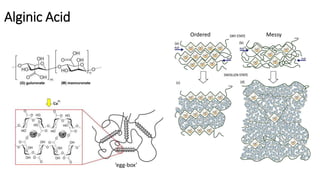
Alginic Acid
‘egg-box’
Ordered Messy
Chemical Stimuli
pH “Shift in pH causes change in the charge on the polymer chains leading to swelling”
 Polyacids = Anionic polymers
 Polybases= Cationic polymers
Poly(acrylic acid) ; Dextran sulfate; Alginic acid;
Guar gum succinate etc….
-COOH; -PO4; -OH; -SO4
PEI = polyethylenimine
Linear Branched-NH2
Ionic strength “Change in ions concentration causes swelling”
A- anion
C+ cation
 The hydrogel exchange protons to the solution
 Electroneutrality
 Ionic strength of the solution is increased
 Exchange of ions with the solution.
 The concentration of free counterions inside the hydrogel increases
 Electroeutrality;
 Osmotic pressure arises which causes the gel to swell
 High levels of Ionic strength (1 M–10 M),
 The hydrogels shrink due to the loss of the osmotic pressure
 Solution has osmotic pressures in the range of those inside the gel
CO2
“On exposure to CO2, the pH of solution changes resulting in
swelling or deswelling of the hydrogel which causes a change in
pressure which is a measure of the partial pressure of CO2”
Glucose “Hydrogels show swelling in response to increased glucose concentration”
Biological stimuli
Enzyme “Enzymes cause hydrogel degradation”
Antigen “Hydrogels sense the free antigen and undergo swelling”
DNA “Single stranded (ss) DNA grafted hydrogel probes show swelling in the presence of ssDNA”
Hydrogels
Water in hydrogels – Swelling
Swelling depends on :
1) Network parameters
2) Nature of solution
3) Structure (porous or poreless)
4) Drying techniques
 Crosslinking density => Crosslinker concentration
 Distance between the two crosslinkers in the same polymer chain
 Higher crosslink density the shorter is the distance
Water in hydrogels - Swelling
 First step: The diffusion rate of the water into the network is determined at the beginning of the swelling process
Depends on: Molecular weight of the solvent; temperature and porosity of the hydrogel
 Second step: how fast polymer chains can relax – slower absorption process
High crosslink density = behavior like a metal mesh = constant rate
Low crosslink density = variable rate
Types of water in hydrogels
Physically trapped between the hydrated polymer chains
Easy to remove – mild conditions
Directly attached to the polymer through hydratation
Part of hydrogel structure – Very high temperature to remove
Intermediate properties between free and bounded
Free and interstitial water can be removed by centrifugation or compression
Multiple Hydrogels Systems
Hydrogels based on single polymer may not meet the requirements for the application (e.g high swelling but inferior mechanical
properties)
Hydrogel characterization
Solubility
 Wd = dried weight
 Wi = initial weight
Swelling  Ws = swollen weight
 Wd = dried weight
FTIR Investigation of the structural arrangement in hydrogel comparing with starting materials
SEM Morphology, network structure
GPC-MALLS (Multi Angle Laser Light Scattering) Determination of molecular distribution
Rheology Rheological properties are dependent on the types of structure
DSC
H-NMR
 Quantify the amount of free and bound water in hydrogels
 The proton NMR gives information about the interchange of water molecules between the so-
called free and bound states
 DSC is based on the assumption that only the free water may be frozen
 The bound water is then obtained by difference of the measured total water content of the
hydrogel test specimen, and the calculated free water content
X-ray diffraction (XRD) Formation of cross-linked network
Applications of hydrogels as biomaterials
Blood contacting hydrogel
Poly(vinyl alcohol)
Poly(acrylamide)
Poly(ethylene oxide)
Poly (ethylene glycole)
Cellulose
Artificial Kidney
Cellulose acetate
Poly(vinyl alcohol)
Poly (ethylene glycole) – Poly(ethylene terephthalate)
Artificial
cartilage
Poly(vinyl alcohol)
Poly(N-isopropyl acrylamide)
Poly(ethylene glycole)-Poly(propylene glycol)
Artificial skin
Poly(vinyl alcohol)
Poly(hydroethylmethacrylate)
Contact lenses
Poly(hydroethylmethacrylate)
Poly(N-vinyl pyrrolidone)
Poly(methacrilic acid)
Poly(butyl methacrylate)
Poly(methyl methacrylate)
Hydrogels for drug delivery applications
Hydrogels for cell encapsulation
Hydrogels for tissue engineering scaffolds
References
 Cheung et al., J Biotechnol Biomater 2015, 5:2
 J Appl Biotechnol Rep. 2018 Sep;5(3):81-91
 Trends in Biotechnology June 2015, Vol.33,No. 6
 Journal of Advanced Research (2015) 6, 105-121
 Material Science and Engineering C 57 (2015) 414-433
 Polymers 2017, 9, 137; doi:10.3390/polym9040137
 Talebian, Set al., (2019). Self-Healing Hydrogels: The Next Paradigm Shift in Tissue Engineering? Advanced Science, 6(16),
[1801664]
 Analyst, 2003, 128, 325–331

Hydrogels

  • 1.
    Hydrogels Antonio Di Martino dimartino@tpu.ru Исследовательскаяшкола химических и биомедицинских Tomsk Polytechnic University
  • 2.
    Introduction 1949 = Firstever hydrogel for biomedical implant – PVA crosslinked with formaldehyde - IVALON 1960 = synthesis of poly (2-hydroxyethyl methacrylate) (pHEMA) gel for contact lenses by Witcherle and Lim pHEMA Revolution for present day hydrogels  Cross-linked networks  Swelling without dissolution  Shape retain 1970 = hydrogels for biomedical applications gained popularity – particularly stimuli responsive hydrogels
  • 3.
    Hydrogel Classifications 1st Generation(cc 1960) = cross-linked hydrogels with high swelling and good mechanical properties 2nd Generation (cc 1970) = responsive by swelling to defined stimuli such as pH, temperature, biological compounds 3rd Generation (cc 1980 to present) = stereo complexed materials (e.g. PEG-PLA cross-linked by cyclodextrin) Present = Smart hydrogels with stimuli sensitive tunable properties Great attention in the use for organ, tissue regeneration and regenerative medicine
  • 4.
    What make hydrogelsinteresting?  Soft and rubbery  Low interfacial tension with water and biological fluids –> reduced cell adhesion -> Less negative immune response  Natural hydrogels – similar to extracellular matrix (ECM) in living tissues  Mucoadhesive and Bioadhesive properties  Enhanced tissue permeability and drug residence Bioadhesion = mechanism by which two biological materials are held together by interfacial forces Mucoadhesion = refers to the attractive forces between a biological material and mucous membrane  Membrane = barrier  Mucus = Mucins + salts + enzymes+ immunoglobuline + glycoprotein + lactoferrin  Mucins = family o high molecular weight glycosylated proteins  Glycosylated proteins = carbohydrate covalently linked to proteins
  • 5.
  • 6.
    Hydrogels 3D materials ableto adsorb large amounts of water while maintaining their dimension stability Water permeability Crosslinking point => SOLUBILITY IS BALANCED BY THE RETRACTIVE FORCE OF ELASTICITY
  • 7.
    Crosslinking points :to maintain the 3D integrity of the hydrogel in the swollen state -COOH -OH -CONH2 CONH- -SO3H  Limited use = > cannot be reshaped and/or resized  Some of the crosslinking agents are toxic (e.g. glutaraldehyde)  Unreacted components have to be removed • Chain entanglements • Hydrophobic interaction • Hydrogen bonds • Ion complexation • Reversible crosslinking point • Weak mechanical properties in the swollen state
  • 10.
    Photochemically crosslinkable hydrogelsand potential applications Gelatin methacryloyl- Chitosan UV-light Tissue engineering Chitosan/methacrylated/PVA Guar gum–methacrylate Methacrylated glycol chitosan/hyaluronic acid Cartilage tissue engineering Tissue Engineering Scaffolds Cartilage tissue engineering Chitosan Poly(ethylene glycol) Cartilage regeneration Riboflavin –UV light
  • 12.
    Stimuli responsive hydrogels– Smart hydrogels Stimuli responsive hydrogels undergo relatively large changes in their swelling behavior, network structure, permeability and/or mechanical strength in response to small environmental changes
  • 13.
    Temperature Shift in temperaturechanges polymer-polymer and polymer- water interaction responsible for swelling Chitosan-Poly(acrylamide) Pressure Swelling under increased pressure and vice versa. This fact is due to an increase in lower critical solution temperature (LCST) value of hydrogels with pressure. LCST is the temperature below which negative thermoresponsive hydrogels swell. Poly(N-isopropylacrylamide) (PNIPAM) Poly(N,N-diethylacrylamide) (PNDAC) PNIPAM PNDAC Light Exposure to light (UV and visible light) reversibly changes the hydrogel from its flowable (moving in one direction) form to non-flowable form and vice versa. Poly(trimethylenium iminium trifluorosulfonimide) 2,6-bis(benzoxal-2-yl)pyridine Physical Stimuli
  • 14.
    Electric field Changes inelectrical charge distribution within the hydrogels matrix on the application of electric field cause swelling– deswelling Polythiophene (PTs) Polypyrrole (PPy) Magnetic Field When a magnetic field is applied, it causes pores in the gel to swell Composite of magnetite nanoparticles and Poly(acrylamide) Ultrasound irradiation Exposure to ultrasound temporarily breaks the ionic cross-links in the hydrogels but they are reformed after ending the exposition Calcium alginate Poly(lactic acid)
  • 15.
  • 16.
    Chemical Stimuli pH “Shiftin pH causes change in the charge on the polymer chains leading to swelling”  Polyacids = Anionic polymers  Polybases= Cationic polymers Poly(acrylic acid) ; Dextran sulfate; Alginic acid; Guar gum succinate etc…. -COOH; -PO4; -OH; -SO4 PEI = polyethylenimine Linear Branched-NH2
  • 17.
    Ionic strength “Changein ions concentration causes swelling” A- anion C+ cation  The hydrogel exchange protons to the solution  Electroneutrality  Ionic strength of the solution is increased  Exchange of ions with the solution.  The concentration of free counterions inside the hydrogel increases  Electroeutrality;  Osmotic pressure arises which causes the gel to swell  High levels of Ionic strength (1 M–10 M),  The hydrogels shrink due to the loss of the osmotic pressure  Solution has osmotic pressures in the range of those inside the gel
  • 18.
    CO2 “On exposure toCO2, the pH of solution changes resulting in swelling or deswelling of the hydrogel which causes a change in pressure which is a measure of the partial pressure of CO2” Glucose “Hydrogels show swelling in response to increased glucose concentration”
  • 19.
    Biological stimuli Enzyme “Enzymescause hydrogel degradation” Antigen “Hydrogels sense the free antigen and undergo swelling” DNA “Single stranded (ss) DNA grafted hydrogel probes show swelling in the presence of ssDNA”
  • 20.
  • 21.
    Water in hydrogels– Swelling Swelling depends on : 1) Network parameters 2) Nature of solution 3) Structure (porous or poreless) 4) Drying techniques  Crosslinking density => Crosslinker concentration  Distance between the two crosslinkers in the same polymer chain  Higher crosslink density the shorter is the distance
  • 22.
    Water in hydrogels- Swelling  First step: The diffusion rate of the water into the network is determined at the beginning of the swelling process Depends on: Molecular weight of the solvent; temperature and porosity of the hydrogel  Second step: how fast polymer chains can relax – slower absorption process High crosslink density = behavior like a metal mesh = constant rate Low crosslink density = variable rate
  • 23.
    Types of waterin hydrogels Physically trapped between the hydrated polymer chains Easy to remove – mild conditions Directly attached to the polymer through hydratation Part of hydrogel structure – Very high temperature to remove Intermediate properties between free and bounded Free and interstitial water can be removed by centrifugation or compression
  • 24.
    Multiple Hydrogels Systems Hydrogelsbased on single polymer may not meet the requirements for the application (e.g high swelling but inferior mechanical properties)
  • 25.
    Hydrogel characterization Solubility  Wd= dried weight  Wi = initial weight Swelling  Ws = swollen weight  Wd = dried weight FTIR Investigation of the structural arrangement in hydrogel comparing with starting materials SEM Morphology, network structure GPC-MALLS (Multi Angle Laser Light Scattering) Determination of molecular distribution
  • 26.
    Rheology Rheological propertiesare dependent on the types of structure DSC H-NMR  Quantify the amount of free and bound water in hydrogels  The proton NMR gives information about the interchange of water molecules between the so- called free and bound states  DSC is based on the assumption that only the free water may be frozen  The bound water is then obtained by difference of the measured total water content of the hydrogel test specimen, and the calculated free water content X-ray diffraction (XRD) Formation of cross-linked network
  • 27.
    Applications of hydrogelsas biomaterials Blood contacting hydrogel Poly(vinyl alcohol) Poly(acrylamide) Poly(ethylene oxide) Poly (ethylene glycole) Cellulose Artificial Kidney Cellulose acetate Poly(vinyl alcohol) Poly (ethylene glycole) – Poly(ethylene terephthalate) Artificial cartilage Poly(vinyl alcohol) Poly(N-isopropyl acrylamide) Poly(ethylene glycole)-Poly(propylene glycol) Artificial skin Poly(vinyl alcohol) Poly(hydroethylmethacrylate) Contact lenses Poly(hydroethylmethacrylate) Poly(N-vinyl pyrrolidone) Poly(methacrilic acid) Poly(butyl methacrylate) Poly(methyl methacrylate)
  • 28.
    Hydrogels for drugdelivery applications
  • 29.
    Hydrogels for cellencapsulation
  • 30.
    Hydrogels for tissueengineering scaffolds
  • 31.
    References  Cheung etal., J Biotechnol Biomater 2015, 5:2  J Appl Biotechnol Rep. 2018 Sep;5(3):81-91  Trends in Biotechnology June 2015, Vol.33,No. 6  Journal of Advanced Research (2015) 6, 105-121  Material Science and Engineering C 57 (2015) 414-433  Polymers 2017, 9, 137; doi:10.3390/polym9040137  Talebian, Set al., (2019). Self-Healing Hydrogels: The Next Paradigm Shift in Tissue Engineering? Advanced Science, 6(16), [1801664]  Analyst, 2003, 128, 325–331