COLLOIDAL SYSTEMS IN
FOOD
PRESENTED BY:
MAMTA SAHURKAR
(FOOD TECHNOLOGY)
LAXMINARAYAN INSTITUTE OF
TECHNOLOGY,
NAGPUR
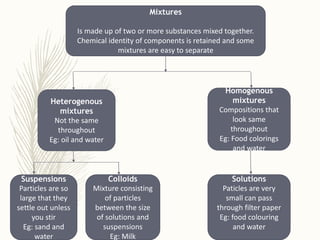
Mixtures
Is made up of two or more substances mixed together.
Chemical identity of components is retained and some
mixtures are easy to separate
Homogenous
mixtures
Compositions that
look same
throughout
Eg: Food colorings
and water
Heterogenous
mixtures
Not the same
throughout
Eg: oil and water
Colloids
Mixture consisting
of particles
between the size
of solutions and
suspensions
Eg: Milk
Suspensions
Particles are so
large that they
settle out unless
you stir
Eg: sand and
water
Solutions
Paticles are very
small can pass
through filter paper
Eg: food colouring
and water
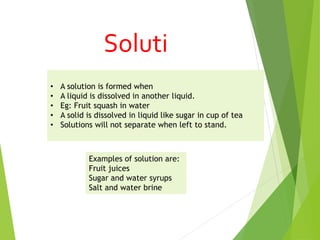
Soluti
ons
Examples of solution are:
Fruit juices
Sugar and water syrups
Salt and water brine
• A solution is formed when
• A liquid is dissolved in another liquid.
• Eg: Fruit squash in water
• A solid is dissolved in liquid like sugar in cup of tea
• Solutions will not separate when left to stand.
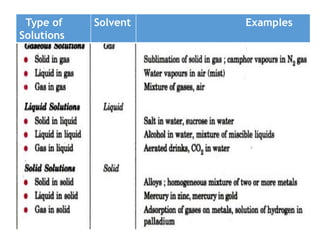
Type of
Solutions
Solvent Examples
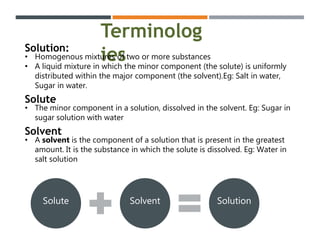
Terminolog
iesSolution:
• Homogenous mixtures of two or more substances
• A liquid mixture in which the minor component (the solute) is uniformly
distributed within the major component (the solvent).Eg: Salt in water,
Sugar in water.
Solute
• The minor component in a solution, dissolved in the solvent. Eg: Sugar in
sugar solution with water
Solvent
• A solvent is the component of a solution that is present in the greatest
amount. It is the substance in which the solute is dissolved. Eg: Water in
salt solution
Solute Solvent Solution
Solubility
Solute Temperature Solubility
Solid Increases Increases
Gas Increases Decreases
Solute Pressure Solubility
Solid Increases Remains same
Gas Increases Increases
Parameters affecting
solubility• Temperature
• Pressure
• Maximum amount of solute that can be
dissolved in a definite amount of solvent
at a specific temperature
• Referred to as: Ability to dissolve.
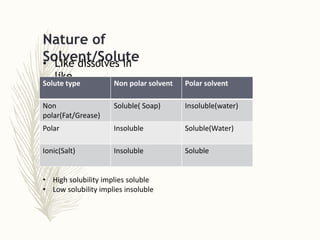
Nature of
Solvent/Solute• Like dissolves in
like
Solute type Non polar solvent Polar solvent
Non
polar(Fat/Grease)
Soluble( Soap) Insoluble(water)
Polar Insoluble Soluble(Water)
Ionic(Salt) Insoluble Soluble
• High solubility implies soluble
• Low solubility implies insoluble
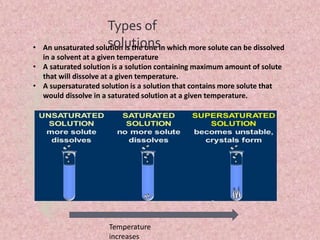
Types of
solutions• An unsaturated solution is the one in which more solute can be dissolved
in a solvent at a given temperature
• A saturated solution is a solution containing maximum amount of solute
that will dissolve at a given temperature.
• A supersaturated solution is a solution that contains more solute that
would dissolve in a saturated solution at a given temperature.
Temperature
increases
COLLOIDS ???
• All prepared food dishes are examples of a
mixture known as a colloid.
• A colloid is a type of chemical mixture where
one substance is dispersed evenly throughout
another. Colloids are formed when one
substance is dispersed through another, but
does not combine to form a solution.
• There are many types of colloidal systems
depending on the state of the two substances
mixed together.
• The mixture of the two substances is called
Properties of colloids
• A colloid is a heterogeneous
mixture
• The size of colloidal particles is
small to be seen with naked
• The colloids are large enough
scatter beam of light passing
through it and making its path
visible
• They do not settle down if
undisturbed
Importance of colloids in foods
ProvidesTexture
Improves mouthfeel
Gives structure
Stability
Important for maintaining rheological
properties of food systems.
Eg: Whipped cream, Mayonnaise, milk,
Butter, Gelatin, Jelly.
COLLOIDAL SYSTEM
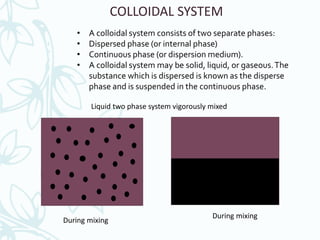
• A colloidal system consists of two separate phases:
• Dispersed phase (or internal phase)
• Continuous phase (or dispersion medium).
• A colloidal system may be solid, liquid, or gaseous.The
substance which is dispersed is known as the disperse
phase and is suspended in the continuous phase.
Liquid two phase system vigorously mixed
During mixing
During mixing
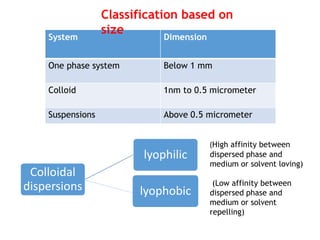
System Dimension
One phase system Below 1 mm
Colloid 1nm to 0.5 micrometer
Suspensions Above 0.5 micrometer
Colloidal
dispersions
lyophilic
lyophobic
(High affinity between
dispersed phase and
medium or solvent loving)
(Low affinity between
dispersed phase and
medium or solvent
repelling)
Classification based on
size
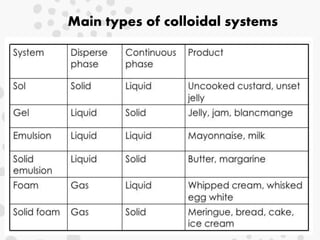
Main types of colloidal systems
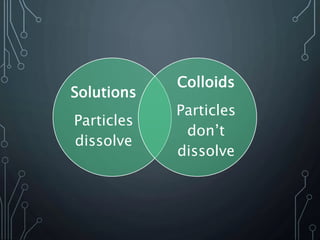
Solutions
Particles
dissolve
Colloids
Particles
don’t
dissolve
• A sol is a colloidal solution suspension of very small solid particles in
a continuous liquid medium.
• Sols exhibit characteristic optical properties.
• They may have an opaque or clear appearance to the naked eye
when viewed under a microscope, but the dispersed particles are
sufficiently large to scatter and polarize the incident light to some
extent.
• This scattering of visible light by colloidal solution is known as Tyndall
effect.
• When viewed through an ultramicroscope, colloidal particles appear
to be in a state of rapid motion called Brownian motion.
SOL
Sol
• A colloid (aggregate of very fine particles dispersed in a
continuous medium) in which the particles are solid and
the dispersion medium is fluid.
• If the dispersion medium is water, the colloid may be
called a hydrosol; and if air, an aerosol.
• Lyophobic sols are characterized by particles that are not
strongly attracted to molecules of the dispersion medium
and that are relatively easily coagulated and precipitated.
• Lyophilic sols are more stable and more closely resemble
true solutions. Many sols are intermediate between
lyophobic and lyophilic types.
GEL
A gel is a solid jelly like material that can have
properties ranging from soft and weak to hard and
tough.
Gels are defined as a substantially dilute cross
linked system, which exhibits no flow when in the
steady-state.
By weight, gels are mostly liquid, yet they behave like
solids due to a three-dimensional cross-linked network
within the liquid. It is the crosslinking within the fluid
that gives a gel its structure (hardness) and
contributes to the adhesive stick
Sols and
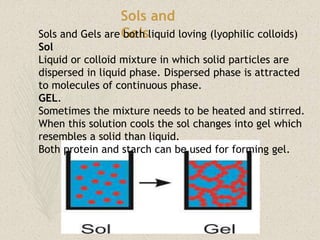
GelsSols and Gels are both liquid loving (lyophilic colloids)
Sol
Liquid or colloid mixture in which solid particles are
dispersed in liquid phase. Dispersed phase is attracted
to molecules of continuous phase.
GEL.
Sometimes the mixture needs to be heated and stirred.
When this solution cools the sol changes into gel which
resembles a solid than liquid.
Both protein and starch can be used for forming gel.
• When a jelly is made, gelatin is
dispersed into a liquid and heated to
form a sol.As the sol cools, protein
molecules unwind forming a network
that traps water and forms a gel.
• If cornflour is mixed with water and
heated, the starch granules absorb
water until they rupture ,the starch then
disperses in water and the mixture
becomes more viscous and forms a gel
on cooling
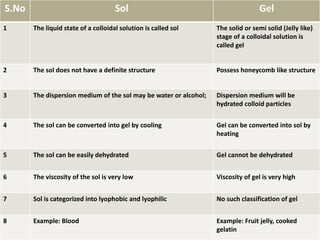
S.No Sol Gel
1 The liquid state of a colloidal solution is called sol The solid or semi solid (Jelly like)
stage of a colloidal solution is
called gel
2 The sol does not have a definite structure Possess honeycomb like structure
3 The dispersion medium of the sol may be water or alcohol; Dispersion medium will be
hydrated colloid particles
4 The sol can be converted into gel by cooling Gel can be converted into sol by
heating
5 The sol can be easily dehydrated Gel cannot be dehydrated
6 The viscosity of the sol is very low Viscosity of gel is very high
7 Sol is categorized into lyophobic and lyophilic No such classification of gel
8 Example: Blood Example: Fruit jelly, cooked
gelatin
Other types of gel are formed with pectin and agar
• Pectin,a form of carbohydrate found in fruits in
production of jam until it is set. However ,for it to gel
there must be at least 50 per cent sugar and conditions
should be acidic.
• Agar is a polysaccharide extracted from seaweed which
is capable of forming gels.
• If a gel is allowed to stand for a time, it starts to ‘weep’
• This loss of liquid is known as syneresis.
Other types of gel
Emulsions:
A solution of one liquid with another immiscible liquid
When water and oil are shaken together, they form an
emulsion. If it is left to stand oil will separate at the top
of water. This is an unstable emulsion.Stable emulsion is
formed when two immiscible liquids are held stable by a
third substance.(Emulsifying agent)
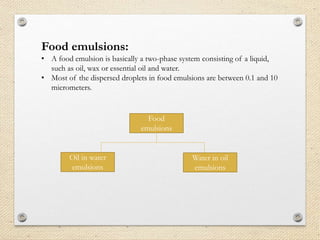
Food emulsions:
• A food emulsion is basically a two-phase system consisting of a liquid,
such as oil, wax or essential oil and water.
• Most of the dispersed droplets in food emulsions are between 0.1 and 10
micrometers.
Food
emulsions
Oil in water
emulsions
Water in oil
emulsions
Emulsifiers
Emulsifiers are the substances which
reduce surface tension at the interface of
two normally immiscible phases,allowing
them to mix and form emulsion
They belong to the general class of
compounds called surface active agents
Functions of emulsifiers:
 To promote emulsion stability
 Control agglomeration of fat globules
 Modify texture
 Shelf life improved
 Modify rheological properties
 Control polymorphism and improve texture of
fats
 An emulsifying agent is made up of two parts:
One is hydrophilic(water loving) and other is hydrophobic(water hating).
 The emulsifier holds the disperse phase within the continuous phase.
This results in emulsion becoming stable
How do they work???
• Emulsifiers reduce surface tension between the two
immiscible phases due to their molecular structure
• They have both a polar group with affinity for water and
non polar group with affinity for oil
 Mayonnaise is an example of a
stable emulsion of oil and
vinegar, when egg yolk(lecithin
) may be used as an emulsifying
agent.
 Stability of emulsions
• Stabilizers are often added to
emulsions to increase the
viscosity of the product.
• These help to improve stability
of the emulsions, as over time
emulsions may separate.
• Stabilizers also increase shelf
life,E461 methylcellulose, used
in low fat spreads.
The particles in suspensions are larger
than those found in solutions.
Components of a suspension can be
evenly distributed by a mechanical
means, like by shaking the contents, but
the components will settle out.
Example: Oil andWater
Suspensions
Solutions Suspensions Colloids
Appearance
Clear, transparent and
homogeneous
Cloudy, heterogeneous, at
least two substances visible
Cloudy but uniform and
homogeneous
Particle Size molecule in size larger than 10,000 Angstroms 10-1000 Angstroms
Effect of Light (Tyndall Effect)
none -- light passes through,
particles do not reflect light
variable
light is dispersed by colloidal
particles
Effect of Sedimentation none
particles will eventually
settle out
none
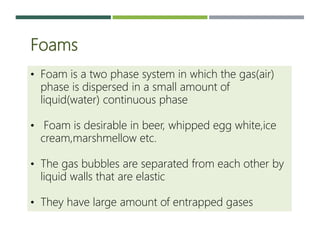
Foams
• Foam is a two phase system in which the gas(air)
phase is dispersed in a small amount of
liquid(water) continuous phase
• Foam is desirable in beer, whipped egg white,ice
cream,marshmellow etc.
• The gas bubbles are separated from each other by
liquid walls that are elastic
• They have large amount of entrapped gases
Bubbly foam
• A bubbly foam is formed when the amount of gas
incorporated is low enough to retain roughly spherical
shape
Polyhedral foam
• The gas to liquid ratio is so large that bubbles are
pressed against one another in honeycomb like structure
Foam
formation
• Air has injected into
liquid
• Large air bubbles have
broken down into
bubbles
• Smaller bubbles have
be prevented from
during the formation of
foam
Foam stability
Foam becomes unstable due
drainage of water from their
structure. Foam stability is
desirable and can be
by
• Increasing elasticity of
wall
• Increasing viscosity of the
solution
• Adding polar foam
Antifoaming agents:
 In food industries undesirable foams may be formed
 Excessive formation leads to the loss of quality of the
product especially in fermentation processes.
 Antifoaming agents cause the collapse of foam and
retard the formation of additional foam.
 Eg. Silicon oils
Thank you

Colloidal systems in food

  • 1.
    COLLOIDAL SYSTEMS IN FOOD PRESENTEDBY: MAMTA SAHURKAR (FOOD TECHNOLOGY) LAXMINARAYAN INSTITUTE OF TECHNOLOGY, NAGPUR
  • 2.
    Mixtures Is made upof two or more substances mixed together. Chemical identity of components is retained and some mixtures are easy to separate Homogenous mixtures Compositions that look same throughout Eg: Food colorings and water Heterogenous mixtures Not the same throughout Eg: oil and water Colloids Mixture consisting of particles between the size of solutions and suspensions Eg: Milk Suspensions Particles are so large that they settle out unless you stir Eg: sand and water Solutions Paticles are very small can pass through filter paper Eg: food colouring and water
  • 3.
    Soluti ons Examples of solutionare: Fruit juices Sugar and water syrups Salt and water brine • A solution is formed when • A liquid is dissolved in another liquid. • Eg: Fruit squash in water • A solid is dissolved in liquid like sugar in cup of tea • Solutions will not separate when left to stand.
  • 4.
  • 5.
    Terminolog iesSolution: • Homogenous mixturesof two or more substances • A liquid mixture in which the minor component (the solute) is uniformly distributed within the major component (the solvent).Eg: Salt in water, Sugar in water. Solute • The minor component in a solution, dissolved in the solvent. Eg: Sugar in sugar solution with water Solvent • A solvent is the component of a solution that is present in the greatest amount. It is the substance in which the solute is dissolved. Eg: Water in salt solution Solute Solvent Solution
  • 6.
    Solubility Solute Temperature Solubility SolidIncreases Increases Gas Increases Decreases Solute Pressure Solubility Solid Increases Remains same Gas Increases Increases Parameters affecting solubility• Temperature • Pressure • Maximum amount of solute that can be dissolved in a definite amount of solvent at a specific temperature • Referred to as: Ability to dissolve.
  • 7.
    Nature of Solvent/Solute• Likedissolves in like Solute type Non polar solvent Polar solvent Non polar(Fat/Grease) Soluble( Soap) Insoluble(water) Polar Insoluble Soluble(Water) Ionic(Salt) Insoluble Soluble • High solubility implies soluble • Low solubility implies insoluble
  • 8.
    Types of solutions• Anunsaturated solution is the one in which more solute can be dissolved in a solvent at a given temperature • A saturated solution is a solution containing maximum amount of solute that will dissolve at a given temperature. • A supersaturated solution is a solution that contains more solute that would dissolve in a saturated solution at a given temperature. Temperature increases
  • 9.
    COLLOIDS ??? • Allprepared food dishes are examples of a mixture known as a colloid. • A colloid is a type of chemical mixture where one substance is dispersed evenly throughout another. Colloids are formed when one substance is dispersed through another, but does not combine to form a solution. • There are many types of colloidal systems depending on the state of the two substances mixed together. • The mixture of the two substances is called
  • 10.
    Properties of colloids •A colloid is a heterogeneous mixture • The size of colloidal particles is small to be seen with naked • The colloids are large enough scatter beam of light passing through it and making its path visible • They do not settle down if undisturbed
  • 11.
    Importance of colloidsin foods ProvidesTexture Improves mouthfeel Gives structure Stability Important for maintaining rheological properties of food systems. Eg: Whipped cream, Mayonnaise, milk, Butter, Gelatin, Jelly.
  • 12.
    COLLOIDAL SYSTEM • Acolloidal system consists of two separate phases: • Dispersed phase (or internal phase) • Continuous phase (or dispersion medium). • A colloidal system may be solid, liquid, or gaseous.The substance which is dispersed is known as the disperse phase and is suspended in the continuous phase. Liquid two phase system vigorously mixed During mixing During mixing
  • 13.
    System Dimension One phasesystem Below 1 mm Colloid 1nm to 0.5 micrometer Suspensions Above 0.5 micrometer Colloidal dispersions lyophilic lyophobic (High affinity between dispersed phase and medium or solvent loving) (Low affinity between dispersed phase and medium or solvent repelling) Classification based on size
  • 14.
    Main types ofcolloidal systems
  • 15.
  • 16.
    • A solis a colloidal solution suspension of very small solid particles in a continuous liquid medium. • Sols exhibit characteristic optical properties. • They may have an opaque or clear appearance to the naked eye when viewed under a microscope, but the dispersed particles are sufficiently large to scatter and polarize the incident light to some extent. • This scattering of visible light by colloidal solution is known as Tyndall effect. • When viewed through an ultramicroscope, colloidal particles appear to be in a state of rapid motion called Brownian motion. SOL
  • 18.
    Sol • A colloid(aggregate of very fine particles dispersed in a continuous medium) in which the particles are solid and the dispersion medium is fluid. • If the dispersion medium is water, the colloid may be called a hydrosol; and if air, an aerosol. • Lyophobic sols are characterized by particles that are not strongly attracted to molecules of the dispersion medium and that are relatively easily coagulated and precipitated. • Lyophilic sols are more stable and more closely resemble true solutions. Many sols are intermediate between lyophobic and lyophilic types.
  • 19.
    GEL A gel isa solid jelly like material that can have properties ranging from soft and weak to hard and tough. Gels are defined as a substantially dilute cross linked system, which exhibits no flow when in the steady-state. By weight, gels are mostly liquid, yet they behave like solids due to a three-dimensional cross-linked network within the liquid. It is the crosslinking within the fluid that gives a gel its structure (hardness) and contributes to the adhesive stick
  • 20.
    Sols and GelsSols andGels are both liquid loving (lyophilic colloids) Sol Liquid or colloid mixture in which solid particles are dispersed in liquid phase. Dispersed phase is attracted to molecules of continuous phase. GEL. Sometimes the mixture needs to be heated and stirred. When this solution cools the sol changes into gel which resembles a solid than liquid. Both protein and starch can be used for forming gel.
  • 21.
    • When ajelly is made, gelatin is dispersed into a liquid and heated to form a sol.As the sol cools, protein molecules unwind forming a network that traps water and forms a gel. • If cornflour is mixed with water and heated, the starch granules absorb water until they rupture ,the starch then disperses in water and the mixture becomes more viscous and forms a gel on cooling
  • 22.
    S.No Sol Gel 1The liquid state of a colloidal solution is called sol The solid or semi solid (Jelly like) stage of a colloidal solution is called gel 2 The sol does not have a definite structure Possess honeycomb like structure 3 The dispersion medium of the sol may be water or alcohol; Dispersion medium will be hydrated colloid particles 4 The sol can be converted into gel by cooling Gel can be converted into sol by heating 5 The sol can be easily dehydrated Gel cannot be dehydrated 6 The viscosity of the sol is very low Viscosity of gel is very high 7 Sol is categorized into lyophobic and lyophilic No such classification of gel 8 Example: Blood Example: Fruit jelly, cooked gelatin
  • 23.
    Other types ofgel are formed with pectin and agar • Pectin,a form of carbohydrate found in fruits in production of jam until it is set. However ,for it to gel there must be at least 50 per cent sugar and conditions should be acidic. • Agar is a polysaccharide extracted from seaweed which is capable of forming gels. • If a gel is allowed to stand for a time, it starts to ‘weep’ • This loss of liquid is known as syneresis. Other types of gel
  • 24.
    Emulsions: A solution ofone liquid with another immiscible liquid When water and oil are shaken together, they form an emulsion. If it is left to stand oil will separate at the top of water. This is an unstable emulsion.Stable emulsion is formed when two immiscible liquids are held stable by a third substance.(Emulsifying agent)
  • 25.
    Food emulsions: • Afood emulsion is basically a two-phase system consisting of a liquid, such as oil, wax or essential oil and water. • Most of the dispersed droplets in food emulsions are between 0.1 and 10 micrometers. Food emulsions Oil in water emulsions Water in oil emulsions
  • 27.
    Emulsifiers Emulsifiers are thesubstances which reduce surface tension at the interface of two normally immiscible phases,allowing them to mix and form emulsion They belong to the general class of compounds called surface active agents Functions of emulsifiers:  To promote emulsion stability  Control agglomeration of fat globules  Modify texture  Shelf life improved  Modify rheological properties  Control polymorphism and improve texture of fats
  • 28.
     An emulsifyingagent is made up of two parts: One is hydrophilic(water loving) and other is hydrophobic(water hating).  The emulsifier holds the disperse phase within the continuous phase. This results in emulsion becoming stable
  • 29.
    How do theywork??? • Emulsifiers reduce surface tension between the two immiscible phases due to their molecular structure • They have both a polar group with affinity for water and non polar group with affinity for oil
  • 30.
     Mayonnaise isan example of a stable emulsion of oil and vinegar, when egg yolk(lecithin ) may be used as an emulsifying agent.  Stability of emulsions • Stabilizers are often added to emulsions to increase the viscosity of the product. • These help to improve stability of the emulsions, as over time emulsions may separate. • Stabilizers also increase shelf life,E461 methylcellulose, used in low fat spreads.
  • 31.
    The particles insuspensions are larger than those found in solutions. Components of a suspension can be evenly distributed by a mechanical means, like by shaking the contents, but the components will settle out. Example: Oil andWater Suspensions
  • 32.
    Solutions Suspensions Colloids Appearance Clear,transparent and homogeneous Cloudy, heterogeneous, at least two substances visible Cloudy but uniform and homogeneous Particle Size molecule in size larger than 10,000 Angstroms 10-1000 Angstroms Effect of Light (Tyndall Effect) none -- light passes through, particles do not reflect light variable light is dispersed by colloidal particles Effect of Sedimentation none particles will eventually settle out none
  • 33.
    Foams • Foam isa two phase system in which the gas(air) phase is dispersed in a small amount of liquid(water) continuous phase • Foam is desirable in beer, whipped egg white,ice cream,marshmellow etc. • The gas bubbles are separated from each other by liquid walls that are elastic • They have large amount of entrapped gases
  • 34.
    Bubbly foam • Abubbly foam is formed when the amount of gas incorporated is low enough to retain roughly spherical shape Polyhedral foam • The gas to liquid ratio is so large that bubbles are pressed against one another in honeycomb like structure
  • 35.
    Foam formation • Air hasinjected into liquid • Large air bubbles have broken down into bubbles • Smaller bubbles have be prevented from during the formation of foam
  • 36.
    Foam stability Foam becomesunstable due drainage of water from their structure. Foam stability is desirable and can be by • Increasing elasticity of wall • Increasing viscosity of the solution • Adding polar foam
  • 37.
    Antifoaming agents:  Infood industries undesirable foams may be formed  Excessive formation leads to the loss of quality of the product especially in fermentation processes.  Antifoaming agents cause the collapse of foam and retard the formation of additional foam.  Eg. Silicon oils
  • 38.