- Pakistan is 5th largest milk producer in the world
- About 4 % of the total production is processed into different
products
- Demand for milk and milk products have been increased all
over the world as a result the no. of dairy industries have also
been increased
- Effluent per liter of milk 0.2 to 0.4L
- So it is becoming difficult to manage the dairy effluents
produced by these dairy industries.
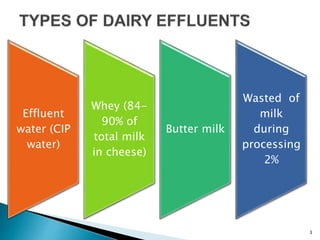
Effluent
water (CIP
water)
Whey (84-
90% of
total milk
in cheese)
Butter milk
Wasted of
milk
during
processing
2%
3
 Dairy industries are considered ‘wet industry’ as a result
of use of huge volumes of water, which is employed for
varied functions.
 Dairy plant use lot of water throughout process for
various purpose
- As ingredient
- For washing of equipments/CIP
Dairy industry generates great deal of waste water
classified by high
- Biological oxygen demand (BOD)
- Chemical oxygen demand (COD)
 Composition of wash water contain
- High concentrations of water,
- Product residues
- Milk elements
- Lactose
 Primarily the dairy waste is
- Organic
- Slightly alkaline in nature
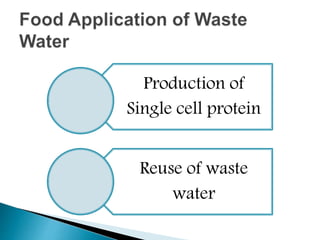
Production of
Single cell protein
Reuse of waste
water
“Single-cell protein (SCP) defined as the formation of cell mass
using microbes by culturing on available wastes”
- Among all liquid industrial waste, dairy industrial effluent
pose serious threat to our environment. There is a need to
utilize them to form a single-cell protein (SCP)
- Due to high BOD and COD of lactose, dairy waste water is
particularly suitable for the production of SCP using lactose-
utilizing microorganisms
- These single cell protein (SCP) are used for rumen and
poultry feed
It is possible to reuse the dairy waste water for various
food applications
- Mechanical treatment
- Chemical treatment
- Biological treatment
 Whey from cheese considered as a byproduct
of the cheese industry.
 Worldwide estimated production of whey is
 115 million tons per annum.
 Almost 45-47% of the produced whey is
disposed off into the environment
 Whey comprises of :
 carbohydrates
 lactic acid,
 Lactose
 fat and
 proteins etc
 Anaerobic digestion is the most cost-
effective technology for production of biogas
from cheese whey
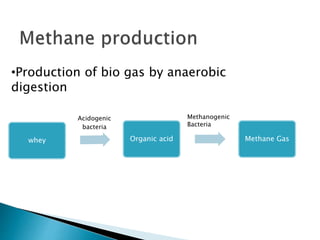
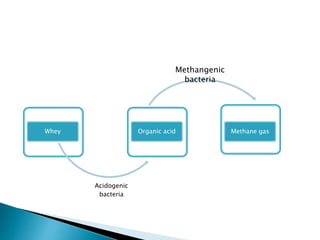
 In the process of anaerobic digestion, initially
acidogenic bacteria hydrolyzed whey and
convert it into organic acids then further
degradation of waste were carried out by
methanogenic bacteria. As a result, methane
gas produced which act as an energy source
whey Organic acid Methane Gas
Acidogenic
bacteria
•Production of bio gas by anaerobic
digestion
Methanogenic
Bacteria
Whey Organic acid Methane gas
Acidogenic
bacteria
Methangenic
bacteria
 Reuse of whey as animal feed
 Cheese whey proteins
 Fermentation to lactic acid
 Lactose isolation
 Powdered form of CW is easy to handle and
transport and can be kept fresh for a longer
period of time.
 So, CW powder is primarily used for animal
feed and in smaller amounts can be used in
foodstuffs designed for human consumption
such as ice cream, bread, sweets, sauces,
dairy products etc
 CW proteins, which comprise 15-22% milk protein
 valuable to health and are characterized by a high
nutritional value and
 therapeutic potential
 Main proteins of whey
 α-lactalbumin,
 β-lactoglobulin,
 bovine serum albumin (BSA) and
 bovine IgG
 Minor proteins
 lactoperoxidase,
 lactoferrin
 Separation of whey proteins
 ultrafiltration, or
 membrane processing,
 whey protein concentrates (WPC) or
 whey protein isolate (WPI)
 WPC contains 30%-90% proteins,
 WPI contains more than 90% protein on dry
matter.
 WPC is free of salts, it is suitable for all types of
human foods, even for dietary foods or baby.
 70% of milk whey consists of lactose.
 Compared to other sugars, the solubility and
sweetness of lactose is low.
 Lactose is used mainly as a component of
food,
 infant formula and
 as a filler or coating agent for tablets in the
pharmaceutical industry.
Disadvantage:
 low digestibility and
 low solubility
 Whey as a energy source
 Fermentation of ethanol
 Fermentation to hydrogen
 bioconversion of disaccharide to grain alcohol
reveals a theoretical most worth of 0.538
metric weight unit of grain alcohol from one
metric weight unit of lactose consumed
 By product of butter industry
 Churning of cream give equal amount of
butter and buttermilk,
 Butter milk powder used in many products
due to higher functional properties
 Butter milk added in many products like
baking goods and in various dairy products
 Butter milk by products
 Butter milk powder
 This byproduct contains:
 90% of the milk volume and
 56% of the milk nutrients.
 The most important of these nutrients are
 lactose (40–50 g/L),
 lipids (4–5 g/L),
 soluble proteins (6–7 g/L), and
 mineral salts (6%–8%)
 Mainly KC1and NaC1 (more than 50%), calcium
(mainly phosphate) and others.
 The butter milk used in many products due to high
amount of milk solids and also used as drink in
summer season
 Due to a high content of phospholipids butter
milk is used in many food products as a
functional ingredient such as salad dressings,
chocolate pasta, cheese seasonings, sauces,
yogurt and ice cream mixes.
 Emulsification is the main functional property
of butter milk
Waste minimization is the
 Reduction in the generation of waste.
 Reuse of waste materials/by-products.

Dairy waste management

  • 2.
    - Pakistan is5th largest milk producer in the world - About 4 % of the total production is processed into different products - Demand for milk and milk products have been increased all over the world as a result the no. of dairy industries have also been increased - Effluent per liter of milk 0.2 to 0.4L - So it is becoming difficult to manage the dairy effluents produced by these dairy industries.
  • 3.
    Effluent water (CIP water) Whey (84- 90%of total milk in cheese) Butter milk Wasted of milk during processing 2% 3
  • 4.
     Dairy industriesare considered ‘wet industry’ as a result of use of huge volumes of water, which is employed for varied functions.  Dairy plant use lot of water throughout process for various purpose - As ingredient - For washing of equipments/CIP Dairy industry generates great deal of waste water classified by high - Biological oxygen demand (BOD) - Chemical oxygen demand (COD)
  • 5.
     Composition ofwash water contain - High concentrations of water, - Product residues - Milk elements - Lactose  Primarily the dairy waste is - Organic - Slightly alkaline in nature
  • 6.
    Production of Single cellprotein Reuse of waste water
  • 7.
    “Single-cell protein (SCP)defined as the formation of cell mass using microbes by culturing on available wastes” - Among all liquid industrial waste, dairy industrial effluent pose serious threat to our environment. There is a need to utilize them to form a single-cell protein (SCP) - Due to high BOD and COD of lactose, dairy waste water is particularly suitable for the production of SCP using lactose- utilizing microorganisms - These single cell protein (SCP) are used for rumen and poultry feed
  • 8.
    It is possibleto reuse the dairy waste water for various food applications - Mechanical treatment - Chemical treatment - Biological treatment
  • 10.
     Whey fromcheese considered as a byproduct of the cheese industry.  Worldwide estimated production of whey is  115 million tons per annum.  Almost 45-47% of the produced whey is disposed off into the environment
  • 11.
     Whey comprisesof :  carbohydrates  lactic acid,  Lactose  fat and  proteins etc
  • 12.
     Anaerobic digestionis the most cost- effective technology for production of biogas from cheese whey  In the process of anaerobic digestion, initially acidogenic bacteria hydrolyzed whey and convert it into organic acids then further degradation of waste were carried out by methanogenic bacteria. As a result, methane gas produced which act as an energy source
  • 13.
    whey Organic acidMethane Gas Acidogenic bacteria •Production of bio gas by anaerobic digestion Methanogenic Bacteria
  • 14.
    Whey Organic acidMethane gas Acidogenic bacteria Methangenic bacteria
  • 15.
     Reuse ofwhey as animal feed  Cheese whey proteins  Fermentation to lactic acid  Lactose isolation
  • 16.
     Powdered formof CW is easy to handle and transport and can be kept fresh for a longer period of time.  So, CW powder is primarily used for animal feed and in smaller amounts can be used in foodstuffs designed for human consumption such as ice cream, bread, sweets, sauces, dairy products etc
  • 17.
     CW proteins,which comprise 15-22% milk protein  valuable to health and are characterized by a high nutritional value and  therapeutic potential  Main proteins of whey  α-lactalbumin,  β-lactoglobulin,  bovine serum albumin (BSA) and  bovine IgG  Minor proteins  lactoperoxidase,  lactoferrin
  • 18.
     Separation ofwhey proteins  ultrafiltration, or  membrane processing,  whey protein concentrates (WPC) or  whey protein isolate (WPI)  WPC contains 30%-90% proteins,  WPI contains more than 90% protein on dry matter.  WPC is free of salts, it is suitable for all types of human foods, even for dietary foods or baby.
  • 19.
     70% ofmilk whey consists of lactose.  Compared to other sugars, the solubility and sweetness of lactose is low.  Lactose is used mainly as a component of food,  infant formula and  as a filler or coating agent for tablets in the pharmaceutical industry. Disadvantage:  low digestibility and  low solubility
  • 20.
     Whey asa energy source  Fermentation of ethanol  Fermentation to hydrogen
  • 21.
     bioconversion ofdisaccharide to grain alcohol reveals a theoretical most worth of 0.538 metric weight unit of grain alcohol from one metric weight unit of lactose consumed
  • 22.
     By productof butter industry  Churning of cream give equal amount of butter and buttermilk,  Butter milk powder used in many products due to higher functional properties  Butter milk added in many products like baking goods and in various dairy products
  • 23.
     Butter milkby products  Butter milk powder
  • 24.
     This byproductcontains:  90% of the milk volume and  56% of the milk nutrients.  The most important of these nutrients are  lactose (40–50 g/L),  lipids (4–5 g/L),  soluble proteins (6–7 g/L), and  mineral salts (6%–8%)  Mainly KC1and NaC1 (more than 50%), calcium (mainly phosphate) and others.  The butter milk used in many products due to high amount of milk solids and also used as drink in summer season
  • 25.
     Due toa high content of phospholipids butter milk is used in many food products as a functional ingredient such as salad dressings, chocolate pasta, cheese seasonings, sauces, yogurt and ice cream mixes.  Emulsification is the main functional property of butter milk
  • 26.
    Waste minimization isthe  Reduction in the generation of waste.  Reuse of waste materials/by-products.