FOLIC ACID DEFICIENCY
Dr G VENKATA RAMANA
MBBS DNB FAMILY MEDICINE
FOLIC ACID
• Folic (pteroylglutamic) acid is a yellow, crystalline,
water-soluble substance.
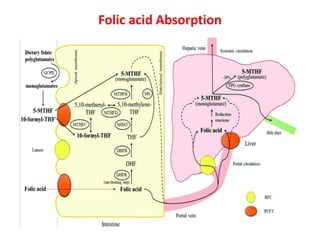
• Most dietary folate is present as polyglutamates
• These are converted to monoglutamate in the upper
small bowel and actively transported into plasma.
• Reduction to DHFA and methylation also occurs at
this site.
• Alcohol interferes with release of methyl-THFA from
hepatocytes.
• RDI of Folic acid
• Adults : 400mcg
• Pregnancy: 600mcg
• Lactation: 500mcg
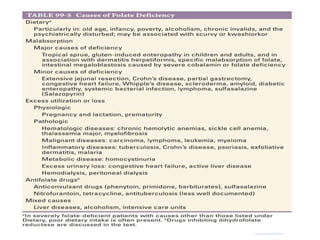
• Total body stores of folate are small and deficiency
can occur in a matter of weeks
Folic acid Absorption
Physiologic roles of folic acid
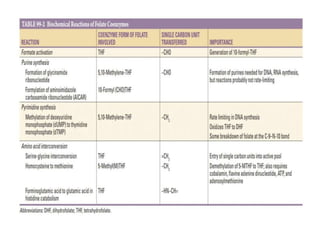
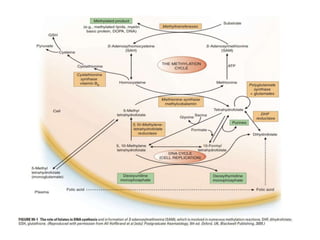
• DNA synthesis, RNA synthesis, DNA methylation
• Folic acid play a critical role in DNA and RNA
synthesis.
• Folic acid deficiency can therefore impair DNA
synthesis, which in turn can cause a cell to arrest in
the DNA synthesis (S) phase of the cell cycle, make
DNA replication errors, and/or undergo apoptotic death
• Hematopoiesis
• Hematopoietic precursor cells are among the most
rapidly dividing cells in the body and hence are one of
the cell types most sensitive to abnormal DNA
synthesis.
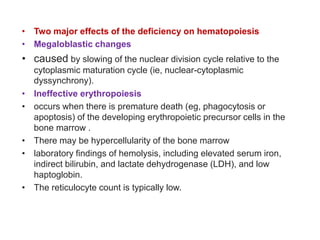
• Two major effects of the deficiency on hematopoiesis
• Megaloblastic changes
• caused by slowing of the nuclear division cycle relative to the
cytoplasmic maturation cycle (ie, nuclear-cytoplasmic
dyssynchrony).
• Ineffective erythropoiesis
• occurs when there is premature death (eg, phagocytosis or
apoptosis) of the developing erythropoietic precursor cells in the
bone marrow .
• There may be hypercellularity of the bone marrow
• laboratory findings of hemolysis, including elevated serum iron,
indirect bilirubin, and lactate dehydrogenase (LDH), and low
haptoglobin.
• The reticulocyte count is typically low.
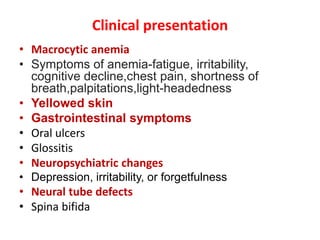
Clinical presentation
• Macrocytic anemia
• Symptoms of anemia-fatigue, irritability,
cognitive decline,chest pain, shortness of
breath,palpitations,light-headedness
• Yellowed skin
• Gastrointestinal symptoms
• Oral ulcers
• Glossitis
• Neuropsychiatric changes
• Depression, irritability, or forgetfulness
• Neural tube defects
• Spina bifida
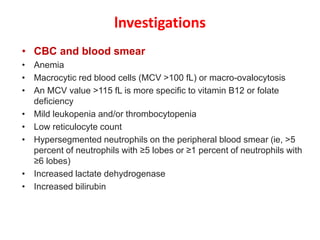
lnvestigations
• CBC and blood smear
• Anemia
• Macrocytic red blood cells (MCV >100 fL) or macro-ovalocytosis
• An MCV value >115 fL is more specific to vitamin B12 or folate
deficiency
• Mild leukopenia and/or thrombocytopenia
• Low reticulocyte count
• Hypersegmented neutrophils on the peripheral blood smear (ie, >5
percent of neutrophils with ≥5 lobes or ≥1 percent of neutrophils with
≥6 lobes)
• Increased lactate dehydrogenase
• Increased bilirubin
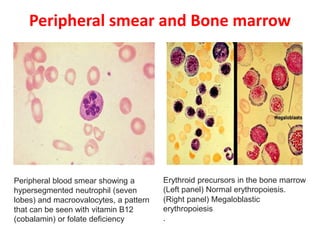
Peripheral smear and Bone marrow
Peripheral blood smear showing a
hypersegmented neutrophil (seven
lobes) and macroovalocytes, a pattern
that can be seen with vitamin B12
(cobalamin) or folate deficiency
Erythroid precursors in the bone marrow
(Left panel) Normal erythropoiesis.
(Right panel) Megaloblastic
erythropoiesis
.
Serum folic acid levels
• Serum folate measurement is very sensitive to dietary intake; a
single folate-rich meal can normalise it in a patient with true folate
deficiency, whereas anorexia, alcohol and anticonvulsant therapy
can reduce it in the absence of megaloblastosis.
• For this reason, red cell folate levels are a more accurate indicator
of folate stores and tissue folate deficiency
• Above 4 ng/mL (above 9.1 nmol/L) – Normal.
• Suggests folate is not deficient, unless the individual has recently
consumed a folate-containing meal or supplement.
• In such cases, RBC folate can be obtained or prefer metabolite
testing .
• RBC folate more costly to obtain.
• From 2 to 4 ng/mL (from 4.5 to 9.1 nmol/L) – Borderline
Additional testing may be indicated depending on the clinical
circumstances and the degree of suspicion for folate deficiency.
• Below 2 ng/mL (below 4.5 nmol/L) – Low
• Consistent with folate deficiency.
• Values may be slightly higher in the first six months of life.
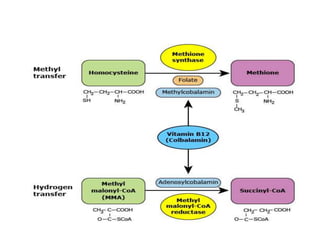
• MMA and homocysteine normal – No deficiency of
folate,vitamin B12.
• MMA and homocysteine elevated – Deficiency of
vitamin B12 (does not eliminate the possibility of folate
deficiency).
• MMA normal, homocysteine elevated – No deficiency
of vitamin B12. Consistent with deficiency of folate.
• RBC folate Surrogate for tissue folate levels.
• RBC folate provides information about folate status
over the lifetime of RBCs, similar to hemoglobin A1C for
blood glucose levels.
• An RBC folate level below 150 ng/mL (<150 mcg/L;
<340 nmol/L) is consistent with folate deficiency as long
as there is not concomitant vitamin B12 deficiency (RBC
folate is lower in individuals with vitamin B12
deficiency).
• False-normal results -Recent blood transfusion or if a
patient has a raised reticulocyte count
Treatment of folate deficiency
• Oral folic acid 1 to 5 mg daily
• Folinic Acid (5-Formyl-THF) stable form of fully reduced folate.
• It is given orally or parenterally to overcome the toxic effects of
methotrexate or other DHF reductase inhibitors, for example,
trimethoprim or cotrimoxazole.
• Duration
• Reversible cause of deficiency- one to four months or until there is
laboratory evidence of hematologic recovery.
• For those with a chronic cause of folate deficiency, such as chronic
hemolytic anemia - indefinitely.
• Intravenous folic acid indications
• Unable to take an oral medication (eg, due to vomiting or obtundation)
• Severe or symptomatic anemia
• Can partially reverse some of the hematologic abnormalities associated
with vitamin B12 deficiency .however, the neurologic manifestations of
vitamin B12 deficiency are not treated by folic acid.
• Thus, administration of folic acid to an individual with vitamin B12 deficiency
can potentially mask untreated vitamin B12 deficiency or even worsen the
neurologic complications.
• Because of this, testing for (and treatment of) vitamin B12 deficiency may
be appropriate in certain patients being treated with folic acid
• Adverse effects
• Oral folic acid is entirely nontoxic.
• Injections rarely cause sensitivity reactions.
• Prevention of folate deficiency
• Enrich cereals and grain products with folic acid to
reduce the risk of neural tube defects.
• Folic acid prophylaxis
• All women,from the moment they begin trying to
conceive until 12 weeks of gestation to prevent neural
tube defects
• Hemolytic anemias/hyperproliferative hematologic states
• Patients with rheumatoid arthritis or psoriasis on
methotrexate
• Patients on antiepileptic drugs
• Patients with ulcerative colitis

FOLIC ACID DEFICIENCY.pptx

  • 1.
    FOLIC ACID DEFICIENCY DrG VENKATA RAMANA MBBS DNB FAMILY MEDICINE
  • 2.
    FOLIC ACID • Folic(pteroylglutamic) acid is a yellow, crystalline, water-soluble substance. • Most dietary folate is present as polyglutamates • These are converted to monoglutamate in the upper small bowel and actively transported into plasma. • Reduction to DHFA and methylation also occurs at this site. • Alcohol interferes with release of methyl-THFA from hepatocytes. • RDI of Folic acid • Adults : 400mcg • Pregnancy: 600mcg • Lactation: 500mcg • Total body stores of folate are small and deficiency can occur in a matter of weeks
  • 4.
  • 5.
    Physiologic roles offolic acid • DNA synthesis, RNA synthesis, DNA methylation • Folic acid play a critical role in DNA and RNA synthesis. • Folic acid deficiency can therefore impair DNA synthesis, which in turn can cause a cell to arrest in the DNA synthesis (S) phase of the cell cycle, make DNA replication errors, and/or undergo apoptotic death • Hematopoiesis • Hematopoietic precursor cells are among the most rapidly dividing cells in the body and hence are one of the cell types most sensitive to abnormal DNA synthesis.
  • 6.
    • Two majoreffects of the deficiency on hematopoiesis • Megaloblastic changes • caused by slowing of the nuclear division cycle relative to the cytoplasmic maturation cycle (ie, nuclear-cytoplasmic dyssynchrony). • Ineffective erythropoiesis • occurs when there is premature death (eg, phagocytosis or apoptosis) of the developing erythropoietic precursor cells in the bone marrow . • There may be hypercellularity of the bone marrow • laboratory findings of hemolysis, including elevated serum iron, indirect bilirubin, and lactate dehydrogenase (LDH), and low haptoglobin. • The reticulocyte count is typically low.
  • 11.
    Clinical presentation • Macrocyticanemia • Symptoms of anemia-fatigue, irritability, cognitive decline,chest pain, shortness of breath,palpitations,light-headedness • Yellowed skin • Gastrointestinal symptoms • Oral ulcers • Glossitis • Neuropsychiatric changes • Depression, irritability, or forgetfulness • Neural tube defects • Spina bifida
  • 12.
    lnvestigations • CBC andblood smear • Anemia • Macrocytic red blood cells (MCV >100 fL) or macro-ovalocytosis • An MCV value >115 fL is more specific to vitamin B12 or folate deficiency • Mild leukopenia and/or thrombocytopenia • Low reticulocyte count • Hypersegmented neutrophils on the peripheral blood smear (ie, >5 percent of neutrophils with ≥5 lobes or ≥1 percent of neutrophils with ≥6 lobes) • Increased lactate dehydrogenase • Increased bilirubin
  • 13.
    Peripheral smear andBone marrow Peripheral blood smear showing a hypersegmented neutrophil (seven lobes) and macroovalocytes, a pattern that can be seen with vitamin B12 (cobalamin) or folate deficiency Erythroid precursors in the bone marrow (Left panel) Normal erythropoiesis. (Right panel) Megaloblastic erythropoiesis .
  • 14.
    Serum folic acidlevels • Serum folate measurement is very sensitive to dietary intake; a single folate-rich meal can normalise it in a patient with true folate deficiency, whereas anorexia, alcohol and anticonvulsant therapy can reduce it in the absence of megaloblastosis. • For this reason, red cell folate levels are a more accurate indicator of folate stores and tissue folate deficiency • Above 4 ng/mL (above 9.1 nmol/L) – Normal. • Suggests folate is not deficient, unless the individual has recently consumed a folate-containing meal or supplement. • In such cases, RBC folate can be obtained or prefer metabolite testing . • RBC folate more costly to obtain. • From 2 to 4 ng/mL (from 4.5 to 9.1 nmol/L) – Borderline Additional testing may be indicated depending on the clinical circumstances and the degree of suspicion for folate deficiency. • Below 2 ng/mL (below 4.5 nmol/L) – Low • Consistent with folate deficiency. • Values may be slightly higher in the first six months of life.
  • 15.
    • MMA andhomocysteine normal – No deficiency of folate,vitamin B12. • MMA and homocysteine elevated – Deficiency of vitamin B12 (does not eliminate the possibility of folate deficiency). • MMA normal, homocysteine elevated – No deficiency of vitamin B12. Consistent with deficiency of folate. • RBC folate Surrogate for tissue folate levels. • RBC folate provides information about folate status over the lifetime of RBCs, similar to hemoglobin A1C for blood glucose levels. • An RBC folate level below 150 ng/mL (<150 mcg/L; <340 nmol/L) is consistent with folate deficiency as long as there is not concomitant vitamin B12 deficiency (RBC folate is lower in individuals with vitamin B12 deficiency). • False-normal results -Recent blood transfusion or if a patient has a raised reticulocyte count
  • 16.
    Treatment of folatedeficiency • Oral folic acid 1 to 5 mg daily • Folinic Acid (5-Formyl-THF) stable form of fully reduced folate. • It is given orally or parenterally to overcome the toxic effects of methotrexate or other DHF reductase inhibitors, for example, trimethoprim or cotrimoxazole. • Duration • Reversible cause of deficiency- one to four months or until there is laboratory evidence of hematologic recovery. • For those with a chronic cause of folate deficiency, such as chronic hemolytic anemia - indefinitely. • Intravenous folic acid indications • Unable to take an oral medication (eg, due to vomiting or obtundation) • Severe or symptomatic anemia • Can partially reverse some of the hematologic abnormalities associated with vitamin B12 deficiency .however, the neurologic manifestations of vitamin B12 deficiency are not treated by folic acid. • Thus, administration of folic acid to an individual with vitamin B12 deficiency can potentially mask untreated vitamin B12 deficiency or even worsen the neurologic complications. • Because of this, testing for (and treatment of) vitamin B12 deficiency may be appropriate in certain patients being treated with folic acid
  • 17.
    • Adverse effects •Oral folic acid is entirely nontoxic. • Injections rarely cause sensitivity reactions. • Prevention of folate deficiency • Enrich cereals and grain products with folic acid to reduce the risk of neural tube defects. • Folic acid prophylaxis • All women,from the moment they begin trying to conceive until 12 weeks of gestation to prevent neural tube defects • Hemolytic anemias/hyperproliferative hematologic states • Patients with rheumatoid arthritis or psoriasis on methotrexate • Patients on antiepileptic drugs • Patients with ulcerative colitis