

JAVA – REMOTE METHOD
INNOVATION
MADE BY : PRANKIT MISHRA
(141CC00007)
SUBMITTED TO : DR. RAKESH BHADONI
INTRODUCTION
 The Java Remote Method Invocation (Java RMI) is a Java API that
performs remote method invocation, the object-oriented equivalent of remote
procedure calls (RPC), with support for direct transfer of serialized Java classes
and distributed garbage collection.
 Usage of the term RMI may denote solely the programming interface or may
signify both the API and JRMP, IIOP, or another implementation, whereas the
term RMI-IIOP specifically denotes the RMI interface delegating most of the
functionality to the supporting CORBA implementation.
WHY IT IS NEEDED..??
 Provide user with a “thin client “
allows good performance on lowed workstations
 Run server on high end hardware
maximize $ investment over many clients
server remote from client
 Distributed network object.
WHAT IS NEEDED FOR RMI..??
 Java makes RMI (Remote Method Invocation) fairly easy, but there are some
extra steps
 To send a message to a remote “server object,”
 The “client object” has to find the object
Do this by looking it up in a registry
 The client object then has to marshal the parameters (prepare them for
transmission)
Java requires Serializable parameters
The server object has to unmarshal its parameters, do its computation, and
marshal its response
 The client object has to unmarshal the response
 Much of this is done for you by special software
GENERAL FUNCTIONING DIAGRAM
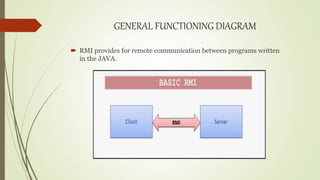
 RMI provides for remote communication between programs written
in the JAVA.
RMI ARCHITECTURE
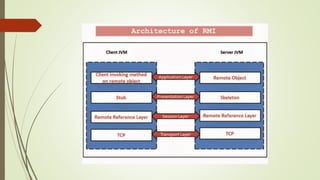
The complete RMI System is divided in 4 layers:
1. Application Layer
2. Proxy Layer
3. Remote Reference Layer
4. Transport Layer
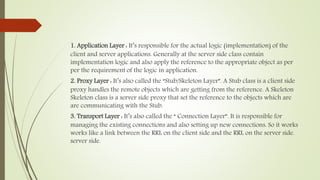
1. Application Layer : It’s responsible for the actual logic (implementation) of the
client and server applications. Generally at the server side class contain
implementation logic and also apply the reference to the appropriate object as per
per the requirement of the logic in application.
2. Proxy Layer : It’s also called the “Stub/Skeleton Layer”. A Stub class is a client side
proxy handles the remote objects which are getting from the reference. A Skeleton
Skeleton class is a server side proxy that set the reference to the objects which are
are communicating with the Stub.
3. Transport Layer : It’s also called the “ Connection Layer”. It is responsible for
managing the existing connections and also setting up new connections. So it works
works like a link between the RRL on the client side and the RRL on the server side.
server side.
4. Remote Reference Layer(RRL) : It is responsible for managing the references made
by the client to the remote object on the server so it is available on both JVM(Client
JVM(Client and Server). The Client side RRL receives the request for methods from
methods from the tub that is transferred into byte stream process called serialization
serialization (Marshalling) and then these data are send to the server side RRL.
RRL.
The server side RRL doing reverse process and convert the binary data into object.
object. This process is called deserialization or unmarshalling and then sent to the
to the Skeleton class.
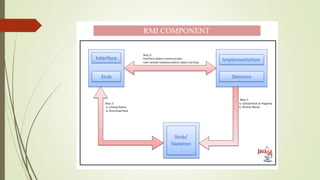
RMI COMPONENTS
The RMI application contains three components:
1. RMI Server
2. RMI Client
3. RMI Registry
RMI SERVER
 RMI Server contains objects whose methods are to be called remotely. It
creates remote objects and applies the reference to these objects in the
Registry, after that the Registry registers these objects who are going to be
called by client remotely.
RMI CLIENT
 The RMI Client gets the reference of one or more remote objects from the
Registry with the help of object name. It can invoke methods on the
remote object to access the services of the object as per the requirement of
logic in RMI application.
 Once the client gets the reference of remote object, the methods in the
remote object are invoked just like as the methods of a local object.
RMI REGISTRY
 In the Server side of the reference of the object (which is invoked
remotely) is applied and after that this reference is set in the RMI registry.
 When the client call the method on this object, its not directly call but it is
a call by the reference which is already set in the Registry so it first gets the
object from this reference which is available at RMI Registry then after
calls the methods as per the requirement of logic in RMI application.
SIMLAR TECHNOLOGY
 CORBA (Common Object Request Broker Architecture) has long been
king
 CORBA supports object transmission between virtually any languages
 Objects have to be described in IDL (Interface Definition Language),
which looks a lot like C++ data definitions
 CORBA is complex and flaky
 Microsoft supported CORBA, then COM, now .NET
THE FUTURE OF RMI
 Now that it is part of JDK1.1, it is highly unlikely that it will be removed at
a later date.
 According to Sun, RMI has not been (and will not be) replaced by Corba
and IIOP.
 According to Java Soft, RMI will be extended in the future with the ability
to use IIOP as a transport protocol.
REFERENCES
 https://www.cis.upenn.edu/~matuszek/cit597-2003/Lectures/32-rmi.
 www.eng.auburn.edu/center/irsc/comp0690/rmi.
 www.javatpoint.com/RMI.
 https://docs.oracle.com/javase/tutorial/rmi.
THANK YOU

Remote Method Innovation (RMI) In JAVA

  • 1.
    JAVA – REMOTEMETHOD INNOVATION MADE BY : PRANKIT MISHRA (141CC00007) SUBMITTED TO : DR. RAKESH BHADONI
  • 2.
    INTRODUCTION  The JavaRemote Method Invocation (Java RMI) is a Java API that performs remote method invocation, the object-oriented equivalent of remote procedure calls (RPC), with support for direct transfer of serialized Java classes and distributed garbage collection.  Usage of the term RMI may denote solely the programming interface or may signify both the API and JRMP, IIOP, or another implementation, whereas the term RMI-IIOP specifically denotes the RMI interface delegating most of the functionality to the supporting CORBA implementation.
  • 3.
    WHY IT ISNEEDED..??  Provide user with a “thin client “ allows good performance on lowed workstations  Run server on high end hardware maximize $ investment over many clients server remote from client  Distributed network object.
  • 4.
    WHAT IS NEEDEDFOR RMI..??  Java makes RMI (Remote Method Invocation) fairly easy, but there are some extra steps  To send a message to a remote “server object,”  The “client object” has to find the object Do this by looking it up in a registry  The client object then has to marshal the parameters (prepare them for transmission) Java requires Serializable parameters The server object has to unmarshal its parameters, do its computation, and marshal its response  The client object has to unmarshal the response  Much of this is done for you by special software
  • 5.
    GENERAL FUNCTIONING DIAGRAM RMI provides for remote communication between programs written in the JAVA.
  • 6.
    RMI ARCHITECTURE The completeRMI System is divided in 4 layers: 1. Application Layer 2. Proxy Layer 3. Remote Reference Layer 4. Transport Layer
  • 8.
    1. Application Layer: It’s responsible for the actual logic (implementation) of the client and server applications. Generally at the server side class contain implementation logic and also apply the reference to the appropriate object as per per the requirement of the logic in application. 2. Proxy Layer : It’s also called the “Stub/Skeleton Layer”. A Stub class is a client side proxy handles the remote objects which are getting from the reference. A Skeleton Skeleton class is a server side proxy that set the reference to the objects which are are communicating with the Stub. 3. Transport Layer : It’s also called the “ Connection Layer”. It is responsible for managing the existing connections and also setting up new connections. So it works works like a link between the RRL on the client side and the RRL on the server side. server side.
  • 9.
    4. Remote ReferenceLayer(RRL) : It is responsible for managing the references made by the client to the remote object on the server so it is available on both JVM(Client JVM(Client and Server). The Client side RRL receives the request for methods from methods from the tub that is transferred into byte stream process called serialization serialization (Marshalling) and then these data are send to the server side RRL. RRL. The server side RRL doing reverse process and convert the binary data into object. object. This process is called deserialization or unmarshalling and then sent to the to the Skeleton class.
  • 10.
    RMI COMPONENTS The RMIapplication contains three components: 1. RMI Server 2. RMI Client 3. RMI Registry
  • 12.
    RMI SERVER  RMIServer contains objects whose methods are to be called remotely. It creates remote objects and applies the reference to these objects in the Registry, after that the Registry registers these objects who are going to be called by client remotely.
  • 13.
    RMI CLIENT  TheRMI Client gets the reference of one or more remote objects from the Registry with the help of object name. It can invoke methods on the remote object to access the services of the object as per the requirement of logic in RMI application.  Once the client gets the reference of remote object, the methods in the remote object are invoked just like as the methods of a local object.
  • 14.
    RMI REGISTRY  Inthe Server side of the reference of the object (which is invoked remotely) is applied and after that this reference is set in the RMI registry.  When the client call the method on this object, its not directly call but it is a call by the reference which is already set in the Registry so it first gets the object from this reference which is available at RMI Registry then after calls the methods as per the requirement of logic in RMI application.
  • 15.
    SIMLAR TECHNOLOGY  CORBA(Common Object Request Broker Architecture) has long been king  CORBA supports object transmission between virtually any languages  Objects have to be described in IDL (Interface Definition Language), which looks a lot like C++ data definitions  CORBA is complex and flaky  Microsoft supported CORBA, then COM, now .NET
  • 16.
    THE FUTURE OFRMI  Now that it is part of JDK1.1, it is highly unlikely that it will be removed at a later date.  According to Sun, RMI has not been (and will not be) replaced by Corba and IIOP.  According to Java Soft, RMI will be extended in the future with the ability to use IIOP as a transport protocol.
  • 17.
  • 18.