automation in it’s next level
FOG Computing
Rishabh Kumar
1342810081
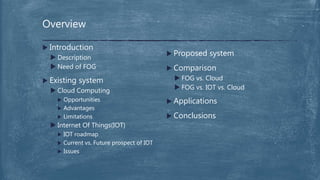
 Proposed system
 Comparison
 FOG vs. Cloud
 FOG vs. IOT vs. Cloud
 Applications
 Conclusions
 Introduction
 Description
 Need of FOG
 Existing system
 Cloud Computing
 Opportunities
 Advantages
 Limitations
 Internet Of Things(IOT)
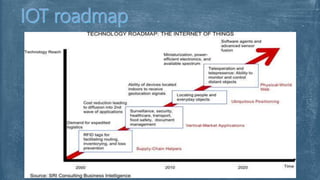
 IOT roadmap
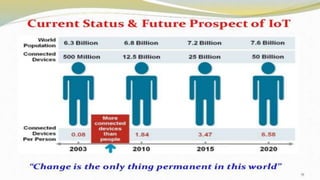
 Current vs. Future prospect of IOT
 Issues
Overview
Fog Computing also known as fogging, a model in which data,
processing and applications are concentrated in devices at the network
edge rather than existing entirely in the cloud
The term “Fog Computing” was introduced by CISCO systems, a new
model to ease wireless data transfer to different distributed systems in
Internet Of Things(IOT) network devices.
Fog Computing is a decentralized computing infrastructure that
distributes computing , data processing and network services closer to
the end users.
Fog Computing is a prototype that extends Cloud Computing and
services to the edge of the network. Similar to Cloud, Fog provides
data, compute, storage and application service to end-users.
Fog Computing is about computing on the edge. In Fog computing
devices communicate peer-to-peer to efficiently share/store data and
take local decisions.
All computing places at the edge of the cloud, often on network
devices, while data remains on the cloud. This lead to increase in
processing times and fewer resources consumed.
Traditionally, cloud computing, concentrates on computing,
processing of all applications and data in the cloud.
Although, fog computing extends the cloud computing paradigm
to network edges. While fog and cloud share same
resources(networking, compute and storage) and share same
attributes, is a extension in the existing systems: to address
applications and services that do not fit the paradigm of cloud.
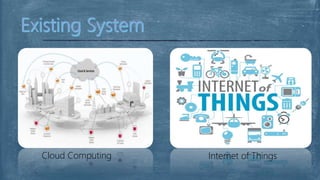
Cloud Computing Internet of Things
Cloud Computing is a general term used to describe a new class of
network based computing that takes place over the Internet.
Basically, it is the practice of using a network of remote servers
hosted on the Internet to store, manage, and process data, rather
than a local server or a personal computer.
The term cloud in science used to describe a large pool of objects
that visually appears from a distance. In computer science it has
been used to refer to platforms for distributed computing .
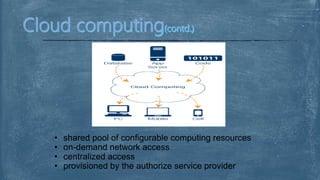
• shared pool of configurable computing resources
• on-demand network access
• centralized access
• provisioned by the authorize service provider
Data and services are stored remotely but accessible from
“anywhere”.
It enables services to be used without any understanding
of their infrastructure.
Cloud computing on economies of scale:
 It potentially lowers the outlay expense for start up companies, as
they would no longer need to buy their own software or servers.
 Cost would be by on-demand pricing.
Lower computer costs:
no need of a high-powered and high-priced computer to run cloud
computing's web-based applications
when using web-based applications, PC might be less expensive,
with a smaller hard disk, less memory, more efficient processor...
Improved performance:
with few large programs hogging your computer's memory, you will
see better performance from your PC.
computers in cloud computing system boot and run faster because
they have fewer programs and processes loaded into memory…
Increased data reliability:
if a hard disk crashes and destroy all your valuable data, a computer
crashing in the cloud should not affect the storage of your data
Reduce software costs:
instead of purchasing expensive software applications, you can get
most of what you need for free
Instant software updates:
when the application is web-based, updates happen automatically
when you access a web-based application, you get the latest version
• without needing to pay for or download an upgrade
Unlimited software capacity:
Cloud computing offers virtually limitless storage
Requires a constant Internet connection:
cloud computing is impossible if you cannot connect to the Internet.
no Internet connection means no work and in areas, where Internet
connections are few or inherently unreliable, this could be a deal-breaker.
Stored data might not be secure:
With cloud computing, all your data is stored on the cloud.
Stored data can be lost:
theoretically, data stored in the cloud is safe, replicated across multiple
machines
but on the off chance that your data goes missing, you have no physical
or local backup.
Can be slow:
Even with a fast connection, web-based applications can sometimes be
slower than accessing a similar software program on your desktop PC.
Features might be limited:
This situation is bound to change, but today many web-based applications
simply are not as full-featured as their desktop-based applications.
• For example, you can do a lot more with Microsoft PowerPoint than with
Google Presentation's web-based offering
The Internet of Things (IOT) is the network of physical objects—
devices, vehicles, buildings and other items embedded with electronics,
software, sensors, and network connectivity—that enables these objects
to collect and exchange data.
Other names given to IOT are:
 M2M(machine to machine)
 “Internet of Everything”(Cisco Systems)
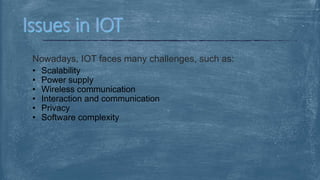
Nowadays, IOT faces many challenges, such as:
• Scalability
• Power supply
• Wireless communication
• Interaction and communication
• Privacy
• Software complexity
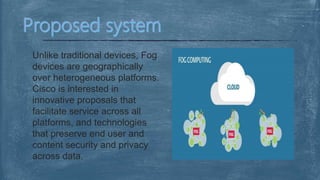
Unlike traditional devices, Fog
devices are geographically
over heterogeneous platforms.
Cisco is interested in
innovative proposals that
facilitate service across all
platforms, and technologies
that preserve end user and
content security and privacy
across data.
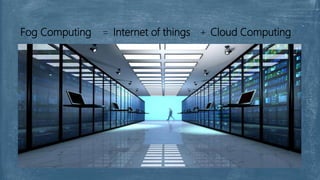
Fog Computing = Internet of things + Cloud Computing
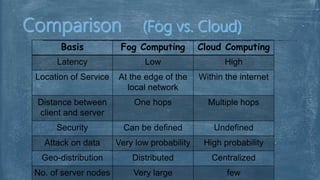
Basis Fog Computing Cloud Computing
Latency Low High
Location of Service At the edge of the
local network
Within the internet
Distance between
client and server
One hops Multiple hops
Security Can be defined Undefined
Attack on data Very low probability High probability
Geo-distribution Distributed Centralized
No. of server nodes Very large few
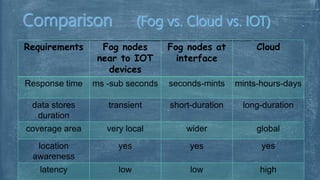
Requirements Fog nodes
near to IOT
devices
Fog nodes at
interface
Cloud
Response time ms -sub seconds seconds-mints mints-hours-days
data stores
duration
transient short-duration long-duration
coverage area very local wider global
location
awareness
yes yes yes
latency low low high
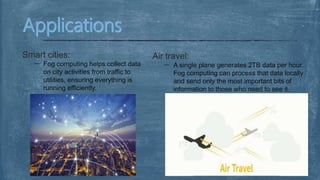
Smart cities:
Fog computing helps collect data
on city activities from traffic to
utilities, ensuring everything is
running efficiently.
Air travel:
A single plane generates 2TB data per hour.
Fog computing can process that data locally
and send only the most important bits of
information to those who need to see it.
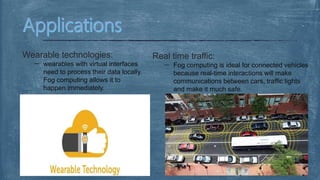
Wearable technologies:
wearables with virtual interfaces
need to process their data locally.
Fog computing allows it to
happen immediately.
Real time traffic:
Fog computing is ideal for connected vehicles
because real-time interactions will make
communications between cars, traffic lights
and make it much safe.
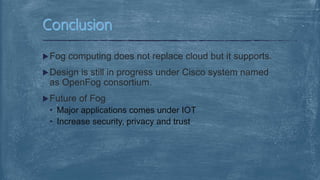
Fog computing does not replace cloud but it supports.
Design is still in progress under Cisco system named
as OpenFog consortium.
Future of Fog
• Major applications comes under IOT
• Increase security, privacy and trust
Questions & Discussion

Fog computing

  • 1.
    automation in it’snext level FOG Computing Rishabh Kumar 1342810081
  • 2.
     Proposed system Comparison  FOG vs. Cloud  FOG vs. IOT vs. Cloud  Applications  Conclusions  Introduction  Description  Need of FOG  Existing system  Cloud Computing  Opportunities  Advantages  Limitations  Internet Of Things(IOT)  IOT roadmap  Current vs. Future prospect of IOT  Issues Overview
  • 3.
    Fog Computing alsoknown as fogging, a model in which data, processing and applications are concentrated in devices at the network edge rather than existing entirely in the cloud The term “Fog Computing” was introduced by CISCO systems, a new model to ease wireless data transfer to different distributed systems in Internet Of Things(IOT) network devices. Fog Computing is a decentralized computing infrastructure that distributes computing , data processing and network services closer to the end users.
  • 4.
    Fog Computing isa prototype that extends Cloud Computing and services to the edge of the network. Similar to Cloud, Fog provides data, compute, storage and application service to end-users. Fog Computing is about computing on the edge. In Fog computing devices communicate peer-to-peer to efficiently share/store data and take local decisions. All computing places at the edge of the cloud, often on network devices, while data remains on the cloud. This lead to increase in processing times and fewer resources consumed.
  • 5.
    Traditionally, cloud computing,concentrates on computing, processing of all applications and data in the cloud. Although, fog computing extends the cloud computing paradigm to network edges. While fog and cloud share same resources(networking, compute and storage) and share same attributes, is a extension in the existing systems: to address applications and services that do not fit the paradigm of cloud.
  • 6.
  • 7.
    Cloud Computing isa general term used to describe a new class of network based computing that takes place over the Internet. Basically, it is the practice of using a network of remote servers hosted on the Internet to store, manage, and process data, rather than a local server or a personal computer. The term cloud in science used to describe a large pool of objects that visually appears from a distance. In computer science it has been used to refer to platforms for distributed computing .
  • 8.
    • shared poolof configurable computing resources • on-demand network access • centralized access • provisioned by the authorize service provider
  • 9.
    Data and servicesare stored remotely but accessible from “anywhere”. It enables services to be used without any understanding of their infrastructure. Cloud computing on economies of scale:  It potentially lowers the outlay expense for start up companies, as they would no longer need to buy their own software or servers.  Cost would be by on-demand pricing.
  • 10.
    Lower computer costs: noneed of a high-powered and high-priced computer to run cloud computing's web-based applications when using web-based applications, PC might be less expensive, with a smaller hard disk, less memory, more efficient processor... Improved performance: with few large programs hogging your computer's memory, you will see better performance from your PC. computers in cloud computing system boot and run faster because they have fewer programs and processes loaded into memory… Increased data reliability: if a hard disk crashes and destroy all your valuable data, a computer crashing in the cloud should not affect the storage of your data
  • 11.
    Reduce software costs: insteadof purchasing expensive software applications, you can get most of what you need for free Instant software updates: when the application is web-based, updates happen automatically when you access a web-based application, you get the latest version • without needing to pay for or download an upgrade Unlimited software capacity: Cloud computing offers virtually limitless storage
  • 12.
    Requires a constantInternet connection: cloud computing is impossible if you cannot connect to the Internet. no Internet connection means no work and in areas, where Internet connections are few or inherently unreliable, this could be a deal-breaker. Stored data might not be secure: With cloud computing, all your data is stored on the cloud. Stored data can be lost: theoretically, data stored in the cloud is safe, replicated across multiple machines but on the off chance that your data goes missing, you have no physical or local backup.
  • 13.
    Can be slow: Evenwith a fast connection, web-based applications can sometimes be slower than accessing a similar software program on your desktop PC. Features might be limited: This situation is bound to change, but today many web-based applications simply are not as full-featured as their desktop-based applications. • For example, you can do a lot more with Microsoft PowerPoint than with Google Presentation's web-based offering
  • 14.
    The Internet ofThings (IOT) is the network of physical objects— devices, vehicles, buildings and other items embedded with electronics, software, sensors, and network connectivity—that enables these objects to collect and exchange data. Other names given to IOT are:  M2M(machine to machine)  “Internet of Everything”(Cisco Systems)
  • 17.
    Nowadays, IOT facesmany challenges, such as: • Scalability • Power supply • Wireless communication • Interaction and communication • Privacy • Software complexity
  • 18.
    Unlike traditional devices,Fog devices are geographically over heterogeneous platforms. Cisco is interested in innovative proposals that facilitate service across all platforms, and technologies that preserve end user and content security and privacy across data.
  • 19.
    Fog Computing =Internet of things + Cloud Computing
  • 20.
    Basis Fog ComputingCloud Computing Latency Low High Location of Service At the edge of the local network Within the internet Distance between client and server One hops Multiple hops Security Can be defined Undefined Attack on data Very low probability High probability Geo-distribution Distributed Centralized No. of server nodes Very large few
  • 21.
    Requirements Fog nodes nearto IOT devices Fog nodes at interface Cloud Response time ms -sub seconds seconds-mints mints-hours-days data stores duration transient short-duration long-duration coverage area very local wider global location awareness yes yes yes latency low low high
  • 22.
    Smart cities: Fog computinghelps collect data on city activities from traffic to utilities, ensuring everything is running efficiently. Air travel: A single plane generates 2TB data per hour. Fog computing can process that data locally and send only the most important bits of information to those who need to see it.
  • 23.
    Wearable technologies: wearables withvirtual interfaces need to process their data locally. Fog computing allows it to happen immediately. Real time traffic: Fog computing is ideal for connected vehicles because real-time interactions will make communications between cars, traffic lights and make it much safe.
  • 24.
    Fog computing doesnot replace cloud but it supports. Design is still in progress under Cisco system named as OpenFog consortium. Future of Fog • Major applications comes under IOT • Increase security, privacy and trust
  • 25.