1
Hardware and Software
• Majid Ali Rajar
• Roll # 2k2016/Med/40
• Subject: Computer Applicaton
• Submitted to: Sir Kamran
2
Contents
 Define hardware and software
 Describe the hardware categories
 Describe the computers categories by size
 Define the two types of software
 Describe the role of the operating system and
utility software
 Compare the uses of vertical and horizontal
market software
 List the common input, output, storage, and
telecommunication devices
3
Hardware and Software
• IT is any computer-based tool that:
▫ People use to work with information
▫ Support the information and information-
processing needs of an organization
• Hardware – physical aspects of computers,
telecommunications, and other information
technology devices
▫ Example: Keyboard, monitor
• Software -a general term for the various kinds
of programs used to operate computers and
related devices
▫ Example: Microsoft Excel
4
Six Categories of Hardware
• Input Device
• Output device
• Storage device
• Central processing unit (CPU)
• communications device
• Connecting device
5
Two main types of software
• Application software - software used to solve
specific problems or perform specific tasks
• System software - handles tasks specific to
technology management and coordinates the
interaction of all technology devices
▫ Operating system software - supports the
application software and manages how the
hardware devices work together
▫ Utility software - provides additional
functionality to the operating system
6
Computer Categories
• Personal digital assistant
(PDA):
a small hand-held computer that
performs simple tasks
• Notebook computer:
a fully functional computer
designed to be carried around
• Tablet computer:
a pen-based computer that
provides the screen capabilities of a
PDA with the functional
capabilities of a notebook
7
Computer Categories (continued)
8
• Desktop computer
• Minicomputer - designed to
meet the computing needs of
several people simultaneously in
a small to medium-size business
environment
• Mainframe computer -
designed to meet the computing
needs of hundreds of people in a
large business environment
• Supercomputers - the fastest,
most powerful, and most
expensive type of computer
Software
• Software contains the instructions that the
hardware executes to perform an information
processing task
• Without the aid of software, the computer
hardware is useless
• Two categories of software
▫ Application
▫ System
9
Application Software
• Application software is used for specific
information processing needs, including:
▫ Payroll
▫ Customer relationship management
▫ Project management
▫ Training
▫ Word processing and many others
10
Application Software (continued)
• Personal productivity software :
used to perform personal tasks such as writing a
memo, creating a graph, or creating a slide
presentation
• Examples:
▫ Microsoft Word
▫ Microsoft Excel
▫ Internet Explorer
▫ Quicken
11
Application Software (continued)
• Vertical market software :
application software that is unique to a
particular industry
▫ Patient-scheduling software
▫ Nursing allocation software
• Horizontal market software :
general enough to be suitable for use in a variety
of industries
▫ Inventory management software
▫ Payroll software
12
System Software
• System software controls how the various
technology tools work together along with the
application software
• Operating System controls application software
and manages how the hardware devices work
together
▫ Example: Microsoft Windows XP Home,
Mac OS, Linux
• Utility
▫ Uninstaller software, spyware software
13
Data Representation
• Binary digit (bit)
▫ the smallest unit of information that a computer
can process
• ASCII (American Standard Code for
Information Interchange)
▫ the coding system that most personal computers
use to represent, process, and store information
• Byte
▫ a group of eight bits to represent a character
14
Common Input Devices
• Input device is a tool
used to capture
information and
commands
• Examples include:
▫ Keyboard
▫ Point-of-sale (POS)
▫ Microphone
▫ Mouse
▫ Pointing stick
▫ Touch pad
▫ Touch screen
▫ Bar code reader
▫ Optical mark recognition
(OMR)
▫ Scanner
15
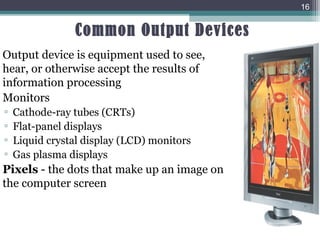
Common Output Devices
16
Output device is equipment used to see,
hear, or otherwise accept the results of
information processing
Monitors
▫ Cathode-ray tubes (CRTs)
▫ Flat-panel displays
▫ Liquid crystal display (LCD) monitors
▫ Gas plasma displays
Pixels - the dots that make up an image on
the computer screen
Common Output Devices (continued)
• Printers
▫ Inkjet printers - make images by forcing ink
droplets through nozzles
▫ Laser printers - form images using an
electrostatic process, the same way a photocopier
works
▫ Multifunction printers - scan, copy, and fax, as
well as print
17
Common Storage Devices
• High-capacity floppy
disk
• Hard disk
• CD-ROM (compact disc
- read-only memory)
• CD-R (compact disc-
recordable)
• CD-RW (compact disc-
rewritable)
• DVD-ROM
• DVD-R
• DVD-RW or DVD+RW
• Flash memory device
• Memory card
18
Telecommunication Devices
Communication Software
• Connectivity software
▫ enables a computer to “dial up” or connect to
another computer
• Web browser software
▫ enables a computer to surf the Web
• E-mail software
▫ enables electronic communication with other
people by sending and receiving e-mail
20
Wireless Connection
• Infrared also called IR or IrDA (infrared data
association) - uses red light to send and receive
information
• Bluetooth - standard for transmitting information in
the form of short range radio waves over distances of up
to 30 feet and is used for purposes such as wirelessly
connecting a cell phone or a PDA to a computer
• WiFi (wireless fidelity) - standard for transmitting
information in the form of radio waves over distances up
to about 300 feet
21
Wireless Connection (continued)
Connecting Devices
• Connecting devices enable the hardware to
communicate with each other
▫ A parallel connector is used to plug a printer into a
system box
▫ Parallel connector interfaces with a parallel port
that is connected to an expansion card
23
Buses, Expansion Slots, Expansion Cards;
Ports, Connectors
• Expansion bus - moves information from the CPU and
RAM to all of the other hardware devices
• Expansion slot - a long skinny socket on the
motherboard into which an expansion card is inserted
• Expansion card - a circuit board that is inserted into an
expansion slot
• Ports - simply the plug-ins found on the outside of the
system box into which a connector is plugged into
• Popular connectors include:
▫ USB (universal serial bus)
▫ Serial connector
▫ Parallel connector
24
Random Access Memory (RAM)
• RAM - temporary
storage that holds
the current
information, the
application
software currently
being used, and the
operating system
software 25
Central Processing Unit (CPU)
• CPU - the actual hardware that interprets and executes
the program instructions and coordinates how all the
other hardware devices work together.
▫ Control unit - interprets software instructions and
tells the other hardware devices what to do, based on
the software instructions
▫ Arithmetic/logic unit (ALU) - performs all
arithmetic operations and all logic operations
• CPU Speed
▫ Megahertz (MHz) - the number of millions of CPU
cycles per second
▫ Gigahertz (GHz) - the number of billions of CPU
cycles per second
26
27

foedumed:Hardware and Sowftware 40_16

  • 1.
  • 2.
    Hardware and Software •Majid Ali Rajar • Roll # 2k2016/Med/40 • Subject: Computer Applicaton • Submitted to: Sir Kamran 2
  • 3.
    Contents  Define hardwareand software  Describe the hardware categories  Describe the computers categories by size  Define the two types of software  Describe the role of the operating system and utility software  Compare the uses of vertical and horizontal market software  List the common input, output, storage, and telecommunication devices 3
  • 4.
    Hardware and Software •IT is any computer-based tool that: ▫ People use to work with information ▫ Support the information and information- processing needs of an organization • Hardware – physical aspects of computers, telecommunications, and other information technology devices ▫ Example: Keyboard, monitor • Software -a general term for the various kinds of programs used to operate computers and related devices ▫ Example: Microsoft Excel 4
  • 5.
    Six Categories ofHardware • Input Device • Output device • Storage device • Central processing unit (CPU) • communications device • Connecting device 5
  • 6.
    Two main typesof software • Application software - software used to solve specific problems or perform specific tasks • System software - handles tasks specific to technology management and coordinates the interaction of all technology devices ▫ Operating system software - supports the application software and manages how the hardware devices work together ▫ Utility software - provides additional functionality to the operating system 6
  • 7.
    Computer Categories • Personaldigital assistant (PDA): a small hand-held computer that performs simple tasks • Notebook computer: a fully functional computer designed to be carried around • Tablet computer: a pen-based computer that provides the screen capabilities of a PDA with the functional capabilities of a notebook 7
  • 8.
    Computer Categories (continued) 8 •Desktop computer • Minicomputer - designed to meet the computing needs of several people simultaneously in a small to medium-size business environment • Mainframe computer - designed to meet the computing needs of hundreds of people in a large business environment • Supercomputers - the fastest, most powerful, and most expensive type of computer
  • 9.
    Software • Software containsthe instructions that the hardware executes to perform an information processing task • Without the aid of software, the computer hardware is useless • Two categories of software ▫ Application ▫ System 9
  • 10.
    Application Software • Applicationsoftware is used for specific information processing needs, including: ▫ Payroll ▫ Customer relationship management ▫ Project management ▫ Training ▫ Word processing and many others 10
  • 11.
    Application Software (continued) •Personal productivity software : used to perform personal tasks such as writing a memo, creating a graph, or creating a slide presentation • Examples: ▫ Microsoft Word ▫ Microsoft Excel ▫ Internet Explorer ▫ Quicken 11
  • 12.
    Application Software (continued) •Vertical market software : application software that is unique to a particular industry ▫ Patient-scheduling software ▫ Nursing allocation software • Horizontal market software : general enough to be suitable for use in a variety of industries ▫ Inventory management software ▫ Payroll software 12
  • 13.
    System Software • Systemsoftware controls how the various technology tools work together along with the application software • Operating System controls application software and manages how the hardware devices work together ▫ Example: Microsoft Windows XP Home, Mac OS, Linux • Utility ▫ Uninstaller software, spyware software 13
  • 14.
    Data Representation • Binarydigit (bit) ▫ the smallest unit of information that a computer can process • ASCII (American Standard Code for Information Interchange) ▫ the coding system that most personal computers use to represent, process, and store information • Byte ▫ a group of eight bits to represent a character 14
  • 15.
    Common Input Devices •Input device is a tool used to capture information and commands • Examples include: ▫ Keyboard ▫ Point-of-sale (POS) ▫ Microphone ▫ Mouse ▫ Pointing stick ▫ Touch pad ▫ Touch screen ▫ Bar code reader ▫ Optical mark recognition (OMR) ▫ Scanner 15
  • 16.
    Common Output Devices 16 Outputdevice is equipment used to see, hear, or otherwise accept the results of information processing Monitors ▫ Cathode-ray tubes (CRTs) ▫ Flat-panel displays ▫ Liquid crystal display (LCD) monitors ▫ Gas plasma displays Pixels - the dots that make up an image on the computer screen
  • 17.
    Common Output Devices(continued) • Printers ▫ Inkjet printers - make images by forcing ink droplets through nozzles ▫ Laser printers - form images using an electrostatic process, the same way a photocopier works ▫ Multifunction printers - scan, copy, and fax, as well as print 17
  • 18.
    Common Storage Devices •High-capacity floppy disk • Hard disk • CD-ROM (compact disc - read-only memory) • CD-R (compact disc- recordable) • CD-RW (compact disc- rewritable) • DVD-ROM • DVD-R • DVD-RW or DVD+RW • Flash memory device • Memory card 18
  • 19.
  • 20.
    Communication Software • Connectivitysoftware ▫ enables a computer to “dial up” or connect to another computer • Web browser software ▫ enables a computer to surf the Web • E-mail software ▫ enables electronic communication with other people by sending and receiving e-mail 20
  • 21.
    Wireless Connection • Infraredalso called IR or IrDA (infrared data association) - uses red light to send and receive information • Bluetooth - standard for transmitting information in the form of short range radio waves over distances of up to 30 feet and is used for purposes such as wirelessly connecting a cell phone or a PDA to a computer • WiFi (wireless fidelity) - standard for transmitting information in the form of radio waves over distances up to about 300 feet 21
  • 22.
  • 23.
    Connecting Devices • Connectingdevices enable the hardware to communicate with each other ▫ A parallel connector is used to plug a printer into a system box ▫ Parallel connector interfaces with a parallel port that is connected to an expansion card 23
  • 24.
    Buses, Expansion Slots,Expansion Cards; Ports, Connectors • Expansion bus - moves information from the CPU and RAM to all of the other hardware devices • Expansion slot - a long skinny socket on the motherboard into which an expansion card is inserted • Expansion card - a circuit board that is inserted into an expansion slot • Ports - simply the plug-ins found on the outside of the system box into which a connector is plugged into • Popular connectors include: ▫ USB (universal serial bus) ▫ Serial connector ▫ Parallel connector 24
  • 25.
    Random Access Memory(RAM) • RAM - temporary storage that holds the current information, the application software currently being used, and the operating system software 25
  • 26.
    Central Processing Unit(CPU) • CPU - the actual hardware that interprets and executes the program instructions and coordinates how all the other hardware devices work together. ▫ Control unit - interprets software instructions and tells the other hardware devices what to do, based on the software instructions ▫ Arithmetic/logic unit (ALU) - performs all arithmetic operations and all logic operations • CPU Speed ▫ Megahertz (MHz) - the number of millions of CPU cycles per second ▫ Gigahertz (GHz) - the number of billions of CPU cycles per second 26
  • 27.