Computer Essentials
Computers & Devices
This module sets out essential concepts and
skills relating to the use of devices, file
creation and management, networks, and
data security
LEARNING OBJECTIVES
 Successful candidate will be able to:
1. Understand key concepts relating to ICT, computers,
devices and software.
2. Start up and shut down a computer
3. Work effectively on the computer desktop using
icons, windows
4. Adjust the main operating system settings and use
built-in help features
5. Create a simple document and print an output
LEARNING OBJECTIVES (Cont’d)
 Successful candidate will be able to:
6. Know about the main concepts of file management &
be able to efficiently organize files & folders
7. Understand key storage concepts and use utility
software to compress and extract large files
8. Understand network concepts and connection options
and be able to connect to a network
9. Understand the importance of protecting data and
devices from malware, and the importance of
backing up data
10. Recognize considerations relating to green IT,
accessibility, and user health
INFORMATION &
COMMUNICATION TECHNOLOGY
What is ICT? It refers to all aspects of managing,
communicating and processing information.
It includes computer hardware and software,
telecommunications, audio-visual systems, cabling,
microwaves, radio waves, etc.
ICT is about saving time, being more effective, working
smarter and communicating faster and more effectively.
INFORMATION &
COMMUNICATION TECHNOLOGY
Different Types of ICT Services/ Uses
Various uses of ICT:
 Internet Services: The internet is a world-wide network
of computers that can be used in various ways enabling
faster and cheaper means of communication.
 Mobile Technology: With the introduction of smartphones
and tablet, mobile device can be used as a mobile phone,
GPS navigation device, web browser and instant messaging
client, game console…
 Office Productivity Applications: A suite of functions,
including word processing, spreadsheets, databases,
presentation software and an email application, e.g. MS
Office, Google Docs…
Main Types of Computers
 Desktop Computer – (often called PC), is a personal
computer that fits on or under a desk. It has a monitor or
another display, keyboard, mouse, and either a horizontal
or a vertical case.
 Laptop/ Notebook – is a lightweight, portable computer
that includes built-in screen, keyboard and touchpad, and
can operate from a built-in battery or electricity.
 Tablet – is a slate-shaped device, that comes in various
sizes and are mostly operated by touch screen. Tablets are
mobile computers larger than smartphones that draw
power from a rechargeable battery.
Main Types of Devices
 Smartphone – is a mobile phone offering advanced
computing and connectivity capabilities.
 They differ from ordinary phones in 2 ways: how they are built and
what functions they can perform.
 In terms of features, most smartphones support full email capabilities,
organizer, a built-in camera and GPS, the ability to read business
documents in several formats, & web browsing…
 The most common OSs used in smartphones are Google Android, Apple
iOS, and Microsoft Windows.
 Media Player – a multimedia player is a portable device
that store, organize and play media including audio,
images, and video files.
 Examples are the MP3, MP4 and iPod.
 Digital Camera – provide a convenient way of storing
videos or images on a microchip or memory card.
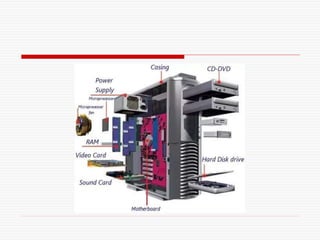
Main Parts of a Computer
 The Processor – The computer’s central processing unit,
or CPU, is the most important part of a computer.
The computer’s speed, performance and multitasking
abilities depend on the CPU.
 Random Access Memory (RAM) - RAM is the working
memory of the computer or device, most data goes into
the RAM
 Read Only Memory (ROM) –is an integrated circuit,
programmed with a specific, permanent set of instructions
and data when it is manufactured.
 Cache Memory – is a RAM that the CPU can access more
quickly than the RAM.
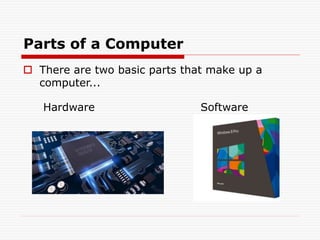
Parts of a Computer
 There are two basic parts that make up a
computer...
Hardware Software
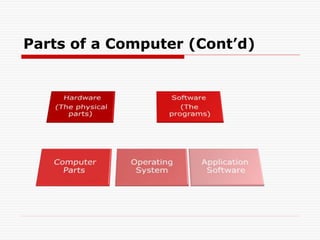
Parts of a Computer (Cont’d)
Hardware
 Hardware is basically anything that you can touch
with your fingers.
Computer Case
CPU
Monitor
Keyboard & Mouse
Disk Drive, CD-ROM, DVD,
Hard Drive
Memory (RAM)
Speakers
Printer
Hardware (Cont’d)
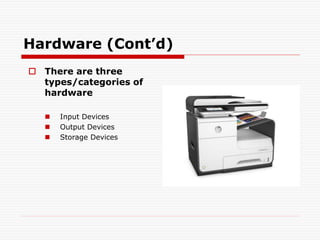
 There are three
types/categories of
hardware
 Input Devices
 Output Devices
 Storage Devices
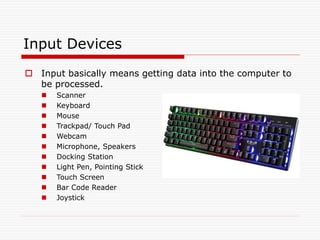
Input Devices
 Input basically means getting data into the computer to
be processed.
 Scanner
 Keyboard
 Mouse
 Trackpad/ Touch Pad
 Webcam
 Microphone, Speakers
 Docking Station
 Light Pen, Pointing Stick
 Touch Screen
 Bar Code Reader
 Joystick
Output Devices
 Output basically means getting data out of the computer.
 Printer
 Impact Printer
 Non-Impact Printer
 Printer Driver
 Print Spooler
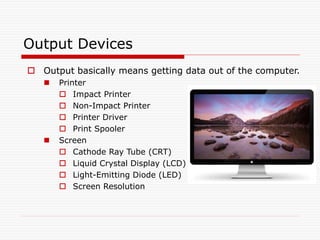
 Screen
 Cathode Ray Tube (CRT)
 Liquid Crystal Display (LCD)
 Light-Emitting Diode (LED)
 Screen Resolution
Storage Devices
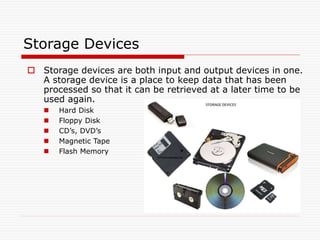
 Storage devices are both input and output devices in one.
A storage device is a place to keep data that has been
processed so that it can be retrieved at a later time to be
used again.
 Hard Disk
 Floppy Disk
 CD’s, DVD’s
 Magnetic Tape
 Flash Memory
Software
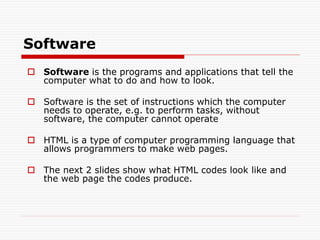
 Software is the programs and applications that tell the
computer what to do and how to look.
 Software is the set of instructions which the computer
needs to operate, e.g. to perform tasks, without
software, the computer cannot operate
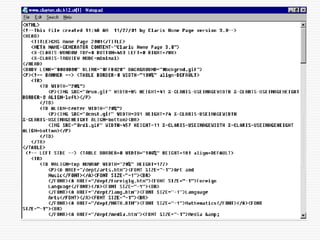
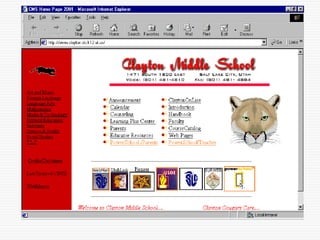
 HTML is a type of computer programming language that
allows programmers to make web pages.
 The next 2 slides show what HTML codes look like and
the web page the codes produce.
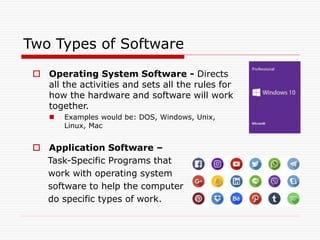
Two Types of Software
 Operating System Software - Directs
all the activities and sets all the rules for
how the hardware and software will work
together.
 Examples would be: DOS, Windows, Unix,
Linux, Mac
 Application Software –
Task-Specific Programs that
work with operating system
software to help the computer
do specific types of work.
Basic types of application software
 Office Productivity Software - word processors,
spreadsheets, and database programs.
 Communication software - allows computers to
communicate with other computers.
 Social Networking Software – Facebook, Twitter…
 Media Applications – used for viewing and playing
multimedia files, such as Windows Media Player…
 Mobile Applications – AKA mobile app, designed to run
on smartphones and tablets.
 Graphics software - allow users to create and
manipulate graphics.
 Entertainment and Leisure software - Warcraft, Age
of Empires, Design Center, Solitaire…
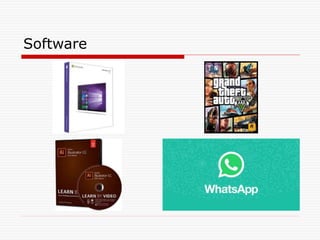
Software
End-User Licensing Agreement
 The EULA, is the type of license used for most software.
 It is an agreement between the manufacturer and the
end-user of the software application, to accept the terms
and conditions of the EULA.
 When an end-user buys software, it does not mean that
the user now owns the software.
 It is the right to install and use.
Types of Software Licenses
 Proprietary License – grants the use of one or more copies
of the software under the EULA, but ownership remains with
the publisher.
 Open Source License – refers to any application of which the
source code is made available for use or modification. Open
source applications can usually be downloaded for free form
the internet or bought at a small fee.
 Shareware/ Trial Version License – they are copyright-
protected, but can be downloaded be a user to review and
evaluate before purchasing. They can either be a fully
functional time–limited version or a feature-limited version.
 Freeware License – Free of charge software, but not
available with the source code, e.g. Adobe Reader.
Find the Circle:
Trouver le Cercle :

Computer application

  • 1.
    Computer Essentials Computers &Devices This module sets out essential concepts and skills relating to the use of devices, file creation and management, networks, and data security
  • 3.
    LEARNING OBJECTIVES  Successfulcandidate will be able to: 1. Understand key concepts relating to ICT, computers, devices and software. 2. Start up and shut down a computer 3. Work effectively on the computer desktop using icons, windows 4. Adjust the main operating system settings and use built-in help features 5. Create a simple document and print an output
  • 4.
    LEARNING OBJECTIVES (Cont’d) Successful candidate will be able to: 6. Know about the main concepts of file management & be able to efficiently organize files & folders 7. Understand key storage concepts and use utility software to compress and extract large files 8. Understand network concepts and connection options and be able to connect to a network 9. Understand the importance of protecting data and devices from malware, and the importance of backing up data 10. Recognize considerations relating to green IT, accessibility, and user health
  • 5.
    INFORMATION & COMMUNICATION TECHNOLOGY Whatis ICT? It refers to all aspects of managing, communicating and processing information. It includes computer hardware and software, telecommunications, audio-visual systems, cabling, microwaves, radio waves, etc. ICT is about saving time, being more effective, working smarter and communicating faster and more effectively.
  • 6.
    INFORMATION & COMMUNICATION TECHNOLOGY DifferentTypes of ICT Services/ Uses Various uses of ICT:  Internet Services: The internet is a world-wide network of computers that can be used in various ways enabling faster and cheaper means of communication.  Mobile Technology: With the introduction of smartphones and tablet, mobile device can be used as a mobile phone, GPS navigation device, web browser and instant messaging client, game console…  Office Productivity Applications: A suite of functions, including word processing, spreadsheets, databases, presentation software and an email application, e.g. MS Office, Google Docs…
  • 7.
    Main Types ofComputers  Desktop Computer – (often called PC), is a personal computer that fits on or under a desk. It has a monitor or another display, keyboard, mouse, and either a horizontal or a vertical case.  Laptop/ Notebook – is a lightweight, portable computer that includes built-in screen, keyboard and touchpad, and can operate from a built-in battery or electricity.  Tablet – is a slate-shaped device, that comes in various sizes and are mostly operated by touch screen. Tablets are mobile computers larger than smartphones that draw power from a rechargeable battery.
  • 8.
    Main Types ofDevices  Smartphone – is a mobile phone offering advanced computing and connectivity capabilities.  They differ from ordinary phones in 2 ways: how they are built and what functions they can perform.  In terms of features, most smartphones support full email capabilities, organizer, a built-in camera and GPS, the ability to read business documents in several formats, & web browsing…  The most common OSs used in smartphones are Google Android, Apple iOS, and Microsoft Windows.  Media Player – a multimedia player is a portable device that store, organize and play media including audio, images, and video files.  Examples are the MP3, MP4 and iPod.  Digital Camera – provide a convenient way of storing videos or images on a microchip or memory card.
  • 9.
    Main Parts ofa Computer  The Processor – The computer’s central processing unit, or CPU, is the most important part of a computer. The computer’s speed, performance and multitasking abilities depend on the CPU.  Random Access Memory (RAM) - RAM is the working memory of the computer or device, most data goes into the RAM  Read Only Memory (ROM) –is an integrated circuit, programmed with a specific, permanent set of instructions and data when it is manufactured.  Cache Memory – is a RAM that the CPU can access more quickly than the RAM.
  • 11.
    Parts of aComputer  There are two basic parts that make up a computer... Hardware Software
  • 12.
    Parts of aComputer (Cont’d)
  • 13.
    Hardware  Hardware isbasically anything that you can touch with your fingers. Computer Case CPU Monitor Keyboard & Mouse Disk Drive, CD-ROM, DVD, Hard Drive Memory (RAM) Speakers Printer
  • 14.
    Hardware (Cont’d)  Thereare three types/categories of hardware  Input Devices  Output Devices  Storage Devices
  • 15.
    Input Devices  Inputbasically means getting data into the computer to be processed.  Scanner  Keyboard  Mouse  Trackpad/ Touch Pad  Webcam  Microphone, Speakers  Docking Station  Light Pen, Pointing Stick  Touch Screen  Bar Code Reader  Joystick
  • 16.
    Output Devices  Outputbasically means getting data out of the computer.  Printer  Impact Printer  Non-Impact Printer  Printer Driver  Print Spooler  Screen  Cathode Ray Tube (CRT)  Liquid Crystal Display (LCD)  Light-Emitting Diode (LED)  Screen Resolution
  • 17.
    Storage Devices  Storagedevices are both input and output devices in one. A storage device is a place to keep data that has been processed so that it can be retrieved at a later time to be used again.  Hard Disk  Floppy Disk  CD’s, DVD’s  Magnetic Tape  Flash Memory
  • 18.
    Software  Software isthe programs and applications that tell the computer what to do and how to look.  Software is the set of instructions which the computer needs to operate, e.g. to perform tasks, without software, the computer cannot operate  HTML is a type of computer programming language that allows programmers to make web pages.  The next 2 slides show what HTML codes look like and the web page the codes produce.
  • 21.
    Two Types ofSoftware  Operating System Software - Directs all the activities and sets all the rules for how the hardware and software will work together.  Examples would be: DOS, Windows, Unix, Linux, Mac  Application Software – Task-Specific Programs that work with operating system software to help the computer do specific types of work.
  • 22.
    Basic types ofapplication software  Office Productivity Software - word processors, spreadsheets, and database programs.  Communication software - allows computers to communicate with other computers.  Social Networking Software – Facebook, Twitter…  Media Applications – used for viewing and playing multimedia files, such as Windows Media Player…  Mobile Applications – AKA mobile app, designed to run on smartphones and tablets.  Graphics software - allow users to create and manipulate graphics.  Entertainment and Leisure software - Warcraft, Age of Empires, Design Center, Solitaire…
  • 23.
  • 24.
    End-User Licensing Agreement The EULA, is the type of license used for most software.  It is an agreement between the manufacturer and the end-user of the software application, to accept the terms and conditions of the EULA.  When an end-user buys software, it does not mean that the user now owns the software.  It is the right to install and use.
  • 25.
    Types of SoftwareLicenses  Proprietary License – grants the use of one or more copies of the software under the EULA, but ownership remains with the publisher.  Open Source License – refers to any application of which the source code is made available for use or modification. Open source applications can usually be downloaded for free form the internet or bought at a small fee.  Shareware/ Trial Version License – they are copyright- protected, but can be downloaded be a user to review and evaluate before purchasing. They can either be a fully functional time–limited version or a feature-limited version.  Freeware License – Free of charge software, but not available with the source code, e.g. Adobe Reader.
  • 26.