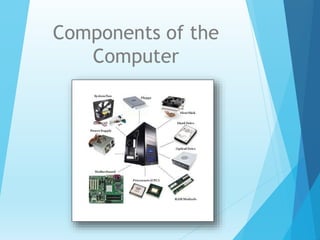
Components of the
Computer
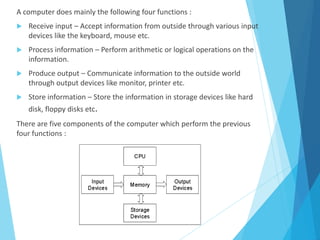
A computer does mainly the following four functions :
 Receive input – Accept information from outside through various input
devices like the keyboard, mouse etc.
 Process information – Perform arithmetic or logical operations on the
information.
 Produce output – Communicate information to the outside world
through output devices like monitor, printer etc.
 Store information – Store the information in storage devices like hard
disk, floppy disks etc.
There are five components of the computer which perform the previous
four functions :
CENTRAL PROCESSING UNIT (CPU)
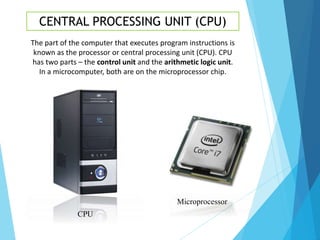
The part of the computer that executes program instructions is
known as the processor or central processing unit (CPU). CPU
has two parts – the control unit and the arithmetic logic unit.
In a microcomputer, both are on the microprocessor chip.
CPU
Microprocessor
Control Unit
 The control unit tells the rest of the computer system how to
carry out a program’s instructions.
 It directs the movement of electronic signals between memory
– which temporarily holds data, instructions and processed
information – and the ALU.
Arithmetic Logic Unit
 Performs basic arithmetic operations such as addition and
subtraction.
 Performs logical operations such as AND, OR, and NOT.
 Most modern ALUs have a small amount of special storage units
called registers that can be accessed faster than main memory.
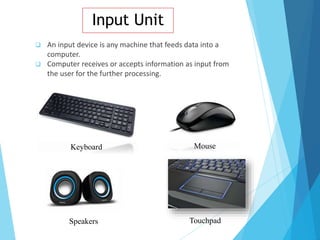
Input Unit
 An input device is any machine that feeds data into a
computer.
 Computer receives or accepts information as input from
the user for the further processing.
Keyboard Mouse
Speakers Touchpad
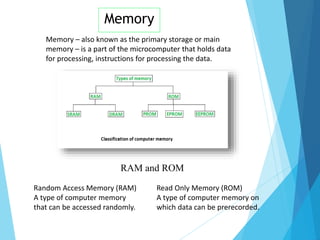
Memory
RAM and ROM
Memory – also known as the primary storage or main
memory – is a part of the microcomputer that holds data
for processing, instructions for processing the data.
Random Access Memory (RAM)
A type of computer memory
that can be accessed randomly.
Read Only Memory (ROM)
A type of computer memory on
which data can be prerecorded.
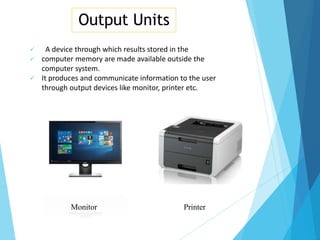
Output Units
 A device through which results stored in the
 computer memory are made available outside the
computer system.
 It produces and communicate information to the user
through output devices like monitor, printer etc.
Monitor Printer

Components of the computer

  • 1.
  • 2.
    A computer doesmainly the following four functions :  Receive input – Accept information from outside through various input devices like the keyboard, mouse etc.  Process information – Perform arithmetic or logical operations on the information.  Produce output – Communicate information to the outside world through output devices like monitor, printer etc.  Store information – Store the information in storage devices like hard disk, floppy disks etc. There are five components of the computer which perform the previous four functions :
  • 3.
    CENTRAL PROCESSING UNIT(CPU) The part of the computer that executes program instructions is known as the processor or central processing unit (CPU). CPU has two parts – the control unit and the arithmetic logic unit. In a microcomputer, both are on the microprocessor chip. CPU Microprocessor
  • 4.
    Control Unit  Thecontrol unit tells the rest of the computer system how to carry out a program’s instructions.  It directs the movement of electronic signals between memory – which temporarily holds data, instructions and processed information – and the ALU. Arithmetic Logic Unit  Performs basic arithmetic operations such as addition and subtraction.  Performs logical operations such as AND, OR, and NOT.  Most modern ALUs have a small amount of special storage units called registers that can be accessed faster than main memory.
  • 5.
    Input Unit  Aninput device is any machine that feeds data into a computer.  Computer receives or accepts information as input from the user for the further processing. Keyboard Mouse Speakers Touchpad
  • 6.
    Memory RAM and ROM Memory– also known as the primary storage or main memory – is a part of the microcomputer that holds data for processing, instructions for processing the data. Random Access Memory (RAM) A type of computer memory that can be accessed randomly. Read Only Memory (ROM) A type of computer memory on which data can be prerecorded.
  • 7.
    Output Units  Adevice through which results stored in the  computer memory are made available outside the computer system.  It produces and communicate information to the user through output devices like monitor, printer etc. Monitor Printer