FNAC OF BREAST
CANCER
DR SAURAV
NORMAL BREAST FNAC
• Usually yields scanty cellularity.
• Following cells can be seen in FNAC of a nonneoplastic breast

 DUCTAL CELLS –
Cells are small round with monomorphic
nuclei.
nuclear membrane is regular with
homogeneous chromatin.
 MYOEPITHELIAL CELLS –
These are elongated spindle-shaped naked cells.
presence of such cells is hallmark of benign nature
of lesion.
 APOCRINE CELLS –
These are large cells having abundant granular
cytoplasm with central to eccentric monomorphic
round nuclei.
These cells are usually present in fibrocystic
disease or fibroadenoma.
 FOAM CELLS –
These cells have abundant vacuolated cytoplasm
and centrally placed monomorphic round nucleus.
phagocytosed material may be found in the
cytoplasm
presence of foam cells usually indicates cystic
degeneration.
DUCTAL CARCINOMA
 FNAC FINDINGS
More or less cell rich smears
Single population of epithelial cells; no
myoepithelial cells, no single bare bipolar nuclei
Variable loss of cell cohesion-irregular clusters and
single cells
Single epithelial cells with intact cytoplasm
Moderate to severe nuclear
atypia;enlargement,pleomorphism,irregular
nuclear membrane and chromatin
Fibroblasts and fragments of collagen associated
with atypical cells
Intracytoplasmic neolumina in some cases
Necrosis unusual, more suggestive of DCIS.
Problems and differential diagnosis
 Representative sampling
 Smearing artifacts
 Carcinoma with small cells
 Fibrosclerotic lesions
In situ and low grade carcinoma
Nuclear atypia in other lesions
Gynaecomastia
Metastatic carcinoma
Ductal carcinoma NOS,low grade
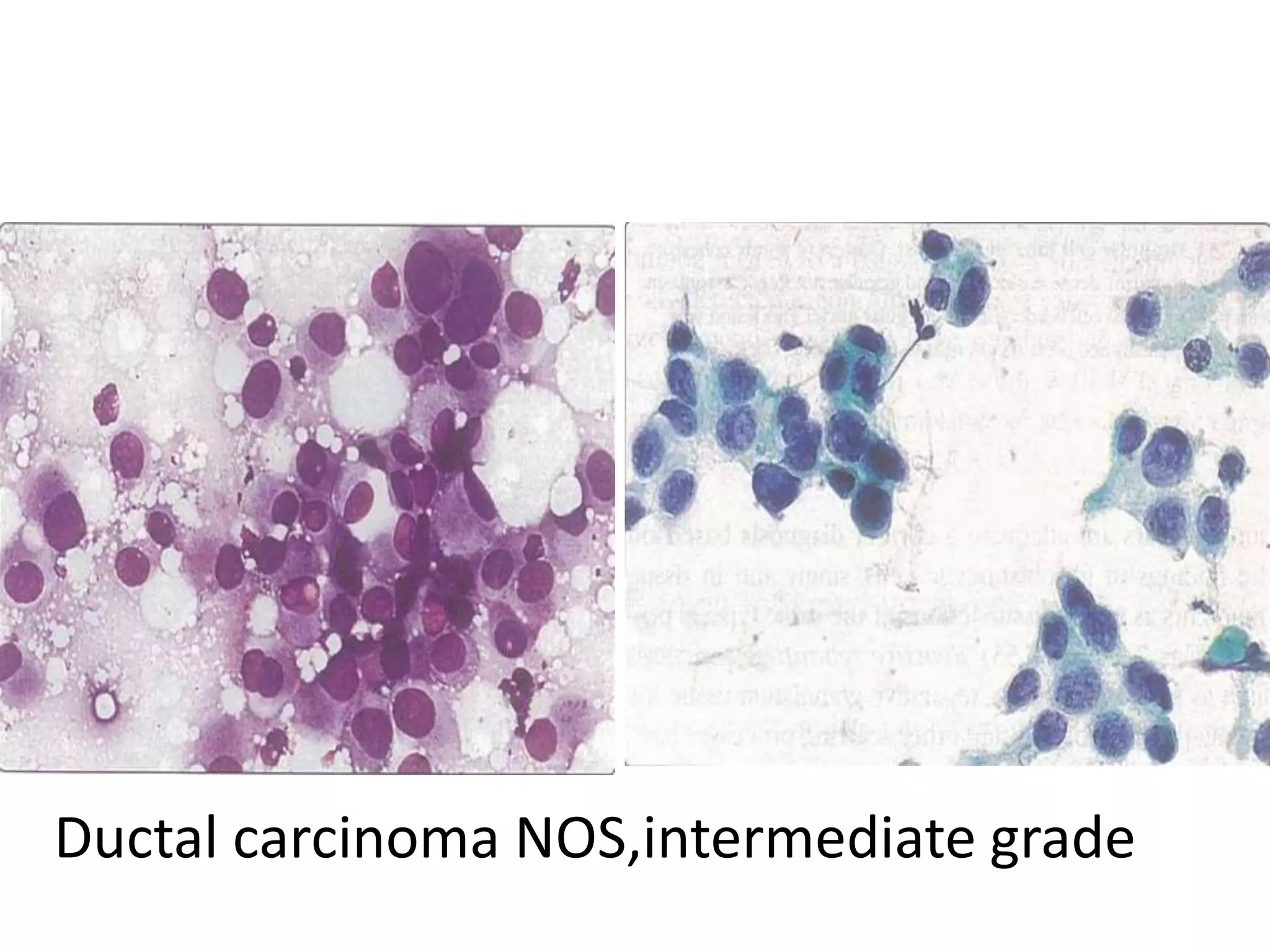
Ductal carcinoma NOS,intermediate grade
Invasive duct carcinoma NOS,high grade
LOBULAR CARCINOMA
 Usual findings
A variable, often poor cell yield
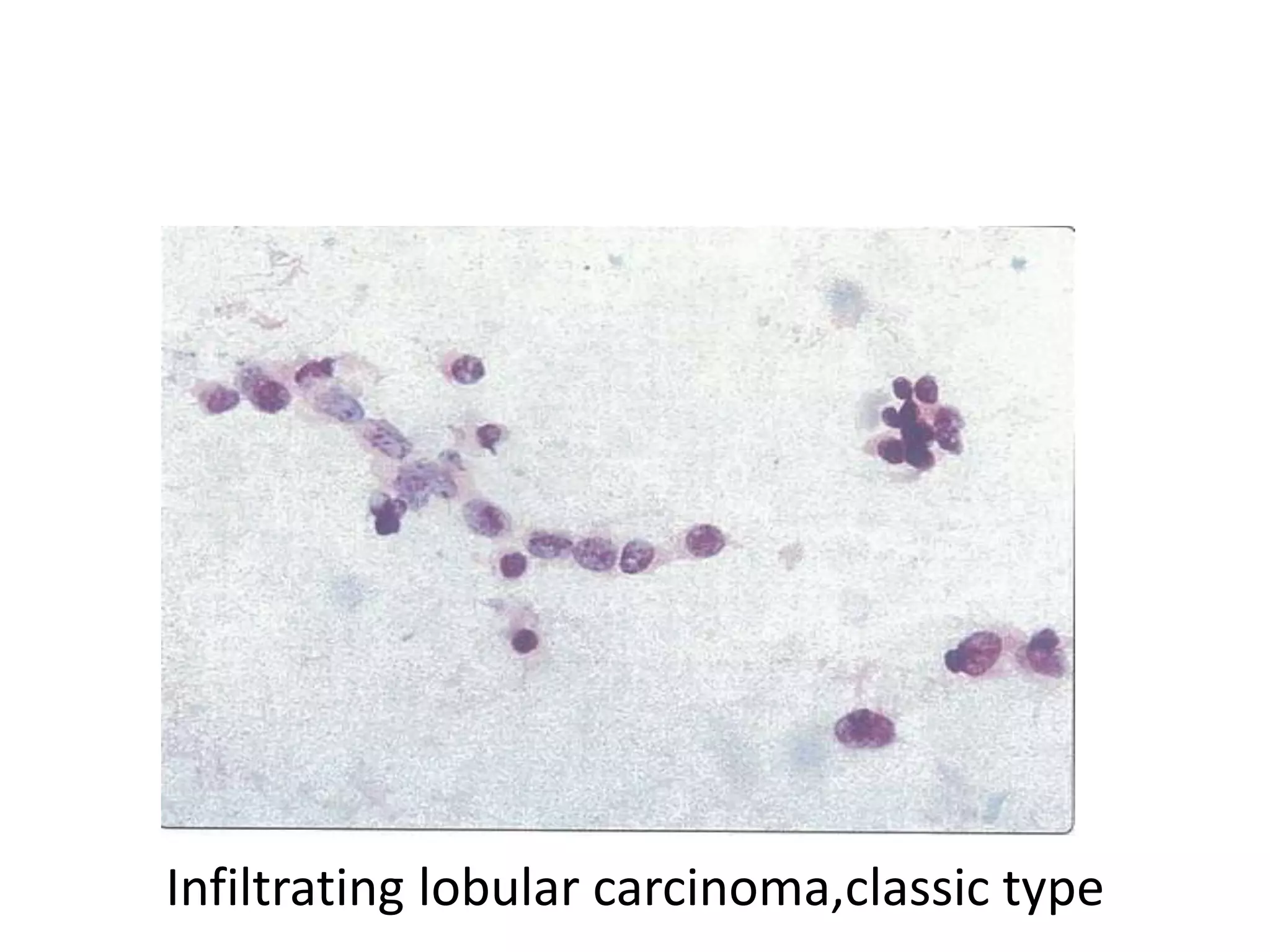
 Cells single and in small clusters, single files
characteristic
Scanty cytoplasm; many naked nuclei; nuclear
moulding in cell clusters
Small hyperchromatic nuclei of relatively uniform
size.
Irregularity of nuclear shape
Intracytoplasmic lumina/mucin vacuoles/signet
ring cells
Few if any naked bipolar nuclei
Traumatised cell pattern
Problems and differential diagnosis
Sparse cellularity
Resemblance to non-neoplastic breast tissue in
low power
Component of benign epithelium
Lobular hyperplasia in pregnancy and lactation
Distinction from low-grade ductal carcinoma
Intracytoplasmic lumina in other lesions
Lobular carcinoma (classic type)
Infiltrating lobular carcinoma,classic type
Lobular carcinoma,alveolar type
MEDULLARY CARCINOMA
– Abundant dissociated cells along with syncytial
clusters of malignant cells
– Round to oval large cells with moderate nuclear
pleomorphism
– Large prominent nucleoli
– Lymphocytes and plasma cells
Problems and differential diagnosis
Metastatic malignancy to axillary nodes
Malignant lymphoma
High grade DCIS (comedocarcinoma)
Medullary carcinoma
MUCINOUS CARCINOMA
Large amount of mucinous material
Floating malignant cells in the pool of mucin
Cells with abundant cytoplasm
Mild to moderately pleomorphic nuclei
Bland nuclear chromatin
“Chicken wire” blood vessels are often present in
smears of mucinous carcinoma
Problems and differential diagnosis
Lack of nuclear pleomorphism
Mucinous DCIS
Mucinous fibroadenoma
Myxoid stromal matrix resembling mucin
Metastatic carcinoma
Hemorrhage and necrosis induced by FNB
Ultrasound gel
Colloid carcinoma
Colloid carcinoma
TUBULAR CARCINOMA
• Usual findings:
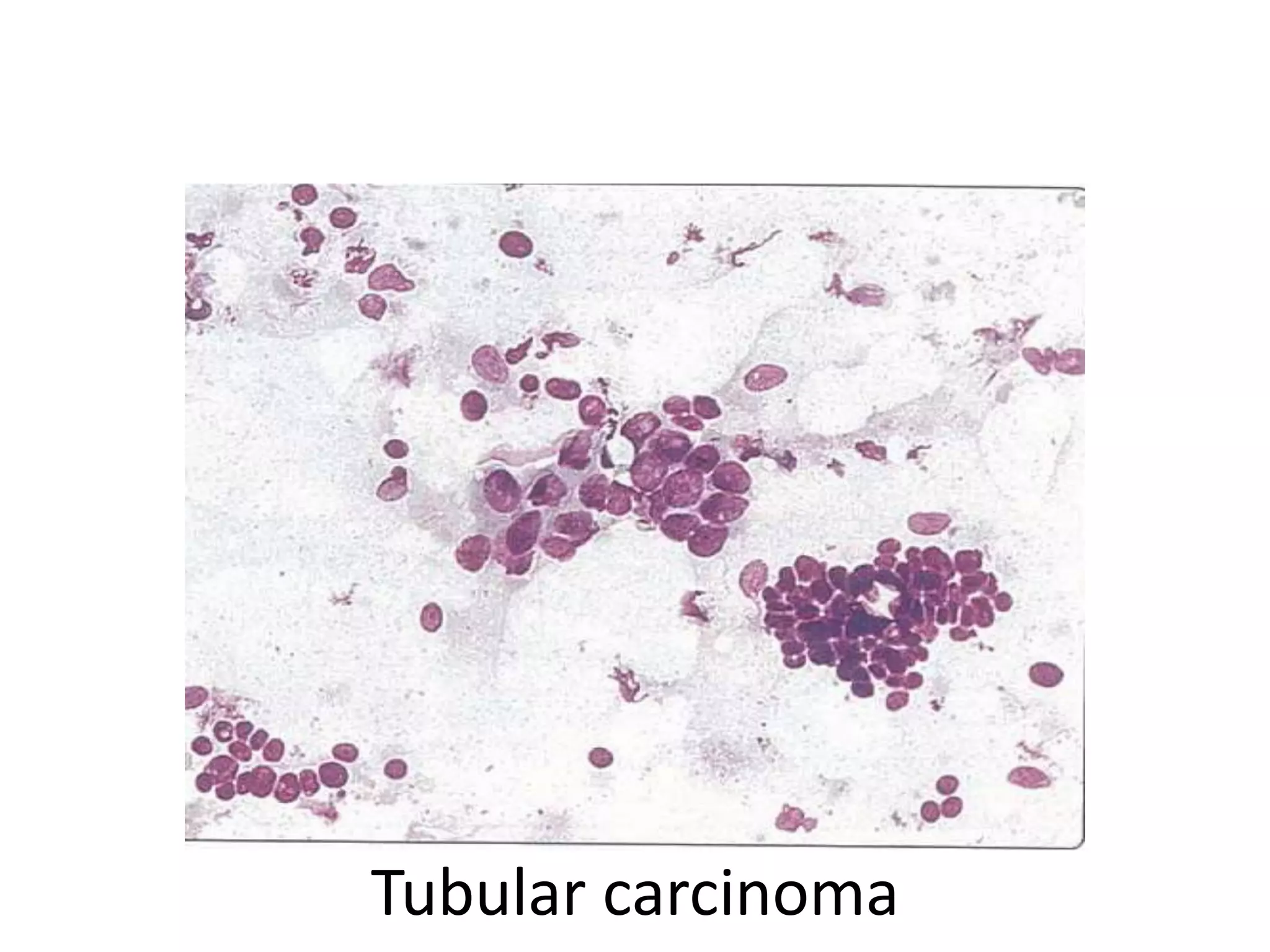
 Moderately cellular smears
 Cells predominantly in cohesive clusters
 Epithelial fragments with an angular or tubular shape
 Relatively uniform, mildly to moderately atypical
epithelial cells
 Single bipolar nuclei of benign type often present in
small numbers
 Fibroblastic cells; fragments of fibromyxoid or elastotic
stroma.
Problems and differential diagnosis
Minor deviation from the benign pattern
Mixed tubular and usual ductal carcinoma
Complex sclerosing lesion/radial scar,adenosis
Fibroadenoma
Tubular carcinoma
Tubular carcinoma
METAPLASIC CARCINOMA
– Predominant cell component is other than
glandular or epithelial
– Population of spindle cells, multinucleated giant
cells or squamous cells may be seen.
Scarff-Bloom-Richardson
(SBR) Grade in Breast Cancer
– Histologic grading system for breast cancer
– The cells and tissue structure of the breast cancer
are examined histopathologically to determine
how aggressive the cancer is
– Correlates well with prognosis
– Adopted by World Health Organization in 1968
– Also referred to as Nottingham modification
Scarff-Bloom-Richardson
(SBR) Grading
• Tubule Formation
– Majority of tumor (>75%) – 1 point
– Moderate degree (10-75%) – 2 points
– Little or none (<10%) – 3 points
• Nuclear pleomorphism (compare to adjacent normal epithelium)
– Small, regular uniform cells – 1 point
– Moderately increased size and variability – 2 points
– Marked variation – 3 points
• Mitotic Count (must adjust for microscope field)
– Low – 1 point
– Moderate – 2 points
– High – 3 point
Scarff-Bloom-Richardson (SBR) Grade
Grade 1

Tubule
Formation

Nuclear
Pleomorphism

Mitotic
Count

Grade 2

Grade 3
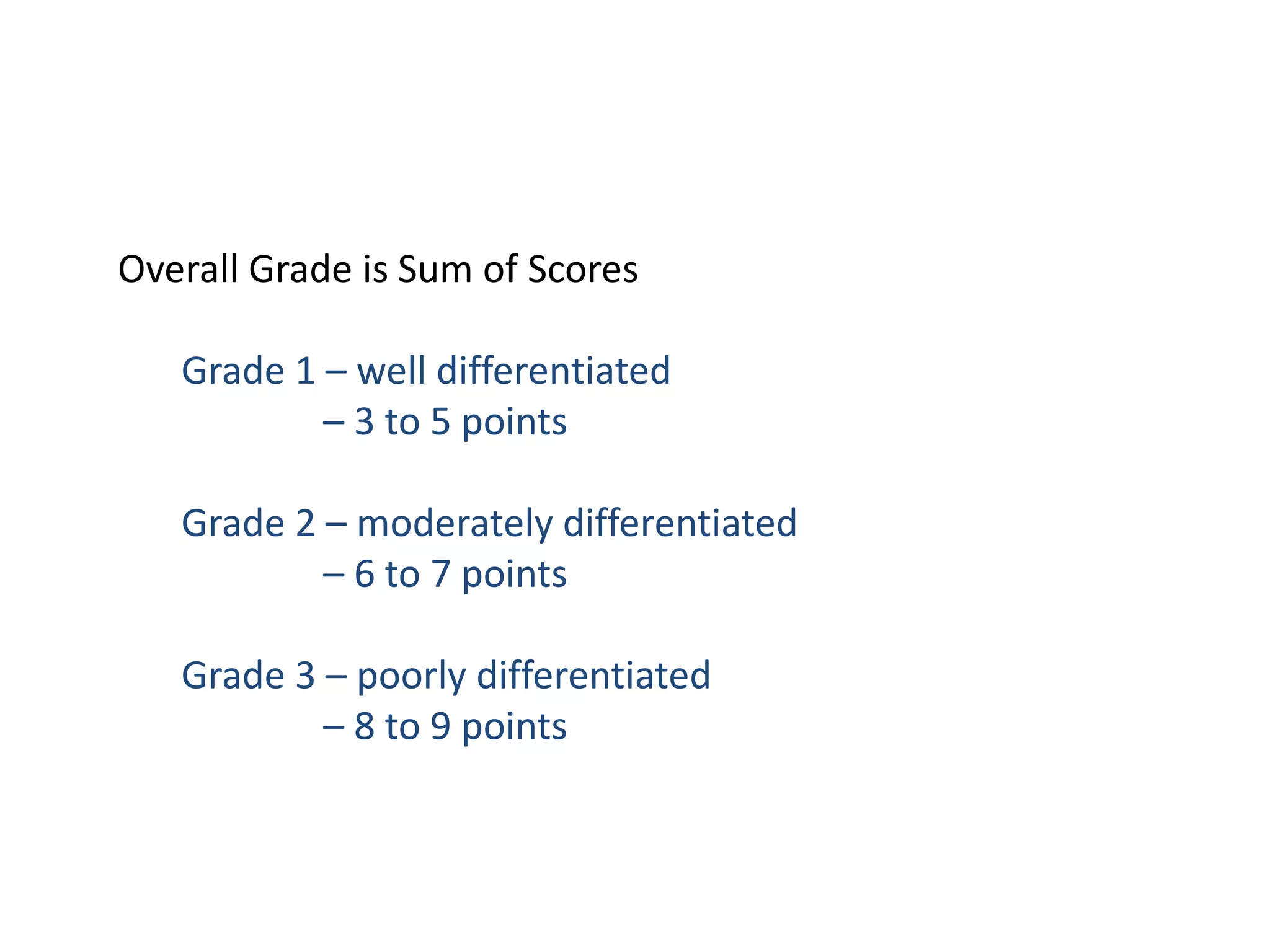
Overall Grade is Sum of Scores
Grade 1 – well differentiated
– 3 to 5 points

Grade 2 – moderately differentiated
– 6 to 7 points
Grade 3 – poorly differentiated
– 8 to 9 points
FNAC of breast

FNAC of breast

  • 1.
  • 2.
    NORMAL BREAST FNAC •Usually yields scanty cellularity. • Following cells can be seen in FNAC of a nonneoplastic breast  DUCTAL CELLS – Cells are small round with monomorphic nuclei. nuclear membrane is regular with homogeneous chromatin.
  • 3.
     MYOEPITHELIAL CELLS– These are elongated spindle-shaped naked cells. presence of such cells is hallmark of benign nature of lesion.  APOCRINE CELLS – These are large cells having abundant granular cytoplasm with central to eccentric monomorphic round nuclei. These cells are usually present in fibrocystic disease or fibroadenoma.
  • 4.
     FOAM CELLS– These cells have abundant vacuolated cytoplasm and centrally placed monomorphic round nucleus. phagocytosed material may be found in the cytoplasm presence of foam cells usually indicates cystic degeneration.
  • 5.
    DUCTAL CARCINOMA  FNACFINDINGS More or less cell rich smears Single population of epithelial cells; no myoepithelial cells, no single bare bipolar nuclei Variable loss of cell cohesion-irregular clusters and single cells Single epithelial cells with intact cytoplasm
  • 6.
    Moderate to severenuclear atypia;enlargement,pleomorphism,irregular nuclear membrane and chromatin Fibroblasts and fragments of collagen associated with atypical cells Intracytoplasmic neolumina in some cases Necrosis unusual, more suggestive of DCIS.
  • 7.
    Problems and differentialdiagnosis  Representative sampling  Smearing artifacts  Carcinoma with small cells  Fibrosclerotic lesions In situ and low grade carcinoma Nuclear atypia in other lesions Gynaecomastia Metastatic carcinoma
  • 8.
  • 9.
  • 10.
  • 11.
    LOBULAR CARCINOMA  Usualfindings A variable, often poor cell yield  Cells single and in small clusters, single files characteristic Scanty cytoplasm; many naked nuclei; nuclear moulding in cell clusters Small hyperchromatic nuclei of relatively uniform size.
  • 12.
    Irregularity of nuclearshape Intracytoplasmic lumina/mucin vacuoles/signet ring cells Few if any naked bipolar nuclei Traumatised cell pattern
  • 13.
    Problems and differentialdiagnosis Sparse cellularity Resemblance to non-neoplastic breast tissue in low power Component of benign epithelium Lobular hyperplasia in pregnancy and lactation Distinction from low-grade ductal carcinoma Intracytoplasmic lumina in other lesions
  • 14.
  • 15.
  • 16.
  • 17.
    MEDULLARY CARCINOMA – Abundantdissociated cells along with syncytial clusters of malignant cells – Round to oval large cells with moderate nuclear pleomorphism – Large prominent nucleoli – Lymphocytes and plasma cells
  • 18.
    Problems and differentialdiagnosis Metastatic malignancy to axillary nodes Malignant lymphoma High grade DCIS (comedocarcinoma)
  • 19.
  • 20.
    MUCINOUS CARCINOMA Large amountof mucinous material Floating malignant cells in the pool of mucin Cells with abundant cytoplasm Mild to moderately pleomorphic nuclei Bland nuclear chromatin “Chicken wire” blood vessels are often present in smears of mucinous carcinoma
  • 21.
    Problems and differentialdiagnosis Lack of nuclear pleomorphism Mucinous DCIS Mucinous fibroadenoma Myxoid stromal matrix resembling mucin Metastatic carcinoma Hemorrhage and necrosis induced by FNB Ultrasound gel
  • 22.
  • 23.
  • 24.
    TUBULAR CARCINOMA • Usualfindings:  Moderately cellular smears  Cells predominantly in cohesive clusters  Epithelial fragments with an angular or tubular shape  Relatively uniform, mildly to moderately atypical epithelial cells  Single bipolar nuclei of benign type often present in small numbers  Fibroblastic cells; fragments of fibromyxoid or elastotic stroma.
  • 25.
    Problems and differentialdiagnosis Minor deviation from the benign pattern Mixed tubular and usual ductal carcinoma Complex sclerosing lesion/radial scar,adenosis Fibroadenoma
  • 26.
  • 27.
  • 28.
    METAPLASIC CARCINOMA – Predominantcell component is other than glandular or epithelial – Population of spindle cells, multinucleated giant cells or squamous cells may be seen.
  • 29.
    Scarff-Bloom-Richardson (SBR) Grade inBreast Cancer – Histologic grading system for breast cancer – The cells and tissue structure of the breast cancer are examined histopathologically to determine how aggressive the cancer is – Correlates well with prognosis – Adopted by World Health Organization in 1968 – Also referred to as Nottingham modification
  • 30.
    Scarff-Bloom-Richardson (SBR) Grading • TubuleFormation – Majority of tumor (>75%) – 1 point – Moderate degree (10-75%) – 2 points – Little or none (<10%) – 3 points • Nuclear pleomorphism (compare to adjacent normal epithelium) – Small, regular uniform cells – 1 point – Moderately increased size and variability – 2 points – Marked variation – 3 points • Mitotic Count (must adjust for microscope field) – Low – 1 point – Moderate – 2 points – High – 3 point
  • 31.
    Scarff-Bloom-Richardson (SBR) Grade Grade1 Tubule Formation Nuclear Pleomorphism Mitotic Count Grade 2 Grade 3
  • 32.
    Overall Grade isSum of Scores Grade 1 – well differentiated – 3 to 5 points Grade 2 – moderately differentiated – 6 to 7 points Grade 3 – poorly differentiated – 8 to 9 points

Editor's Notes

  • #3 Fnac of normal breast
  • #6 Fnac findings of breast carcinoma (1) ductal carcinoma
  • #9 NOS(NO SPECIAL TYPE) Showing Clustered and single malignant epithelial cells,mild nuclear enlargement and atypia,absence of bipolar nuclei
  • #10 Showing Poorly cohesive malignant cells,single and in clusters,obvious nuclear enlargement and pleomorphism;irregular chromatin
  • #11 Mainly dispersed malignant cells,prominent nuclear enlargement and pleomorphism,coarsechromatin,an occasion mitotic figure,some lymphocytes and fibroblast in the background no bipolar nuclei
  • #12 Fnac usual findings
  • #15 ShowingPoorly cohesive cell clusters,uniformly small nuclei with irregular shapes nuclear moulding indistinct cytoplasm
  • #16 Single file of cells with small nuclei of irregular shape
  • #17 Cellular smear of poorly cohesive clusters of malignant cells with moderate nuclear atypia
  • #18 Fnac findings
  • #20 Numerous dispersed malignant cells with large pleomorphicnuclei,many scattered lymphoid cells
  • #21 Fnac findings
  • #23 Showing Moderately cohesive epithelial cells with abundant cytoplasm and moderate nuclear enlargement
  • #24 Chicken wire blood vessels with a background of stringy mucin
  • #27 Clusters of epithelial cells variable nuclei atypia,,a few single bipolar nuclei can be seen
  • #28 Another case showing tubular and angular epithelial fragments,fibrousstroma ,spindle cells
  • #31 This grading icludes 3 criteria..(1)tubule formation.(2)nuclear pleomorphism).mitotic count
  • #32 Grade 1 (well differentiated) cancers have relatively normal-looking cells that do not appear to be growing rapidly and are arranged in small tubules.Grade 2 (moderately differentiated) cancers have features between grades 1 and 3.Grade 3 (poorly differentiated) cancers, the highest grade, lack normal features and tend to grow and spread more aggressively