Biliary pathologies 
By Navdeep Singh
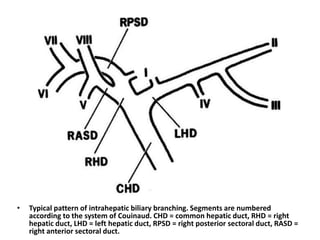
• Typical pattern of intrahepatic biliary branching. Segments are numbered 
according to the system of Couinaud. CHD = common hepatic duct, RHD = right 
hepatic duct, LHD = left hepatic duct, RPSD = right posterior sectoral duct, RASD = 
right anterior sectoral duct.
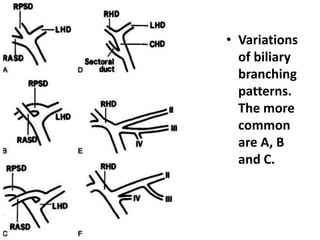
• Variations 
of biliary 
branching 
patterns. 
The more 
common 
are A, B 
and C.
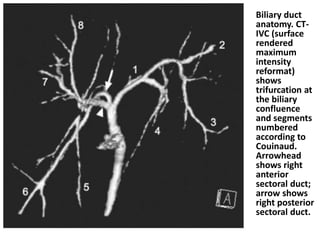
• Biliary duct 
anatomy. CT-IVC 
(surface 
rendered 
maximum 
intensity 
reformat) 
shows 
trifurcation at 
the biliary 
confluence 
and segments 
numbered 
according to 
Couinaud. 
Arrowhead 
shows right 
anterior 
sectoral duct; 
arrow shows 
right posterior 
sectoral duct.
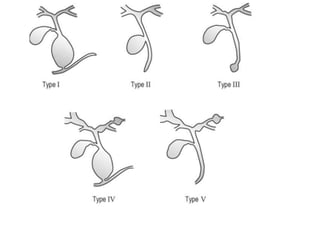
• Luschka describe an intrahepatic duct running 
adjacent to the gallbladder fossa, 
unaccompanied by a portal vein branch, and 
emptying into either the right hepatic or 
common hepatic duct. 
• The term ‘cystohepatic duct’is probably best 
reserved for small ducts that drain directly 
into the gallbladder or cystic duct. The 
significance of these variants is their proximity 
to the gallbladder and the potential for injury 
at cholecystectomy resulting in a bile leak.
GALLBLADDER ANATOMICAL 
VARIANTS 
• Agenesis of the gallbladder is extremely rare, 
with a prevalence of 0.03–0.07 per cent. 
• Double gallbladder occurs in about 0.03 per cent, 
usually with a shared cystic duct, and the 
accessory gallbladder is often diseased. 
• True gallbladder septae are uncommon and when 
occurring at the fundus form a Phrygian cap. 
Frequently, an apparent septum is merely 
gallbladder wall folding, which can vary with 
patient position.
GALLBLADDER STONES 
• Prevalence in adults in western community 15 per 
cent. 
• Asymptomatic in about 80 %. 
• They confer small lifetime risk of developing 
gallbladder carcinoma. 
• About 70 per cent of gallbladder stones are solely 
or predominantly cholesterol in type, with up to 
30 per cent being black pigment stones composed 
mainly of calcium bilirubinate. 
• 20% radioopaque.
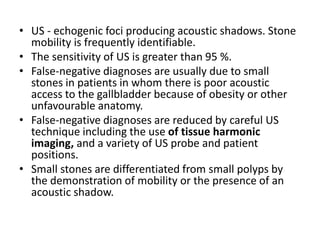
• US - echogenic foci producing acoustic shadows. Stone 
mobility is frequently identifiable. 
• The sensitivity of US is greater than 95 %. 
• False-negative diagnoses are usually due to small 
stones in patients in whom there is poor acoustic 
access to the gallbladder because of obesity or other 
unfavourable anatomy. 
• False-negative diagnoses are reduced by careful US 
technique including the use of tissue harmonic 
imaging, and a variety of US probe and patient 
positions. 
• Small stones are differentiated from small polyps by 
the demonstration of mobility or the presence of an 
acoustic shadow.
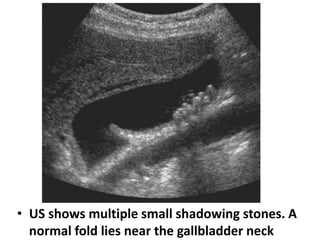
• US shows multiple small shadowing stones. A 
normal fold lies near the gallbladder neck
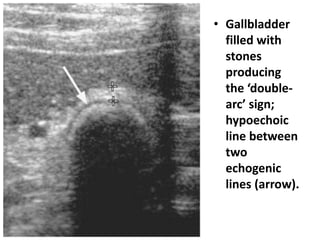
• Gallbladder 
filled with 
stones 
producing 
the ‘double-arc’ 
sign; 
hypoechoic 
line between 
two 
echogenic 
lines (arrow).
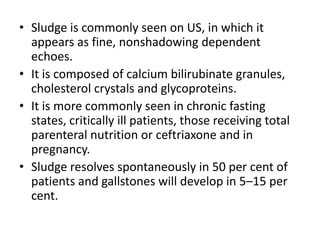
• Sludge is commonly seen on US, in which it 
appears as fine, nonshadowing dependent 
echoes. 
• It is composed of calcium bilirubinate granules, 
cholesterol crystals and glycoproteins. 
• It is more commonly seen in chronic fasting 
states, critically ill patients, those receiving total 
parenteral nutrition or ceftriaxone and in 
pregnancy. 
• Sludge resolves spontaneously in 50 per cent of 
patients and gallstones will develop in 5–15 per 
cent.
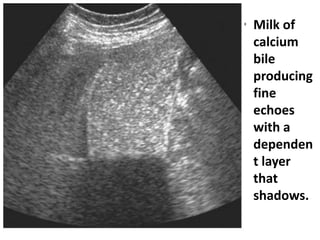
• Milk of calcium bile, or limey bile, is an 
uncommon condition in which the gallbladder 
bile becomes very viscous, probably as a result 
of stasis, and contains a high concentration of 
calcium bilirubinate. 
• On US it causes diffuse echoes, similar to 
sludge, but is more echogenic with a tendency 
to layer out and produce an acoustic shadow. 
• On CT and, occasionally, on plain radiographs 
it is visible as layering high-density material.
• Milk of 
calcium 
bile 
producing 
fine 
echoes 
with a 
dependen 
t layer 
that 
shadows.
CHOLECYSTITIS 
• 90–95 % of cases, is due to gallstones (acute calculous 
cholecystitis). 
• The positive predictive values of stones combined with 
either tenderness localized to the gallbladder (positive 
sonographic Murphy's sign), or the presence of a 
gallbladder wall thickness of >3 mm, are 92 per cent and 95 
per cent, respectively. 
• Gallstone(s) may be impacted in the neck of the gallbladder 
and this region must be carefully examined. 
• Other US signs are gallbladder distension (diameter >5 cm), 
pericholecystic fluid, gallbladder wall striations and, 
occasionally, obvious wall hyperaemia on Doppler 
examination. 
• Fine echoes seen within the gallbladder may be seen due to 
sludge or pus (gallbladder empyema).
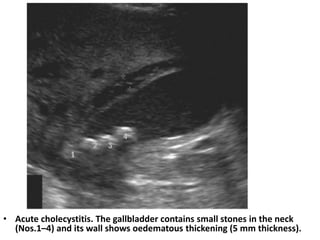
• Acute cholecystitis. The gallbladder contains small stones in the neck 
(Nos.1–4) and its wall shows oedematous thickening (5 mm thickness).
• CT is less accurate than US for acute 
cholecystitis. 
• The CT findings in acute cholecystitis include 
gallbladder wall thickening, subserosal 
oedema, gallbladder distension, high-density 
bile, pericholecystic fluid and inflammatory 
stranding in the pericholecystic fat.
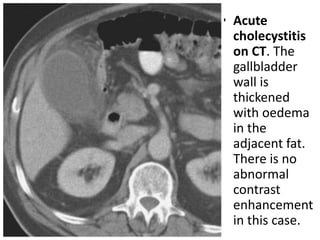
• Acute 
cholecystitis 
on CT. The 
gallbladder 
wall is 
thickened 
with oedema 
in the 
adjacent fat. 
There is no 
abnormal 
contrast 
enhancement 
in this case.
• Gangrenous cholecystitis 
• irregularity or asymmetrical thickening of the 
gallbladder wall, internal membranous echoes 
resulting from sloughed mucosa and 
pericholecystic fluid. 
• The clinical findings, paradoxically, may diminish 
with progression to gangrenous change. 
• CT signs that suggest gangrenous cholecystitis 
are gas in the wall or lumen, discontinuous 
and/or irregular mucosal enhancement, internal 
membranes representing sloughed mucosa and 
pericholecystic abscess
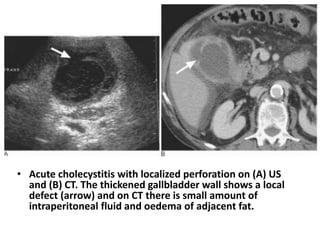
• Acute cholecystitis with localized perforation on (A) US 
and (B) CT. The thickened gallbladder wall shows a local 
defect (arrow) and on CT there is small amount of 
intraperitoneal fluid and oedema of adjacent fat.
• Emphysematous cholecystitis 
• Accounts for only 1 %, but has a relatively high 
mortality rate. 
• It is more common in men. 
• Diabetics, and stones are present. 
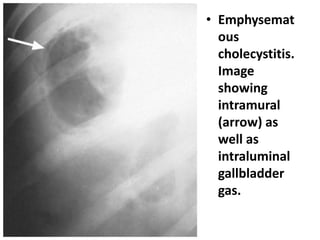
• Diagnosis - intramural and/or intraluminal gas 
caused by gas-forming organisms. On US 
intramural gas appears as focal or diffuse bright 
echogenic lines. Intraluminal gas, in the 
nondependent portion of the gallbladder, causes 
a curvilinear, brightly echogenic band with 
shadowing, which can make recognition of the 
gallbladder difficult and lead to a false-negative 
US result.
• Emphysemat 
ous 
cholecystitis. 
Image 
showing 
intramural 
(arrow) as 
well as 
intraluminal 
gallbladder 
gas.
• Acalculous cholecystitis 
• Usually seen in critically ill patirnts. 
• US signs are gallbladder distension, 
gallbladder wall thickening, echogenic 
contents and, occasionally, sloughed 
membranes/mucosa and pericholecystic fluid. 
• A positive diagnosis is often difficult as sludge 
and gallbladder distension may occur without 
cholecystitis in this group of patients. 
• Biliary scintigraphy is possibly the most 
accurate modality.
• Chronic acalculous cholecystitis is a controversial 
entity as there are no clear clinical, pathological 
or imaging criteria for its diagnosis. 
• US may show gallbladder wall thickening and, by 
definition, no stones. 
• Cholescintigraphy followed by the IV infusion of 
cholecystokinin (CCK), or one of its analogues, 
can be used to assess gallbladder contractibility. 
• An ejection fraction greater than 35 per cent on 
CCK-cholescintigraphy is generally taken to be an 
indicator of gallbladder dysfunction and helps 
select patients who may benefit from 
cholecystectomy.
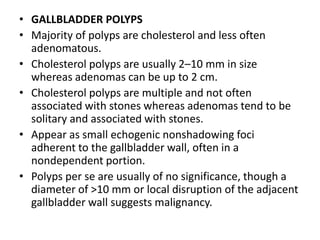
• GALLBLADDER POLYPS 
• Majority of polyps are cholesterol and less often 
adenomatous. 
• Cholesterol polyps are usually 2–10 mm in size 
whereas adenomas can be up to 2 cm. 
• Cholesterol polyps are multiple and not often 
associated with stones whereas adenomas tend to be 
solitary and associated with stones. 
• Appear as small echogenic nonshadowing foci 
adherent to the gallbladder wall, often in a 
nondependent portion. 
• Polyps per se are usually of no significance, though a 
diameter of >10 mm or local disruption of the adjacent 
gallbladder wall suggests malignancy.
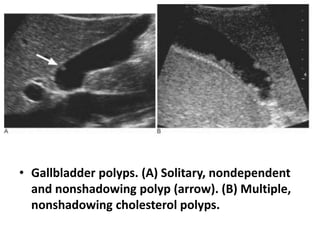
• Gallbladder polyps. (A) Solitary, nondependent 
and nonshadowing polyp (arrow). (B) Multiple, 
nonshadowing cholesterol polyps.
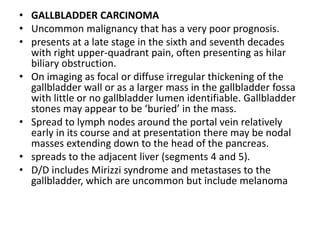
• GALLBLADDER CARCINOMA 
• Uncommon malignancy that has a very poor prognosis. 
• presents at a late stage in the sixth and seventh decades 
with right upper-quadrant pain, often presenting as hilar 
biliary obstruction. 
• On imaging as focal or diffuse irregular thickening of the 
gallbladder wall or as a larger mass in the gallbladder fossa 
with little or no gallbladder lumen identifiable. Gallbladder 
stones may appear to be ‘buried’ in the mass. 
• Spread to lymph nodes around the portal vein relatively 
early in its course and at presentation there may be nodal 
masses extending down to the head of the pancreas. 
• spreads to the adjacent liver (segments 4 and 5). 
• D/D includes Mirizzi syndrome and metastases to the 
gallbladder, which are uncommon but include melanoma
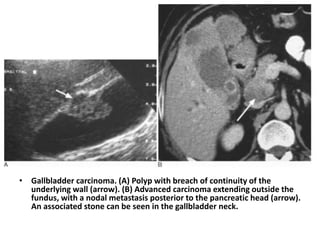
• Gallbladder carcinoma. (A) Polyp with breach of continuity of the 
underlying wall (arrow). (B) Advanced carcinoma extending outside the 
fundus, with a nodal metastasis posterior to the pancreatic head (arrow). 
An associated stone can be seen in the gallbladder neck.
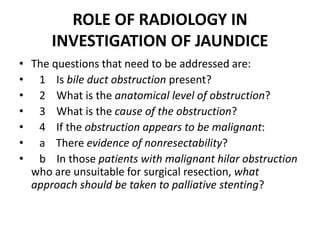
ROLE OF RADIOLOGY IN 
INVESTIGATION OF JAUNDICE 
• The questions that need to be addressed are: 
• 1 Is bile duct obstruction present? 
• 2 What is the anatomical level of obstruction? 
• 3 What is the cause of the obstruction? 
• 4 If the obstruction appears to be malignant: 
• a There evidence of nonresectability? 
• b In those patients with malignant hilar obstruction 
who are unsuitable for surgical resection, what 
approach should be taken to palliative stenting?
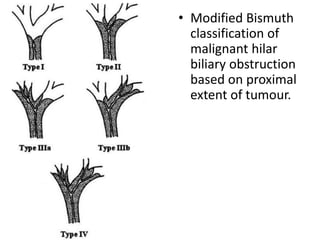
• Modified Bismuth 
classification of 
malignant hilar 
biliary obstruction 
based on proximal 
extent of tumour.
• CHOLEDOCHOLITHIASIS 
• 90 % of bile duct stones are secondary stones. 
• USG - Most commonly used initial imaging 
modality. Reports of its sensitivity vary greatly 
with the upper range being 50–80 per cent. 
The sensitivity in jaundiced patients tends to 
be better. 
• Positive stone diagnosis depends on the 
demonstration of an intraductal echogenic 
focus in both the longitudinal and transverse 
planes.
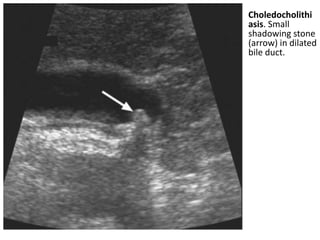
• Choledocholithi 
asis. Small 
shadowing stone 
(arrow) in dilated 
bile duct.
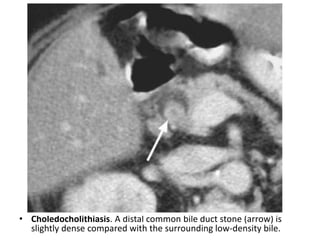
• Choledocholithiasis. A distal common bile duct stone (arrow) is 
slightly dense compared with the surrounding low-density bile.
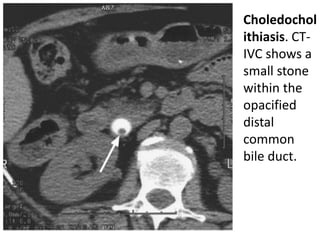
• Choledochol 
ithiasis. CT-IVC 
shows a 
small stone 
within the 
opacified 
distal 
common 
bile duct.
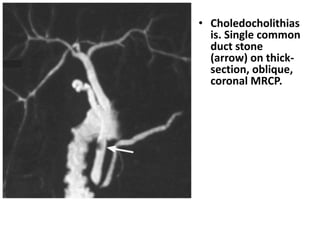
• Choledocholithias 
is. Single common 
duct stone 
(arrow) on thick-section, 
oblique, 
coronal MRCP.
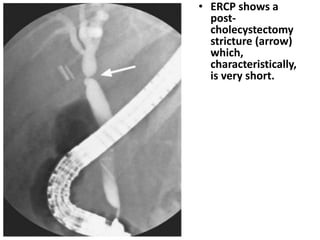
• ERCP shows a 
post-cholecystectomy 
stricture (arrow) 
which, 
characteristically, 
is very short.
• Primary sclerosing cholangitis 
• 70 % of patients having a background of chronic inflammatory 
bowel disease, usually ulcerative colitis. 
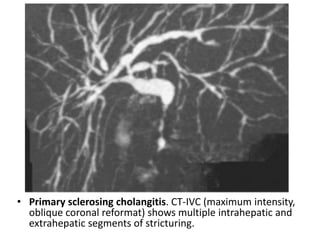
• Characterized on cholangiography by multiple segments of 
stricturing involving intrahepatic and/or extrahepatic ducts. A 
characteristic feature in the common duct is diverticula-like out-pouchings. 
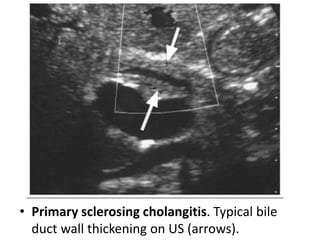
• On USG, PSC is characterized by bile duct wall thickening which is 
most pronounced at sites of stricturing, and the diverticula-like out-pouchings 
may be seen as local echogenic foci in the duct wall. 
• Well-established PSC is associated with areas of atrophy and 
hypertrophy within the liver, best seen with CT or MRI. 
• Bile duct stones occur in about 10 %. 
• Cholangiocarcinoma occurs in about 10 % and is notoriously difficult 
to diagnose early. It should be suspected if there is progressive duct 
dilatation proximal to a stricture, or if a nodule >1 cm in diameter is 
identified.
• Primary sclerosing cholangitis. CT-IVC (maximum intensity, 
oblique coronal reformat) shows multiple intrahepatic and 
extrahepatic segments of stricturing.
• Primary sclerosing cholangitis. Typical bile 
duct wall thickening on US (arrows).
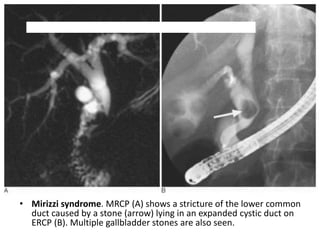
• Mirizzi syndrome 
• is characterized by narrowing of the common duct 
caused by inflammation and fibrosis related to chronic 
gallstone disease. 
• Typically a stone is impacted in the neck of the 
gallbladder, the cystic duct, or cystic duct remnant. A 
fistula may develop between the gallbladder or cystic 
duct and the common duct and the stone may partially 
or totally pass into the common duct. 
• The level of stricturing varies, being most common in 
the upper and middle common duct. 
• On cholangiography the stricture is usually smooth, 2– 
3 cm in length, and often has a concavity toward the 
right. 
• USG - there is ductal dilatation down to the level of a 
stone that is not clearly within the common duct.
• Mirizzi syndrome. MRCP (A) shows a stricture of the lower common 
duct caused by a stone (arrow) lying in an expanded cystic duct on 
ERCP (B). Multiple gallbladder stones are also seen.
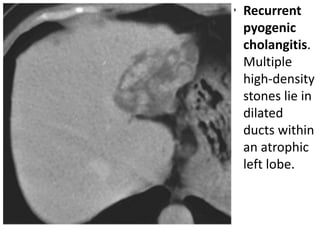
• Recurrent pyogenic cholangitis 
• also referred to as oriental cholangiohepatitis, occurs 
mainly in South-East Asia or its emigrants. 
• Characterized by recurrent episodes of cholangitis, bile 
duct stones, biliary dilatation and strictures. 
• Infection is due to enteric bacteria that are thought to be 
responsible for stone formation, although parasites, in 
particular Clonorchis sinensis, may play a partial role. 
• The stones are more often intrahepatic, can be very 
extensive, and are composed of calcium bilirubinate, often 
visible on CT as high densities within dilated intrahepatic 
ducts. 
• US shows duct dilatation and stones that may not shadow. 
• Cholangiography by any technique shows duct dilatation 
and multiple stones, which may be widespread or 
segmental, and duct strictures are common.
• Recurrent 
pyogenic 
cholangitis. 
Multiple 
high-density 
stones lie in 
dilated 
ducts within 
an atrophic 
left lobe.
• CHOLANGIOCARCINOMA 
• Arises from the bile duct epithelium and that tends to 
spread by local infiltration. 
• Approximately 60 per cent arise in the perihilar region 
(Klatskin tumours), less than 30 per cent arise in the 
distal common duct, and less than 10 per cent are 
diffuse or multifocal. 
• Present as malignant hilar biliary obstruction. 
• Their appearance on imaging varies with size and 
pathological type. Most of the exophytic tumours are 
less than 5 cm and the infiltrating stenotic tumors are 
usually less than 1–2 cm in diameter. 
• On US the tumours appear as nodules or focal bile duct 
wall thickening, which are usually slightly hyperechoic.
• On CT the nodules are usually isodense or slightly 
hypodense compared with liver and are more easily 
seen on dual-phase contrast-enhanced imaging; 
• the infiltrating stenotic type tend to enhance in the 
arterial phase and the exophytic are more conspicuous 
on portal phase contrast-enhanced imaging, where 
they appear less dense than liver. Delayed phase 
imaging to 10–20 min may show late tumour 
enhancement. 
• On MRI the tumours are hypointense on T1 and 
hyperintense on T2 and show some progressive 
enhancement on dynamic imaging. 
• The proximal extent of the stricturing, which critically 
affects treatment options, is well shown with MRCP, 
which performs better than US and CT and is 
comparable to direct cholangiography .
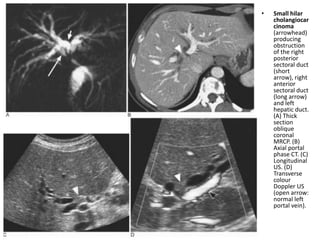
• Small hilar 
cholangiocar 
cinoma 
(arrowhead) 
producing 
obstruction 
of the right 
posterior 
sectoral duct 
(short 
arrow), right 
anterior 
sectoral duct 
(long arrow) 
and left 
hepatic duct. 
(A) Thick 
section 
oblique 
coronal 
MRCP. (B) 
Axial portal 
phase CT. (C) 
Longitudinal 
US. (D) 
Transverse 
colour 
Doppler US 
(open arrow: 
normal left 
portal vein).
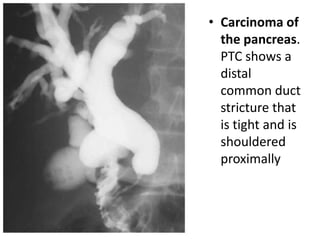
• Carcinoma of 
the pancreas. 
PTC shows a 
distal 
common duct 
stricture that 
is tight and is 
shouldered 
proximally
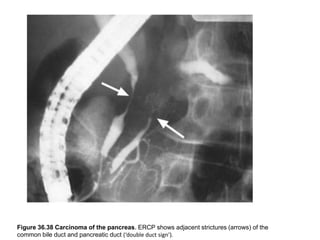
Figure 36.38 Carcinoma of the pancreas. ERCP shows adjacent strictures (arrows) of the 
common bile duct and pancreatic duct (‘double duct sign’).

Biliary pathologies

  • 1.
  • 2.
    • Typical patternof intrahepatic biliary branching. Segments are numbered according to the system of Couinaud. CHD = common hepatic duct, RHD = right hepatic duct, LHD = left hepatic duct, RPSD = right posterior sectoral duct, RASD = right anterior sectoral duct.
  • 3.
    • Variations ofbiliary branching patterns. The more common are A, B and C.
  • 4.
    • Biliary duct anatomy. CT-IVC (surface rendered maximum intensity reformat) shows trifurcation at the biliary confluence and segments numbered according to Couinaud. Arrowhead shows right anterior sectoral duct; arrow shows right posterior sectoral duct.
  • 5.
    • Luschka describean intrahepatic duct running adjacent to the gallbladder fossa, unaccompanied by a portal vein branch, and emptying into either the right hepatic or common hepatic duct. • The term ‘cystohepatic duct’is probably best reserved for small ducts that drain directly into the gallbladder or cystic duct. The significance of these variants is their proximity to the gallbladder and the potential for injury at cholecystectomy resulting in a bile leak.
  • 6.
    GALLBLADDER ANATOMICAL VARIANTS • Agenesis of the gallbladder is extremely rare, with a prevalence of 0.03–0.07 per cent. • Double gallbladder occurs in about 0.03 per cent, usually with a shared cystic duct, and the accessory gallbladder is often diseased. • True gallbladder septae are uncommon and when occurring at the fundus form a Phrygian cap. Frequently, an apparent septum is merely gallbladder wall folding, which can vary with patient position.
  • 7.
    GALLBLADDER STONES •Prevalence in adults in western community 15 per cent. • Asymptomatic in about 80 %. • They confer small lifetime risk of developing gallbladder carcinoma. • About 70 per cent of gallbladder stones are solely or predominantly cholesterol in type, with up to 30 per cent being black pigment stones composed mainly of calcium bilirubinate. • 20% radioopaque.
  • 8.
    • US -echogenic foci producing acoustic shadows. Stone mobility is frequently identifiable. • The sensitivity of US is greater than 95 %. • False-negative diagnoses are usually due to small stones in patients in whom there is poor acoustic access to the gallbladder because of obesity or other unfavourable anatomy. • False-negative diagnoses are reduced by careful US technique including the use of tissue harmonic imaging, and a variety of US probe and patient positions. • Small stones are differentiated from small polyps by the demonstration of mobility or the presence of an acoustic shadow.
  • 9.
    • US showsmultiple small shadowing stones. A normal fold lies near the gallbladder neck
  • 10.
    • Gallbladder filledwith stones producing the ‘double-arc’ sign; hypoechoic line between two echogenic lines (arrow).
  • 11.
    • Sludge iscommonly seen on US, in which it appears as fine, nonshadowing dependent echoes. • It is composed of calcium bilirubinate granules, cholesterol crystals and glycoproteins. • It is more commonly seen in chronic fasting states, critically ill patients, those receiving total parenteral nutrition or ceftriaxone and in pregnancy. • Sludge resolves spontaneously in 50 per cent of patients and gallstones will develop in 5–15 per cent.
  • 12.
    • Milk ofcalcium bile, or limey bile, is an uncommon condition in which the gallbladder bile becomes very viscous, probably as a result of stasis, and contains a high concentration of calcium bilirubinate. • On US it causes diffuse echoes, similar to sludge, but is more echogenic with a tendency to layer out and produce an acoustic shadow. • On CT and, occasionally, on plain radiographs it is visible as layering high-density material.
  • 13.
    • Milk of calcium bile producing fine echoes with a dependen t layer that shadows.
  • 14.
    CHOLECYSTITIS • 90–95% of cases, is due to gallstones (acute calculous cholecystitis). • The positive predictive values of stones combined with either tenderness localized to the gallbladder (positive sonographic Murphy's sign), or the presence of a gallbladder wall thickness of >3 mm, are 92 per cent and 95 per cent, respectively. • Gallstone(s) may be impacted in the neck of the gallbladder and this region must be carefully examined. • Other US signs are gallbladder distension (diameter >5 cm), pericholecystic fluid, gallbladder wall striations and, occasionally, obvious wall hyperaemia on Doppler examination. • Fine echoes seen within the gallbladder may be seen due to sludge or pus (gallbladder empyema).
  • 15.
    • Acute cholecystitis.The gallbladder contains small stones in the neck (Nos.1–4) and its wall shows oedematous thickening (5 mm thickness).
  • 16.
    • CT isless accurate than US for acute cholecystitis. • The CT findings in acute cholecystitis include gallbladder wall thickening, subserosal oedema, gallbladder distension, high-density bile, pericholecystic fluid and inflammatory stranding in the pericholecystic fat.
  • 17.
    • Acute cholecystitis on CT. The gallbladder wall is thickened with oedema in the adjacent fat. There is no abnormal contrast enhancement in this case.
  • 18.
    • Gangrenous cholecystitis • irregularity or asymmetrical thickening of the gallbladder wall, internal membranous echoes resulting from sloughed mucosa and pericholecystic fluid. • The clinical findings, paradoxically, may diminish with progression to gangrenous change. • CT signs that suggest gangrenous cholecystitis are gas in the wall or lumen, discontinuous and/or irregular mucosal enhancement, internal membranes representing sloughed mucosa and pericholecystic abscess
  • 19.
    • Acute cholecystitiswith localized perforation on (A) US and (B) CT. The thickened gallbladder wall shows a local defect (arrow) and on CT there is small amount of intraperitoneal fluid and oedema of adjacent fat.
  • 20.
    • Emphysematous cholecystitis • Accounts for only 1 %, but has a relatively high mortality rate. • It is more common in men. • Diabetics, and stones are present. • Diagnosis - intramural and/or intraluminal gas caused by gas-forming organisms. On US intramural gas appears as focal or diffuse bright echogenic lines. Intraluminal gas, in the nondependent portion of the gallbladder, causes a curvilinear, brightly echogenic band with shadowing, which can make recognition of the gallbladder difficult and lead to a false-negative US result.
  • 21.
    • Emphysemat ous cholecystitis. Image showing intramural (arrow) as well as intraluminal gallbladder gas.
  • 22.
    • Acalculous cholecystitis • Usually seen in critically ill patirnts. • US signs are gallbladder distension, gallbladder wall thickening, echogenic contents and, occasionally, sloughed membranes/mucosa and pericholecystic fluid. • A positive diagnosis is often difficult as sludge and gallbladder distension may occur without cholecystitis in this group of patients. • Biliary scintigraphy is possibly the most accurate modality.
  • 23.
    • Chronic acalculouscholecystitis is a controversial entity as there are no clear clinical, pathological or imaging criteria for its diagnosis. • US may show gallbladder wall thickening and, by definition, no stones. • Cholescintigraphy followed by the IV infusion of cholecystokinin (CCK), or one of its analogues, can be used to assess gallbladder contractibility. • An ejection fraction greater than 35 per cent on CCK-cholescintigraphy is generally taken to be an indicator of gallbladder dysfunction and helps select patients who may benefit from cholecystectomy.
  • 24.
    • GALLBLADDER POLYPS • Majority of polyps are cholesterol and less often adenomatous. • Cholesterol polyps are usually 2–10 mm in size whereas adenomas can be up to 2 cm. • Cholesterol polyps are multiple and not often associated with stones whereas adenomas tend to be solitary and associated with stones. • Appear as small echogenic nonshadowing foci adherent to the gallbladder wall, often in a nondependent portion. • Polyps per se are usually of no significance, though a diameter of >10 mm or local disruption of the adjacent gallbladder wall suggests malignancy.
  • 25.
    • Gallbladder polyps.(A) Solitary, nondependent and nonshadowing polyp (arrow). (B) Multiple, nonshadowing cholesterol polyps.
  • 26.
    • GALLBLADDER CARCINOMA • Uncommon malignancy that has a very poor prognosis. • presents at a late stage in the sixth and seventh decades with right upper-quadrant pain, often presenting as hilar biliary obstruction. • On imaging as focal or diffuse irregular thickening of the gallbladder wall or as a larger mass in the gallbladder fossa with little or no gallbladder lumen identifiable. Gallbladder stones may appear to be ‘buried’ in the mass. • Spread to lymph nodes around the portal vein relatively early in its course and at presentation there may be nodal masses extending down to the head of the pancreas. • spreads to the adjacent liver (segments 4 and 5). • D/D includes Mirizzi syndrome and metastases to the gallbladder, which are uncommon but include melanoma
  • 27.
    • Gallbladder carcinoma.(A) Polyp with breach of continuity of the underlying wall (arrow). (B) Advanced carcinoma extending outside the fundus, with a nodal metastasis posterior to the pancreatic head (arrow). An associated stone can be seen in the gallbladder neck.
  • 28.
    ROLE OF RADIOLOGYIN INVESTIGATION OF JAUNDICE • The questions that need to be addressed are: • 1 Is bile duct obstruction present? • 2 What is the anatomical level of obstruction? • 3 What is the cause of the obstruction? • 4 If the obstruction appears to be malignant: • a There evidence of nonresectability? • b In those patients with malignant hilar obstruction who are unsuitable for surgical resection, what approach should be taken to palliative stenting?
  • 29.
    • Modified Bismuth classification of malignant hilar biliary obstruction based on proximal extent of tumour.
  • 30.
    • CHOLEDOCHOLITHIASIS •90 % of bile duct stones are secondary stones. • USG - Most commonly used initial imaging modality. Reports of its sensitivity vary greatly with the upper range being 50–80 per cent. The sensitivity in jaundiced patients tends to be better. • Positive stone diagnosis depends on the demonstration of an intraductal echogenic focus in both the longitudinal and transverse planes.
  • 31.
    • Choledocholithi asis.Small shadowing stone (arrow) in dilated bile duct.
  • 32.
    • Choledocholithiasis. Adistal common bile duct stone (arrow) is slightly dense compared with the surrounding low-density bile.
  • 33.
    • Choledochol ithiasis.CT-IVC shows a small stone within the opacified distal common bile duct.
  • 34.
    • Choledocholithias is.Single common duct stone (arrow) on thick-section, oblique, coronal MRCP.
  • 35.
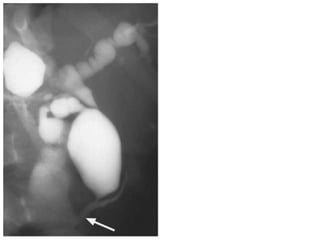
    • ERCP showsa post-cholecystectomy stricture (arrow) which, characteristically, is very short.
  • 36.
    • Primary sclerosingcholangitis • 70 % of patients having a background of chronic inflammatory bowel disease, usually ulcerative colitis. • Characterized on cholangiography by multiple segments of stricturing involving intrahepatic and/or extrahepatic ducts. A characteristic feature in the common duct is diverticula-like out-pouchings. • On USG, PSC is characterized by bile duct wall thickening which is most pronounced at sites of stricturing, and the diverticula-like out-pouchings may be seen as local echogenic foci in the duct wall. • Well-established PSC is associated with areas of atrophy and hypertrophy within the liver, best seen with CT or MRI. • Bile duct stones occur in about 10 %. • Cholangiocarcinoma occurs in about 10 % and is notoriously difficult to diagnose early. It should be suspected if there is progressive duct dilatation proximal to a stricture, or if a nodule >1 cm in diameter is identified.
  • 37.
    • Primary sclerosingcholangitis. CT-IVC (maximum intensity, oblique coronal reformat) shows multiple intrahepatic and extrahepatic segments of stricturing.
  • 38.
    • Primary sclerosingcholangitis. Typical bile duct wall thickening on US (arrows).
  • 39.
    • Mirizzi syndrome • is characterized by narrowing of the common duct caused by inflammation and fibrosis related to chronic gallstone disease. • Typically a stone is impacted in the neck of the gallbladder, the cystic duct, or cystic duct remnant. A fistula may develop between the gallbladder or cystic duct and the common duct and the stone may partially or totally pass into the common duct. • The level of stricturing varies, being most common in the upper and middle common duct. • On cholangiography the stricture is usually smooth, 2– 3 cm in length, and often has a concavity toward the right. • USG - there is ductal dilatation down to the level of a stone that is not clearly within the common duct.
  • 40.
    • Mirizzi syndrome.MRCP (A) shows a stricture of the lower common duct caused by a stone (arrow) lying in an expanded cystic duct on ERCP (B). Multiple gallbladder stones are also seen.
  • 41.
    • Recurrent pyogeniccholangitis • also referred to as oriental cholangiohepatitis, occurs mainly in South-East Asia or its emigrants. • Characterized by recurrent episodes of cholangitis, bile duct stones, biliary dilatation and strictures. • Infection is due to enteric bacteria that are thought to be responsible for stone formation, although parasites, in particular Clonorchis sinensis, may play a partial role. • The stones are more often intrahepatic, can be very extensive, and are composed of calcium bilirubinate, often visible on CT as high densities within dilated intrahepatic ducts. • US shows duct dilatation and stones that may not shadow. • Cholangiography by any technique shows duct dilatation and multiple stones, which may be widespread or segmental, and duct strictures are common.
  • 42.
    • Recurrent pyogenic cholangitis. Multiple high-density stones lie in dilated ducts within an atrophic left lobe.
  • 45.
    • CHOLANGIOCARCINOMA •Arises from the bile duct epithelium and that tends to spread by local infiltration. • Approximately 60 per cent arise in the perihilar region (Klatskin tumours), less than 30 per cent arise in the distal common duct, and less than 10 per cent are diffuse or multifocal. • Present as malignant hilar biliary obstruction. • Their appearance on imaging varies with size and pathological type. Most of the exophytic tumours are less than 5 cm and the infiltrating stenotic tumors are usually less than 1–2 cm in diameter. • On US the tumours appear as nodules or focal bile duct wall thickening, which are usually slightly hyperechoic.
  • 46.
    • On CTthe nodules are usually isodense or slightly hypodense compared with liver and are more easily seen on dual-phase contrast-enhanced imaging; • the infiltrating stenotic type tend to enhance in the arterial phase and the exophytic are more conspicuous on portal phase contrast-enhanced imaging, where they appear less dense than liver. Delayed phase imaging to 10–20 min may show late tumour enhancement. • On MRI the tumours are hypointense on T1 and hyperintense on T2 and show some progressive enhancement on dynamic imaging. • The proximal extent of the stricturing, which critically affects treatment options, is well shown with MRCP, which performs better than US and CT and is comparable to direct cholangiography .
  • 47.
    • Small hilar cholangiocar cinoma (arrowhead) producing obstruction of the right posterior sectoral duct (short arrow), right anterior sectoral duct (long arrow) and left hepatic duct. (A) Thick section oblique coronal MRCP. (B) Axial portal phase CT. (C) Longitudinal US. (D) Transverse colour Doppler US (open arrow: normal left portal vein).
  • 48.
    • Carcinoma of the pancreas. PTC shows a distal common duct stricture that is tight and is shouldered proximally
  • 49.
    Figure 36.38 Carcinomaof the pancreas. ERCP shows adjacent strictures (arrows) of the common bile duct and pancreatic duct (‘double duct sign’).