EFFUSION CYTOLOGY
Nicholas Afriyie
1
EFFUSION CYTOLOGY
• Effusion is an excess amount of serous fluid in the body cavity
• All serous membranes produces serous fluid but excess amount of the
serous fluid may indicate a pathology and is termed as an effusion.
• Serous effusion can be found in the following body cavities: pleural
cavity, peritoneal cavity and pericardial cavity.
2
TYPES OF EFFUSION
Transudates
• ultrafiltrate of plasma with little protein and few or no cells
• arise from either increased capillary hydrostatic pressure or
decreased oncotic pressure secondary to congestive heart failure,
fluid overload, cirrhosis or hypoalbuminemia.
 Exudates
• extravascular fluid collection that is rich in protein and/or cells.
• result from increased capillary permeability or decreased
lymphatic resorption associated with infection, connective tissue
disease, pancreatitis or cancer
3
SAMPLING TECHNIQUES
• Serous effusion is usually sampled by simply inserting a wide-bore
needle (under local anesthesia) through the body wall into the fluid-
containing cavity.
• Examples:
 Peritoneal fluid from peritoneal cavity- by paracentesis
 Pleural fluid from pleural cavity- by thoracentesis
 pericardial fluid from pericardial cavity- by pericardiocentesis
4
GROSS APPEARANCE OF SEROUS EFFUSION
• Many serous effusions are noticeably bloodstained.
• The cancerous cells in serous effusion form a thick, whitish-yellow layer
at the bottom of container when allowed to stand and sediment
spontaneously.
• Individual particles of cancer in a serous effusion may occasionally be large
enough to be visible to the naked eye. Eg: spheroids, ellipsoids .
• Fluids containing numerous pigmented melanoma cells may be chocolate
brown.
5
CONT’D
• Effusions containing many hemosiderophages may appear lighter brown.
• Effusions from patients who are jaundiced or that are a result of leakage of
bile into the peritoneal cavity may have a rather dark brown-orange or
greenish appearance that remains with the supernatant after the specimen
has been centrifuged
• Serous effusions caused by malignant mesothelioma of epithelial type
often have thin honey consistence due to increased viscosity of the fluid
due to the high concentration of hyaluronic acid contained in the
malignant mesothelioma.
6
CONT’D
• Peritoneal effusion due to pseudomyxoma peritonei has heavy mucoid
consistence and the cells it contains do not sediment during
centrifugation.
•
Effusions containing numerous cholesterol crystals are
yellow and turbid and have a swirling, shimmering, gold paint
appearance when agitated
• Chylous effusions have a
milky white appearance with a creamy topmost layer due to
their high concentration of emulsified lipid.
7
PREPARATION OF SEROUS FLUID
 Remove any clots that may be present and extract all fluid
 Pour off an aliquot (up to 50 mL) of the fluid and centrifuge for 3
mins at 2000rpm
 Pour off the supernatant
 Prepare slide with the sediment and stain
8
Staining techniques
• Three main staining techniques are employed
a toluidine blue-stained wet film
a liquid-based preparation stained with the Papanicolaou stain
and cell blocks stained with hematoxylin and eosin
9
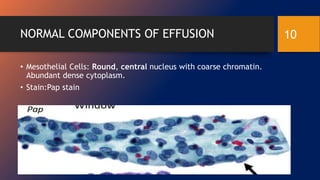
NORMAL COMPONENTS OF EFFUSION
• Mesothelial Cells: Round, central nucleus with coarse chromatin.
Abundant dense cytoplasm.
• Stain:Pap stain
10
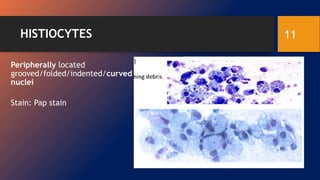
HISTIOCYTES
Peripherally located
grooved/folded/indented/curved
nuclei
Stain: Pap stain
11
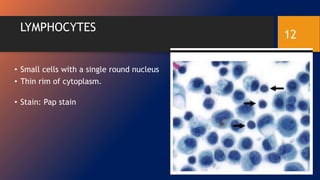
LYMPHOCYTES
• Small cells with a single round nucleus
• Thin rim of cytoplasm.
• Stain: Pap stain
12
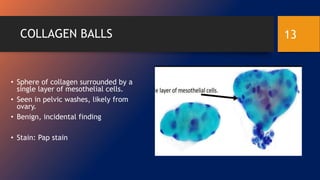
COLLAGEN BALLS
• Sphere of collagen surrounded by a
single layer of mesothelial cells.
• Seen in pelvic washes, likely from
ovary.
• Benign, incidental finding
• Stain: Pap stain
13
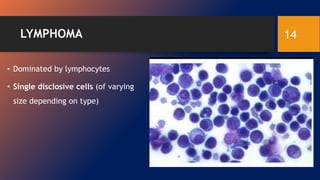
LYMPHOMA
• Dominated by lymphocytes
• Single disclosive cells (of varying
size depending on type)
14
MALIGNANT MESOTHELIOMA
• All mesothelial cells (no “foreign” second
population)
Often maintain similar cytologic features (lacy
skirts, etc…)
Can be cytologically malignant or relatively bland
“More and bigger cells, in more and bigger
clusters.”
Large clusters with knobby, flower-like contours
15
BENIGN EFFUSIONS
• Rheumatoid effusions- Granulomas, multinucleated giant cells,
and epithelioid histiocytes.
• Eosinophilic effusion- abundant eosinophils
• Lupus effusion- neutrophils with a phagocytosed nucleus, Necrotic
debris
• Chylous effusion- lymphocytes with some lipophages and mesos
• Tuberculous effusion- Abundant lymphocytes (T-cells) with sparse
mesos and
16
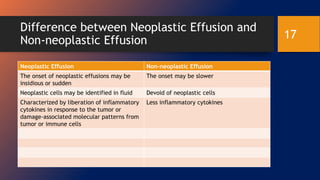
Difference between Neoplastic Effusion and
Non-neoplastic Effusion
Neoplastic Effusion Non-neoplastic Effusion
The onset of neoplastic effusions may be
insidious or sudden
The onset may be slower
Neoplastic cells may be identified in fluid Devoid of neoplastic cells
Characterized by liberation of inflammatory
cytokines in response to the tumor or
damage-associated molecular patterns from
tumor or immune cells
Less inflammatory cytokines
17
References
1. Ducatman, B. S. (2020). Cytology: Diagnostic principles and
clinical correlates. Elsevier.
2. Bibbo, M., & Hoda, R. S. (1998). Comprehensive
Cytopathology. International Journal of Gynecological
Pathology, 17(1), 93.
18

Effusion cytology.pptx

  • 1.
  • 2.
    EFFUSION CYTOLOGY • Effusionis an excess amount of serous fluid in the body cavity • All serous membranes produces serous fluid but excess amount of the serous fluid may indicate a pathology and is termed as an effusion. • Serous effusion can be found in the following body cavities: pleural cavity, peritoneal cavity and pericardial cavity. 2
  • 3.
    TYPES OF EFFUSION Transudates •ultrafiltrate of plasma with little protein and few or no cells • arise from either increased capillary hydrostatic pressure or decreased oncotic pressure secondary to congestive heart failure, fluid overload, cirrhosis or hypoalbuminemia.  Exudates • extravascular fluid collection that is rich in protein and/or cells. • result from increased capillary permeability or decreased lymphatic resorption associated with infection, connective tissue disease, pancreatitis or cancer 3
  • 4.
    SAMPLING TECHNIQUES • Serouseffusion is usually sampled by simply inserting a wide-bore needle (under local anesthesia) through the body wall into the fluid- containing cavity. • Examples:  Peritoneal fluid from peritoneal cavity- by paracentesis  Pleural fluid from pleural cavity- by thoracentesis  pericardial fluid from pericardial cavity- by pericardiocentesis 4
  • 5.
    GROSS APPEARANCE OFSEROUS EFFUSION • Many serous effusions are noticeably bloodstained. • The cancerous cells in serous effusion form a thick, whitish-yellow layer at the bottom of container when allowed to stand and sediment spontaneously. • Individual particles of cancer in a serous effusion may occasionally be large enough to be visible to the naked eye. Eg: spheroids, ellipsoids . • Fluids containing numerous pigmented melanoma cells may be chocolate brown. 5
  • 6.
    CONT’D • Effusions containingmany hemosiderophages may appear lighter brown. • Effusions from patients who are jaundiced or that are a result of leakage of bile into the peritoneal cavity may have a rather dark brown-orange or greenish appearance that remains with the supernatant after the specimen has been centrifuged • Serous effusions caused by malignant mesothelioma of epithelial type often have thin honey consistence due to increased viscosity of the fluid due to the high concentration of hyaluronic acid contained in the malignant mesothelioma. 6
  • 7.
    CONT’D • Peritoneal effusiondue to pseudomyxoma peritonei has heavy mucoid consistence and the cells it contains do not sediment during centrifugation. • Effusions containing numerous cholesterol crystals are yellow and turbid and have a swirling, shimmering, gold paint appearance when agitated • Chylous effusions have a milky white appearance with a creamy topmost layer due to their high concentration of emulsified lipid. 7
  • 8.
    PREPARATION OF SEROUSFLUID  Remove any clots that may be present and extract all fluid  Pour off an aliquot (up to 50 mL) of the fluid and centrifuge for 3 mins at 2000rpm  Pour off the supernatant  Prepare slide with the sediment and stain 8
  • 9.
    Staining techniques • Threemain staining techniques are employed a toluidine blue-stained wet film a liquid-based preparation stained with the Papanicolaou stain and cell blocks stained with hematoxylin and eosin 9
  • 10.
    NORMAL COMPONENTS OFEFFUSION • Mesothelial Cells: Round, central nucleus with coarse chromatin. Abundant dense cytoplasm. • Stain:Pap stain 10
  • 11.
  • 12.
    LYMPHOCYTES • Small cellswith a single round nucleus • Thin rim of cytoplasm. • Stain: Pap stain 12
  • 13.
    COLLAGEN BALLS • Sphereof collagen surrounded by a single layer of mesothelial cells. • Seen in pelvic washes, likely from ovary. • Benign, incidental finding • Stain: Pap stain 13
  • 14.
    LYMPHOMA • Dominated bylymphocytes • Single disclosive cells (of varying size depending on type) 14
  • 15.
    MALIGNANT MESOTHELIOMA • Allmesothelial cells (no “foreign” second population) Often maintain similar cytologic features (lacy skirts, etc…) Can be cytologically malignant or relatively bland “More and bigger cells, in more and bigger clusters.” Large clusters with knobby, flower-like contours 15
  • 16.
    BENIGN EFFUSIONS • Rheumatoideffusions- Granulomas, multinucleated giant cells, and epithelioid histiocytes. • Eosinophilic effusion- abundant eosinophils • Lupus effusion- neutrophils with a phagocytosed nucleus, Necrotic debris • Chylous effusion- lymphocytes with some lipophages and mesos • Tuberculous effusion- Abundant lymphocytes (T-cells) with sparse mesos and 16
  • 17.
    Difference between NeoplasticEffusion and Non-neoplastic Effusion Neoplastic Effusion Non-neoplastic Effusion The onset of neoplastic effusions may be insidious or sudden The onset may be slower Neoplastic cells may be identified in fluid Devoid of neoplastic cells Characterized by liberation of inflammatory cytokines in response to the tumor or damage-associated molecular patterns from tumor or immune cells Less inflammatory cytokines 17
  • 18.
    References 1. Ducatman, B.S. (2020). Cytology: Diagnostic principles and clinical correlates. Elsevier. 2. Bibbo, M., & Hoda, R. S. (1998). Comprehensive Cytopathology. International Journal of Gynecological Pathology, 17(1), 93. 18

Editor's Notes

  • #4 Transudates are usually bilateral and arise from either increased capillary hydrostatic pressure or decreased oncotic pressure secondary to congestive heart failure, fluid overload, cirrhosis or hypoalbuminemia. Transudate: extravascular fluid collection that is basically an ultrafiltrate of plasma with little protein and few or no cells. Fluid appears grossly clear. Exudates are usually unilateral and result from increased capillary permeability or decreased lymphatic resorption associated with infection, connective tissue disease, pancreatitis or cancer Exudate: extravascular fluid collection that is rich in protein and/or cells. Fluid appears grossly cloudy. Effusions into body cavities can be further described as follows:Serous: a transudate with mainly edema fluid and few cells. Serosanguinous: an effusion with red blood cells. Fibrinous (serofibrinous): fibrin strands are derived from a protein-rich exudate. Purulent: numerous PMN's are present. Also called "empyema" in the pleural space.
  • #5 Centesis: Although a serous effusion may be removed at the time of surgical exploration, it is usually sampled by the relatively simple procedure of inserting a wide-bore needle (under local anesthesia) through the body wall into the fluid-containing cavity
  • #9 The clots may be fixed in 10% buffered formalin and processed by histopathological methods.