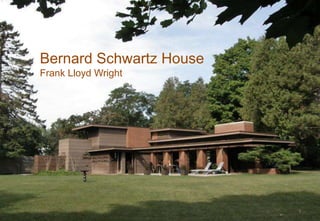
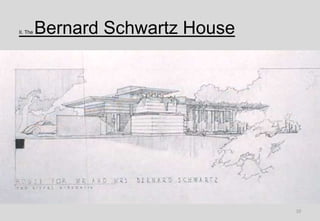
Bernard Schwartz House
Frank Lloyd Wright
1
Contents
I. About Frank Lloyd Wright (pg.3-9)
• Style and Design (pg. 6-8)
• Philosophy (pg. 9)
II. The Bernard Schwartz House (pg.10-18)
III. Other images (pg.19-40)
• Exteriors (pg. 20-26)
• Interiors (pg.27-36)
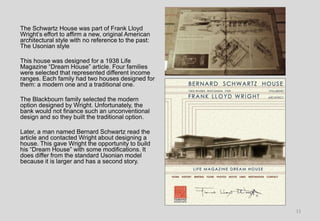
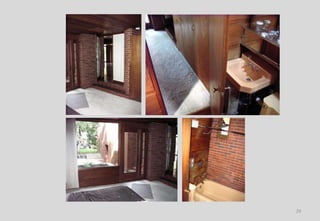
• Other details (pg.37-40)
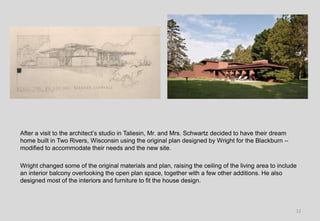
IV. Sources (pg.41)
2
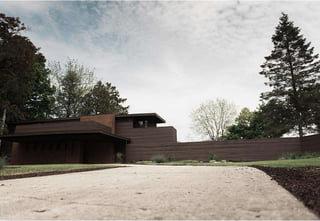
I. About
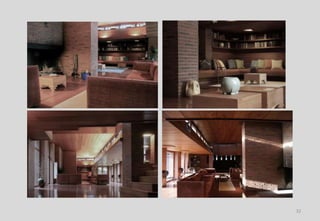
FRANK LLOYD
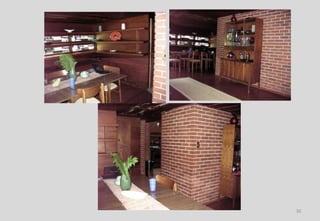
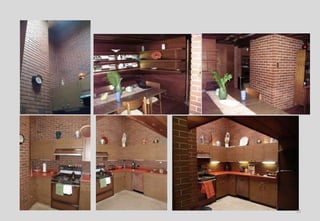
WRIGHT“The mission of an architect is to help people understand how to make
life more beautiful, the world a better one for living in, and to give
reason, rhyme, and meaning to life.”
– FRANK LLOYD WRIGHT, 1957
3
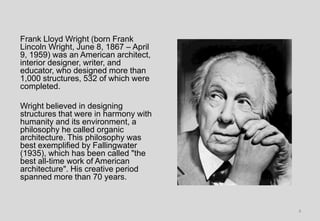
Frank Lloyd Wright (born Frank
Lincoln Wright, June 8, 1867 – April
9, 1959) was an American architect,
interior designer, writer, and
educator, who designed more than
1,000 structures, 532 of which were
completed.
Wright believed in designing
structures that were in harmony with
humanity and its environment, a
philosophy he called organic
architecture. This philosophy was
best exemplified by Fallingwater
(1935), which has been called "the
best all-time work of American
architecture". His creative period
spanned more than 70 years.
4
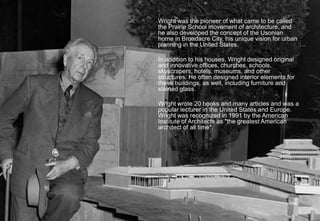
Wright was the pioneer of what came to be called
the Prairie School movement of architecture, and
he also developed the concept of the Usonian
home in Broadacre City, his unique vision for urban
planning in the United States.
In addition to his houses, Wright designed original
and innovative offices, churches, schools,
skyscrapers, hotels, museums, and other
structures. He often designed interior elements for
these buildings, as well, including furniture and
stained glass.
Wright wrote 20 books and many articles and was a
popular lecturer in the United States and Europe.
Wright was recognized in 1991 by the American
Institute of Architects as "the greatest American
architect of all time".
5
Style & Design
Prairie Style
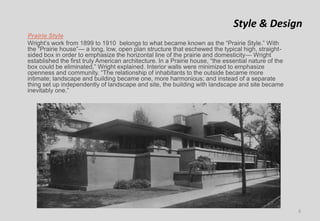
Wright’s work from 1899 to 1910 belongs to what became known as the “Prairie Style.” With
the “Prairie house”— a long, low, open plan structure that eschewed the typical high, straight-
sided box in order to emphasize the horizontal line of the prairie and domesticity— Wright
established the first truly American architecture. In a Prairie house, “the essential nature of the
box could be eliminated,” Wright explained. Interior walls were minimized to emphasize
openness and community. “The relationship of inhabitants to the outside became more
intimate; landscape and building became one, more harmonious; and instead of a separate
thing set up independently of landscape and site, the building with landscape and site became
inevitably one.”
6
Usonian
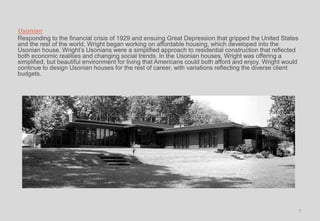
Responding to the financial crisis of 1929 and ensuing Great Depression that gripped the United States
and the rest of the world, Wright began working on affordable housing, which developed into the
Usonian house. Wright’s Usonians were a simplified approach to residential construction that reflected
both economic realities and changing social trends. In the Usonian houses, Wright was offering a
simplified, but beautiful environment for living that Americans could both afford and enjoy. Wright would
continue to design Usonian houses for the rest of career, with variations reflecting the diverse client
budgets.
7
Material and Machine
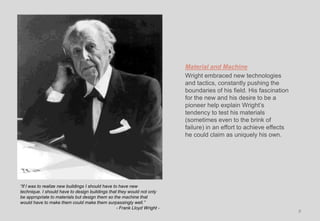
Wright embraced new technologies
and tactics, constantly pushing the
boundaries of his field. His fascination
for the new and his desire to be a
pioneer help explain Wright’s
tendency to test his materials
(sometimes even to the brink of
failure) in an effort to achieve effects
he could claim as uniquely his own.
8
“If I was to realize new buildings I should have to have new
technique. I should have to design buildings that they would not only
be appropriate to materials but design them so the machine that
would have to make them could make them surpassingly well.”
- Frank Lloyd Wright -
Design for Democracy
Wright always aspired to provide his client with
environments that were not only functional but also
“eloquent and humane.” Perhaps uniquely among the great
architects, Wright pursued an architecture for everyman
rather than every man for one architecture through the
careful use of standardization to achieve accessible tailoring
options to for his clients.
Integrity and Connection
Believing that architecture could be genuinely
transformative, Wright devoted his life to creating a
total aesthetic that would enhance society’s well being.
“Above all integrity,” he would say: “buildings like
people must first be sincere, must be true.” Architecture
was not just about buildings, but about nourishing the
lives of those within them.
9
Nature’s Principles and Structures
For Wright, a truly organic building developed from within outwards and was thus in harmony with its time, place,
and inhabitants. “In organic architecture then, it is quite impossible to consider the building as one thing, its
furnishings another and its setting and environment still another,” he concluded. “The spirit in which these buildings
are conceived sees all these together at work as one thing.” To that end, Wright designed furniture, rugs, fabrics, art
glass, lighting, dinnerware, and graphic arts.
“There is no architecture
without a philosophy.
There is no art of any kind
without its own
philosophy.”
– FRANK LLOYD WRIGHT,
1959
Philosophy
II. The Bernard Schwartz House
10
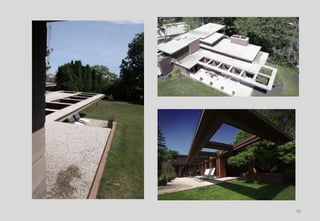
The Schwartz House was part of Frank Lloyd
Wright’s effort to affirm a new, original American
architectural style with no reference to the past:
The Usonian style
This house was designed for a 1938 Life
Magazine “Dream House” article. Four families
were selected that represented different income
ranges. Each family had two houses designed for
them: a modern one and a traditional one.
The Blackbourn family selected the modern
option designed by Wright. Unfortunately, the
bank would not finance such an unconventional
design and so they built the traditional option.
Later, a man named Bernard Schwartz read the
article and contacted Wright about designing a
house. This gave Wright the opportunity to build
his “Dream House” with some modifications. It
does differ from the standard Usonian model
because it is larger and has a second story.
11
After a visit to the architect’s studio in Taliesin, Mr. and Mrs. Schwartz decided to have their dream
home built in Two Rivers, Wisconsin using the original plan designed by Wright for the Blackburn –
modified to accommodate their needs and the new site.
Wright changed some of the original materials and plan, raising the ceiling of the living area to include
an interior balcony overlooking the open plan space, together with a few other additions. He also
designed most of the interiors and furniture to fit the house design.
12
13
14
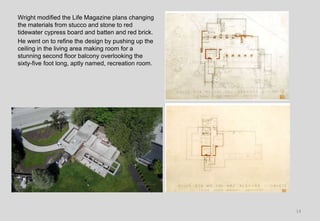
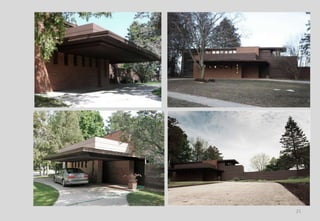
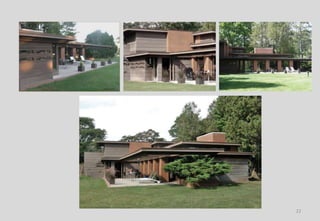
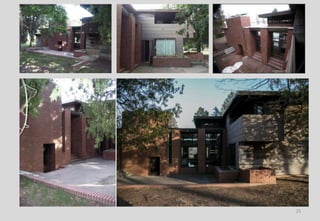
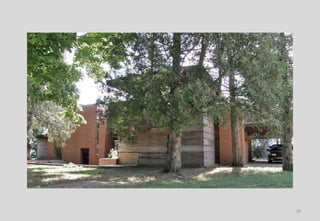
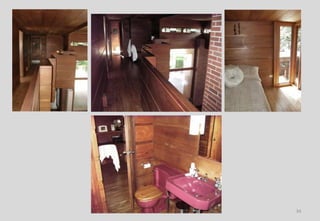
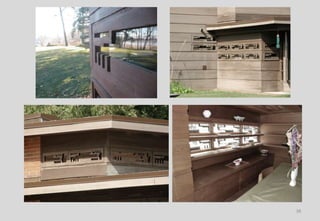
Wright modified the Life Magazine plans changing
the materials from stucco and stone to red
tidewater cypress board and batten and red brick.
He went on to refine the design by pushing up the
ceiling in the living area making room for a
stunning second floor balcony overlooking the
sixty-five foot long, aptly named, recreation room.
15
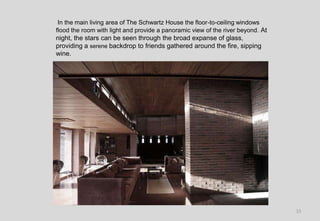
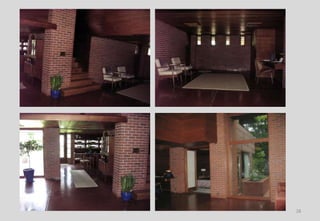
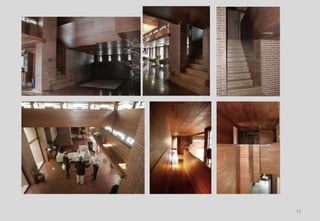
In the main living area of The Schwartz House the floor-to-ceiling windows
flood the room with light and provide a panoramic view of the river beyond. At
night, the stars can be seen through the broad expanse of glass,
providing a serene backdrop to friends gathered around the fire, sipping
wine.
16
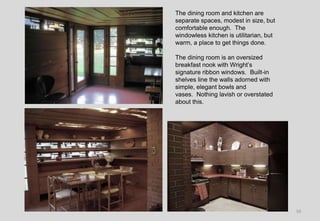
The dining room and kitchen are
separate spaces, modest in size, but
comfortable enough. The
windowless kitchen is utilitarian, but
warm, a place to get things done.
The dining room is an oversized
breakfast nook with Wright’s
signature ribbon windows. Built-in
shelves line the walls adorned with
simple, elegant bowls and
vases. Nothing lavish or overstated
about this.
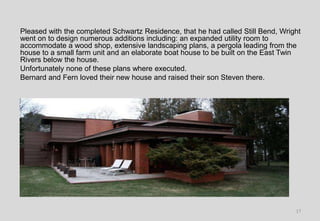
Pleased with the completed Schwartz Residence, that he had called Still Bend, Wright
went on to design numerous additions including: an expanded utility room to
accommodate a wood shop, extensive landscaping plans, a pergola leading from the
house to a small farm unit and an elaborate boat house to be built on the East Twin
Rivers below the house.
Unfortunately none of these plans where executed.
Bernard and Fern loved their new house and raised their son Steven there.
17
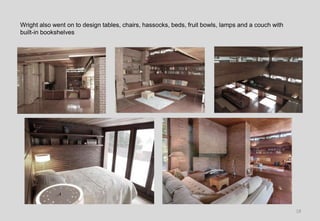
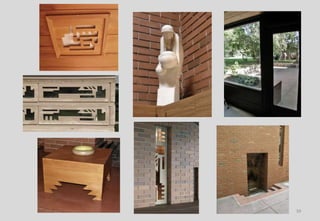
Wright also went on to design tables, chairs, hassocks, beds, fruit bowls, lamps and a couch with
built-in bookshelves
18
Other images of the Bernard Schwartz House
19
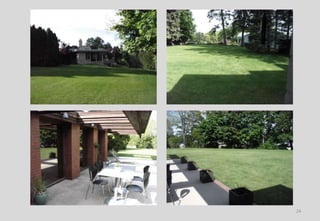
20
Exteriors
21
22
23
24
25
26
27
Interiors
28
29
30
31
32
33
34
35
36
37
Other details
38
39
40
Sources
• https://www.pinterest.com/pin/189573465540969051/?lp=true
• https://www.flickr.com/groups/1406383@N25/pool/
• https://www.youtube.com/watch?v=hI-9Vwx2PXw
• https://3dwarehouse.sketchup.com/model/uf6b8b7d6-99b9-43b7-a37d-dbab24a88992/Bernard-Schwartz-house-1939?hl=en
• https://www.theschwartzhouse.com/
• https://en.wikipedia.org/wiki/Bernard_Schwartz_House
• https://franklloydwright.org/site/bernard-schwartz-house/
• https://www.youtube.com/watch?v=ceOpGj4CmBY
• https://www.youtube.com/watch?v=9kQfFr80eco
• http://www.aaonetwork.org/news/articles/bernard-schwartz-house
• https://plansmatter.com/view-rentals/still-bend-two-rivers-wi-usa
• https://www.wisconsinhistory.org/Records/Image/IM71234
• http://www.galenfrysinger.com/frank_lloyd_wright.htm
• http://www.markfederighiphotography.com/blog/2013/11/6/elaine-scott-married-frank-lloyd-wrights-bernard-schwartz-house-two-rivers-wi
• https://fr.airbnb.com/rooms/13783?guests=1&adults=1
• https://www.boutique-homes.com/vacation-rentals/americas/united-states/the-schwartz-house-two-rivers-wisconsin/
• https://www.youtube.com/watch?v=yjIoaxtgF8Q
• http://www.peterbeers.net/interests/flw_rt/Wisconsin/schwartz_house/schwartz_house.htm
41
Thank you for reading

Bernard schwartz house

  • 1.
  • 2.
    Contents I. About FrankLloyd Wright (pg.3-9) • Style and Design (pg. 6-8) • Philosophy (pg. 9) II. The Bernard Schwartz House (pg.10-18) III. Other images (pg.19-40) • Exteriors (pg. 20-26) • Interiors (pg.27-36) • Other details (pg.37-40) IV. Sources (pg.41) 2
  • 3.
    I. About FRANK LLOYD WRIGHT“Themission of an architect is to help people understand how to make life more beautiful, the world a better one for living in, and to give reason, rhyme, and meaning to life.” – FRANK LLOYD WRIGHT, 1957 3
  • 4.
    Frank Lloyd Wright(born Frank Lincoln Wright, June 8, 1867 – April 9, 1959) was an American architect, interior designer, writer, and educator, who designed more than 1,000 structures, 532 of which were completed. Wright believed in designing structures that were in harmony with humanity and its environment, a philosophy he called organic architecture. This philosophy was best exemplified by Fallingwater (1935), which has been called "the best all-time work of American architecture". His creative period spanned more than 70 years. 4
  • 5.
    Wright was thepioneer of what came to be called the Prairie School movement of architecture, and he also developed the concept of the Usonian home in Broadacre City, his unique vision for urban planning in the United States. In addition to his houses, Wright designed original and innovative offices, churches, schools, skyscrapers, hotels, museums, and other structures. He often designed interior elements for these buildings, as well, including furniture and stained glass. Wright wrote 20 books and many articles and was a popular lecturer in the United States and Europe. Wright was recognized in 1991 by the American Institute of Architects as "the greatest American architect of all time". 5
  • 6.
    Style & Design PrairieStyle Wright’s work from 1899 to 1910 belongs to what became known as the “Prairie Style.” With the “Prairie house”— a long, low, open plan structure that eschewed the typical high, straight- sided box in order to emphasize the horizontal line of the prairie and domesticity— Wright established the first truly American architecture. In a Prairie house, “the essential nature of the box could be eliminated,” Wright explained. Interior walls were minimized to emphasize openness and community. “The relationship of inhabitants to the outside became more intimate; landscape and building became one, more harmonious; and instead of a separate thing set up independently of landscape and site, the building with landscape and site became inevitably one.” 6
  • 7.
    Usonian Responding to thefinancial crisis of 1929 and ensuing Great Depression that gripped the United States and the rest of the world, Wright began working on affordable housing, which developed into the Usonian house. Wright’s Usonians were a simplified approach to residential construction that reflected both economic realities and changing social trends. In the Usonian houses, Wright was offering a simplified, but beautiful environment for living that Americans could both afford and enjoy. Wright would continue to design Usonian houses for the rest of career, with variations reflecting the diverse client budgets. 7
  • 8.
    Material and Machine Wrightembraced new technologies and tactics, constantly pushing the boundaries of his field. His fascination for the new and his desire to be a pioneer help explain Wright’s tendency to test his materials (sometimes even to the brink of failure) in an effort to achieve effects he could claim as uniquely his own. 8 “If I was to realize new buildings I should have to have new technique. I should have to design buildings that they would not only be appropriate to materials but design them so the machine that would have to make them could make them surpassingly well.” - Frank Lloyd Wright -
  • 9.
    Design for Democracy Wrightalways aspired to provide his client with environments that were not only functional but also “eloquent and humane.” Perhaps uniquely among the great architects, Wright pursued an architecture for everyman rather than every man for one architecture through the careful use of standardization to achieve accessible tailoring options to for his clients. Integrity and Connection Believing that architecture could be genuinely transformative, Wright devoted his life to creating a total aesthetic that would enhance society’s well being. “Above all integrity,” he would say: “buildings like people must first be sincere, must be true.” Architecture was not just about buildings, but about nourishing the lives of those within them. 9 Nature’s Principles and Structures For Wright, a truly organic building developed from within outwards and was thus in harmony with its time, place, and inhabitants. “In organic architecture then, it is quite impossible to consider the building as one thing, its furnishings another and its setting and environment still another,” he concluded. “The spirit in which these buildings are conceived sees all these together at work as one thing.” To that end, Wright designed furniture, rugs, fabrics, art glass, lighting, dinnerware, and graphic arts. “There is no architecture without a philosophy. There is no art of any kind without its own philosophy.” – FRANK LLOYD WRIGHT, 1959 Philosophy
  • 10.
    II. The BernardSchwartz House 10
  • 11.
    The Schwartz Housewas part of Frank Lloyd Wright’s effort to affirm a new, original American architectural style with no reference to the past: The Usonian style This house was designed for a 1938 Life Magazine “Dream House” article. Four families were selected that represented different income ranges. Each family had two houses designed for them: a modern one and a traditional one. The Blackbourn family selected the modern option designed by Wright. Unfortunately, the bank would not finance such an unconventional design and so they built the traditional option. Later, a man named Bernard Schwartz read the article and contacted Wright about designing a house. This gave Wright the opportunity to build his “Dream House” with some modifications. It does differ from the standard Usonian model because it is larger and has a second story. 11
  • 12.
    After a visitto the architect’s studio in Taliesin, Mr. and Mrs. Schwartz decided to have their dream home built in Two Rivers, Wisconsin using the original plan designed by Wright for the Blackburn – modified to accommodate their needs and the new site. Wright changed some of the original materials and plan, raising the ceiling of the living area to include an interior balcony overlooking the open plan space, together with a few other additions. He also designed most of the interiors and furniture to fit the house design. 12
  • 13.
  • 14.
    14 Wright modified theLife Magazine plans changing the materials from stucco and stone to red tidewater cypress board and batten and red brick. He went on to refine the design by pushing up the ceiling in the living area making room for a stunning second floor balcony overlooking the sixty-five foot long, aptly named, recreation room.
  • 15.
    15 In the mainliving area of The Schwartz House the floor-to-ceiling windows flood the room with light and provide a panoramic view of the river beyond. At night, the stars can be seen through the broad expanse of glass, providing a serene backdrop to friends gathered around the fire, sipping wine.
  • 16.
    16 The dining roomand kitchen are separate spaces, modest in size, but comfortable enough. The windowless kitchen is utilitarian, but warm, a place to get things done. The dining room is an oversized breakfast nook with Wright’s signature ribbon windows. Built-in shelves line the walls adorned with simple, elegant bowls and vases. Nothing lavish or overstated about this.
  • 17.
    Pleased with thecompleted Schwartz Residence, that he had called Still Bend, Wright went on to design numerous additions including: an expanded utility room to accommodate a wood shop, extensive landscaping plans, a pergola leading from the house to a small farm unit and an elaborate boat house to be built on the East Twin Rivers below the house. Unfortunately none of these plans where executed. Bernard and Fern loved their new house and raised their son Steven there. 17
  • 18.
    Wright also wenton to design tables, chairs, hassocks, beds, fruit bowls, lamps and a couch with built-in bookshelves 18
  • 19.
    Other images ofthe Bernard Schwartz House 19
  • 20.
  • 21.
  • 22.
  • 23.
  • 24.
  • 25.
  • 26.
  • 27.
  • 28.
  • 29.
  • 30.
  • 31.
  • 32.
  • 33.
  • 34.
  • 35.
  • 36.
  • 37.
  • 38.
  • 39.
  • 40.
  • 41.
    Sources • https://www.pinterest.com/pin/189573465540969051/?lp=true • https://www.flickr.com/groups/1406383@N25/pool/ •https://www.youtube.com/watch?v=hI-9Vwx2PXw • https://3dwarehouse.sketchup.com/model/uf6b8b7d6-99b9-43b7-a37d-dbab24a88992/Bernard-Schwartz-house-1939?hl=en • https://www.theschwartzhouse.com/ • https://en.wikipedia.org/wiki/Bernard_Schwartz_House • https://franklloydwright.org/site/bernard-schwartz-house/ • https://www.youtube.com/watch?v=ceOpGj4CmBY • https://www.youtube.com/watch?v=9kQfFr80eco • http://www.aaonetwork.org/news/articles/bernard-schwartz-house • https://plansmatter.com/view-rentals/still-bend-two-rivers-wi-usa • https://www.wisconsinhistory.org/Records/Image/IM71234 • http://www.galenfrysinger.com/frank_lloyd_wright.htm • http://www.markfederighiphotography.com/blog/2013/11/6/elaine-scott-married-frank-lloyd-wrights-bernard-schwartz-house-two-rivers-wi • https://fr.airbnb.com/rooms/13783?guests=1&adults=1 • https://www.boutique-homes.com/vacation-rentals/americas/united-states/the-schwartz-house-two-rivers-wisconsin/ • https://www.youtube.com/watch?v=yjIoaxtgF8Q • http://www.peterbeers.net/interests/flw_rt/Wisconsin/schwartz_house/schwartz_house.htm 41
  • 42.