Architectural Design Theory
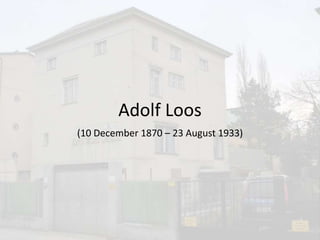
Adolf Loos
(10 December 1870 – 23 August 1933)
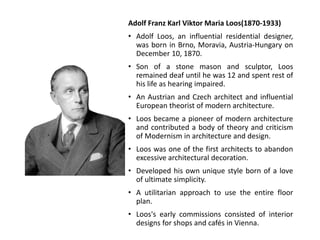
Adolf Franz Karl Viktor Maria Loos(1870-1933)
• Adolf Loos, an influential residential designer,
was born in Brno, Moravia, Austria-Hungary on
December 10, 1870.
• Son of a stone mason and sculptor, Loos
remained deaf until he was 12 and spent rest of
his life as hearing impaired.
• An Austrian and Czech architect and influential
European theorist of modern architecture.
• Loos became a pioneer of modern architecture
and contributed a body of theory and criticism
of Modernism in architecture and design.
• Loos was one of the first architects to abandon
excessive architectural decoration.
• Developed his own unique style born of a love
of ultimate simplicity.
• A utilitarian approach to use the entire floor
plan.
• Loos's early commissions consisted of interior
designs for shops and cafés in Vienna.
Philosophy
• Loos had a very practical attitude toward architecture.
• A great aversion to the application of falsity through the use of appropriated
ornamentation.
• He explored the idea that the progress of culture is associated with the deletion
of ornament from everyday objects.
• Work was a basis in the square and the cube which possibly reflects an influence
of the early twentieth century Cubist movement.
• Loos' stripped-down buildings influenced the minimal massing of modern
architecture.
• Noted for the lack of ornamentation on their exteriors.
• Interiors finished with rich and expensive materials, notably stone, marble and
wood, displaying natural patterns and textures in flat planes.
• The distinction is not between complicated and simple, but between organic
and superfluous decoration.
• Loos was also interested in the decorative arts, collecting sterling silver and high
quality leather goods.
• Major characteristics of Loos’ work are the use of rich materials chosen for their
appropriateness, exceptional craftsmanship- frequent use of marble in the
structure, contrasting colours.
Major Works
• 1899 Café Museum, Vienna
• 1904 Villa Karma, Montreux, Switzerland
• 1907 Field Christian Cross, Radesinska Svratka, Czech Republic
• 1908 American Bar, Vienna
• 1910 Steiner House, Vienna
• 1910 Goldman & Salatsch Building, Vienna
• 1913 Scheu House, Vienna
• 1915 Sugar mill, Hrušovany u Brna, Czech Republic
• 1915-16 Villa Duschnitz, Vienna
• 1917 House for sugar mill owner, Hrušovany u Brna, Czech Republic
• 1922 Rufer House, Vienna
• 1925 Maison Tzara, house and studio, Montmartre, Paris
Major Works
• 1926 Villa Müller, Vienna
• 1928 Villa Müller, Prague, Czech Republic
• 1929 Khuner Villa, Kreuzberg, Austria
• 1932 Villa Winternitz, Na Cihlářce 10, Praha 5, Czech Republic
• 1928–1933 Many residential interiors in Pilsen, Czech Republic
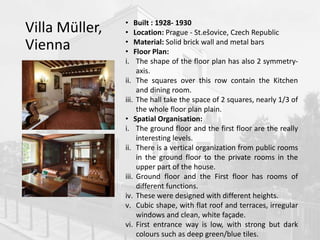
Villa Müller,
Vienna
• Built : 1928- 1930
• Location: Prague - St.ešovice, Czech Republic
• Material: Solid brick wall and metal bars
• Floor Plan:
i. The shape of the floor plan has also 2 symmetry-
axis.
ii. The squares over this row contain the Kitchen
and dining room.
iii. The hall take the space of 2 squares, nearly 1/3 of
the whole floor plan plain.
• Spatial Organisation:
i. The ground floor and the first floor are the really
interesting levels.
ii. There is a vertical organization from public rooms
in the ground floor to the private rooms in the
upper part of the house.
iii. Ground floor and the First floor has rooms of
different functions.
iv. These were designed with different heights.
v. Cubic shape, with flat roof and terraces, irregular
windows and clean, white façade.
vi. First entrance way is low, with strong but dark
colours such as deep green/blue tiles.
Concept
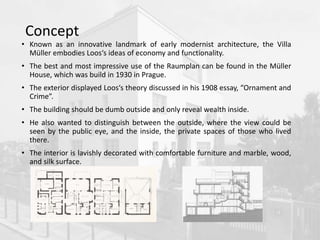
• Known as an innovative landmark of early modernist architecture, the Villa
Müller embodies Loos‘s ideas of economy and functionality.
• The best and most impressive use of the Raumplan can be found in the Müller
House, which was build in 1930 in Prague.
• The exterior displayed Loos‘s theory discussed in his 1908 essay, “Ornament and
Crime”.
• The building should be dumb outside and only reveal wealth inside.
• He also wanted to distinguish between the outside, where the view could be
seen by the public eye, and the inside, the private spaces of those who lived
there.
• The interior is lavishly decorated with comfortable furniture and marble, wood,
and silk surface.
Rufer House, Vienna
• Built : 1922
• Location: Vienna, Austria
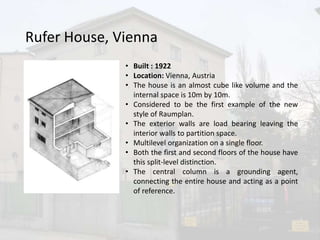
• The house is an almost cube like volume and the
internal space is 10m by 10m.
• Considered to be the first example of the new
style of Raumplan.
• The exterior walls are load bearing leaving the
interior walls to partition space.
• Multilevel organization on a single floor.
• Both the first and second floors of the house have
this split-level distinction.
• The central column is a grounding agent,
connecting the entire house and acting as a point
of reference.
Concept
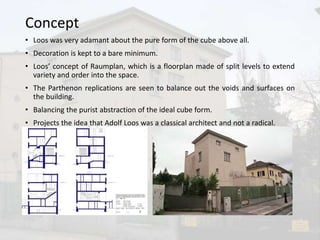
• Loos was very adamant about the pure form of the cube above all.
• Decoration is kept to a bare minimum.
• Loos’ concept of Raumplan, which is a floorplan made of split levels to extend
variety and order into the space.
• The Parthenon replications are seen to balance out the voids and surfaces on
the building.
• Balancing the purist abstraction of the ideal cube form.
• Projects the idea that Adolf Loos was a classical architect and not a radical.
Louis I Kahn
(February 20, 1901 – March 17, 1974)
Louis Isadore Kahn(1901-1974)
• Born in Estonia to a poor family that
immigrated to Philadelphia when he
was five.
• He was an American architect,
educator, and philosopher.
• Studied architecture at the University
of Pennsylvania. A Beaux Arts School.
• Graduated 1924. The Beaux Arts was
fading and modern architecture rising.
• After he graduated, the country
entered the Great Depression. Kahn’s
few buildings were socially based and
undistinguished.
• Kahn struggled with monumentality.
• As a of this struggle, he produced a
profound spiritual philosophy and
between 1957 and 1974, designed a
series of buildings considered some of
the finest in the 20th century.
Philosophy:
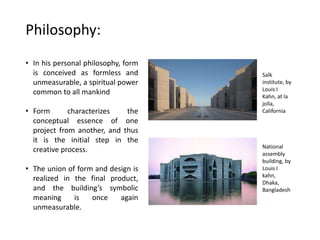
• In his personal philosophy, form
is conceived as formless and
unmeasurable, a spiritual power
common to all mankind
• Form characterizes the
conceptual essence of one
project from another, and thus
it is the initial step in the
creative process.
• The union of form and design is
realized in the final product,
and the building’s symbolic
meaning is once again
unmeasurable.
Salk
institute, by
Louis I
Kahn, at la
jolla,
California
National
assembly
building, by
Louis I
kahn,
Dhaka,
Bangladesh
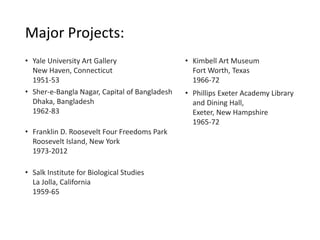
Major Projects:
• Yale University Art Gallery
New Haven, Connecticut
1951-53
• Sher-e-Bangla Nagar, Capital of Bangladesh
Dhaka, Bangladesh
1962-83
• Franklin D. Roosevelt Four Freedoms Park
Roosevelt Island, New York
1973-2012
• Salk Institute for Biological Studies
La Jolla, California
1959-65
• Kimbell Art Museum
Fort Worth, Texas
1966-72
• Phillips Exeter Academy Library
and Dining Hall,
Exeter, New Hampshire
1965-72
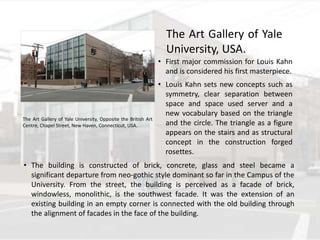
• First major commission for Louis Kahn
and is considered his first masterpiece.
• Louis Kahn sets new concepts such as
symmetry, clear separation between
space and space used server and a
new vocabulary based on the triangle
and the circle. The triangle as a figure
appears on the stairs and as structural
concept in the construction forged
rosettes.
• The building is constructed of brick, concrete, glass and steel became a
significant departure from neo-gothic style dominant so far in the Campus of the
University. From the street, the building is perceived as a facade of brick,
windowless, monolithic, is the southwest facade. It was the extension of an
existing building in an empty corner is connected with the old building through
the alignment of facades in the face of the building.
The Art Gallery of Yale University, Opposite the British Art
Centre, Chapel Street, New Haven, Connecticut, USA.
The Art Gallery of Yale
University, USA.
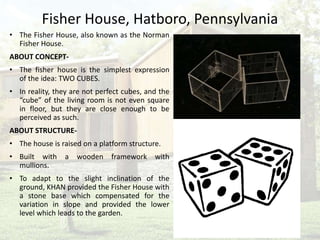
Fisher House, Hatboro, Pennsylvania
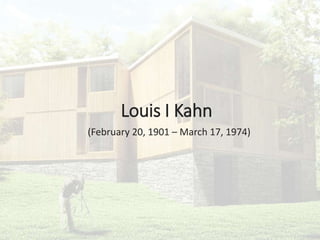
• The Fisher House, also known as the Norman
Fisher House.
ABOUT CONCEPT-
• The fisher house is the simplest expression
of the idea: TWO CUBES.
• In reality, they are not perfect cubes, and the
“cube” of the living room is not even square
in floor, but they are close enough to be
perceived as such.
ABOUT STRUCTURE-
• The house is raised on a platform structure.
• Built with a wooden framework with
mullions.
• To adapt to the slight inclination of the
ground, KHAN provided the Fisher House with
a stone base which compensated for the
variation in slope and provided the lower
level which leads to the garden.
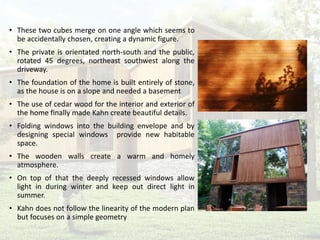
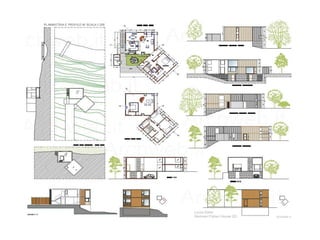
• These two cubes merge on one angle which seems to
be accidentally chosen, creating a dynamic figure.
• The private is orientated north-south and the public,
rotated 45 degrees, northeast southwest along the
driveway.
• The foundation of the home is built entirely of stone,
as the house is on a slope and needed a basement
• The use of cedar wood for the interior and exterior of
the home finally made Kahn create beautiful details.
• Folding windows into the building envelope and by
designing special windows provide new habitable
space.
• The wooden walls create a warm and homely
atmosphere.
• On top of that the deeply recessed windows allow
light in during winter and keep out direct light in
summer.
• Kahn does not follow the linearity of the modern plan
but focuses on a simple geometry
Thank You

20th century architects

  • 1.
  • 2.
    Adolf Loos (10 December1870 – 23 August 1933)
  • 3.
    Adolf Franz KarlViktor Maria Loos(1870-1933) • Adolf Loos, an influential residential designer, was born in Brno, Moravia, Austria-Hungary on December 10, 1870. • Son of a stone mason and sculptor, Loos remained deaf until he was 12 and spent rest of his life as hearing impaired. • An Austrian and Czech architect and influential European theorist of modern architecture. • Loos became a pioneer of modern architecture and contributed a body of theory and criticism of Modernism in architecture and design. • Loos was one of the first architects to abandon excessive architectural decoration. • Developed his own unique style born of a love of ultimate simplicity. • A utilitarian approach to use the entire floor plan. • Loos's early commissions consisted of interior designs for shops and cafés in Vienna.
  • 4.
    Philosophy • Loos hada very practical attitude toward architecture. • A great aversion to the application of falsity through the use of appropriated ornamentation. • He explored the idea that the progress of culture is associated with the deletion of ornament from everyday objects. • Work was a basis in the square and the cube which possibly reflects an influence of the early twentieth century Cubist movement. • Loos' stripped-down buildings influenced the minimal massing of modern architecture. • Noted for the lack of ornamentation on their exteriors. • Interiors finished with rich and expensive materials, notably stone, marble and wood, displaying natural patterns and textures in flat planes. • The distinction is not between complicated and simple, but between organic and superfluous decoration. • Loos was also interested in the decorative arts, collecting sterling silver and high quality leather goods. • Major characteristics of Loos’ work are the use of rich materials chosen for their appropriateness, exceptional craftsmanship- frequent use of marble in the structure, contrasting colours.
  • 5.
    Major Works • 1899Café Museum, Vienna • 1904 Villa Karma, Montreux, Switzerland • 1907 Field Christian Cross, Radesinska Svratka, Czech Republic • 1908 American Bar, Vienna • 1910 Steiner House, Vienna • 1910 Goldman & Salatsch Building, Vienna • 1913 Scheu House, Vienna • 1915 Sugar mill, Hrušovany u Brna, Czech Republic • 1915-16 Villa Duschnitz, Vienna • 1917 House for sugar mill owner, Hrušovany u Brna, Czech Republic • 1922 Rufer House, Vienna • 1925 Maison Tzara, house and studio, Montmartre, Paris
  • 6.
    Major Works • 1926Villa Müller, Vienna • 1928 Villa Müller, Prague, Czech Republic • 1929 Khuner Villa, Kreuzberg, Austria • 1932 Villa Winternitz, Na Cihlářce 10, Praha 5, Czech Republic • 1928–1933 Many residential interiors in Pilsen, Czech Republic
  • 7.
    Villa Müller, Vienna • Built: 1928- 1930 • Location: Prague - St.ešovice, Czech Republic • Material: Solid brick wall and metal bars • Floor Plan: i. The shape of the floor plan has also 2 symmetry- axis. ii. The squares over this row contain the Kitchen and dining room. iii. The hall take the space of 2 squares, nearly 1/3 of the whole floor plan plain. • Spatial Organisation: i. The ground floor and the first floor are the really interesting levels. ii. There is a vertical organization from public rooms in the ground floor to the private rooms in the upper part of the house. iii. Ground floor and the First floor has rooms of different functions. iv. These were designed with different heights. v. Cubic shape, with flat roof and terraces, irregular windows and clean, white façade. vi. First entrance way is low, with strong but dark colours such as deep green/blue tiles.
  • 8.
    Concept • Known asan innovative landmark of early modernist architecture, the Villa Müller embodies Loos‘s ideas of economy and functionality. • The best and most impressive use of the Raumplan can be found in the Müller House, which was build in 1930 in Prague. • The exterior displayed Loos‘s theory discussed in his 1908 essay, “Ornament and Crime”. • The building should be dumb outside and only reveal wealth inside. • He also wanted to distinguish between the outside, where the view could be seen by the public eye, and the inside, the private spaces of those who lived there. • The interior is lavishly decorated with comfortable furniture and marble, wood, and silk surface.
  • 9.
    Rufer House, Vienna •Built : 1922 • Location: Vienna, Austria • The house is an almost cube like volume and the internal space is 10m by 10m. • Considered to be the first example of the new style of Raumplan. • The exterior walls are load bearing leaving the interior walls to partition space. • Multilevel organization on a single floor. • Both the first and second floors of the house have this split-level distinction. • The central column is a grounding agent, connecting the entire house and acting as a point of reference.
  • 10.
    Concept • Loos wasvery adamant about the pure form of the cube above all. • Decoration is kept to a bare minimum. • Loos’ concept of Raumplan, which is a floorplan made of split levels to extend variety and order into the space. • The Parthenon replications are seen to balance out the voids and surfaces on the building. • Balancing the purist abstraction of the ideal cube form. • Projects the idea that Adolf Loos was a classical architect and not a radical.
  • 11.
    Louis I Kahn (February20, 1901 – March 17, 1974)
  • 12.
    Louis Isadore Kahn(1901-1974) •Born in Estonia to a poor family that immigrated to Philadelphia when he was five. • He was an American architect, educator, and philosopher. • Studied architecture at the University of Pennsylvania. A Beaux Arts School. • Graduated 1924. The Beaux Arts was fading and modern architecture rising. • After he graduated, the country entered the Great Depression. Kahn’s few buildings were socially based and undistinguished. • Kahn struggled with monumentality. • As a of this struggle, he produced a profound spiritual philosophy and between 1957 and 1974, designed a series of buildings considered some of the finest in the 20th century.
  • 13.
    Philosophy: • In hispersonal philosophy, form is conceived as formless and unmeasurable, a spiritual power common to all mankind • Form characterizes the conceptual essence of one project from another, and thus it is the initial step in the creative process. • The union of form and design is realized in the final product, and the building’s symbolic meaning is once again unmeasurable. Salk institute, by Louis I Kahn, at la jolla, California National assembly building, by Louis I kahn, Dhaka, Bangladesh
  • 14.
    Major Projects: • YaleUniversity Art Gallery New Haven, Connecticut 1951-53 • Sher-e-Bangla Nagar, Capital of Bangladesh Dhaka, Bangladesh 1962-83 • Franklin D. Roosevelt Four Freedoms Park Roosevelt Island, New York 1973-2012 • Salk Institute for Biological Studies La Jolla, California 1959-65 • Kimbell Art Museum Fort Worth, Texas 1966-72 • Phillips Exeter Academy Library and Dining Hall, Exeter, New Hampshire 1965-72
  • 15.
    • First majorcommission for Louis Kahn and is considered his first masterpiece. • Louis Kahn sets new concepts such as symmetry, clear separation between space and space used server and a new vocabulary based on the triangle and the circle. The triangle as a figure appears on the stairs and as structural concept in the construction forged rosettes. • The building is constructed of brick, concrete, glass and steel became a significant departure from neo-gothic style dominant so far in the Campus of the University. From the street, the building is perceived as a facade of brick, windowless, monolithic, is the southwest facade. It was the extension of an existing building in an empty corner is connected with the old building through the alignment of facades in the face of the building. The Art Gallery of Yale University, Opposite the British Art Centre, Chapel Street, New Haven, Connecticut, USA. The Art Gallery of Yale University, USA.
  • 16.
    Fisher House, Hatboro,Pennsylvania • The Fisher House, also known as the Norman Fisher House. ABOUT CONCEPT- • The fisher house is the simplest expression of the idea: TWO CUBES. • In reality, they are not perfect cubes, and the “cube” of the living room is not even square in floor, but they are close enough to be perceived as such. ABOUT STRUCTURE- • The house is raised on a platform structure. • Built with a wooden framework with mullions. • To adapt to the slight inclination of the ground, KHAN provided the Fisher House with a stone base which compensated for the variation in slope and provided the lower level which leads to the garden.
  • 17.
    • These twocubes merge on one angle which seems to be accidentally chosen, creating a dynamic figure. • The private is orientated north-south and the public, rotated 45 degrees, northeast southwest along the driveway. • The foundation of the home is built entirely of stone, as the house is on a slope and needed a basement • The use of cedar wood for the interior and exterior of the home finally made Kahn create beautiful details. • Folding windows into the building envelope and by designing special windows provide new habitable space. • The wooden walls create a warm and homely atmosphere. • On top of that the deeply recessed windows allow light in during winter and keep out direct light in summer. • Kahn does not follow the linearity of the modern plan but focuses on a simple geometry
  • 19.