Ar. Richard Rogers
Rogers Stirk Harbour + Partners: RSHP
About
• Born 23 july 1933 in Florence,Italy.
• Attended the Architectural Association School of Architecture in
London, before graduating fromYale School of Architecture in 1962.
• After working with Piano and Foster, Rogers established the Richard
Rogers Partnership in 1976.This became Rogers Stirk Harbour +
Partners in 2007.The firm maintains offices in London, Barcelona,
Madrid, andTokyo.
Honours
• RIBA Gold Medal (1985)
• Thomas Jefferson Medal (1999)
• Stirling Prize (2006), (2009)
• Minerva Medal (2007)
• Pritzker Prize (2007)
Works
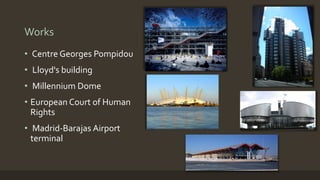
• Centre Georges Pompidou
• Lloyd's building
• Millennium Dome
• European Court of Human
Rights
• Madrid-Barajas Airport
terminal
Design Philosophy
• He had a very environmental
conception of designs.
• The notion of social
integration is one of the other
most important points of the
Richard Rogers’ architectural
concept.
• According to him social
problems can find solutions in
the construction of “compact
cities with multiple centers”.
• Richard Rogers’ architectural
philosophy’s topics are legible,
transparent, lightweight,
systems, urban, public and
green.
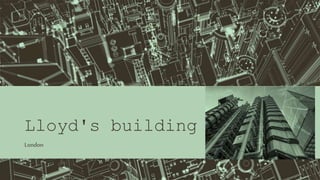
Lloyd's building
London
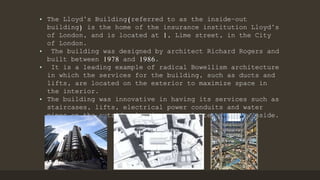
• The Lloyd’s Building(referred to as the inside–out
building) is the home of the insurance institution Lloyd’s
of London, and is located at 1, Lime street, in the City
of London.
• The building was designed by architect Richard Rogers and
built between 1978 and 1986.
• It is a leading example of radical Bowellism architecture
in which the services for the building, such as ducts and
lifts, are located on the exterior to maximize space in
the interior.
• The building was innovative in having its services such as
staircases, lifts, electrical power conduits and water
pipes on the outside, leaving an uncluttered space inside.
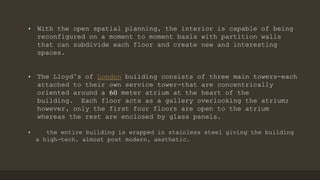
• With the open spatial planning, the interior is capable of being
reconfigured on a moment to moment basis with partition walls
that can subdivide each floor and create new and interesting
spaces.
• The Lloyd’s of London building consists of three main towers-each
attached to their own service tower-that are concentrically
oriented around a 60 meter atrium at the heart of the
building. Each floor acts as a gallery overlooking the atrium;
however, only the first four floors are open to the atrium
whereas the rest are enclosed by glass panels.
• the entire building is wrapped in stainless steel giving the building
a high-tech, almost post modern, aesthetic.
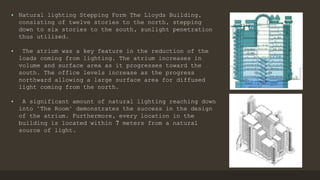
• Natural lighting Stepping Form The Lloyds Building,
consisting of twelve stories to the north, stepping
down to six stories to the south, sunlight penetration
thus utilized.
• The atrium was a key feature in the reduction of the
loads coming from lighting. The atrium increases in
volume and surface area as it progresses toward the
south. The office levels increase as the progress
northward allowing a large surface area for diffused
light coming from the north.
• A significant amount of natural lighting reaching down
into "The Room" demonstrates the success in the design
of the atrium. Furthermore, every location in the
building is located within 7 meters from a natural
source of light.
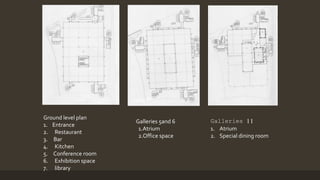
Ground level plan
1. Entrance
2. Restaurant
3. Bar
4. Kitchen
5. Conference room
6. Exhibition space
7. library
Galleries 5and 6
1.Atrium
2.Office space
Galleries 11
1. Atrium
2. Special dining room
Millennium Dome
Greenwich Peninsula,, London
This spectacular multi-purpose space, architecture and engineering example of modern
social at the service was opened in January 1, 2000, coinciding with the start of the
new millennium, hosting an exhibition which closed on December 31 of that year.
Millennium Dome is a large building with a single roof located on the banks of the
River Thames, on a former industrial land on the Greenwich Peninsula, southeast of
London, England.
The Millennium Dome is one of the largest single roof structures performed worldwide.
His image resembles a large white tent subject to 12 yellow towers 100 feet high.
Each of these towers represents the hours of a clock and every month of the year. Its
original design was intended to accommodate major exhibitions, but to the failure to
call for public level was reused for music concerts and events, both artistic and
sports.
Structure
• The structure was designed by the Buro Happold, and the
entire roof structure weighs less than the air contained
within the building.
• In its construction were used for the base concrete, steel
towers painted yellow, cloth glass fiber matrix of PTFE (
Teflon ) for cover and rubber feet anchor it to the
ground.
• It took cable 70km high strength steel to attach the
fabric to the towers.
Thank you

Ar. Richard Rogers

  • 1.
    Ar. Richard Rogers RogersStirk Harbour + Partners: RSHP
  • 2.
    About • Born 23july 1933 in Florence,Italy. • Attended the Architectural Association School of Architecture in London, before graduating fromYale School of Architecture in 1962. • After working with Piano and Foster, Rogers established the Richard Rogers Partnership in 1976.This became Rogers Stirk Harbour + Partners in 2007.The firm maintains offices in London, Barcelona, Madrid, andTokyo.
  • 3.
    Honours • RIBA GoldMedal (1985) • Thomas Jefferson Medal (1999) • Stirling Prize (2006), (2009) • Minerva Medal (2007) • Pritzker Prize (2007)
  • 4.
    Works • Centre GeorgesPompidou • Lloyd's building • Millennium Dome • European Court of Human Rights • Madrid-Barajas Airport terminal
  • 5.
    Design Philosophy • Hehad a very environmental conception of designs. • The notion of social integration is one of the other most important points of the Richard Rogers’ architectural concept. • According to him social problems can find solutions in the construction of “compact cities with multiple centers”. • Richard Rogers’ architectural philosophy’s topics are legible, transparent, lightweight, systems, urban, public and green.
  • 6.
  • 7.
    • The Lloyd’sBuilding(referred to as the inside–out building) is the home of the insurance institution Lloyd’s of London, and is located at 1, Lime street, in the City of London. • The building was designed by architect Richard Rogers and built between 1978 and 1986. • It is a leading example of radical Bowellism architecture in which the services for the building, such as ducts and lifts, are located on the exterior to maximize space in the interior. • The building was innovative in having its services such as staircases, lifts, electrical power conduits and water pipes on the outside, leaving an uncluttered space inside.
  • 8.
    • With theopen spatial planning, the interior is capable of being reconfigured on a moment to moment basis with partition walls that can subdivide each floor and create new and interesting spaces. • The Lloyd’s of London building consists of three main towers-each attached to their own service tower-that are concentrically oriented around a 60 meter atrium at the heart of the building. Each floor acts as a gallery overlooking the atrium; however, only the first four floors are open to the atrium whereas the rest are enclosed by glass panels. • the entire building is wrapped in stainless steel giving the building a high-tech, almost post modern, aesthetic.
  • 9.
    • Natural lightingStepping Form The Lloyds Building, consisting of twelve stories to the north, stepping down to six stories to the south, sunlight penetration thus utilized. • The atrium was a key feature in the reduction of the loads coming from lighting. The atrium increases in volume and surface area as it progresses toward the south. The office levels increase as the progress northward allowing a large surface area for diffused light coming from the north. • A significant amount of natural lighting reaching down into "The Room" demonstrates the success in the design of the atrium. Furthermore, every location in the building is located within 7 meters from a natural source of light.
  • 10.
    Ground level plan 1.Entrance 2. Restaurant 3. Bar 4. Kitchen 5. Conference room 6. Exhibition space 7. library Galleries 5and 6 1.Atrium 2.Office space Galleries 11 1. Atrium 2. Special dining room
  • 11.
  • 12.
    This spectacular multi-purposespace, architecture and engineering example of modern social at the service was opened in January 1, 2000, coinciding with the start of the new millennium, hosting an exhibition which closed on December 31 of that year. Millennium Dome is a large building with a single roof located on the banks of the River Thames, on a former industrial land on the Greenwich Peninsula, southeast of London, England. The Millennium Dome is one of the largest single roof structures performed worldwide. His image resembles a large white tent subject to 12 yellow towers 100 feet high. Each of these towers represents the hours of a clock and every month of the year. Its original design was intended to accommodate major exhibitions, but to the failure to call for public level was reused for music concerts and events, both artistic and sports.
  • 13.
    Structure • The structurewas designed by the Buro Happold, and the entire roof structure weighs less than the air contained within the building. • In its construction were used for the base concrete, steel towers painted yellow, cloth glass fiber matrix of PTFE ( Teflon ) for cover and rubber feet anchor it to the ground. • It took cable 70km high strength steel to attach the fabric to the towers.
  • 14.