CE8394
FLUID MECHANICS AND MACHINERY
Prepared by
AMOS GAMALEAL DAVID
Assistant Professor
Department of Mechanical Engineering
Panimalar Institute of Technology, Chennai - 600123
UNIT I – FLUID PROPERTIES AND FLOW
CHARACTERISTICS
 Units and dimensions
 Properties of fluids
 Mass density
 Specific weight
 Specific volume
 Specific gravity
 Viscosity
 Compressibility
 Vapor pressure
 Surface tension and
 Capillarity.
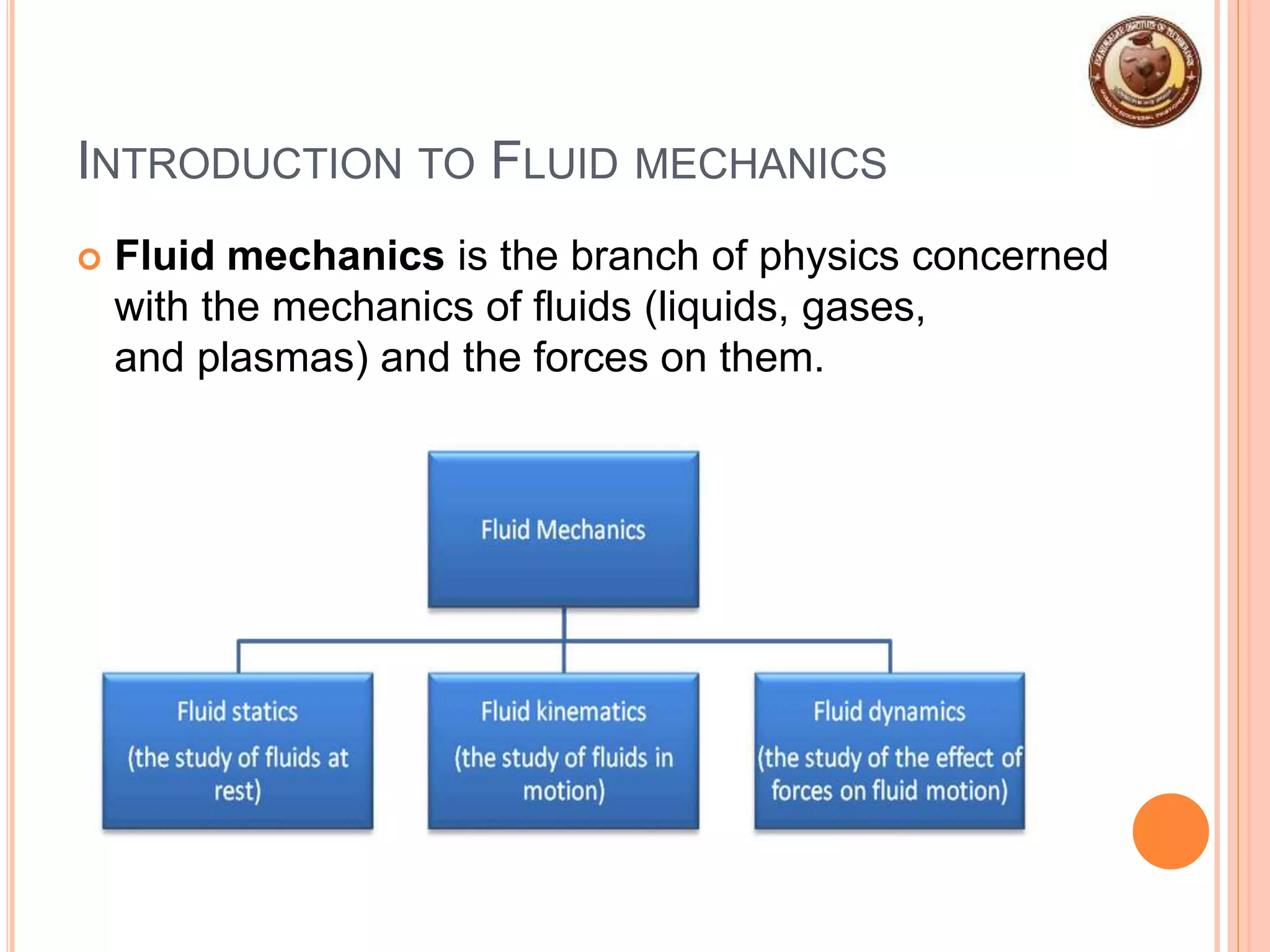
INTRODUCTION TO FLUID MECHANICS
 Fluid mechanics is the branch of physics concerned
with the mechanics of fluids (liquids, gases,
and plasmas) and the forces on them.
CHARACTERISTICS OF FLUIDS
 Gas or liquid state
 “Large” molecular spacing relative to a solid
 “Weak” intermolecular cohesive forces
 Can not resist a shear stress in a stationary state
 Will take the shape of its container
 Generally considered a continuum
 Viscosity distinguishes different types of fluids
UNITS AND DIMENSIONS
 System of units
 System International (SI)
 Fundamental dimensions: Length, Mass and Time
 Units (meter, kilogram and second)
 Bristish Gravitation System (BG)
 Fundamental dimensions: length, force and time
 Units: (ft, slug, second)
 CGS System
 Fundamental dimensions: length, mass and time
 Units: (centimeter, gram and second)
PROPERTIES OF FLUIDS – MASS DENSITY
Density or Mass Density
 Density or mass density of a fluid is defined as the
ratio of the mass of a fluid to its volume.
 Mass per unit volume of a fluid is density.
 Symbol =
 Unit = kg/m3
SPECIFIC WEIGHT
Specific Weight or Weight Density:
 It is the ratio between the weight of the fluid to its
volume.
 Weight per unit volume of a fluid is called weight
density
 Symbol = w
 Unit = N/m3
SPECIFIC VOLUME
 It is defined as the volume of a fluid occupied by a
unit mass or volume per unit mass of a fluid is
called specific volume.
 Specific Volume = =
=
 Unit = m3/kg
SPECIFIC GRAVITY
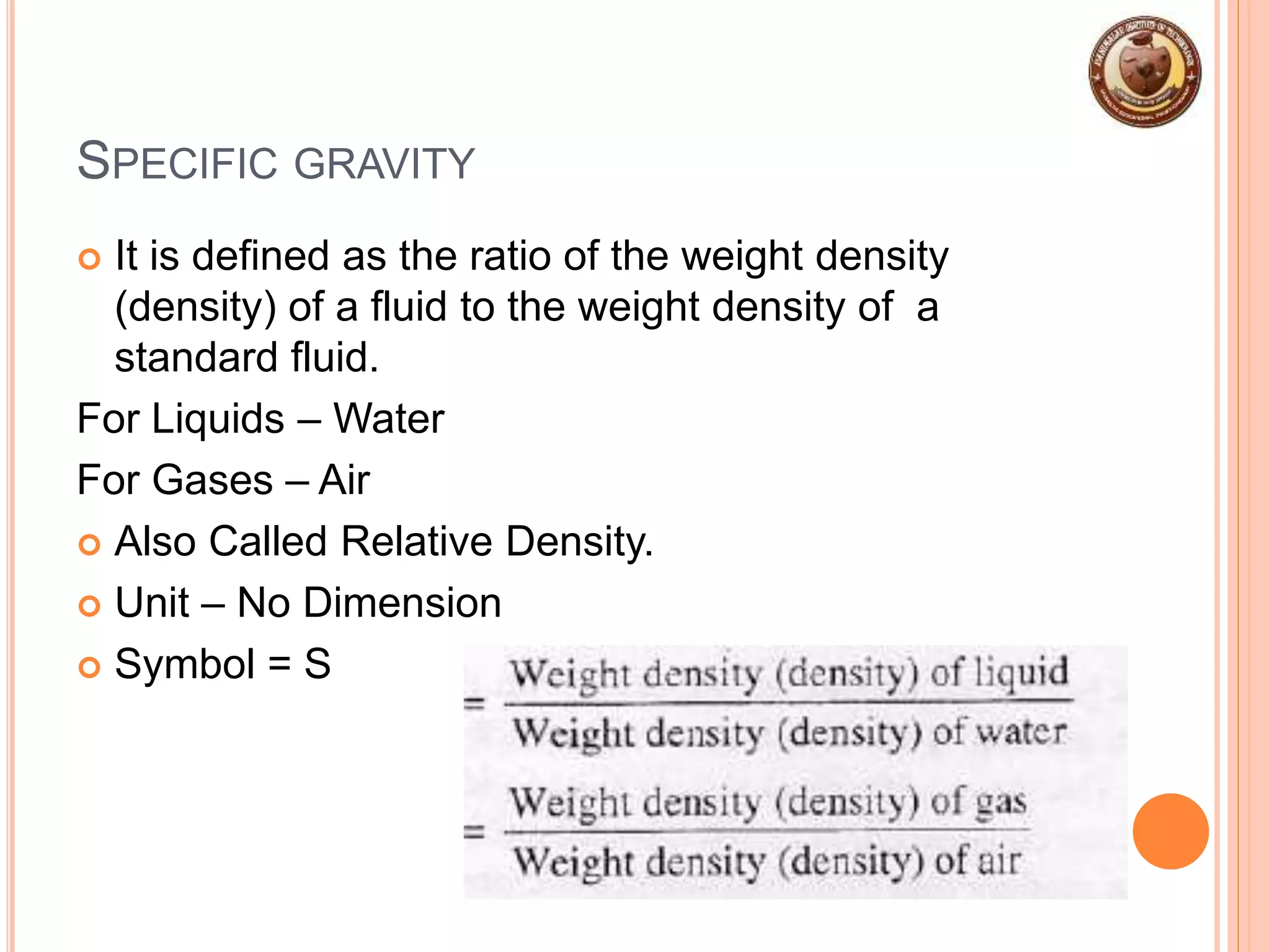
 It is defined as the ratio of the weight density
(density) of a fluid to the weight density of a
standard fluid.
For Liquids – Water
For Gases – Air
 Also Called Relative Density.
 Unit – No Dimension
 Symbol = S
VISCOSITY
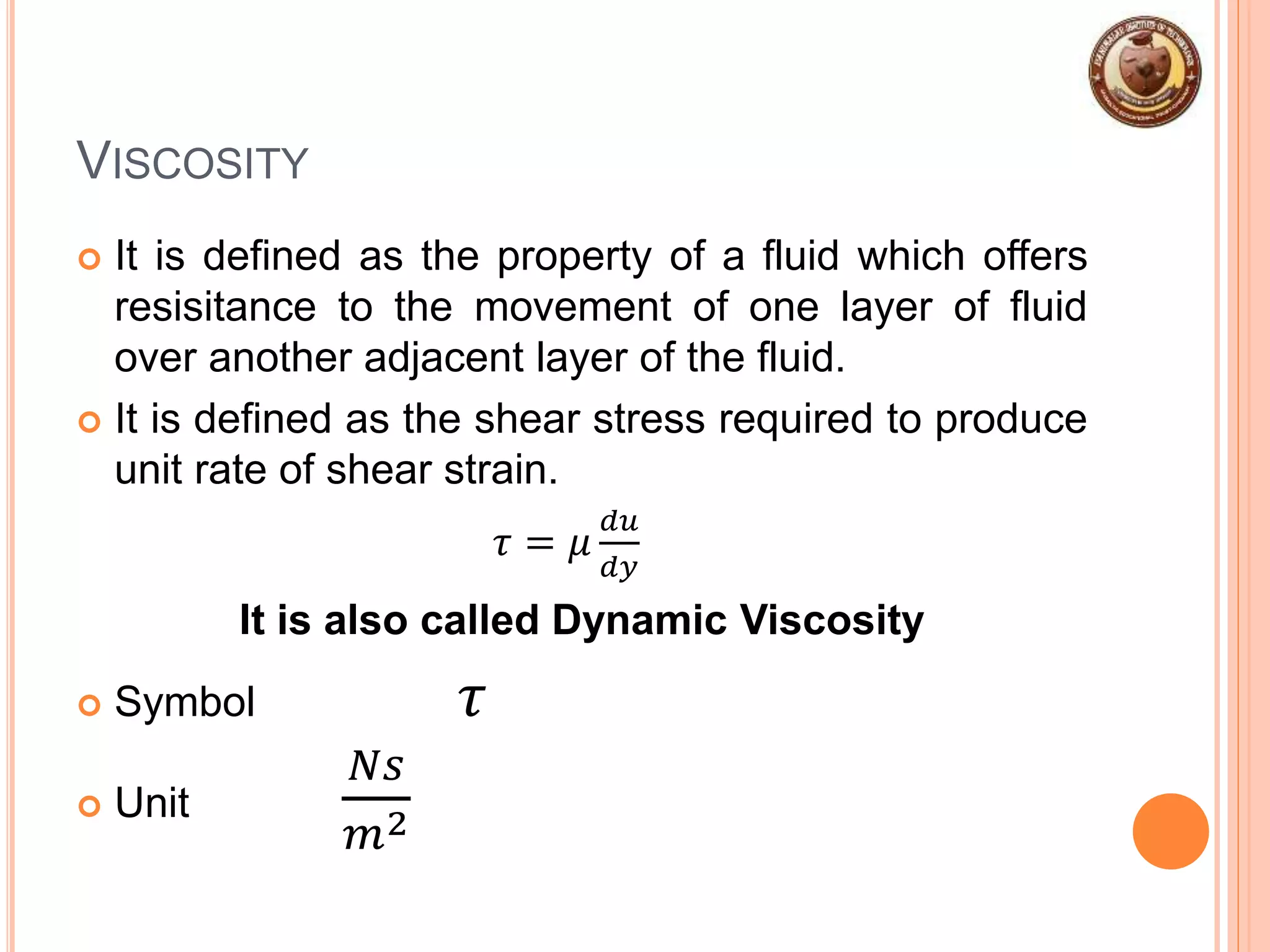
 It is defined as the property of a fluid which offers
resisitance to the movement of one layer of fluid
over another adjacent layer of the fluid.
 It is defined as the shear stress required to produce
unit rate of shear strain.
𝜏 = 𝜇
𝑑𝑢
𝑑𝑦
It is also called Dynamic Viscosity
 Symbol 𝜏
 Unit
𝑁𝑠
𝑚2
VISCOSITY
Kinematic Viscosity
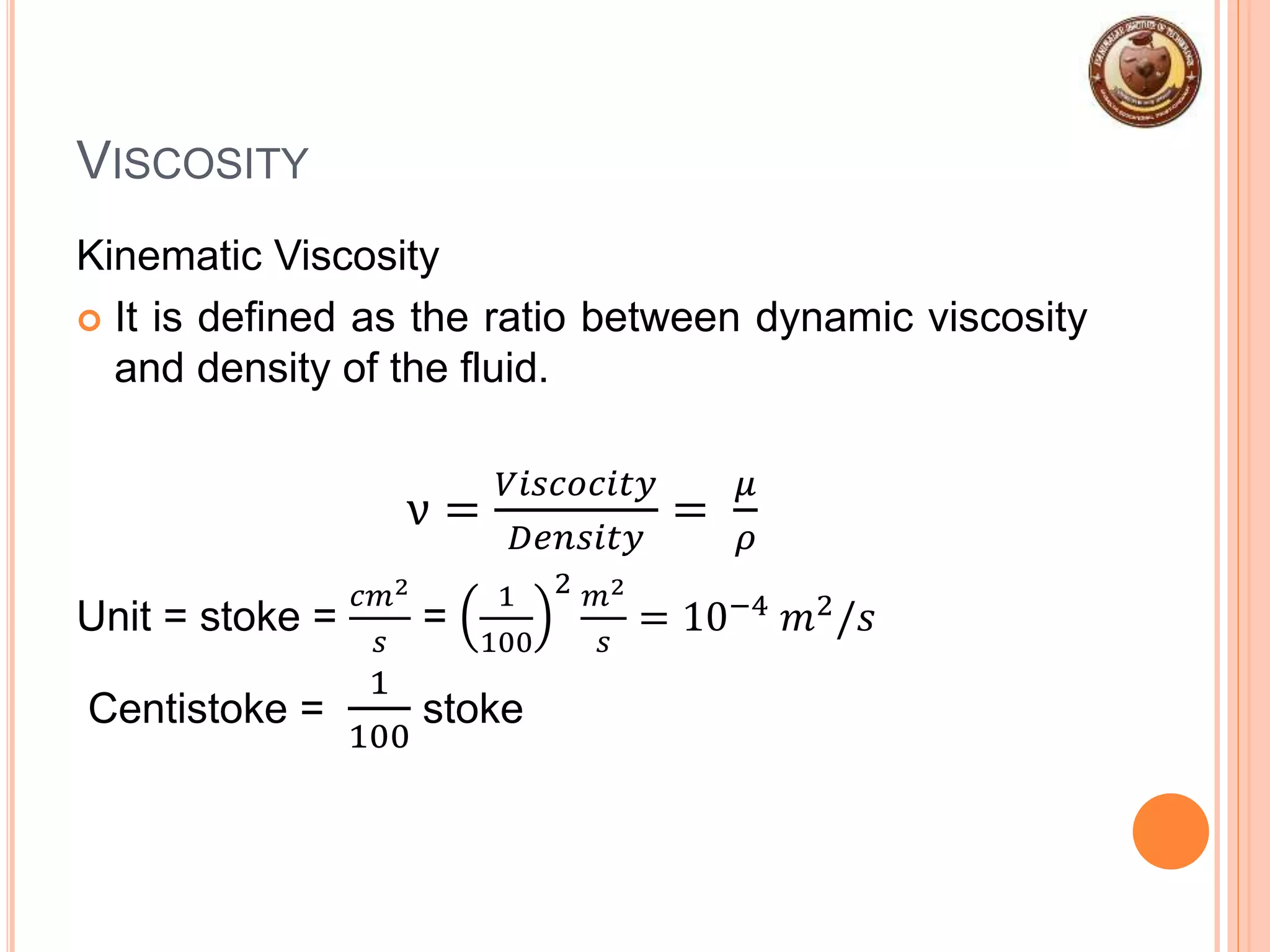
 It is defined as the ratio between dynamic viscosity
and density of the fluid.
ν =
𝑉𝑖𝑠𝑐𝑜𝑐𝑖𝑡𝑦
𝐷𝑒𝑛𝑠𝑖𝑡𝑦
=
𝜇
𝜌
Unit = stoke =
𝑐𝑚2
𝑠
=
1
100
2 𝑚2
𝑠
= 10−4 𝑚2/𝑠
Centistoke =
1
100
stoke
NEWTON`S LAW OF VISCOSITY
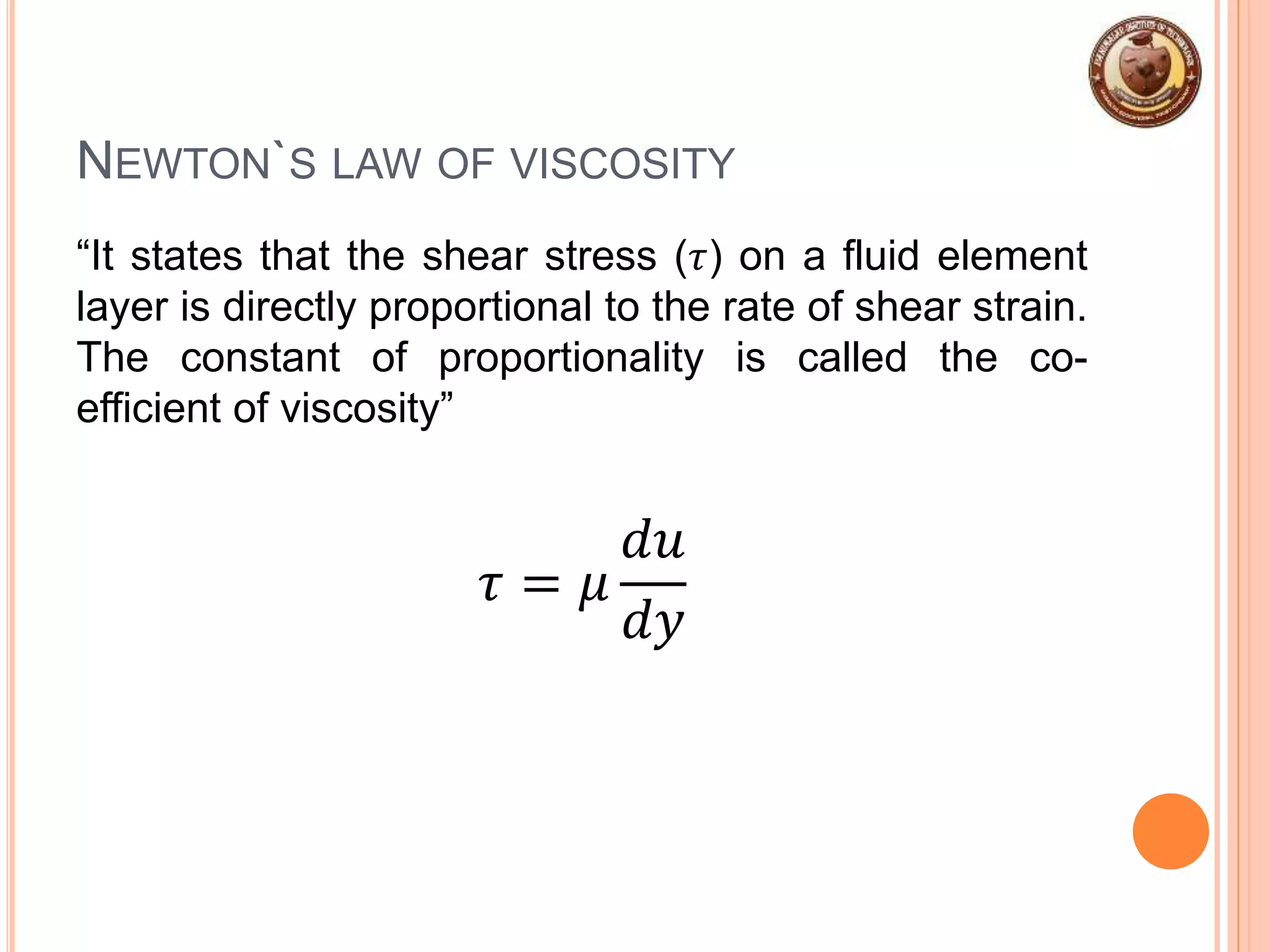
“It states that the shear stress (𝜏) on a fluid element
layer is directly proportional to the rate of shear strain.
The constant of proportionality is called the co-
efficient of viscosity”
𝜏 = 𝜇
𝑑𝑢
𝑑𝑦
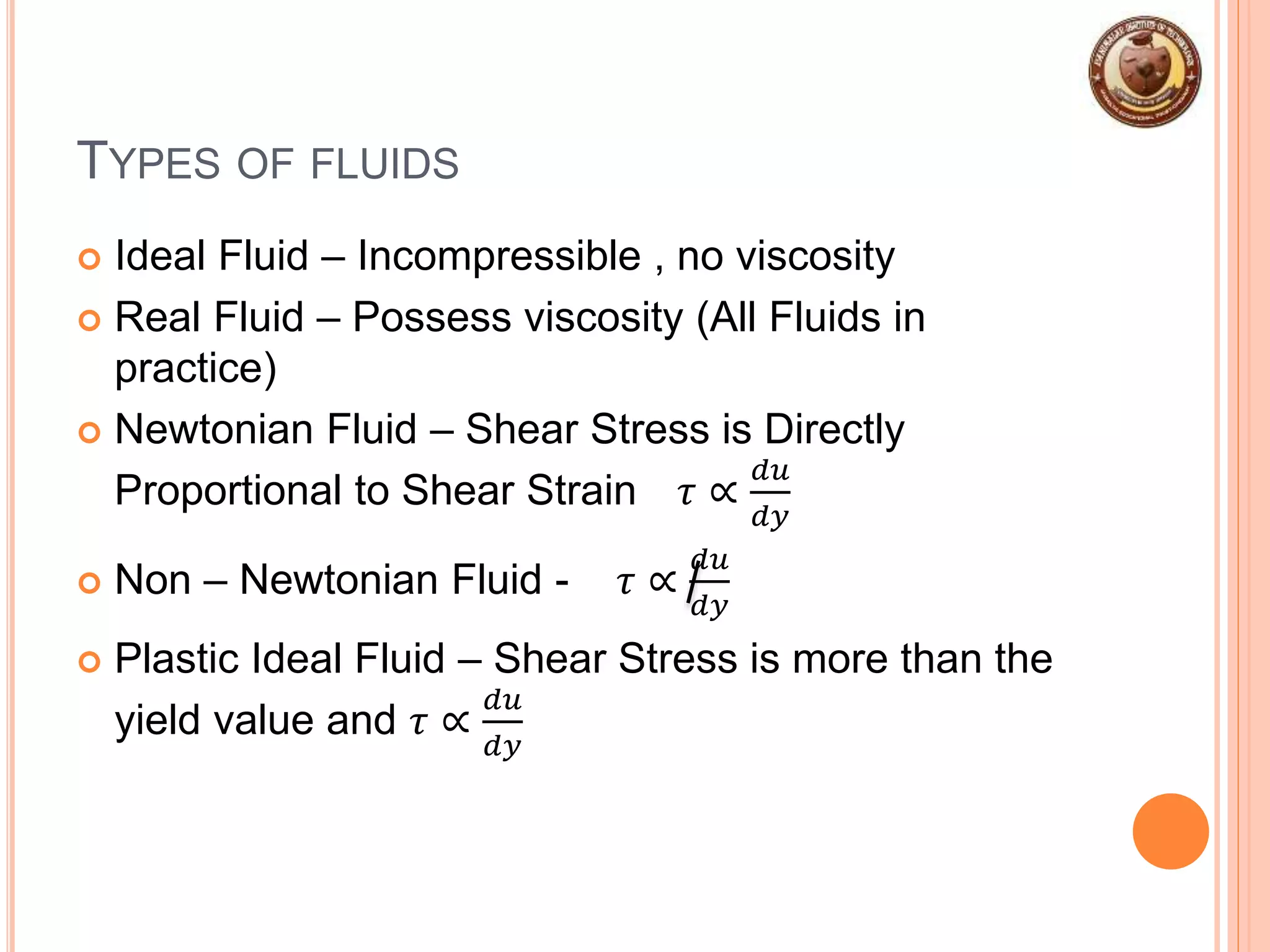
TYPES OF FLUIDS
 Ideal Fluid – Incompressible , no viscosity
 Real Fluid – Possess viscosity (All Fluids in
practice)
 Newtonian Fluid – Shear Stress is Directly
Proportional to Shear Strain 𝜏 ∝
𝑑𝑢
𝑑𝑦
 Non – Newtonian Fluid - 𝜏 ∝
𝑑𝑢
𝑑𝑦
 Plastic Ideal Fluid – Shear Stress is more than the
yield value and 𝜏 ∝
𝑑𝑢
𝑑𝑦
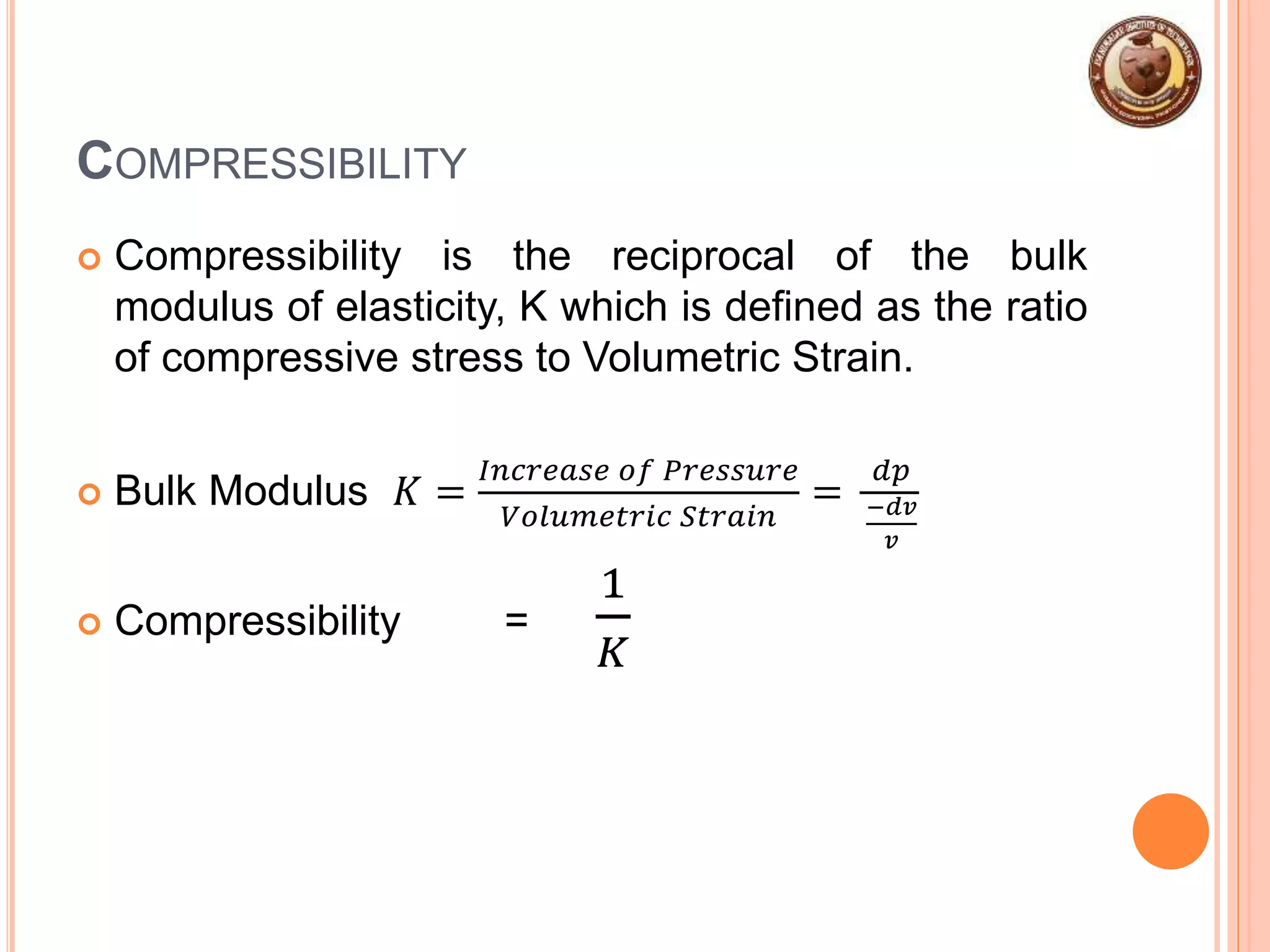
COMPRESSIBILITY
 Compressibility is the reciprocal of the bulk
modulus of elasticity, K which is defined as the ratio
of compressive stress to Volumetric Strain.
 Bulk Modulus 𝐾 =
𝐼𝑛𝑐𝑟𝑒𝑎𝑠𝑒 𝑜𝑓 𝑃𝑟𝑒𝑠𝑠𝑢𝑟𝑒
𝑉𝑜𝑙𝑢𝑚𝑒𝑡𝑟𝑖𝑐 𝑆𝑡𝑟𝑎𝑖𝑛
=
𝑑𝑝
−𝑑𝑣
𝑣
 Compressibility =
1
𝐾
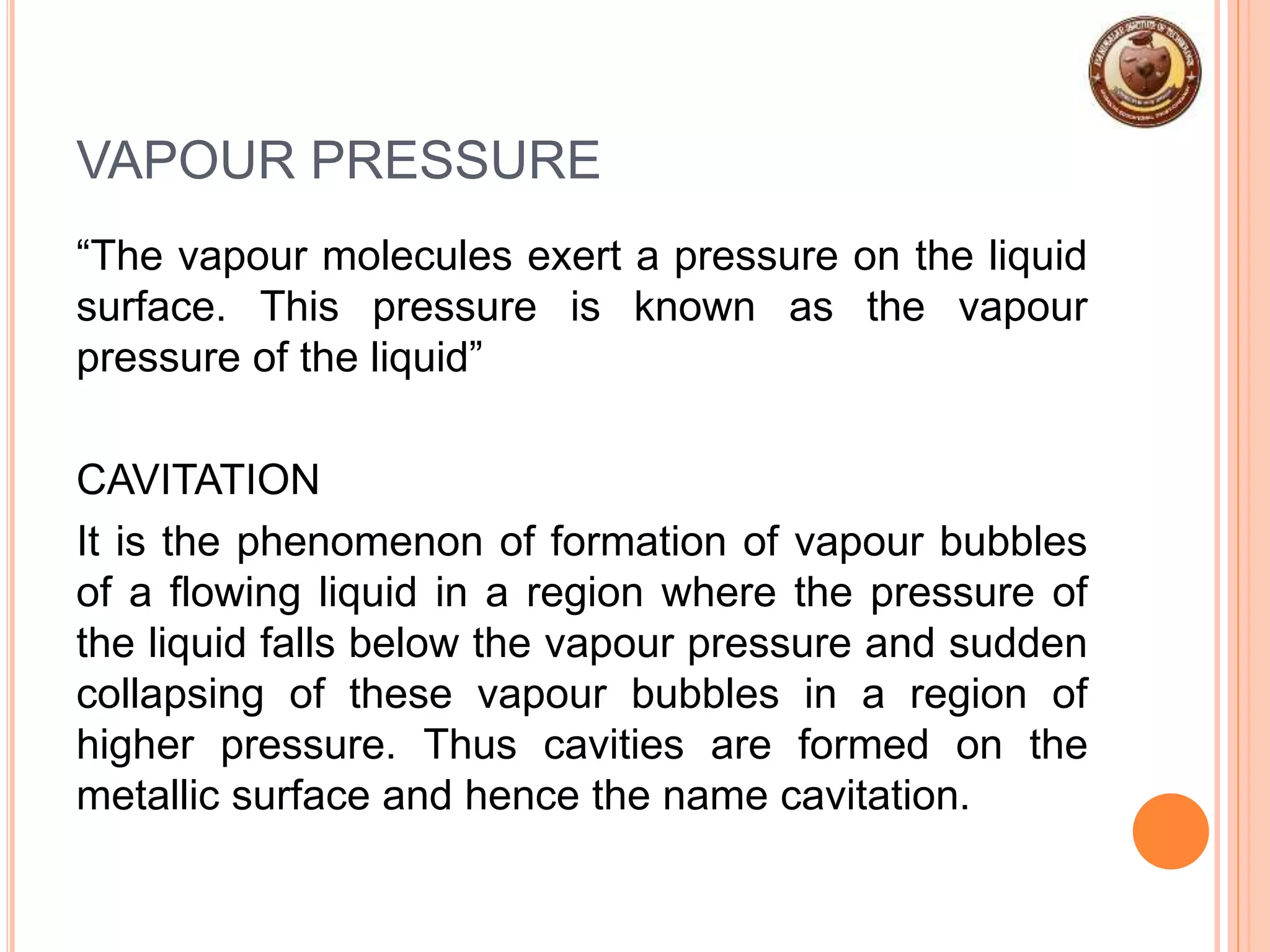
VAPOUR PRESSURE
“The vapour molecules exert a pressure on the liquid
surface. This pressure is known as the vapour
pressure of the liquid”
CAVITATION
It is the phenomenon of formation of vapour bubbles
of a flowing liquid in a region where the pressure of
the liquid falls below the vapour pressure and sudden
collapsing of these vapour bubbles in a region of
higher pressure. Thus cavities are formed on the
metallic surface and hence the name cavitation.
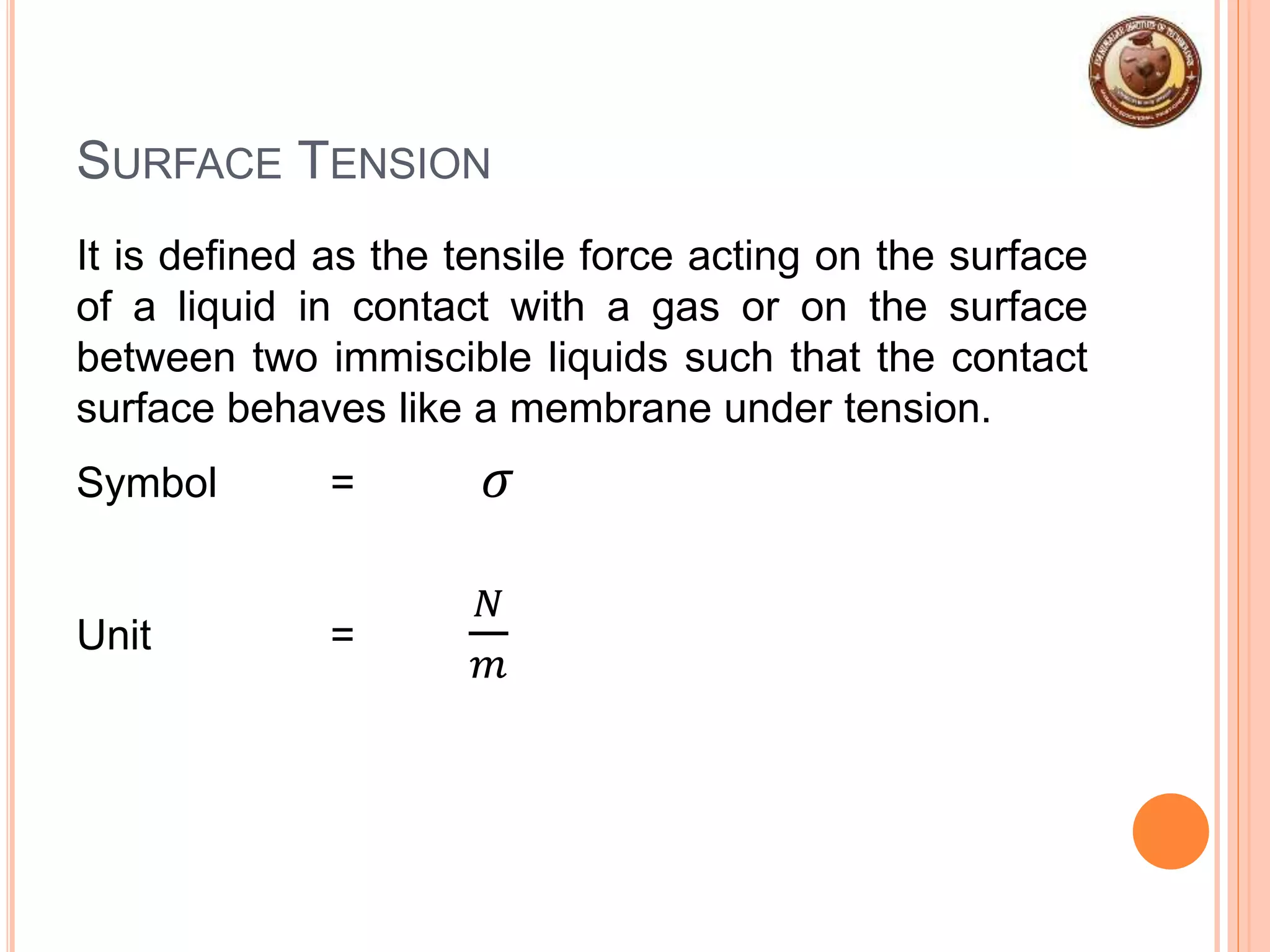
SURFACE TENSION
It is defined as the tensile force acting on the surface
of a liquid in contact with a gas or on the surface
between two immiscible liquids such that the contact
surface behaves like a membrane under tension.
Symbol = 𝜎
Unit =
𝑁
𝑚
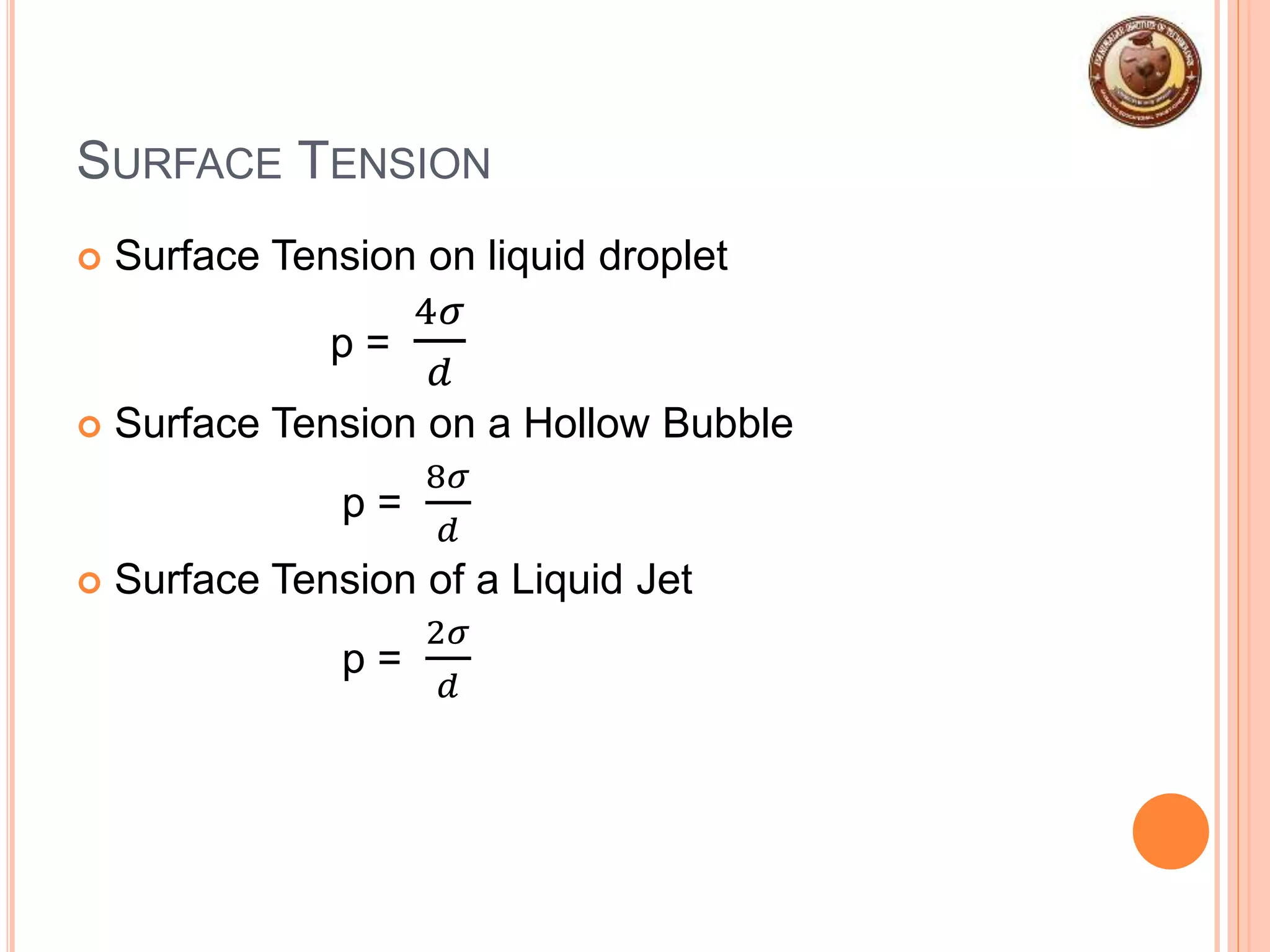
SURFACE TENSION
 Surface Tension on liquid droplet
p =
4𝜎
𝑑
 Surface Tension on a Hollow Bubble
p =
8𝜎
𝑑
 Surface Tension of a Liquid Jet
p =
2𝜎
𝑑

Fluid Mechanics and Machinery Unit I

  • 1.
    CE8394 FLUID MECHANICS ANDMACHINERY Prepared by AMOS GAMALEAL DAVID Assistant Professor Department of Mechanical Engineering Panimalar Institute of Technology, Chennai - 600123
  • 2.
    UNIT I –FLUID PROPERTIES AND FLOW CHARACTERISTICS  Units and dimensions  Properties of fluids  Mass density  Specific weight  Specific volume  Specific gravity  Viscosity  Compressibility  Vapor pressure  Surface tension and  Capillarity.
  • 3.
    INTRODUCTION TO FLUIDMECHANICS  Fluid mechanics is the branch of physics concerned with the mechanics of fluids (liquids, gases, and plasmas) and the forces on them.
  • 4.
    CHARACTERISTICS OF FLUIDS Gas or liquid state  “Large” molecular spacing relative to a solid  “Weak” intermolecular cohesive forces  Can not resist a shear stress in a stationary state  Will take the shape of its container  Generally considered a continuum  Viscosity distinguishes different types of fluids
  • 5.
    UNITS AND DIMENSIONS System of units  System International (SI)  Fundamental dimensions: Length, Mass and Time  Units (meter, kilogram and second)  Bristish Gravitation System (BG)  Fundamental dimensions: length, force and time  Units: (ft, slug, second)  CGS System  Fundamental dimensions: length, mass and time  Units: (centimeter, gram and second)
  • 6.
    PROPERTIES OF FLUIDS– MASS DENSITY Density or Mass Density  Density or mass density of a fluid is defined as the ratio of the mass of a fluid to its volume.  Mass per unit volume of a fluid is density.  Symbol =  Unit = kg/m3
  • 7.
    SPECIFIC WEIGHT Specific Weightor Weight Density:  It is the ratio between the weight of the fluid to its volume.  Weight per unit volume of a fluid is called weight density  Symbol = w  Unit = N/m3
  • 8.
    SPECIFIC VOLUME  Itis defined as the volume of a fluid occupied by a unit mass or volume per unit mass of a fluid is called specific volume.  Specific Volume = = =  Unit = m3/kg
  • 9.
    SPECIFIC GRAVITY  Itis defined as the ratio of the weight density (density) of a fluid to the weight density of a standard fluid. For Liquids – Water For Gases – Air  Also Called Relative Density.  Unit – No Dimension  Symbol = S
  • 10.
    VISCOSITY  It isdefined as the property of a fluid which offers resisitance to the movement of one layer of fluid over another adjacent layer of the fluid.  It is defined as the shear stress required to produce unit rate of shear strain. 𝜏 = 𝜇 𝑑𝑢 𝑑𝑦 It is also called Dynamic Viscosity  Symbol 𝜏  Unit 𝑁𝑠 𝑚2
  • 11.
    VISCOSITY Kinematic Viscosity  Itis defined as the ratio between dynamic viscosity and density of the fluid. ν = 𝑉𝑖𝑠𝑐𝑜𝑐𝑖𝑡𝑦 𝐷𝑒𝑛𝑠𝑖𝑡𝑦 = 𝜇 𝜌 Unit = stoke = 𝑐𝑚2 𝑠 = 1 100 2 𝑚2 𝑠 = 10−4 𝑚2/𝑠 Centistoke = 1 100 stoke
  • 12.
    NEWTON`S LAW OFVISCOSITY “It states that the shear stress (𝜏) on a fluid element layer is directly proportional to the rate of shear strain. The constant of proportionality is called the co- efficient of viscosity” 𝜏 = 𝜇 𝑑𝑢 𝑑𝑦
  • 13.
    TYPES OF FLUIDS Ideal Fluid – Incompressible , no viscosity  Real Fluid – Possess viscosity (All Fluids in practice)  Newtonian Fluid – Shear Stress is Directly Proportional to Shear Strain 𝜏 ∝ 𝑑𝑢 𝑑𝑦  Non – Newtonian Fluid - 𝜏 ∝ 𝑑𝑢 𝑑𝑦  Plastic Ideal Fluid – Shear Stress is more than the yield value and 𝜏 ∝ 𝑑𝑢 𝑑𝑦
  • 14.
    COMPRESSIBILITY  Compressibility isthe reciprocal of the bulk modulus of elasticity, K which is defined as the ratio of compressive stress to Volumetric Strain.  Bulk Modulus 𝐾 = 𝐼𝑛𝑐𝑟𝑒𝑎𝑠𝑒 𝑜𝑓 𝑃𝑟𝑒𝑠𝑠𝑢𝑟𝑒 𝑉𝑜𝑙𝑢𝑚𝑒𝑡𝑟𝑖𝑐 𝑆𝑡𝑟𝑎𝑖𝑛 = 𝑑𝑝 −𝑑𝑣 𝑣  Compressibility = 1 𝐾
  • 15.
    VAPOUR PRESSURE “The vapourmolecules exert a pressure on the liquid surface. This pressure is known as the vapour pressure of the liquid” CAVITATION It is the phenomenon of formation of vapour bubbles of a flowing liquid in a region where the pressure of the liquid falls below the vapour pressure and sudden collapsing of these vapour bubbles in a region of higher pressure. Thus cavities are formed on the metallic surface and hence the name cavitation.
  • 16.
    SURFACE TENSION It isdefined as the tensile force acting on the surface of a liquid in contact with a gas or on the surface between two immiscible liquids such that the contact surface behaves like a membrane under tension. Symbol = 𝜎 Unit = 𝑁 𝑚
  • 17.
    SURFACE TENSION  SurfaceTension on liquid droplet p = 4𝜎 𝑑  Surface Tension on a Hollow Bubble p = 8𝜎 𝑑  Surface Tension of a Liquid Jet p = 2𝜎 𝑑