CONTENT
1] DEFINATION OF HYDRAULIC TURBINE
2] CLASIFICATION
3] TYPES
3.1] Pelton turbine
3.2] Kaplan turbine
3.3] Francis turbine
4] DIFFERENCE BETWEEN PELTON , KAPLAN ,
FRANCIS TURBINES.
INTRODUCTION
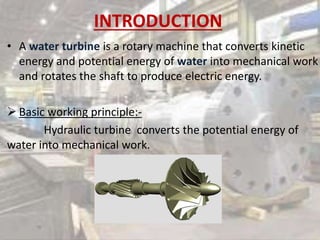
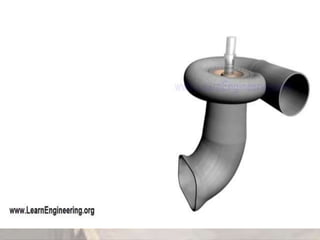
• A water turbine is a rotary machine that converts kinetic
energy and potential energy of water into mechanical work
and rotates the shaft to produce electric energy.
 Basic working principle:-
Hydraulic turbine converts the potential energy of
water into mechanical work.
CLASSIFICATION
• Based on head
a) High head turbines
b) Medium head turbines
c) Low head turbines
• Based on hydraulic action of water
a) Impulse turbines
b) Reaction turbines
• Based on direction of flow of water in the runner
a) Tangential flow turbines
b) Radial flow turbines
c) Axial flow turbines
d) Mixed flow turbines
Three most popular turbines are
• PELTON WHEEL { PELTON TURBINE}
• KAPLAN TURBINE {PROPELLER TURBINE}
• FRANCIS TURBINE
PELTON WHEEL
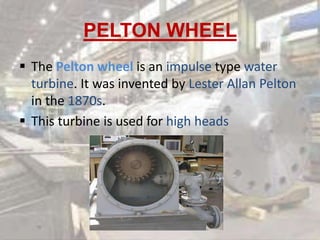
 The Pelton wheel is an impulse type water
turbine. It was invented by Lester Allan Pelton
in the 1870s.
 This turbine is used for high heads
SPECIFICATION
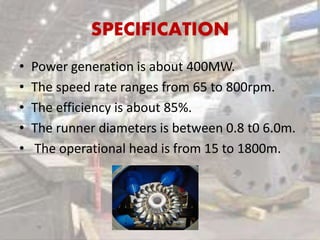
• Power generation is about 400MW.
• The speed rate ranges from 65 to 800rpm.
• The efficiency is about 85%.
• The runner diameters is between 0.8 t0 6.0m.
• The operational head is from 15 to 1800m.
MAIN COMPONENTS
1] Nozzle and spear
2] Runner and bucket
3] Casing
4] Breaking jet
1] Nozzle :- It controls the amount of water striking
the vanes of runner.
2] Casing :- It is used to prevent splashing of
water.
3] Runner and Bucket :- It is circular disc on the
periphery on which evenly spaced bucket are
fixed.
4] Breaking jet :- Its function is to stop the
runner in a short time period.
WORKING
1. The flow of water is tangential to the runner. So it is
a tangential flow impulse turbine.
2. The runner consists of a single wheel mounted on a
horizontal shaft.
3. Water falls towards the turbine through a pipe called
penstock and flows through a nozzle.
4. The high speed jet of water hits the buckets (vanes)
on the wheel and causes the wheel to rotate.
5. A spear rod which has a spear shaped end can be
moved by a hand wheel.
6. This movement controls the flow of water leaving
the nozzle before it strikes the bucket.
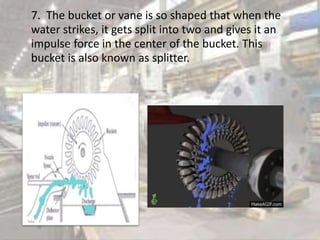
7. The bucket or vane is so shaped that when the
water strikes, it gets split into two and gives it an
impulse force in the center of the bucket. This
bucket is also known as splitter.
SR NO. STATION POWER
GENERATED[MW]
1 AMBALA CANTT[INDIA] 800
2 BIEUDRON[SWISS] 1269
3 CASTAIC [US] 1500
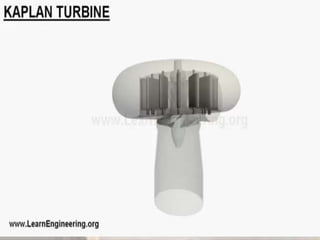
KAPLANTURBINE
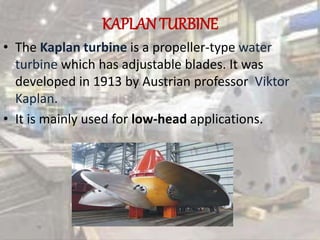
• The Kaplan turbine is a propeller-type water
turbine which has adjustable blades. It was
developed in 1913 by Austrian professor Viktor
Kaplan.
• It is mainly used for low-head applications.
SPECIFICATIONS
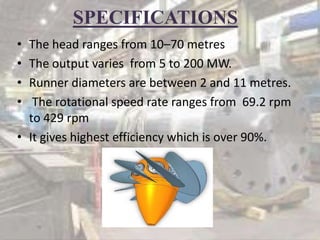
• The head ranges from 10–70 metres
• The output varies from 5 to 200 MW.
• Runner diameters are between 2 and 11 metres.
• The rotational speed rate ranges from 69.2 rpm
to 429 rpm
• It gives highest efficiency which is over 90%.
THE MAIN COMPONENTS ARE :-
1] Scroll casing
2] Guide vanes
3] Draft tube
4] Runner
5] Hub
1] Scroll casing: It is the casing which guides the
water and control the water passage.
2] Guide vanes : It is the vanes which guide the
water and perform same function that by scroll.
3] Draft tube:- It discharges the water to trail
race through gradually expanding tube.
4] Runner :- It is connected to shaft of the
generator.
5] Hub:- It part on which runner is mounted
WORKING
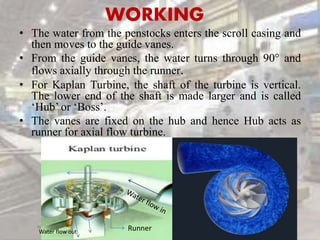
• The water from the penstocks enters the scroll casing and
then moves to the guide vanes.
• From the guide vanes, the water turns through 90° and
flows axially through the runner.
• For Kaplan Turbine, the shaft of the turbine is vertical.
The lower end of the shaft is made larger and is called
‘Hub’ or ‘Boss’.
• The vanes are fixed on the hub and hence Hub acts as
runner for axial flow turbine.
RunnerWater flow out
APLLICATIONS
• The kaplan turbine is used in Indian.
SR
NO.
STATION POWER
GENERATED
[MW]
1. LPH 55
2. KADRA 150
3. KODASSALLI 120
4. ALMATTI 275
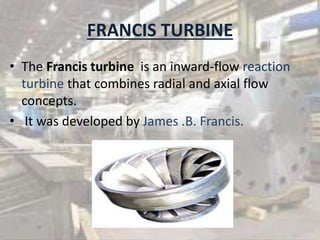
FRANCIS TURBINE
• The Francis turbine is an inward-flow reaction
turbine that combines radial and axial flow
concepts.
• It was developed by James .B. Francis.
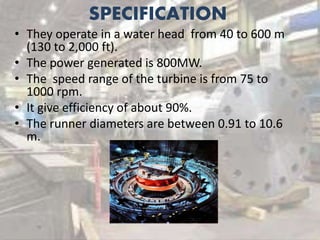
SPECIFICATION
• They operate in a water head from 40 to 600 m
(130 to 2,000 ft).
• The power generated is 800MW.
• The speed range of the turbine is from 75 to
1000 rpm.
• It give efficiency of about 90%.
• The runner diameters are between 0.91 to 10.6
m.
THE MAIN PARTS ARE :-
1] Spiral casing
2] Guide vanes
3] Runners
4] Draft tube
1] Spiral casing :- It guides the water to the guide
vanes and also control the flow.
2] Guide vanes :- They guide the water to runner
and get closed on increase in flow.
3] Runner :- They are heart of the turbine and
rotate on the impact of flow.
4] Draft tube :- It is place from where the water
is discharged from the turbine
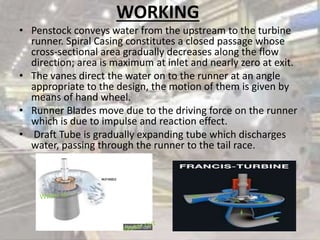
WORKING
• Penstock conveys water from the upstream to the turbine
runner. Spiral Casing constitutes a closed passage whose
cross-sectional area gradually decreases along the flow
direction; area is maximum at inlet and nearly zero at exit.
• The vanes direct the water on to the runner at an angle
appropriate to the design, the motion of them is given by
means of hand wheel.
• Runner Blades move due to the driving force on the runner
which is due to impulse and reaction effect.
• Draft Tube is gradually expanding tube which discharges
water, passing through the runner to the tail race.
The Francis turbine are used in places
like:-
SR NO . PLACES POWER GENERATION
[MW]
1 Koyna IV (India) 250
2 Turkwell (Kenya) 53
3 Karun (Iran) 250
4 Three Gorges (China) 765
DIFFERENCE BETWEEN
PELTON,KAPLAN,FRANCIS
PARAMETERS PELTON TURBINE KAPLAN TURBINE FRANCIS TURBINE
TYPE OF TURBINE IMPULSE TYPE PROPELLER TYPPE INWARD FLOW
REACTION TYPE
POWER GENRATION
[MW]
400 200 800
SPEED RATE[rpm] 65 - 800 70-429 75 -1000
EFFICIENCY[%] 85 80 90
THANK You…
Any query?

Hydraulic turbines

  • 2.
    CONTENT 1] DEFINATION OFHYDRAULIC TURBINE 2] CLASIFICATION 3] TYPES 3.1] Pelton turbine 3.2] Kaplan turbine 3.3] Francis turbine 4] DIFFERENCE BETWEEN PELTON , KAPLAN , FRANCIS TURBINES.
  • 3.
    INTRODUCTION • A waterturbine is a rotary machine that converts kinetic energy and potential energy of water into mechanical work and rotates the shaft to produce electric energy.  Basic working principle:- Hydraulic turbine converts the potential energy of water into mechanical work.
  • 4.
    CLASSIFICATION • Based onhead a) High head turbines b) Medium head turbines c) Low head turbines • Based on hydraulic action of water a) Impulse turbines b) Reaction turbines • Based on direction of flow of water in the runner a) Tangential flow turbines b) Radial flow turbines c) Axial flow turbines d) Mixed flow turbines
  • 5.
    Three most popularturbines are • PELTON WHEEL { PELTON TURBINE} • KAPLAN TURBINE {PROPELLER TURBINE} • FRANCIS TURBINE
  • 6.
    PELTON WHEEL  ThePelton wheel is an impulse type water turbine. It was invented by Lester Allan Pelton in the 1870s.  This turbine is used for high heads
  • 7.
    SPECIFICATION • Power generationis about 400MW. • The speed rate ranges from 65 to 800rpm. • The efficiency is about 85%. • The runner diameters is between 0.8 t0 6.0m. • The operational head is from 15 to 1800m.
  • 8.
    MAIN COMPONENTS 1] Nozzleand spear 2] Runner and bucket 3] Casing 4] Breaking jet 1] Nozzle :- It controls the amount of water striking the vanes of runner. 2] Casing :- It is used to prevent splashing of water.
  • 9.
    3] Runner andBucket :- It is circular disc on the periphery on which evenly spaced bucket are fixed. 4] Breaking jet :- Its function is to stop the runner in a short time period.
  • 10.
    WORKING 1. The flowof water is tangential to the runner. So it is a tangential flow impulse turbine. 2. The runner consists of a single wheel mounted on a horizontal shaft. 3. Water falls towards the turbine through a pipe called penstock and flows through a nozzle. 4. The high speed jet of water hits the buckets (vanes) on the wheel and causes the wheel to rotate. 5. A spear rod which has a spear shaped end can be moved by a hand wheel. 6. This movement controls the flow of water leaving the nozzle before it strikes the bucket.
  • 11.
    7. The bucketor vane is so shaped that when the water strikes, it gets split into two and gives it an impulse force in the center of the bucket. This bucket is also known as splitter.
  • 13.
    SR NO. STATIONPOWER GENERATED[MW] 1 AMBALA CANTT[INDIA] 800 2 BIEUDRON[SWISS] 1269 3 CASTAIC [US] 1500
  • 14.
    KAPLANTURBINE • The Kaplanturbine is a propeller-type water turbine which has adjustable blades. It was developed in 1913 by Austrian professor Viktor Kaplan. • It is mainly used for low-head applications.
  • 15.
    SPECIFICATIONS • The headranges from 10–70 metres • The output varies from 5 to 200 MW. • Runner diameters are between 2 and 11 metres. • The rotational speed rate ranges from 69.2 rpm to 429 rpm • It gives highest efficiency which is over 90%.
  • 16.
    THE MAIN COMPONENTSARE :- 1] Scroll casing 2] Guide vanes 3] Draft tube 4] Runner 5] Hub 1] Scroll casing: It is the casing which guides the water and control the water passage. 2] Guide vanes : It is the vanes which guide the water and perform same function that by scroll.
  • 17.
    3] Draft tube:-It discharges the water to trail race through gradually expanding tube. 4] Runner :- It is connected to shaft of the generator. 5] Hub:- It part on which runner is mounted
  • 18.
    WORKING • The waterfrom the penstocks enters the scroll casing and then moves to the guide vanes. • From the guide vanes, the water turns through 90° and flows axially through the runner. • For Kaplan Turbine, the shaft of the turbine is vertical. The lower end of the shaft is made larger and is called ‘Hub’ or ‘Boss’. • The vanes are fixed on the hub and hence Hub acts as runner for axial flow turbine. RunnerWater flow out
  • 20.
    APLLICATIONS • The kaplanturbine is used in Indian. SR NO. STATION POWER GENERATED [MW] 1. LPH 55 2. KADRA 150 3. KODASSALLI 120 4. ALMATTI 275
  • 21.
    FRANCIS TURBINE • TheFrancis turbine is an inward-flow reaction turbine that combines radial and axial flow concepts. • It was developed by James .B. Francis.
  • 22.
    SPECIFICATION • They operatein a water head from 40 to 600 m (130 to 2,000 ft). • The power generated is 800MW. • The speed range of the turbine is from 75 to 1000 rpm. • It give efficiency of about 90%. • The runner diameters are between 0.91 to 10.6 m.
  • 23.
    THE MAIN PARTSARE :- 1] Spiral casing 2] Guide vanes 3] Runners 4] Draft tube 1] Spiral casing :- It guides the water to the guide vanes and also control the flow. 2] Guide vanes :- They guide the water to runner and get closed on increase in flow.
  • 24.
    3] Runner :-They are heart of the turbine and rotate on the impact of flow. 4] Draft tube :- It is place from where the water is discharged from the turbine
  • 25.
    WORKING • Penstock conveyswater from the upstream to the turbine runner. Spiral Casing constitutes a closed passage whose cross-sectional area gradually decreases along the flow direction; area is maximum at inlet and nearly zero at exit. • The vanes direct the water on to the runner at an angle appropriate to the design, the motion of them is given by means of hand wheel. • Runner Blades move due to the driving force on the runner which is due to impulse and reaction effect. • Draft Tube is gradually expanding tube which discharges water, passing through the runner to the tail race.
  • 27.
    The Francis turbineare used in places like:- SR NO . PLACES POWER GENERATION [MW] 1 Koyna IV (India) 250 2 Turkwell (Kenya) 53 3 Karun (Iran) 250 4 Three Gorges (China) 765
  • 28.
    DIFFERENCE BETWEEN PELTON,KAPLAN,FRANCIS PARAMETERS PELTONTURBINE KAPLAN TURBINE FRANCIS TURBINE TYPE OF TURBINE IMPULSE TYPE PROPELLER TYPPE INWARD FLOW REACTION TYPE POWER GENRATION [MW] 400 200 800 SPEED RATE[rpm] 65 - 800 70-429 75 -1000 EFFICIENCY[%] 85 80 90
  • 29.