FLUID MECHANICS
LAMINAR FLOW AND TURBULENT FLOW
B.H. Gardi collage of engineering and technology
JAYDEEP KOSHIYA 13CE034
7TH SEM. CIVIL
LAMINAR FLOW
• DEFINITION:-
• A laminar flow is one in which the fluid particles move in layers or
lamina with one layer sliding over the other.
• Fluid element move in well defined paths and they retain the same
relative position at successive cross-section of the flow passage.
• This flow is also known as the streamline.
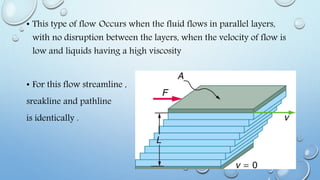
• This type of flow Occurs when the fluid flows in parallel layers,
with no disruption between the layers, when the velocity of flow is
low and liquids having a high viscosity
• For this flow streamline ,
sreakline and pathline
is identically .
HISTORY OF LAMINAR FLOW
• The phenomenon was first investigated in the 1880s by
osbourne reynolds in an experiment which has become a
classic in fluid mechanics.
• In laminar flow the motion of the particles of fluid is very
orderly with all particles moving in straight lines parallel to
the pipe walls.
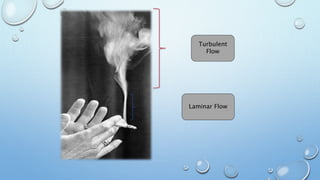
Laminar Flow
Turbulent
Flow
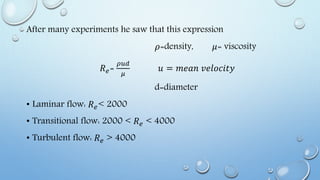
After many experiments he saw that this expression
𝜌=density, 𝜇= viscosity
𝑅 𝑒=
𝜌𝑢𝑑
𝜇
𝑢 = 𝑚𝑒𝑎𝑛 𝑣𝑒𝑙𝑜𝑐𝑖𝑡𝑦
d=diameter
• Laminar flow: 𝑅 𝑒< 2000
• Transitional flow: 2000 < 𝑅 𝑒 < 4000
• Turbulent flow: 𝑅 𝑒 > 4000
Property of laminar flow
• Re < 2000
• 'low' velocity
• Dye does not mix with water
• Fluid particles move in straight lines
• Simple mathematical analysis possible.
Ex. Blood flow through capillaries is laminar flow, as it
satisfies the 6 conditions
APPLICATION OF LAMINAR FLOW
• Most popular use of laminar
flow is in fountain.
Like , in burj –al- Arab. In Dubai.
• Laminar flow is not only in liquid
But it is also in gases.
TURBULENT FLOW
• DEFINITION:-
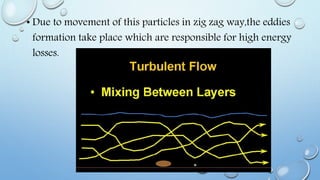
It is this type of flow in which the fluid particles move in a
zig-zag way
• All fluid particles are disturbed and they mix with each
other.
• Thus this is continuos transfer of momentum to adjacent
layer.
• Due to movement of this particles in zig zag way,the eddies
formation take place which are responsible for high energy
losses.
Property of turbulent flow
• Re > 4000
•'high' velocity
•Dye mixes rapidly and completely
•Particle paths completely irregular
•Average motion is in the direction of the flow.
•Changes/fluctuations are very difficult to detect. Must use
laser.
•Mathematical analysis very difficult - so experimental measures are
used
•Most common type of flow

Fluid mechanics

  • 1.
    FLUID MECHANICS LAMINAR FLOWAND TURBULENT FLOW B.H. Gardi collage of engineering and technology JAYDEEP KOSHIYA 13CE034 7TH SEM. CIVIL
  • 2.
    LAMINAR FLOW • DEFINITION:- •A laminar flow is one in which the fluid particles move in layers or lamina with one layer sliding over the other. • Fluid element move in well defined paths and they retain the same relative position at successive cross-section of the flow passage. • This flow is also known as the streamline.
  • 3.
    • This typeof flow Occurs when the fluid flows in parallel layers, with no disruption between the layers, when the velocity of flow is low and liquids having a high viscosity • For this flow streamline , sreakline and pathline is identically .
  • 4.
    HISTORY OF LAMINARFLOW • The phenomenon was first investigated in the 1880s by osbourne reynolds in an experiment which has become a classic in fluid mechanics. • In laminar flow the motion of the particles of fluid is very orderly with all particles moving in straight lines parallel to the pipe walls.
  • 5.
  • 6.
    After many experimentshe saw that this expression 𝜌=density, 𝜇= viscosity 𝑅 𝑒= 𝜌𝑢𝑑 𝜇 𝑢 = 𝑚𝑒𝑎𝑛 𝑣𝑒𝑙𝑜𝑐𝑖𝑡𝑦 d=diameter • Laminar flow: 𝑅 𝑒< 2000 • Transitional flow: 2000 < 𝑅 𝑒 < 4000 • Turbulent flow: 𝑅 𝑒 > 4000
  • 7.
    Property of laminarflow • Re < 2000 • 'low' velocity • Dye does not mix with water • Fluid particles move in straight lines • Simple mathematical analysis possible. Ex. Blood flow through capillaries is laminar flow, as it satisfies the 6 conditions
  • 8.
    APPLICATION OF LAMINARFLOW • Most popular use of laminar flow is in fountain. Like , in burj –al- Arab. In Dubai. • Laminar flow is not only in liquid But it is also in gases.
  • 10.
    TURBULENT FLOW • DEFINITION:- Itis this type of flow in which the fluid particles move in a zig-zag way • All fluid particles are disturbed and they mix with each other. • Thus this is continuos transfer of momentum to adjacent layer.
  • 11.
    • Due tomovement of this particles in zig zag way,the eddies formation take place which are responsible for high energy losses.
  • 12.
    Property of turbulentflow • Re > 4000 •'high' velocity •Dye mixes rapidly and completely •Particle paths completely irregular •Average motion is in the direction of the flow. •Changes/fluctuations are very difficult to detect. Must use laser. •Mathematical analysis very difficult - so experimental measures are used •Most common type of flow