Understanding Water Hammer Ohio AWWA State Conference Presentation September 17, 2004  Dan Barr, PE
What Is Water Hammer?
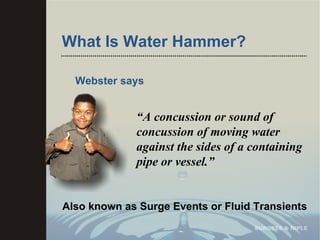
What Is Water Hammer? Webster says “ A concussion or sound of concussion of moving water against the sides of a containing pipe or vessel.” Also known as Surge Events or Fluid Transients
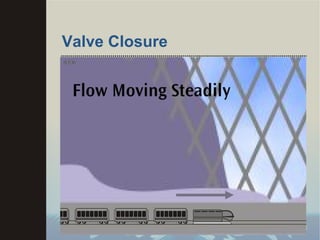
Valve Closure
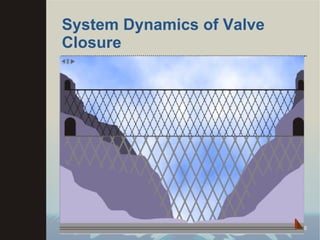
System Dynamics of Valve Closure
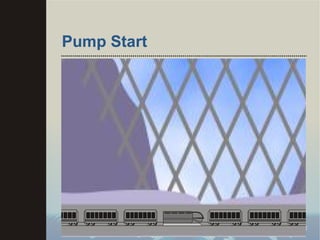
Pump Start
Why Should I Care About Water Hammer?
Why Should I Care About Water Hammer? Service breaks Main breaks and flexible pipes versus rigid Plastic pipe has lower pressure rises but could fatigue and potentially fail at pressures under their rated capacity over time. Steel, Concrete, and Ductile Iron don’t expand as easily generating higher pressure rises, but lower fatigue problems. Contamination potential from negative pressures in mains Instrumentation and Gauge failures from extreme high or low pressures Control and Alarm issues – PRVs, Pressure based pump controls, etc.
Where and When Should I Be Concerned About Water Hammer?  Anywhere flow stops or starts quickly Pump stations  Control valves and isolation valves Hydrants Rapid and large demand changes Air release valves Column separation Longer Mains and higher velocities Networked mains less likely to have problems
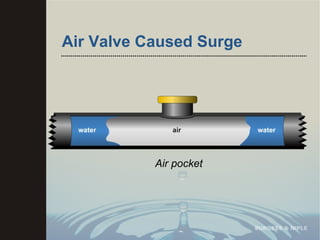
Air Valve Caused Surge Air pocket
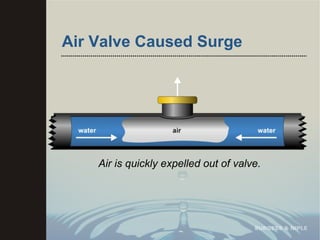
Air Valve Caused Surge Air is quickly expelled out of valve.
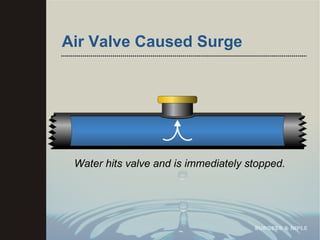
Air Valve Caused Surge Water hits valve and is immediately stopped.
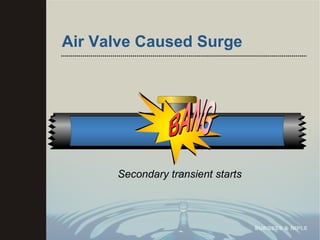
Air Valve Caused Surge Secondary transient starts
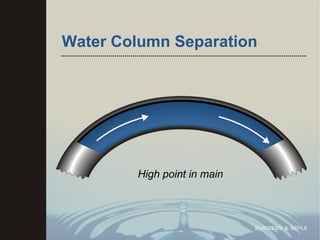
Water Column Separation High point in main
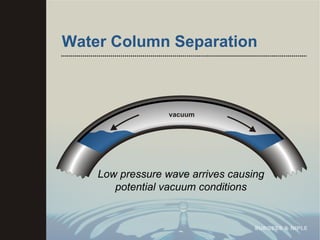
Water Column Separation Low pressure wave arrives causing potential vacuum conditions
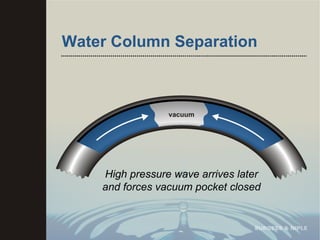
Water Column Separation High pressure wave arrives later and forces vacuum pocket closed
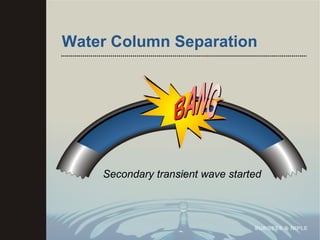
Water Column Separation Secondary transient wave started
Do I Have Problems with Water Hammer?  How Can I Tell?  Banging Noises and Vibration – Where term water hammer comes from Pressure waves bouncing off piping Check valve slamming Frequent pipe breaks in the same places especially near pump stations, etc or low or high points in the system. System measurements – normally transients are too fast for SCADA systems Potentially minimal symptoms due to infrequent occurrence or no monitoring
What Do I Do About It? Competent computer analysis to fully determine cause of problem or confirm no problem.  Will also establish proper selection of any required corrective measures including locations, timing, and sizing. Preventive measures  Valve operation including timing Pump starts/stops including delays, interlocking, and timing Proper check valve selection to prevent slamming  Air valves
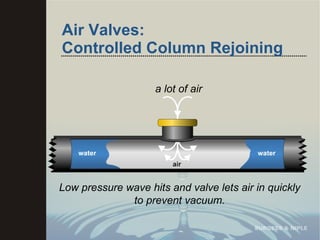
Air Valves: Controlled Column Rejoining a lot of air Low pressure wave hits and valve lets air in quickly to prevent vacuum.
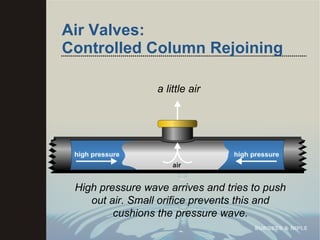
Air Valves: Controlled Column Rejoining a little air High pressure wave arrives and tries to push out air. Small orifice prevents this and cushions the pressure wave.
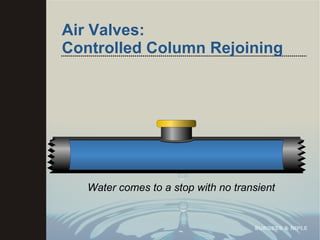
Air Valves: Controlled Column Rejoining Water comes to a stop with no transient
What Do I Do About It? Control measures Surge control valves like pressure relief valves Surge and air tanks Pump bypasses Stronger system design
Questions and Answers

Water Hammer

  • 1.
    Understanding Water HammerOhio AWWA State Conference Presentation September 17, 2004 Dan Barr, PE
  • 2.
  • 3.
  • 4.
    What Is WaterHammer? Webster says “ A concussion or sound of concussion of moving water against the sides of a containing pipe or vessel.” Also known as Surge Events or Fluid Transients
  • 5.
  • 6.
    System Dynamics ofValve Closure
  • 7.
  • 8.
    Why Should ICare About Water Hammer?
  • 9.
    Why Should ICare About Water Hammer? Service breaks Main breaks and flexible pipes versus rigid Plastic pipe has lower pressure rises but could fatigue and potentially fail at pressures under their rated capacity over time. Steel, Concrete, and Ductile Iron don’t expand as easily generating higher pressure rises, but lower fatigue problems. Contamination potential from negative pressures in mains Instrumentation and Gauge failures from extreme high or low pressures Control and Alarm issues – PRVs, Pressure based pump controls, etc.
  • 10.
    Where and WhenShould I Be Concerned About Water Hammer? Anywhere flow stops or starts quickly Pump stations Control valves and isolation valves Hydrants Rapid and large demand changes Air release valves Column separation Longer Mains and higher velocities Networked mains less likely to have problems
  • 11.
    Air Valve CausedSurge Air pocket
  • 12.
    Air Valve CausedSurge Air is quickly expelled out of valve.
  • 13.
    Air Valve CausedSurge Water hits valve and is immediately stopped.
  • 14.
    Air Valve CausedSurge Secondary transient starts
  • 15.
    Water Column SeparationHigh point in main
  • 16.
    Water Column SeparationLow pressure wave arrives causing potential vacuum conditions
  • 17.
    Water Column SeparationHigh pressure wave arrives later and forces vacuum pocket closed
  • 18.
    Water Column SeparationSecondary transient wave started
  • 19.
    Do I HaveProblems with Water Hammer? How Can I Tell? Banging Noises and Vibration – Where term water hammer comes from Pressure waves bouncing off piping Check valve slamming Frequent pipe breaks in the same places especially near pump stations, etc or low or high points in the system. System measurements – normally transients are too fast for SCADA systems Potentially minimal symptoms due to infrequent occurrence or no monitoring
  • 20.
    What Do IDo About It? Competent computer analysis to fully determine cause of problem or confirm no problem. Will also establish proper selection of any required corrective measures including locations, timing, and sizing. Preventive measures Valve operation including timing Pump starts/stops including delays, interlocking, and timing Proper check valve selection to prevent slamming Air valves
  • 21.
    Air Valves: ControlledColumn Rejoining a lot of air Low pressure wave hits and valve lets air in quickly to prevent vacuum.
  • 22.
    Air Valves: ControlledColumn Rejoining a little air High pressure wave arrives and tries to push out air. Small orifice prevents this and cushions the pressure wave.
  • 23.
    Air Valves: ControlledColumn Rejoining Water comes to a stop with no transient
  • 24.
    What Do IDo About It? Control measures Surge control valves like pressure relief valves Surge and air tanks Pump bypasses Stronger system design
  • 25.