Fluid Kinematics
azezahmad@live.com
Topics to cover
Introduction
Categorization of flow
Real fluid flow & Ideal fluid flow
Incompressible fluid flow & Compressible fluid flow
Pressure flow & Gravity flow
Laminar flow & Turbulent flow
Reynolds Number
azezahmad@live.com
2
Introduction
The fluid kinematics deals with description of the motion of
the fluids without reference to the force causing the motion.
Thus it is stressed to know how fluid flows and how to
describe fluid motion. This concept helps us to simplify the
complex nature of a real fluid flow.
Hydrodynamic parameters like pressure and density along
with flow velocity may vary from one point to another and
also from one instant to another at a fixed point.
3
Categorization
According to type of variations, categorizing the flow :
1. Real fluid flow
2. Ideal fluid flow
3. Incompressible fluid flow
4. Compressible fluid flow
5. Pressure flow
6. Gravity flow
4
1. Real fluid flow
Real fluid flow point toward that flow in which frictional or viscous
effects are counted. It is also known as Viscid flow.
OR
The flow in which effects of tangential or shearing forces are taken into
account; these forces give rise to fluid friction, because they oppose the
sliding of one particle past another.
azezahmad@live.com
5
2. Ideal fluid flow
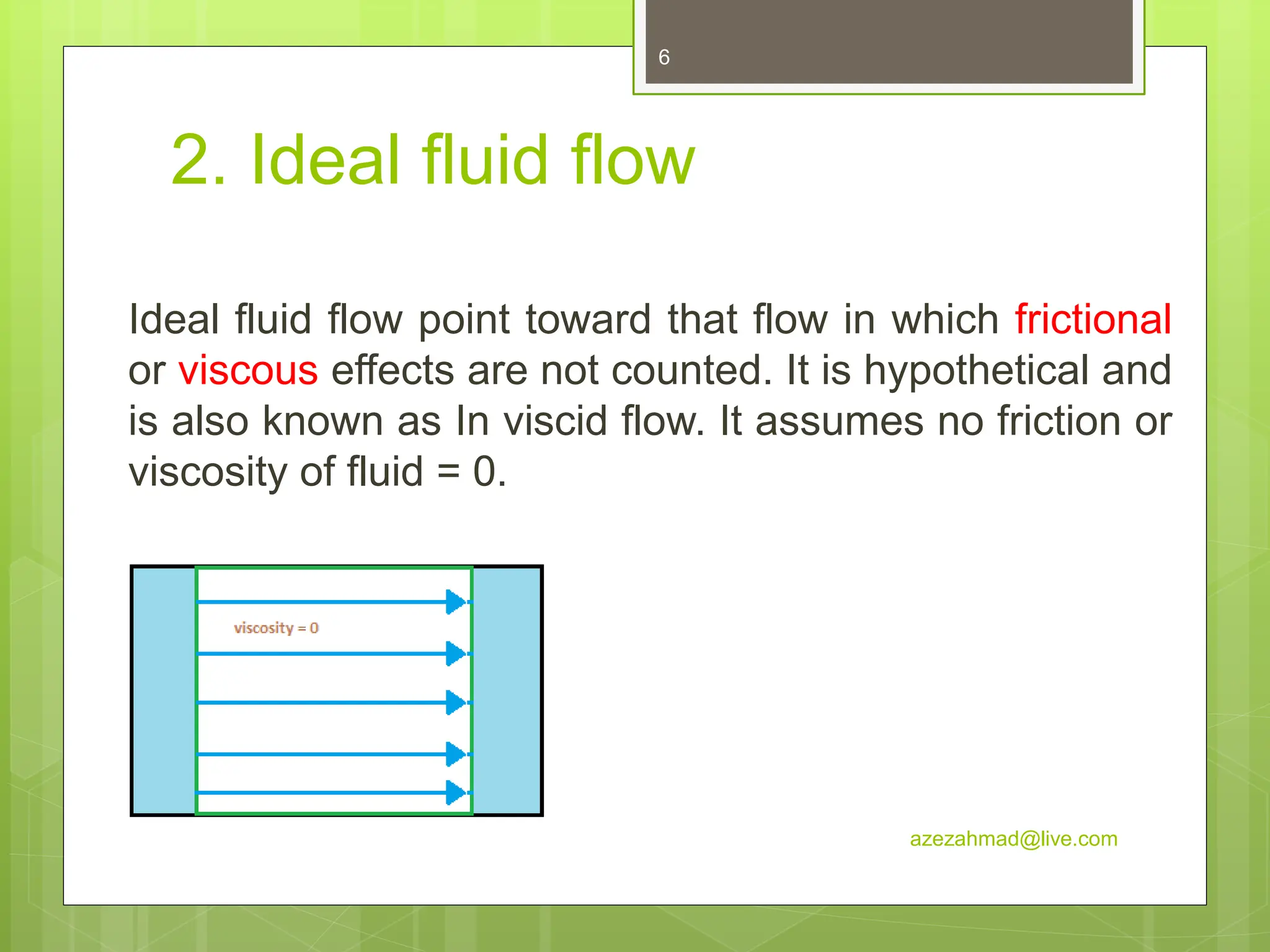
Ideal fluid flow point toward that flow in which frictional
or viscous effects are not counted. It is hypothetical and
is also known as In viscid flow. It assumes no friction or
viscosity of fluid = 0.
azezahmad@live.com
6
3. Incompressible fluid flow
Fluid motion with negligible changes in density. No fluid
is truly incompressible, since even liquids can have their
density increased through application of sufficient
pressure. But density changes in a flow will be
negligible
OR
incompressible flow or isochoric flow refers to a flow
in which the material density is constant within a fluid
parcel
7
4. Compressible fluid flow
Gases are compressible : their densities is a function of
absolute pressure and absolute temperature.
8
5. Pressure flow
Pressure flow implies that flow occurs under pressure.
Gases always flow in this manner. Liquid also flow under
pressure, for example a pipe flowing full.
9
6. Gravity flow
When a liquid flows with a free surface for example a
partially full pipe, the flow is referred to as gravity flow
because gravity is the primary moving force.
10
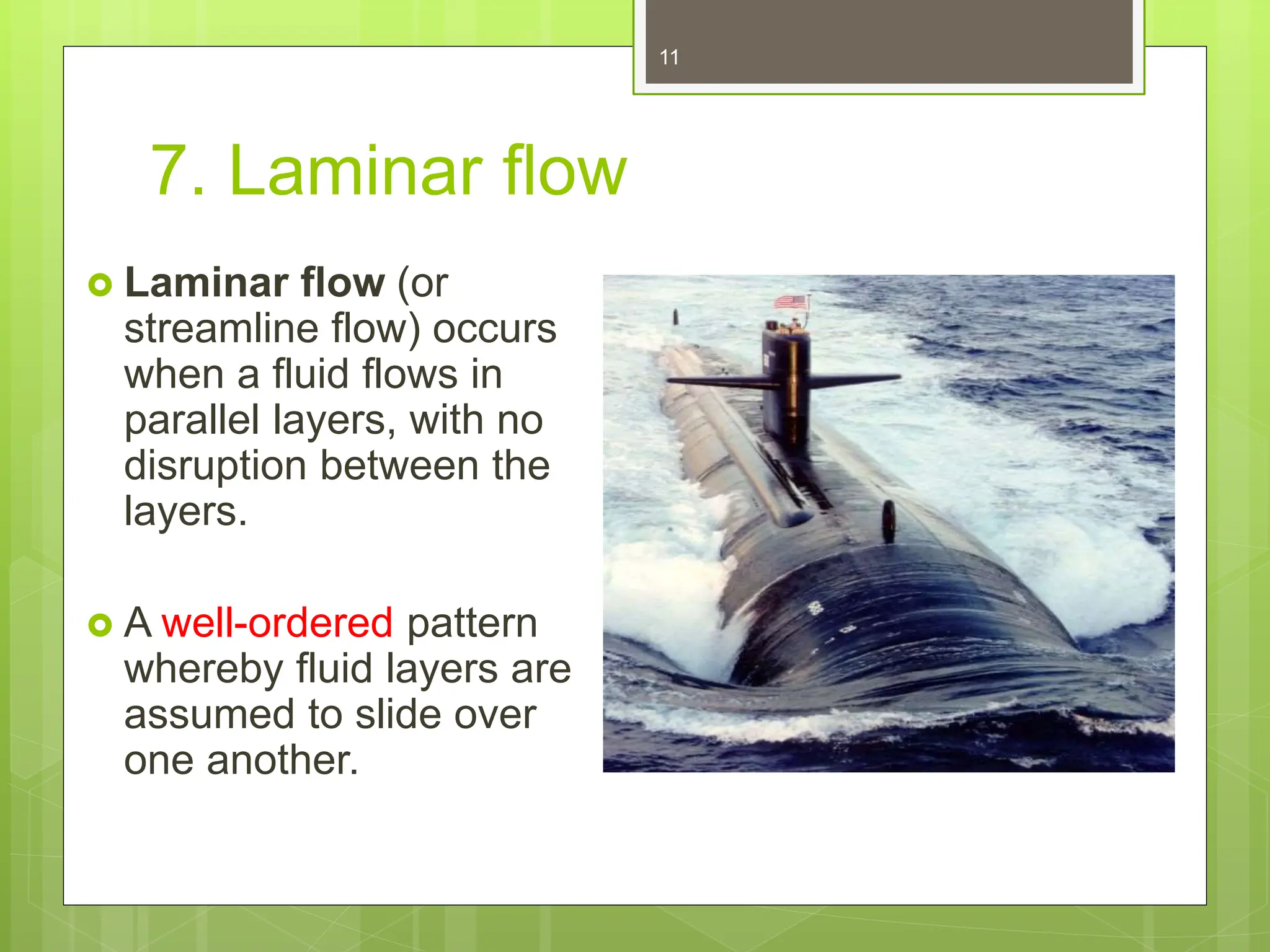
7. Laminar flow
 Laminar flow (or
streamline flow) occurs
when a fluid flows in
parallel layers, with no
disruption between the
layers.
 A well-ordered pattern
whereby fluid layers are
assumed to slide over
one another.
11
8. Turbulent flow
In turbulent flow vortices, eddies and wakes make
the flow unpredictable. Turbulent flow happens in
general at high flow rates and with larger pipes.
12
9. Transitional flow
Transitional flow is a mixture of laminar and turbulent flow, with
turbulence in the center of the pipe, and laminar flow near the edges.
Each of these flows behave in different manners in terms of their
frictional energy loss while flowing, and have different equations that
predict their behavior.
13
Reynolds Number
The Reynolds Number, the non-dimensional number, can be defined as
the ratio of
 the inertia force (ρ u L) and
 the viscous or friction force (μ)
Re = ρ u L / μ OR Re = u L / ν
Where,
 Re = Reynolds Number (non-dimensional)
 ρ = density (kg/m3, lbm/ft3 )
 u = velocity (m/s, ft/s)
 μ = dynamic viscosity (Ns/m2, lbm/s ft)
 L = characteristic length (m, ft)
 ν = kinematic viscosity (m2/s, ft2/s)
14
Reynolds Number
15
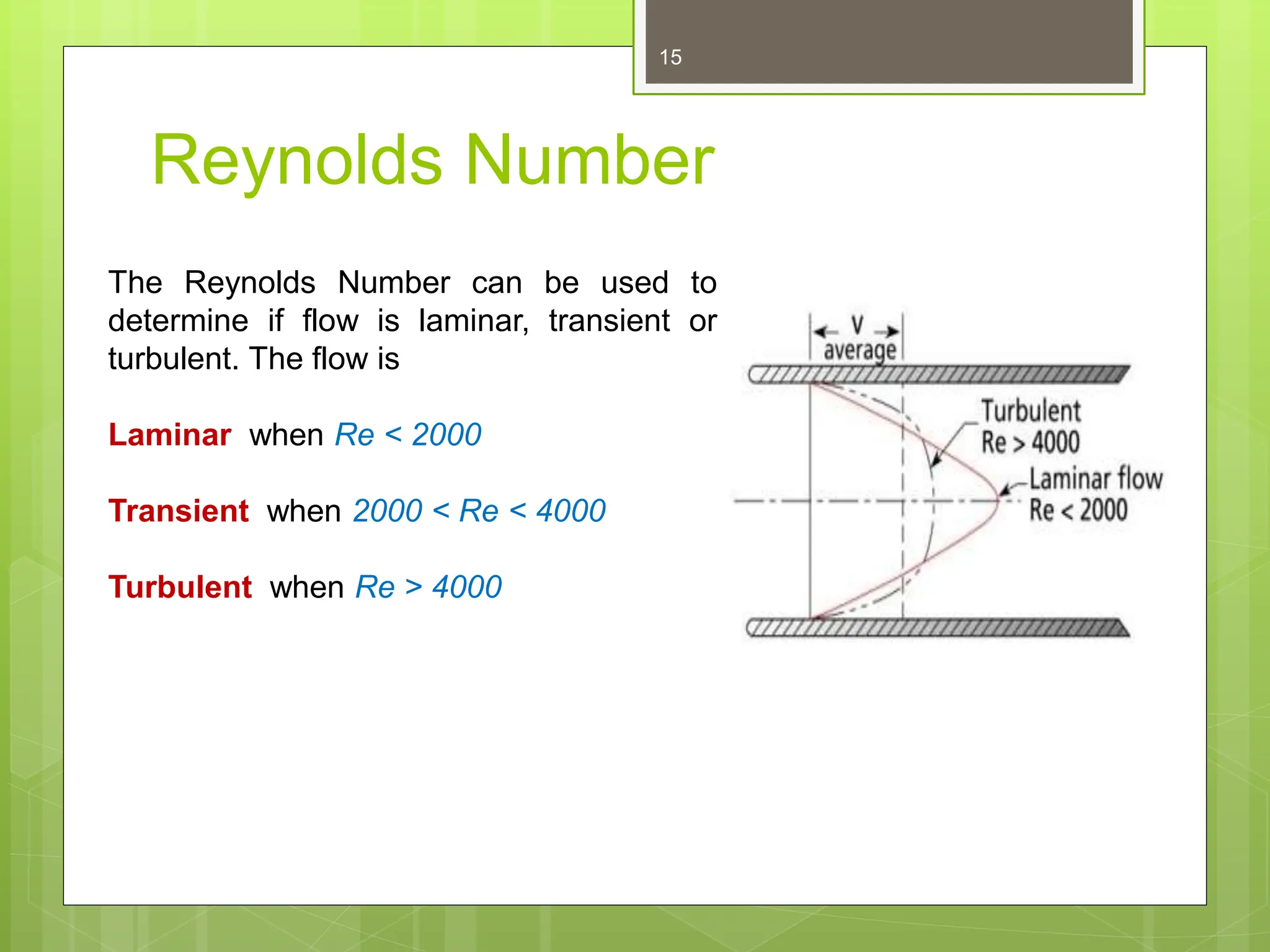
The Reynolds Number can be used to
determine if flow is laminar, transient or
turbulent. The flow is
Laminar when Re < 2000
Transient when 2000 < Re < 4000
Turbulent when Re > 4000
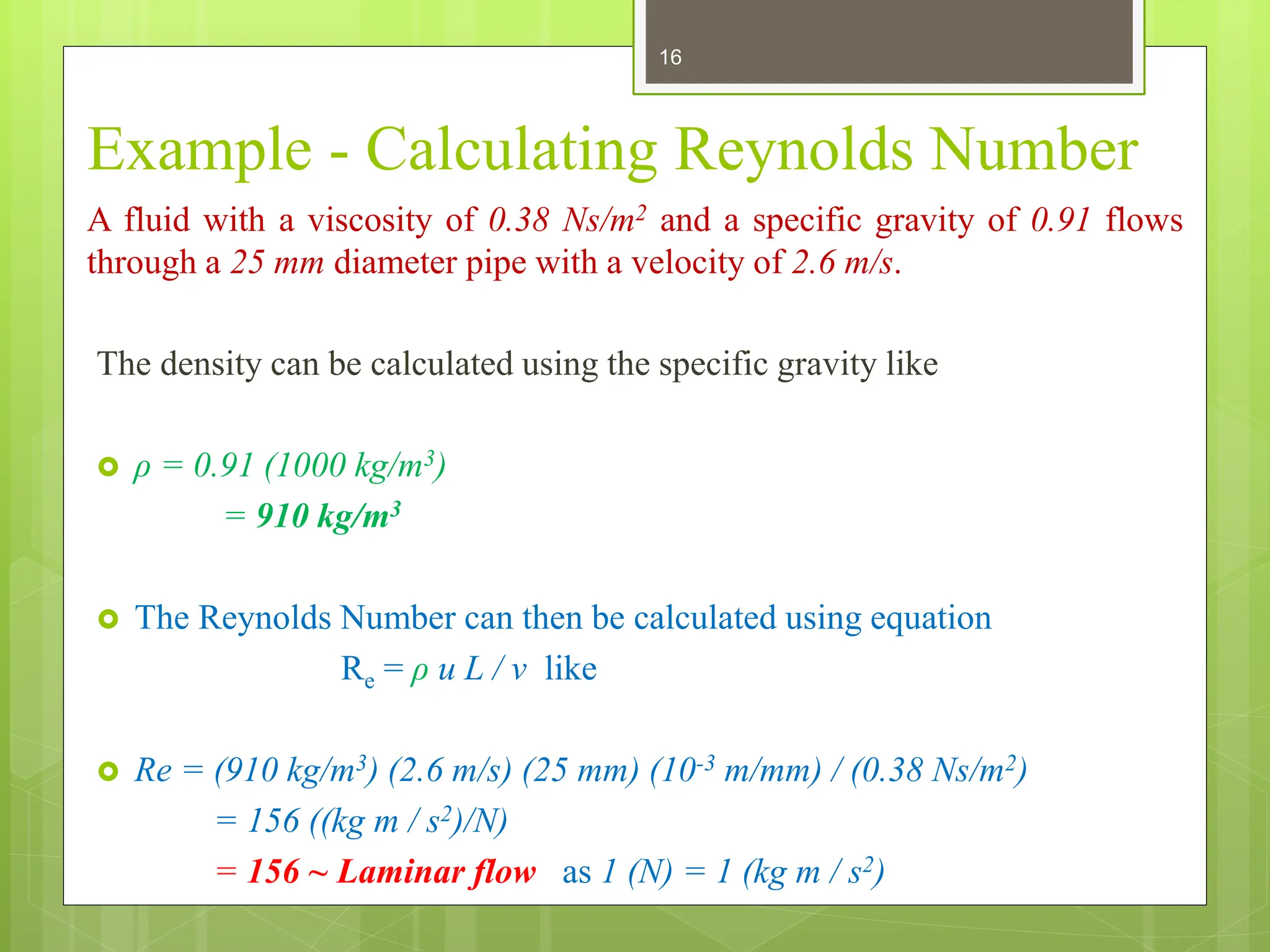
Example - Calculating Reynolds Number
A fluid with a viscosity of 0.38 Ns/m2 and a specific gravity of 0.91 flows
through a 25 mm diameter pipe with a velocity of 2.6 m/s.
The density can be calculated using the specific gravity like
 ρ = 0.91 (1000 kg/m3)
= 910 kg/m3
 The Reynolds Number can then be calculated using equation
Re = ρ u L / ν like
 Re = (910 kg/m3) (2.6 m/s) (25 mm) (10-3 m/mm) / (0.38 Ns/m2)
= 156 ((kg m / s2)/N)
= 156 ~ Laminar flow as 1 (N) = 1 (kg m / s2)
16

1-Fluid-Kinematics. -downloaded with 1stBrowser-.pptx

  • 1.
  • 2.
    Topics to cover Introduction Categorizationof flow Real fluid flow & Ideal fluid flow Incompressible fluid flow & Compressible fluid flow Pressure flow & Gravity flow Laminar flow & Turbulent flow Reynolds Number azezahmad@live.com 2
  • 3.
    Introduction The fluid kinematicsdeals with description of the motion of the fluids without reference to the force causing the motion. Thus it is stressed to know how fluid flows and how to describe fluid motion. This concept helps us to simplify the complex nature of a real fluid flow. Hydrodynamic parameters like pressure and density along with flow velocity may vary from one point to another and also from one instant to another at a fixed point. 3
  • 4.
    Categorization According to typeof variations, categorizing the flow : 1. Real fluid flow 2. Ideal fluid flow 3. Incompressible fluid flow 4. Compressible fluid flow 5. Pressure flow 6. Gravity flow 4
  • 5.
    1. Real fluidflow Real fluid flow point toward that flow in which frictional or viscous effects are counted. It is also known as Viscid flow. OR The flow in which effects of tangential or shearing forces are taken into account; these forces give rise to fluid friction, because they oppose the sliding of one particle past another. azezahmad@live.com 5
  • 6.
    2. Ideal fluidflow Ideal fluid flow point toward that flow in which frictional or viscous effects are not counted. It is hypothetical and is also known as In viscid flow. It assumes no friction or viscosity of fluid = 0. azezahmad@live.com 6
  • 7.
    3. Incompressible fluidflow Fluid motion with negligible changes in density. No fluid is truly incompressible, since even liquids can have their density increased through application of sufficient pressure. But density changes in a flow will be negligible OR incompressible flow or isochoric flow refers to a flow in which the material density is constant within a fluid parcel 7
  • 8.
    4. Compressible fluidflow Gases are compressible : their densities is a function of absolute pressure and absolute temperature. 8
  • 9.
    5. Pressure flow Pressureflow implies that flow occurs under pressure. Gases always flow in this manner. Liquid also flow under pressure, for example a pipe flowing full. 9
  • 10.
    6. Gravity flow Whena liquid flows with a free surface for example a partially full pipe, the flow is referred to as gravity flow because gravity is the primary moving force. 10
  • 11.
    7. Laminar flow Laminar flow (or streamline flow) occurs when a fluid flows in parallel layers, with no disruption between the layers.  A well-ordered pattern whereby fluid layers are assumed to slide over one another. 11
  • 12.
    8. Turbulent flow Inturbulent flow vortices, eddies and wakes make the flow unpredictable. Turbulent flow happens in general at high flow rates and with larger pipes. 12
  • 13.
    9. Transitional flow Transitionalflow is a mixture of laminar and turbulent flow, with turbulence in the center of the pipe, and laminar flow near the edges. Each of these flows behave in different manners in terms of their frictional energy loss while flowing, and have different equations that predict their behavior. 13
  • 14.
    Reynolds Number The ReynoldsNumber, the non-dimensional number, can be defined as the ratio of  the inertia force (ρ u L) and  the viscous or friction force (μ) Re = ρ u L / μ OR Re = u L / ν Where,  Re = Reynolds Number (non-dimensional)  ρ = density (kg/m3, lbm/ft3 )  u = velocity (m/s, ft/s)  μ = dynamic viscosity (Ns/m2, lbm/s ft)  L = characteristic length (m, ft)  ν = kinematic viscosity (m2/s, ft2/s) 14
  • 15.
    Reynolds Number 15 The ReynoldsNumber can be used to determine if flow is laminar, transient or turbulent. The flow is Laminar when Re < 2000 Transient when 2000 < Re < 4000 Turbulent when Re > 4000
  • 16.
    Example - CalculatingReynolds Number A fluid with a viscosity of 0.38 Ns/m2 and a specific gravity of 0.91 flows through a 25 mm diameter pipe with a velocity of 2.6 m/s. The density can be calculated using the specific gravity like  ρ = 0.91 (1000 kg/m3) = 910 kg/m3  The Reynolds Number can then be calculated using equation Re = ρ u L / ν like  Re = (910 kg/m3) (2.6 m/s) (25 mm) (10-3 m/mm) / (0.38 Ns/m2) = 156 ((kg m / s2)/N) = 156 ~ Laminar flow as 1 (N) = 1 (kg m / s2) 16