SNPIT &RC
PRESENTATION ON: Flow pattern and Types of flow
MADE BY: Civil-B (3rd SEM)
SUBJECT : Fluid Mechanics(2130602)
GUIDED BY: Sarika Javiya Mam
Bankim Joshi Sir
CREW MEMBERS PEN NO.
1.Kathan Sindhvad = 160490106087
2.Vishal Sharma = 160490106085
3.Malhar Shukla = 160490106086
4.Upadhyay Nishank = 160490106092
Flow Patterns
 Streamlines are a family of curves that are
instantaneously tangent to the velocity vector of the
flow. These show the direction in which a massless fluid
element will travel at any point in time.
 Streaklines are the loci of points of all the fluid particles
that have passed continuously through a particular
spatial point in the past. Dye steadily injected into the
fluid at a fixed point extends along a streakline.
 Pathlines are the trajectories that individual fluid
particles follow. These can be thought of as "recording"
the path of a fluid element in the flow over a certain
period. The direction the path takes will be determined
by the streamlines of the fluid at each moment in time.
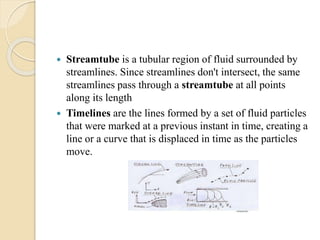
 Streamtube is a tubular region of fluid surrounded by
streamlines. Since streamlines don't intersect, the same
streamlines pass through a streamtube at all points
along its length
 Timelines are the lines formed by a set of fluid particles
that were marked at a previous instant in time, creating a
line or a curve that is displaced in time as the particles
move.
Types of flows
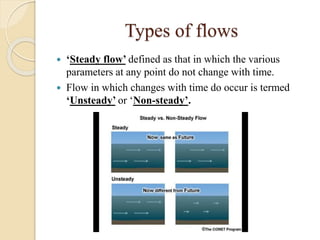
 ‘Steady flow’ defined as that in which the various
parameters at any point do not change with time.
 Flow in which changes with time do occur is termed
‘Unsteady’ or ‘Non-steady’.
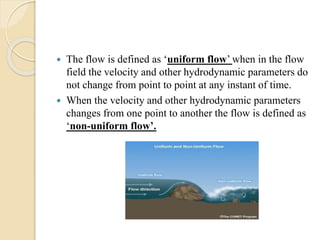
 The flow is defined as ‘uniform flow’ when in the flow
field the velocity and other hydrodynamic parameters do
not change from point to point at any instant of time.
 When the velocity and other hydrodynamic parameters
changes from one point to another the flow is defined as
‘non-uniform flow’.
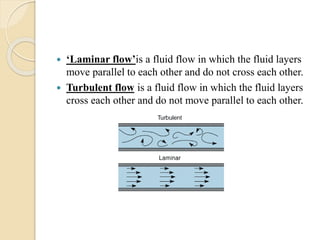
 ‘Laminar flow’is a fluid flow in which the fluid layers
move parallel to each other and do not cross each other.
 Turbulent flow is a fluid flow in which the fluid layers
cross each other and do not move parallel to each other.
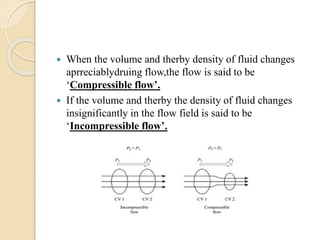
 When the volume and therby density of fluid changes
aprreciablydruing flow,the flow is said to be
‘Compressible flow’.
 If the volume and therby the density of fluid changes
insignificantly in the flow field is said to be
‘Incompressible flow’.
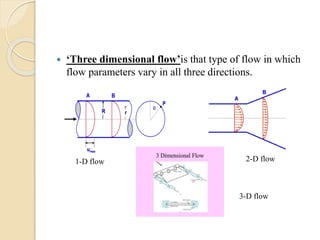
 Fluid flow in which all flow is parallel to some straight
line, and characteristics of flow do not change in moving
perpendicular to this line is ‘One dimensional flow’or
‘1-D flow’.
 Fluid motion can be said to be a ‘Two-dimensional
flow’ or ‘2-D flow’ when the flow velocity at every
point is parallel to a fixed plane. The velocity at any
point on a given normal to that fixed plane should be
constant.
 ‘Three dimensional flow’is that type of flow in which
flow parameters vary in all three directions.
1-D flow 2-D flow
3-D flow
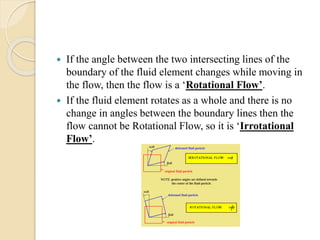
 If the angle between the two intersecting lines of the
boundary of the fluid element changes while moving in
the flow, then the flow is a ‘Rotational Flow’.
 If the fluid element rotates as a whole and there is no
change in angles between the boundary lines then the
flow cannot be Rotational Flow, so it is ‘Irrotational
Flow’.

Flow patterns and types of flow

  • 1.
    SNPIT &RC PRESENTATION ON:Flow pattern and Types of flow MADE BY: Civil-B (3rd SEM) SUBJECT : Fluid Mechanics(2130602) GUIDED BY: Sarika Javiya Mam Bankim Joshi Sir
  • 2.
    CREW MEMBERS PENNO. 1.Kathan Sindhvad = 160490106087 2.Vishal Sharma = 160490106085 3.Malhar Shukla = 160490106086 4.Upadhyay Nishank = 160490106092
  • 3.
    Flow Patterns  Streamlinesare a family of curves that are instantaneously tangent to the velocity vector of the flow. These show the direction in which a massless fluid element will travel at any point in time.  Streaklines are the loci of points of all the fluid particles that have passed continuously through a particular spatial point in the past. Dye steadily injected into the fluid at a fixed point extends along a streakline.  Pathlines are the trajectories that individual fluid particles follow. These can be thought of as "recording" the path of a fluid element in the flow over a certain period. The direction the path takes will be determined by the streamlines of the fluid at each moment in time.
  • 4.
     Streamtube isa tubular region of fluid surrounded by streamlines. Since streamlines don't intersect, the same streamlines pass through a streamtube at all points along its length  Timelines are the lines formed by a set of fluid particles that were marked at a previous instant in time, creating a line or a curve that is displaced in time as the particles move.
  • 5.
    Types of flows ‘Steady flow’ defined as that in which the various parameters at any point do not change with time.  Flow in which changes with time do occur is termed ‘Unsteady’ or ‘Non-steady’.
  • 6.
     The flowis defined as ‘uniform flow’ when in the flow field the velocity and other hydrodynamic parameters do not change from point to point at any instant of time.  When the velocity and other hydrodynamic parameters changes from one point to another the flow is defined as ‘non-uniform flow’.
  • 7.
     ‘Laminar flow’isa fluid flow in which the fluid layers move parallel to each other and do not cross each other.  Turbulent flow is a fluid flow in which the fluid layers cross each other and do not move parallel to each other.
  • 8.
     When thevolume and therby density of fluid changes aprreciablydruing flow,the flow is said to be ‘Compressible flow’.  If the volume and therby the density of fluid changes insignificantly in the flow field is said to be ‘Incompressible flow’.
  • 9.
     Fluid flowin which all flow is parallel to some straight line, and characteristics of flow do not change in moving perpendicular to this line is ‘One dimensional flow’or ‘1-D flow’.  Fluid motion can be said to be a ‘Two-dimensional flow’ or ‘2-D flow’ when the flow velocity at every point is parallel to a fixed plane. The velocity at any point on a given normal to that fixed plane should be constant.
  • 10.
     ‘Three dimensionalflow’is that type of flow in which flow parameters vary in all three directions. 1-D flow 2-D flow 3-D flow
  • 11.
     If theangle between the two intersecting lines of the boundary of the fluid element changes while moving in the flow, then the flow is a ‘Rotational Flow’.  If the fluid element rotates as a whole and there is no change in angles between the boundary lines then the flow cannot be Rotational Flow, so it is ‘Irrotational Flow’.