

FundamentalsFundamentalsFundamentalsFundamentals
FLUID MECHANICSFLUID MECHANICS
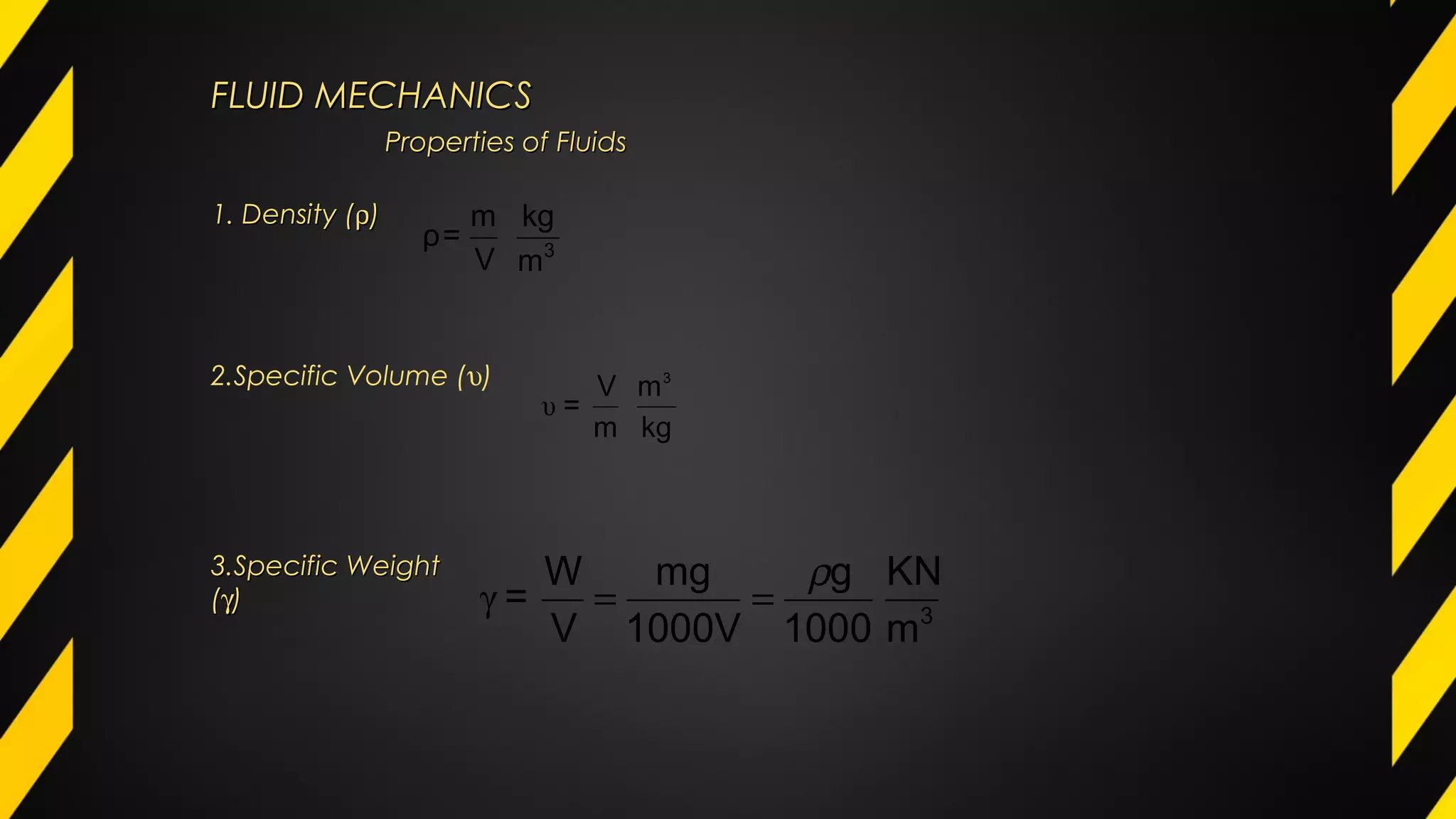
1. Density (1. Density (ρρ))
3
m
kg
V
m
=ρ
2.Specific Volume (υ)
kg
m
m
V
=
3
υ
3.Specific Weight3.Specific Weight
((γγ))
3
m
KN
1000
g
1000V
mg
V
W
=
ρ
==γ
Properties of FluidsProperties of Fluids
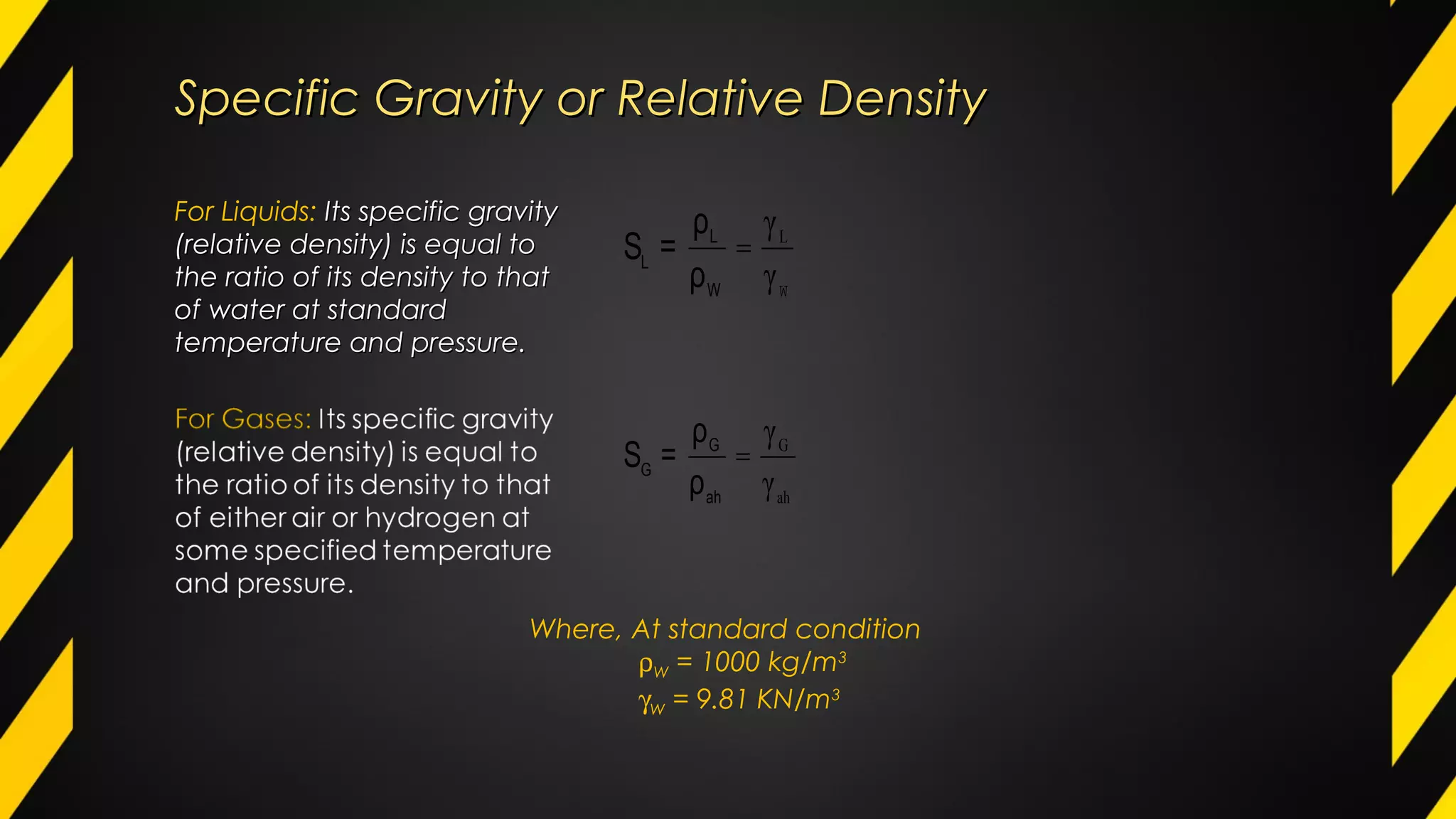
Specific Gravity or Relative DensitySpecific Gravity or Relative Density
For Liquids: Its specific gravityIts specific gravity
(relative density) is equal to(relative density) is equal to
the ratio of its density to thatthe ratio of its density to that
of water at standardof water at standard
temperature and pressure.temperature and pressure.
W
=
γ
γL
W
L
L
ρ
ρ
=S
ah
G
γ
γ
=
ah
G
G
ρ
ρ
=S
Where, At standard condition
ρW = 1000 kg/m3
γW = 9.81 KN/m3
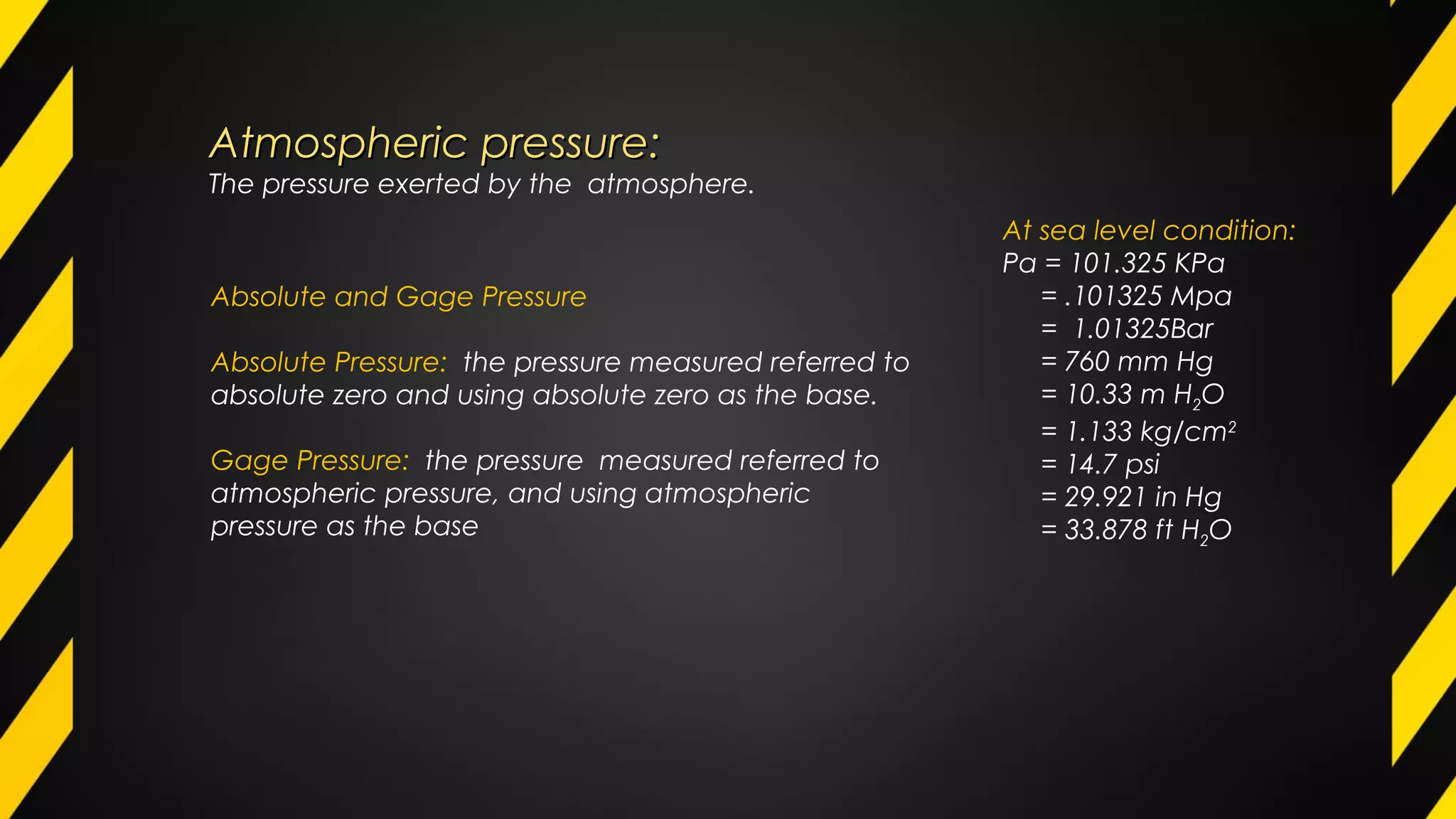
Atmospheric pressure:Atmospheric pressure:
The pressure exerted by the atmosphere.
At sea level condition:
Pa = 101.325 KPa
= .101325 Mpa
= 1.01325Bar
= 760 mm Hg
= 10.33 m H2O
= 1.133 kg/cm2
= 14.7 psi
= 29.921 in Hg
= 33.878 ft H2O
Absolute and Gage Pressure
Absolute Pressure: the pressure measured referred to
absolute zero and using absolute zero as the base.
Gage Pressure: the pressure measured referred to
atmospheric pressure, and using atmospheric
pressure as the base
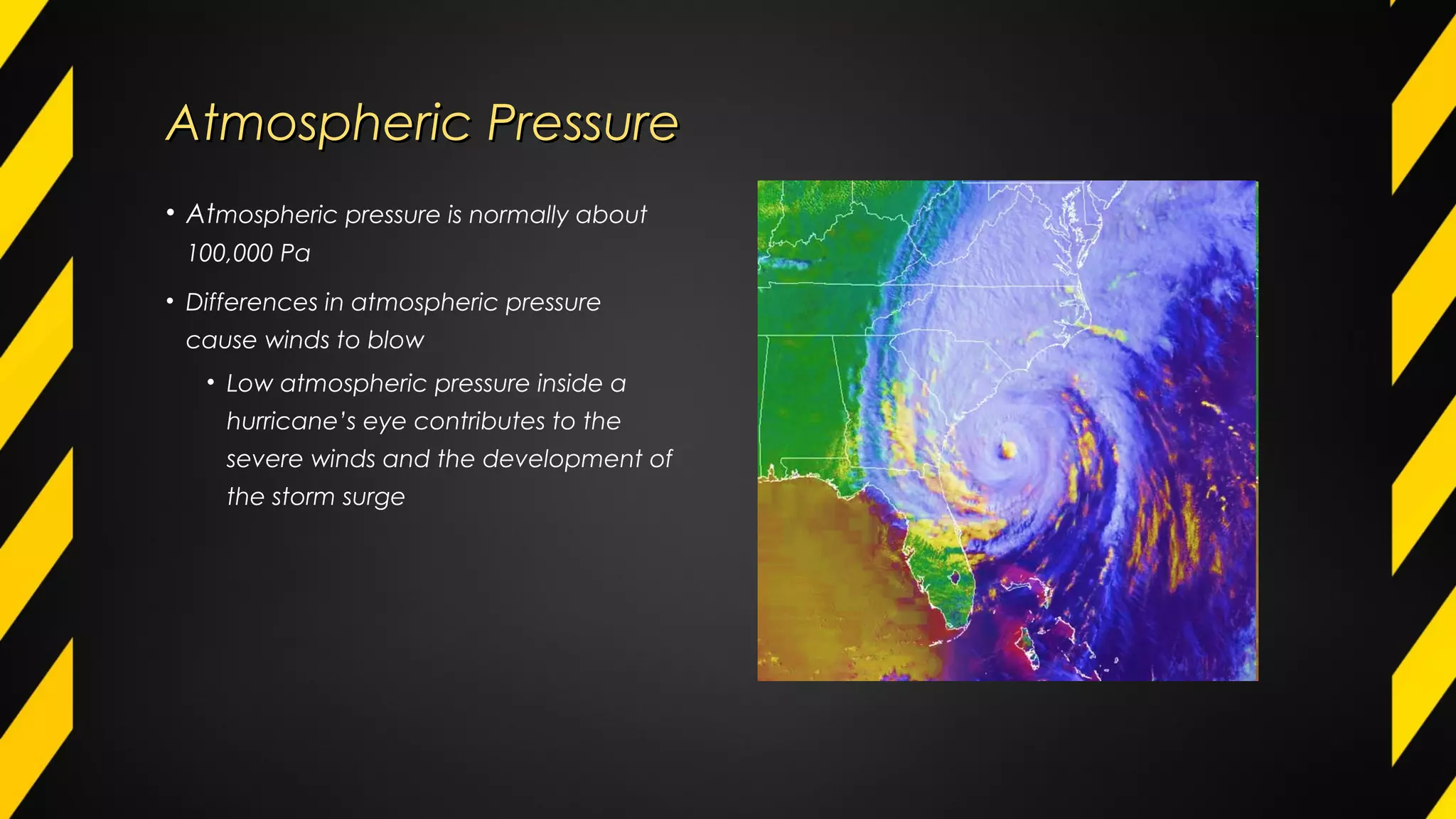
Atmospheric PressureAtmospheric Pressure
• Atmospheric pressure is normally about
100,000 Pa
• Differences in atmospheric pressure
cause winds to blow
• Low atmospheric pressure inside a
hurricane’s eye contributes to the
severe winds and the development of
the storm surge
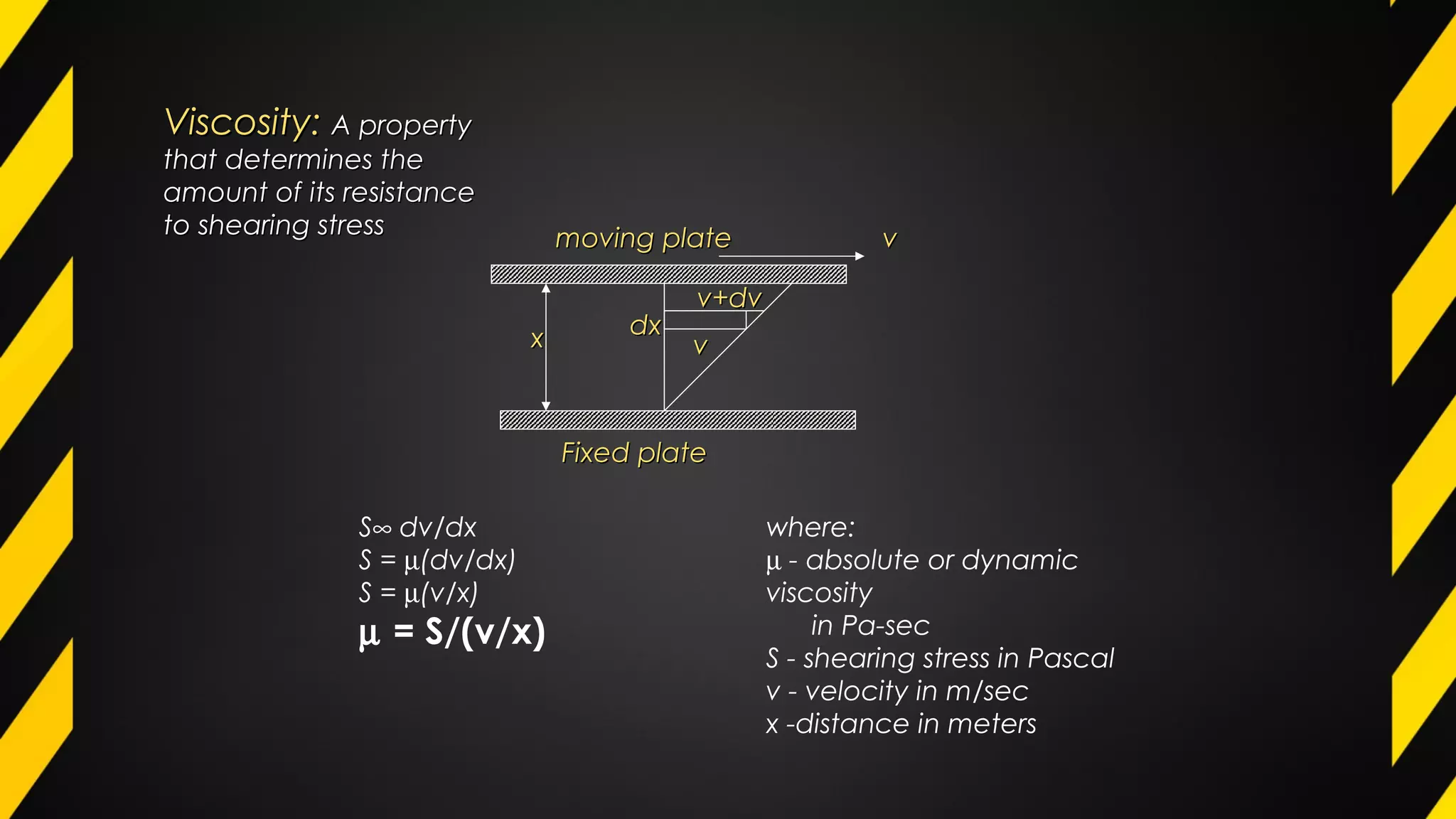
Viscosity:Viscosity: A propertyA property
that determines thethat determines the
amount of its resistanceamount of its resistance
to shearing stressto shearing stress
xx dxdx
v+dvv+dv
vv
moving platemoving plate
Fixed plateFixed plate
vv
S∞ dv/dx
S = µ(dv/dx)
S = µ(v/x)
µ = S/(v/x)
where:
µ - absolute or dynamic
viscosity
in Pa-sec
S - shearing stress in Pascal
v - velocity in m/sec
x -distance in meters
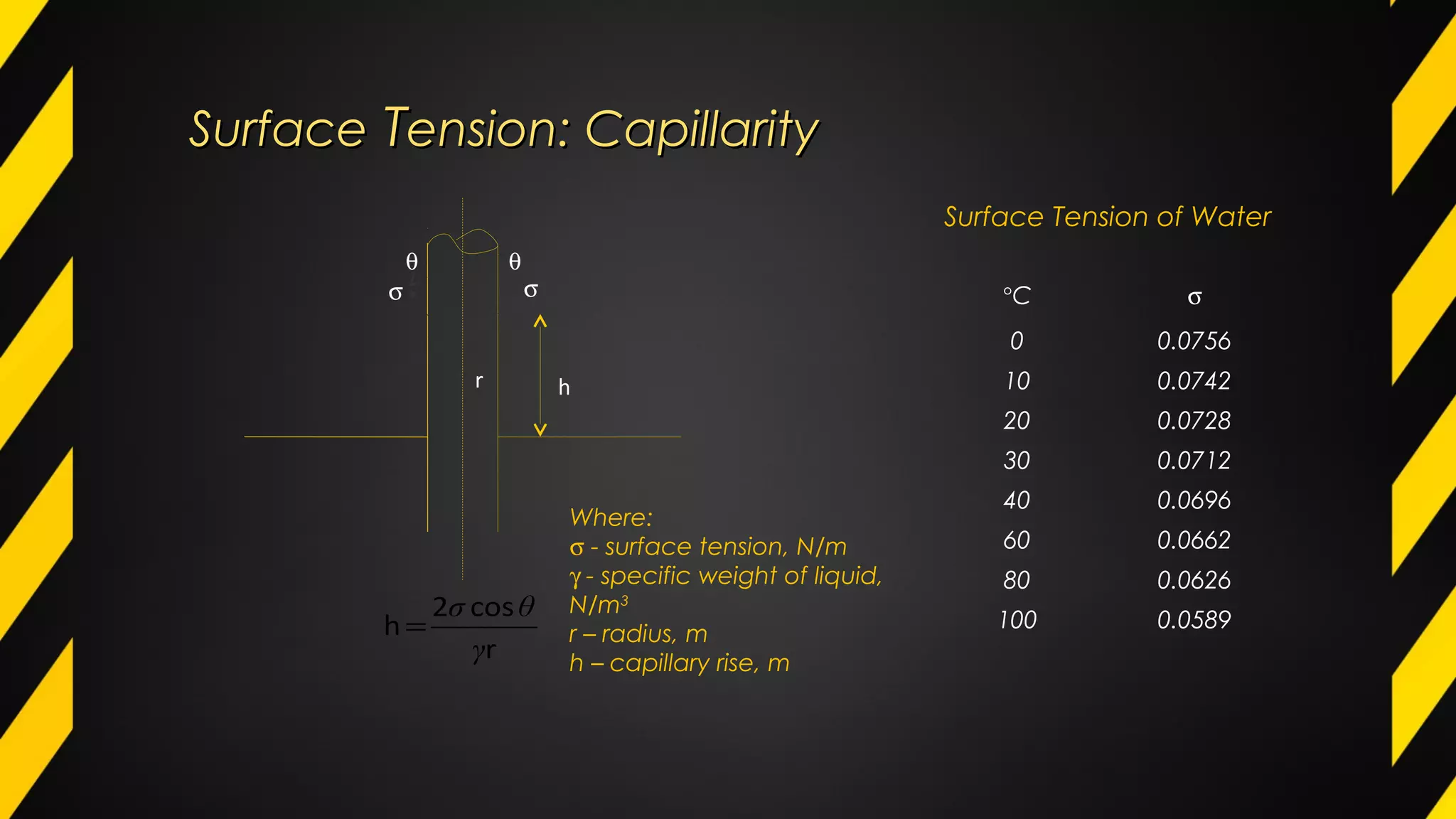
θ θ
r h
σ σ
SurfaceSurface TTension: Capillarityension: Capillarity
Where:
σ - surface tension, N/m
γ - specific weight of liquid,
N/m3
r – radius, m
h – capillary rise, m
°C σ
0 0.0756
10 0.0742
20 0.0728
30 0.0712
40 0.0696
60 0.0662
80 0.0626
100 0.0589
Surface Tension of Water
r
cos2
h
γ
θσ
=
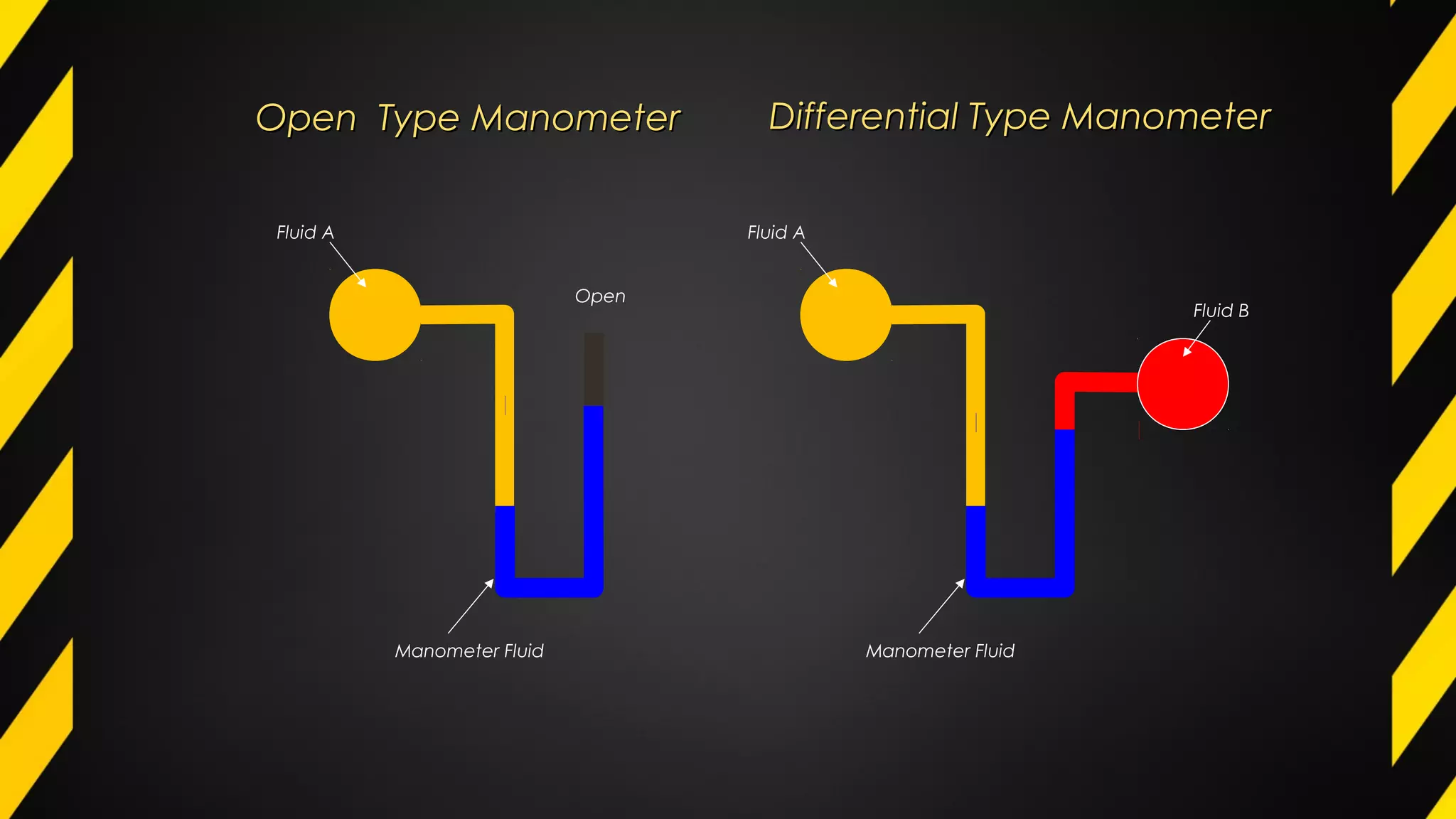
MANOMETERS
Manometer is an instrument used in measuring gage pressure in length of some liquid
column.
Open Type Manometer : It has an atmospheric surface and is capable in measuring
gage pressure.
 Differential Type Manometer : It has no atmospheric surface and is capable in
measuring differences of pressure.
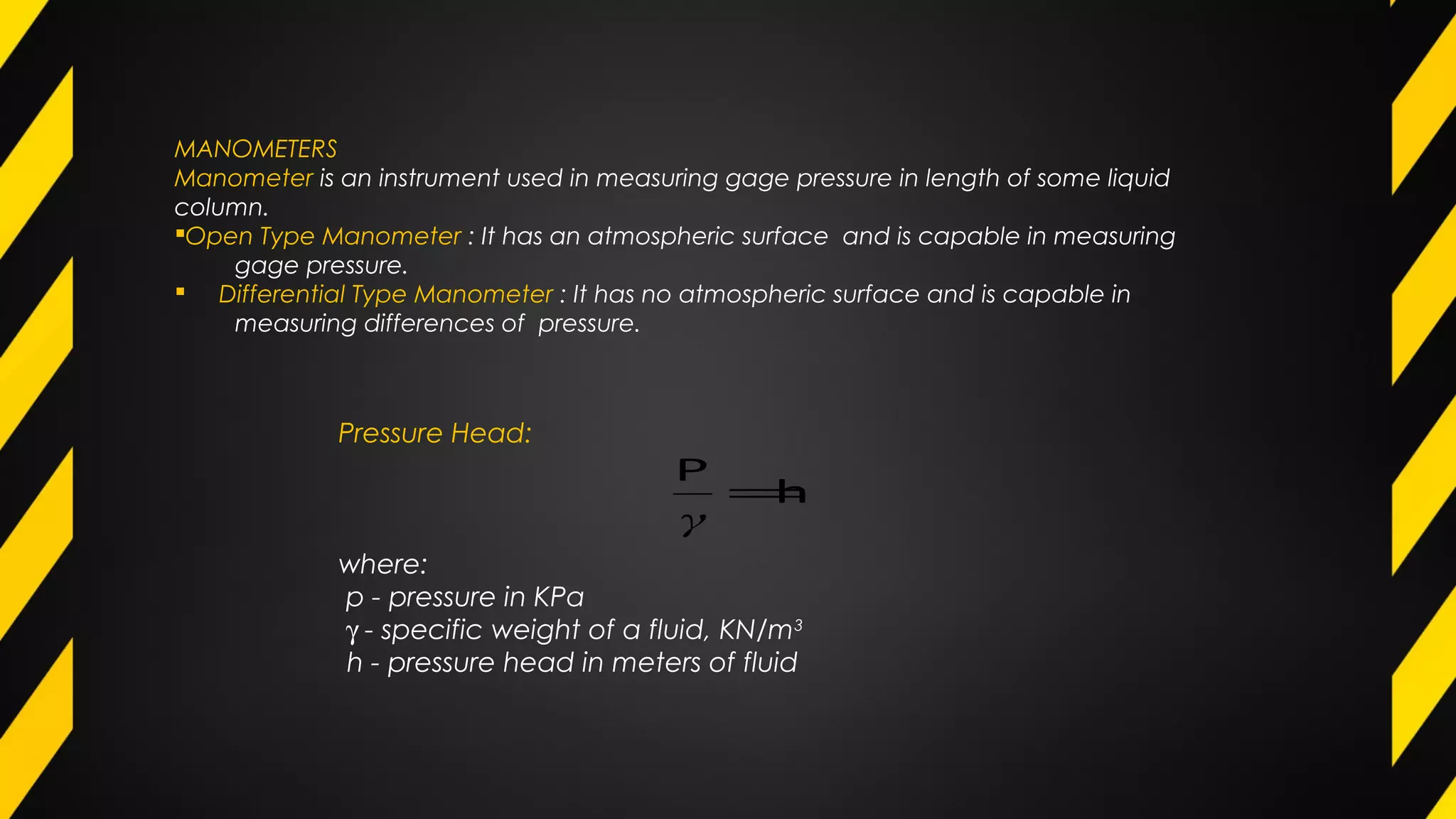
Pressure Head:
where:
p - pressure in KPa
γ - specific weight of a fluid, KN/m3
h - pressure head in meters of fluid
h
P
=
γ
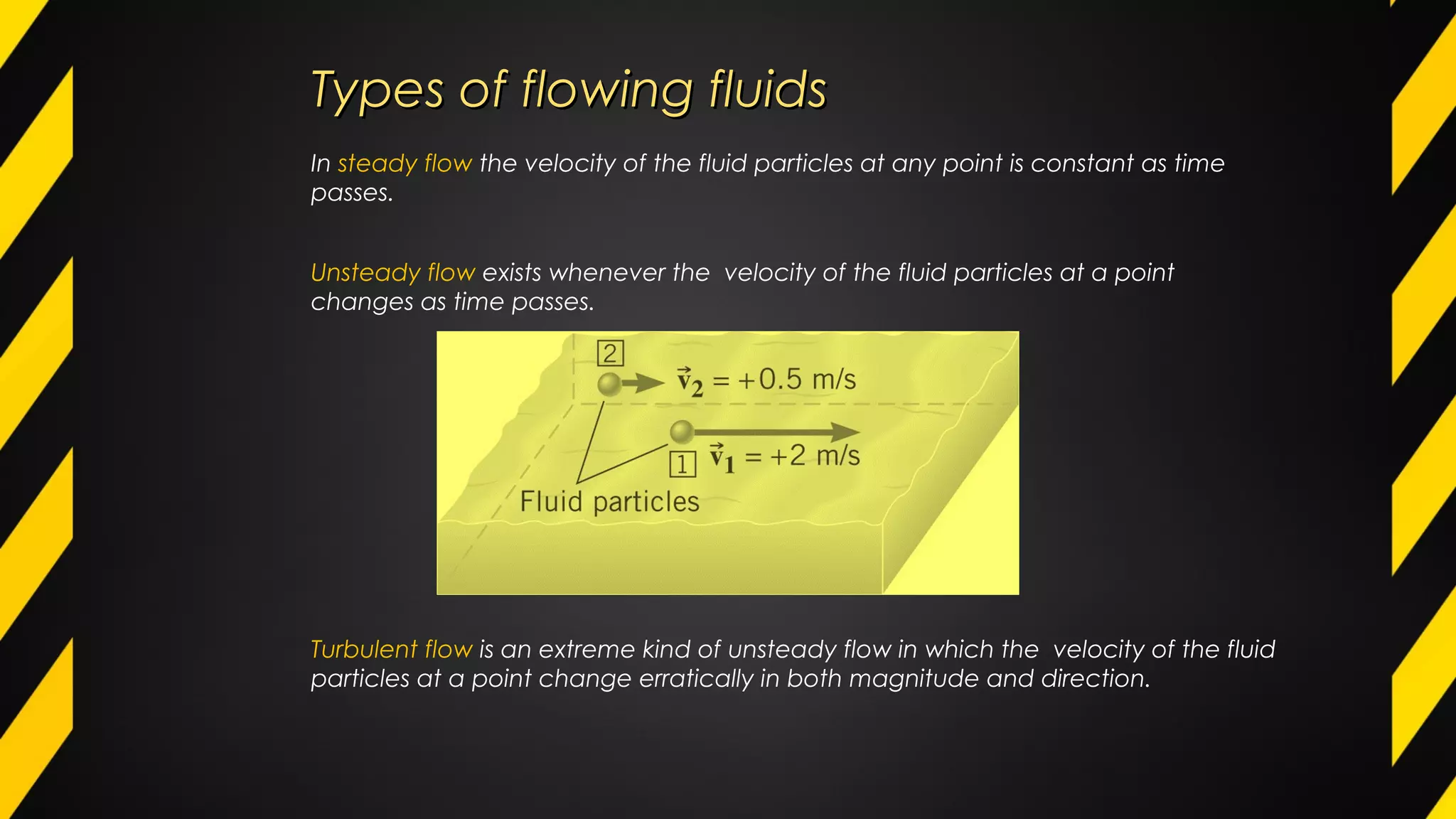
In steady flow the velocity of the fluid particles at any point is constant as time
passes.
Unsteady flow exists whenever the velocity of the fluid particles at a point
changes as time passes.
Turbulent flow is an extreme kind of unsteady flow in which the velocity of the fluid
particles at a point change erratically in both magnitude and direction.
Types of flowing fluidsTypes of flowing fluids
More types of fluid flowMore types of fluid flow
• Fluid flow can be compressible or incompressible.
• Most liquids are nearly incompressible.
• Fluid flow can be viscous or nonviscous.
• An incompressible, nonviscous fluid is called an ideal fluid.
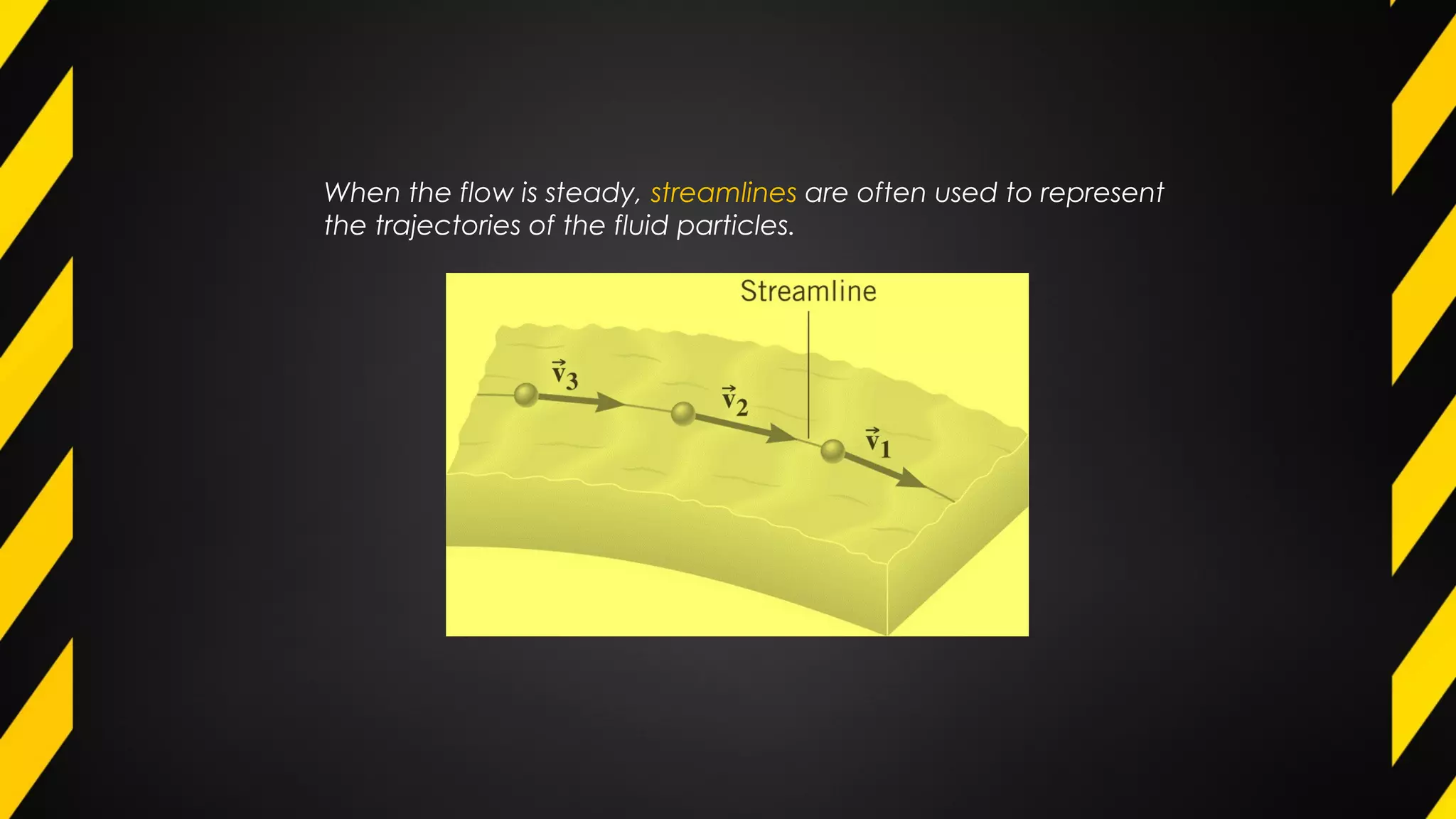
When the flow is steady, streamlines are often used to represent
the trajectories of the fluid particles.
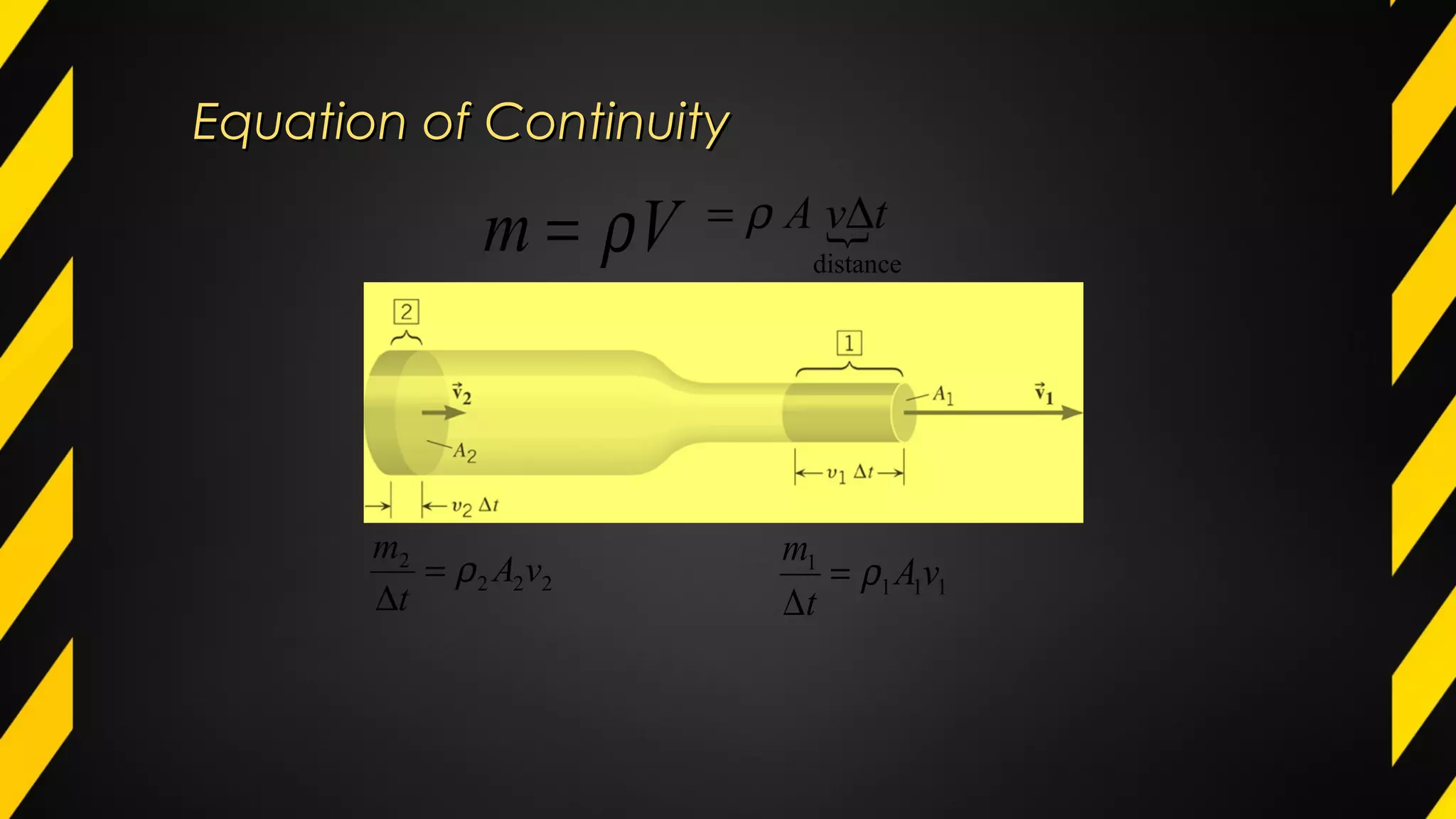
222
2
vA
t
m
ρ=
∆ 111
1
vA
t
m
ρ=
∆
Vm ρ=
Equation of ContinuityEquation of Continuity

distance
tvA ∆= ρ
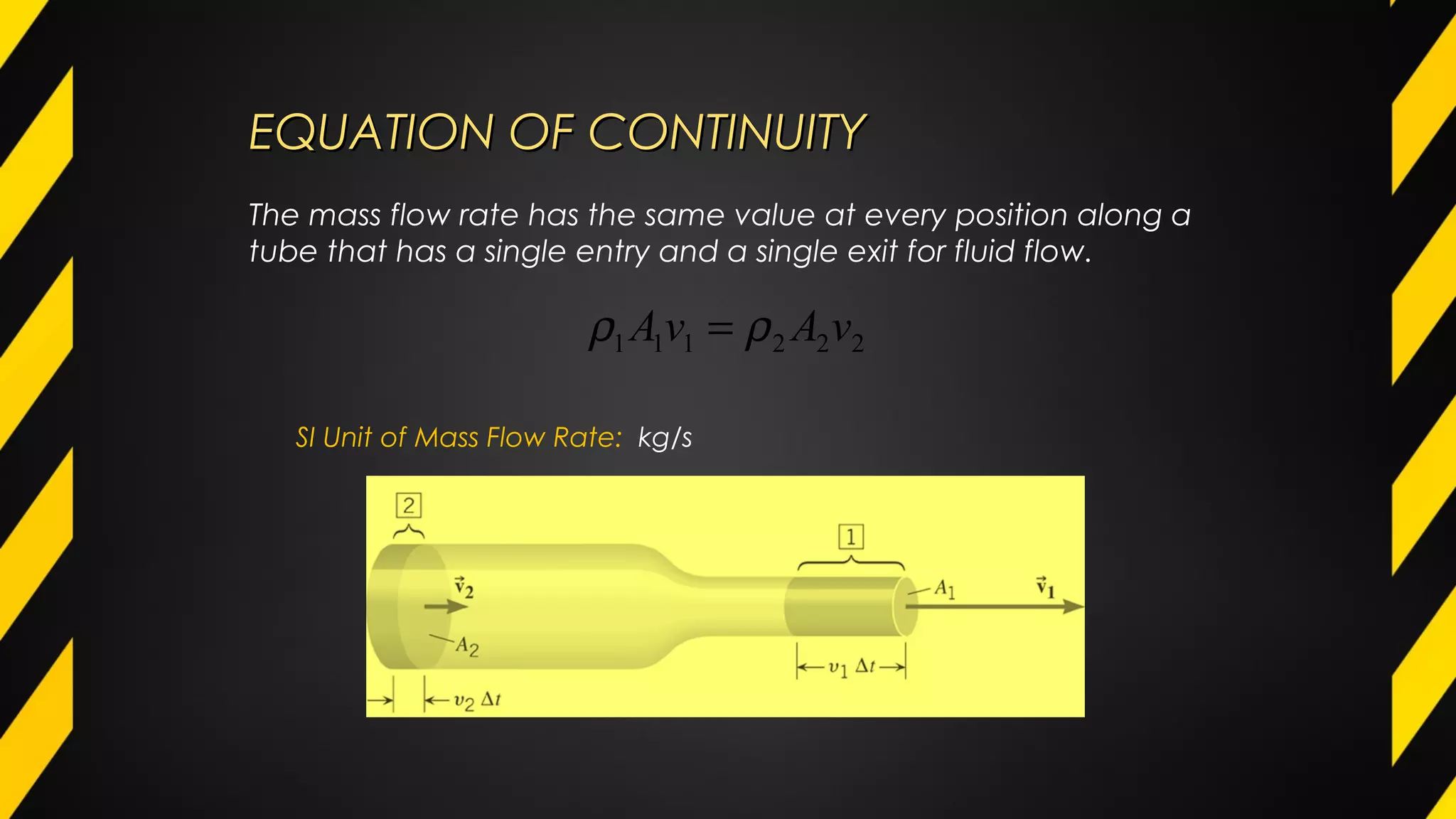
222111 vAvA ρρ =
EQUATION OF CONTINUITYEQUATION OF CONTINUITY
The mass flow rate has the same value at every position along a
tube that has a single entry and a single exit for fluid flow.
SI Unit of Mass Flow Rate: kg/s
Open Type ManometerOpen Type Manometer
Open
Manometer Fluid
Fluid A
Differential Type ManometerDifferential Type Manometer
Fluid B
Manometer Fluid
Fluid A
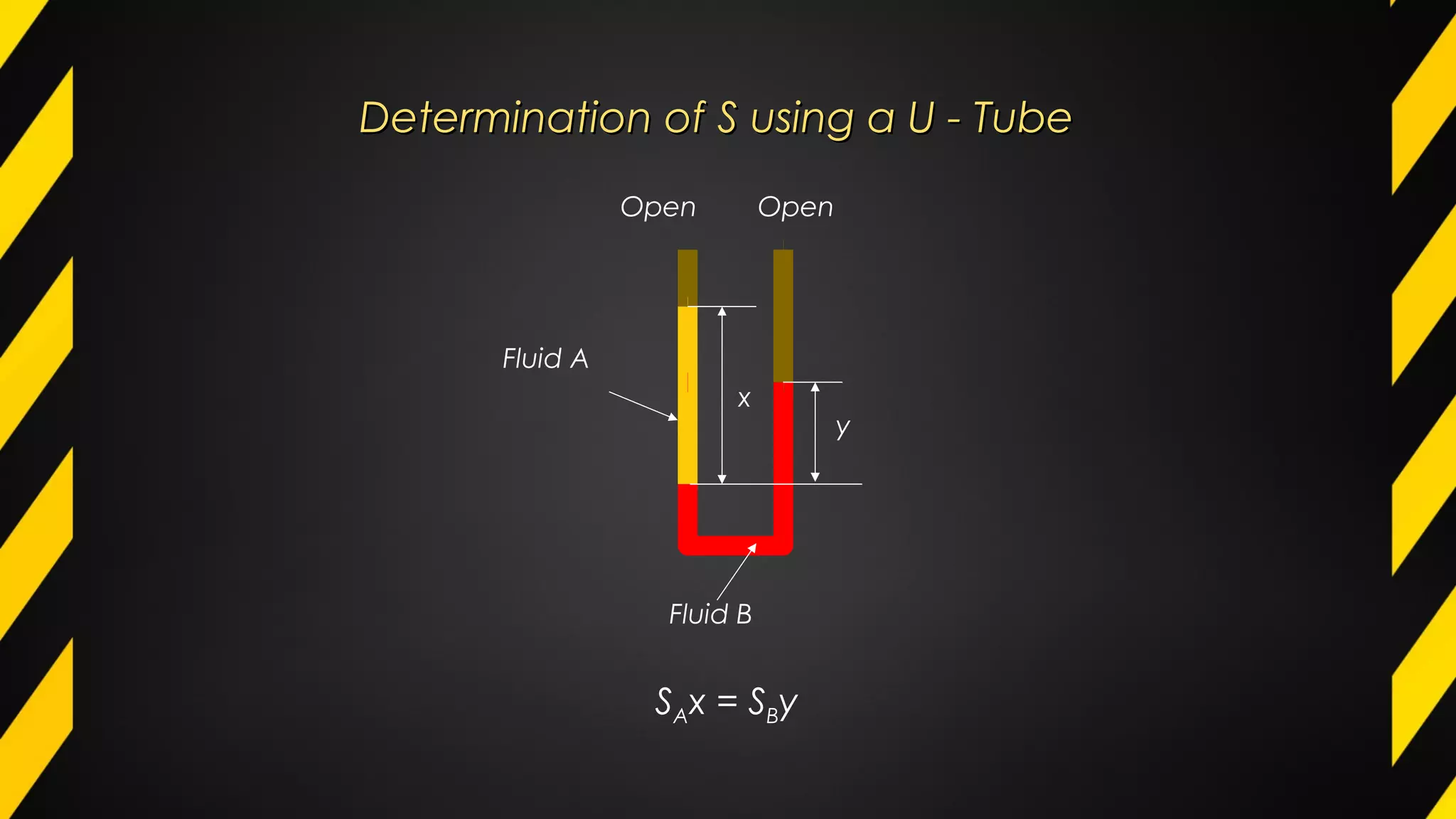
Determination of S using a U - TubeDetermination of S using a U - Tube
x
y
Open Open
Fluid A
Fluid B
SAx = SBy
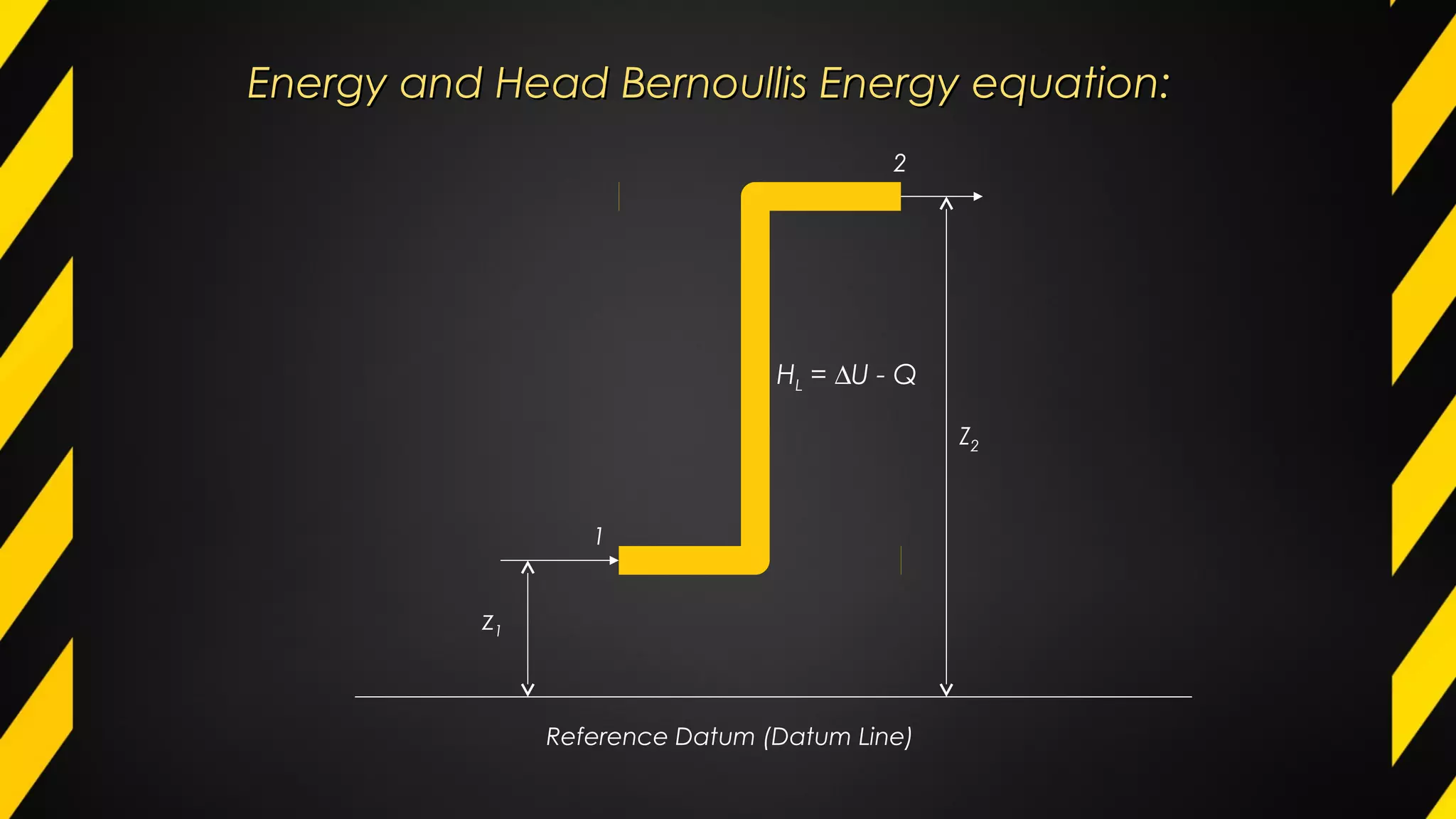
Energy and Head Bernoullis Energy equation:Energy and Head Bernoullis Energy equation:
Reference Datum (Datum Line)
1
2
z1
Z2
HL = ∆U - Q
BERNOULLI’S EQUATIONBERNOULLI’S EQUATION
In steady flow of a nonviscous, incompressible fluid, the pressure, the
fluid speed, and the elevation at two points are related by:
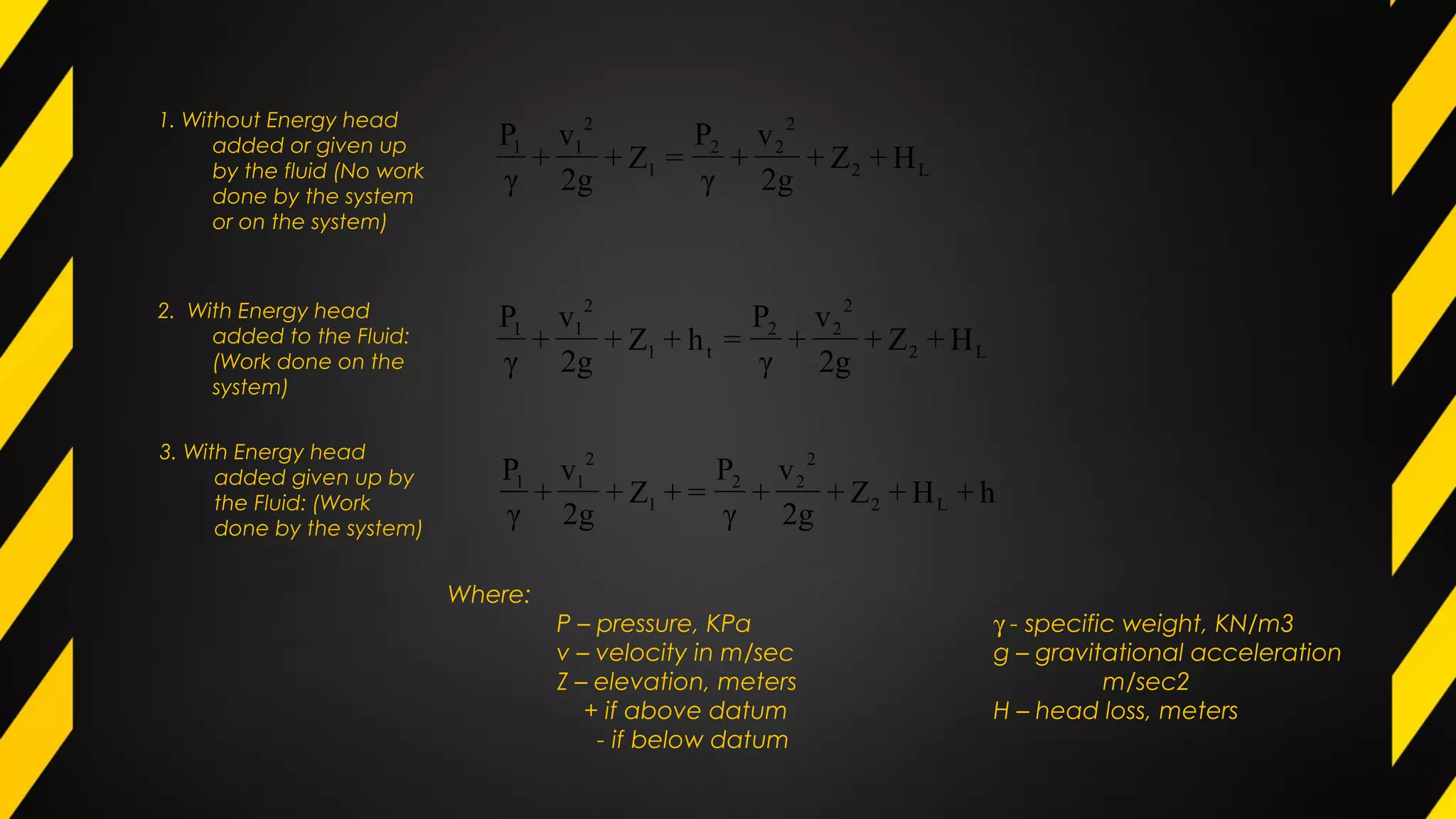
1. Without Energy head
added or given up
by the fluid (No work
done by the system
or on the system)
L2
2
22
t1
2
11
H+Z+
2g
v
+
γ
P
=h+Z+
2g
v
+
γ
P
L2
2
22
1
2
11
H+Z+
2g
v
+
γ
P
=Z+
2g
v
+
γ
P
h+H+Z+
2g
v
+
γ
P
=+Z+
2g
v
+
γ
P
L2
2
22
1
2
11
2. With Energy head
added to the Fluid:
(Work done on the
system)
3. With Energy head
added given up by
the Fluid: (Work
done by the system)
Where:
P – pressure, KPa γ - specific weight, KN/m3
v – velocity in m/sec g – gravitational acceleration
Z – elevation, meters m/sec2
+ if above datum H – head loss, meters
- if below datum
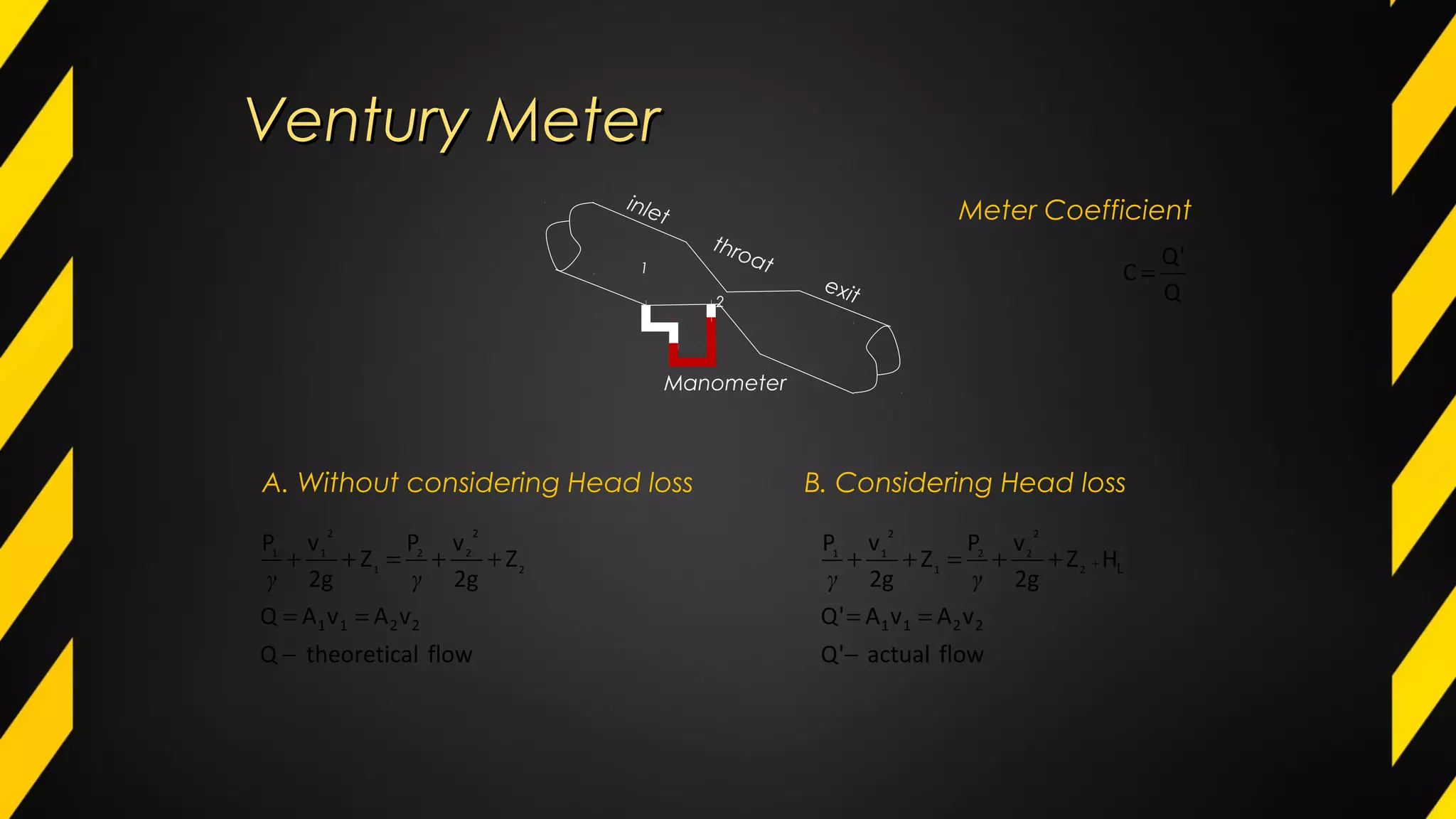
Ventury MeterVentury Meter
A. Without considering Head loss
flowltheoreticaQ
vAvAQ
Z
g2
vP
Z
g2
vP
2211
2
2
22
1
2
11
−
==
++=++
γγ
inlet
throat
exit
Manometer
1
2
B. Considering Head loss
flowactual'Q
vAvA'Q
HZ
g2
vP
Z
g2
vP
2211
L2
2
22
1
2
11
−
==
++=++ +
γγ
Meter Coefficient
Q
'Q
C =
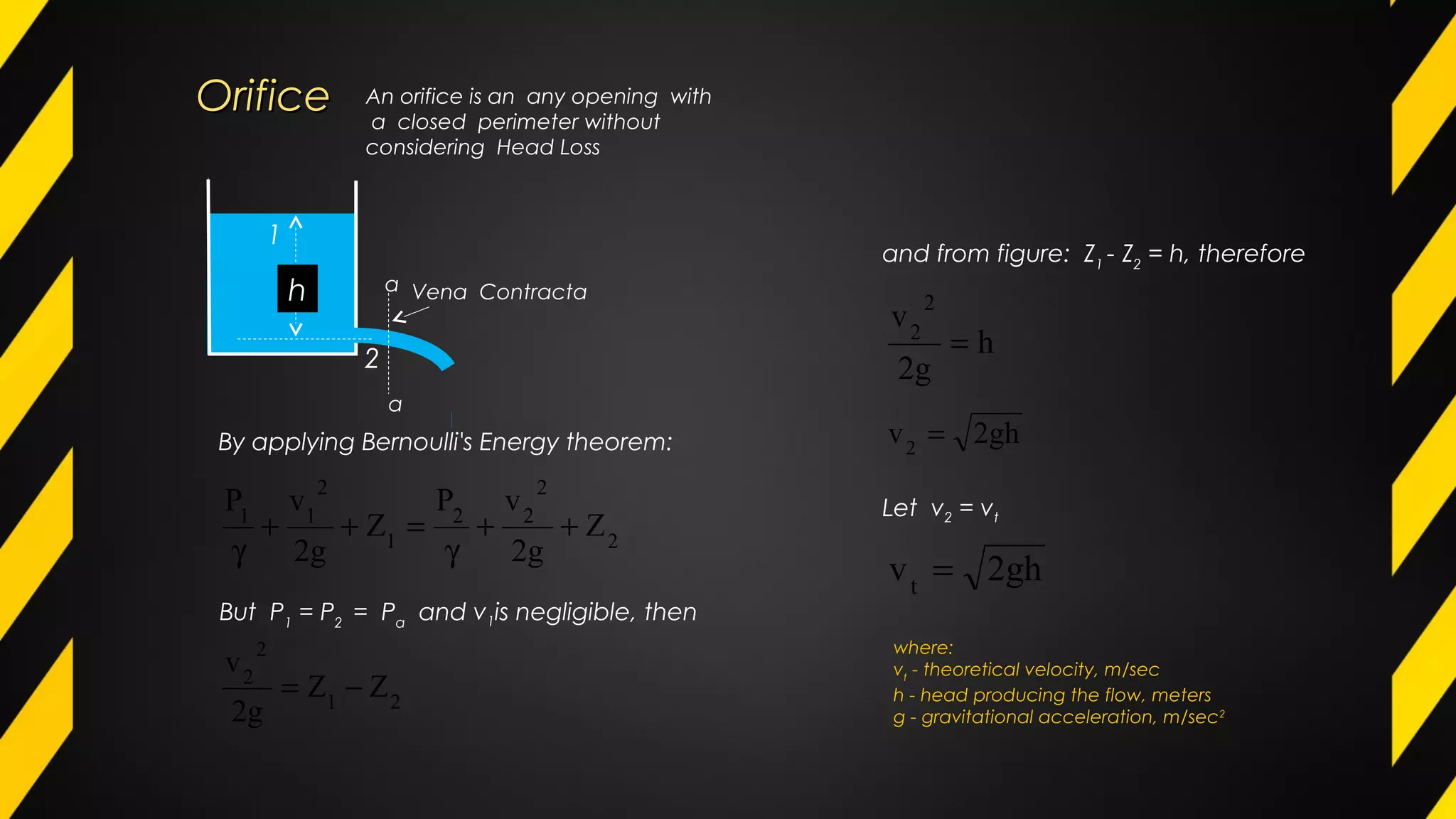
An orifice is an any opening with
a closed perimeter without
considering Head Loss
1
2
a
a
Vena Contractah
By applying Bernoulli's Energy theorem:
2
2
22
1
2
11
Z
g2
vP
Z
g2
vP
++
γ
=++
γ
But P1
= P2
= Pa
and v1is negligible, then
21
2
2
ZZ
g2
v
−=
and from figure: Z1
- Z2
= h, therefore
h
g2
v 2
2
=
gh2v2
=
Let v2 = vt
gh2vt
=
where:
vt
- theoretical velocity, m/sec
h - head producing the flow, meters
g - gravitational acceleration, m/sec2
OrificeOrifice
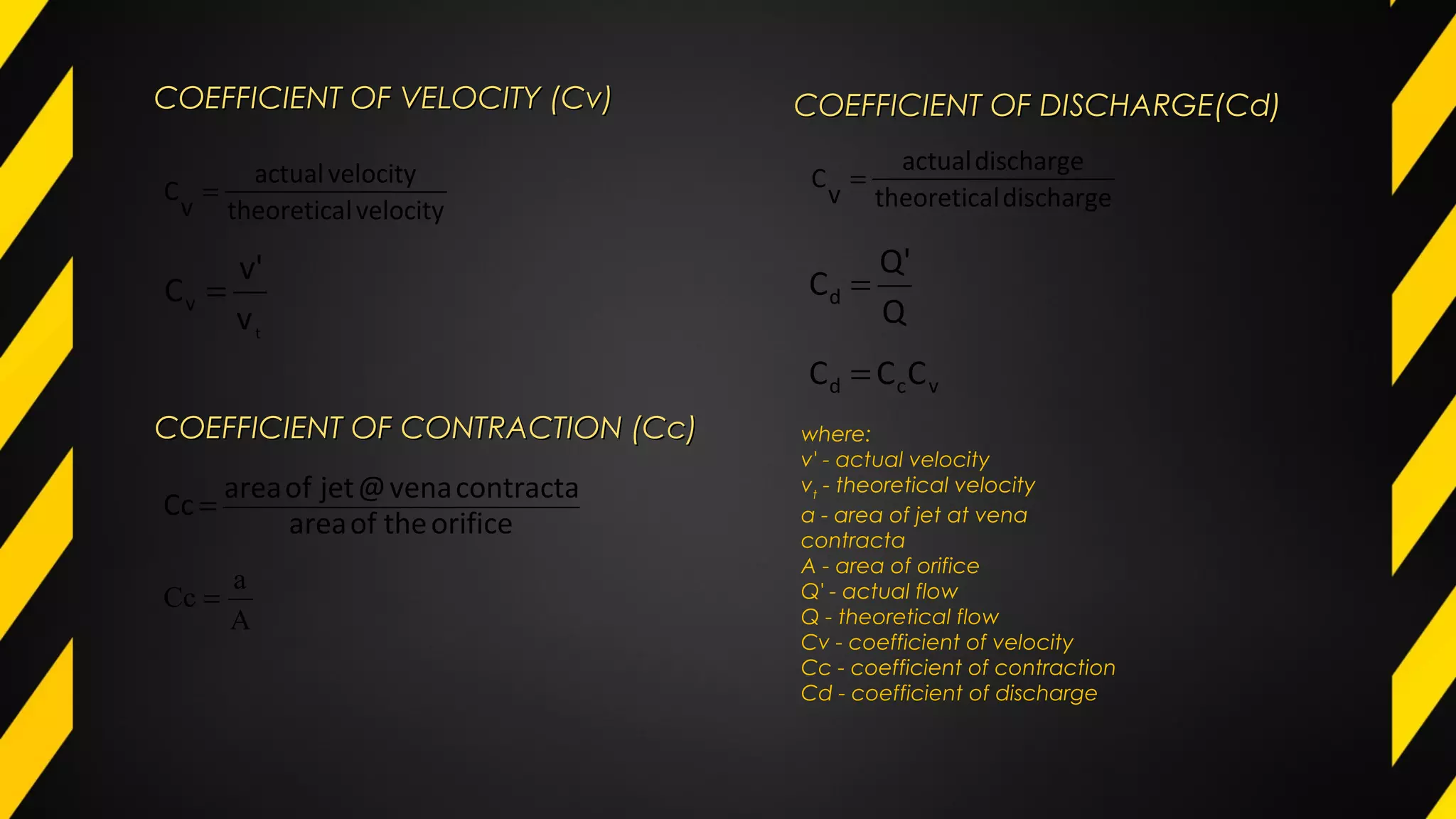
COEFFICIENT OF VELOCITY (Cv)COEFFICIENT OF VELOCITY (Cv)
velocityltheoretica
velocityactual
v
C =
t
v
v'
Cv =
COEFFICIENT OF CONTRACTION (Cc)COEFFICIENT OF CONTRACTION (Cc)
orificetheofarea
contractavena@jetofarea
Cc =
A
a
Cc =
COEFFICIENT OF DISCHARGE(Cd)COEFFICIENT OF DISCHARGE(Cd)
dischargeltheoretica
dischargeactual
v
C =
Q
Q'
Cd =
vcd CCC =
where:
v' - actual velocity
vt
- theoretical velocity
a - area of jet at vena
contracta
A - area of orifice
Q' - actual flow
Q - theoretical flow
Cv - coefficient of velocity
Cc - coefficient of contraction
Cd - coefficient of discharge
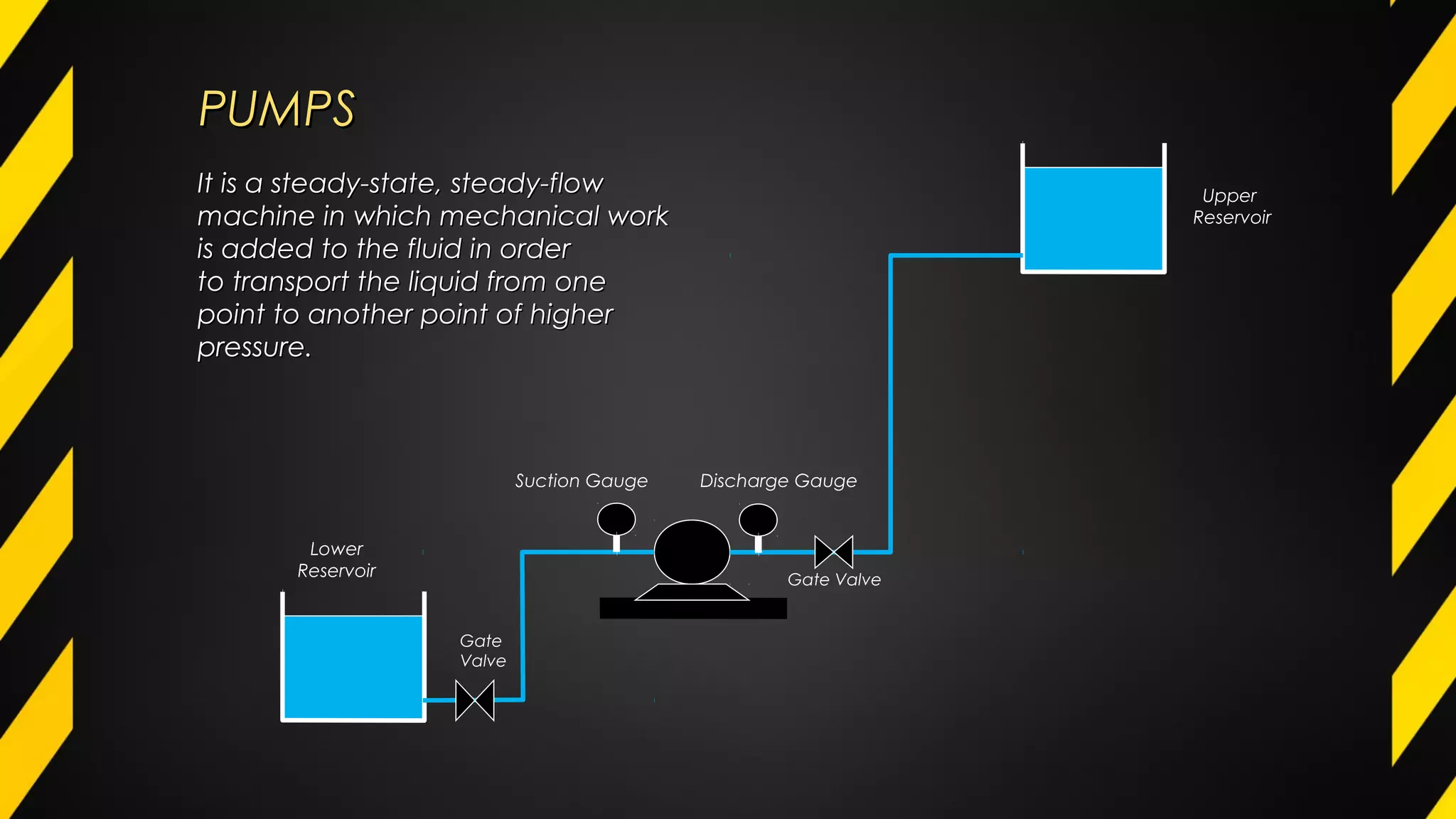
It is a steady-state, steady-flowIt is a steady-state, steady-flow
machine in which mechanical workmachine in which mechanical work
is added to the fluid in orderis added to the fluid in order
to transport the liquid from oneto transport the liquid from one
point to another point of higherpoint to another point of higher
pressure.pressure.
Lower
Reservoir
Upper
Reservoir
Suction Gauge Discharge Gauge
Gate Valve
Gate
Valve
PUMPSPUMPS
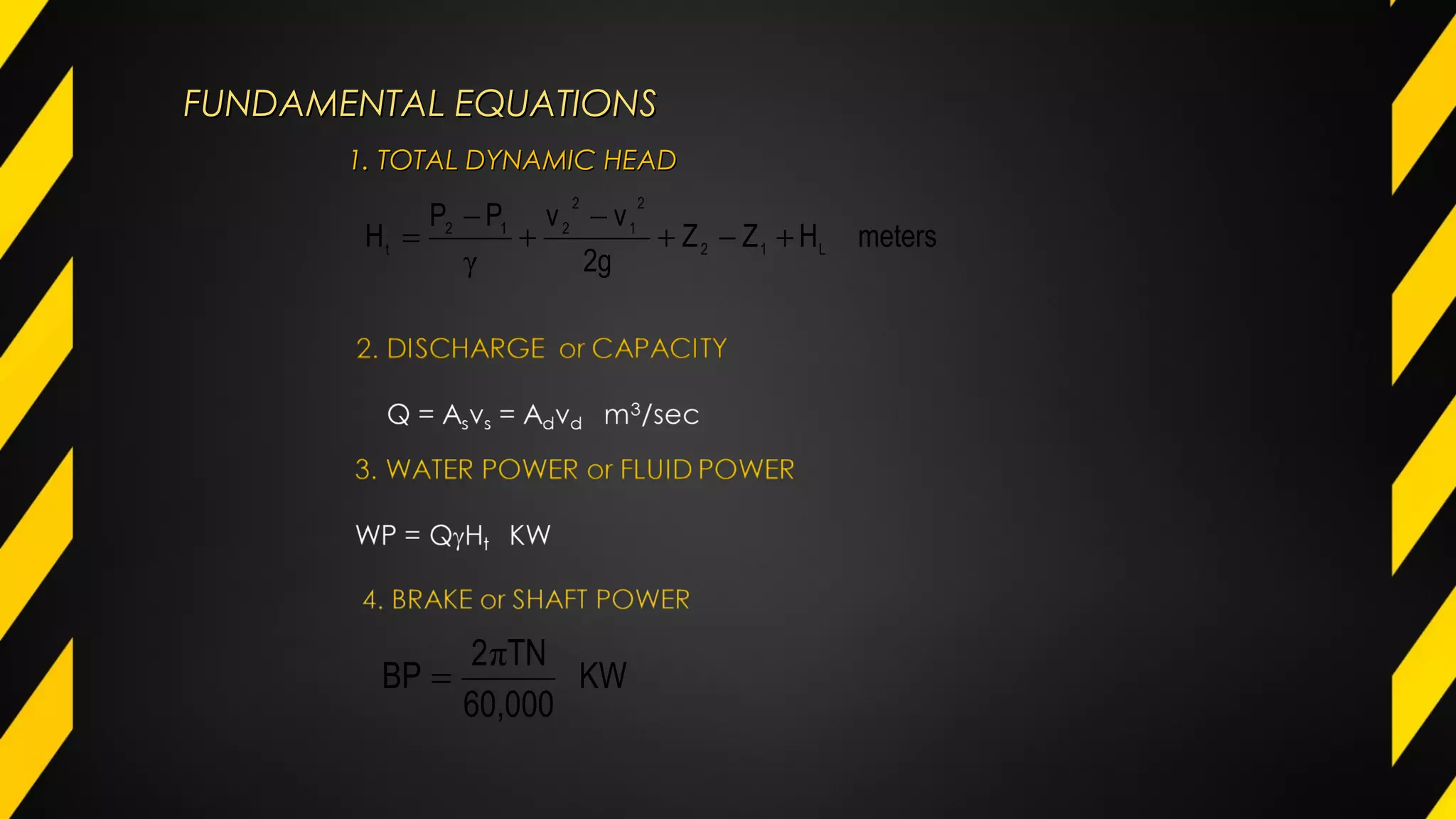
FUNDAMENTAL EQUATIONSFUNDAMENTAL EQUATIONS
1. TOTAL DYNAMIC HEAD1. TOTAL DYNAMIC HEAD
metersHZZ
2g
vvPP
H L12
2
1
2
212
t +−+
−
+
−
=
γ
KW
60,000
TN2
BP
π
=
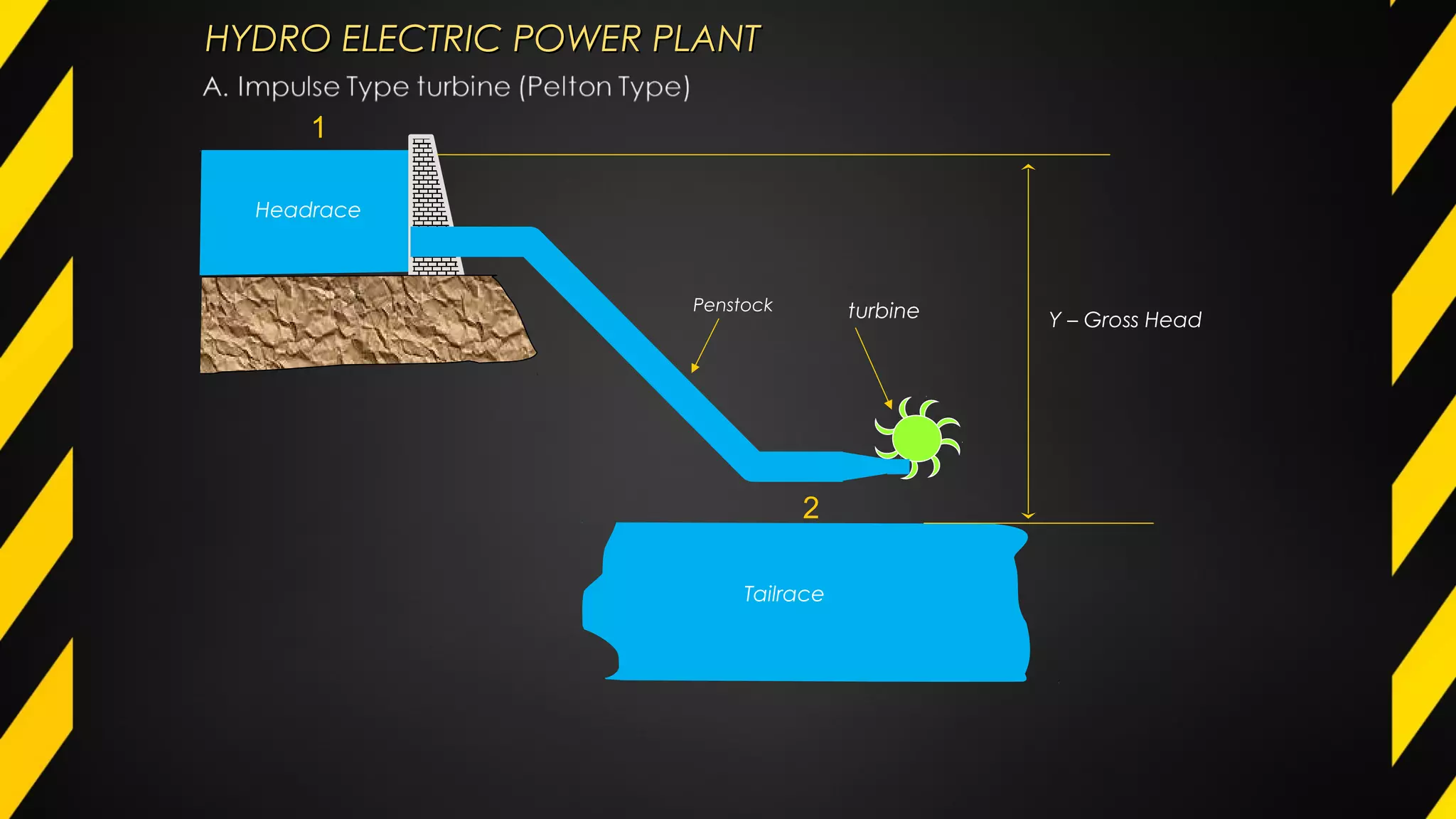
HYDRO ELECTRIC POWER PLANTHYDRO ELECTRIC POWER PLANT
Headrace
Tailrace
Y – Gross Head
Penstock turbine
1
2
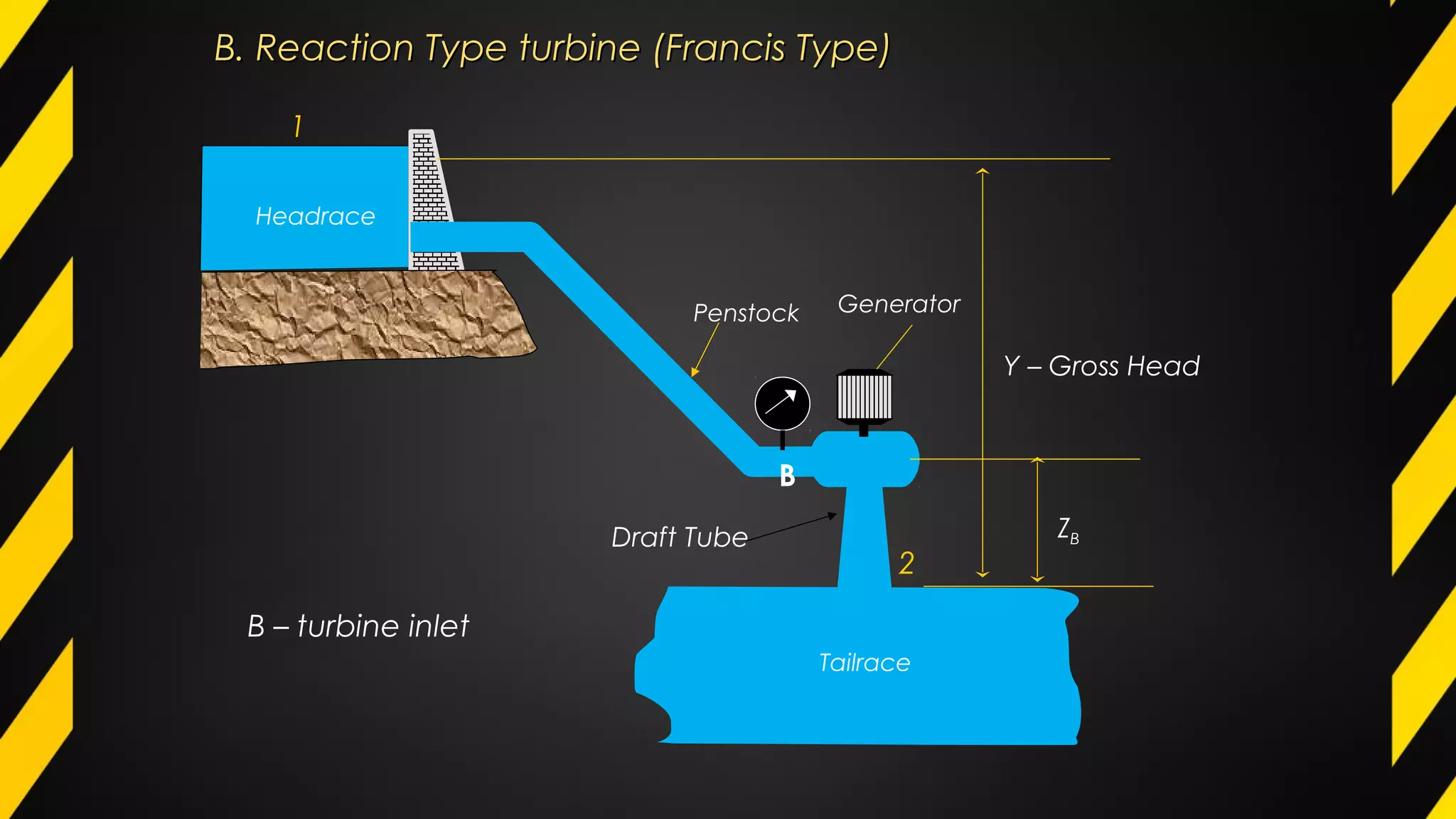
B. Reaction Type turbine (Francis Type)B. Reaction Type turbine (Francis Type)
Headrace
Tailrace
Y – Gross Head
Penstock
ZB
1
2
Draft Tube
B
Generator
B – turbine inlet
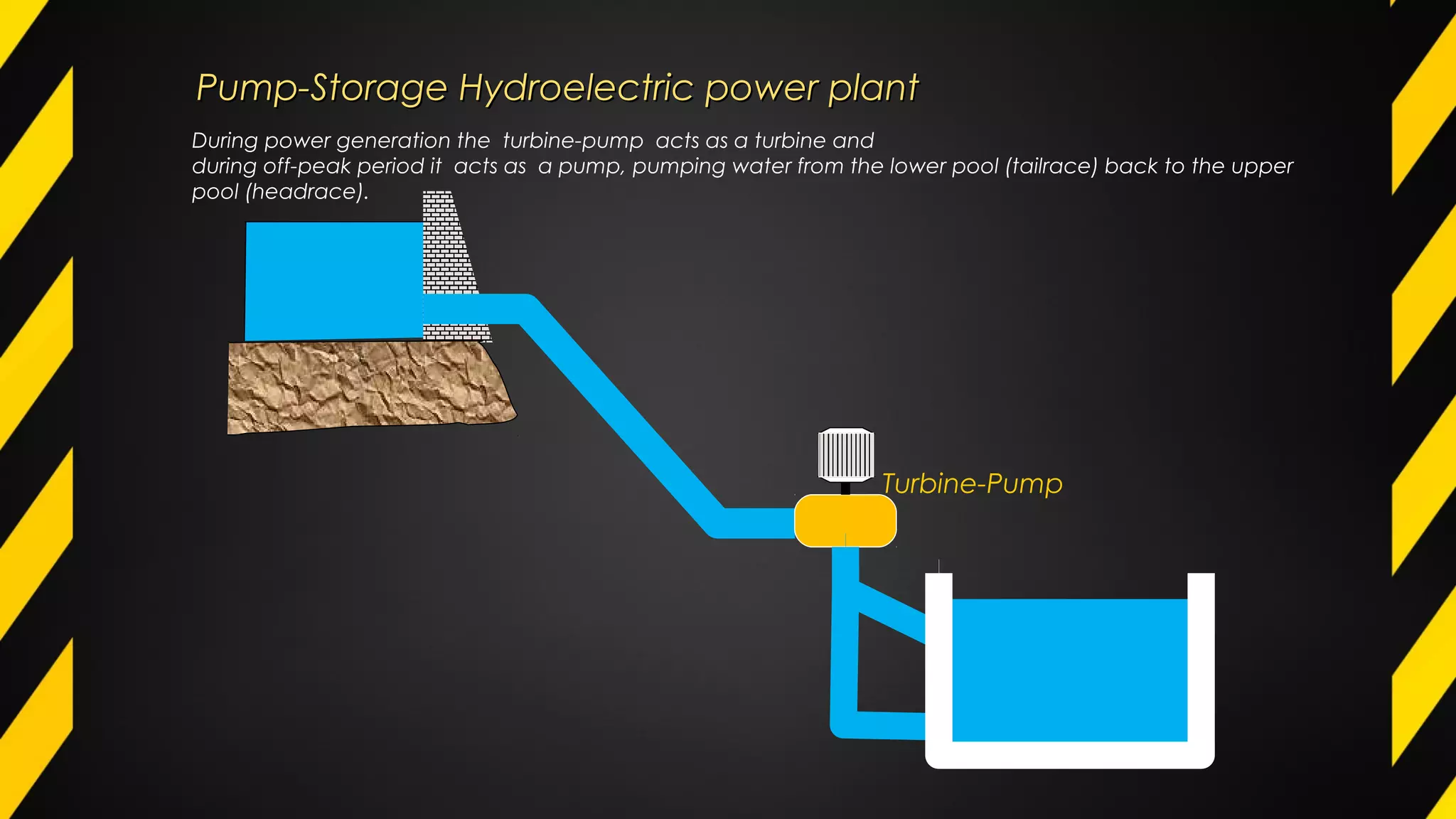
During power generation the turbine-pump acts as a turbine and
during off-peak period it acts as a pump, pumping water from the lower pool (tailrace) back to the upper
pool (headrace).
Turbine-Pump
Pump-Storage Hydroelectric power plantPump-Storage Hydroelectric power plant
Skillcruise.com

Fluid fundamentals

  • 1.
  • 2.
    FLUID MECHANICSFLUID MECHANICS 1.Density (1. Density (ρρ)) 3 m kg V m =ρ 2.Specific Volume (υ) kg m m V = 3 υ 3.Specific Weight3.Specific Weight ((γγ)) 3 m KN 1000 g 1000V mg V W = ρ ==γ Properties of FluidsProperties of Fluids
  • 3.
    Specific Gravity orRelative DensitySpecific Gravity or Relative Density For Liquids: Its specific gravityIts specific gravity (relative density) is equal to(relative density) is equal to the ratio of its density to thatthe ratio of its density to that of water at standardof water at standard temperature and pressure.temperature and pressure. W = γ γL W L L ρ ρ =S ah G γ γ = ah G G ρ ρ =S Where, At standard condition ρW = 1000 kg/m3 γW = 9.81 KN/m3
  • 4.
    Atmospheric pressure:Atmospheric pressure: Thepressure exerted by the atmosphere. At sea level condition: Pa = 101.325 KPa = .101325 Mpa = 1.01325Bar = 760 mm Hg = 10.33 m H2O = 1.133 kg/cm2 = 14.7 psi = 29.921 in Hg = 33.878 ft H2O Absolute and Gage Pressure Absolute Pressure: the pressure measured referred to absolute zero and using absolute zero as the base. Gage Pressure: the pressure measured referred to atmospheric pressure, and using atmospheric pressure as the base
  • 5.
    Atmospheric PressureAtmospheric Pressure •Atmospheric pressure is normally about 100,000 Pa • Differences in atmospheric pressure cause winds to blow • Low atmospheric pressure inside a hurricane’s eye contributes to the severe winds and the development of the storm surge
  • 6.
    Viscosity:Viscosity: A propertyAproperty that determines thethat determines the amount of its resistanceamount of its resistance to shearing stressto shearing stress xx dxdx v+dvv+dv vv moving platemoving plate Fixed plateFixed plate vv S∞ dv/dx S = µ(dv/dx) S = µ(v/x) µ = S/(v/x) where: µ - absolute or dynamic viscosity in Pa-sec S - shearing stress in Pascal v - velocity in m/sec x -distance in meters
  • 7.
    θ θ r h σσ SurfaceSurface TTension: Capillarityension: Capillarity Where: σ - surface tension, N/m γ - specific weight of liquid, N/m3 r – radius, m h – capillary rise, m °C σ 0 0.0756 10 0.0742 20 0.0728 30 0.0712 40 0.0696 60 0.0662 80 0.0626 100 0.0589 Surface Tension of Water r cos2 h γ θσ =
  • 8.
    MANOMETERS Manometer is aninstrument used in measuring gage pressure in length of some liquid column. Open Type Manometer : It has an atmospheric surface and is capable in measuring gage pressure.  Differential Type Manometer : It has no atmospheric surface and is capable in measuring differences of pressure. Pressure Head: where: p - pressure in KPa γ - specific weight of a fluid, KN/m3 h - pressure head in meters of fluid h P = γ
  • 9.
    In steady flowthe velocity of the fluid particles at any point is constant as time passes. Unsteady flow exists whenever the velocity of the fluid particles at a point changes as time passes. Turbulent flow is an extreme kind of unsteady flow in which the velocity of the fluid particles at a point change erratically in both magnitude and direction. Types of flowing fluidsTypes of flowing fluids
  • 10.
    More types offluid flowMore types of fluid flow • Fluid flow can be compressible or incompressible. • Most liquids are nearly incompressible. • Fluid flow can be viscous or nonviscous. • An incompressible, nonviscous fluid is called an ideal fluid.
  • 11.
    When the flowis steady, streamlines are often used to represent the trajectories of the fluid particles.
  • 12.
    222 2 vA t m ρ= ∆ 111 1 vA t m ρ= ∆ Vm ρ= Equationof ContinuityEquation of Continuity  distance tvA ∆= ρ
  • 13.
    222111 vAvA ρρ= EQUATION OF CONTINUITYEQUATION OF CONTINUITY The mass flow rate has the same value at every position along a tube that has a single entry and a single exit for fluid flow. SI Unit of Mass Flow Rate: kg/s
  • 14.
    Open Type ManometerOpenType Manometer Open Manometer Fluid Fluid A Differential Type ManometerDifferential Type Manometer Fluid B Manometer Fluid Fluid A
  • 15.
    Determination of Susing a U - TubeDetermination of S using a U - Tube x y Open Open Fluid A Fluid B SAx = SBy
  • 16.
    Energy and HeadBernoullis Energy equation:Energy and Head Bernoullis Energy equation: Reference Datum (Datum Line) 1 2 z1 Z2 HL = ∆U - Q
  • 17.
    BERNOULLI’S EQUATIONBERNOULLI’S EQUATION Insteady flow of a nonviscous, incompressible fluid, the pressure, the fluid speed, and the elevation at two points are related by:
  • 18.
    1. Without Energyhead added or given up by the fluid (No work done by the system or on the system) L2 2 22 t1 2 11 H+Z+ 2g v + γ P =h+Z+ 2g v + γ P L2 2 22 1 2 11 H+Z+ 2g v + γ P =Z+ 2g v + γ P h+H+Z+ 2g v + γ P =+Z+ 2g v + γ P L2 2 22 1 2 11 2. With Energy head added to the Fluid: (Work done on the system) 3. With Energy head added given up by the Fluid: (Work done by the system) Where: P – pressure, KPa γ - specific weight, KN/m3 v – velocity in m/sec g – gravitational acceleration Z – elevation, meters m/sec2 + if above datum H – head loss, meters - if below datum
  • 19.
    Ventury MeterVentury Meter A.Without considering Head loss flowltheoreticaQ vAvAQ Z g2 vP Z g2 vP 2211 2 2 22 1 2 11 − == ++=++ γγ inlet throat exit Manometer 1 2 B. Considering Head loss flowactual'Q vAvA'Q HZ g2 vP Z g2 vP 2211 L2 2 22 1 2 11 − == ++=++ + γγ Meter Coefficient Q 'Q C =
  • 20.
    An orifice isan any opening with a closed perimeter without considering Head Loss 1 2 a a Vena Contractah By applying Bernoulli's Energy theorem: 2 2 22 1 2 11 Z g2 vP Z g2 vP ++ γ =++ γ But P1 = P2 = Pa and v1is negligible, then 21 2 2 ZZ g2 v −= and from figure: Z1 - Z2 = h, therefore h g2 v 2 2 = gh2v2 = Let v2 = vt gh2vt = where: vt - theoretical velocity, m/sec h - head producing the flow, meters g - gravitational acceleration, m/sec2 OrificeOrifice
  • 21.
    COEFFICIENT OF VELOCITY(Cv)COEFFICIENT OF VELOCITY (Cv) velocityltheoretica velocityactual v C = t v v' Cv = COEFFICIENT OF CONTRACTION (Cc)COEFFICIENT OF CONTRACTION (Cc) orificetheofarea contractavena@jetofarea Cc = A a Cc = COEFFICIENT OF DISCHARGE(Cd)COEFFICIENT OF DISCHARGE(Cd) dischargeltheoretica dischargeactual v C = Q Q' Cd = vcd CCC = where: v' - actual velocity vt - theoretical velocity a - area of jet at vena contracta A - area of orifice Q' - actual flow Q - theoretical flow Cv - coefficient of velocity Cc - coefficient of contraction Cd - coefficient of discharge
  • 22.
    It is asteady-state, steady-flowIt is a steady-state, steady-flow machine in which mechanical workmachine in which mechanical work is added to the fluid in orderis added to the fluid in order to transport the liquid from oneto transport the liquid from one point to another point of higherpoint to another point of higher pressure.pressure. Lower Reservoir Upper Reservoir Suction Gauge Discharge Gauge Gate Valve Gate Valve PUMPSPUMPS
  • 23.
    FUNDAMENTAL EQUATIONSFUNDAMENTAL EQUATIONS 1.TOTAL DYNAMIC HEAD1. TOTAL DYNAMIC HEAD metersHZZ 2g vvPP H L12 2 1 2 212 t +−+ − + − = γ KW 60,000 TN2 BP π =
  • 24.
    HYDRO ELECTRIC POWERPLANTHYDRO ELECTRIC POWER PLANT Headrace Tailrace Y – Gross Head Penstock turbine 1 2
  • 25.
    B. Reaction Typeturbine (Francis Type)B. Reaction Type turbine (Francis Type) Headrace Tailrace Y – Gross Head Penstock ZB 1 2 Draft Tube B Generator B – turbine inlet
  • 26.
    During power generationthe turbine-pump acts as a turbine and during off-peak period it acts as a pump, pumping water from the lower pool (tailrace) back to the upper pool (headrace). Turbine-Pump Pump-Storage Hydroelectric power plantPump-Storage Hydroelectric power plant
  • 27.

Editor's Notes