Basic Fluid
Basic Fluid
Mechanics
Mechanics
Presenter:
Presenter:
Dr.Barhm Abdullah Mohamad
Dr. Barhm Abdullah Mohamad
PhD in Mechanical Engineering
PhD in Mechanical Engineering
Department of Petroleum Technology, Koya Technical Institute, Erbil Polytechnic
Department of Petroleum Technology, Koya Technical Institute, Erbil Polytechnic
University, 44001 Erbil, Iraq
University, 44001 Erbil, Iraq
Scopus ID: 57194050884
Scopus ID: 57194050884
Research ID: G-4516-2017
Research ID: G-4516-2017
Phone: 009647512209152
Phone: 009647512209152
Email: barhm.Mohamad@epu.edu.iq
Email: barhm.Mohamad@epu.edu.iq
2.
Introduction
Introduction
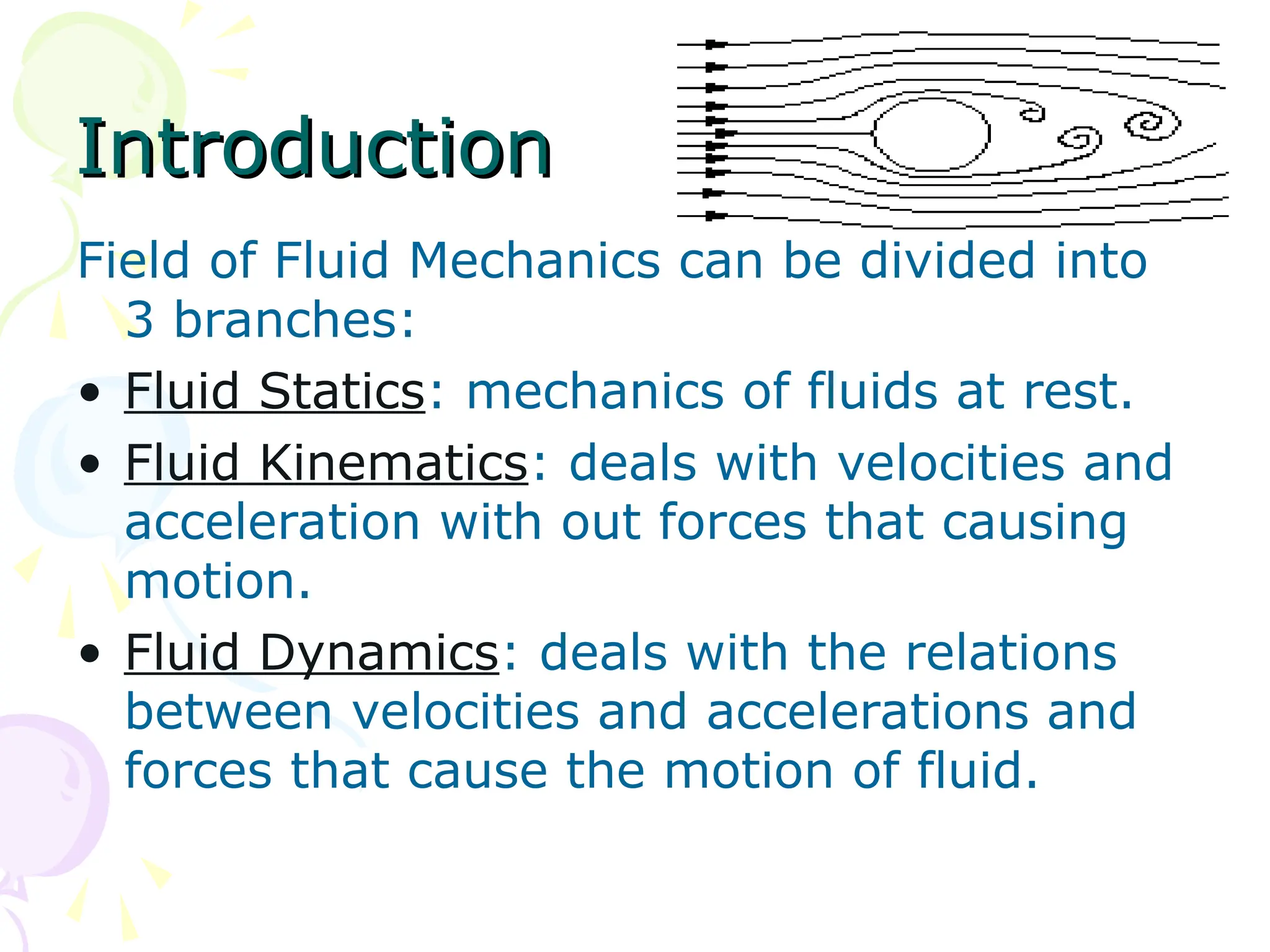
Field of FluidMechanics can be divided into
3 branches:
• Fluid Statics: mechanics of fluids at rest.
• Fluid Kinematics: deals with velocities and
acceleration with out forces that causing
motion.
• Fluid Dynamics: deals with the relations
between velocities and accelerations and
forces that cause the motion of fluid.
3.
Fluid mechanic ismain subject of :
Fluid mechanic is main subject of :
Mechanics of fluids is extremely important in
many areas of engineering and science.
Examples are:
• Mechanical engineering:
– Pipeline projects.
– Design of tanks.
– Design of pumps, turbines, air-conditioning
equipment.
• Petroleum Engineering
– Mud logging, cementing.
• Chemical Engineering
– Design of chemical processing equipment.
4.
Dimensions and Units
Dimensionsand Units
In fluid mechanics, we are using units
of
• U.S: two primary sets of units are
used:
– SI (System International) units
– English units
5.
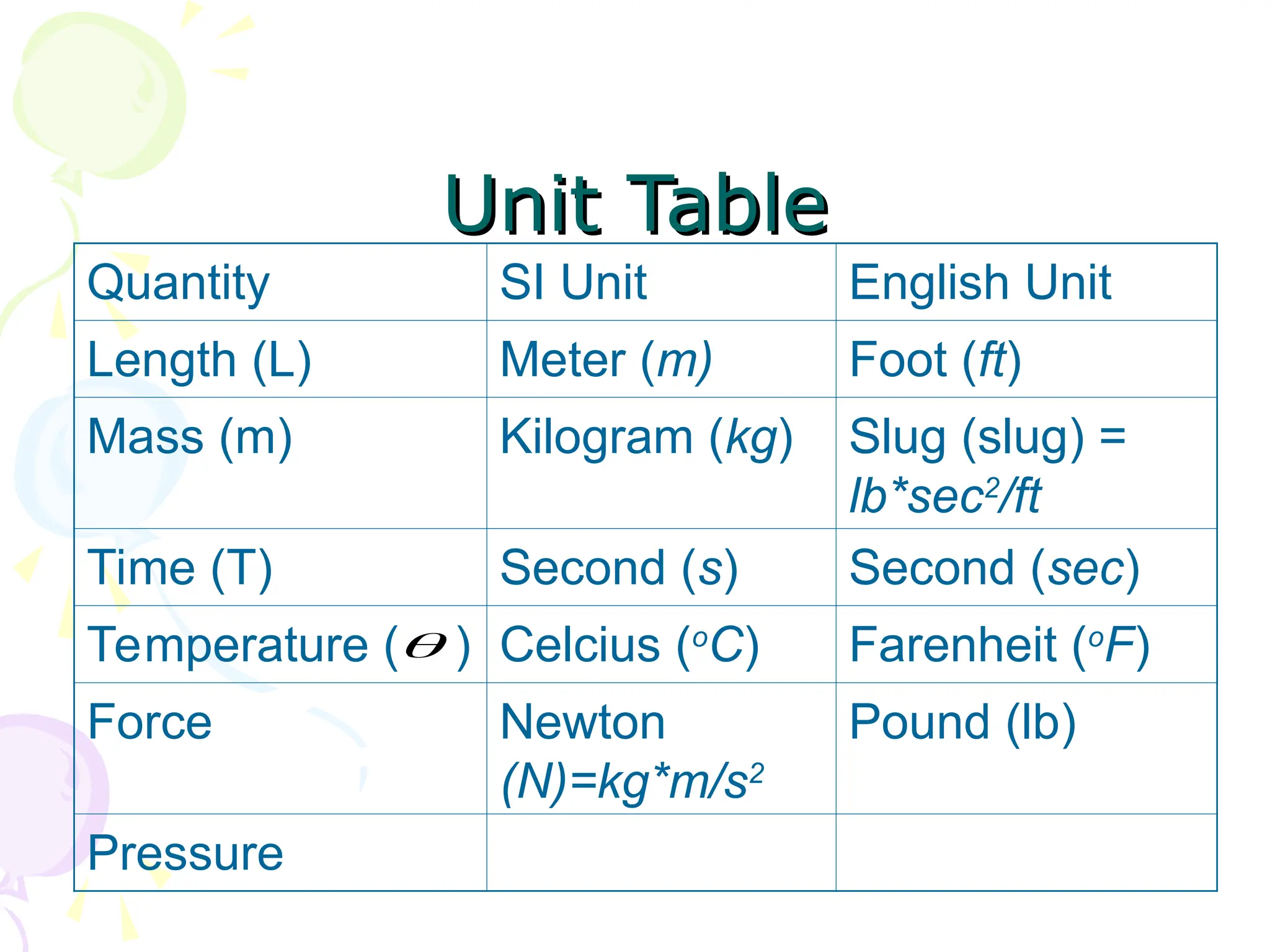
Unit Table
Unit Table
QuantitySI Unit English Unit
Length (L) Meter (m) Foot (ft)
Mass (m) Kilogram (kg) Slug (slug) =
lb*sec2
/ft
Time (T) Second (s) Second (sec)
Temperature ( ) Celcius (o
C) Farenheit (o
F)
Force Newton
(N)=kg*m/s2
Pound (lb)
Pressure
6.
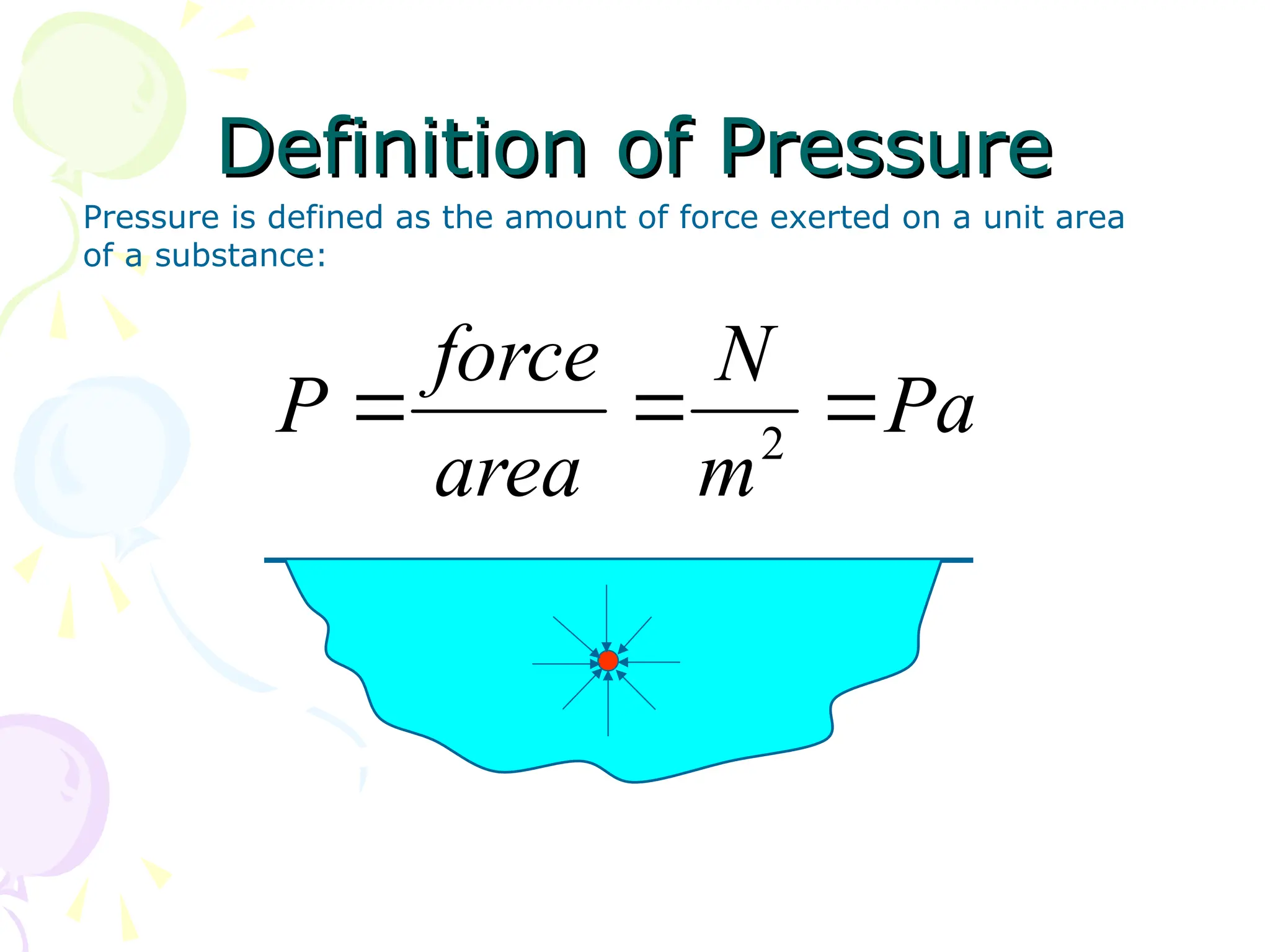
Definition of Pressure
Definitionof Pressure
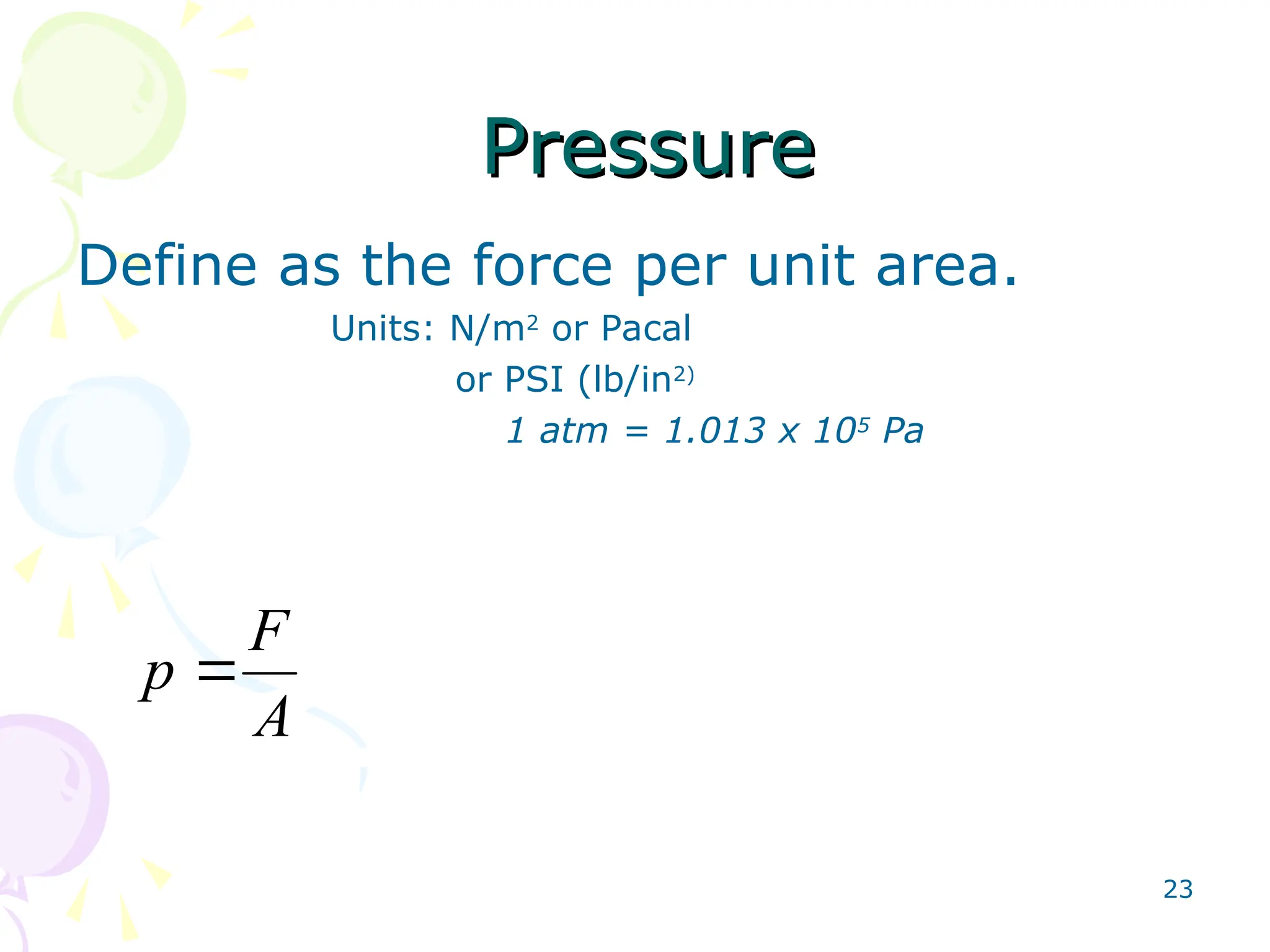
Pressure is defined as the amount of force exerted on a unit area
of a substance:
Pa
m
N
area
force
P
2
7.
Weight
Weight
• Weight (W): is defined as mass on the earth
surface.
W = m . g
Where :
g = gravitational acceleration
g = 9.81 m/s2
in SI units
g = 32.2 ft/sec2
in English units
8.
Density and specificweight
Density (mass per unit
volume):
m
V
[ ]
[ ]
[ ]
( )
m
V
kg
m
in SI units
3
Units of density:
Specific weight (weight per unit
volume):
[ ] [ ][ ] ( )
g
kg
m
m
s
N
m
in SI units
3 2 3
Units of specific weight:
g
9.
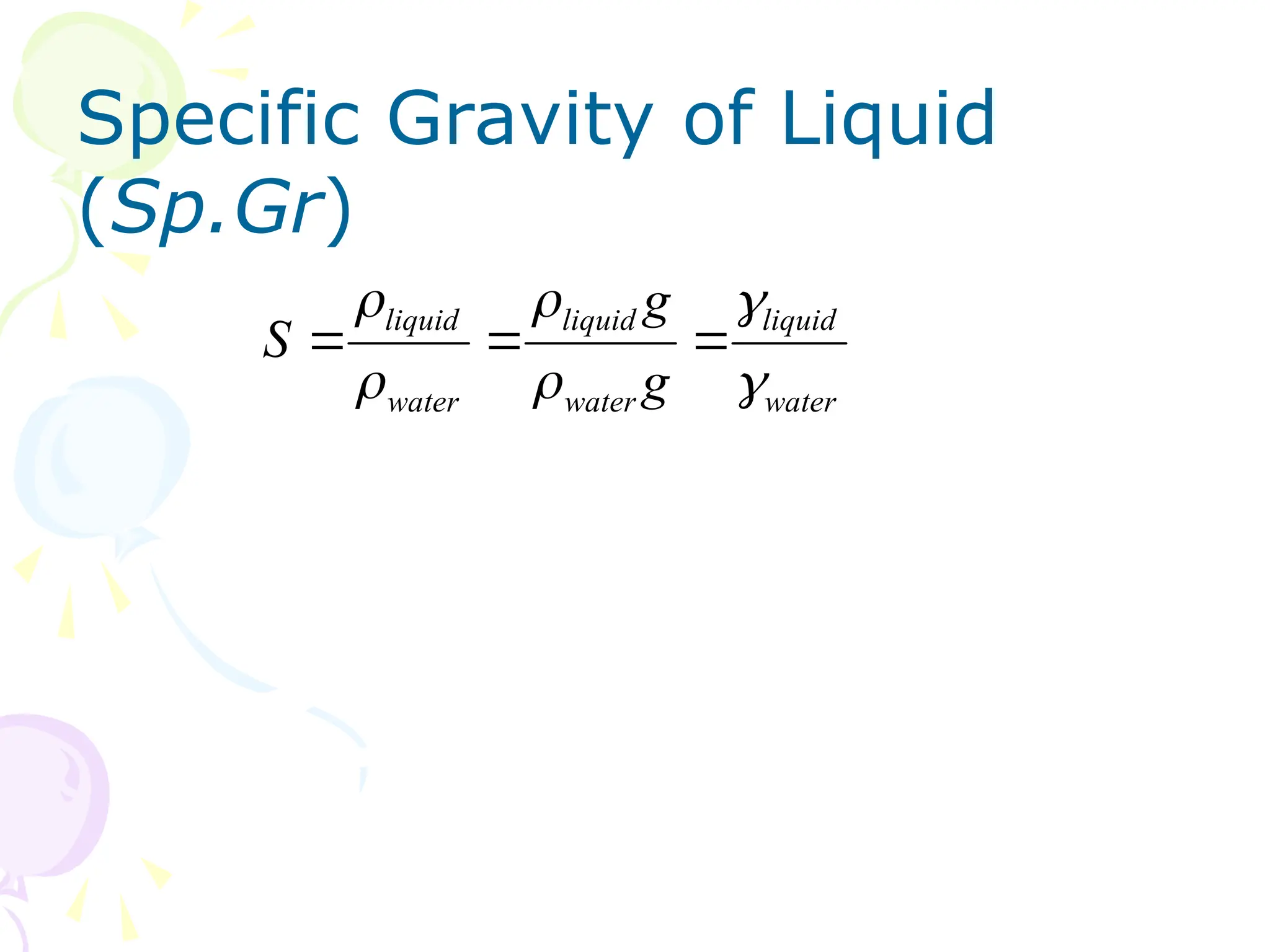
Specific Gravity ofLiquid
(Sp.Gr)
water
liquid
water
liquid
water
liquid
g
g
S
10.
Definition of Fluidsand
Definition of Fluids and
Viscosity
Viscosity
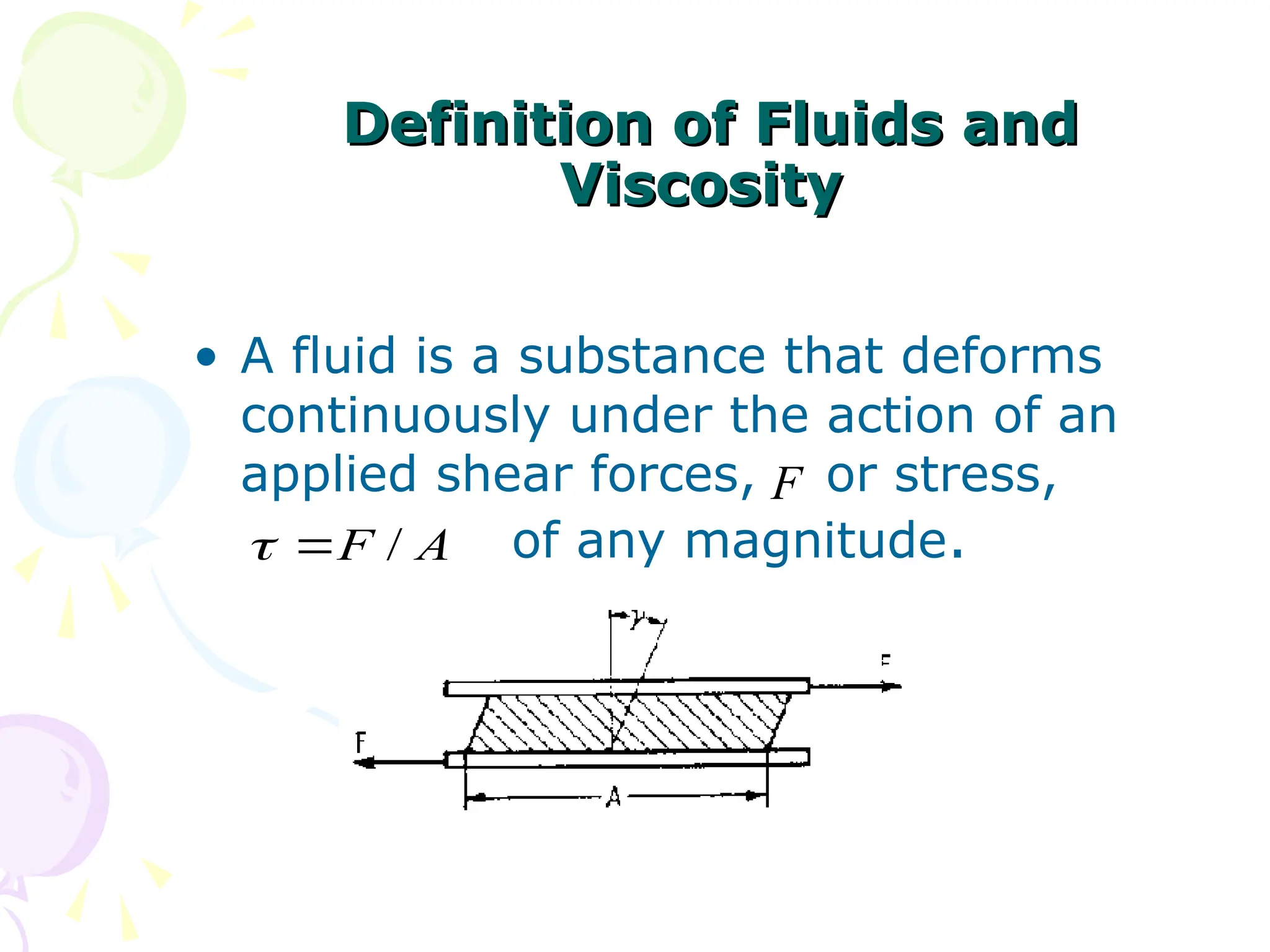
• A fluid is a substance that deforms
continuously under the action of an
applied shear forces, or stress,
of any magnitude.
A
F /
F
11.
Viscosity ( )
Viscosity( )
• Viscosity can be thought as the internal stickiness of
a fluid
• Representative of internal friction in fluids
• Viscosity of a fluid depends on temperature:
– In liquids, viscosity decreases with increasing temperature.
– In gases, viscosity increases with increasing temperature
and molecular interchange between layers increases with
temperature.
12.
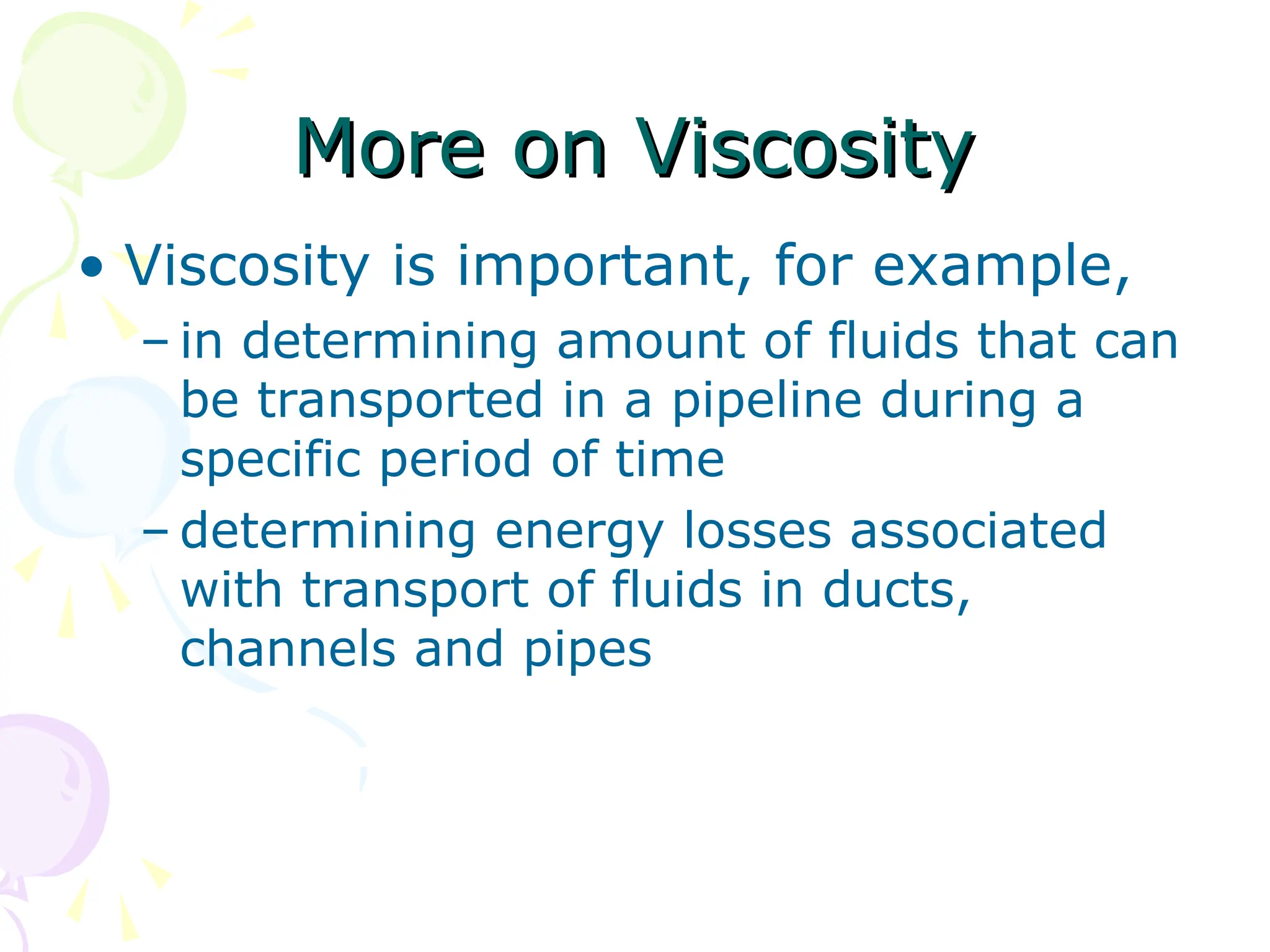
More on Viscosity
Moreon Viscosity
• Viscosity is important, for example,
– in determining amount of fluids that can
be transported in a pipeline during a
specific period of time
– determining energy losses associated
with transport of fluids in ducts,
channels and pipes
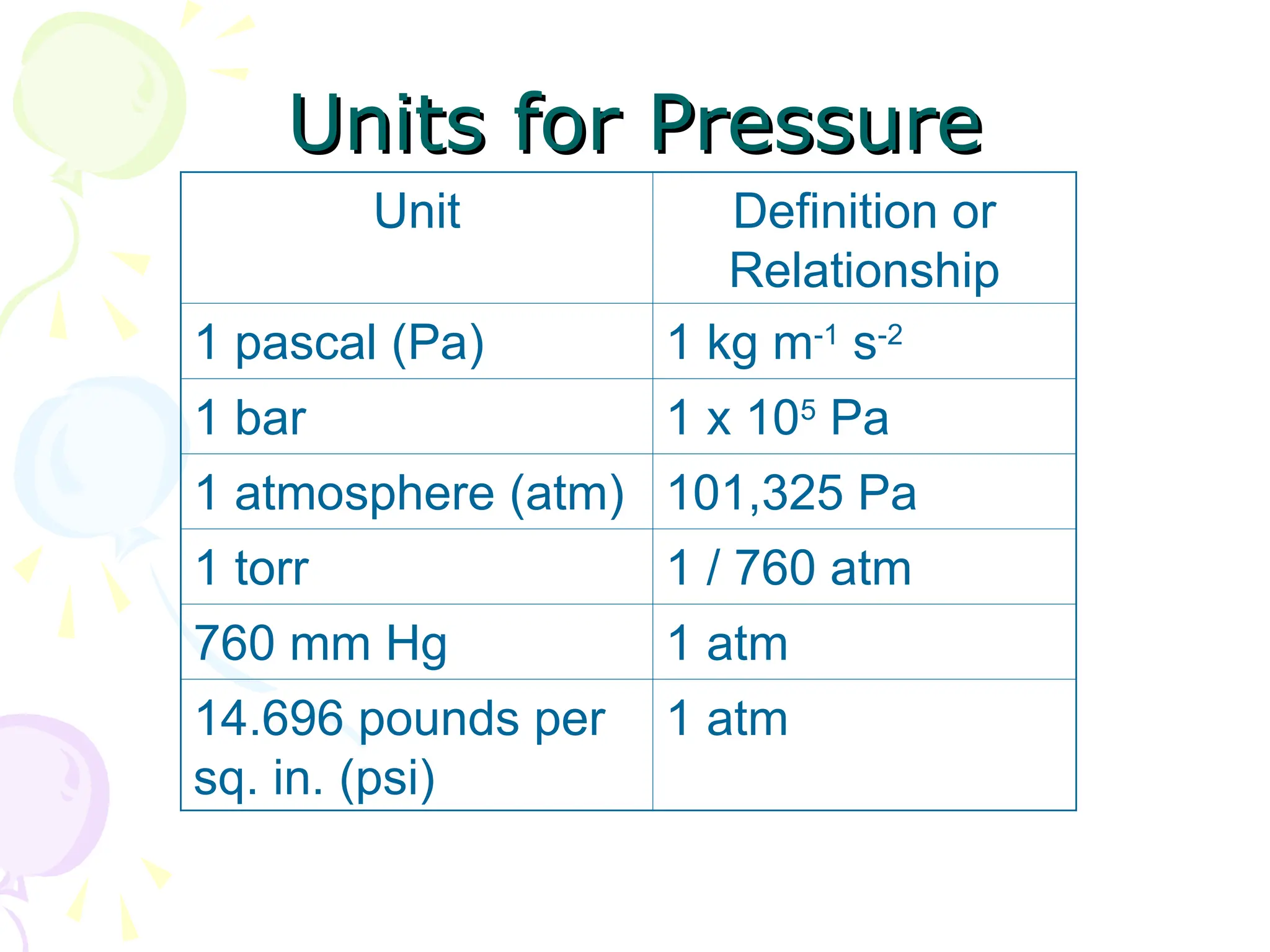
Units for Pressure
Unitsfor Pressure
Unit Definition or
Relationship
1 pascal (Pa) 1 kg m-1
s-2
1 bar 1 x 10⁵
Pa
1 atmosphere (atm) 101,325 Pa
1 torr 1 / 760 atm
760 mm Hg 1 atm
14.696 pounds per
sq. in. (psi)
1 atm
19.
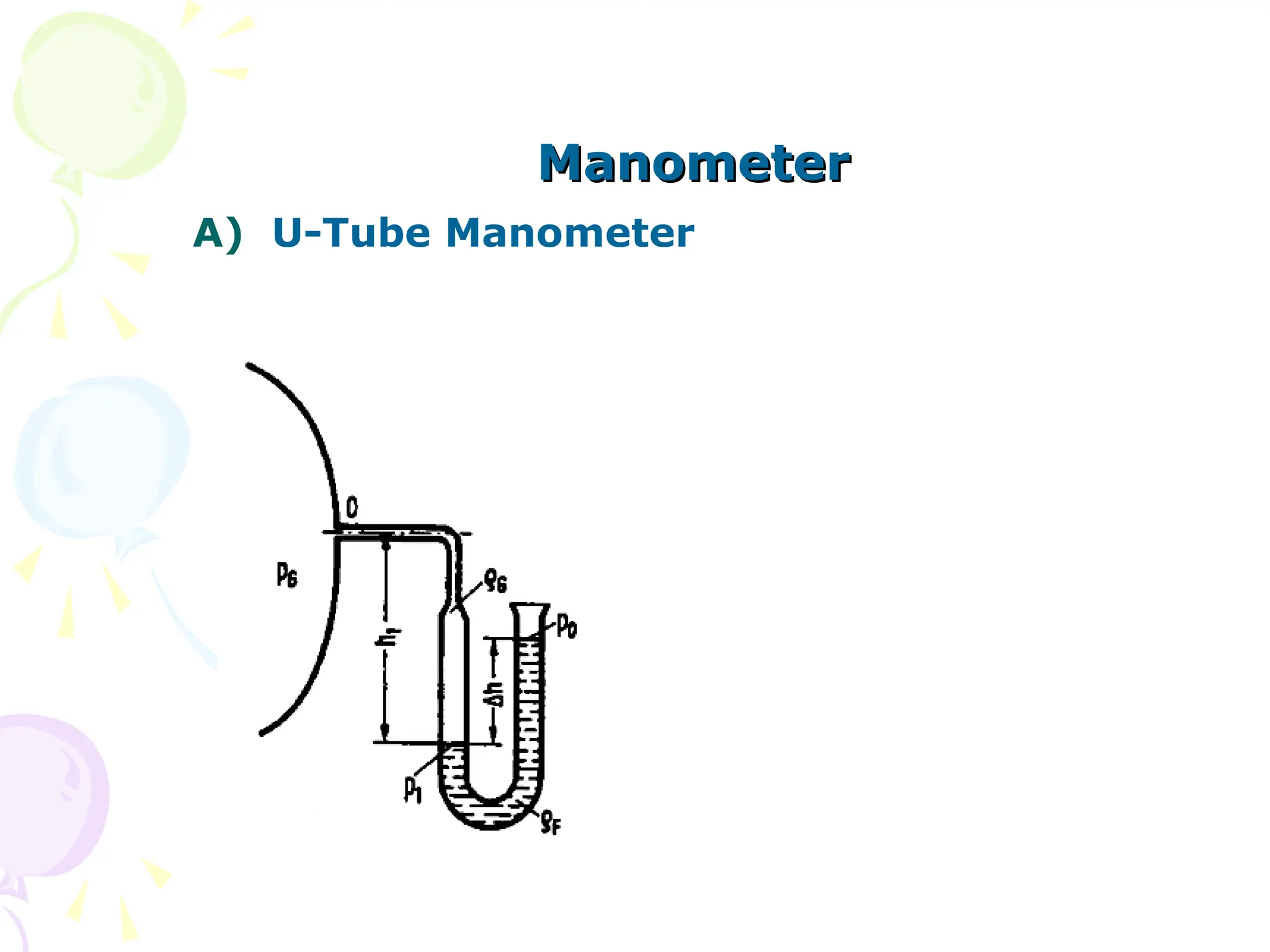
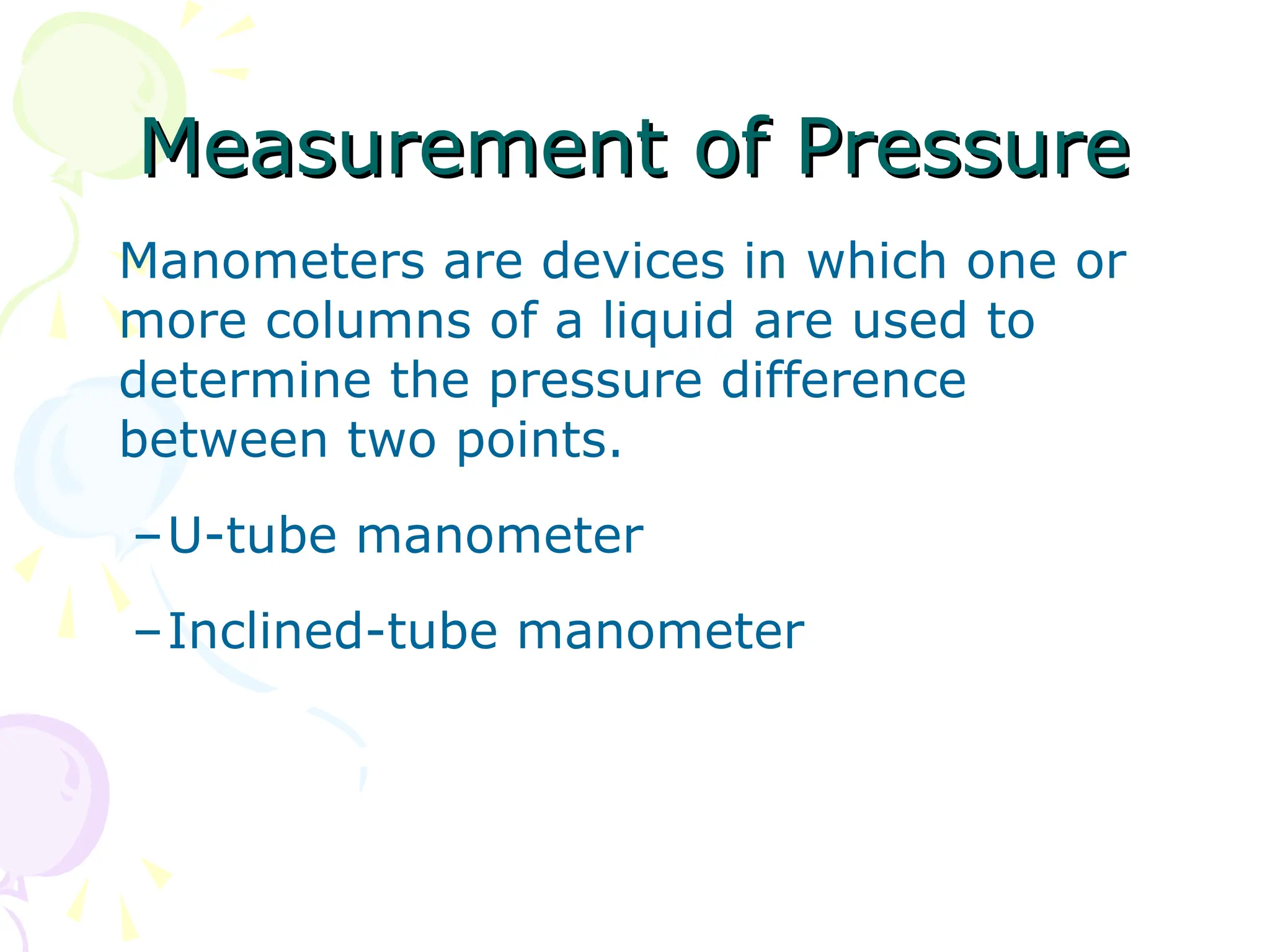
Measurement of Pressure
Measurementof Pressure
Manometers are devices in which one or
more columns of a liquid are used to
determine the pressure difference
between two points.
–U-tube manometer
–Inclined-tube manometer
20.
20
Density &
Density &
SpecificGravity
Specific Gravity
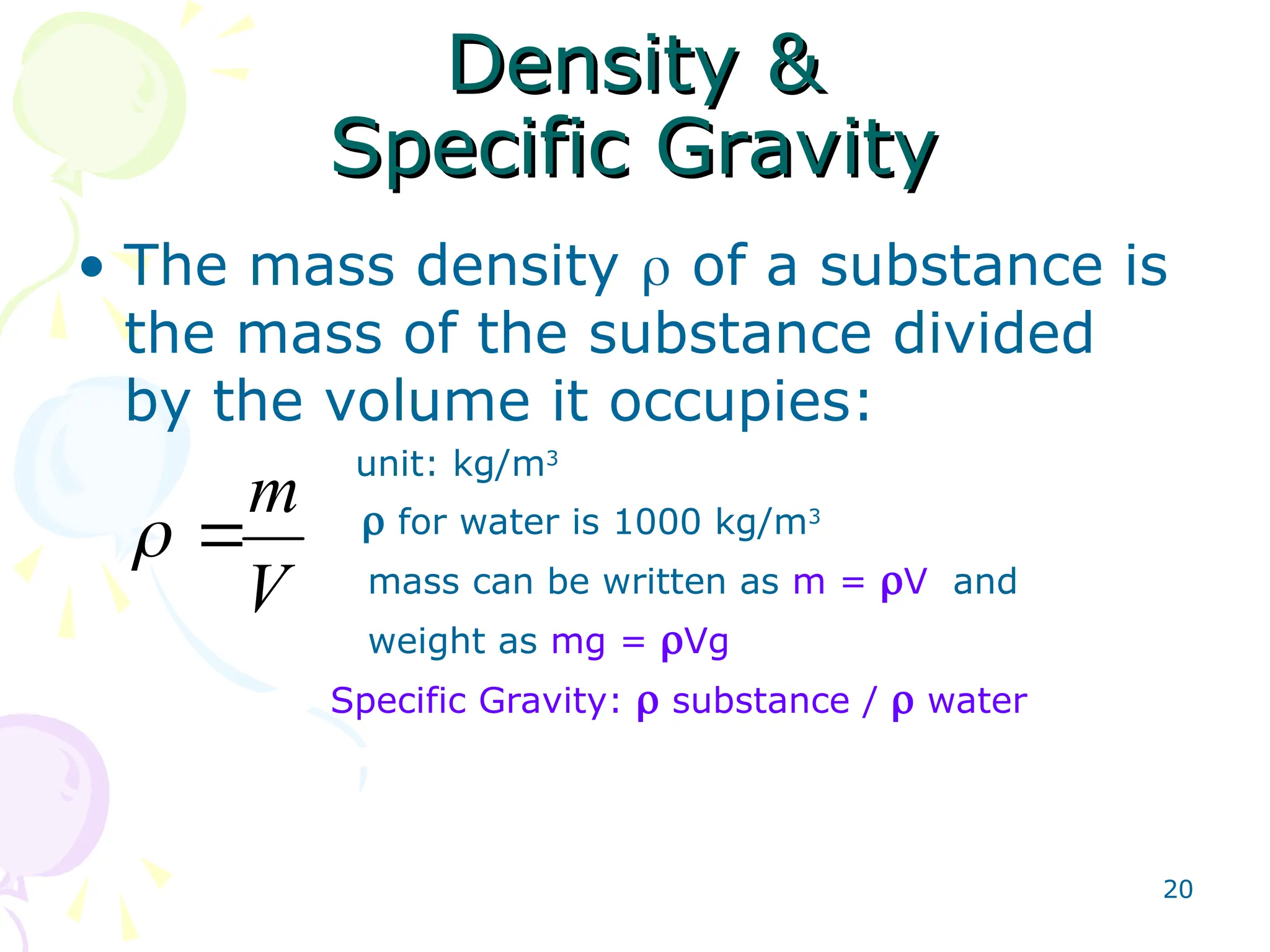
• The mass density of a substance is
the mass of the substance divided
by the volume it occupies:
unit: kg/m3
for water is 1000 kg/m3
mass can be written as m = V and
weight as mg = Vg
Specific Gravity: substance / water
V
m
21.
21
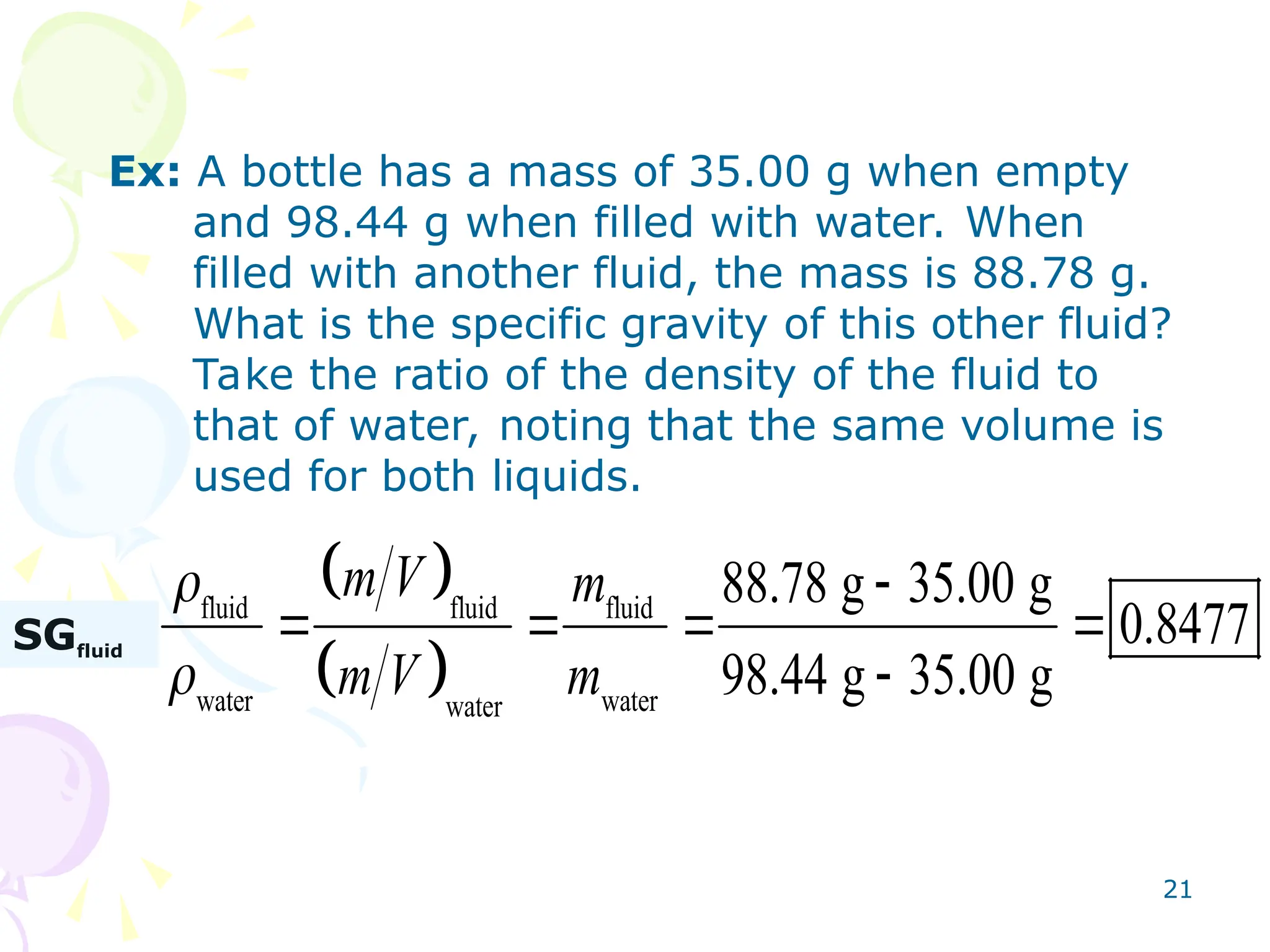
Ex: A bottlehas a mass of 35.00 g when empty
and 98.44 g when filled with water. When
filled with another fluid, the mass is 88.78 g.
What is the specific gravity of this other fluid?
Take the ratio of the density of the fluid to
that of water, noting that the same volume is
used for both liquids.
fluid fluid fluid
fluid
water water
water
88.78 g 35.00 g
0.8477
98.44 g 35.00 g
m V m
SJ
m V m
SGfluid
22.
22
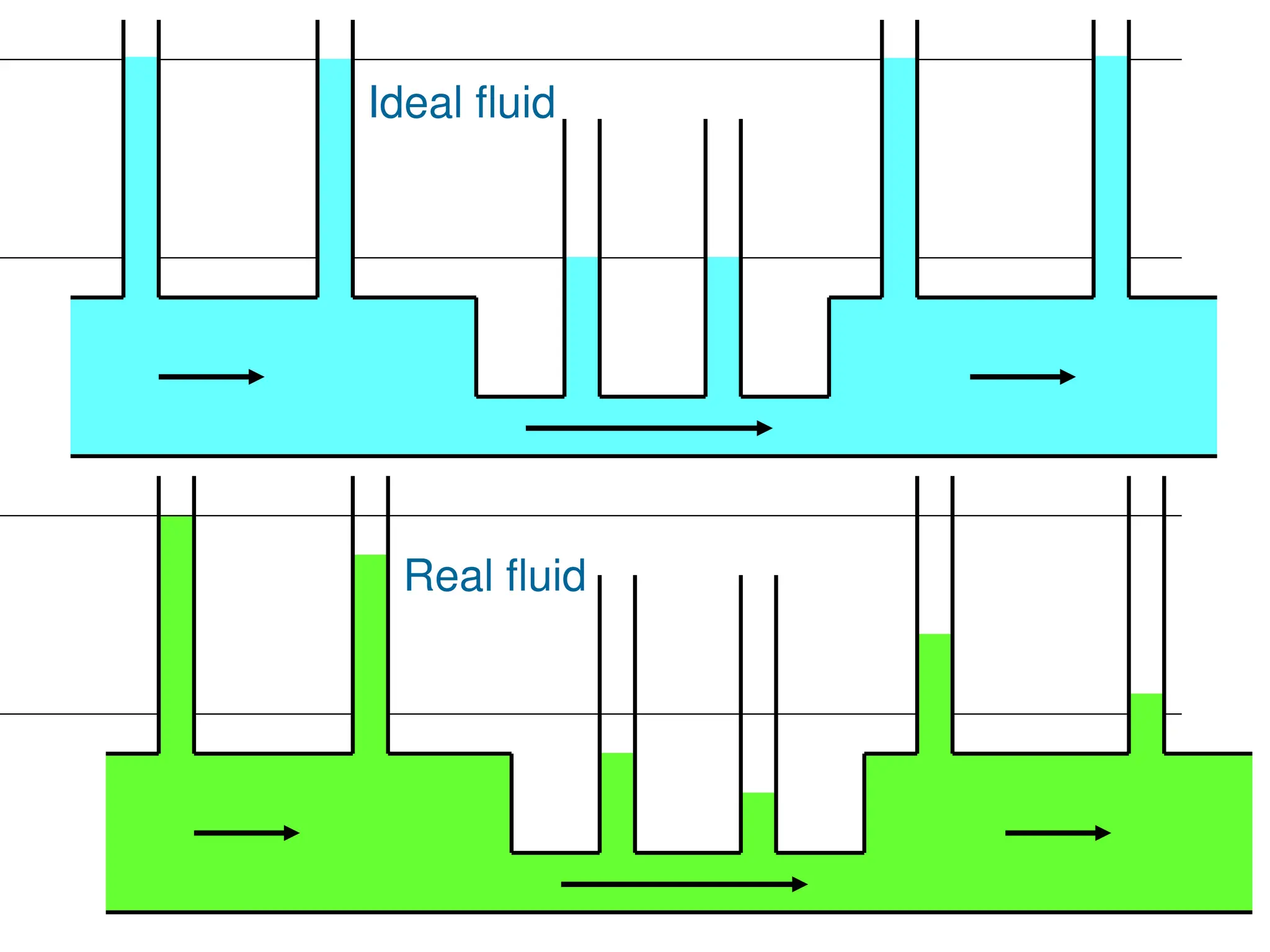
ideal fluid
ideal fluid
•to be incompressible (so that its
density does not change),
• to flow at a steady rate,
• to be nonviscous (no friction
between the fluid and the container
through which it is flowing), and
• flows irrotationally (no swirls or
eddies).
25
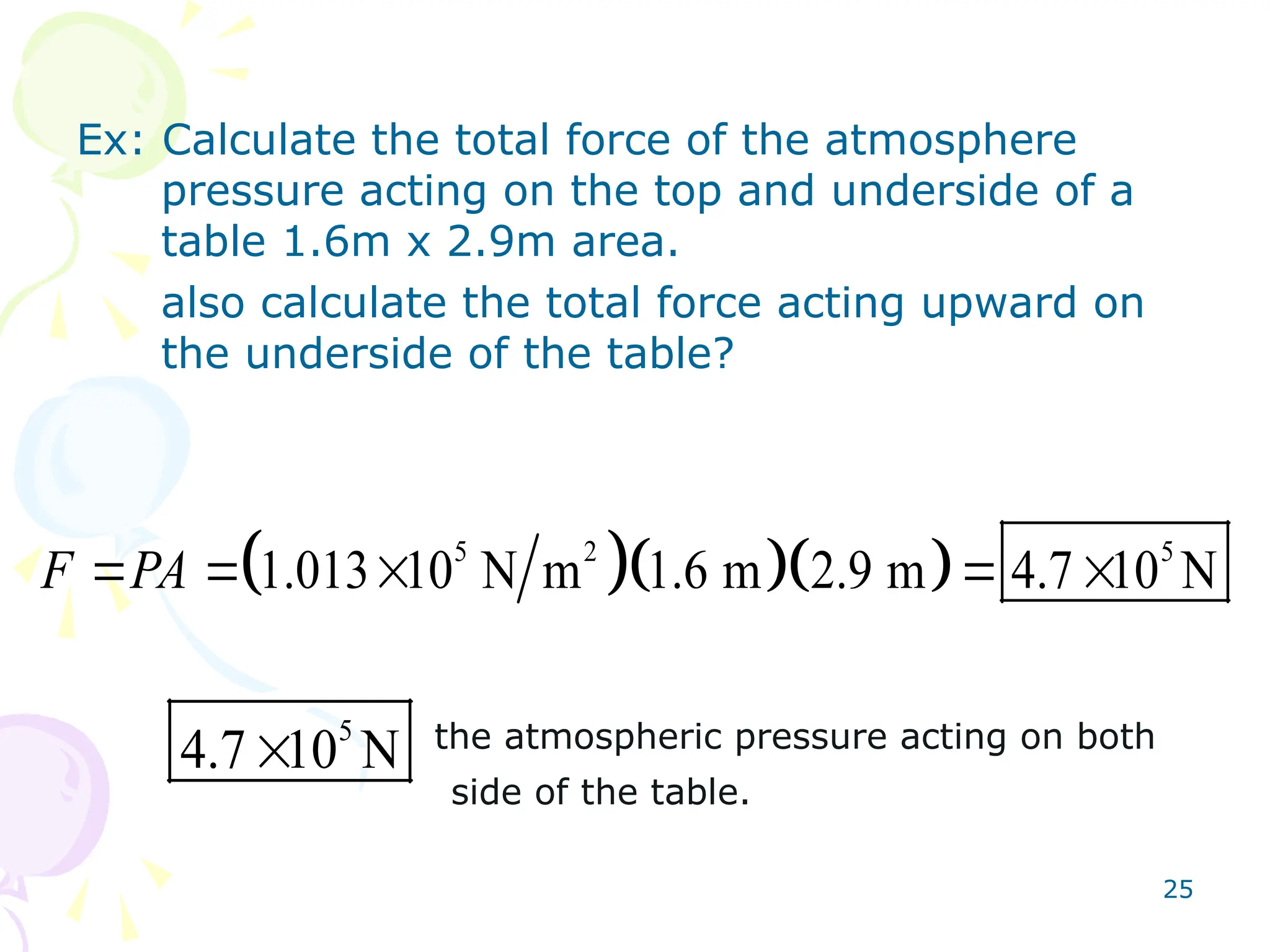
Ex: Calculate thetotal force of the atmosphere
pressure acting on the top and underside of a
table 1.6m x 2.9m area.
also calculate the total force acting upward on
the underside of the table?
the atmospheric pressure acting on both
side of the table.
5 2 5
1.013 10 N m 1.6 m 2.9 m 4.7 10 N
F PA
5
4.7 10 N
26.
26
Atmospheric Pressure andGauge Pressure
Atmospheric Pressure and Gauge Pressure
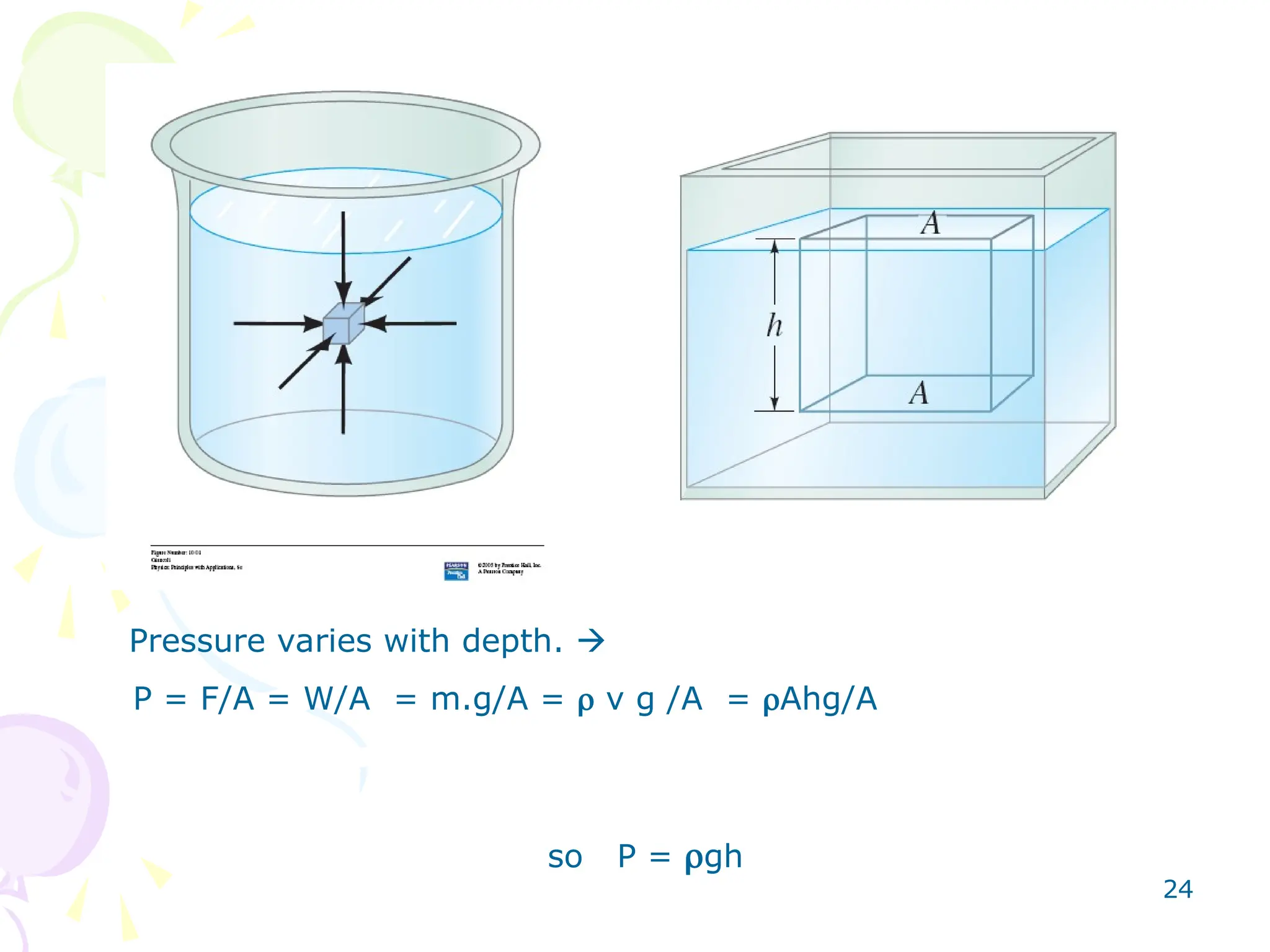
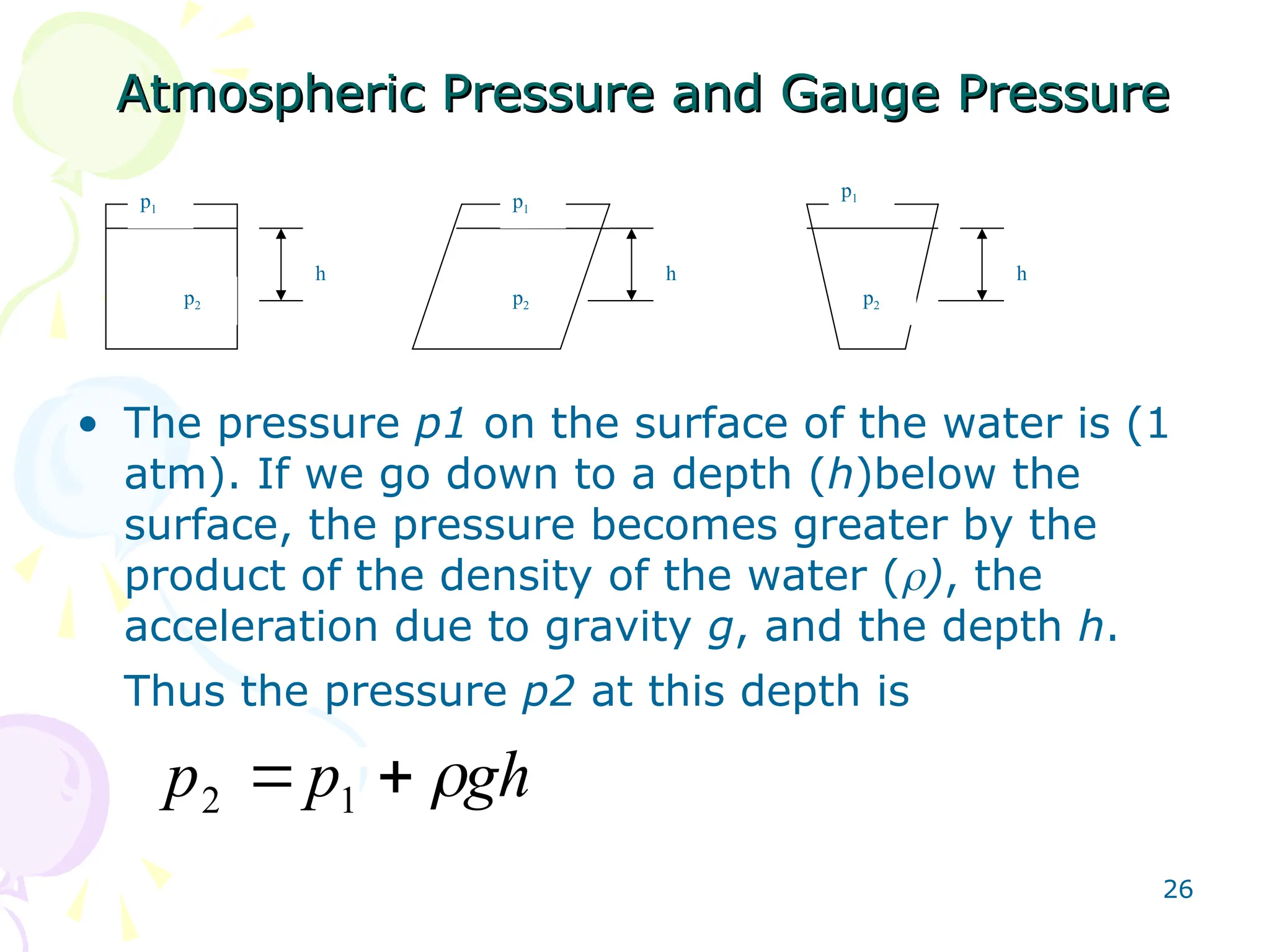
• The pressure p1 on the surface of the water is (1
atm). If we go down to a depth (h)below the
surface, the pressure becomes greater by the
product of the density of the water (), the
acceleration due to gravity g, and the depth h.
Thus the pressure p2 at this depth is
h h h
p2 p2 p2
p1 p1
p1
gh
p
p
1
2
27.
27
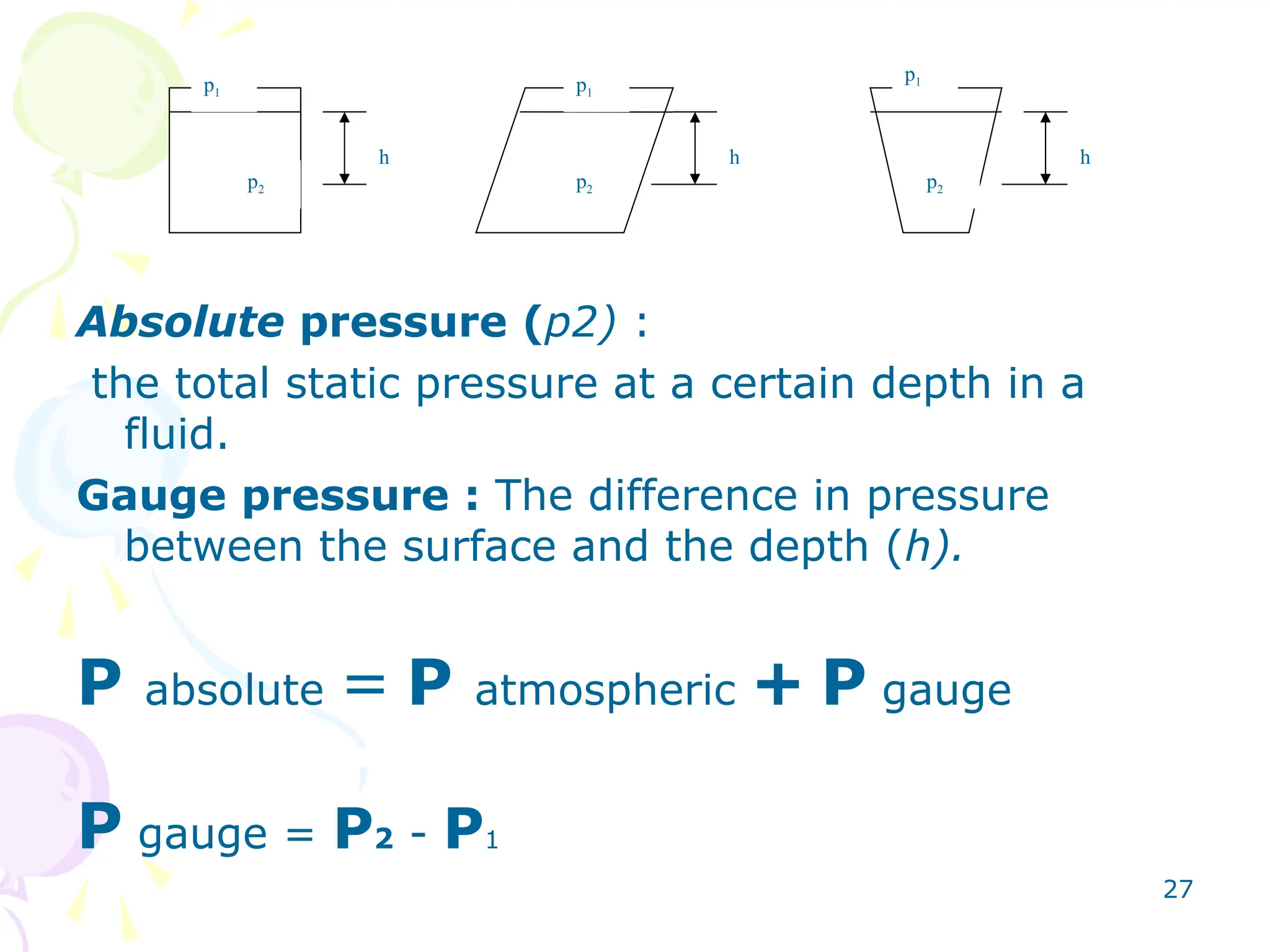
Absolute pressure (p2):
the total static pressure at a certain depth in a
fluid.
Gauge pressure : The difference in pressure
between the surface and the depth (h).
P absolute = P atmospheric + P gauge
P gauge = P2 - P1
h h h
p2 p2 p2
p1 p1
p1
28.
28
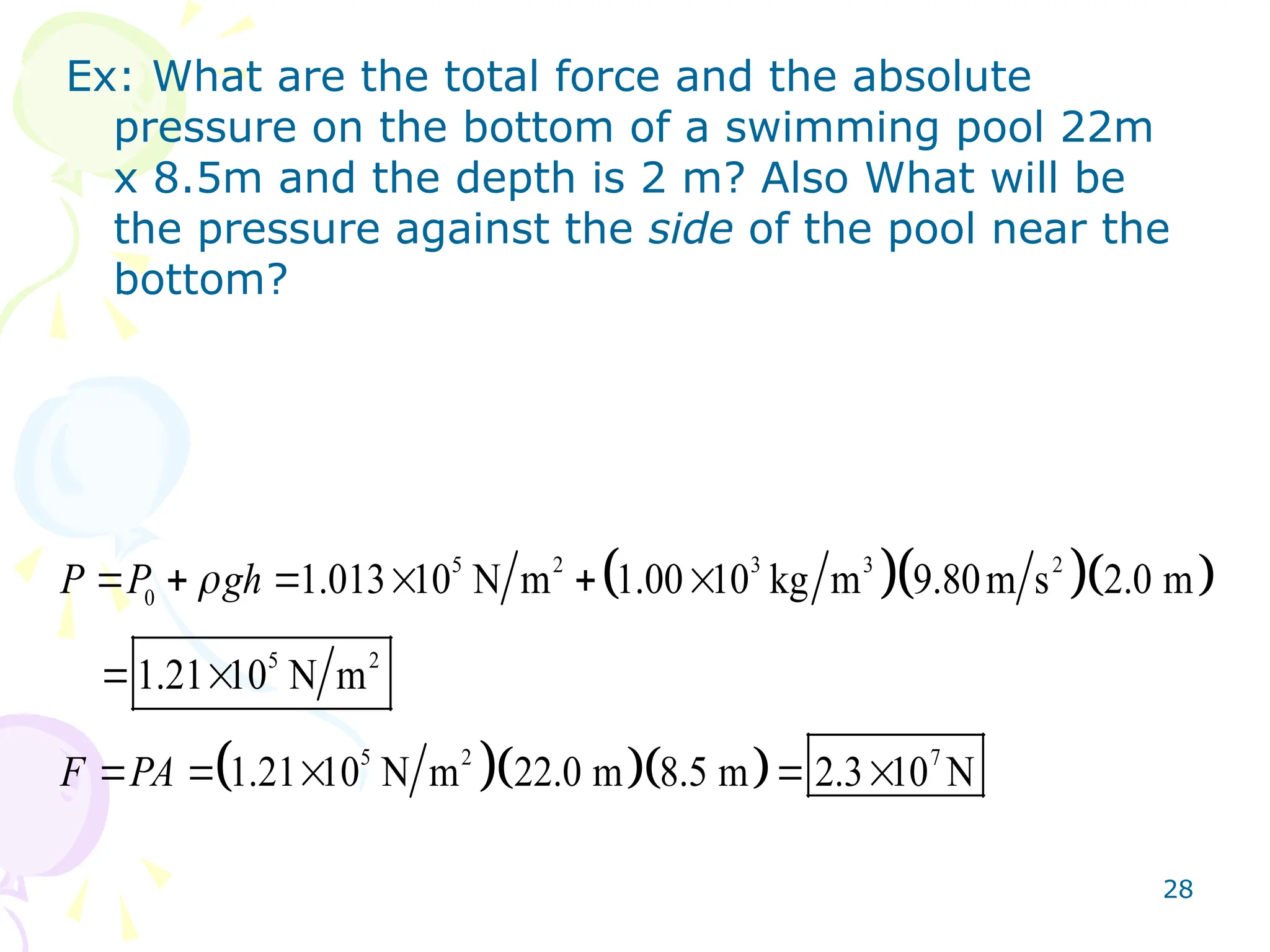
Ex: What arethe total force and the absolute
pressure on the bottom of a swimming pool 22m
x 8.5m and the depth is 2 m? Also What will be
the pressure against the side of the pool near the
bottom?
5 2 3 3 2
0
5 2
5 2 7
1.013 10 N m 1.00 10 kg m 9.80m s 2.0 m
1.21 10 N m
1.21 10 N m 22.0 m 8.5 m 2.3 10 N
P P gh
F PA
29.
29
The pressure againstthe side of the
pool, near the bottom, will be the
same as the pressure at the
bottom,
5 2
1.21 10 N m
P
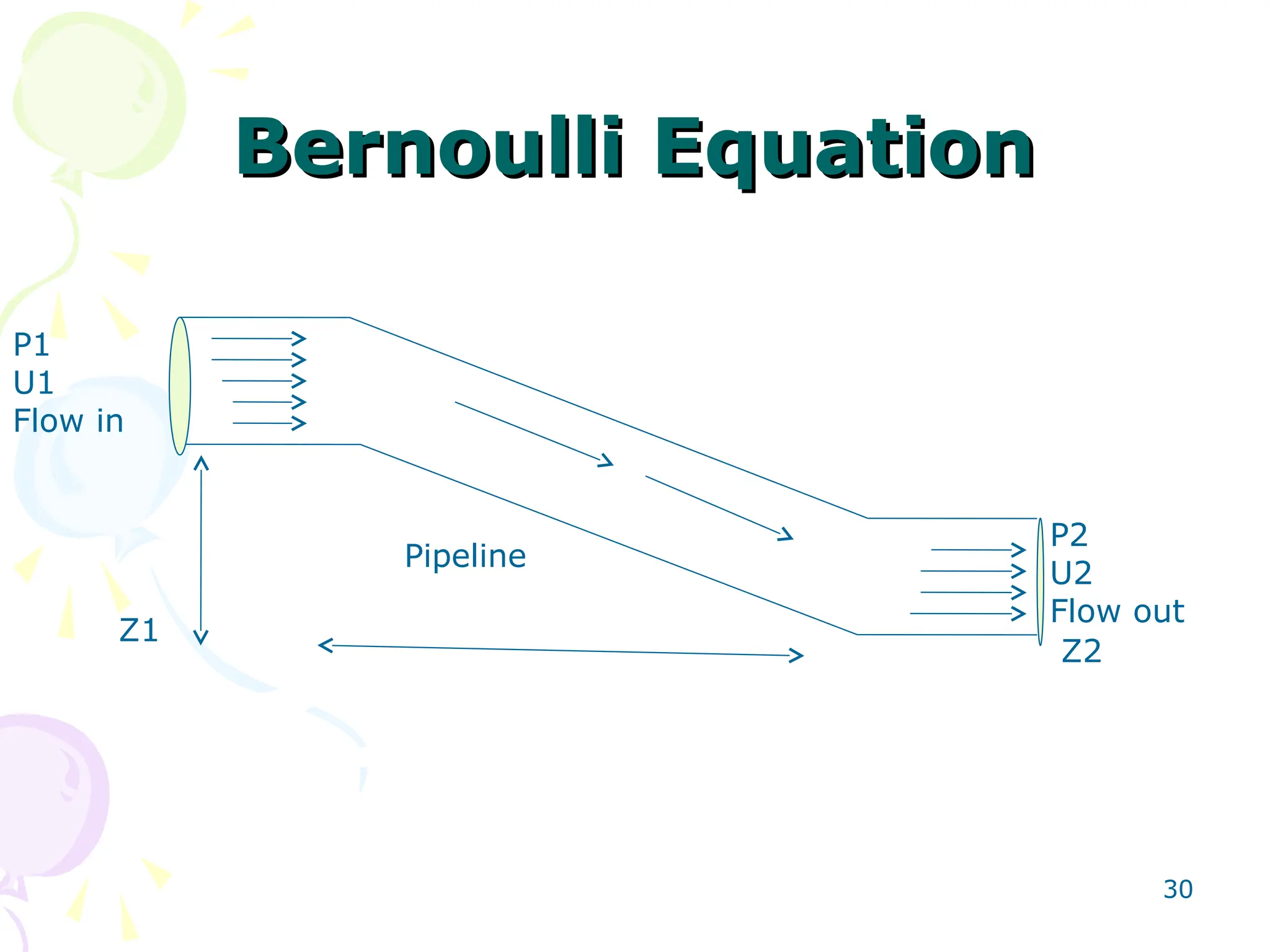
Bernoulli Equation
Bernoulli Equation
•
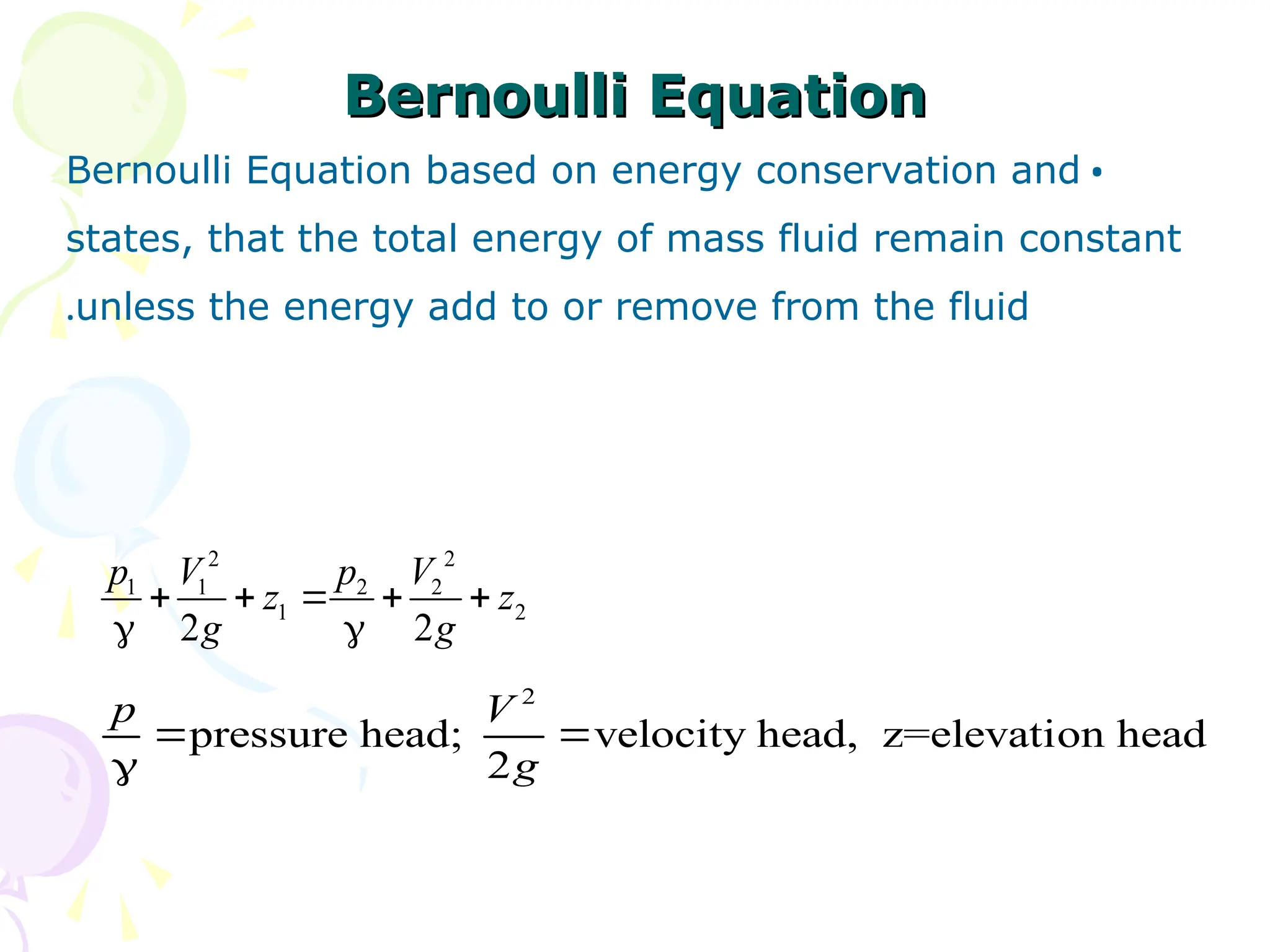
BernoulliEquation based on energy conservation and
states, that the total energy of mass fluid remain constant
unless the energy add to or remove from the fluid
.
2 2
1 1 2 2
1 2
2 2
p V p V
z z
g g
2
pressure head; velocity head, z=elevation head
2
p V
g
34
Fluids in Motion;Flow Rate and the
Equation of Continuity
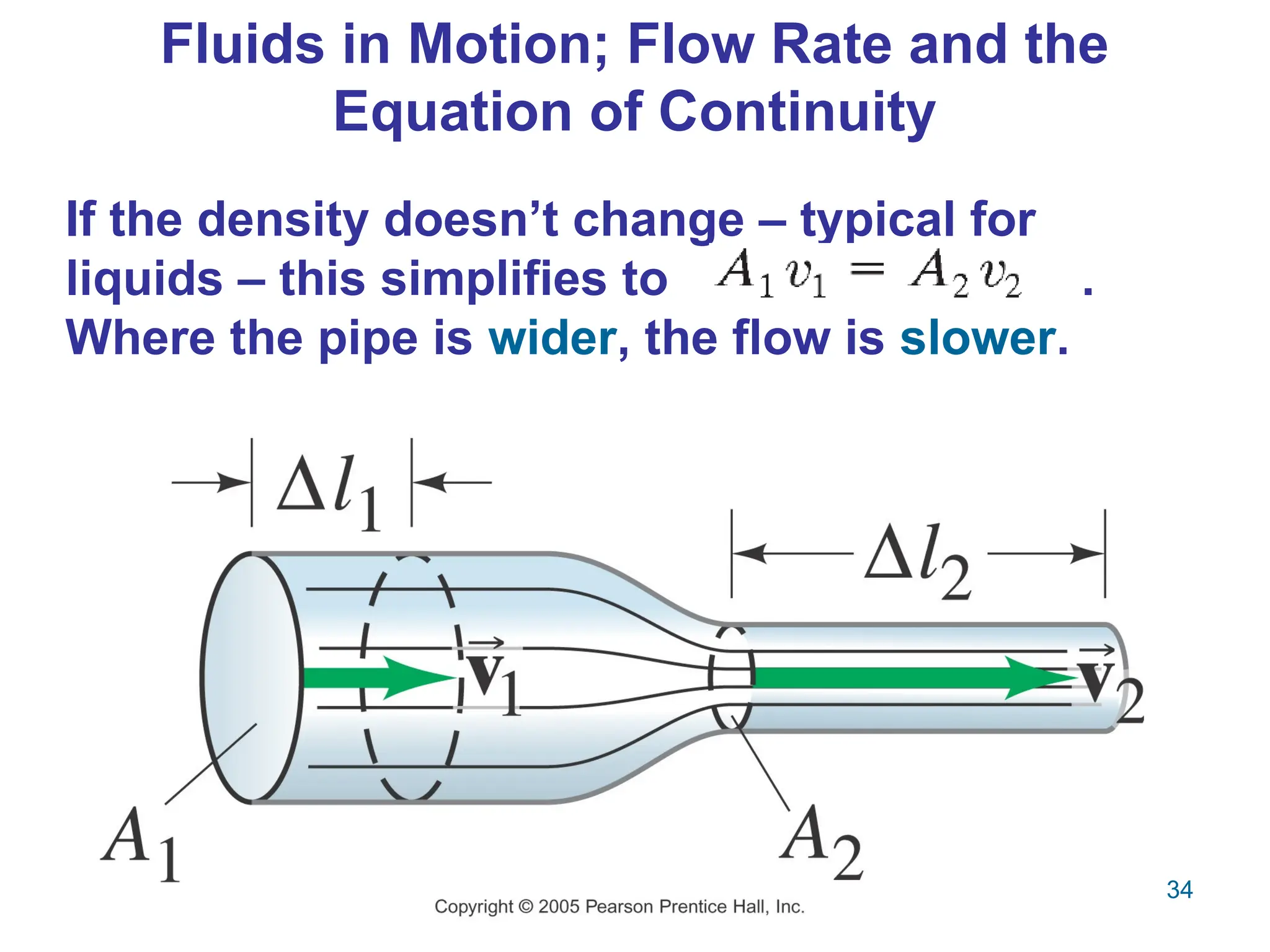
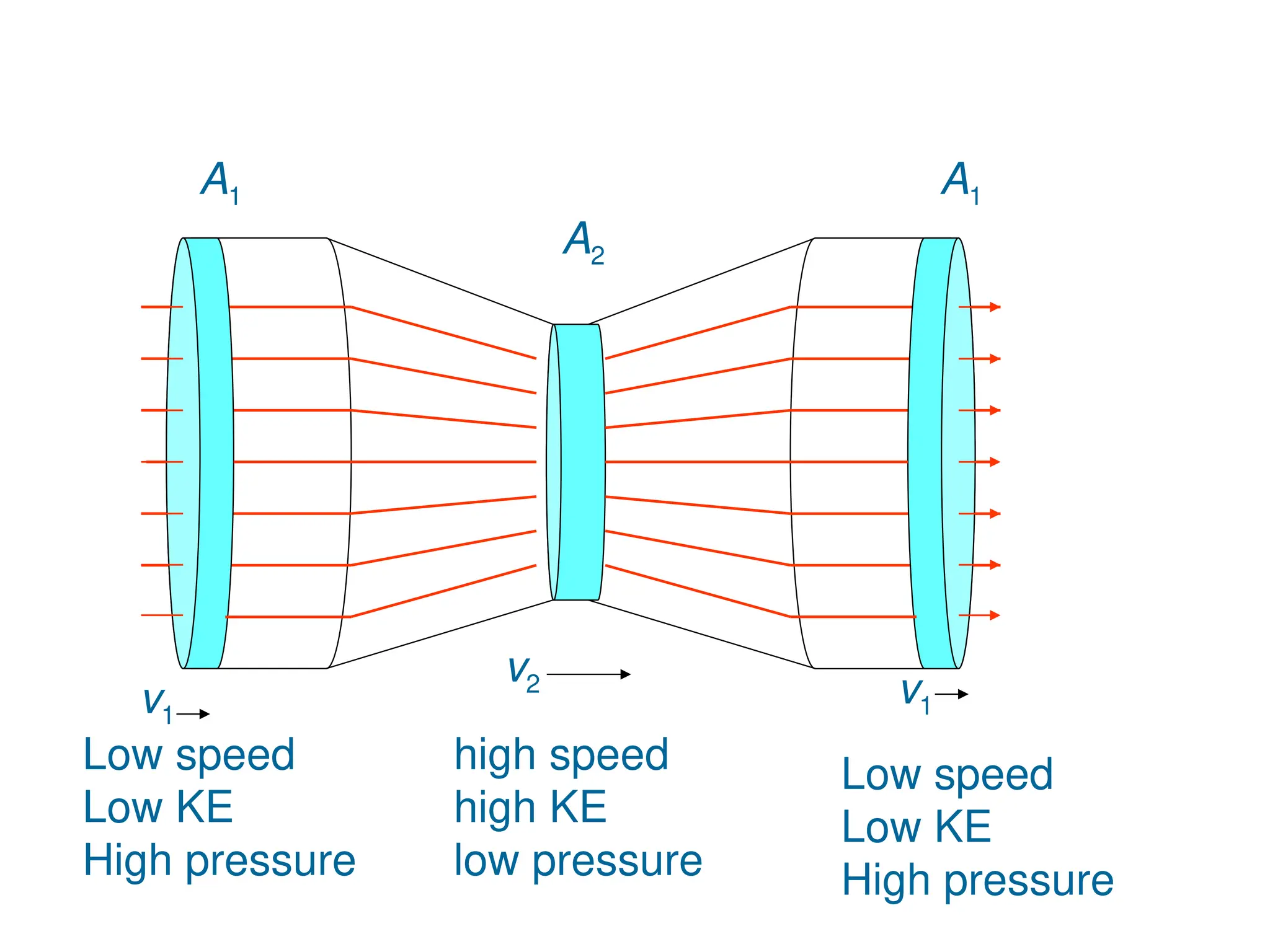
If the density doesn’t change – typical for
liquids – this simplifies to .
Where the pipe is wider, the flow is slower.
35.
35
Fluids in Motion;Flow Rate and the
Equation of Continuity
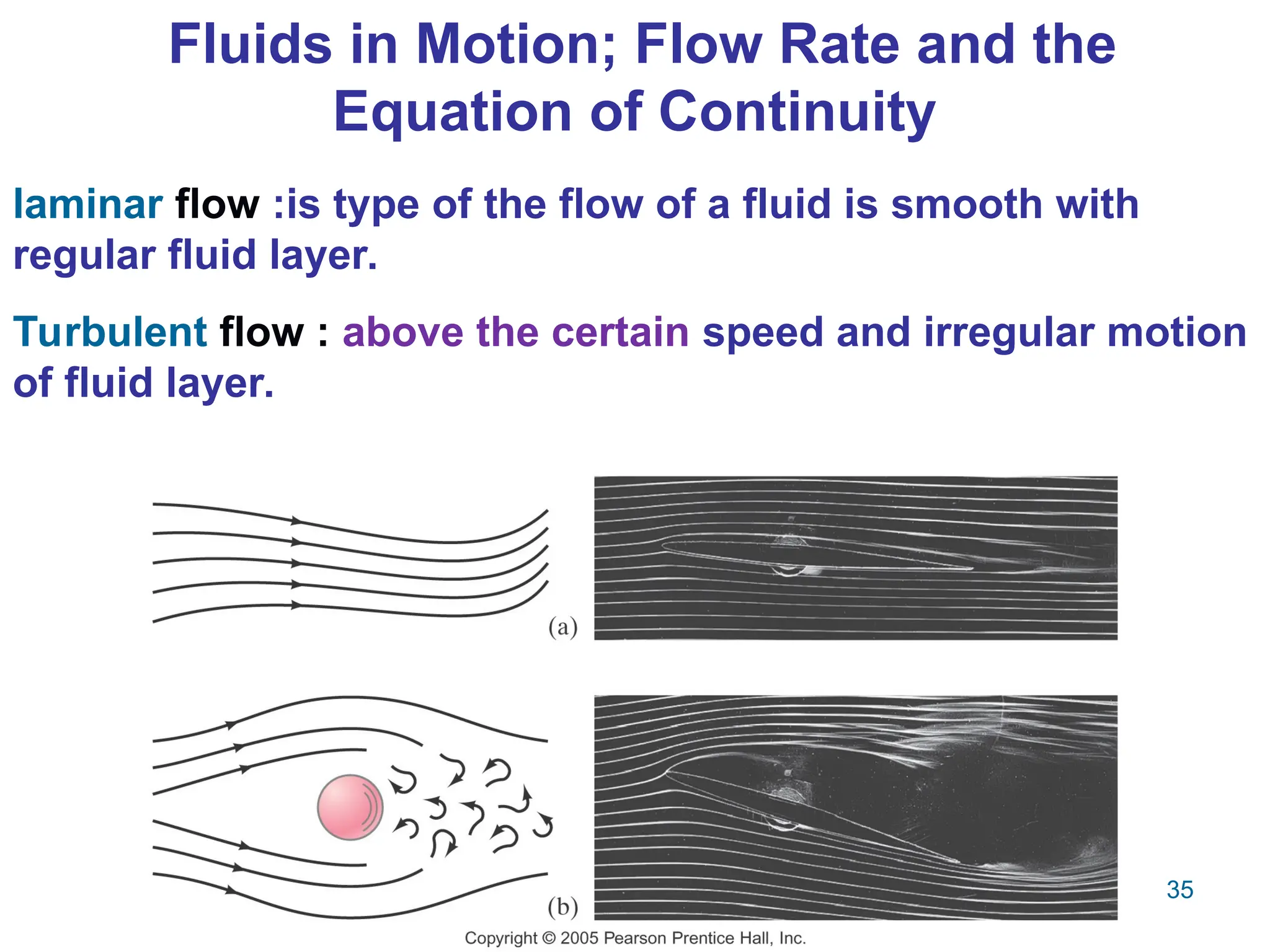
laminar flow :is type of the flow of a fluid is smooth with
regular fluid layer.
Turbulent flow : above the certain speed and irregular motion
of fluid layer.
36.
36
We will dealwith laminar flow.
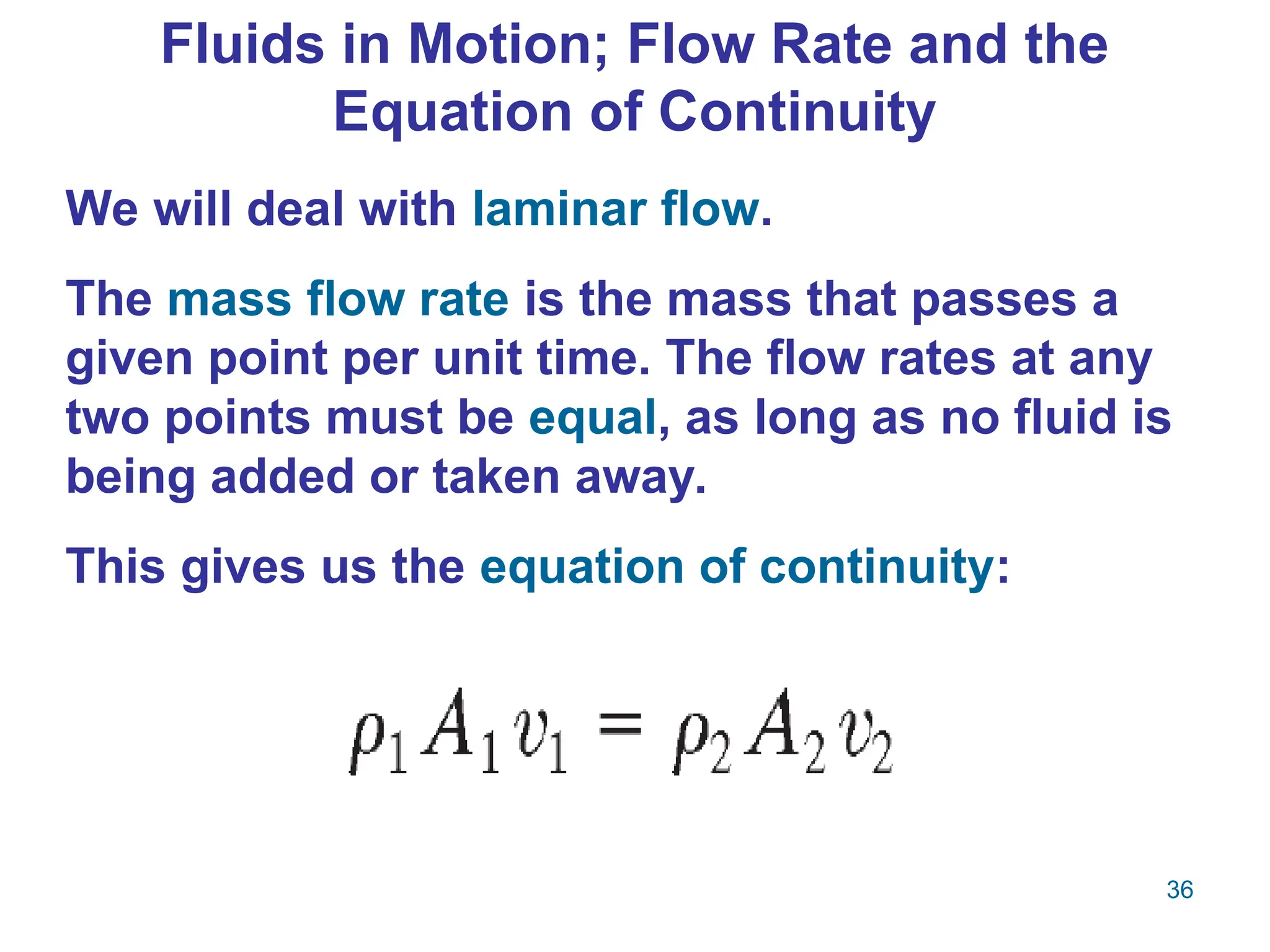
The mass flow rate is the mass that passes a
given point per unit time. The flow rates at any
two points must be equal, as long as no fluid is
being added or taken away.
This gives us the equation of continuity:
Fluids in Motion; Flow Rate and the
Equation of Continuity
37.
37
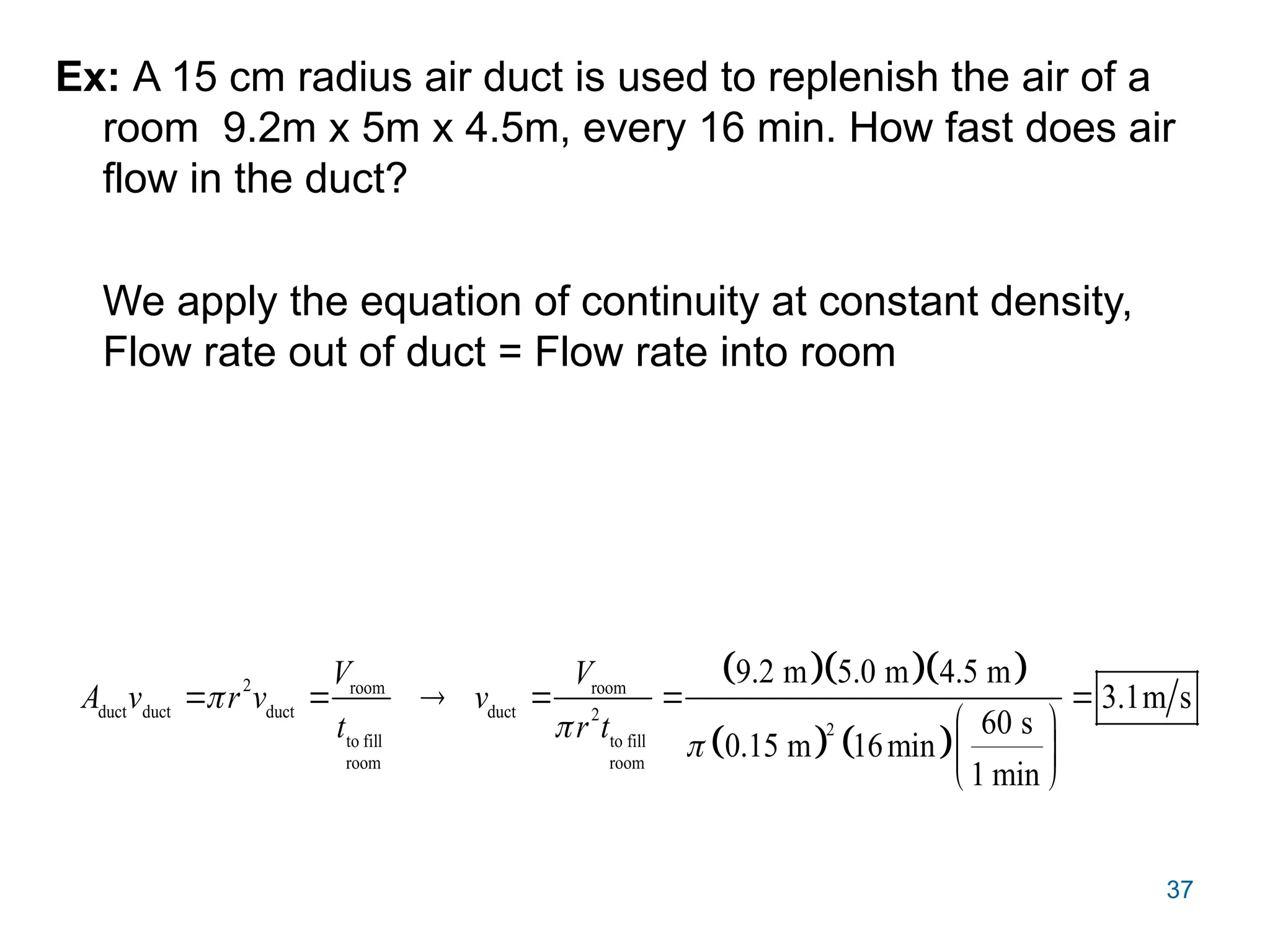
Ex: A 15cm radius air duct is used to replenish the air of a
room 9.2m x 5m x 4.5m, every 16 min. How fast does air
flow in the duct?
We apply the equation of continuity at constant density,
Flow rate out of duct = Flow rate into room
2 room room
duct duct duct duct 2
2
to fill to fill
room room
9.2 m 5.0 m 4.5 m
3.1m s
60 s
0.15 m 16min
1 min
V V
A v r v v
t r t
38.
38
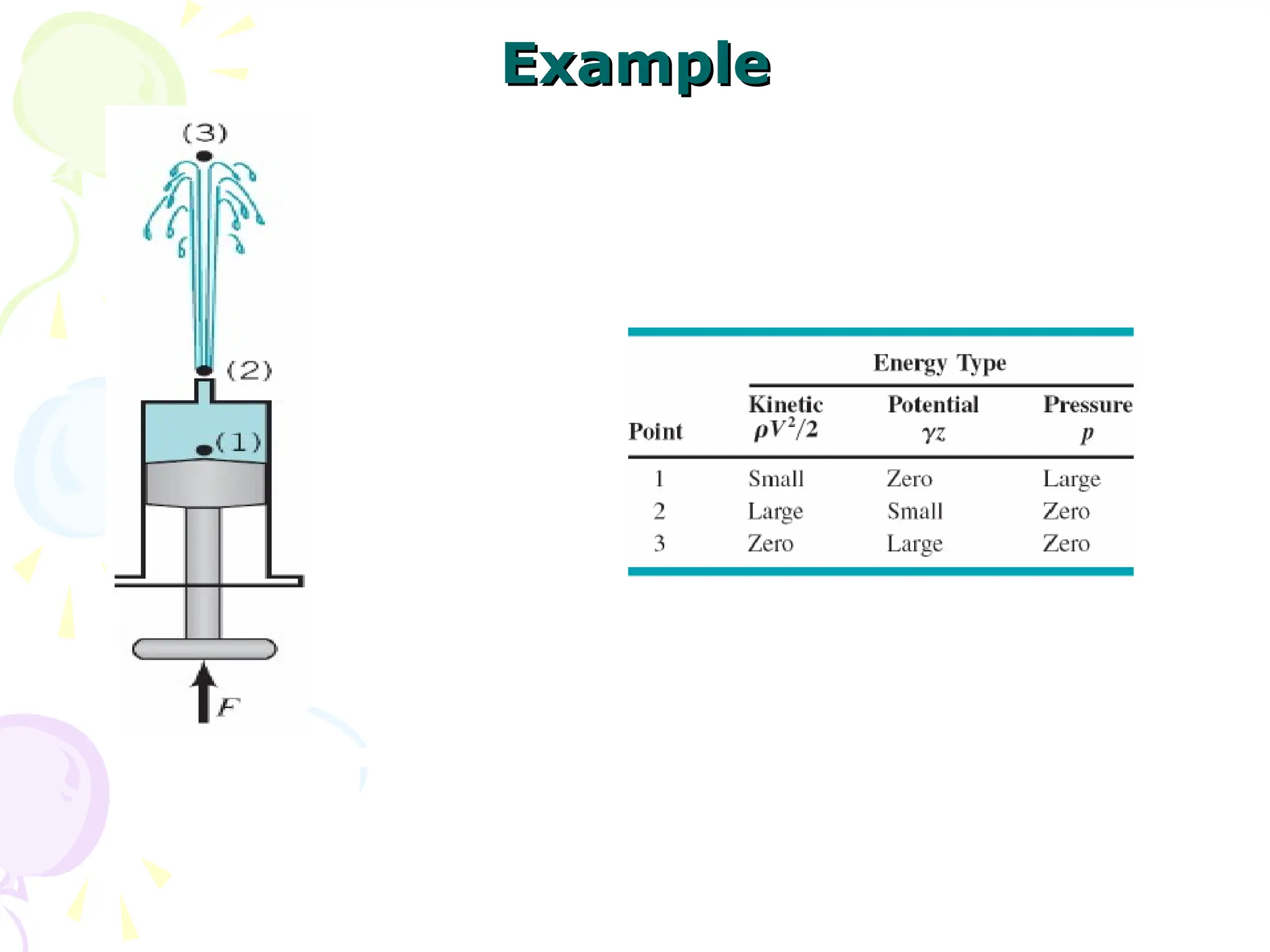
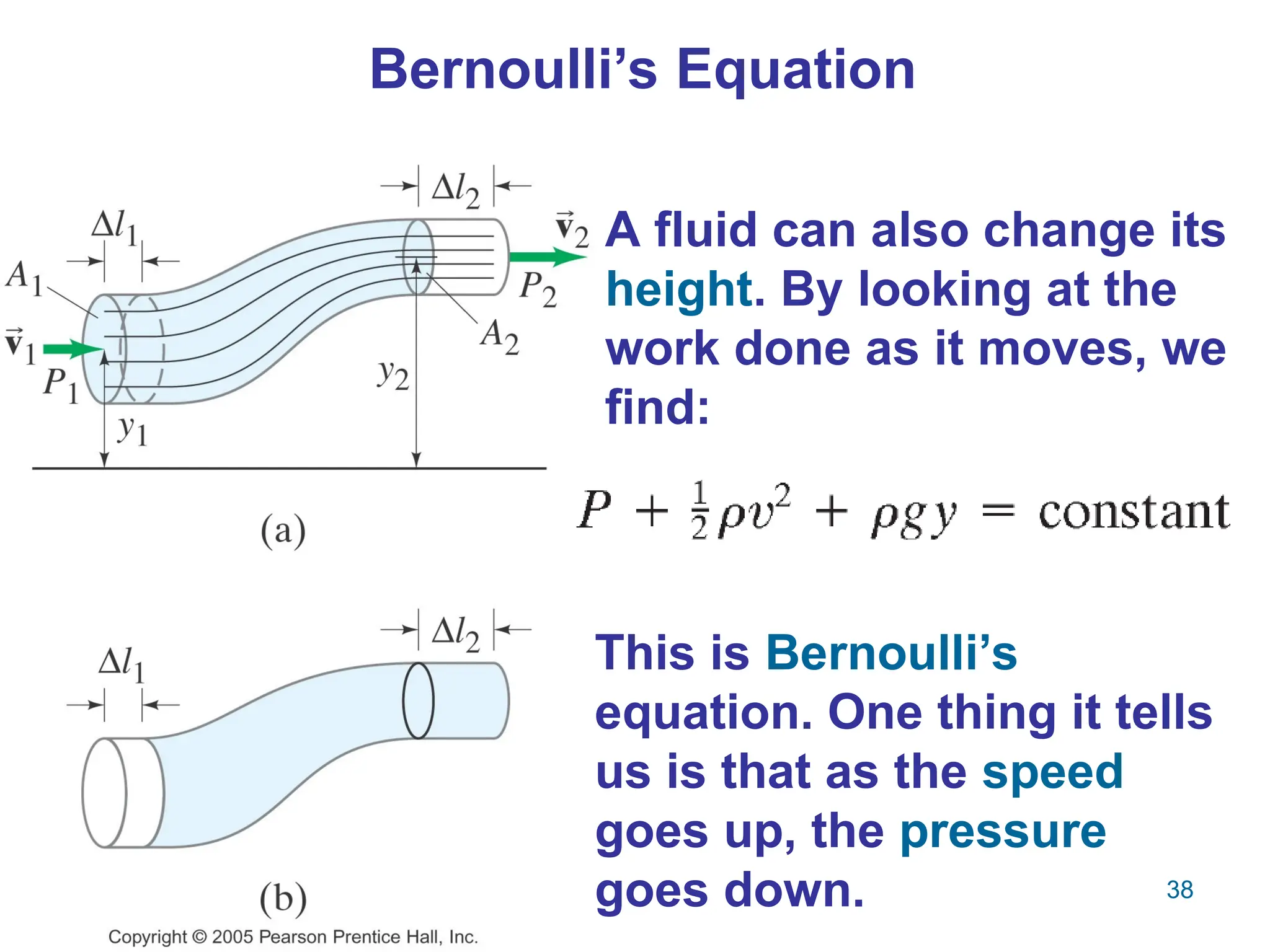
Bernoulli’s Equation
A fluidcan also change its
height. By looking at the
work done as it moves, we
find:
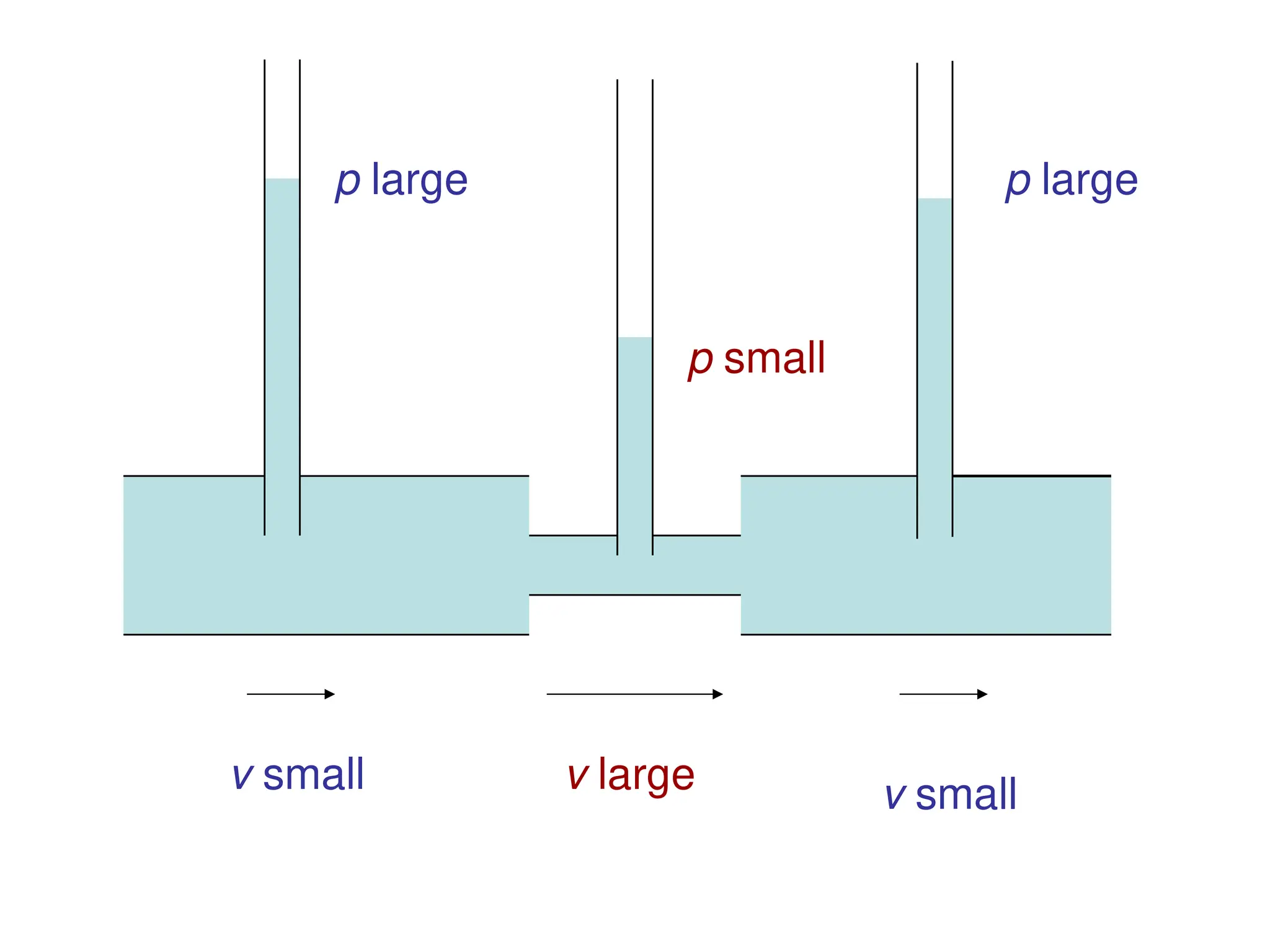
This is Bernoulli’s
equation. One thing it tells
us is that as the speed
goes up, the pressure
goes down.
39.
39
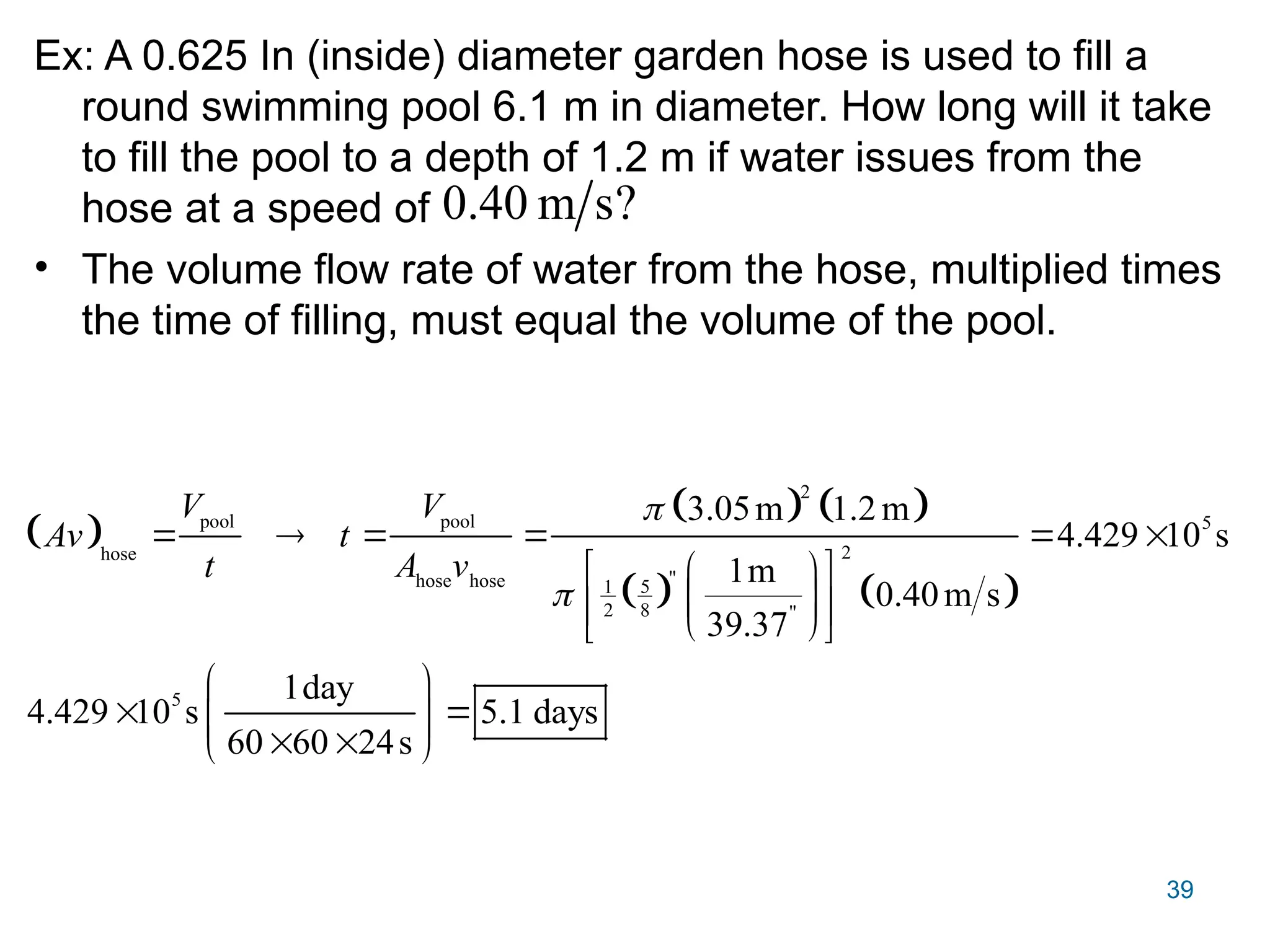
Ex: A 0.625In (inside) diameter garden hose is used to fill a
round swimming pool 6.1 m in diameter. How long will it take
to fill the pool to a depth of 1.2 m if water issues from the
hose at a speed of
• The volume flow rate of water from the hose, multiplied times
the time of filling, must equal the volume of the pool.
?
s
m
40
.
0
2
pool pool 5
2
hose
"
hose hose 5
1
2 8 "
5
3.05m 1.2m
4.429 10 s
1m
0.40m s
39.37
1day
4.429 10 s 5.1 days
60 60 24s
V V
Av t
t A v
40.
40
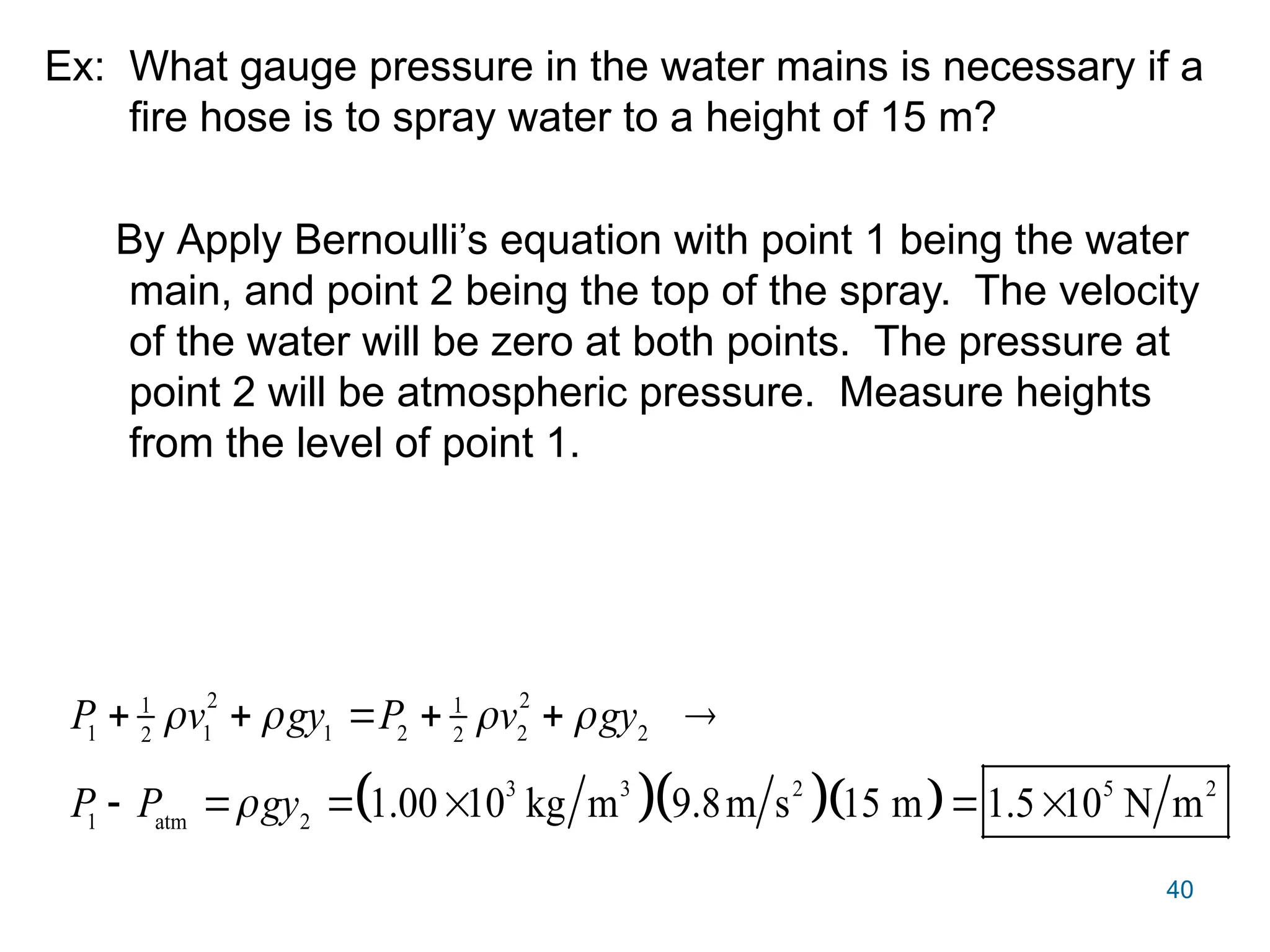
Ex: What gaugepressure in the water mains is necessary if a
fire hose is to spray water to a height of 15 m?
By Apply Bernoulli’s equation with point 1 being the water
main, and point 2 being the top of the spray. The velocity
of the water will be zero at both points. The pressure at
point 2 will be atmospheric pressure. Measure heights
from the level of point 1.
2 2
1 1
1 1 1 2 2 2
2 2
3 3 2 5 2
1 atm 2
1.00 10 kg m 9.8m s 15 m 1.5 10 N m
P v gy P v gy
P P gy
t)
unit weigh
per
(energy
g
where
,
2
2
2
2
2
2
1
2
1
1
z
g
V
p
z
g
V
p
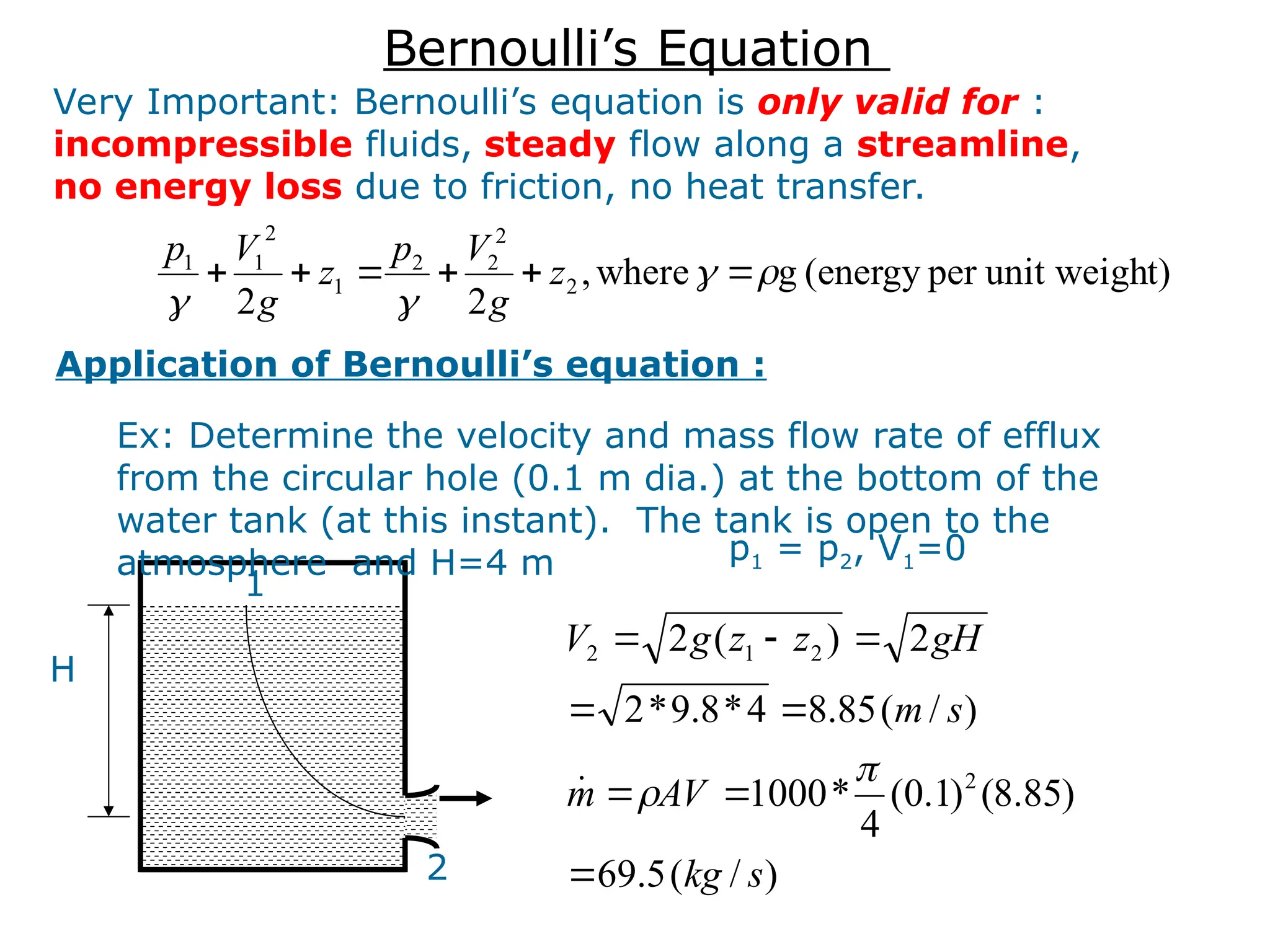
VeryImportant: Bernoulli’s equation is only valid for :
incompressible fluids, steady flow along a streamline,
no energy loss due to friction, no heat transfer.
Application of Bernoulli’s equation :
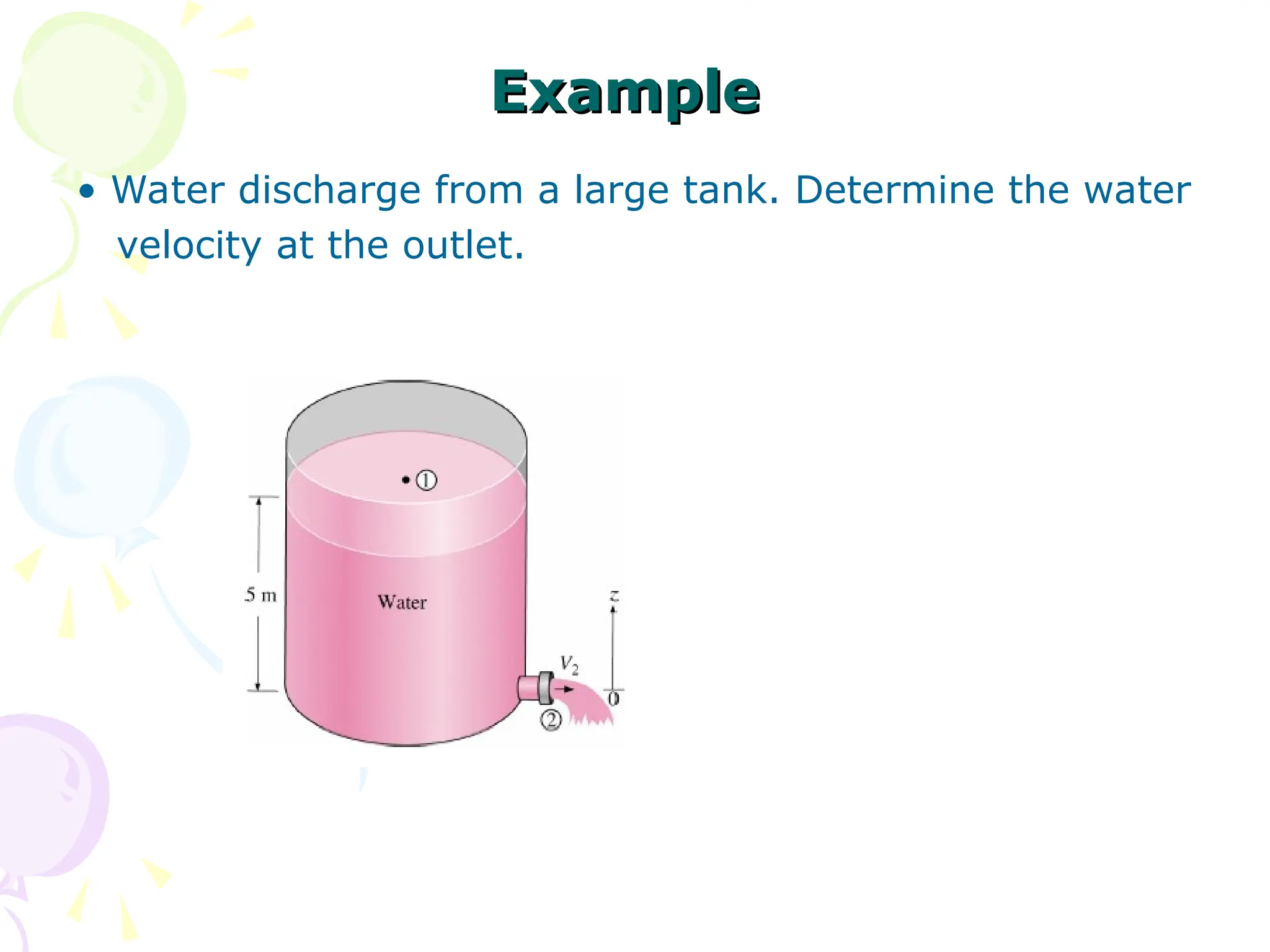
Ex: Determine the velocity and mass flow rate of efflux
from the circular hole (0.1 m dia.) at the bottom of the
water tank (at this instant). The tank is open to the
atmosphere and H=4 m
H
1
2
p1 = p2, V1=0
)
/
(
5
.
69
)
85
.
8
(
)
1
.
0
(
4
*
1000
)
/
(
85
.
8
4
*
8
.
9
*
2
2
)
(
2
2
2
1
2
s
kg
AV
m
s
m
gH
z
z
g
V
Bernoulli’s Equation
45.
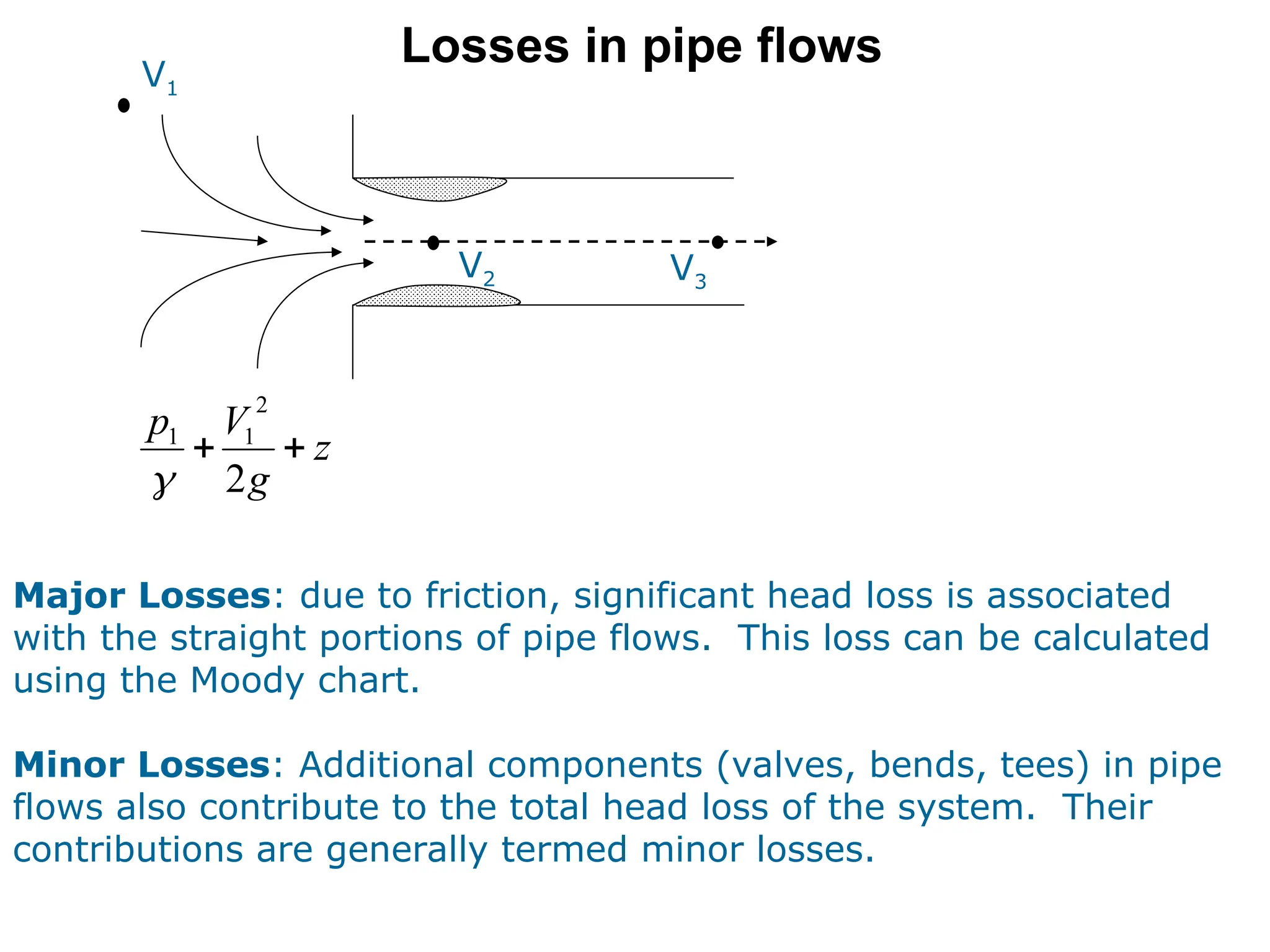
Losses in pipeflows
V2 V3
V1
z
g
V
p
2
2
1
1
Major Losses: due to friction, significant head loss is associated
with the straight portions of pipe flows. This loss can be calculated
using the Moody chart.
Minor Losses: Additional components (valves, bends, tees) in pipe
flows also contribute to the total head loss of the system. Their
contributions are generally termed minor losses.
46.
Energy exchange (conservation)in a thermal system
1
2
1
1
2
z
g
V
p
2
2
2
2
2
z
g
V
p
Energy added, hA
(ex. pump, compressor)
Energy extracted, hE
(ex. turbine, windmill)
Energy lost, hL
(ex. friction, valve, expansion)
pump turbine
heat exchanger
condenser
hE
hA
hL, friction loss
through pipes hL
loss through
elbows
hL
loss through
valves
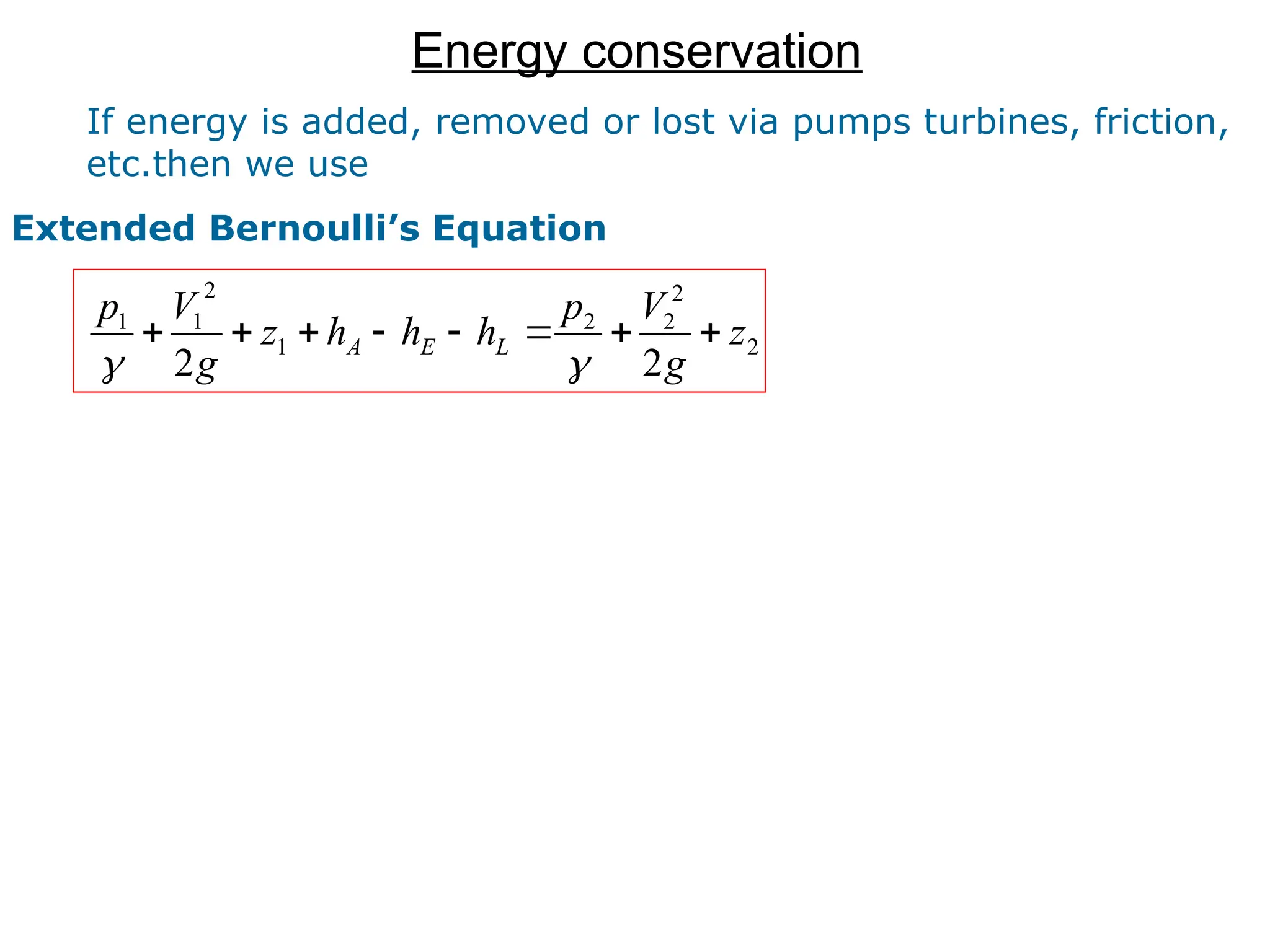
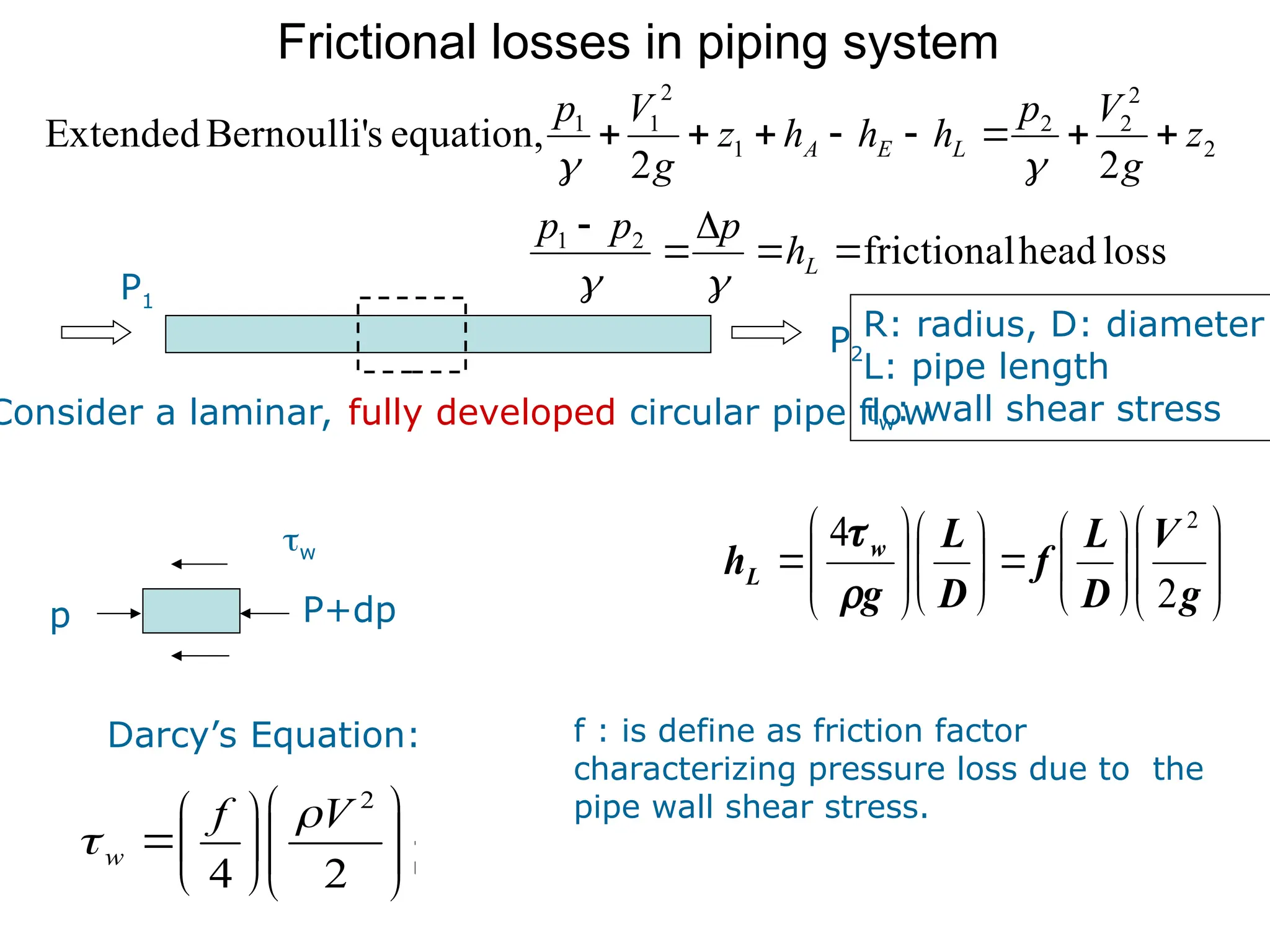
Frictional losses inpiping system
loss
head
frictional
2
2
equation,
s
Bernoulli'
Extended
2
1
2
2
2
2
1
2
1
1
L
L
E
A
h
p
p
p
z
g
V
p
h
h
h
z
g
V
p
P1
P2
Consider a laminar, fully developed circular pipe flow
p P+dp
w
Darcy’s Equation:
R: radius, D: diameter
L: pipe length
w: wall shear stress
w
f V
F
H
I
K
F
H
G I
K
J
4 2
2
2
4
2
V
f
w
g
V
D
L
f
D
L
g
h w
L
2
4 2
f : is define as friction factor
characterizing pressure loss due to the
pipe wall shear stress.
50.
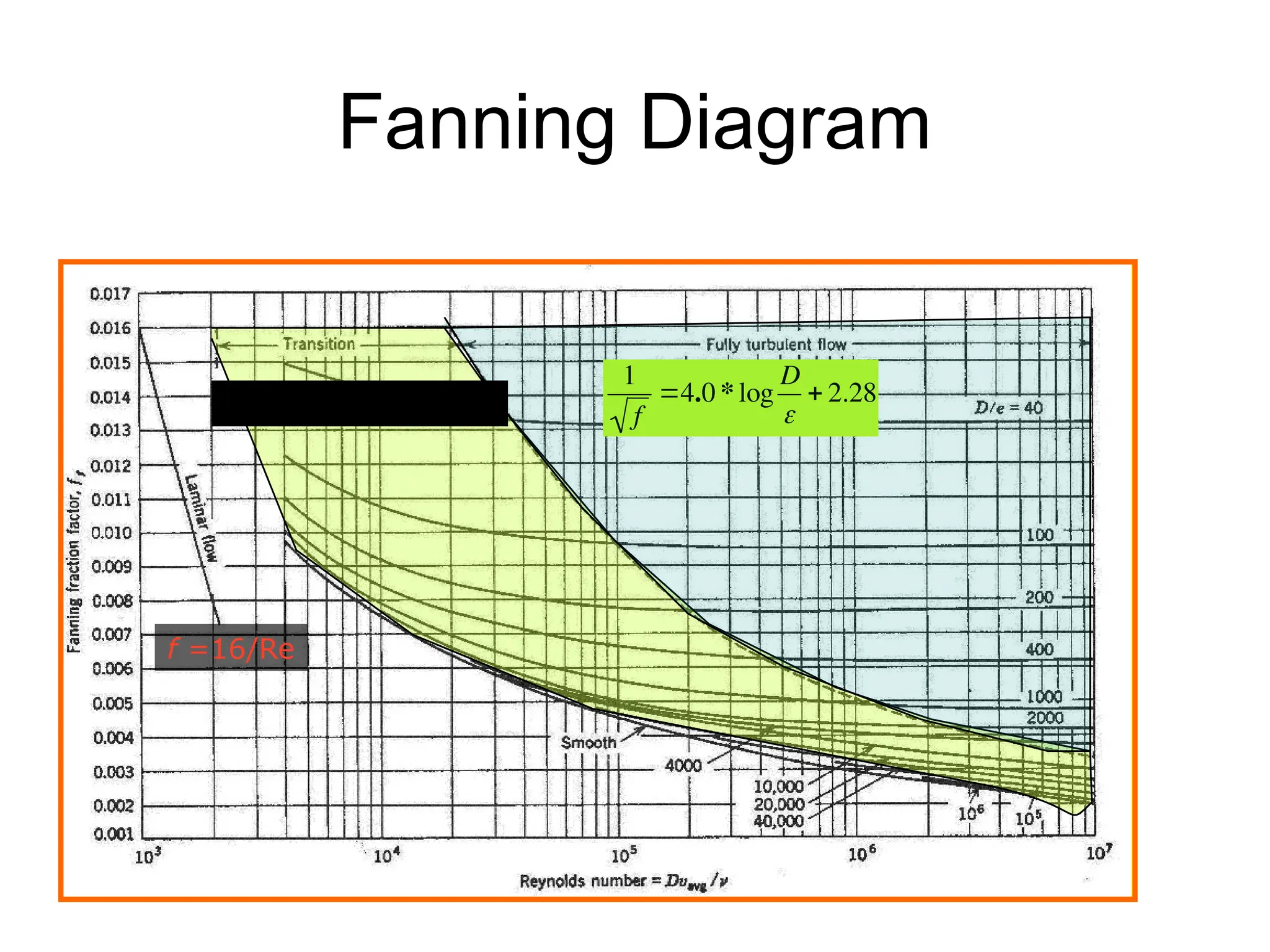
Friction Factor forSmooth, Transition,
and Rough Turbulent flow
4
0
Re
log
0
4
1
.
*
*
.
f
f
Smooth pipe, Re>3000
28
.
2
log
0
4
1
D
f
*
.
Rough pipe, [ (D/)/(Re√ƒ) <0.01]
f
P
L
D
2U2
f 0.079Re 0.25
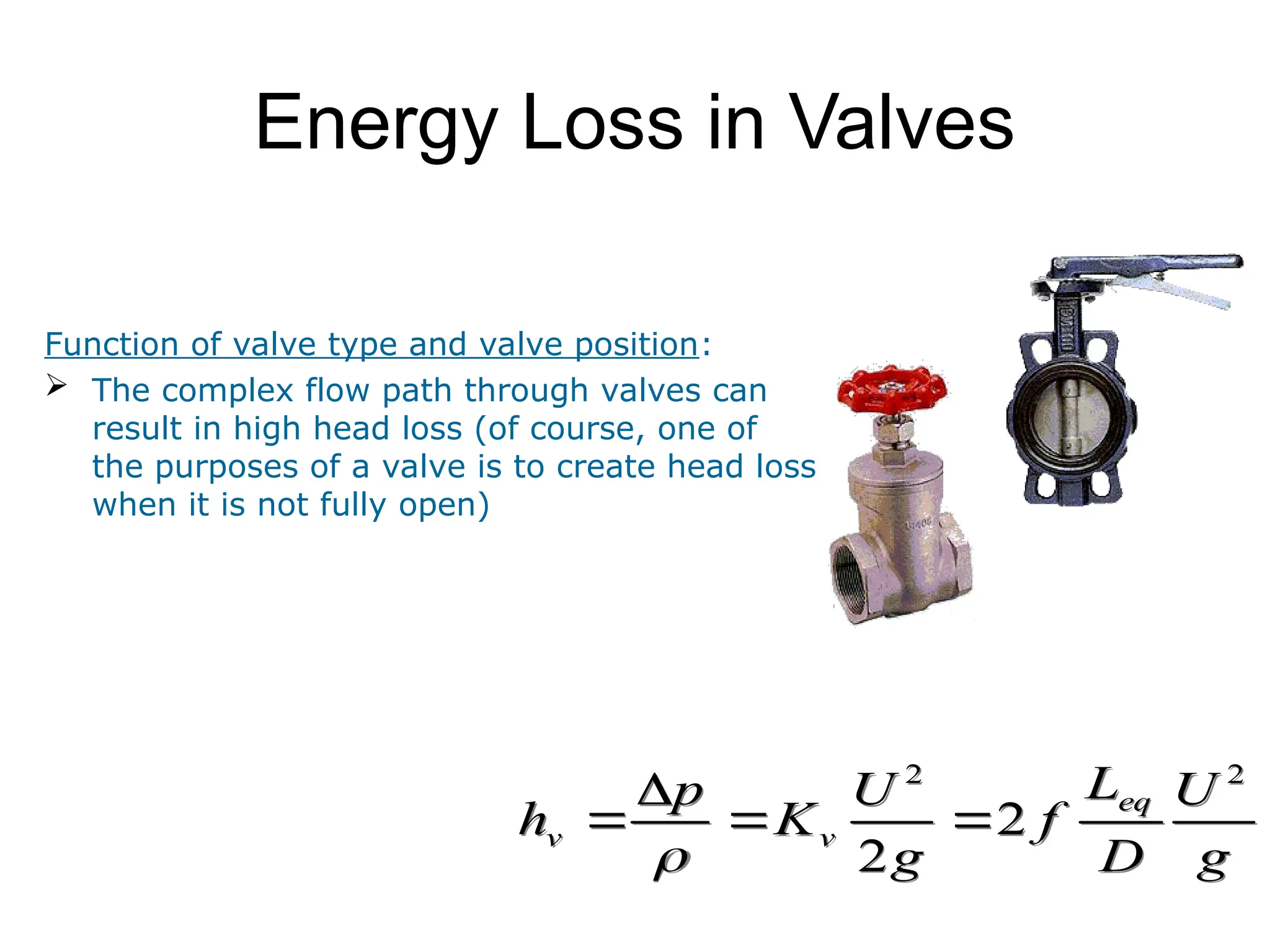
Energy Loss inValves
g
U
D
L
f
g
U
K
p
h
eq
v
v
2
2
2
2
Function of valve type and valve position:
The complex flow path through valves can
result in high head loss (of course, one of
the purposes of a valve is to create head loss
when it is not fully open)
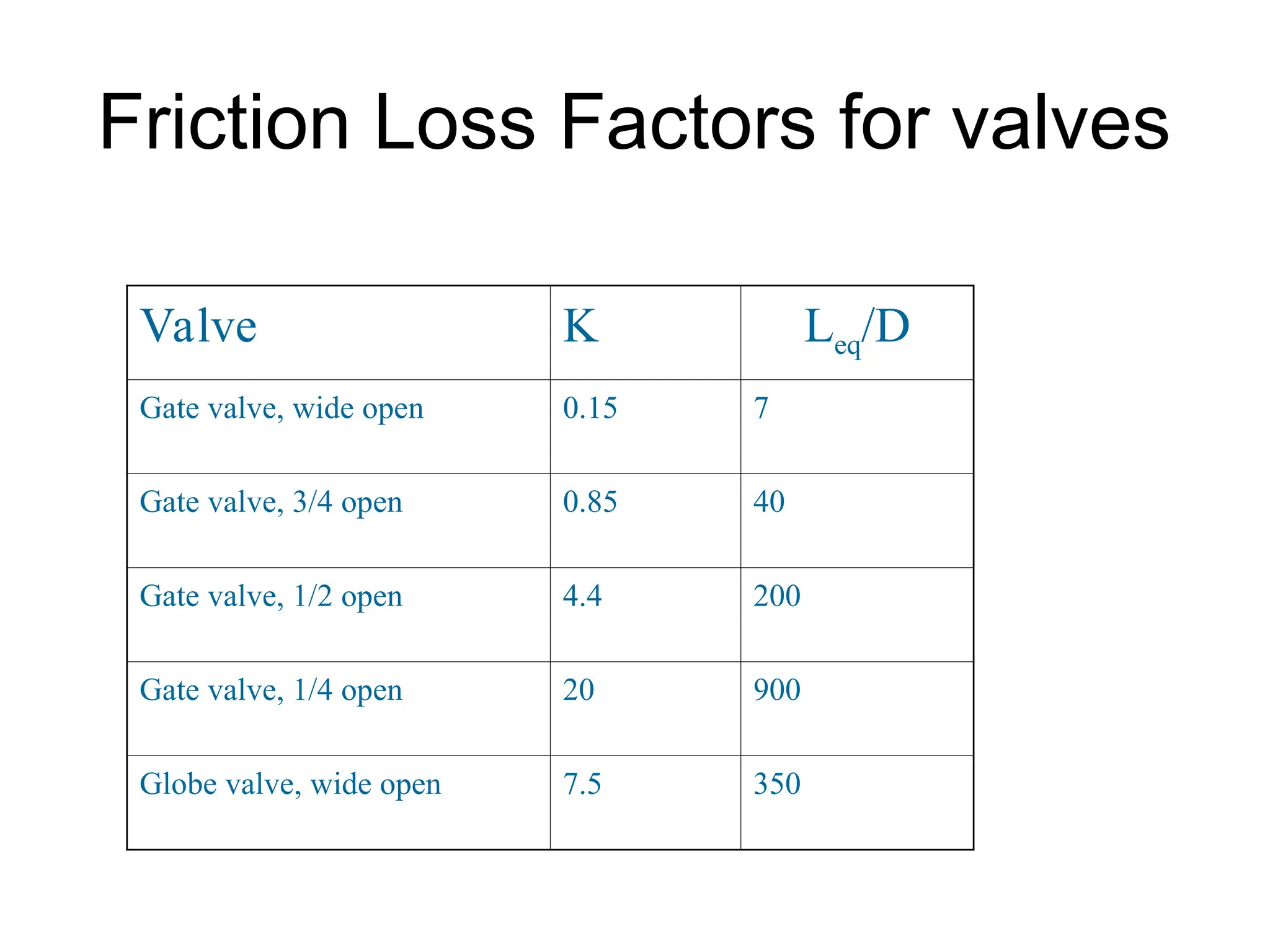
53.
Friction Loss Factorsfor valves
Valve K Leq/D
Gate valve, wide open 0.15 7
Gate valve, 3/4 open 0.85 40
Gate valve, 1/2 open 4.4 200
Gate valve, 1/4 open 20 900
Globe valve, wide open 7.5 350
54.
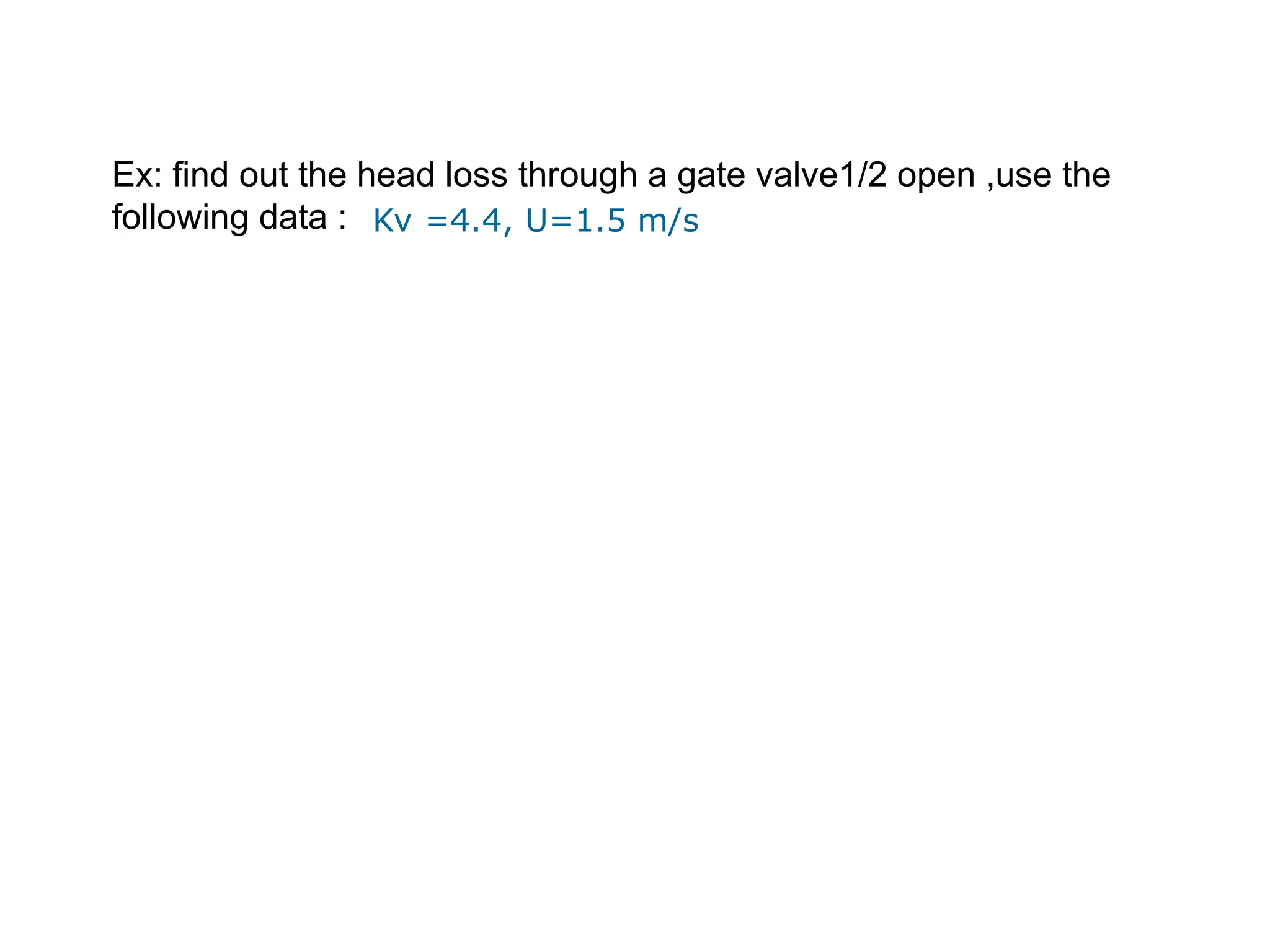
Ex: find outthe head loss through a gate valve1/2 open ,use the
following data : Kv =4.4, U=1.5 m/s
55.
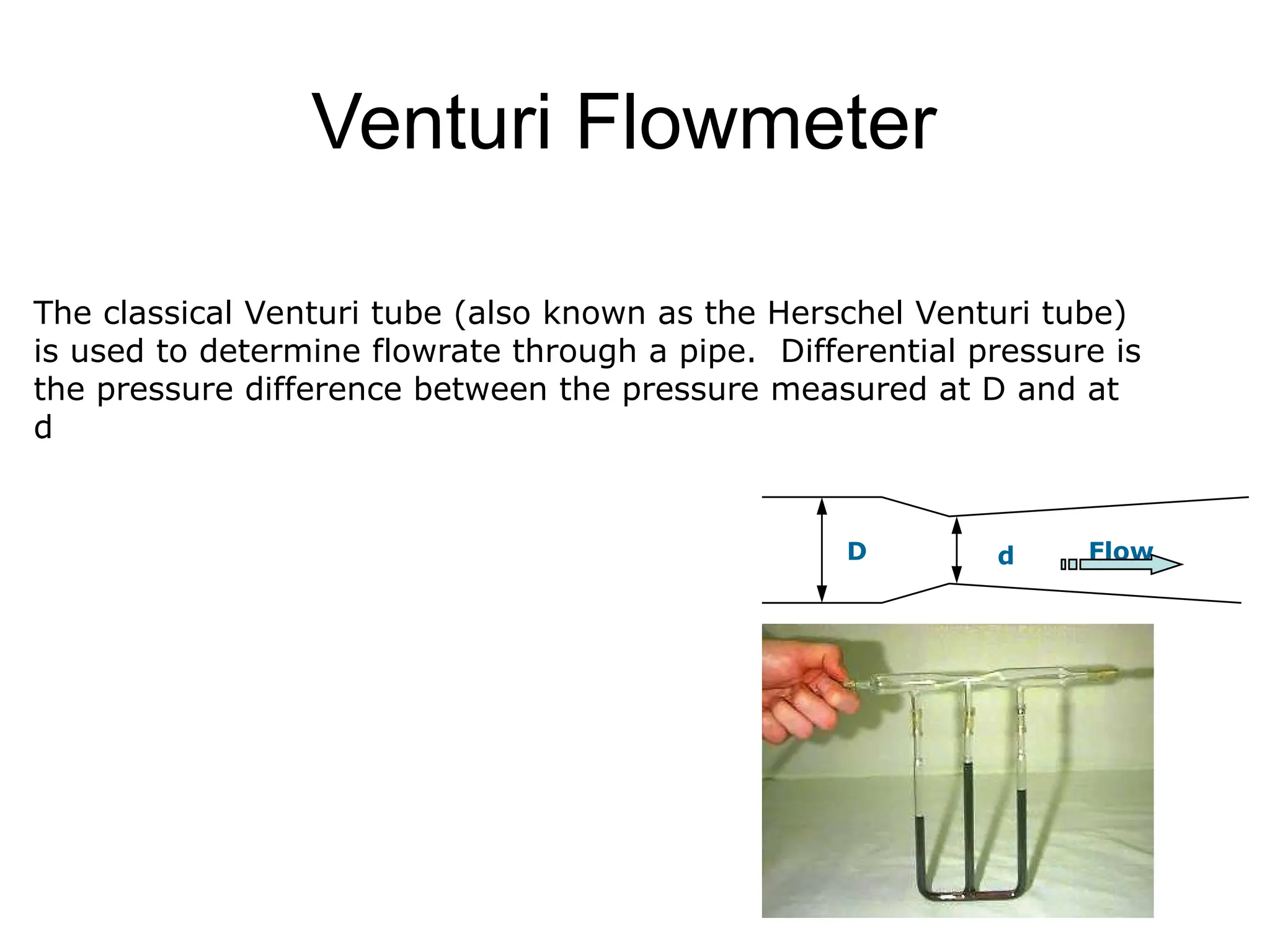
Venturi Flowmeter
The classicalVenturi tube (also known as the Herschel Venturi tube)
is used to determine flowrate through a pipe. Differential pressure is
the pressure difference between the pressure measured at D and at
d
D d Flow
56.
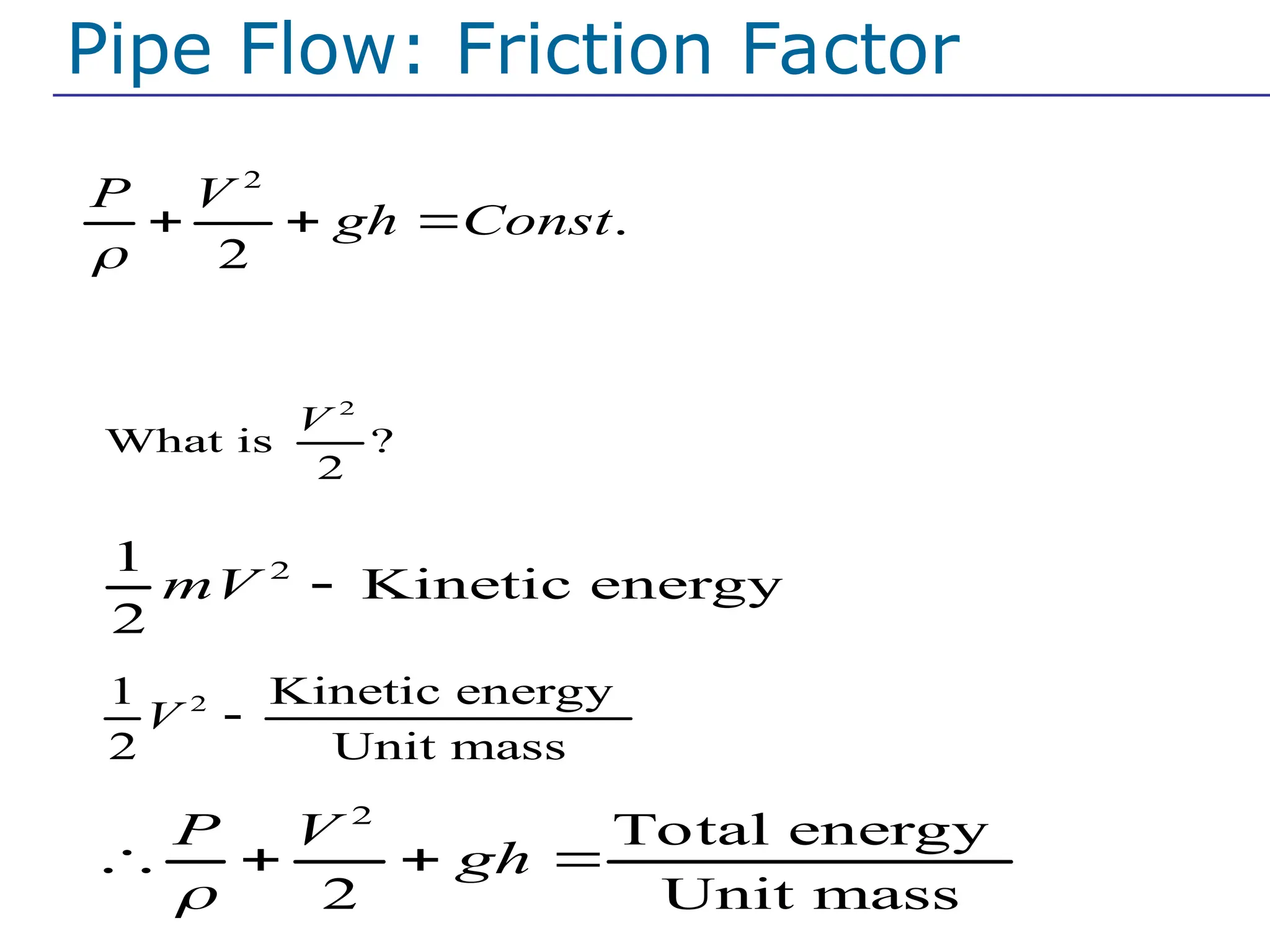
Pipe Flow: FrictionFactor
1. Energy conservation equation
2
.
2
P V
gh Const
If there is no friction
2
1
Kinetic energy
2
mV
2
What is ?
2
V
2
1 Kinetic energy
2 Unit mass
V
2
Total energy
2 Unit mass
P V
gh
57.
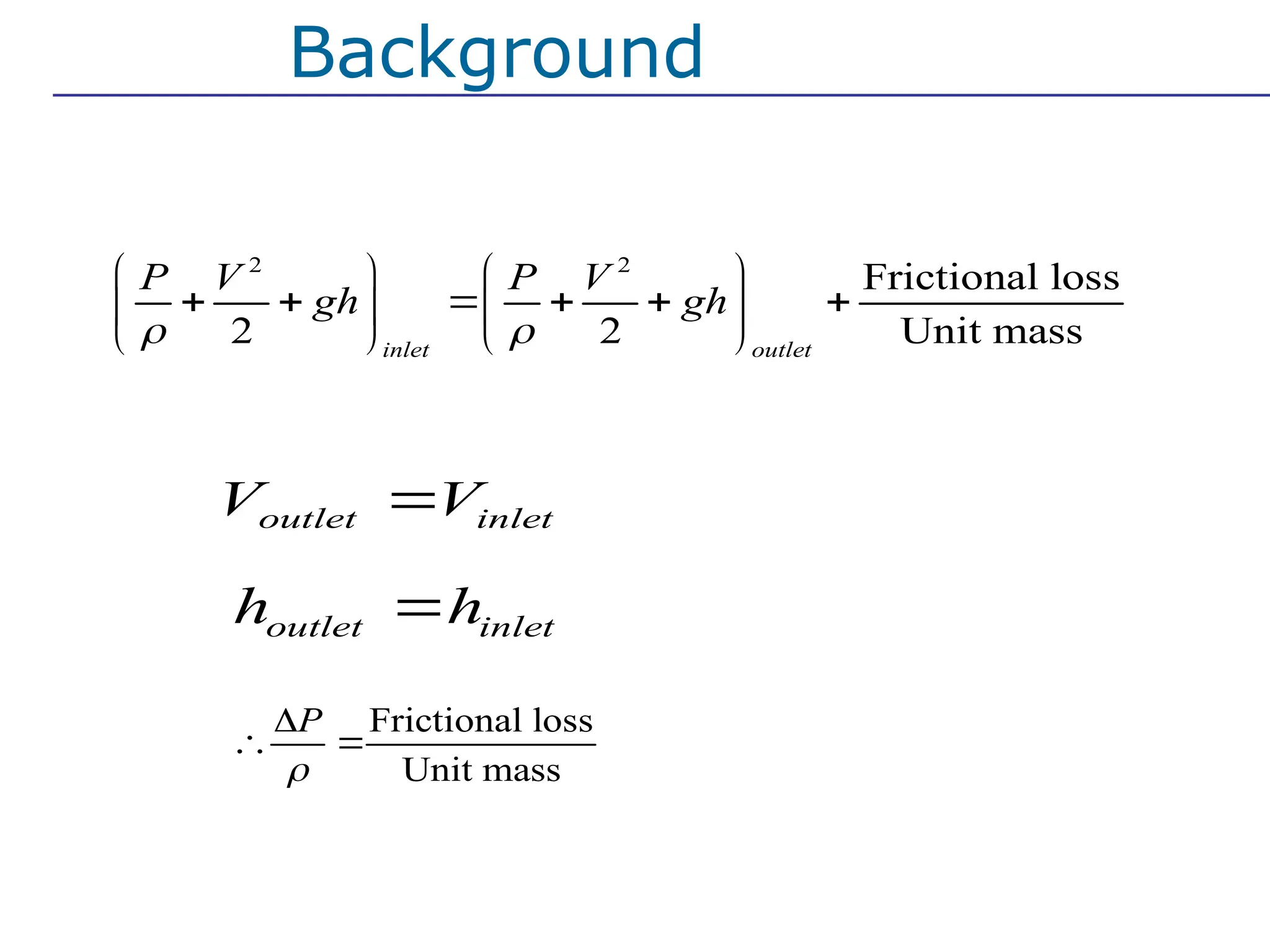
2. If thereis frictional loss , then
Frictional loss
Unit mass
P
2 2
Frictional loss
2 2 Unit mass
inlet outlet
P V P V
gh gh
In many
cases
outlet inlet
h h
outlet inlet
V V
Background
58.
Q. Where areall frictional loss can occur ?
• in pipe, in valves, joints etc
• First focus on pipe friction
In pipe, Can we relate the friction to other properties ?
Flow properties
Fuid properties
properties
Background
59.
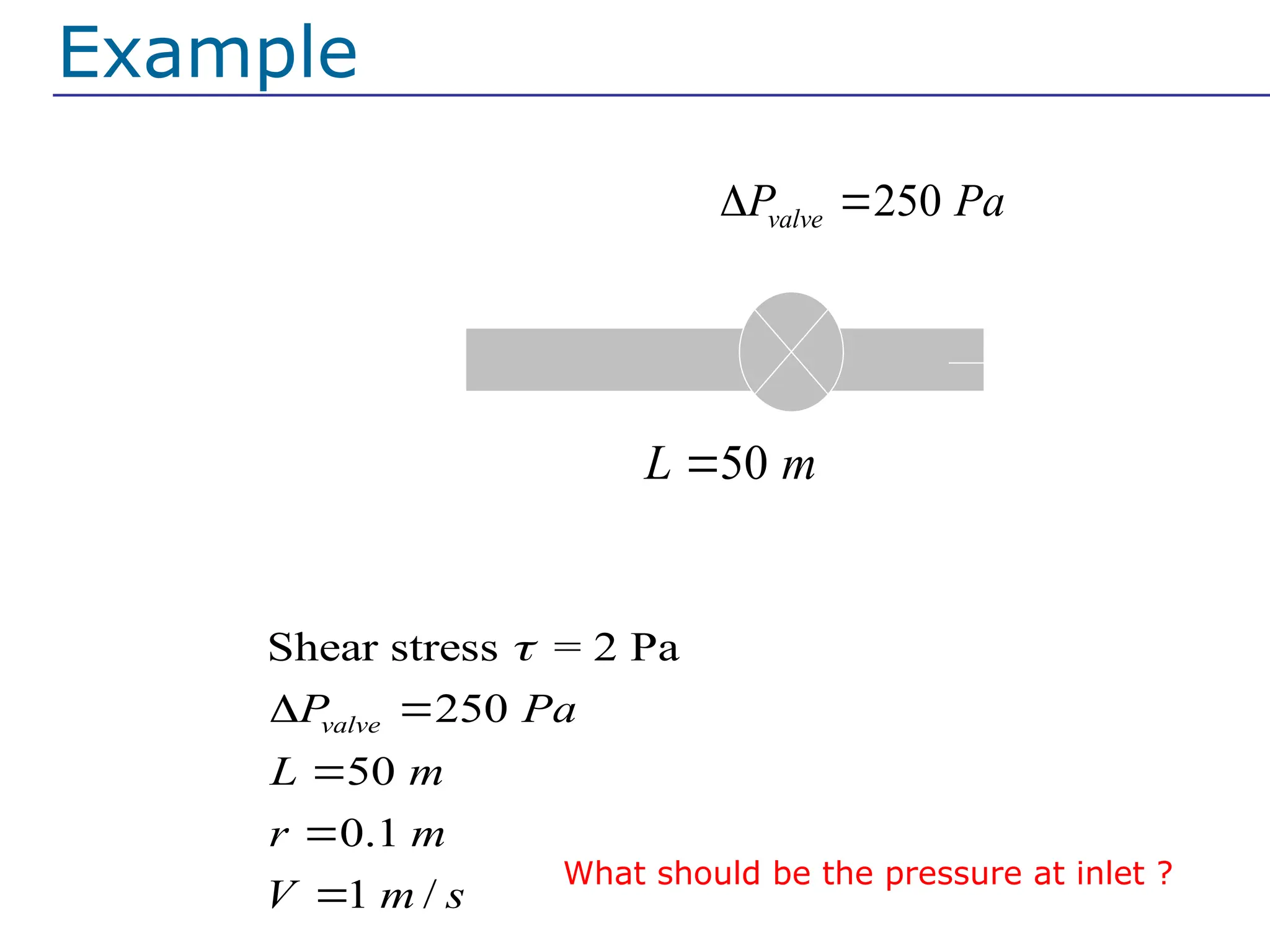
Example for generalcase:
At the normal operating condition given following data
Shear stress = 2 Pa
250
50
0.1
1 /
valve
P Pa
L m
r m
V m s
250
valve
P Pa
50
L m
0 gauge
pressure
Example
What should be the pressure at inlet ?
60.
Solution : takingpressure balance
0
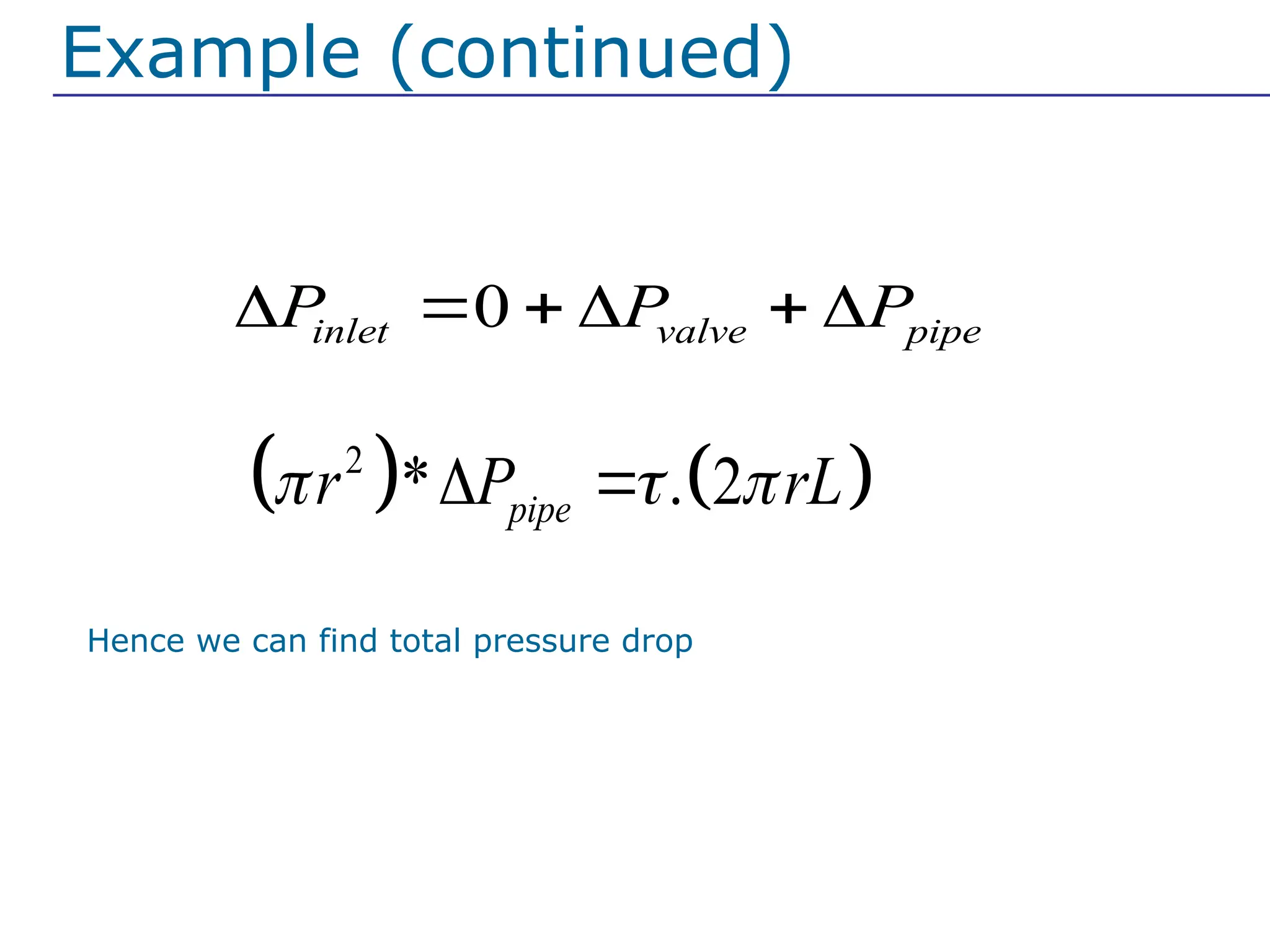
inlet valve pipe
P P P
2
* . 2
pipe
r P rL
Example (continued)
For pipe, Force balance
Hence we can find total pressure drop
61.
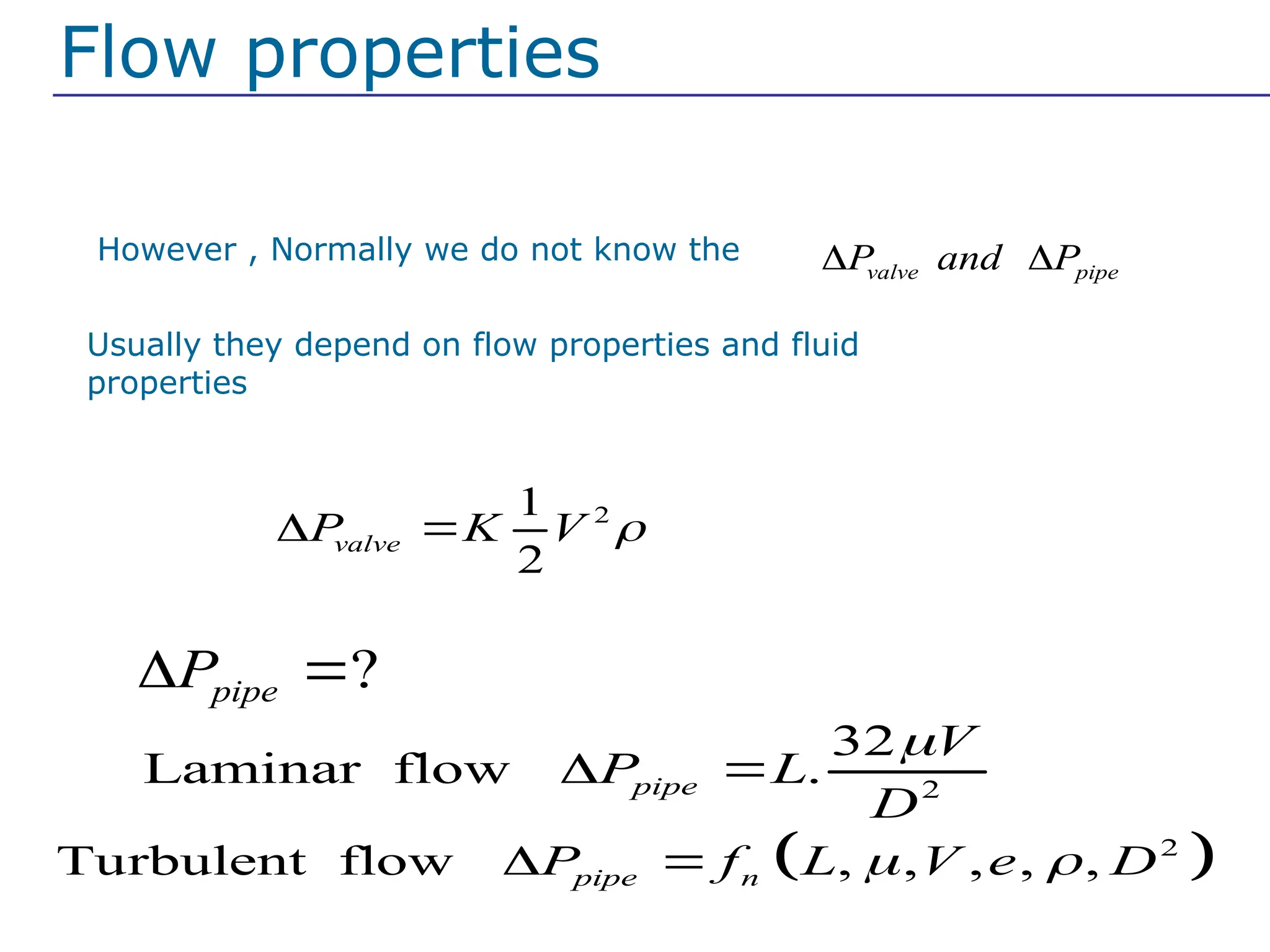
We have saidnothing about fluid flow properties
valve pipe
P and P
However , Normally we do not know the
Usually they depend on flow properties and fluid
properties
?
pipe
P
2
1
2
valve
P K V
2
32
Laminar flow .
pipe
V
P L
D
2
Turbulent flow , , , , ,
pipe n
P f L V e D
Flow properties
Empirical
62.
2
( )
1
2
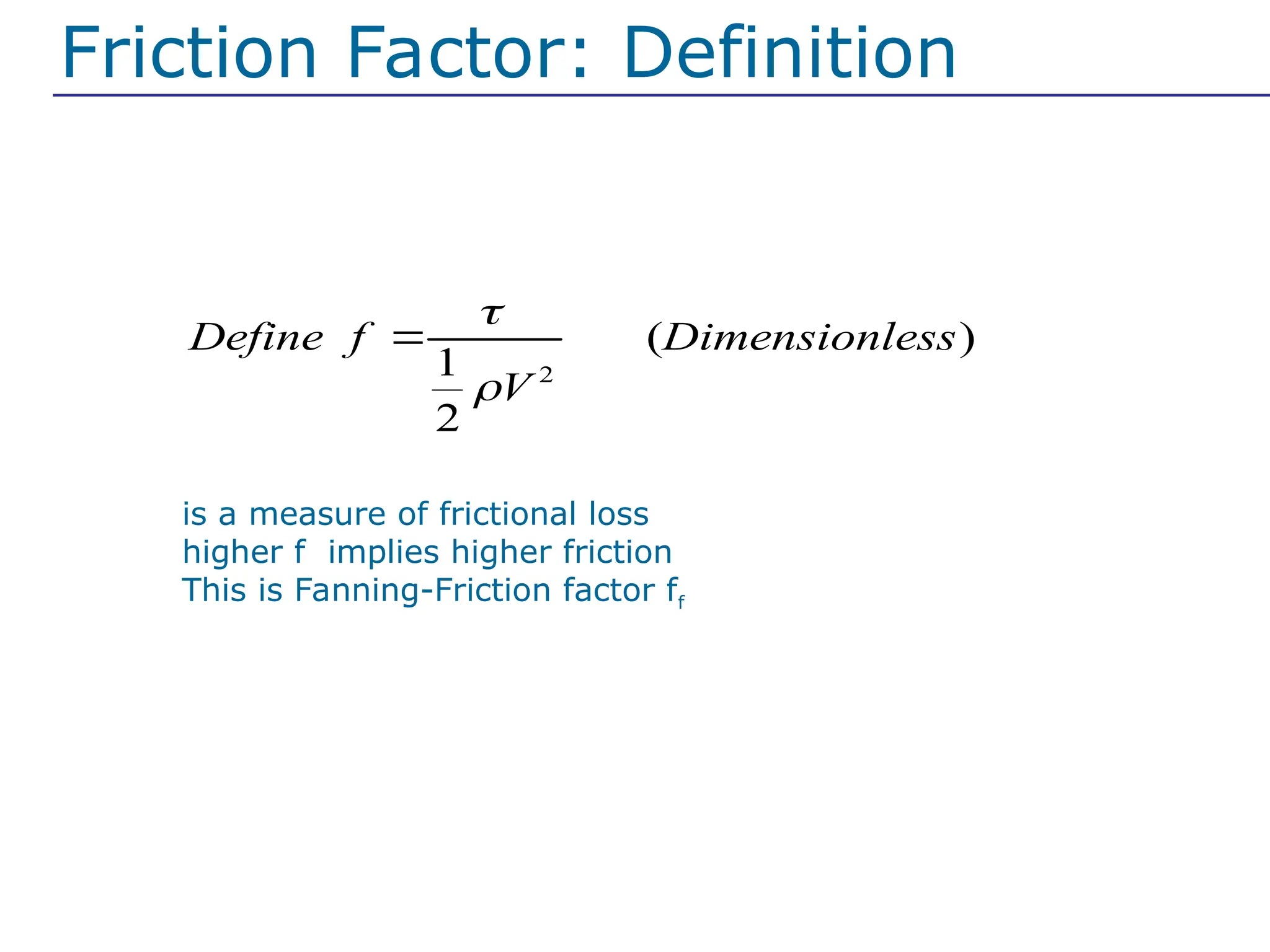
Define fDimensionless
V
In general we want to find
is a measure of frictional loss
higher f implies higher friction
This is Fanning-Friction factor ff
Friction Factor: Definition
63.
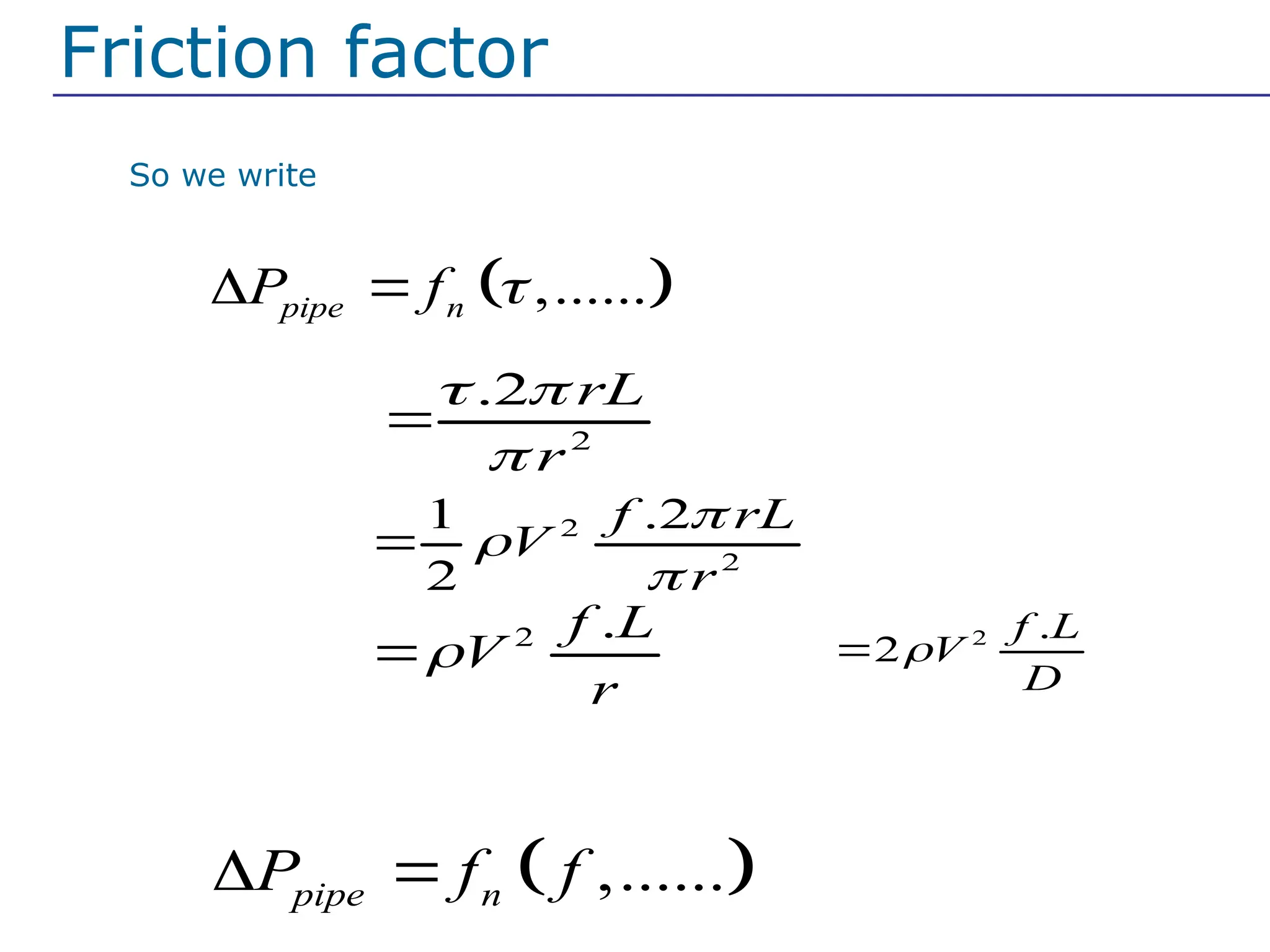
So we write
,......
pipe n
P f
,......
pipe n
P f f
2
2
1 .2
2
f rL
V
r
2
.2 rL
r
2 .
f L
V
r
Friction factor
This is for pipe with circular cross section
2 .
2
f L
V
D
64.
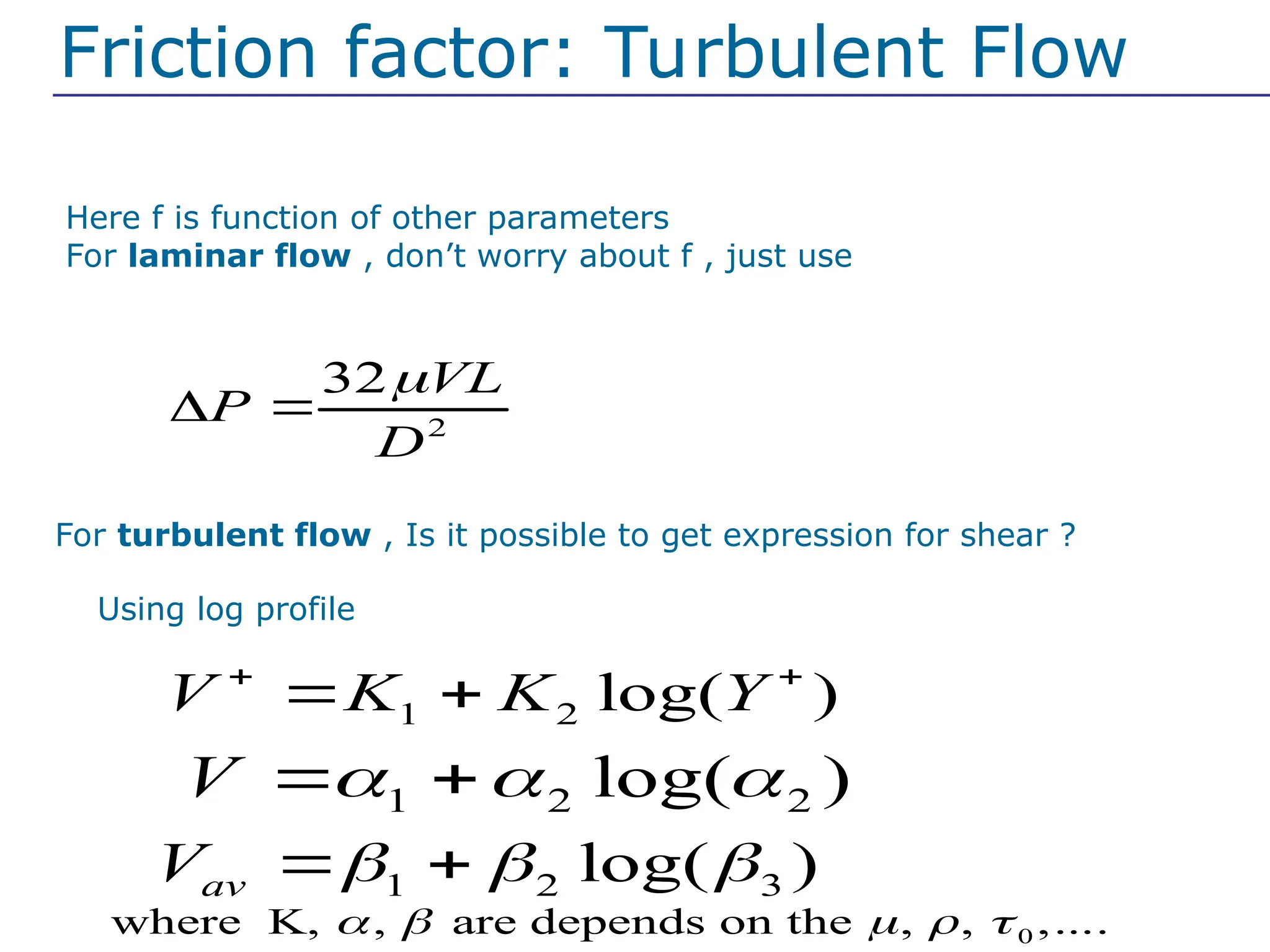
Here f isfunction of other parameters
For laminar flow , don’t worry about f , just use
2
32 VL
P
D
For turbulent flow , Is it possible to get expression for shear ?
Friction factor: Turbulent Flow
Using log profile
1 2 log( )
V K K Y
1 2 2
log( )
V
1 2 3
log( )
av
V
0
where K, , are depends on the , , ,....
65.
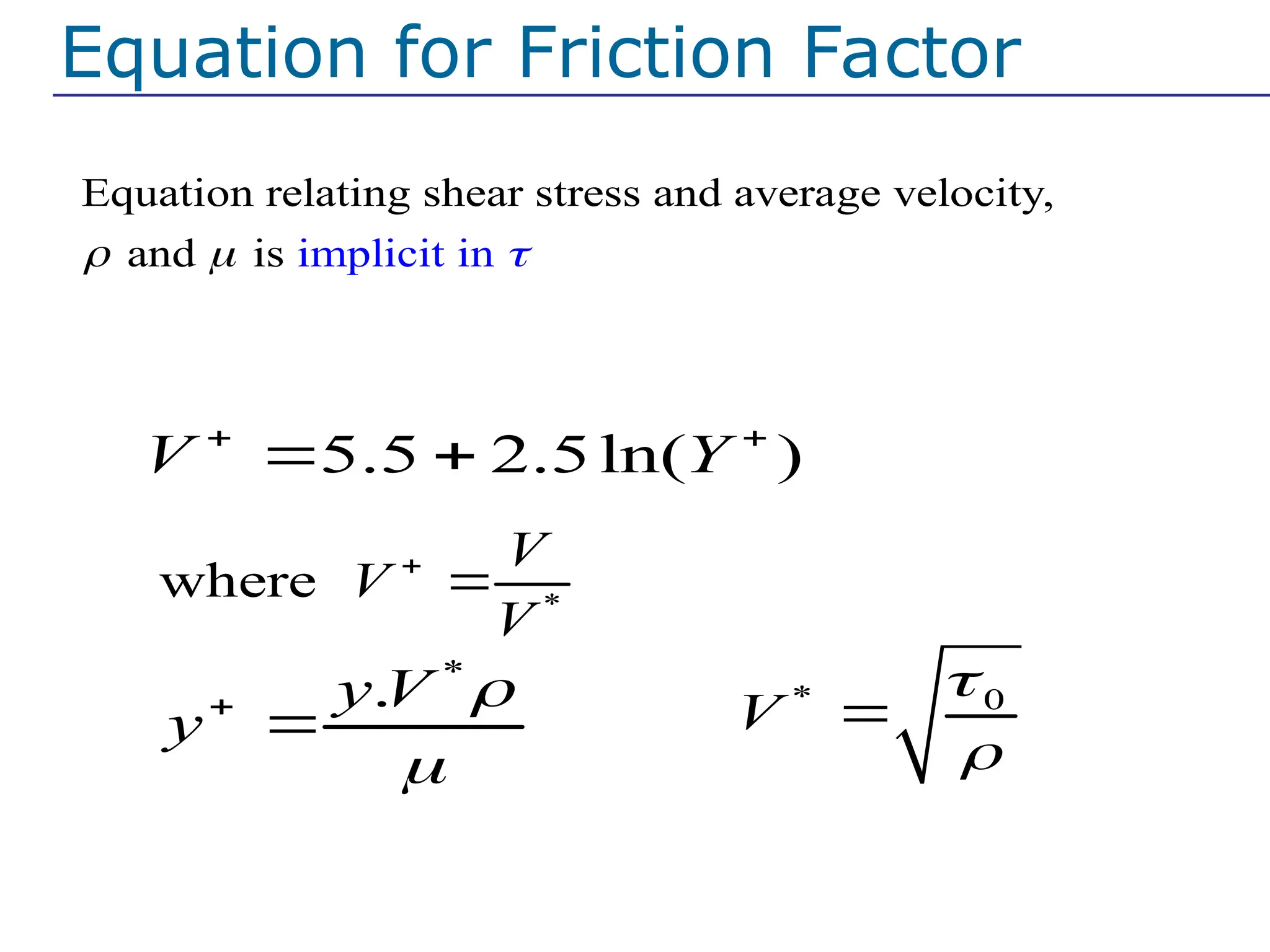
Equation relating shearstress and average velocity,
and implicit n
is i
Because original equation
*
where
V
V
V
*
.
y V
y
* 0
V
5.5 2.5ln( )
V Y
Equation for Friction Factor
66.
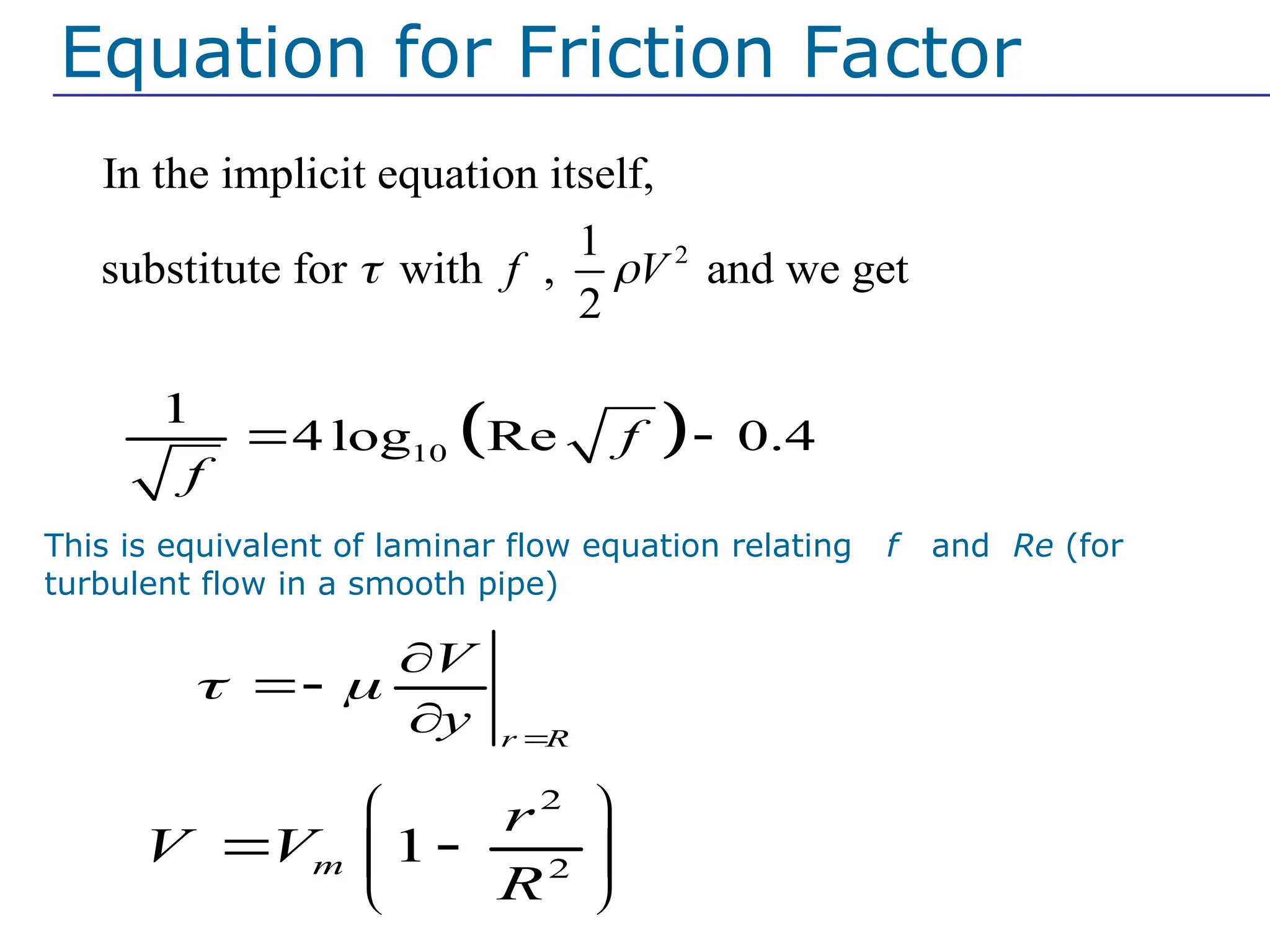
10
1
4 logRe 0.4
f
f
2
In the implicit equation itself,
1
substitute for with , and we get
2
f V
r R
V
y
2
2
1
m
r
V V
R
This is equivalent of laminar flow equation relating f and Re (for
turbulent flow in a smooth pipe)
Equation for Friction Factor
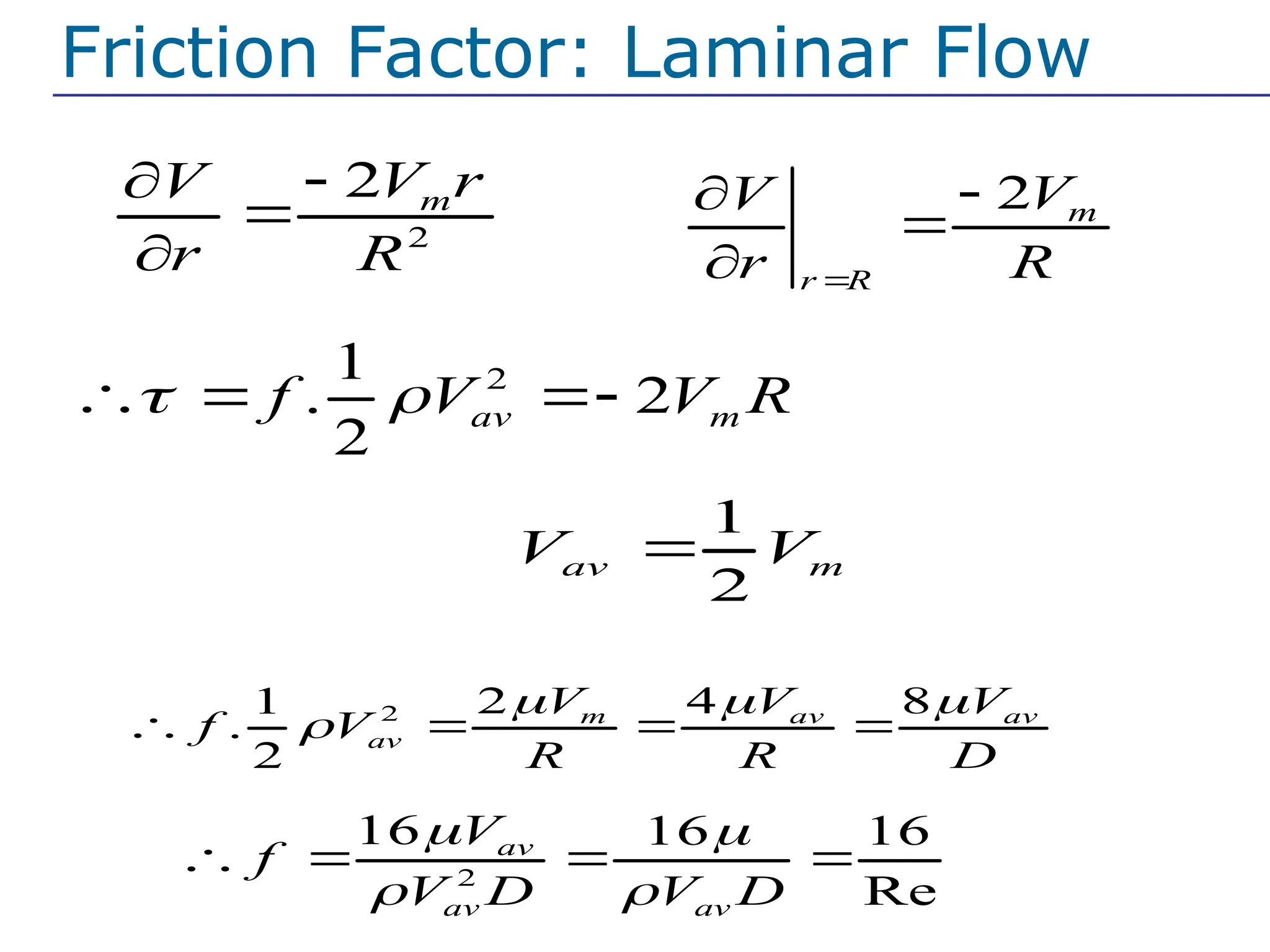
67.
2
2 m
V r
V
rR
2 m
r R
V
V
r R
2
1
. 2
2
av m
f V V R
Friction Factor: Laminar Flow
2 2 4 8
1
.
2
m av av
av
V V V
f V
R R D
2
16 16 16
Re
av
av av
V
f
V D V D
1
2
av m
V V
For laminar flow
68.
2
1
.
2
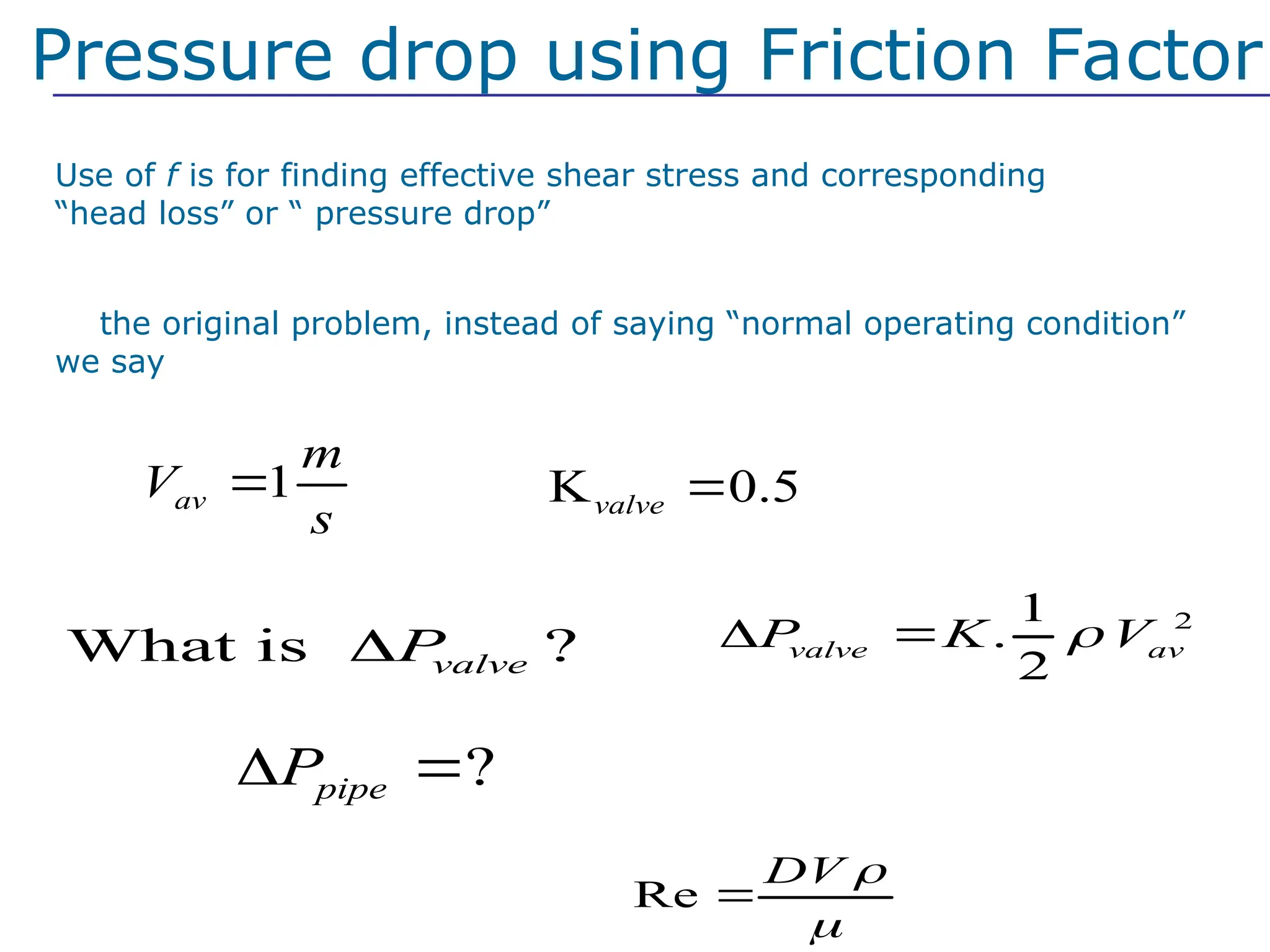
valve av
P KV
?
pipe
P
Re
DV
Use of f is for finding effective shear stress and corresponding
“head loss” or “ pressure drop”
What is ?
valve
P
K 0.5
valve
In the original problem, instead of saying “normal operating condition”
we say
Pressure drop using Friction Factor
Laminar or turbulent?
1
av
m
V
s
69.
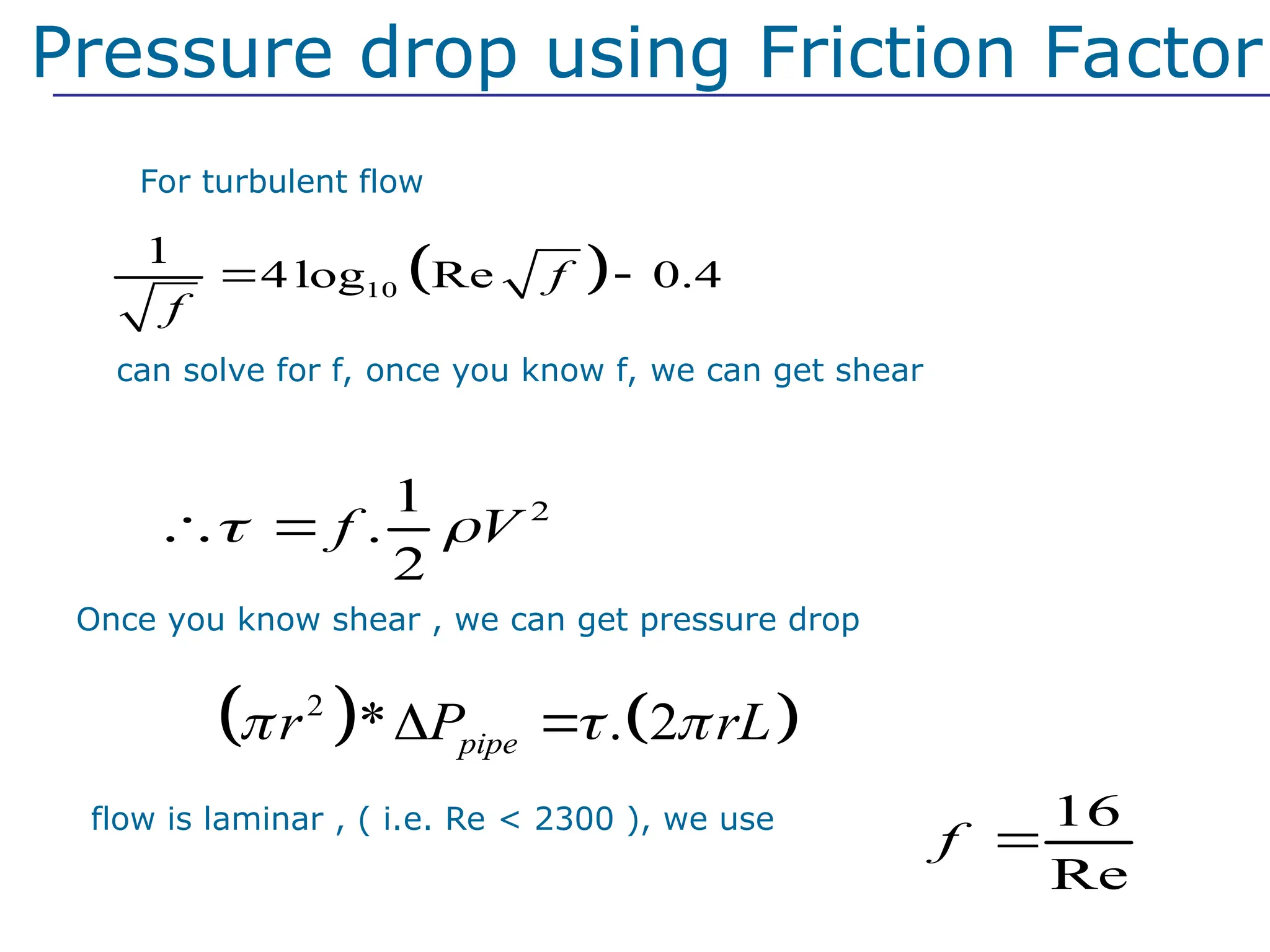
For turbulent flow
10
1
4 log Re 0.4
f
f
We can solve for f, once you know f, we can get shear
2
1
.
2
f V
Pressure drop using Friction Factor
Once you know shear , we can get pressure drop
2
* . 2
pipe
r P rL
If flow is laminar , ( i.e. Re < 2300 ), we use 16
Re
f
70.
2 2
2
1 12
. .
2 2
rL
P K V f V
r
2
1
.
2
pipe
P K V P
2
2
1 2
.
2
rL
P K V
r
And original equation becomes,
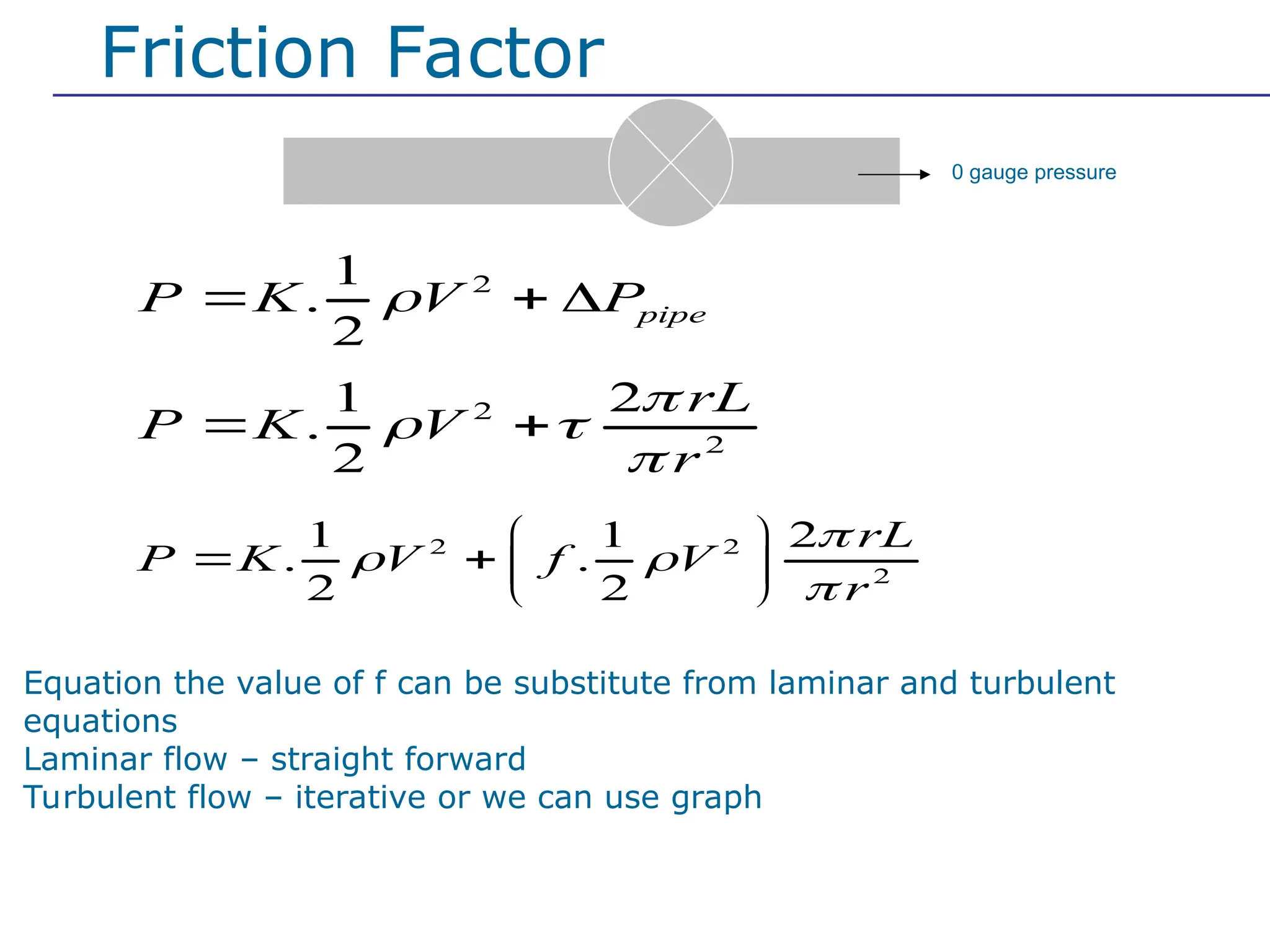
Equation the value of f can be substitute from laminar and turbulent
equations
Laminar flow – straight forward
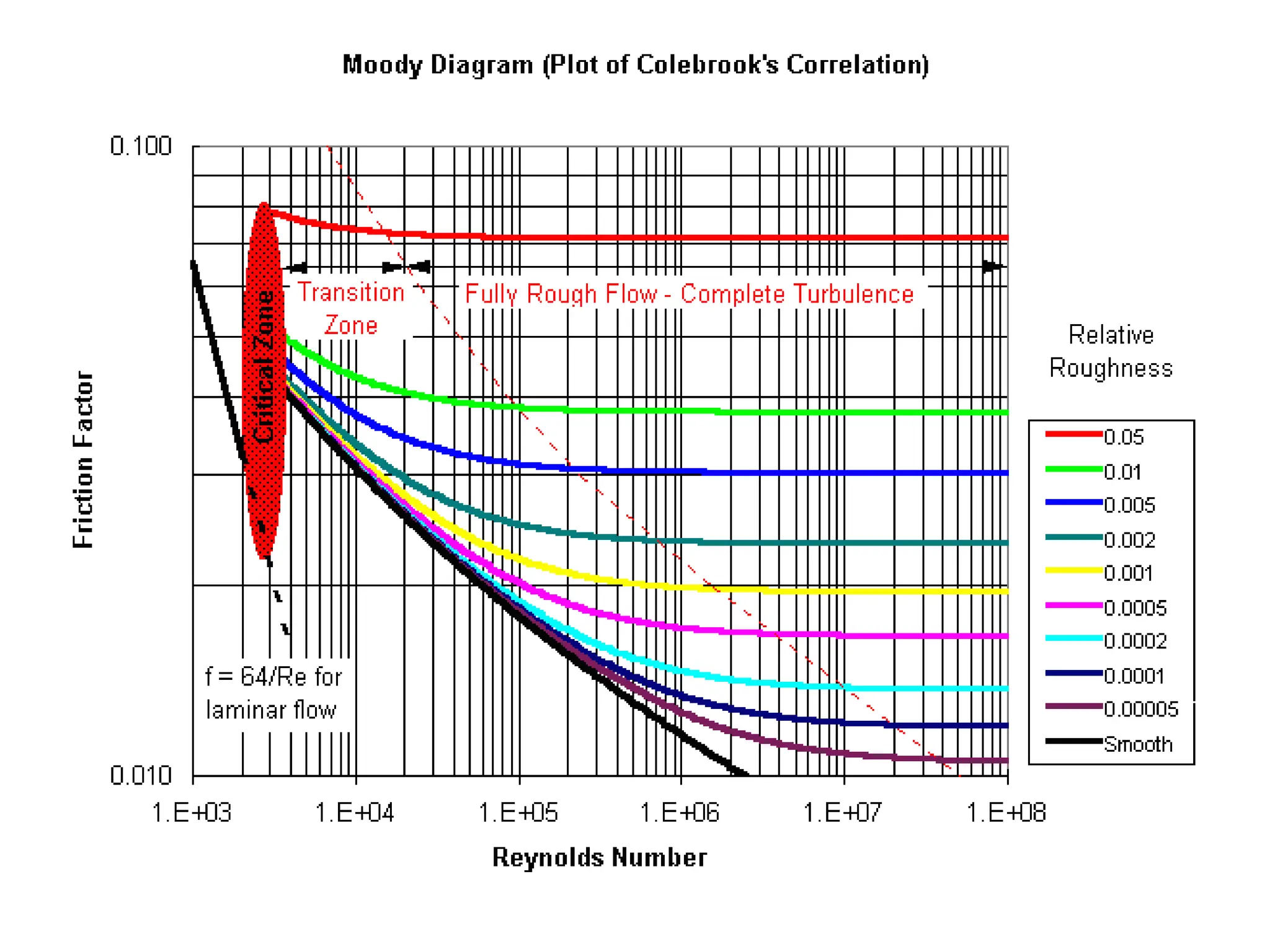
Turbulent flow – iterative or we can use graph
Friction Factor
0 gauge pressure
71.
Determination of Qor D
Given a pipe (system) with known D and a specified flow rate (Q
~ V), we can calculate the pressure needed
i.e. is the pumping requirement
We have a pump: Given that we have a pipe (of dia D), what is
flow rate that we can get?
OR
We have a pump: Given that we need certain flow rate, of what
size pipe should we use?
72.
Determination of Qor D
that we have a pipe (of dia D), what is flow rate that we can get?
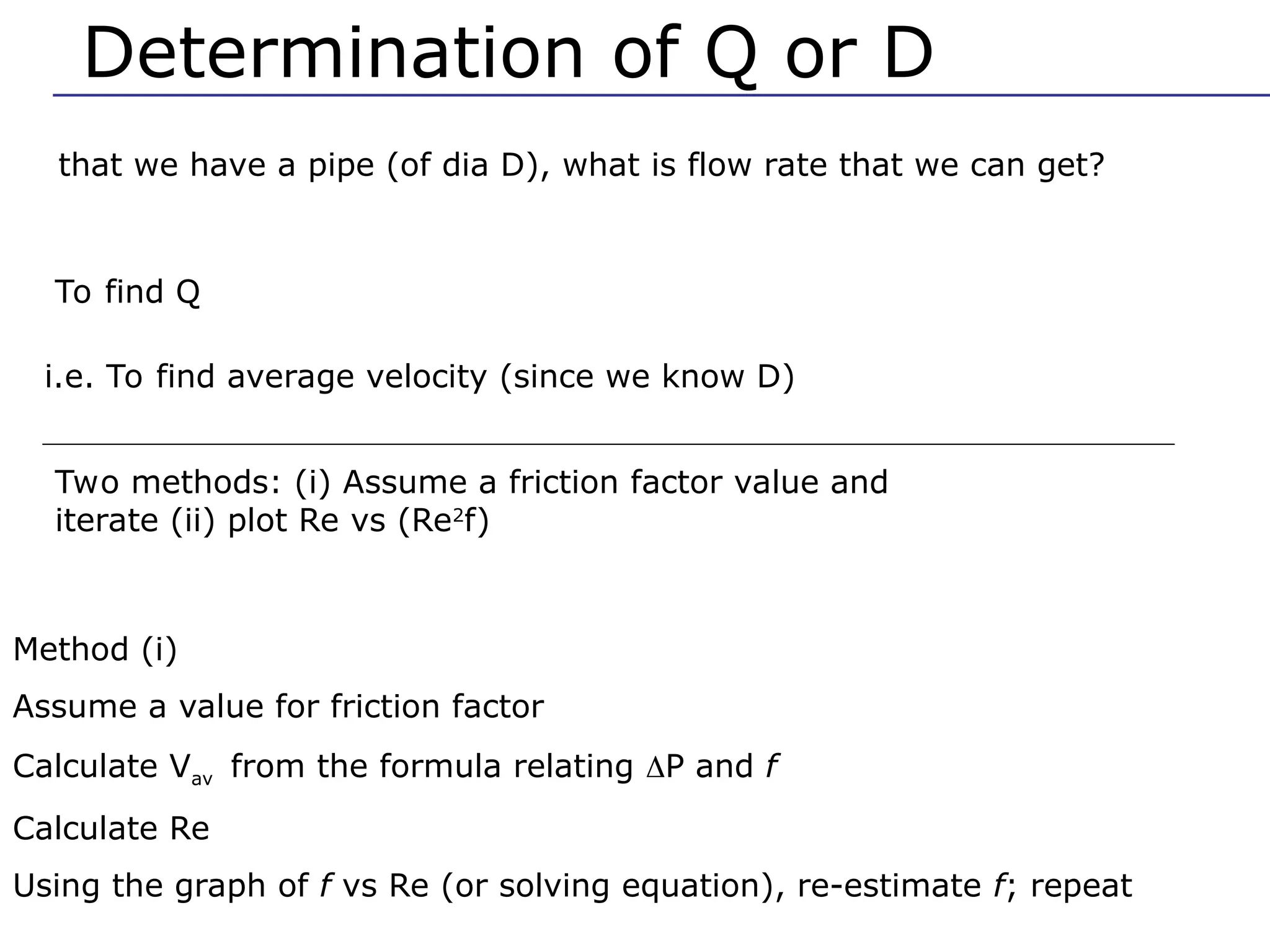
To find Q
i.e. To find average velocity (since we know D)
Two methods: (i) Assume a friction factor value and
iterate (ii) plot Re vs (Re2
f)
Method (i)
Assume a value for friction factor
Calculate Vav from the formula relating P and f
Calculate Re
Using the graph of f vs Re (or solving equation), re-estimate f; repeat
73.
Determination of Qor D
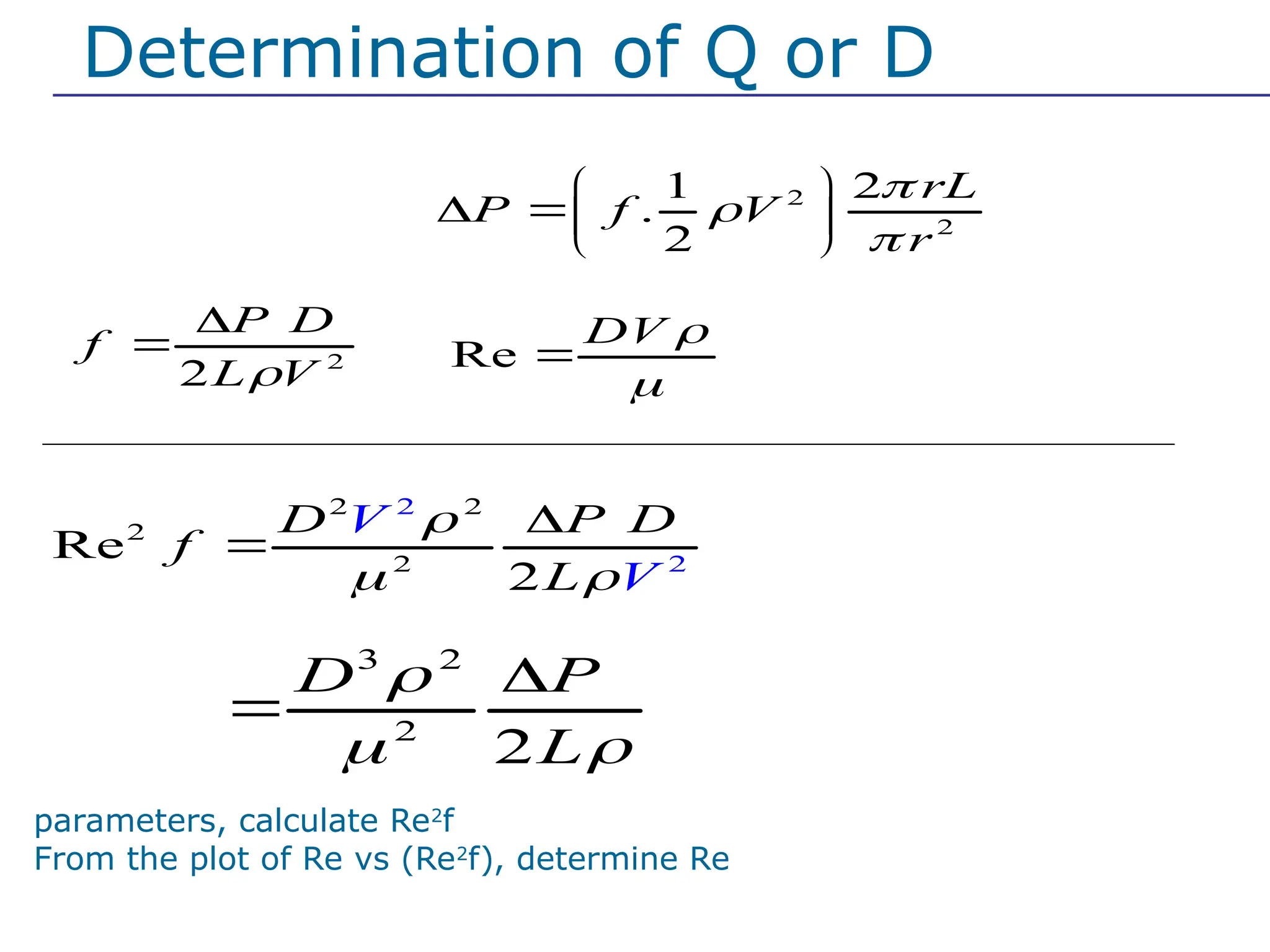
Method (ii)
2
2
1 2
.
2
rL
P f V
r
2
2
P D
f
L V
Re
DV
2 2
2
2 2
2
Re
2
D P D
f
L
V
V
3 2
2
2
D P
L
From the plot of f vs Re,
plot Re vs (Re2
f)
parameters, calculate Re2
f
From the plot of Re vs (Re2
f), determine Re Calculate Vav
74.
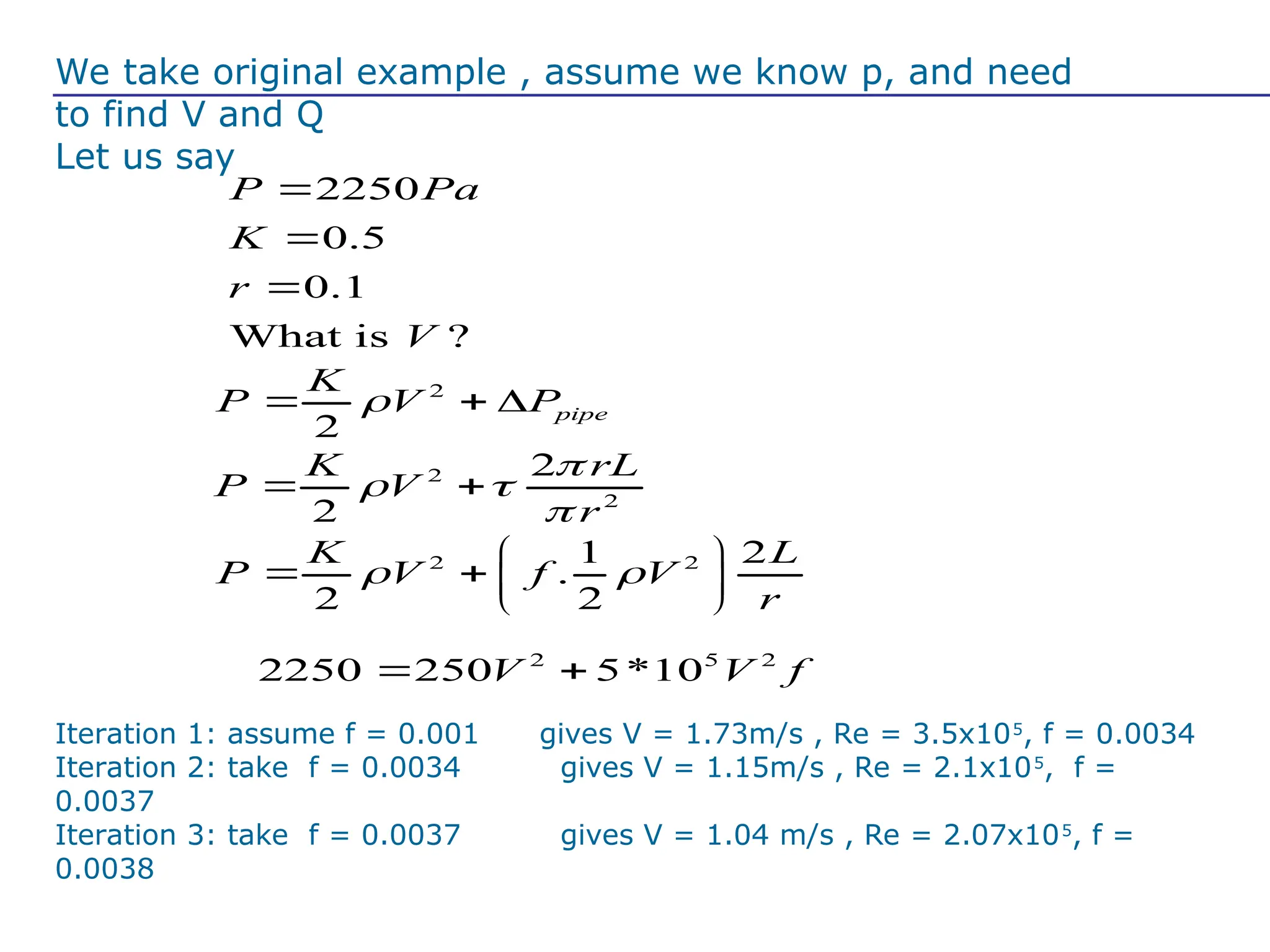
We take originalexample , assume we know p, and need
to find V and Q
Let us say
2250
0.5
0.1
What is ?
P Pa
K
r
V
2
2
pipe
K
P V P
2 5 2
2250 250 5*10
V V f
2
2
2
2
K rL
P V
r
2 2
1 2
.
2 2
K L
P V f V
r
Iteration 1: assume f = 0.001 gives V = 1.73m/s , Re = 3.5x10⁵
, f = 0.0034
Iteration 2: take f = 0.0034 gives V = 1.15m/s , Re = 2.1x10⁵
, f =
0.0037
Iteration 3: take f = 0.0037 gives V = 1.04 m/s , Re = 2.07x10⁵
, f =
0.0038
75.
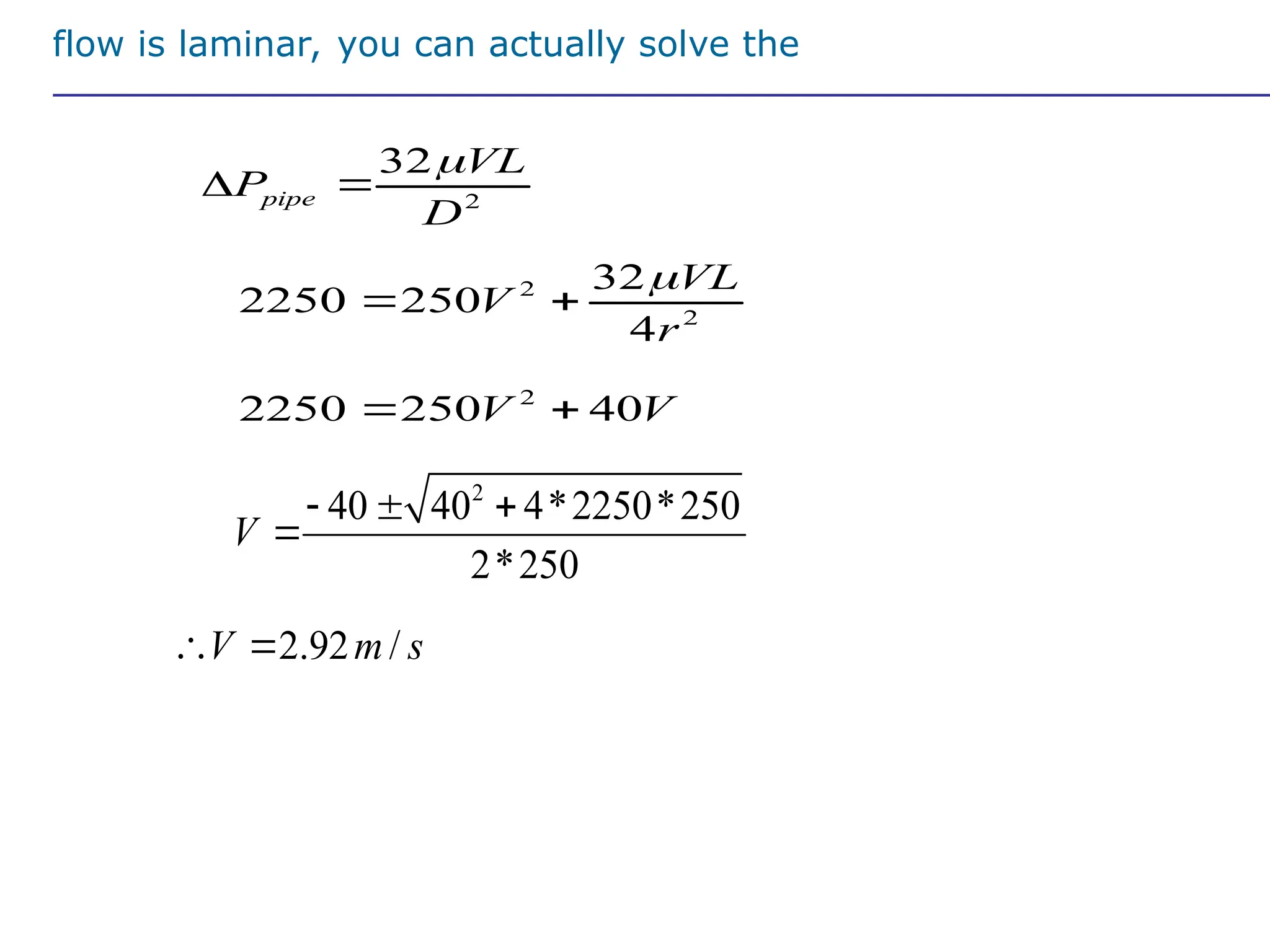
If flow islaminar, you can actually solve the
equation
2
2250 250 40
V V
2
2
32
2250 250
4
VL
V
r
2
32
pipe
VL
P
D
2
40 40 4*2250*250
2*250
V
2.92 /
V m s
76.
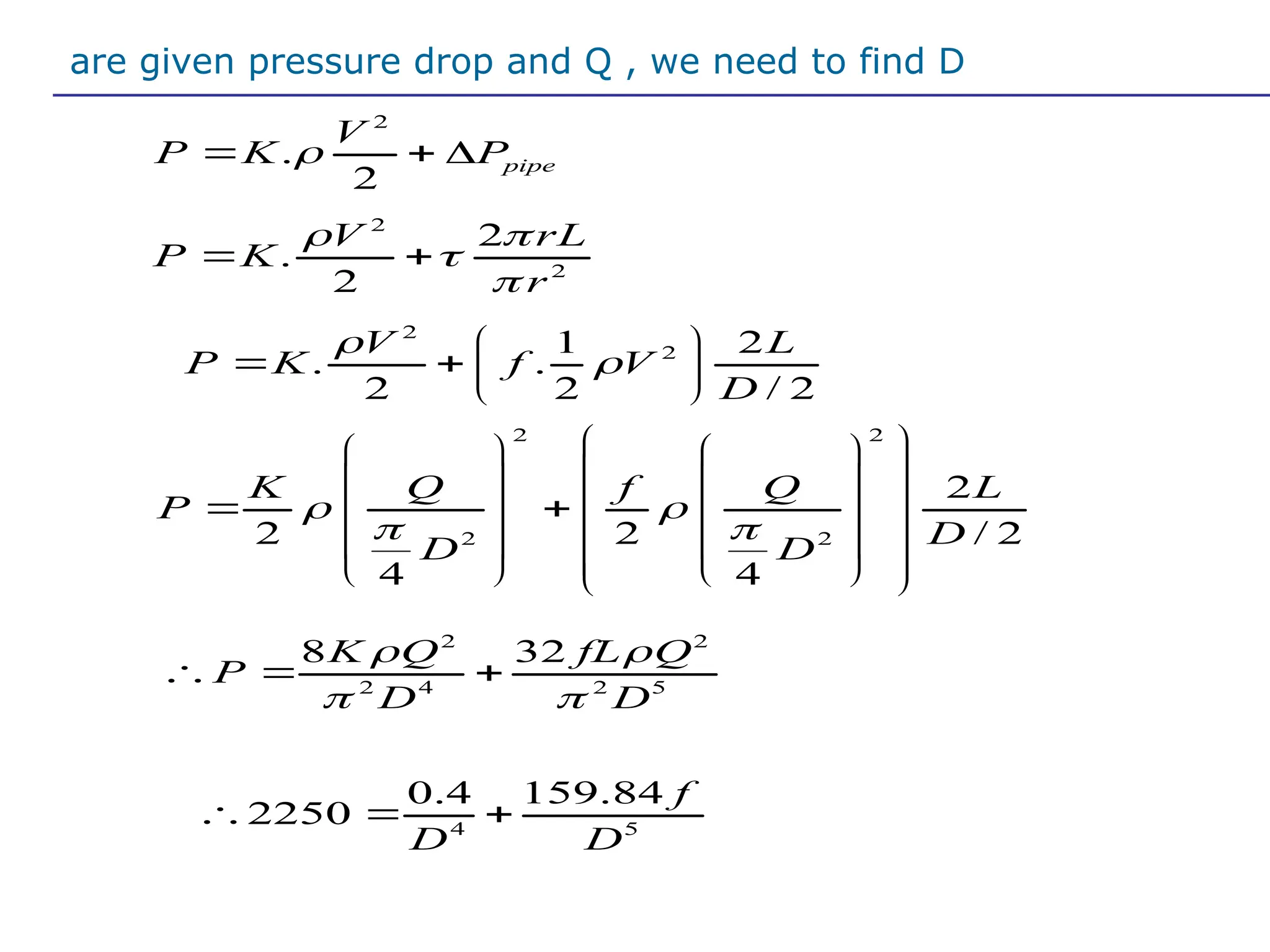
Iare given pressuredrop and Q , we need to find D
2
2
1 2
. .
2 2 / 2
V L
P K f V
D
2
.
2
pipe
V
P K P
2
2
2
.
2
V rL
P K
r
2 2
2 2
2
2 2 / 2
4 4
K Q f Q L
P
D
D D
2 2
2 4 2 5
8 32
K Q fL Q
P
D D
4 5
0.4 159.84
2250
f
D D
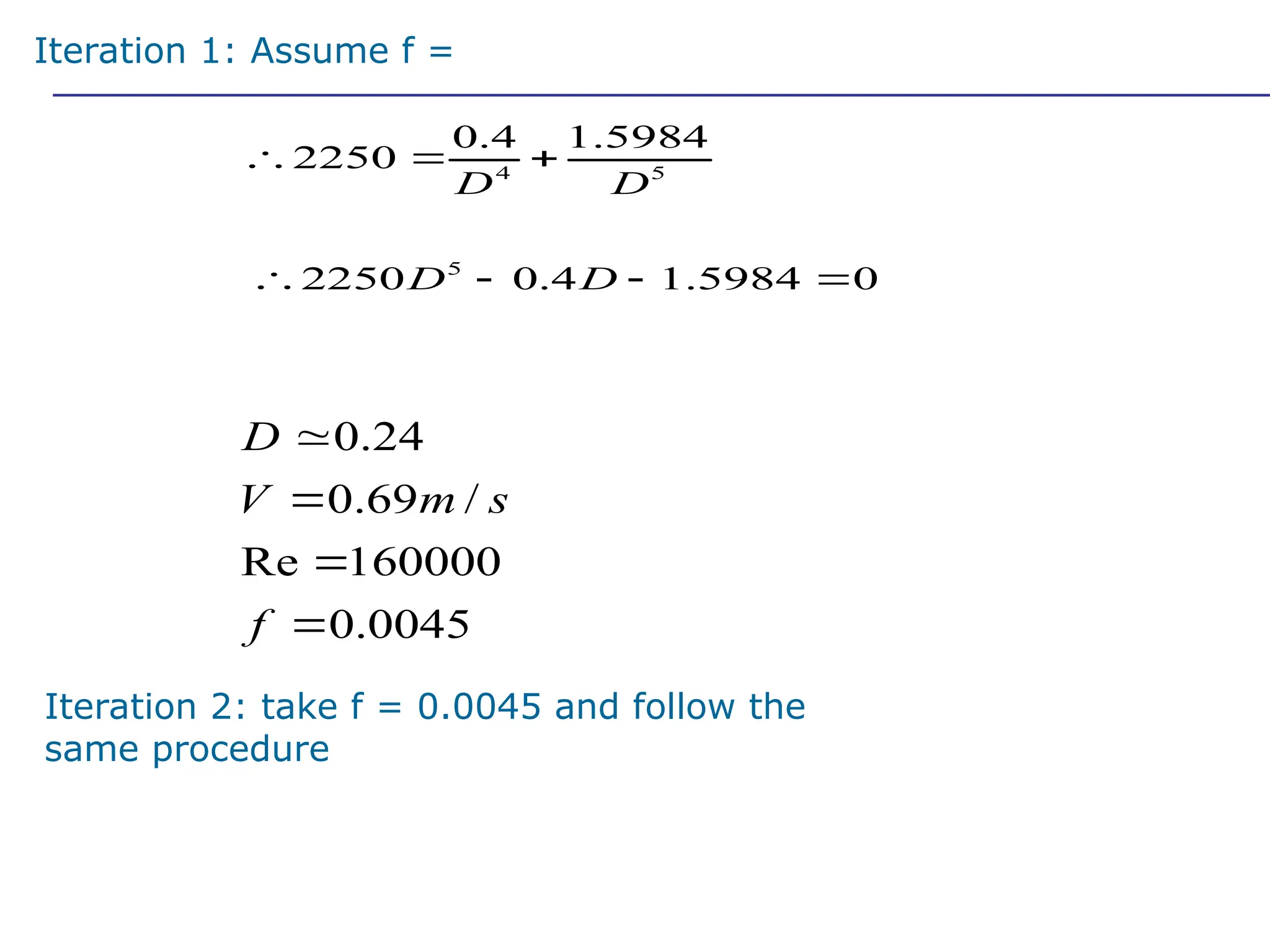
77.
4 5
0.4 1.5984
2250
DD
5
2250 0.4 1.5984 0
D D
0.24
0.69 /
Re 160000
0.0045
D
V m s
f
Iteration 1: Assume f = 0.01
Iteration 2: take f = 0.0045 and follow the
same procedure
Solving this approximately (how?), we get
79.
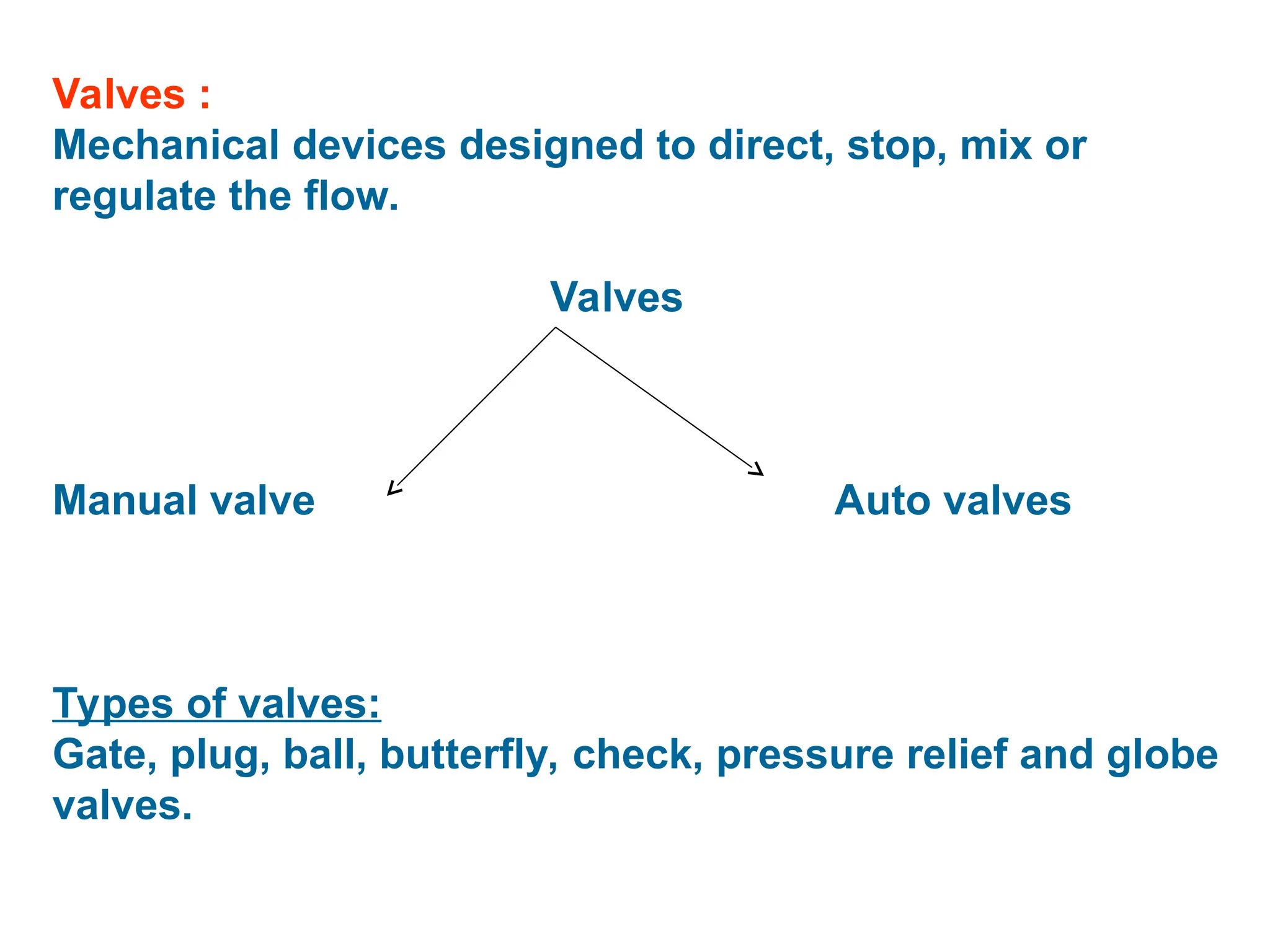
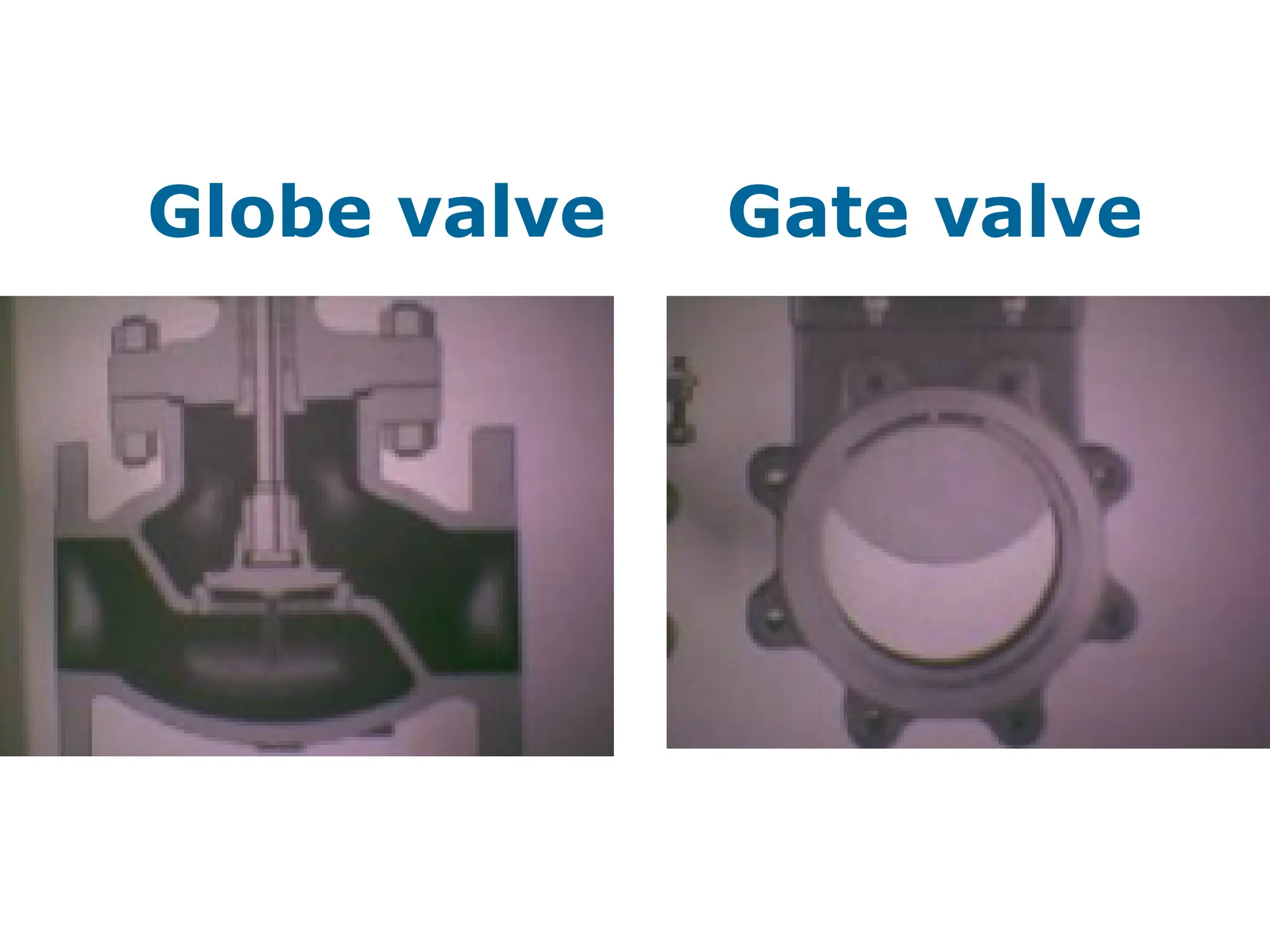
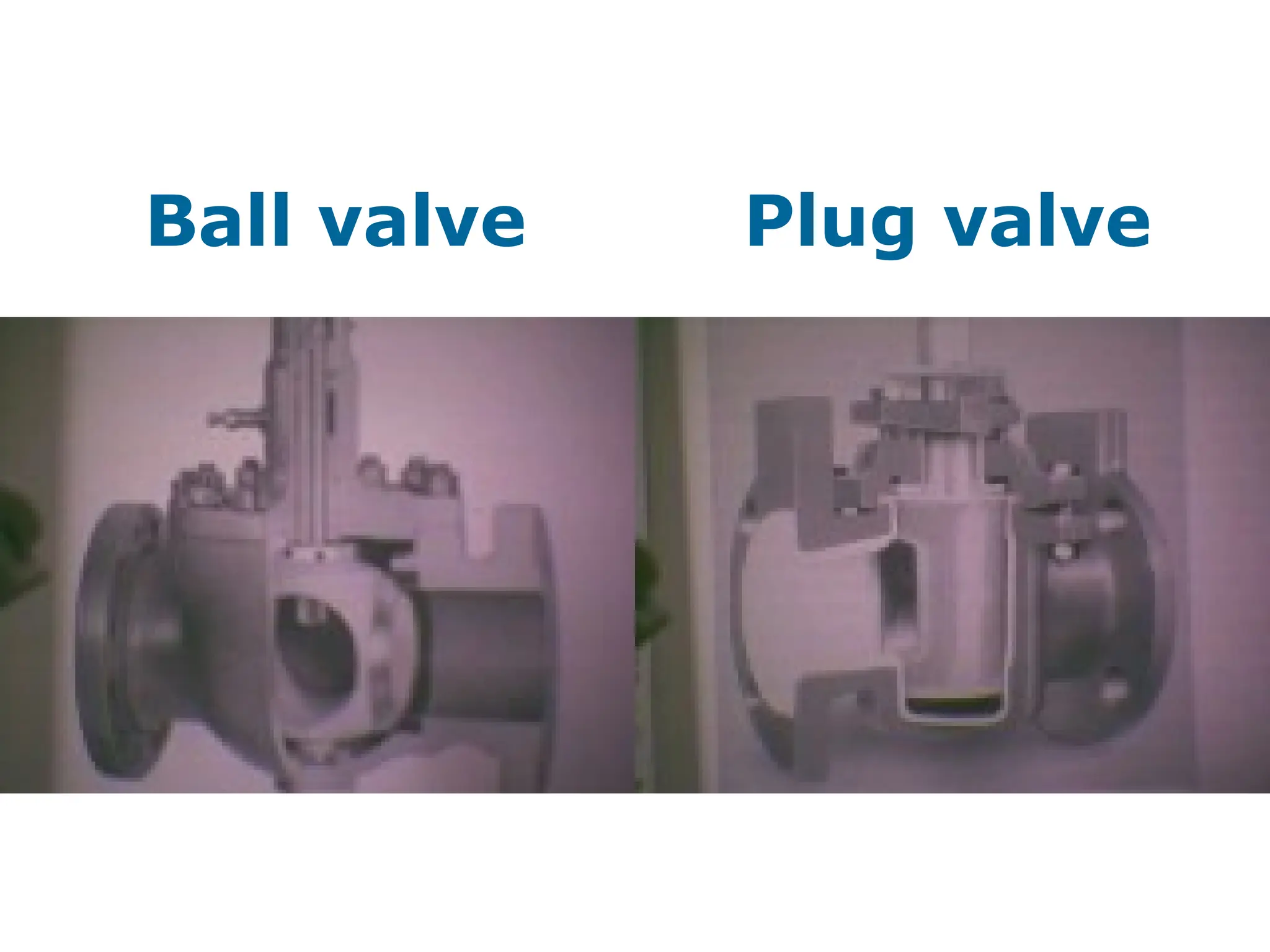
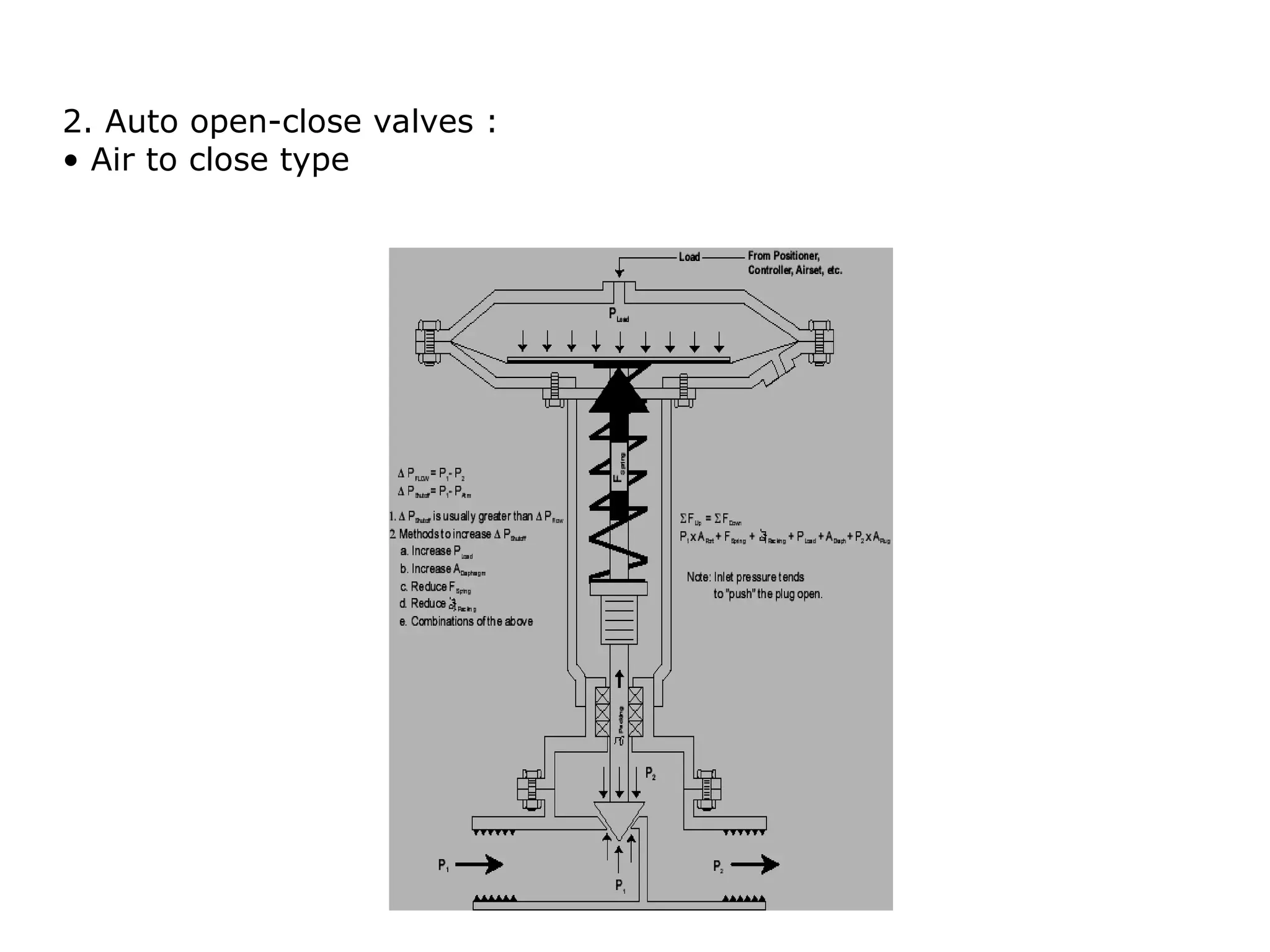
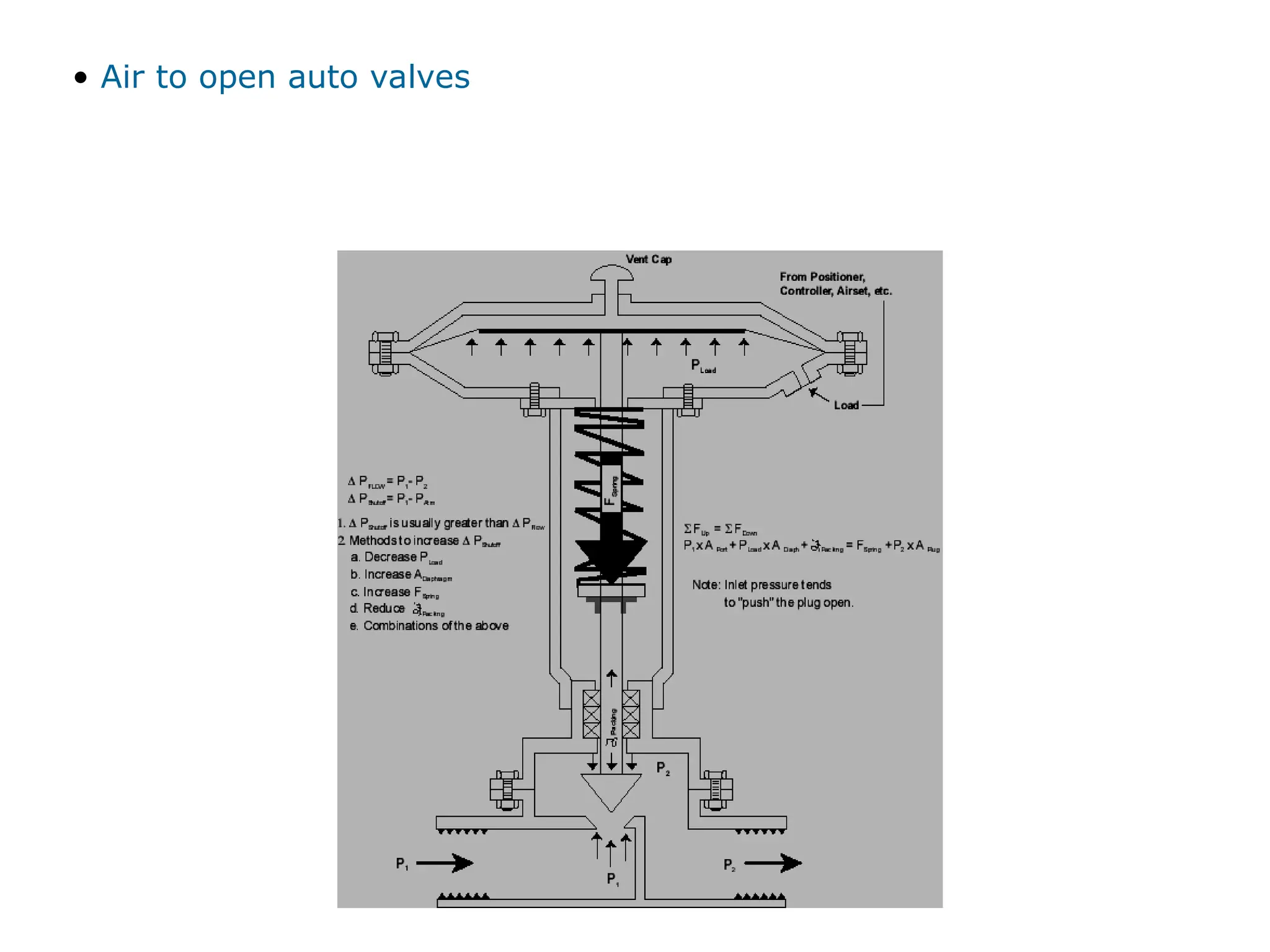
Valves :
Mechanical devicesdesigned to direct, stop, mix or
regulate the flow.
Valves
Manual valve Auto valves
Types of valves:
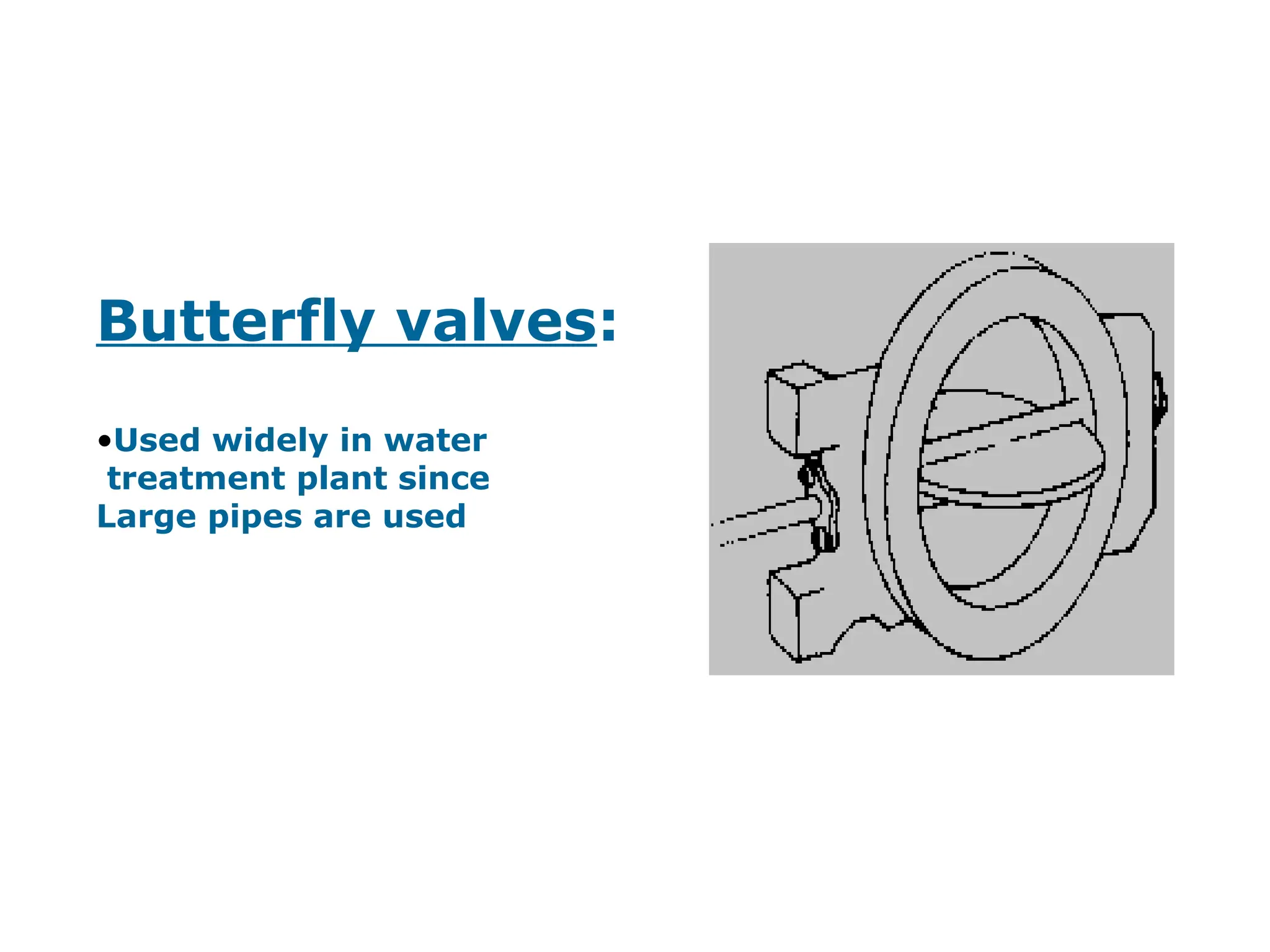
Gate, plug, ball, butterfly, check, pressure relief and globe
valves.
Structure of valvesmade of :
Steel, Iron, Brass or any other Special alloys.
Valve selection:
Valve coefficient (Cv):
Measurement commonly applied to valves is
the valve coefficient or the flow coefficient.
83.
Valve coefficient (Cv):is defined as
number of US gallons per minute of
water at 60°F that flows through
valve with a pressure drop of 1 Psi .
BALL VALVES
Similar tobutterfly control valves, Accurate
Control possible, Improved sealing & highly accurate
Matching of balls have provided tight shutoff.
• Used in slurries or pulp applications. Can be installed
vertically in pipelines.
88.
88
References
1. Rajput R.K., Fluid mechanics and hydraulic machines, Chandra print, India, 2002.
2. Cengel Y., Fundamental of fluid flow, McGraw Hill, India, 2008.
3. Yahya S. M., Fundamental of compressible fluid flow, Wiley & Pearson, 2010.
4. Barhm Mohamad, Jalics Karoly, Andrei Zelentsov, CFD Modelling of formula student car intake system, Facta
Universitatis, Series: Mechanical Engineering 18, 1, pp.153-163, 2020.
5. Barhm Mohamad, Jalics Karoly, Andrei Zelentsov, Трехмерное моделирование течения газа во впускной системе
автомобиля «Формулы Студент», Journal of Siberian Federal University. Engineering & Technologies, 13, 5, pp. 597-
610, 2020.
6. Barhm Mohamad, Jálics Károly, Andrei Zelentsov, Hangtompító akusztikai tervezése hibrid módszerrel, Multidiszciplináris
Tudományok, 9, 4, pp. 548-555, 2019.
7. Barhm Mohamad, Mohammed Ali, Hayder Neamah, Andrei Zelentsov, Salah Amroune, Fluid dynamic and acoustic
optimization methodology of a formula-student race car engine exhaust system using multilevel numerical CFD models,
Diagnostyka, 21, 3, pp.103-111, 2020.
8. Barhm Mohamad, A review of flow acoustic effects on a commercial automotive exhaust system, Mobility & Vehicle
Mechanics, 45, 2, pp.1-4, 2019.
9. Abdelmalek Elhadi, Salah Amroune, Moussa Zaoui, Barhm Mohamad, Ali Bouchoucha, Experimental investigations of
surface wear by dry sliding and induced damage of medium carbon steel, Diagnostyka, 22, 2, pp. 3-10, 2021.
10. Chouki Farsi, Salah Amroune, Mustafa Moussaoui, Barhm Mohamad, Houria Benkherbache, High-Gradient magnetic
separation method for weakly magnetic particles: an Industrial Application, METALLOPHYSICS AND ADVANCED
TECHNOLOGIES’ (i.e. ‘Metallofizika i Noveishie Tekhnologii’), 41, 8, pp. 1103–1119, 2019.
#64 The formula is different for pipe with zero roughness (smooth pipe) vs rough pipe. Similarly another formula is available for flow in transition regime. Please refer to the text book for the actual formulas.
#75 Notice that if the flow is laminar, then most of the pressure drop occurs in the valve and a very little in the pipe. Of course, the flow is not laminar, this is just to illustrate how to solve it if the flow is laminar
#76 Again if the flow is laminar, one can solve it easily.



![Density and specific weight
Density (mass per unit
volume):
m
V
[ ]
[ ]
[ ]
( )
m
V
kg
m
in SI units
3
Units of density:
Specific weight (weight per unit
volume):
[ ] [ ][ ] ( )
g
kg
m
m
s
N
m
in SI units
3 2 3
Units of specific weight:
g](https://image.slidesharecdn.com/fluidmechanicshow-230129184022-8a96aaf3-250430160206-c18ebfef/75/fluidmechanicshow-230129184022-8a96aaf3-ppt-8-2048.jpg)


![Friction Factor for Smooth, Transition,
and Rough Turbulent flow
4
0
Re
log
0
4
1
.
*
*
.
f
f
Smooth pipe, Re>3000
28
.
2
log
0
4
1
D
f
*
.
Rough pipe, [ (D/)/(Re√ƒ) <0.01]
f
P
L
D
2U2
f 0.079Re 0.25](https://image.slidesharecdn.com/fluidmechanicshow-230129184022-8a96aaf3-250430160206-c18ebfef/75/fluidmechanicshow-230129184022-8a96aaf3-ppt-50-2048.jpg)