Fluid, Electrolyte and Acid-
Base Balance
Essentials of general surgery
(Lawrence)
H.Rezaei MD.
Assistant professor of general
surgery
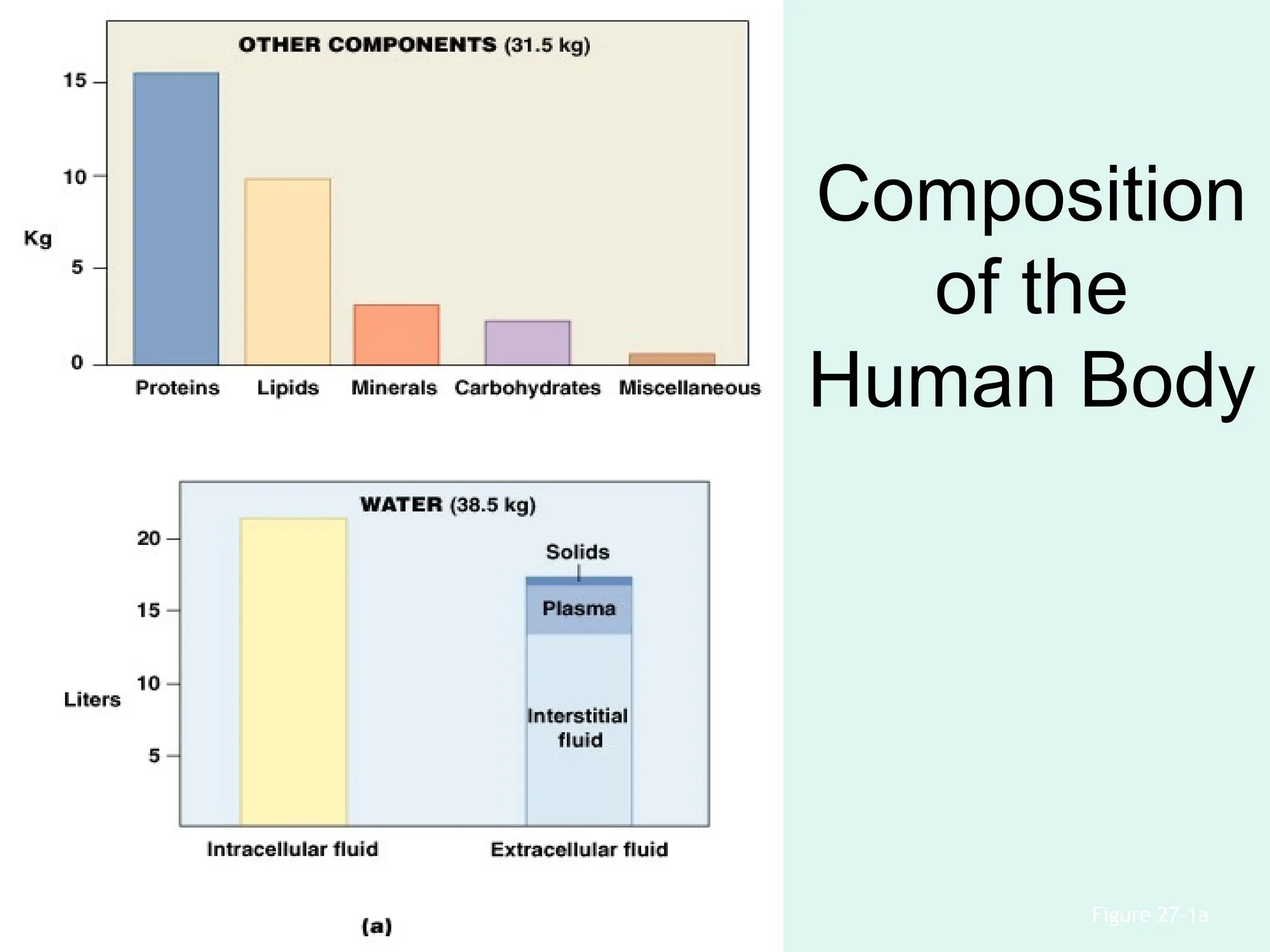
Composition
of the
Human Body
Figure 27–1a
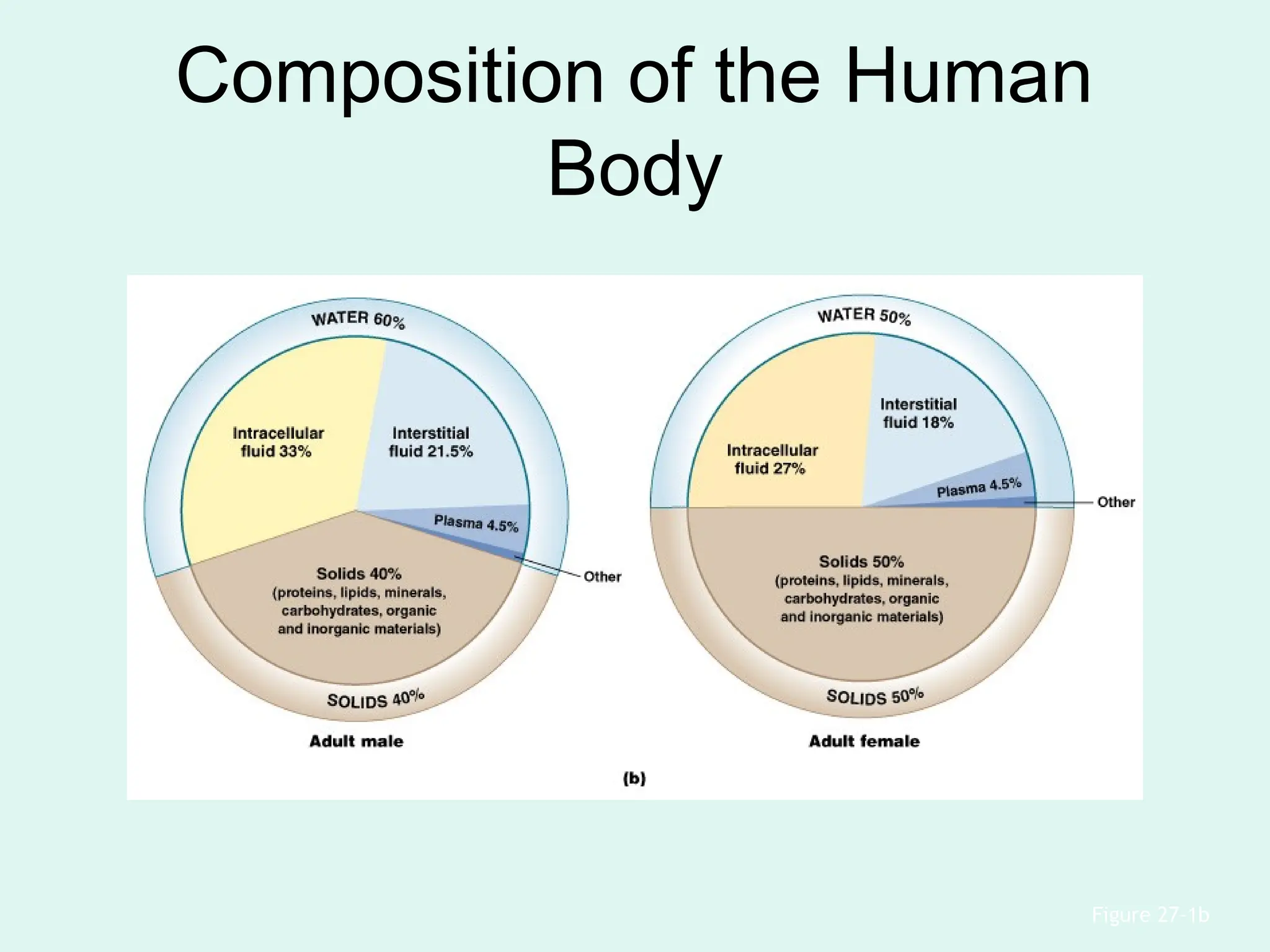
Composition of the Human
Body
Figure 27–1b
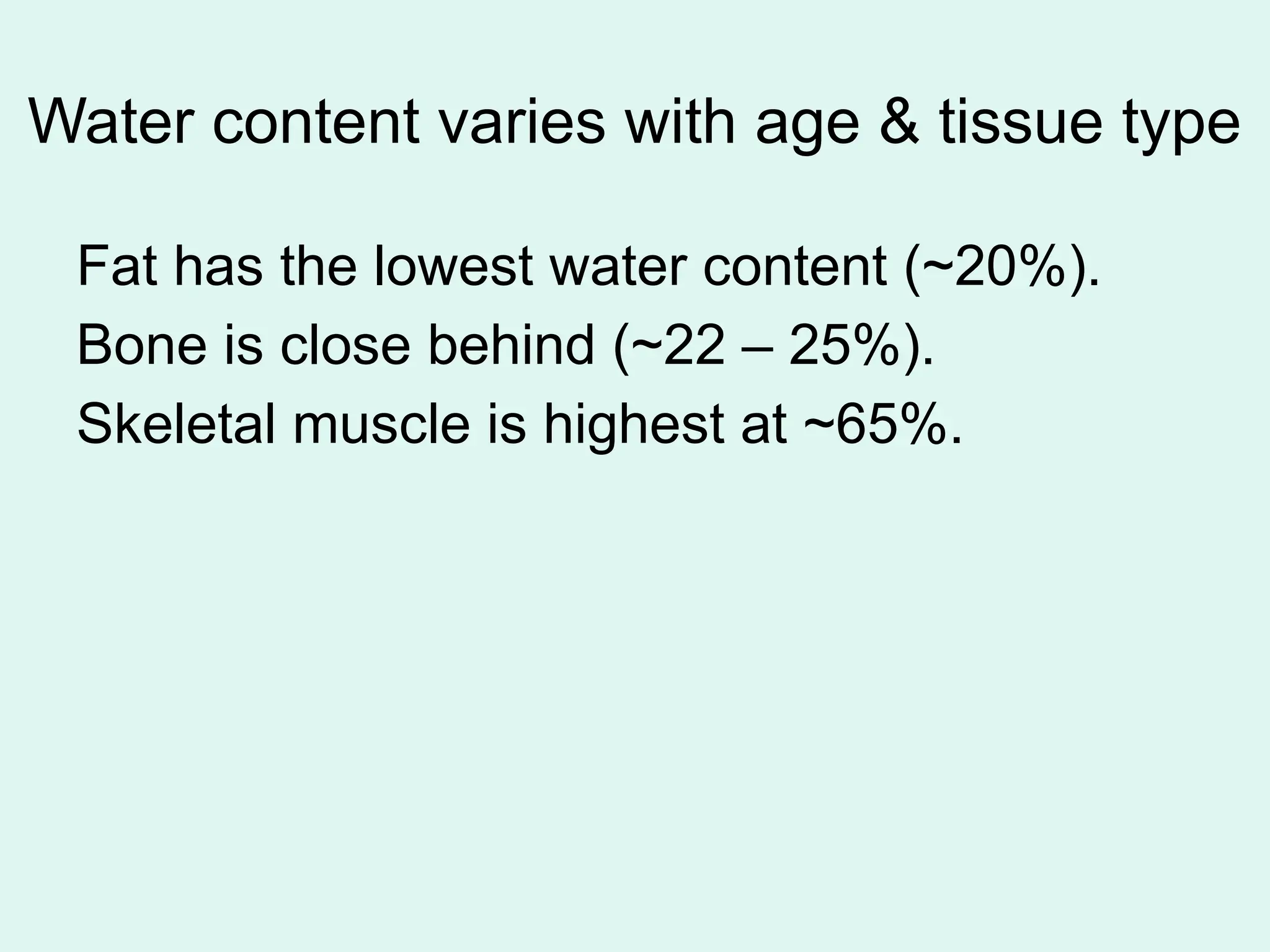
Water content varies with age & tissue type
Fat has the lowest water content (~20%).
Bone is close behind (~22 – 25%).
Skeletal muscle is highest at ~65%.
Fluid Compartments
• ECF (extra cellular fluid) and ICF
(intracellular fluid) are called fluid
compartments:
– because they behave as distinct entities
– are separated by cell membranes and active
transport
Water Composition
• Is 60% percent of male body weight
• Is 50% percent of female body weight
• Mostly in intracellular fluid
Water Exchange
• Water exchange between ICF(2/3) and
ECF(1/3) occurs across cell membranes
by:
– osmosis
– diffusion
– carrier-mediated transport
Major Subdivisions of ECF
• Interstitial fluid of peripheral tissues(2/3)
• Plasma of circulating blood(1/3)
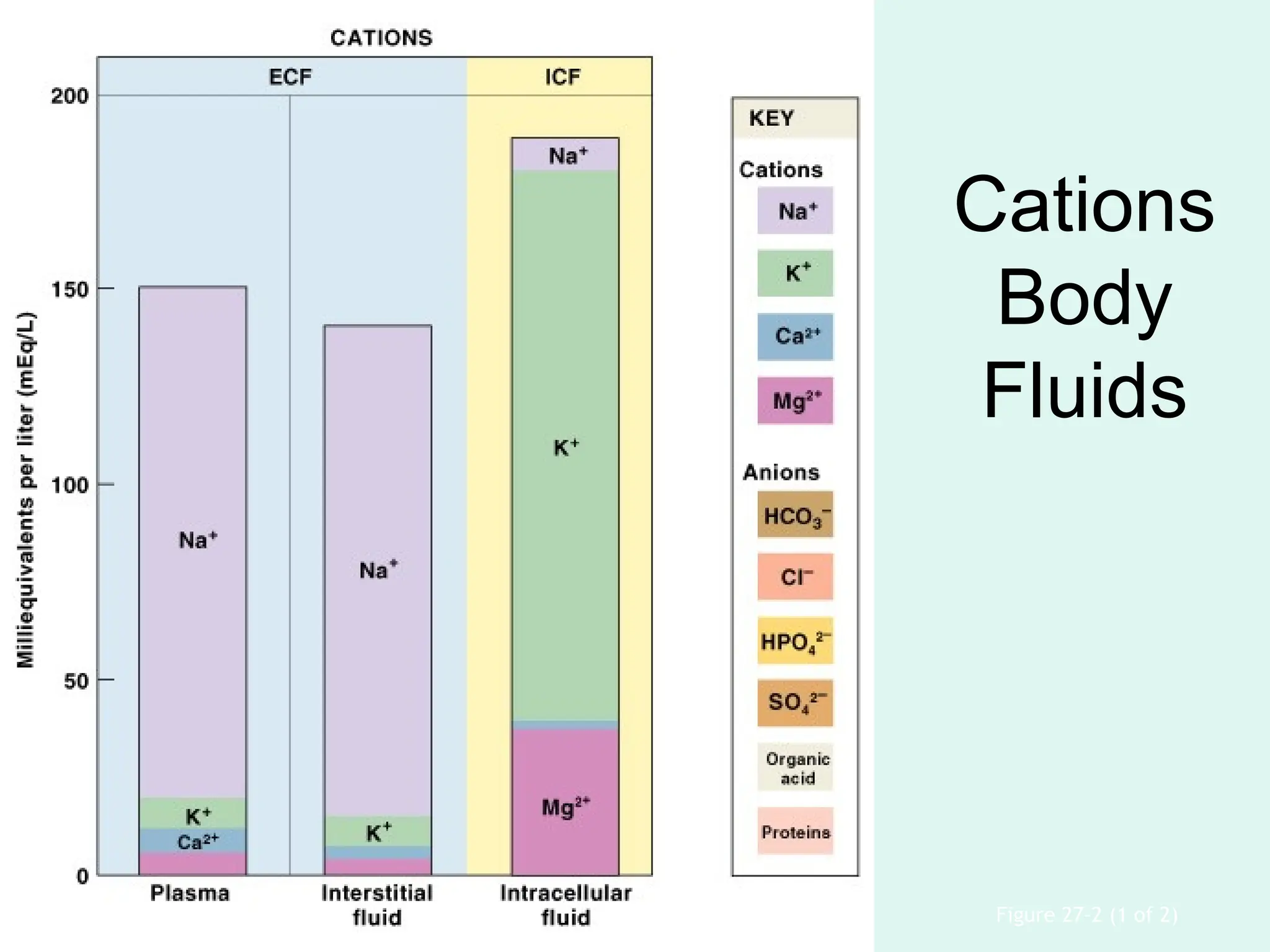
Cations
Body
Fluids
Figure 27–2 (1 of 2)
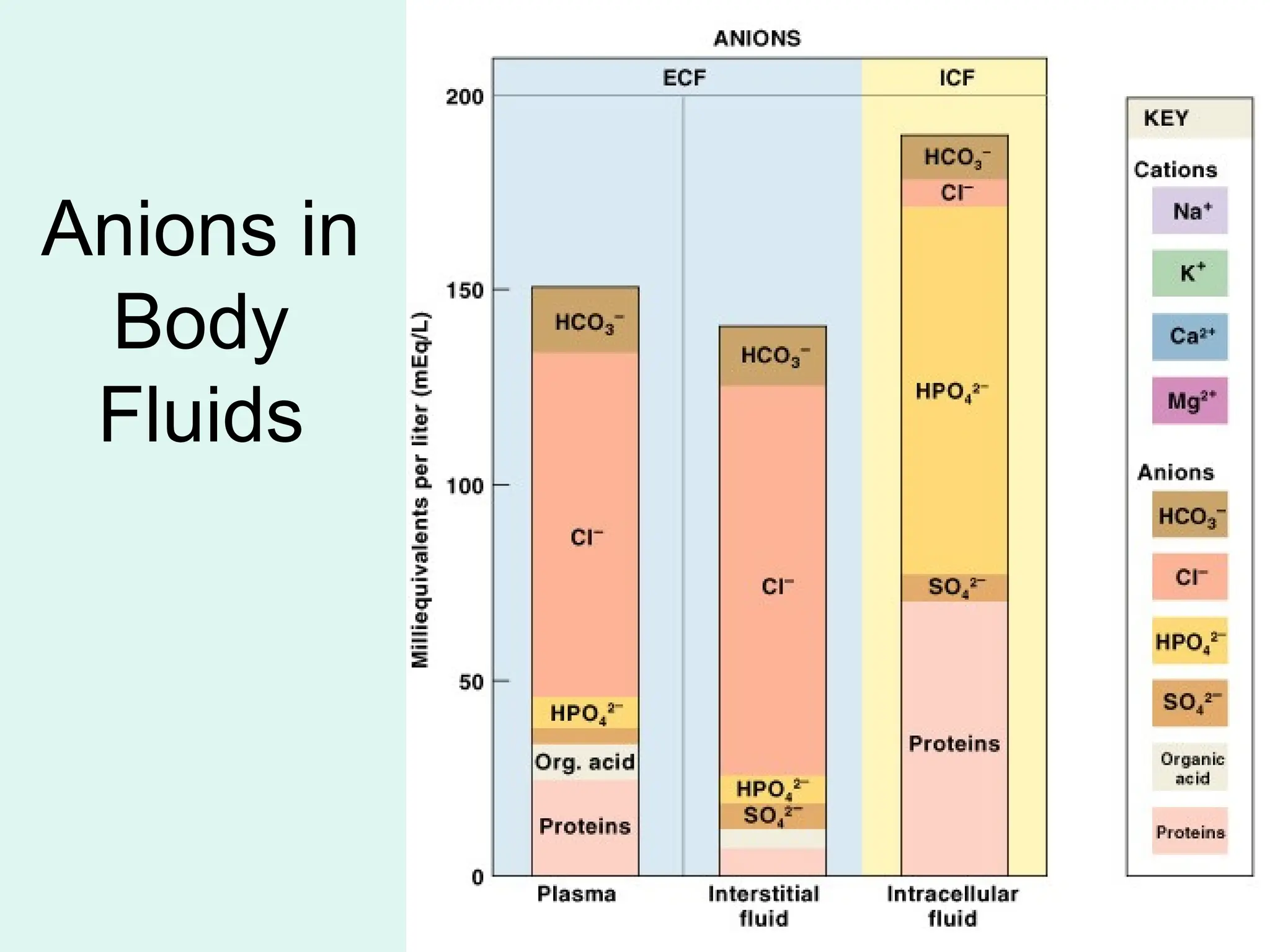
Anions in
Body
Fluids
Figure 27–2 (2 of 2)
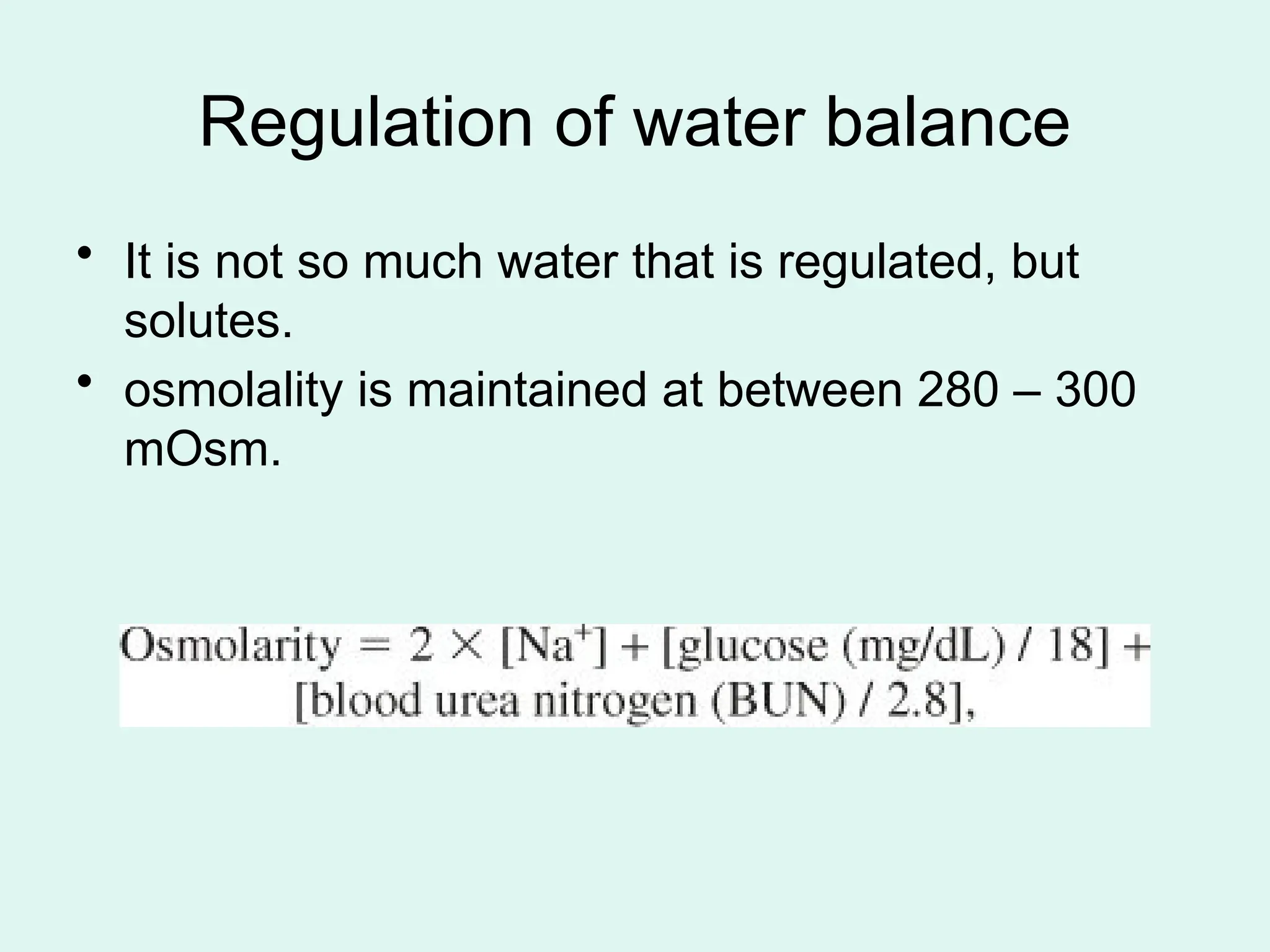
Regulation of water balance
• It is not so much water that is regulated, but
solutes.
• osmolality is maintained at between 280 – 300
mOsm.
Sodium
• Is the dominant cation in ECF
• Sodium salts provide 90% of ECF osmotic
concentration (97% with other related
anions)
• Need: 1-3meq/kg/day
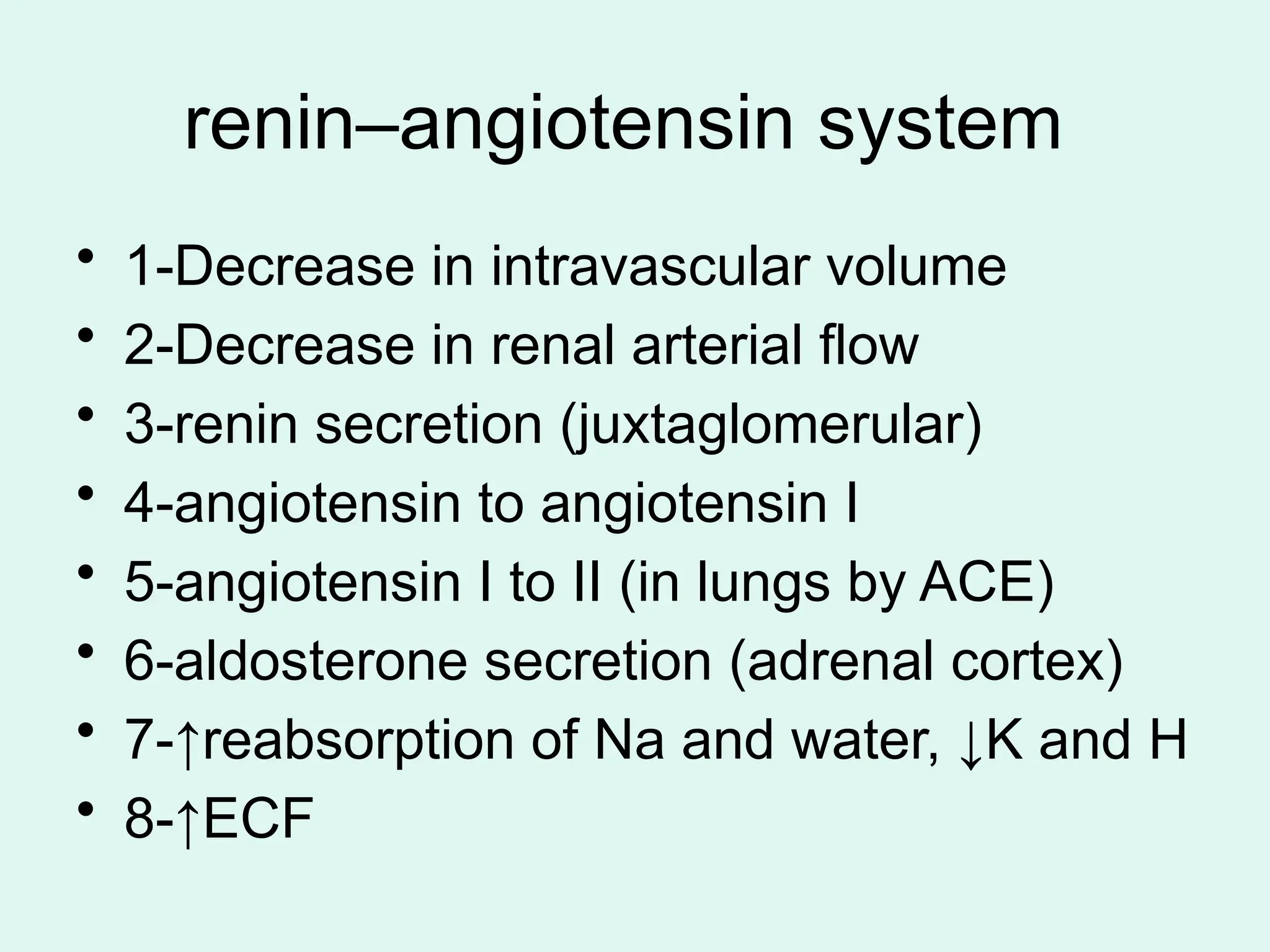
renin–angiotensin system
• 1-Decrease in intravascular volume
• 2-Decrease in renal arterial flow
• 3-renin secretion (juxtaglomerular)
• 4-angiotensin to angiotensin I
• 5-angiotensin I to II (in lungs by ACE)
• 6-aldosterone secretion (adrenal cortex)
• 7-↑reabsorption of Na and water, ↓K and H
• 8-↑ECF
Antidiuretic Hormone (ADH) or
vasopressin
• Stimulates water conservation at kidneys:
– reducing urinary water loss
– concentrating urine
• Stimulates thirst center:
– promoting fluid intake
Potassium
• Is the dominant cation in ICF
• Need: 0.5-1meq/kg/day
• 95% excreted in urine and 5% in feces
Normal Potassium
Concentrations
• In ICF:
– about 160 mEq/L
• In ECF:
– is 3.8–5.0 mEq/L
FLUIDS AND ELECTROLYTES
IN THE PERIOPERATIVE
PERIOD
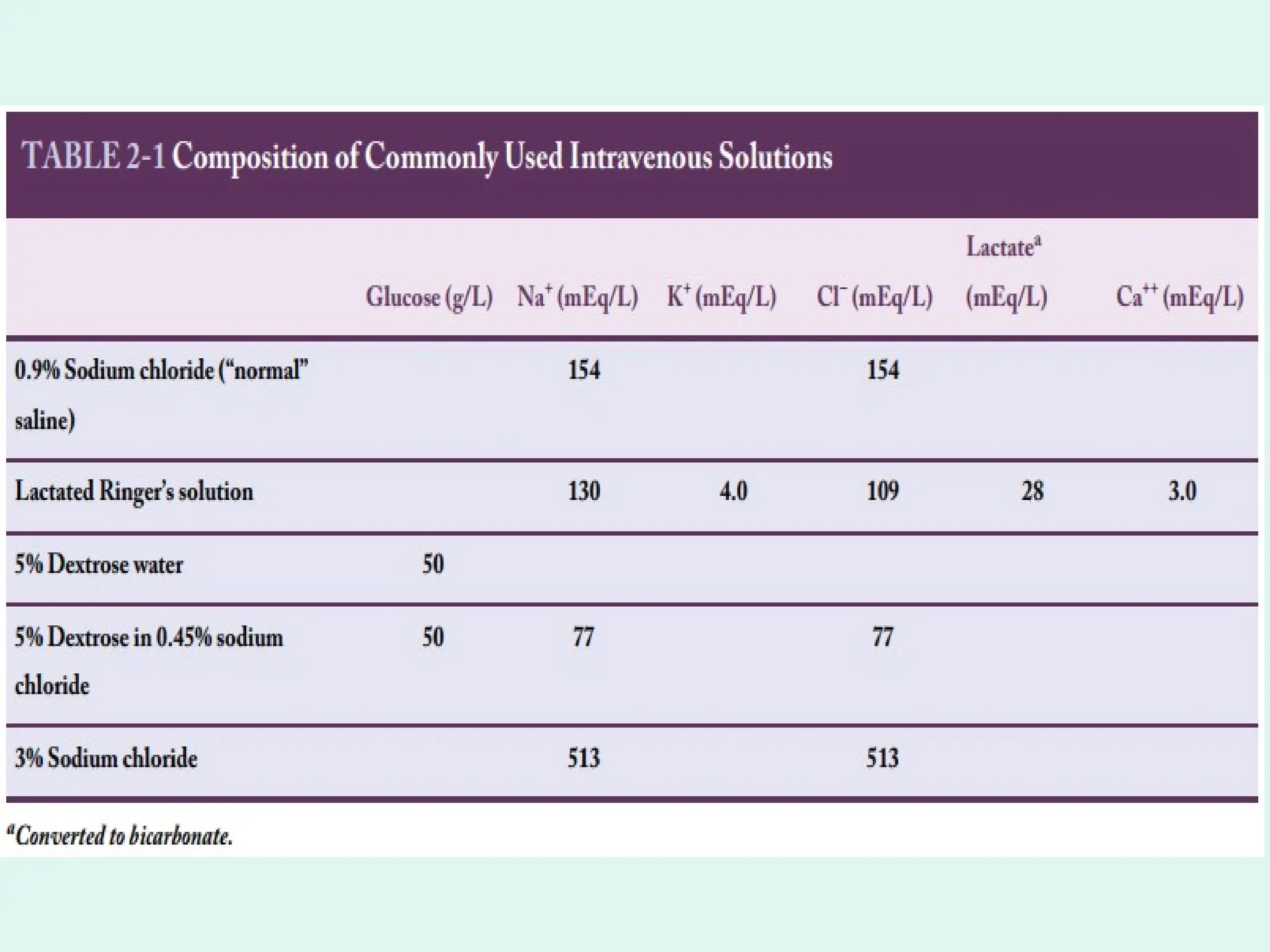
• Maintenance (D.W5% 1/2N.S +20meq
KCl) (4:2:1 rule)
• Replacement of ongoing loss (same fluid)
• Fluid, electrolyte, and acid–base imbalances
must be identified and treated promptly in
acutely ill patients
• Third spacing
• Loss: ↓hemodynamic - ↓out(0.5cc/kg/h) –
lab(↑ hct- bun/cr20- feNa20)
• Isotonic crystalloides
• Monitor by hemodynamics, output and IVC
sono
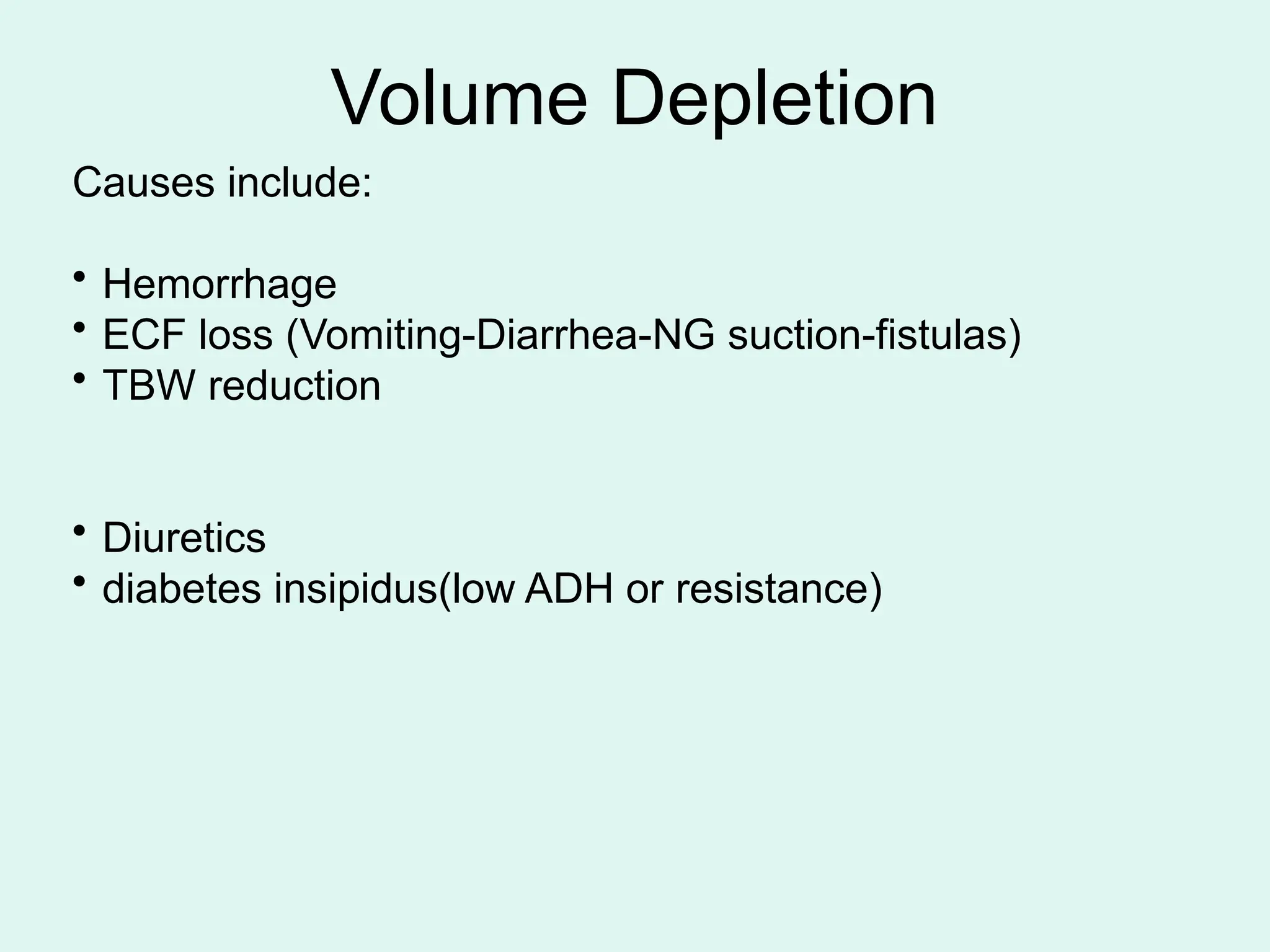
Volume Depletion
Causes include:
• Hemorrhage
• ECF loss (Vomiting-Diarrhea-NG suction-fistulas)
• TBW reduction
• Diuretics
• diabetes insipidus(low ADH or resistance)
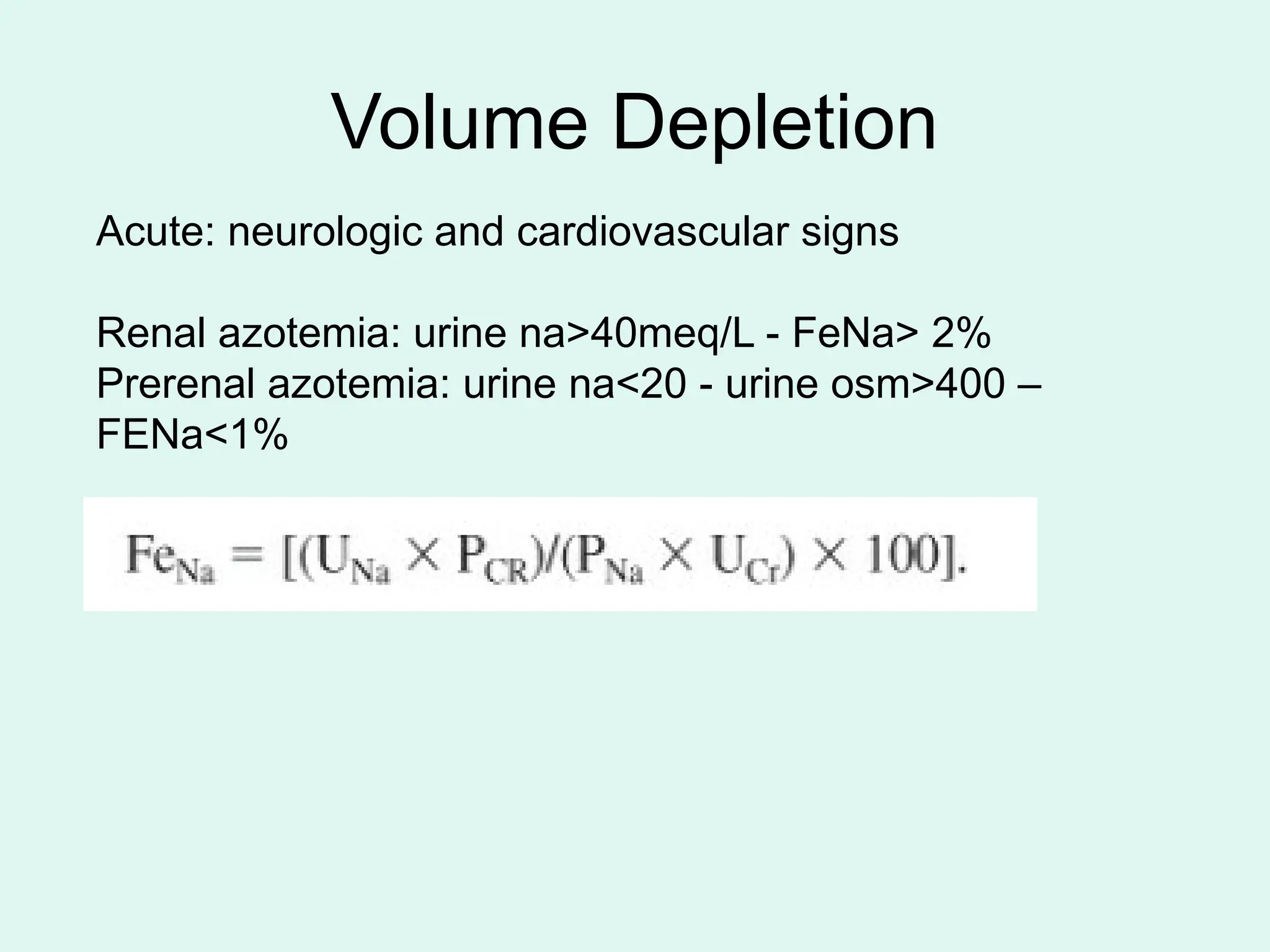
Volume Depletion
Acute: neurologic and cardiovascular signs
Renal azotemia: urine na>40meq/L - FeNa> 2%
Prerenal azotemia: urine na<20 - urine osm>400 –
FENa<1%
Resuscitation
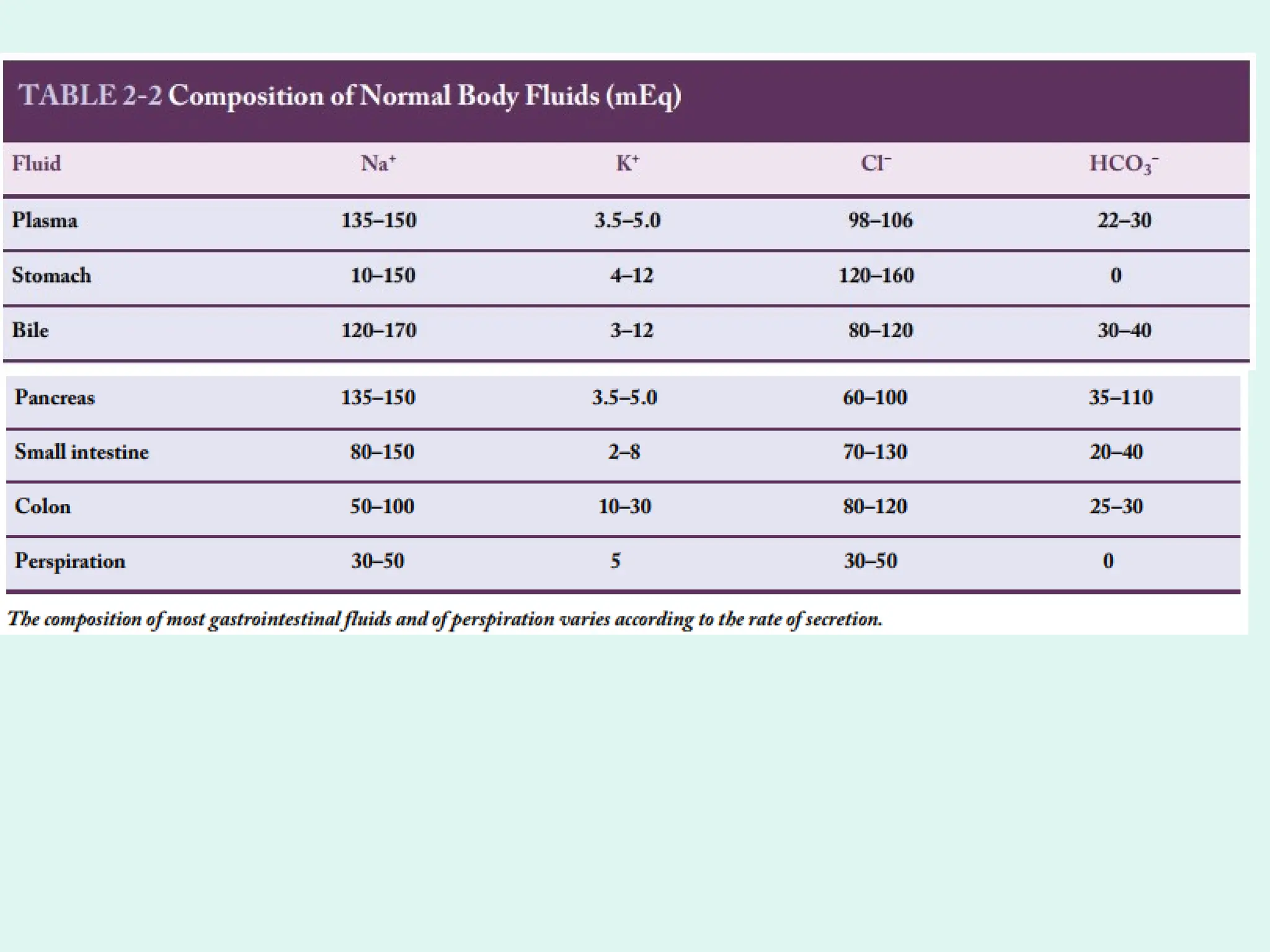
Isotonic crystalloides (bowel,bile,pancreas,third space)
For vomiting or NG secretions ½ saline+ 20-40 meq/L KCl
Big angiocaths (16)
OUT>0.5 cc/kg/h in adults and >1 in children
Volume excess
• abnormal fluid retention
• excessive or inappropriate fluid intake
• combination
Volume excess
• fluid or sodium restriction
• diuresis along with a replacement of
potassium losses
• In vascular volume deficit careful
replacement with crystalloid or blood
products may be needed
Hyponatremia
• Low, high or normal ECF
• Dilutional
• Artificial (high TG or Glucose)
• Necrotizing soft tissue infections
Hyponatremia
• Acute Hyponatremia (120-130)
results in:
– Cerebral edema (brain swelling)
– Sluggish neural activity
– ↑DTR
– Convulsions, muscle spasms, deranged
behavior.
– Coma,areflexia,death
Treatment
• Water restriction
• Stop thiazide
• In chronic max:12 meq/l/d (central
pontine myelinolysis)
• Water and Na restriction in high ECF
• Isotonic in low ECF
• Hypertonic in severe symptoms
• Half in 12-18 hours
Sodium deficite
Hypernatremia
• loss of water alone (hypothalamic abnormalities,
nonreplaced insensible losses)
• loss of water and salt together (gastrointestinal losses,
osmotic diuresis, excessive diuretic use, central or
nephrogenic diabetes insipidus, burns, excessive
sweating)
• increased total body sodium without any water loss
(Cushing’s syndrome, hyperaldosteronism,
ectopic production of ACTH, iatrogenic sodium
administration, ingestion of seawater)
Hypernatremia
• symptoms of dehydration
• neuromuscular and neurologic disorders
(twitching, restlessness, weakness,
delirium, coma, seizures, and death)
• Intracranial hemorrhage is a common
postmortem finding in patients who die of
hypernatremia.
Treatment
• Water (po or D.W5%)
• Half replacement in 12-24h with
monitoring
• Fast replacement results in brain
edema
Potassium
• 98% of potassium in the human body is in
ICF
• Cells expend energy to recover potassium
ions diffused from cytoplasm into ECF
Hypokalemioa
<3.5 meq/L
Low intake, excretion or
shift(insulin,alkalosis)
Paradoxical aciduria in vomiting
symptoms
<3 meq/L
skeletal muscle weakness, fatigue,
paresthesias, paralysis, rhabdomyolysis.
Deep-tendon reflexes may be diminished or
absent.
anorexia, polyuria, and nausea and vomiting
associated with paralytic ileus
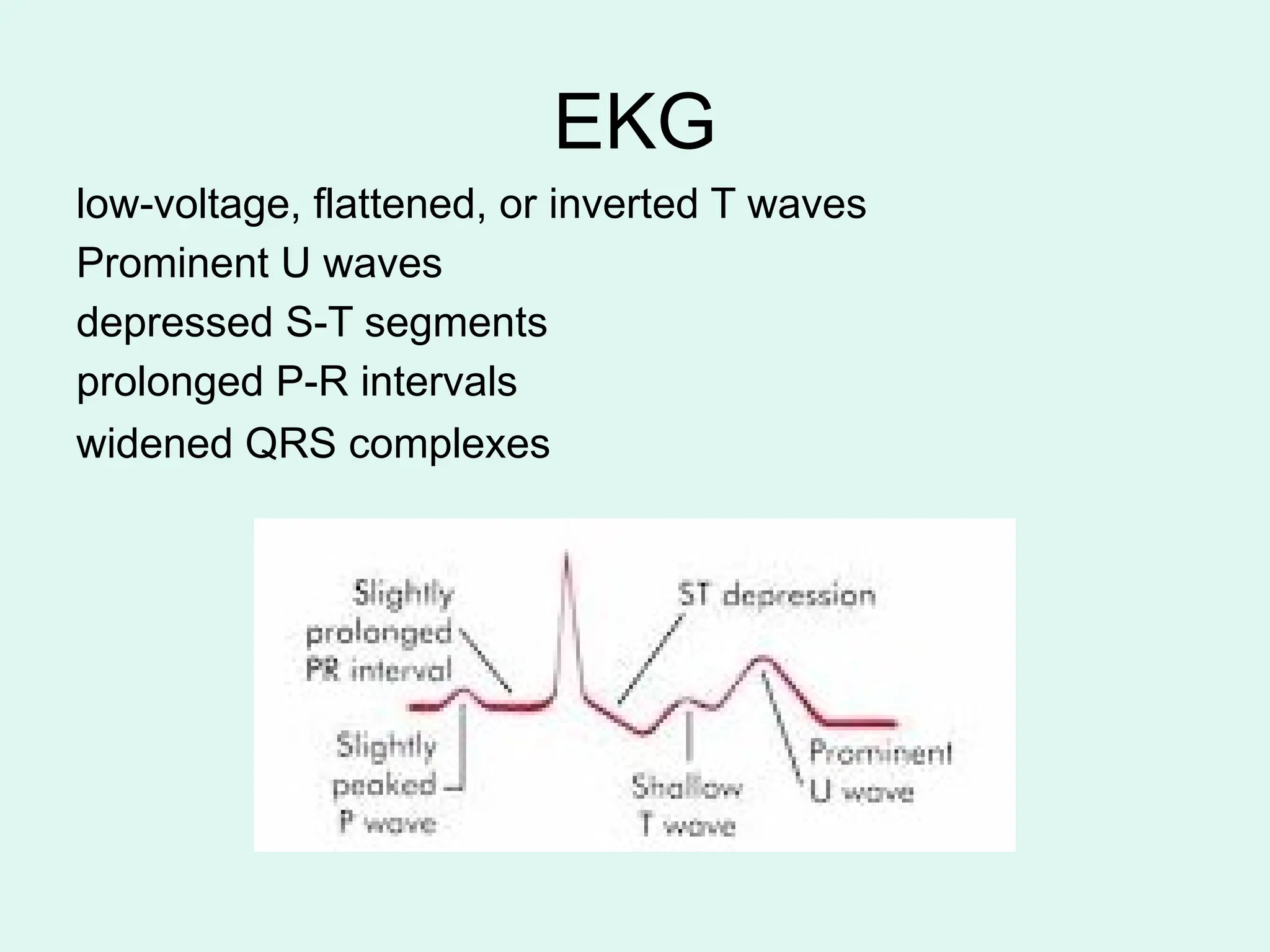
EKG
low-voltage, flattened, or inverted T waves
Prominent U waves
depressed S-T segments
prolonged P-R intervals
widened QRS complexes
Treatment
• Check Digoxin level in mild
• Ca and Mg in severe or resistant
• Oral or IV(less than 10meq/h)
• Till above 3.5
Hyperkalemioa
>5 meq/L
high intake(food or blood) or
shift(crush,hemolysis,hematoma,catabolism,
acidosis) or renal disease
K sparing diuretics, NSAIDs, B blockers,
ACEi
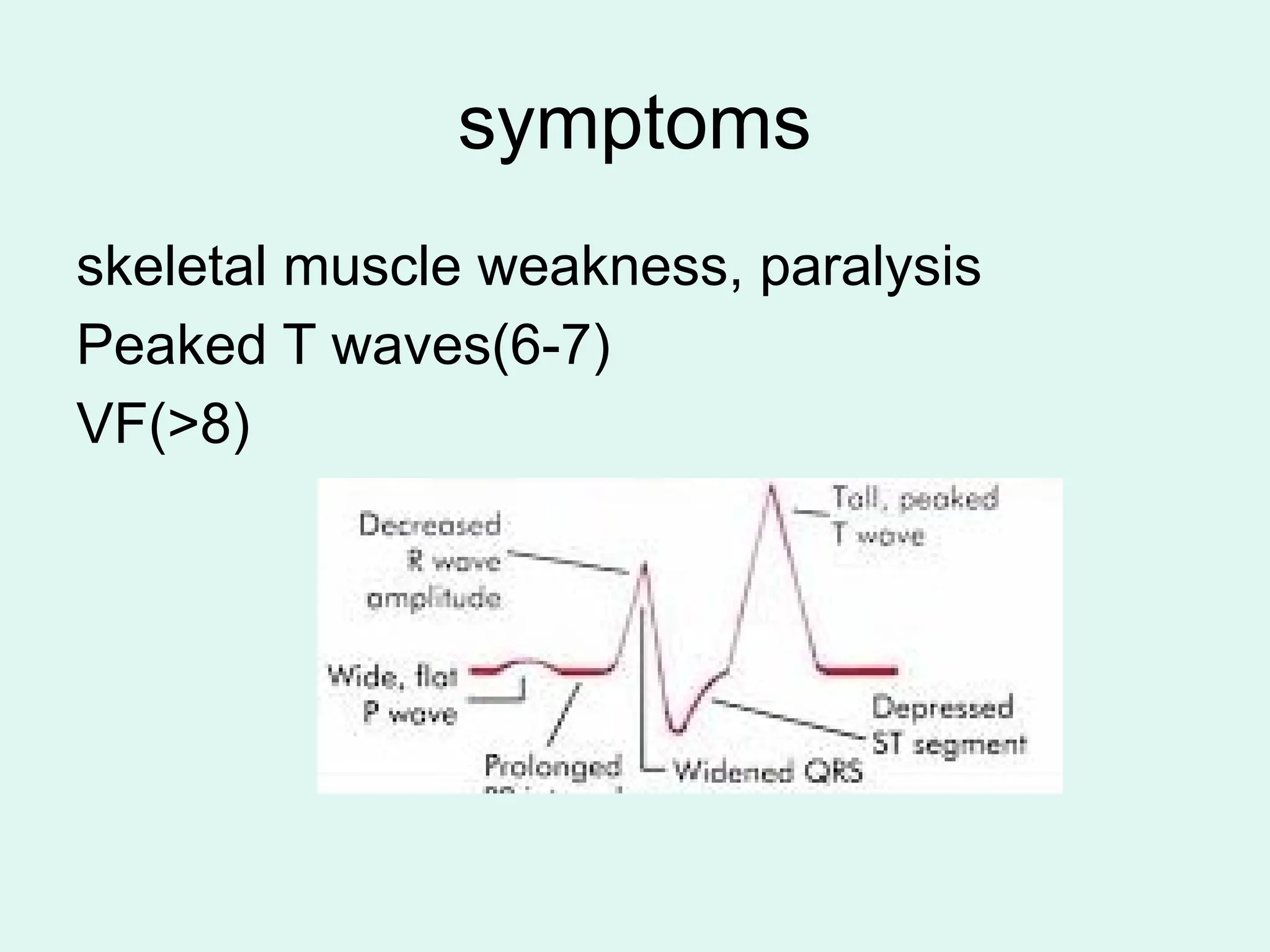
symptoms
skeletal muscle weakness, paralysis
Peaked T waves(6-7)
VF(>8)
Treatment
• Recheck
• In mild(<6) restrict potassium intake,
eliminate causes (potassium-sparing
diuretics) and treat fluid volume or acid–
base disorders.
Potassium-wasting diuretics may be
administered, and hormone deficiencies
may be replaced
Treatment
• >6
• 10 units of insulin with 25 g of glucose
intravenously over 5 minutes
• Bicarbonate
• Kayexalate
• Ca-gluconate(only in ecg changes)
• hemodialysis
Calcium
• Total 8.5-10.5
• Ionized 4.75-5.3 (physiologic effect)
• PTH : intestinal absorption, renal
excretion, and calcium exchange between
bone and the ECF.
Hypocalcemia
• < 8 mEq/L
• acute pancreatitis , necrotizing fasciitis
• Inadequate intestinal absorption(IBD)
• chronic diarrhea or pancreatic or intestinal
fistulas
• Artifactual hypocalcemia
• phenytoin and phenobarbital
• Vit D deficiency
• Massive transfusion
• Hypopara and hypomagnesemia(low PTH)
symptoms
circumoral tingling
numbness and tingling of the fingertips
muscle cramps
Hyperactive deep-tendon reflexes
Chvostek’s sign
Tetany
Trousseau sign (carpopedal spasm)
Seizures
Confusion
Prolonged Q-T intervals
Treatment
• Check K,Mg,Ph,ALP
• Check acid base abnormalities
• IV calcium gluconate in severe and
symptomatic
• Vit D and thiazide in hypopara
Hypercalcemia
• >10.5
• Primary and secondary hyperpara
• Metastatic cancer( bone metastase or PTH
secretion)
symptoms
weakness, fatigue, anorexia, nausea, vomiting
severe headaches, diffuse musculoskeletal pain,
polyuria, polydipsia
hypovolemia and dehydration
shortened Q-T intervals and widened T waves
calcification may develop in the kidneys as well as
in unusual locations (heart, skin)
Pancreatitis and renal failure
>15 mg/dL cause confusion and depression and
death
Treatment
• Decrease intake
• Hydration
• Increase urinary excretion(loop
diuretics)
• phosphate
Magnesium
• Is an important structural component of
bone
• Is a cofactor for important enzymatic
reactions
Hypomagnesemia
• Elderly with malabsorption or fasting or GI loss
• Chronic alcoholism
• Acute pancreatitis
• Endocrine disorders
symptoms
nausea, vomiting, anorexia, weakness, lethargy
muscle cramps, fasciculations, tetany, carpopedal
spasm, paresthesias, irritability, inattention,
confusion
cardiac arrhythmias
Treatment
• Oral in mild
• IV magnesium solphate in moderate
and malabsorption
Hypermagnesemia
• Rare
• renal failure, dehydration, severe metabolic
acidosis, adrenal insufficiency, familial benign
• hypocalciuric hypercalcemia, or overdosage with
magnesium salts in cathartics
• treatment of eclampsia
• renal failure who use magnesium-containing
antacids
symptoms
nausea ,lethargy, weakness,
hypoventilation, and decreased deep-tendon
reflexes
hypotension and bradycardia, skeletal muscle
paralysis, respiratory depression
coma and death
Treatment
• Oral hydration and decrease intake in
mild
• IV calcium, hydration, diuresis,
hemodialysis
Phosphate
• 2.5-4.5
• Are required for bone mineralization
Hypophosphatemia
• Along with hypokalemia and hypomagnesemia
• Decrease in intake or increase in excretion or
shift
• Alcohol whitdrawal
• Vit D deficiency
• Malignancies
• Hypermetabolic state
• Hungry bone syndrome
symptoms
anorexia, dizziness, osteomalacia, severe
congestive cardiomyopathy, proximal muscle
weakness, visual defects, ascending paralysis,
hemolytic anemia, respiratory failure
Inability to wean from the ventilator
rhabdomyolysis, hypercalciuria
severe hypocalcemia are also seen
seizures, coma, and death
Treatment
• aggressive search for and treatment of the
cause
• Phosphate salts may be given orally or
intravenously
Hyperphosphatemia
• increase in intake or decrese in excretion or shift
• Renal failure
• Hypopara
• Vit D toxicity
• sarcoidosis or TB
• Tumor lysis syndrome
symptoms
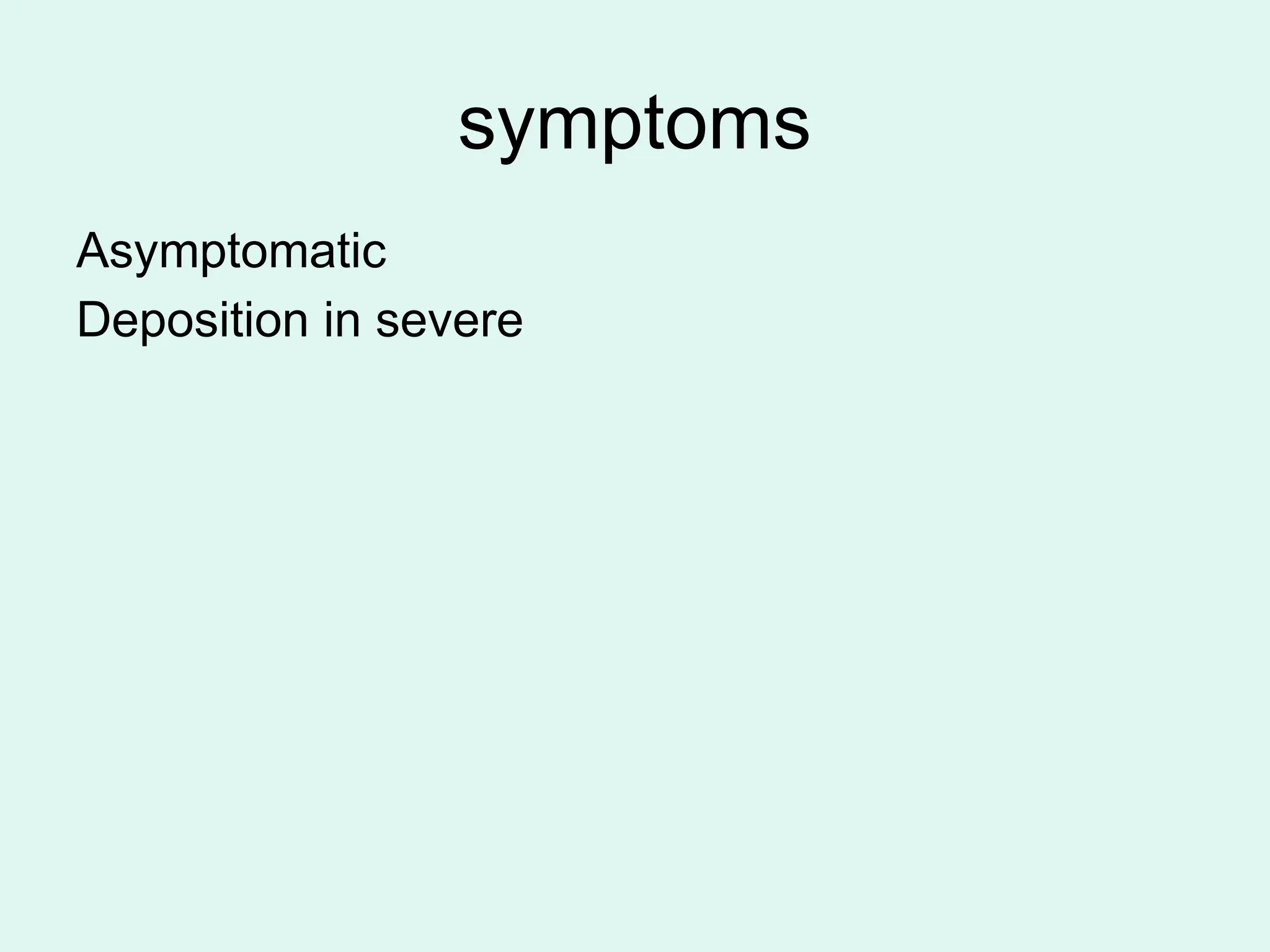
Asymptomatic
Deposition in severe
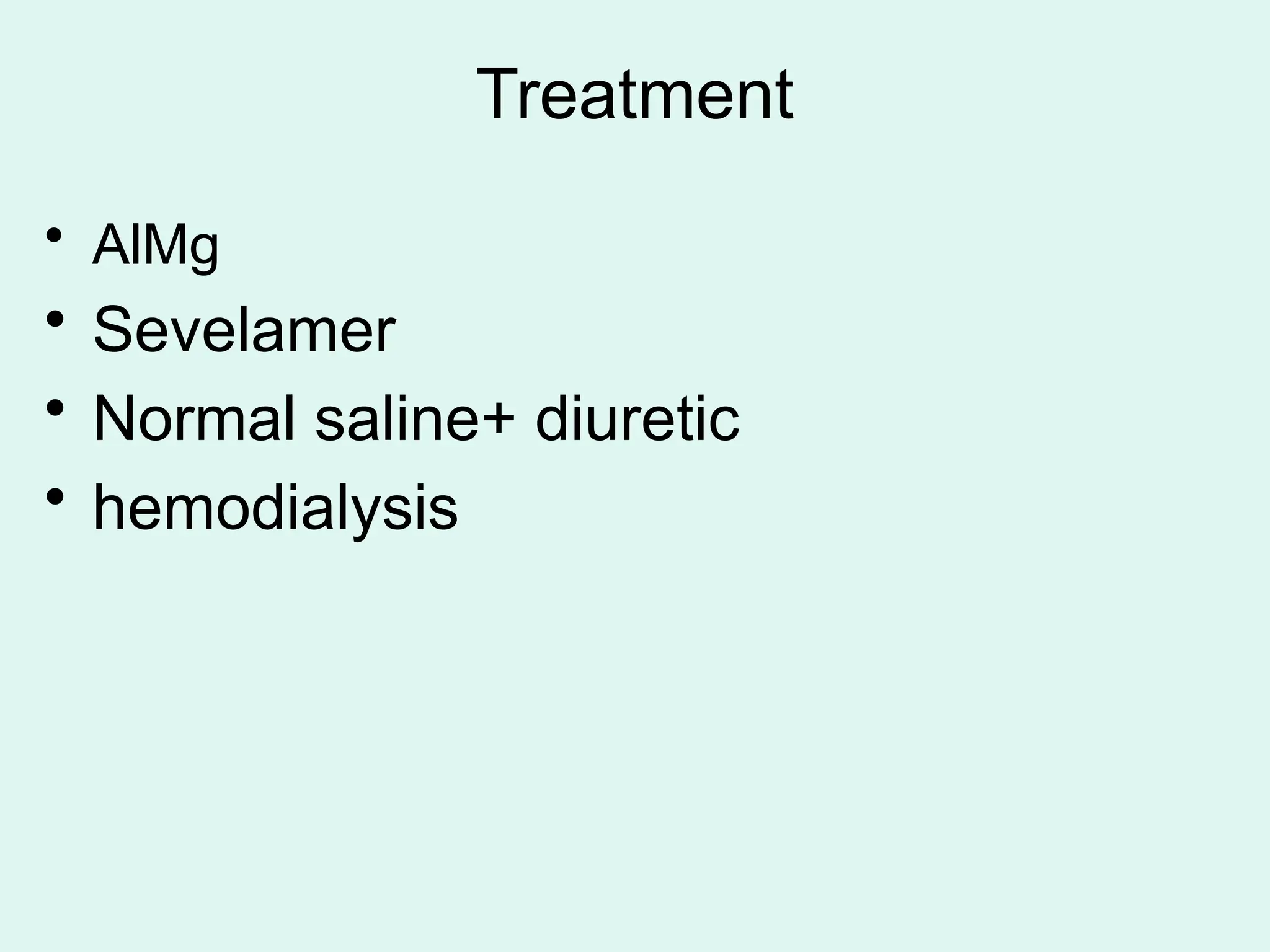
Treatment
• AlMg
• Sevelamer
• Normal saline+ diuretic
• hemodialysis
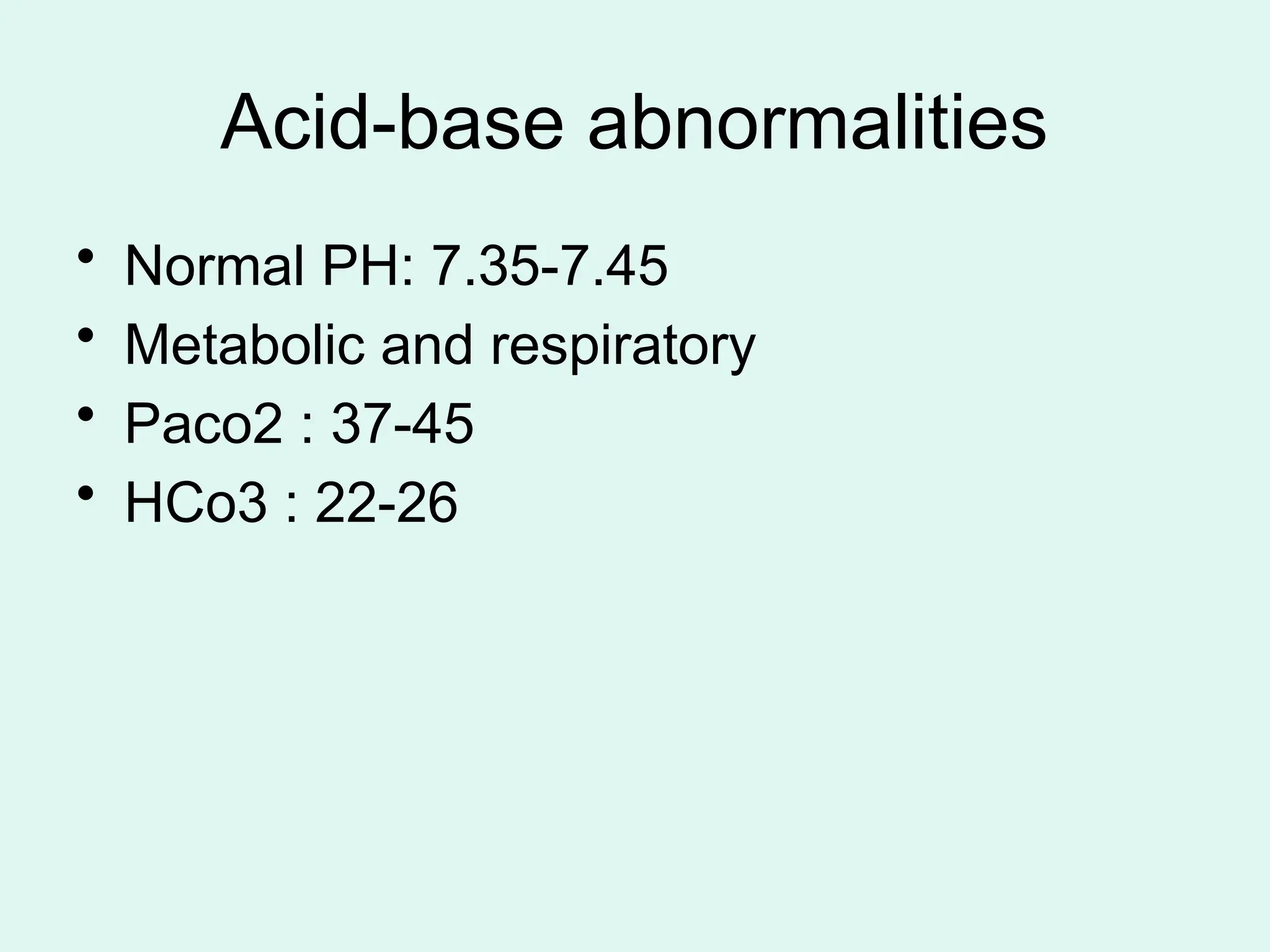
Acid-base abnormalities
• Normal PH: 7.35-7.45
• Metabolic and respiratory
• Paco2 : 37-45
• HCo3 : 22-26
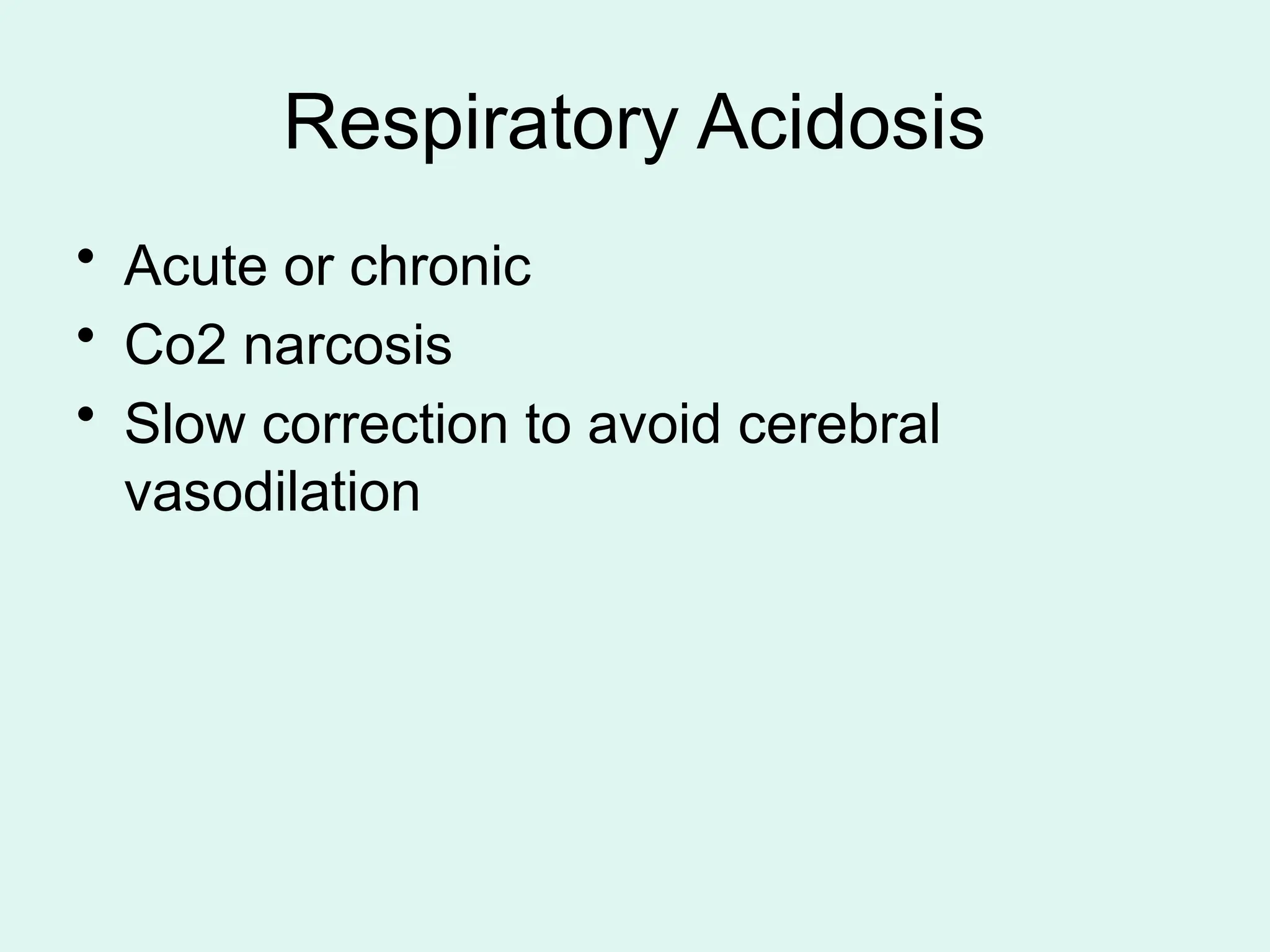
Respiratory Acidosis
• Acute or chronic
• Co2 narcosis
• Slow correction to avoid cerebral
vasodilation
Metabolic Acidosis
• Anion gap
• AG= Na – (Cl+HCO3) Nl: 9-15
• Normal: diarrhea, RTA, acetazolamide,
mafenide
• High: lactic, DKA, renal failure, liver failure,
poisoning
• Treatment: correct the underlying problem
Respiratory Alkalosis
• Hypoventilation
• Symptoms of hypocalcemia
• Correction of underlying problem
metabolic Alkalosis
• Renal or GI bicarb loss
• Loop diuretics
• Ileus, arrhythmia, digoxin toxication
• Treatment with NaCl and potassium in
chloride responsive metabolic alkalosis
(vomiting)

fluid and electrolytes beeefore surgery.

  • 1.
    Fluid, Electrolyte andAcid- Base Balance Essentials of general surgery (Lawrence) H.Rezaei MD. Assistant professor of general surgery
  • 2.
  • 3.
    Composition of theHuman Body Figure 27–1b
  • 4.
    Water content varieswith age & tissue type Fat has the lowest water content (~20%). Bone is close behind (~22 – 25%). Skeletal muscle is highest at ~65%.
  • 5.
    Fluid Compartments • ECF(extra cellular fluid) and ICF (intracellular fluid) are called fluid compartments: – because they behave as distinct entities – are separated by cell membranes and active transport
  • 6.
    Water Composition • Is60% percent of male body weight • Is 50% percent of female body weight • Mostly in intracellular fluid
  • 7.
    Water Exchange • Waterexchange between ICF(2/3) and ECF(1/3) occurs across cell membranes by: – osmosis – diffusion – carrier-mediated transport
  • 8.
    Major Subdivisions ofECF • Interstitial fluid of peripheral tissues(2/3) • Plasma of circulating blood(1/3)
  • 9.
  • 10.
  • 11.
    Regulation of waterbalance • It is not so much water that is regulated, but solutes. • osmolality is maintained at between 280 – 300 mOsm.
  • 12.
    Sodium • Is thedominant cation in ECF • Sodium salts provide 90% of ECF osmotic concentration (97% with other related anions) • Need: 1-3meq/kg/day
  • 13.
    renin–angiotensin system • 1-Decreasein intravascular volume • 2-Decrease in renal arterial flow • 3-renin secretion (juxtaglomerular) • 4-angiotensin to angiotensin I • 5-angiotensin I to II (in lungs by ACE) • 6-aldosterone secretion (adrenal cortex) • 7-↑reabsorption of Na and water, ↓K and H • 8-↑ECF
  • 14.
    Antidiuretic Hormone (ADH)or vasopressin • Stimulates water conservation at kidneys: – reducing urinary water loss – concentrating urine • Stimulates thirst center: – promoting fluid intake
  • 15.
    Potassium • Is thedominant cation in ICF • Need: 0.5-1meq/kg/day • 95% excreted in urine and 5% in feces
  • 16.
    Normal Potassium Concentrations • InICF: – about 160 mEq/L • In ECF: – is 3.8–5.0 mEq/L
  • 17.
    FLUIDS AND ELECTROLYTES INTHE PERIOPERATIVE PERIOD • Maintenance (D.W5% 1/2N.S +20meq KCl) (4:2:1 rule) • Replacement of ongoing loss (same fluid)
  • 18.
    • Fluid, electrolyte,and acid–base imbalances must be identified and treated promptly in acutely ill patients • Third spacing • Loss: ↓hemodynamic - ↓out(0.5cc/kg/h) – lab(↑ hct- bun/cr20- feNa20) • Isotonic crystalloides • Monitor by hemodynamics, output and IVC sono
  • 21.
    Volume Depletion Causes include: •Hemorrhage • ECF loss (Vomiting-Diarrhea-NG suction-fistulas) • TBW reduction • Diuretics • diabetes insipidus(low ADH or resistance)
  • 22.
    Volume Depletion Acute: neurologicand cardiovascular signs Renal azotemia: urine na>40meq/L - FeNa> 2% Prerenal azotemia: urine na<20 - urine osm>400 – FENa<1%
  • 23.
    Resuscitation Isotonic crystalloides (bowel,bile,pancreas,thirdspace) For vomiting or NG secretions ½ saline+ 20-40 meq/L KCl Big angiocaths (16) OUT>0.5 cc/kg/h in adults and >1 in children
  • 24.
    Volume excess • abnormalfluid retention • excessive or inappropriate fluid intake • combination
  • 25.
    Volume excess • fluidor sodium restriction • diuresis along with a replacement of potassium losses • In vascular volume deficit careful replacement with crystalloid or blood products may be needed
  • 26.
    Hyponatremia • Low, highor normal ECF • Dilutional • Artificial (high TG or Glucose) • Necrotizing soft tissue infections
  • 27.
    Hyponatremia • Acute Hyponatremia(120-130) results in: – Cerebral edema (brain swelling) – Sluggish neural activity – ↑DTR – Convulsions, muscle spasms, deranged behavior. – Coma,areflexia,death
  • 28.
    Treatment • Water restriction •Stop thiazide • In chronic max:12 meq/l/d (central pontine myelinolysis) • Water and Na restriction in high ECF • Isotonic in low ECF • Hypertonic in severe symptoms
  • 29.
    • Half in12-18 hours Sodium deficite
  • 30.
    Hypernatremia • loss ofwater alone (hypothalamic abnormalities, nonreplaced insensible losses) • loss of water and salt together (gastrointestinal losses, osmotic diuresis, excessive diuretic use, central or nephrogenic diabetes insipidus, burns, excessive sweating) • increased total body sodium without any water loss (Cushing’s syndrome, hyperaldosteronism, ectopic production of ACTH, iatrogenic sodium administration, ingestion of seawater)
  • 31.
    Hypernatremia • symptoms ofdehydration • neuromuscular and neurologic disorders (twitching, restlessness, weakness, delirium, coma, seizures, and death) • Intracranial hemorrhage is a common postmortem finding in patients who die of hypernatremia.
  • 32.
    Treatment • Water (poor D.W5%) • Half replacement in 12-24h with monitoring • Fast replacement results in brain edema
  • 33.
    Potassium • 98% ofpotassium in the human body is in ICF • Cells expend energy to recover potassium ions diffused from cytoplasm into ECF
  • 34.
    Hypokalemioa <3.5 meq/L Low intake,excretion or shift(insulin,alkalosis) Paradoxical aciduria in vomiting
  • 35.
    symptoms <3 meq/L skeletal muscleweakness, fatigue, paresthesias, paralysis, rhabdomyolysis. Deep-tendon reflexes may be diminished or absent. anorexia, polyuria, and nausea and vomiting associated with paralytic ileus
  • 36.
    EKG low-voltage, flattened, orinverted T waves Prominent U waves depressed S-T segments prolonged P-R intervals widened QRS complexes
  • 37.
    Treatment • Check Digoxinlevel in mild • Ca and Mg in severe or resistant • Oral or IV(less than 10meq/h) • Till above 3.5
  • 38.
    Hyperkalemioa >5 meq/L high intake(foodor blood) or shift(crush,hemolysis,hematoma,catabolism, acidosis) or renal disease K sparing diuretics, NSAIDs, B blockers, ACEi
  • 39.
    symptoms skeletal muscle weakness,paralysis Peaked T waves(6-7) VF(>8)
  • 40.
    Treatment • Recheck • Inmild(<6) restrict potassium intake, eliminate causes (potassium-sparing diuretics) and treat fluid volume or acid– base disorders. Potassium-wasting diuretics may be administered, and hormone deficiencies may be replaced
  • 41.
    Treatment • >6 • 10units of insulin with 25 g of glucose intravenously over 5 minutes • Bicarbonate • Kayexalate • Ca-gluconate(only in ecg changes) • hemodialysis
  • 42.
    Calcium • Total 8.5-10.5 •Ionized 4.75-5.3 (physiologic effect) • PTH : intestinal absorption, renal excretion, and calcium exchange between bone and the ECF.
  • 43.
    Hypocalcemia • < 8mEq/L • acute pancreatitis , necrotizing fasciitis • Inadequate intestinal absorption(IBD) • chronic diarrhea or pancreatic or intestinal fistulas • Artifactual hypocalcemia • phenytoin and phenobarbital • Vit D deficiency • Massive transfusion • Hypopara and hypomagnesemia(low PTH)
  • 44.
    symptoms circumoral tingling numbness andtingling of the fingertips muscle cramps Hyperactive deep-tendon reflexes Chvostek’s sign Tetany Trousseau sign (carpopedal spasm) Seizures Confusion Prolonged Q-T intervals
  • 45.
    Treatment • Check K,Mg,Ph,ALP •Check acid base abnormalities • IV calcium gluconate in severe and symptomatic • Vit D and thiazide in hypopara
  • 46.
    Hypercalcemia • >10.5 • Primaryand secondary hyperpara • Metastatic cancer( bone metastase or PTH secretion)
  • 47.
    symptoms weakness, fatigue, anorexia,nausea, vomiting severe headaches, diffuse musculoskeletal pain, polyuria, polydipsia hypovolemia and dehydration shortened Q-T intervals and widened T waves calcification may develop in the kidneys as well as in unusual locations (heart, skin) Pancreatitis and renal failure >15 mg/dL cause confusion and depression and death
  • 48.
    Treatment • Decrease intake •Hydration • Increase urinary excretion(loop diuretics) • phosphate
  • 49.
    Magnesium • Is animportant structural component of bone • Is a cofactor for important enzymatic reactions
  • 50.
    Hypomagnesemia • Elderly withmalabsorption or fasting or GI loss • Chronic alcoholism • Acute pancreatitis • Endocrine disorders
  • 51.
    symptoms nausea, vomiting, anorexia,weakness, lethargy muscle cramps, fasciculations, tetany, carpopedal spasm, paresthesias, irritability, inattention, confusion cardiac arrhythmias
  • 52.
    Treatment • Oral inmild • IV magnesium solphate in moderate and malabsorption
  • 53.
    Hypermagnesemia • Rare • renalfailure, dehydration, severe metabolic acidosis, adrenal insufficiency, familial benign • hypocalciuric hypercalcemia, or overdosage with magnesium salts in cathartics • treatment of eclampsia • renal failure who use magnesium-containing antacids
  • 54.
    symptoms nausea ,lethargy, weakness, hypoventilation,and decreased deep-tendon reflexes hypotension and bradycardia, skeletal muscle paralysis, respiratory depression coma and death
  • 55.
    Treatment • Oral hydrationand decrease intake in mild • IV calcium, hydration, diuresis, hemodialysis
  • 56.
    Phosphate • 2.5-4.5 • Arerequired for bone mineralization
  • 57.
    Hypophosphatemia • Along withhypokalemia and hypomagnesemia • Decrease in intake or increase in excretion or shift • Alcohol whitdrawal • Vit D deficiency • Malignancies • Hypermetabolic state • Hungry bone syndrome
  • 58.
    symptoms anorexia, dizziness, osteomalacia,severe congestive cardiomyopathy, proximal muscle weakness, visual defects, ascending paralysis, hemolytic anemia, respiratory failure Inability to wean from the ventilator rhabdomyolysis, hypercalciuria severe hypocalcemia are also seen seizures, coma, and death
  • 59.
    Treatment • aggressive searchfor and treatment of the cause • Phosphate salts may be given orally or intravenously
  • 60.
    Hyperphosphatemia • increase inintake or decrese in excretion or shift • Renal failure • Hypopara • Vit D toxicity • sarcoidosis or TB • Tumor lysis syndrome
  • 61.
  • 62.
    Treatment • AlMg • Sevelamer •Normal saline+ diuretic • hemodialysis
  • 63.
    Acid-base abnormalities • NormalPH: 7.35-7.45 • Metabolic and respiratory • Paco2 : 37-45 • HCo3 : 22-26
  • 64.
    Respiratory Acidosis • Acuteor chronic • Co2 narcosis • Slow correction to avoid cerebral vasodilation
  • 65.
    Metabolic Acidosis • Aniongap • AG= Na – (Cl+HCO3) Nl: 9-15 • Normal: diarrhea, RTA, acetazolamide, mafenide • High: lactic, DKA, renal failure, liver failure, poisoning • Treatment: correct the underlying problem
  • 66.
    Respiratory Alkalosis • Hypoventilation •Symptoms of hypocalcemia • Correction of underlying problem
  • 67.
    metabolic Alkalosis • Renalor GI bicarb loss • Loop diuretics • Ileus, arrhythmia, digoxin toxication • Treatment with NaCl and potassium in chloride responsive metabolic alkalosis (vomiting)