MRS.ROJARANI.K, RNM,,M.SC(N),
MEDICAL SURGICAL NURSING
ASSISTANT PROFESSOR
GANGA COLLEGE OF NURSING
COIMBATORE
ANEMIA
MEDICAL SURGICAL
NURSING
LEARNING OBJECTIVES
By the end of the class , the students will be able to
• Review the hematology
• Define Anemia.
• State the incidence of anemia
• List the Causes of Anemia.
• Enlist the risk factor of anemia
• Classify the Anemia.
• Mention the types of Anemia
LEARNING OBJECTIVES
• Describe the Pathophysiology of each type of Anemia.
• Enumerate the Clinical features of Anemia
• Outline the Diagnostic evaluation.
• Explain in detail the Management of Anemia.
REVIEW OF HEMATOLOGY
REVIEW OF HEMATOLOGIC SYSTEM
• Hematology is the study of the blood forming tissues. In fetal life
,various tissues produce red blood cells but after birth their
production is controlled, exclusively by the bone marrow, primarily in
the long bones of the vertebrae, sternum and ribs assume RBC
production.
• Age, sex and the altitude at which a person lives affect the number
of RBCs.
• Normally ,RBCs are biconcave disks that are capable of changing
shape as they flow through the microvasculature of the body. They
have a uniform size that is determined mainly by the amount of
cellular content of substances primarily hemoglobin.
REVIEW OF HEMATOLOGY CONT’..
• Their function is to transport oxygen to tissues.
• hemoglobin production depends on sufficient amounts of
circulating iron.
• Iron is absorbed from dietary intake by the intestines and
stored by the liver in both soluble and insoluble forms, to be
used when necessary.
Bone marrow:
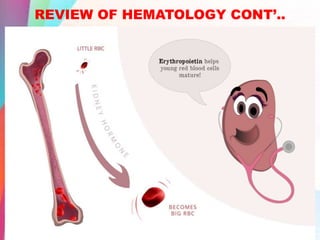
• Hematopoiesis (red blood cell production) occurs in the bone
marrow during the first5 years of life. Beyond 5 years of age
,most red blood cells are produced in the marrow of the ribs,
sternum, vertebrae, pelvis, skull, scapulae and clavicle.
REVIEW OF HEMATOLOGY CONT’..
INTRODUCTION
• Anaemia is the general name for a range of disorders affecting
red blood cells. Red blood cells contain haemoglobin, which is
responsible for carrying oxygen in the blood. To produce red
blood cells, the body needs iron, vitamin B12 and folic acid.
• Severe or long-lasting anaemia can damage your heart, brain,
and other organs in your body. Very severe anaemia may even
cause death.
INCIDENCE
• Anemia is a major killer in India.
• Statistics reveal that every second Indian woman is anemic
• Anaemia is widespread in India--58.6% of children, 53.2% of
non-pregnant women and 50.4% of pregnant women were
found to be anaemic in 2016, as per the NFHS
• One in every five maternal deaths is directly due to anemia.
• Anemia affects both sexes, although pregnant women and
adolescent girls are most susceptible and most affected by this
disease.
DEFINITION
Anemia (An-without, emia-blood)
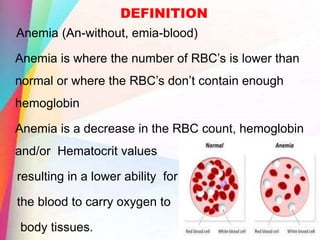
Anemia is where the number of RBC’s is lower than
normal or where the RBC’s don’t contain enough
hemoglobin
Anemia is a decrease in the RBC count, hemoglobin
and/or Hematocrit values
resulting in a lower ability for
the blood to carry oxygen to
body tissues.
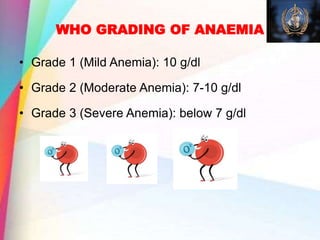
WHO GRADING OF ANAEMIA
• Grade 1 (Mild Anemia): 10 g/dl
• Grade 2 (Moderate Anemia): 7-10 g/dl
• Grade 3 (Severe Anemia): below 7 g/dl
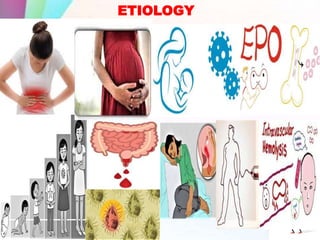
ETIOLOGY
ETIOLOGY CONT’
Increased
Requirements
Menstruating females
Pregnancy. Lactation
Growing infants and children
Erythropoietin treatment
Increased loss G.I bleeding. Menorrhagia
Persistent Hematuria
Intravascular haemolytic anaemia
Regular blood donors
Parasitic infection
ETIOLOGY CONT’
ETIOLOGY CONT’
Decreased
intake
Vegetarian diet
Socio Economic Factors
Decreased
Absorption
Upper GI Pathology(Celiac and Crohn’s
Disease)
Gastrectomy
Medication(Antacids Zantac)
RISK FACTOR
RISK FACTOR
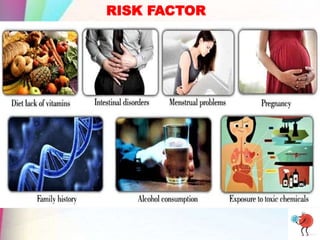
 A diet lacking in certain vitamins
 Intestinal disorders
 Menstruation
 Pregnancy
 Chronic conditions - such as AIDs, diabetes, kidney disease,
cancer, rheumatoid arthritis, heart failure, and liver disease
 Family history
 Age
 People who suffer from alcoholism
 People who face exposure to toxic chemicals
CLASSIFICATION OF ANEMIA
CLASSIFICATION OF
ANEMIA
On the basis
of cause
On the basis
of Morphology
Blood
loss
Inadequate
production
of normal
blood cells
Excessive
destruction
of blood
cells
normo
cytic
Micro
cytic
Macroc
ytic
ETIOLOGICAL CLASSIFICATION
1. Decreased erythrocyte production:
a. Decreased haemoglobin synthesis
➢ Iron deficiency
b. Defective DNA synthesis
➢ Cobalamine [ vitamin b12 ] deficiency
➢ Folic acid deficiency
c. Decreased number of erythrocyte precussors
➢ Aplastic anemia
➢ Anemia of myleoproliferative disease
ETIOLOGICAL CLASSIFICATION
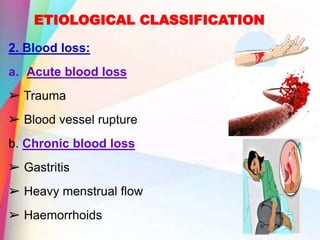
2. Blood loss:
a. Acute blood loss
➢ Trauma
➢ Blood vessel rupture
b. Chronic blood loss
➢ Gastritis
➢ Heavy menstrual flow
➢ Haemorrhoids
ETIOLOGICAL CLASSIFICATION
3. Increased Erythrocyte Destruction:
a. Intrinsic factor
➢ Abnormal haemoglobin
➢ Enzyme deficiency
➢ Membrane abnormalities
b.Extrinsic factor
➢ Physical trauma
➢ Infectious agent
➢ Medications ➢ Toxins
MORPHOLOGICAL CLASSIFICATION
1.Normochromic, Normocytic Anemia:
It has normal MCHC, normal MCV. The cells are normal in size and
normal color.
If the MCV is in the normal range (80-100), it is called
a normocytic anemia (normal red blood cell volume).
These include:
➢ Anemias of chronic disease
➢ Hemolytic anemia (those characterized by accelerated destruction of
RBC's)
➢ Anemia of acute hemorrhage
➢ Aplastic anemia (those characterized by disappearance of RBC
precursors from the marrow)
MORPHOLOGICAL CLASSIFICATION CONT’..
2.Hypochromic, Microcytic Anemia:
▪ It has low MCHC, low MCV.
▪ If the MCV is low (less than 80), the anemia is
categorized as microcytic anemia (low red blood cell
volume) and pale in color.
These include:
➢ Iron deficiency anemia
➢ Thalassemias
➢ Anemia of chronic diseases
MORPHOLOGICAL CLASSIFICATION CONT’..
3.Normochromic, Macrocytic Anemia:
It has normal MCHC, high MCV.
The cells are larger than normal over 100 fl and
normal color.
These include:
➢ Vitamin B12 deficiency
➢ Folic acid deficiency
TYPES OF ANEMIA
1. Anemia Caused By Decreased Erythrocyte
Production: IRON DEFICIENCY
ANEMIA
MEGALOPLASTIC
ANEMIA
THALASEMIA
APLASTIC ANEMIA
TYPES OF ANEMIA
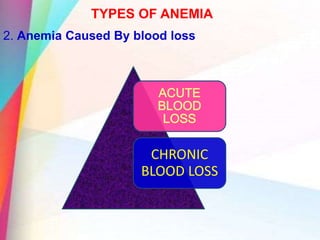
2. Anemia Caused By blood loss
CHRONIC
BLOOD LOSS
TYPES OF ANEMIA
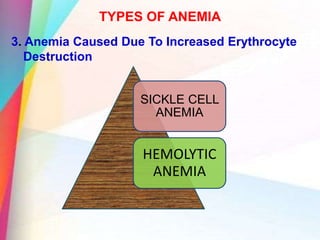
3. Anemia Caused Due To Increased Erythrocyte
Destruction
SICKLE CELL
ANEMIA
HEMOLYTIC
ANEMIA
1. Iron deficiency anemia
Definition:
It is the decrease or deficient in the iron content in the
blood
Etiology:
✓Insufficient dietary intake
✓Absorption of Iron
✓Blood loss due to diseases.
✓Bleeding lesions of the GI tract
✓Parasitic infestation
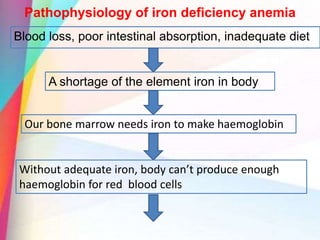
Pathophysiology of iron deficiency anemia
Blood loss, poor intestinal absorption, inadequate diet
A shortage of the element iron in body
Our bone marrow needs iron to make haemoglobin
Without adequate iron, body can’t produce enough
haemoglobin for red blood cells
Pathophysiology cont’..
Decreased haemoglobin may result in insufficient
oxygen delivery to the tissue
↓ Decreased hemoglobin < 11gm/dl
Symptoms occur
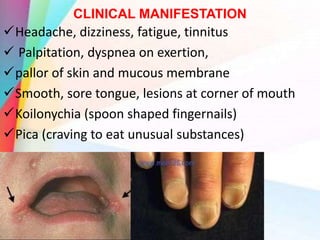
CLINICAL MANIFESTATION
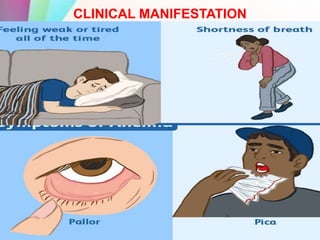
Headache, dizziness, fatigue, tinnitus
 Palpitation, dyspnea on exertion,
pallor of skin and mucous membrane
Smooth, sore tongue, lesions at corner of mouth
Koilonychia (spoon shaped fingernails)
Pica (craving to eat unusual substances)
CLINICAL MANIFESTATION
DIAGNOSTIC EVALUATION
• History collection, Physical examination
• CBC and Iron profile:
Decreased Hb, hematocrit, serum iron, ferritin,
elevated red cell distribution, elevated total iron-
binding capacity
• source of chronic blood loss may include
Sigmoidoscopy ,Colonoscopy
✓ Upper and lower GI studies
✓ Stool and urine for occult blood examination
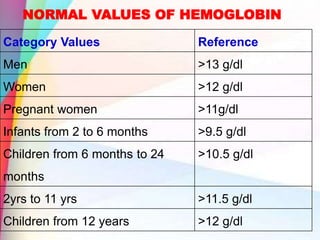
NORMAL VALUES OF HEMOGLOBIN
Category Values Reference
Men >13 g/dl
Women >12 g/dl
Pregnant women >11g/dl
Infants from 2 to 6 months >9.5 g/dl
Children from 6 months to 24
months
>10.5 g/dl
2yrs to 11 yrs >11.5 g/dl
Children from 12 years >12 g/dl
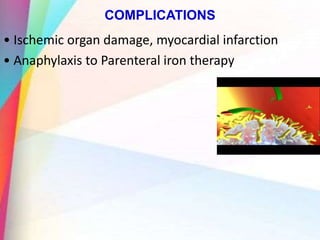
COMPLICATIONS
• Ischemic organ damage, myocardial infarction
• Anaphylaxis to Parenteral iron therapy
Collaborative care:
Identification and treatment of underlying cause
Drug therapy:
• ✓ Iron 150-200mg along with laxatives and antacids ✓
Ferrous sulfate or ferrous gluconate administration
• ✓ Iron dextran, iron sucrose, sodium ferric gluconate
IM/ IV
General management:
❖Transfusion of packed RBC’s
Collaborative care:
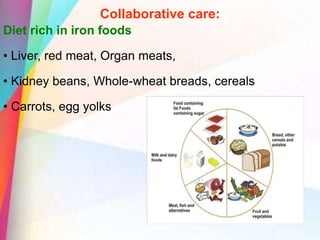
Diet rich in iron foods
• Liver, red meat, Organ meats,
• Kidney beans, Whole-wheat breads, cereals
• Carrots, egg yolks
THALASSEMIA
Definition:
Thalassemia is a group of disease that have an autosomal
recessive genetic basis involving inadequate production of
normal haemoglobin due to the absence or reduced
globulin protein.
Causes:
• Mutation in the DNA of cells that produce hemoglobin
• It is a form of thalassemia involving the genes HB1 and
HB2
• It is most commonly inherited in a Mendelian recessive
fashion
THALASSEMIA CONT’
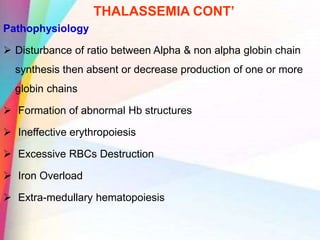
Pathophysiology
 Disturbance of ratio between Alpha & non alpha globin chain
synthesis then absent or decrease production of one or more
globin chains
 Formation of abnormal Hb structures
 Ineffective erythropoiesis
 Excessive RBCs Destruction
 Iron Overload
 Extra-medullary hematopoiesis
THALASSEMIA CONT’
Pathophysiology CONT’
THALASSEMIA CONT’
Clinical manifestations:
• Physical and mental retardation
• Spleenomegaly
• Hepatomegaly
• Jaundice ( due to RBC haemolysis)
Collaborative care:
No specific drug or diet therapy
If Mild:
• It requires no treatment because body adapts to it.
If Severe:
• Blood transfusion or exchange transfusion
• IV deferox amine ( binds to iron)
• Zinc supplementation o Ascorbic and iron
supplements
MEGALOBLASTIC ANEMIA
DEFINITION:
Megaloblastic anemia are a group of disorders caused
by impaired DNA synthesis and characterized by the
presence of large RBC’s.
Classification:
Cobalmine deficiency Folic acid deficiency
COBALAMINE DEFICIENCY
DEFINITION
It is a major type of Megaloblastic anemia associated
with vitamin B12 deficiency, it is called pernicious
anemia
COBALAMINE DEFICIENCY
ETIOLOGY
• Autoimmune gastric mucosal atrophy
• Dietary deficiency
• Deficiency of gastric intrinsic factor. Intrinsic factor may
not be secreted and orally ingested vitamin B12 not
absorbed
• Pernicious anemia
• Gastrectomy
• Intestinal malabsorption
• Increased requirements
• Ascorbic acid, neomycin drugs interfere with vitamin
B12 absorption
PATHOPHYSIOLOGY
Defect in gastric mucosal, after gastrectomy, or small
bowel disease
↓
Inhibiting folic acid transport
↓
Reducing DNA synthesis in precursor cells
↓
These cells undergo improper DNA synthesis and
increased in size and cause anemia
CLINICAL MANIFESTATIONS
• Severe pallor
• Slight jaundice
• Fatigue
• Weight loss
• Parasthesia of the
hands and feet
• Difficulty with gait
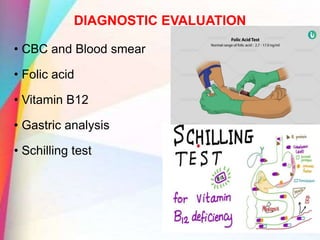
DIAGNOSTIC EVALUATION
• CBC and Blood smear
• Folic acid
• Vitamin B12
• Gastric analysis
• Schilling test
COLLABORATIVE CARE
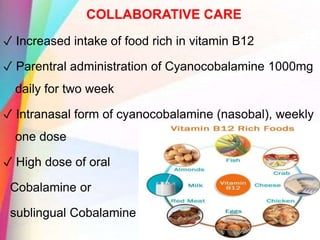
✓ Increased intake of food rich in vitamin B12
✓ Parentral administration of Cyanocobalamine 1000mg
daily for two week
✓ Intranasal form of cyanocobalamine (nasobal), weekly
one dose
✓ High dose of oral
Cobalamine or
sublingual Cobalamine
COMPLICATIONS
Neurological complication
• Paresthesia
• Gait disturbance
• Bladder and bowel dysfunction
• Cerebral dysfunction may be persistent
FOLIC ACID DEFICIENCY
DEFINITION:
Chronic Megaloblastic anemia caused by folic acid
(folate) deficiency
ETIOLOGY
• Poor nutrition, lack of vegetables, citrus fruits, nuts,
beans
• Malabsorption syndrome
• Small bowel disorder
• Drugs like oral contraceptives, anti seizures decreased
absorption
• Alcohol abuse and anorexia
• haemodialysis
PATHOPHYSIOLOGY
Folic acid requires for DNA synthesis leading for RBC
formation and malnutrition
↓
Folic acid deficiency
↓
The disease develops slowly
↓
Symptoms are attributed to other problems
CLINICAL MANIFESTATIONS
• Fatigue
• Weakness, dizziness
• Pallor
• Headache
• Tachycardia
• Sore tongue
• Cracked lips
• Dyspepsia
• Smooth beefy red tongue
DIAGNOSTIC EVALUATION
• Vitamin B12
• Folic acid
• CBC- Decreased RBC, Hb, hematocrit
COMPLICATION
✓ Congenital acquired neural tube defects
MANAGEMENT
• NUTRITIONAL THERAPY
Diet includes liver, organ meats, eggs, cabbage
• REPLACEMENT THERAPY
Folic acid dose is 1mg mouth In malabsorption states
upto 5mg/day
APLASTIC ANEMIA
DEFINITION:
It is a disorder characterized by bone marrow hypoplasia
(hypocellular) in pancytopenia (insufficient no's of RBCs,
WBCs, platelet) It is the damage to bone marrow stem
cells, or damage to the microenvironment within the
marrow, and replacement of the marrow with fat. It results
in bone marrow aplasia
( decrease in all blood cell types).
APLASTIC ANEMIA
INCIDENCE:
• The incidence of aplastic anemia is low
• Approximately 4 of every 1 million persons
APLASTIC ANEMIA
CONGENITAL:
• Fanconi syndrome
• Caused by chromosomal
alterations
• Approximately 30% of the
aplastic anemia's appear in
the childhood are inherited
ACQUIRED:
• Chemical agent and
toxins
• Drugs • Pregnancy
• Radiation • Viral, bacterial
infection
• Approximately 70%
aplastic anemia’s idiopathic
ETIOLOGY
PATHOPHYSIOLOGY APLASTIC ANEMIA
Decrease in or damage to marrow stem cell
↓
Damage to microenvironment with in the marrow
↓
Replacement of marrow with fat
↓
T cell mediate an inappropriate attack against the bone marrow
↓
Resulting in bone marrow aplasia (markedly reduced hematopoiesis)
↓
Severe leukopenia and thrombocytopenia occur ↓ Pancytopenia
occurs
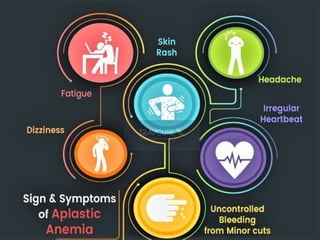
CLINICAL MANIFESTATION OF APLASTIC ANEMIA
FROM ANEMIA:
•Pallor
•Weakness
•Fatigue
•Dyspnea
•Palpitation
FROM INFECTIONS
• Associated with neutropenia
• Fever, headache, diarrhea,
malaise,
• Adventitious abdominal pain,
erythema, pain
• Exudates at wounds or sites
of invasive procedure
THROMBOCYTOPENIA:
• Bleeding from gums, nose,
GI tract, GU tract, Purpura,
petechiae, ecchymosis
APLASTIC ANEMIA
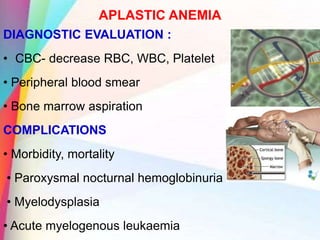
DIAGNOSTIC EVALUATION :
• CBC- decrease RBC, WBC, Platelet
• Peripheral blood smear
• Bone marrow aspiration
COMPLICATIONS
• Morbidity, mortality
• Paroxysmal nocturnal hemoglobinuria
• Myelodysplasia
• Acute myelogenous leukaemia
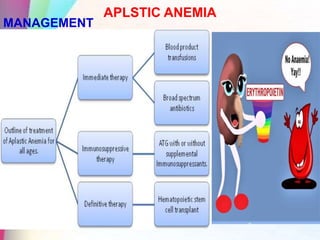
APLSTIC ANEMIA
MANAGEMENT
NURSING DIAGNOSIS OF APLASTIC
ANEMIA
• Risk for infection related to inadequate secondary
defenses or immuno suppression.
• Ineffective tissue perfusion related to anemia.
• Deficient knowledge related to incomplete information
about the disease process.
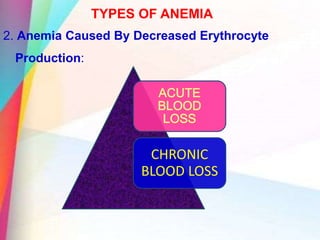
TYPES OF ANEMIA
2. Anemia Caused By Decreased Erythrocyte
Production:
CHRONIC
BLOOD LOSS
ACUTE BLOOD LOSS
Definition: It occurs as a result of sudden haemorrage
Etiology:
➢ Trauma, Complication of surgery
➢ Conditions that disrupts vascular integrity
Clinical manifestations:
It depends on the degree of blood loss 10%- none
20% -no detectable symptoms, postural hypotension
40% -BP, CVP, cardiac output below normal level
50%- shock and potential death
ACUTE BLOOD LOSS
Diagnostic measures:
Blood test ( plasma volume and RBC)
❑Hb and hematocrit
Collaborative care:
❑Replacing blood volume
❑Identifying source of haemorrhage and stopping the
blood loss
❑IV fluids rushing such as RL
❑Correcting RBC’s loss ❑Blood transfusion
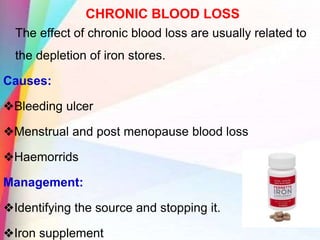
CHRONIC BLOOD LOSS
The effect of chronic blood loss are usually related to
the depletion of iron stores.
Causes:
❖Bleeding ulcer
❖Menstrual and post menopause blood loss
❖Haemorrids
Management:
❖Identifying the source and stopping it.
❖Iron supplement
CHRONIC BLOOD LOSS PATHOPHYSIOLOGY
Extensive blood loss of more than 20% of the blood volume
Regional vasoconstriction , decrease in central venous
pressure and in venous return
Reduction of the cardiac output
The heart rate rises, the temperature in the
periphery drops, and the skin is pale and moist.
CHRONIC BLOOD LOSS
Clinical manifestation
• cold or clammy skin.
• pale skin.
• rapid, shallow breathing.
• rapid heart rate.
• confusion.
• weakness.
• weak pulse.
Management:
❖Identifying the source and stopping it.
❖Iron supplement
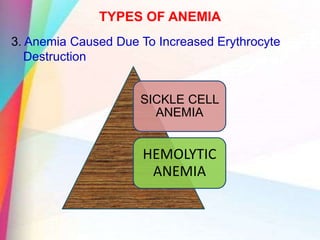
TYPES OF ANEMIA
3. Anemia Caused Due To Increased Erythrocyte
Destruction
SICKLE CELL
ANEMIA
HEMOLYTIC
ANEMIA
SICKLE CELL ANEMIA
DEFINITION:
It is a group of inherited, autosomal recessive
disorders characterized by the presence of abnormal
form of Hb in the erythrocytes. This abnormal Hb,
hemoglobin S, causes the erythrocytes to stiffen and
elongate taking on a sickle shape in response to low
oxygen levels
SICKLE CELL ANEMIA
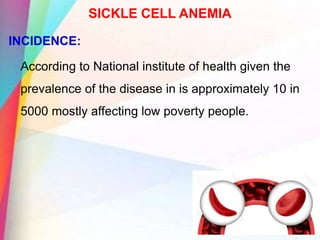
INCIDENCE:
According to National institute of health given the
prevalence of the disease in is approximately 10 in
5000 mostly affecting low poverty people.
SICKLE CELL ANEMIA
ETIOLOGY
✓ Hereditary & Autosomal recessive disorder
✓ Triggers or sustain a sickling episode –dehydration ,
decreased plasma volume &low body temperature.
✓ Increased hydrogen ion concentration (acidosis)
SICKLE CELL ANEMIA
NORMAL CELL AND ABNORMAL CELL
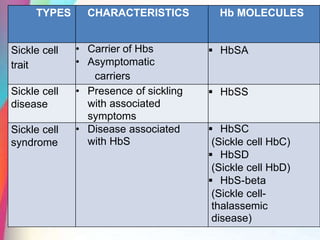
TYPES CHARACTERISTICS Hb MOLECULES
Sickle cell
trait
• Carrier of Hbs
• Asymptomatic
carriers
 HbSA
Sickle cell
disease
• Presence of sickling
with associated
symptoms
 HbSS
Sickle cell
syndrome
• Disease associated
with HbS
 HbSC
(Sickle cell HbC)
 HbSD
(Sickle cell HbD)
 HbS-beta
(Sickle cell-
thalassemic
disease)
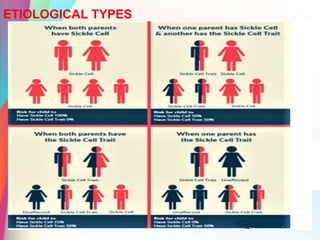
ETIOLOGICAL TYPES
Sickle cell trait
• It occurs when a person is heterogeneous for
hemoglobin S, the person has inherited Hbs from one
parent and normal Hb from other parent
• It is typically a very mild to asymptomatic condition
• Disorders of Hbs synthesis are categorized as
hemoglobinopathies
• It is an umbrella term for a group of inherited
hemoglobinopathies
ETIOLOGICAL TYPES
SICKLE CELL ANEMIA:
It occurs when a person is homozygous for
hemoglobin S (HbSS), the person has inherited Hbs
from both parents.
SICKLE CELL THALASEMIA:
It occurs when a person has inherited Hbs from one
parent and another type of abnormal hemoglobin
(such as Thalassemia or hemoglobin C) from the other
parent.
Sickle cell Crisis
The terms "sickle cell crisis" or "sickling crisis" may be
used to describe several independent acute conditions
occurring in patients with sickle cell disease. Sickle
cell disease results in anaemia and crises that could
be of many types including the Vaso-occlusive crisis,
aplastic crisis, aplastic crisis, sequestration crisis,
haemolytic crisis.
1.Vaso-occlusive crisis
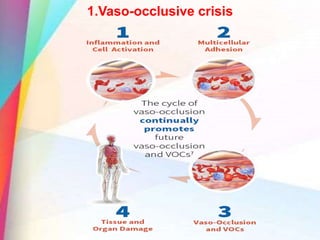
The vaso-occlusive crisis is caused by sickle shaped
red blood cells that obstruct capillaries and restrict
blood flow to an organ, resulting in ischemia, pain,
necrosis and often organ damage.
MANAGEMENT
Painful crises are treated with hydration, analgesics
and blood transfusion; pain management requires
opiod administration at regular intervals until the crisis
has settled. For milder crises, a subgroup of patients
manage on NSAIDs (such as diclofenac or naproxen.
1.Vaso-occlusive crisis
2. Splenic sequestration crisis
It is acute, painful enlargements of the spleen, caused
by intra splenic trapping of red cells and resulting in a
precipitous fall in hemoglobin levels with the potential
for hypovolemic shock. Sequestration crises are
considered an emergency. If not treated, patients may
die within 1–2 hours due to circulatory failure.
MANAGEMENT
Is supportive, sometimes with blood transfusion.
These crises are transient, they continue for 3–4 hours
and may last for one day surgical autosplenectomy.
3.Aplastic crisis
Aplastic crises are acute worsening of the patient's
baseline anaemia, producing pallor, tachycardia, and
fatigue. This crisis is normally triggered by parvovirus
B19, which directly affects erythropoiesis (production
of red blood cells) by invading the red cell precursors
and multiplying in them and destroying them.
4.Haemolytic Crisis
Haemolytic crises are acute accelerated drops in
haemoglobin level. The red blood cells break
down at a faster rate. This is particularly common
in patients with co-existent G6PD deficiency.
Management is supportive, sometimes with blood
transfusions.
ETIOLOGY
✓ Viral or bacterial infection
✓ High altitude
✓ Emotional or physical stress
✓ Surgical blood loss
✓ Dehydration
✓ Acidosis
✓ Increased plasma osmolality
✓ Decreased plasma volume
✓ Low body temperature
✓ unknown
PATHOPHYSIOLOGY
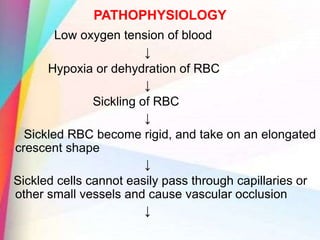
Low oxygen tension of blood
↓
Hypoxia or dehydration of RBC
↓
Sickling of RBC
↓
Sickled RBC become rigid, and take on an elongated
crescent shape
↓
Sickled cells cannot easily pass through capillaries or
other small vessels and cause vascular occlusion
↓
PATHOPHYSIOLOGY cont’..
Leading to acute or chronic tissue injury
↓
Resulting hemostasis
↓
Promote a self-perpetuating cycle of local hypoxia,
deoxygenation of more erythrocytes
↓
More sickling
↓
Circulating sickle cells are hemolysed by the spleen
↓
Leading to anemia
CLINICAL MANIFESTATIONS:
COMMON SYMPTOMS:
• Pallor of mucous membrane, fatigue
• Jaundice
• During sickle cell crisis the pain episodes can affect
the sites simultaneously like back, chest, extremities,
abdomen
• Fever, swelling, tenderness, hypertension, nausea,
vomiting
CLINICAL MANIFESTATIONS:
COMMON SYMPTOMS cont’
• EYE: Hemorrhage, retinal detachment, blindness,
retinopathy
• HEART: Heart failure
• SPLEEN: Splenic atrophy
• PENIS: Priapism
• SKIN: Stasis ulcer of hands, ankles and feet
• LIVER: Hepatomegaly
CLINICAL MANIFESTATIONS:
COMMON SYMPTOMS cont
• GALLBLADER:Gallstones
• BONES, JOINTS: Osteonecrosis
• KIDNEY: Hematuria, renal failure
• LUNG: Acute chest syndrome, pulmonary
hypertension, pneumonia
• BRAIN: Thrombosis or hemorrhage causing paralysis,
sensory deficit or death C
DIAGNOSTIC EVALUATION:
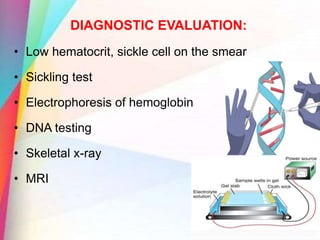
• Low hematocrit, sickle cell on the smear
• Sickling test
• Electrophoresis of hemoglobin
• DNA testing
• Skeletal x-ray
• MRI
COLLABORATIVE MANAGEMENT:
• No specific treatment
• To avoid high altitude
•Maintain adequate fluid intake, and electrolytes
• Treat infection with antibiotics
• Pneumovax, hemophilus influenza, influenza, hepatitis
immunization
•Oxygen administration to treat hypoxia, control sickling
• Transfusion of RBCs, blood
•Narcotic analgesics
Drug therapy:
• Analgesics – opioid along with break through
analgesics
• NSAID’s
• Anti-neuropathic pain medications (eg. Tricyclic
antidepressants)
• Anti- epileptic medications
• Local anesthetics
• Nerve blockers
Drug therapy:cont’..
 Folic acid supplementation
✓ Antisickling agent- Droxia to increase the production
of hemoglobin
✓ Bone marrow transplantation
✓ TENS Therapy( transcutaneous electrical nerve
stimulation)
✓ Patient teaching for long term care of patient D
NURSING DIAGNOSIS
• Pain related to tissue hypoxia due to agglutination of
sickled cells within blood vessels.
• Activity intolerance related to weakness and malaise.
• Imbalanced nutrition less than body requirements
related to poor nutritional intake, anorexia, and
treatment.
• Ineffective tissue perfusion related to inadequate blood
volume or hematocrit.
HEMOLYTIC ANEMIA
Haemolytic Anaemia is a Condition in Which RBCs are
Destroyed and Removed from the Blood stream before
their Normal Life Span.
Classification :
Inherited Hemolytic Anemia: Anemia that occurs from
birth due to hereditary e.g.-Sickle Cell Anemia
&Thalassemia
Acquired Hemolytic Anemia: Anemia that is acquired
due to traumatic events like dialysis, ECMO, prosthetic
heart valves
SYMPTOMS
Common symptoms of anemia
Easy fatigue and loss of energy
Unusually rapid heart beat, particularly with exercise
Shortness of breath and headache, particularly with
exercise
Difficulty concentrating
Dizziness
Pale skin
Leg cramps
Insomnia
SIGNS OF ANAEMIA
Brittle nails
Koilonychia (spoon shaped nails)
Atrophy of the papillae of the tongue
Angular stomatitis
Brittle hair
Dysphagia and Glossitis
Plummer vinson/kelly patterson
INVESTIGATIONS
•
INVESTIGATION
The red cell population is defined by
1.Quantitative parameters:
Volume of packed cells i.e. the hematocrit
Hemoglobin concentration
Red cell concentration per unit volume.
2.Qualitative parameters:
Mean corpuscular volume
Mean corpuscular hemoglobin
Mean corpuscular hemoglobin concentration.
INVESTIGATIONS
Hematocrit ( Packed cell volume): It is the proportion
of the volume of blood sample that is occupied by
RBCs.
– Men -42-52%
– Women-36-48%
Cell Volume Hemoglobin Concentration: It is the
amount of hemoglobin per unit volume of
blood.(Gms/Dl)
– Women -12-16gms/dl
– Men - 14-17gms/dl
INVESTIGATIONS
Red Cell Count: Total number of Red Cells per unit
volume of blood sample. [ No.of RBC/ cu.mm]
– Men - 4.2-5.4*106//mm3
– Women- 3.6-5.0*106/mm3
INVESTIGATIONS
Mean corpuscular Volume: It is the average volume a
RBC. [ fL ]
➢ Normal 82-98mm3or 82-98fL
Mean Corpuscular Hemoglobin: It is the average
hemoglobin content per RBC.
➢ Normal value is 27 to 31 pL
Mean Corpuscular Hemoglobin Concentration: It is the
average concentration of hemoglobin in a given Red Cell
Volume. [Gms/ dL ]
➢ Normal 32-36 g/Dl I
INVESTIGATION
• CBC
• Stool hemoglobin test
• Peripheral blood smear
• Iron level, Transferrin level, Ferritin,Folate
• Vitamin B12
• Bilirubin
• Hemoglobin electrophoresis
• Reticulocyte count
• LFT and RFT
• TIBC
• Bone marrow biopsy
NURSING DIAGNOSIS
Imbalanced nutrition less than body requirements related
to parent’s lack of knowledge of age appropriate nutritional
needs.
Interventions
• Encourage the administration of iron in an empty stomach
• Instruct the patient to keep iron supplements
• Instruct the patient to expect black stools
• Poor nutritional habits may be attributable to a lack of
resources
NURSING DIAGNOSIS
• Activity intolerance related to weakness, fatigue, and
general malaise
• Altered nutritional Level, less than body requirements,
related to inadequate intake of essential nutrients
• Ineffective tissue perfusion related to inadequate blood
volume or HCT
• Ineffective Family Coping related to disabling and life-
threatening disease
NURSING MANAGEMENT
MANAGING FATIGUE:
❑Assist the patient to prioritize activities and to
establish a balance between activity and rest.
❑Patients with chronic anemia need to maintain some
physical activity and exercise to prevent the
deconditioning that results from inactivity.
NURSING MANAGEMENT
MAINTAINING ADEQUATE NUTRITION
• A healthy diet should be encouraged.
• Because alcohol interferes with the utilization of
essential nutrients, the nurse should advise the patient
to avoid alcoholic beverages or to limit their intake and
should provide the rationale for this recommendation.
• Dietary teaching sessions should be individualized,
including cultural aspects related to food preferences
and food preparation.
NURSING MANAGEMENT
MAINTAINING ADEQUATE PERFUSION
• Lost volume is replaced with transfusions or intravenous
fluids, based on the symptoms and the laboratory
findings.
• Supplemental oxygen may be necessary, but it is rarely
needed on a long-term basis unless there is underlying
severe cardiac or pulmonary disease as well.
• Monitor the vital signs closely
• Other medications, such as antihypertensive agents,
may need to be adjusted or withheld.
NURSING MANAGEMENT
MONITORING AND MANAGING POTENTIAL COMPLICATIONS:
• Assess for signs and symptoms of heart failure.
• A serial record of body weights can be more useful than a record
of dietary intake and output, because the intake and output
measurements may not be accurate.
• In the case of fluid retention resulting from congestive heart
failure, diuretics may be required.
• In megaloblastic forms of anemia, the significant potential
complications are neurological.
• A neurologic assessment should be performed for patients with
known or suspected megaloblastic anaemia
PATIENT HEALTH EDUCATION
GENERAL ADVICE:
• Provide blankets and warm clothing to increase comfort
and aid circulation.
• Notify physician if excessive vomiting, coughing or straining
at stools occurs so that medication can be prescribed to
alleviate symptom.
• Avoid contact on gingival when brushing and flossing teeth.
• Transfuse whole blood and packed red blood cells as
ordered by physician.
GENERAL ADVICE
• Avoid situations in which trauma may occur, such as shaving
with straight-edge razor,and ambulating after taking medication
• Avoid forceful sexual intercourse and use adequate lubrication.
• Bowel movements will be black from excess iron excretion.
• Keep skin clean and bedclothes dry.
• Monitor Hb/Hct and assess whether other factors (e.g.,
nutritional deficiencies, fluid and electrolyte disorders,
depression, etc.)
• Assess activity schedule and suggest daily activities that allow
for rest periods.
EDUCATION ON MEDICATIONS
• Avoid aspirin-containing products to prevent bleeding.
Use of stool softeners or laxative
Iron preparation taken on empty stomach cause
dyspepsia, abdominal discomfort, and diarrhoea Liquid
iron preparations should be well diluted and taken
through a straw (undiluted liquid iron stains teeth).
Take iron on an empty stomach (1 hour before or 2
hours after a meal).
Avoid rectal thermometers ,suppository and enemas
EDUCATION ON DIET:
• Increase the intake of vitamin C (citrus fruits and
juices,
• Strawberries , tomatoes, broccoli), to enhance iron
absorption.
• Eat foods high in fiber to minimize problems with
constipation.
• Iron salts are gastric irritants and should always be
taken following meals.
EDUCATION ON DIET:
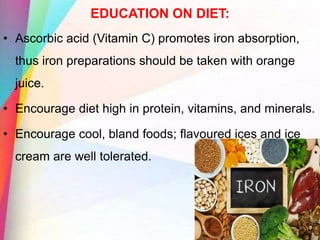
• Ascorbic acid (Vitamin C) promotes iron absorption,
thus iron preparations should be taken with orange
juice.
• Encourage diet high in protein, vitamins, and minerals.
• Encourage cool, bland foods; flavoured ices and ice
cream are well tolerated.
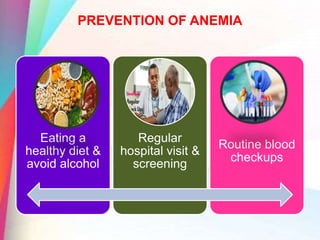
PREVENTION OF ANEMIA
Eating a
healthy diet &
avoid alcohol
Regular
hospital visit &
screening
Routine blood
checkups
SUMMARY
Definition of anemia
Classification of anemia
Anemia Cause
Pathophysiology
Types of anemia
Anemia Symptoms
 Lab Investigation of Anemia
 Treatment
 Prevention
REFERENCES
1. Janice L.Hinkle,Kerry H.Cheever(2018) Brunner and
Suddarth’s Text Book of Medical Surgical Nursing
,14th edition,south asian edition,vol II,Wolters
Kluwer.pg no. 925-938
2. Lewis,S.L.Heitkemper,M.Dirksen,S.R.etal.(2016)
.Medical surgical nursing assessment and
management of clinicalproblems.2 nd South Asian
edition, Mosby Elsevier pg no.1085- 1098
REFERENCES
3 Lizy Sonia & Shaina sharma (2016).Medical Surgical
Nursing-prep Manual for Undergraduates, volI,
Thomson Press, India, Elsevier publishers.pg no.521
WEB SOURCES
www.healthline.com/health/anemia
https://my.clevelandclinic.org/health/diseases/3929-
anemia
Anemia

Anemia

  • 1.
    MRS.ROJARANI.K, RNM,,M.SC(N), MEDICAL SURGICALNURSING ASSISTANT PROFESSOR GANGA COLLEGE OF NURSING COIMBATORE
  • 2.
  • 3.
    LEARNING OBJECTIVES By theend of the class , the students will be able to • Review the hematology • Define Anemia. • State the incidence of anemia • List the Causes of Anemia. • Enlist the risk factor of anemia • Classify the Anemia. • Mention the types of Anemia
  • 4.
    LEARNING OBJECTIVES • Describethe Pathophysiology of each type of Anemia. • Enumerate the Clinical features of Anemia • Outline the Diagnostic evaluation. • Explain in detail the Management of Anemia.
  • 5.
    REVIEW OF HEMATOLOGY REVIEWOF HEMATOLOGIC SYSTEM • Hematology is the study of the blood forming tissues. In fetal life ,various tissues produce red blood cells but after birth their production is controlled, exclusively by the bone marrow, primarily in the long bones of the vertebrae, sternum and ribs assume RBC production. • Age, sex and the altitude at which a person lives affect the number of RBCs. • Normally ,RBCs are biconcave disks that are capable of changing shape as they flow through the microvasculature of the body. They have a uniform size that is determined mainly by the amount of cellular content of substances primarily hemoglobin.
  • 6.
    REVIEW OF HEMATOLOGYCONT’.. • Their function is to transport oxygen to tissues. • hemoglobin production depends on sufficient amounts of circulating iron. • Iron is absorbed from dietary intake by the intestines and stored by the liver in both soluble and insoluble forms, to be used when necessary. Bone marrow: • Hematopoiesis (red blood cell production) occurs in the bone marrow during the first5 years of life. Beyond 5 years of age ,most red blood cells are produced in the marrow of the ribs, sternum, vertebrae, pelvis, skull, scapulae and clavicle.
  • 7.
  • 9.
    INTRODUCTION • Anaemia isthe general name for a range of disorders affecting red blood cells. Red blood cells contain haemoglobin, which is responsible for carrying oxygen in the blood. To produce red blood cells, the body needs iron, vitamin B12 and folic acid. • Severe or long-lasting anaemia can damage your heart, brain, and other organs in your body. Very severe anaemia may even cause death.
  • 10.
    INCIDENCE • Anemia isa major killer in India. • Statistics reveal that every second Indian woman is anemic • Anaemia is widespread in India--58.6% of children, 53.2% of non-pregnant women and 50.4% of pregnant women were found to be anaemic in 2016, as per the NFHS • One in every five maternal deaths is directly due to anemia. • Anemia affects both sexes, although pregnant women and adolescent girls are most susceptible and most affected by this disease.
  • 11.
    DEFINITION Anemia (An-without, emia-blood) Anemiais where the number of RBC’s is lower than normal or where the RBC’s don’t contain enough hemoglobin Anemia is a decrease in the RBC count, hemoglobin and/or Hematocrit values resulting in a lower ability for the blood to carry oxygen to body tissues.
  • 12.
    WHO GRADING OFANAEMIA • Grade 1 (Mild Anemia): 10 g/dl • Grade 2 (Moderate Anemia): 7-10 g/dl • Grade 3 (Severe Anemia): below 7 g/dl
  • 13.
  • 14.
    ETIOLOGY CONT’ Increased Requirements Menstruating females Pregnancy.Lactation Growing infants and children Erythropoietin treatment Increased loss G.I bleeding. Menorrhagia Persistent Hematuria Intravascular haemolytic anaemia Regular blood donors Parasitic infection
  • 15.
  • 16.
    ETIOLOGY CONT’ Decreased intake Vegetarian diet SocioEconomic Factors Decreased Absorption Upper GI Pathology(Celiac and Crohn’s Disease) Gastrectomy Medication(Antacids Zantac)
  • 17.
  • 18.
    RISK FACTOR  Adiet lacking in certain vitamins  Intestinal disorders  Menstruation  Pregnancy  Chronic conditions - such as AIDs, diabetes, kidney disease, cancer, rheumatoid arthritis, heart failure, and liver disease  Family history  Age  People who suffer from alcoholism  People who face exposure to toxic chemicals
  • 19.
    CLASSIFICATION OF ANEMIA CLASSIFICATIONOF ANEMIA On the basis of cause On the basis of Morphology Blood loss Inadequate production of normal blood cells Excessive destruction of blood cells normo cytic Micro cytic Macroc ytic
  • 20.
    ETIOLOGICAL CLASSIFICATION 1. Decreasederythrocyte production: a. Decreased haemoglobin synthesis ➢ Iron deficiency b. Defective DNA synthesis ➢ Cobalamine [ vitamin b12 ] deficiency ➢ Folic acid deficiency c. Decreased number of erythrocyte precussors ➢ Aplastic anemia ➢ Anemia of myleoproliferative disease
  • 21.
    ETIOLOGICAL CLASSIFICATION 2. Bloodloss: a. Acute blood loss ➢ Trauma ➢ Blood vessel rupture b. Chronic blood loss ➢ Gastritis ➢ Heavy menstrual flow ➢ Haemorrhoids
  • 22.
    ETIOLOGICAL CLASSIFICATION 3. IncreasedErythrocyte Destruction: a. Intrinsic factor ➢ Abnormal haemoglobin ➢ Enzyme deficiency ➢ Membrane abnormalities b.Extrinsic factor ➢ Physical trauma ➢ Infectious agent ➢ Medications ➢ Toxins
  • 23.
    MORPHOLOGICAL CLASSIFICATION 1.Normochromic, NormocyticAnemia: It has normal MCHC, normal MCV. The cells are normal in size and normal color. If the MCV is in the normal range (80-100), it is called a normocytic anemia (normal red blood cell volume). These include: ➢ Anemias of chronic disease ➢ Hemolytic anemia (those characterized by accelerated destruction of RBC's) ➢ Anemia of acute hemorrhage ➢ Aplastic anemia (those characterized by disappearance of RBC precursors from the marrow)
  • 24.
    MORPHOLOGICAL CLASSIFICATION CONT’.. 2.Hypochromic,Microcytic Anemia: ▪ It has low MCHC, low MCV. ▪ If the MCV is low (less than 80), the anemia is categorized as microcytic anemia (low red blood cell volume) and pale in color. These include: ➢ Iron deficiency anemia ➢ Thalassemias ➢ Anemia of chronic diseases
  • 25.
    MORPHOLOGICAL CLASSIFICATION CONT’.. 3.Normochromic,Macrocytic Anemia: It has normal MCHC, high MCV. The cells are larger than normal over 100 fl and normal color. These include: ➢ Vitamin B12 deficiency ➢ Folic acid deficiency
  • 27.
    TYPES OF ANEMIA 1.Anemia Caused By Decreased Erythrocyte Production: IRON DEFICIENCY ANEMIA MEGALOPLASTIC ANEMIA THALASEMIA APLASTIC ANEMIA
  • 28.
    TYPES OF ANEMIA 2.Anemia Caused By blood loss CHRONIC BLOOD LOSS
  • 29.
    TYPES OF ANEMIA 3.Anemia Caused Due To Increased Erythrocyte Destruction SICKLE CELL ANEMIA HEMOLYTIC ANEMIA
  • 30.
    1. Iron deficiencyanemia Definition: It is the decrease or deficient in the iron content in the blood Etiology: ✓Insufficient dietary intake ✓Absorption of Iron ✓Blood loss due to diseases. ✓Bleeding lesions of the GI tract ✓Parasitic infestation
  • 31.
    Pathophysiology of irondeficiency anemia Blood loss, poor intestinal absorption, inadequate diet A shortage of the element iron in body Our bone marrow needs iron to make haemoglobin Without adequate iron, body can’t produce enough haemoglobin for red blood cells
  • 32.
    Pathophysiology cont’.. Decreased haemoglobinmay result in insufficient oxygen delivery to the tissue ↓ Decreased hemoglobin < 11gm/dl Symptoms occur
  • 33.
    CLINICAL MANIFESTATION Headache, dizziness,fatigue, tinnitus  Palpitation, dyspnea on exertion, pallor of skin and mucous membrane Smooth, sore tongue, lesions at corner of mouth Koilonychia (spoon shaped fingernails) Pica (craving to eat unusual substances)
  • 34.
  • 35.
    DIAGNOSTIC EVALUATION • Historycollection, Physical examination • CBC and Iron profile: Decreased Hb, hematocrit, serum iron, ferritin, elevated red cell distribution, elevated total iron- binding capacity • source of chronic blood loss may include Sigmoidoscopy ,Colonoscopy ✓ Upper and lower GI studies ✓ Stool and urine for occult blood examination
  • 36.
    NORMAL VALUES OFHEMOGLOBIN Category Values Reference Men >13 g/dl Women >12 g/dl Pregnant women >11g/dl Infants from 2 to 6 months >9.5 g/dl Children from 6 months to 24 months >10.5 g/dl 2yrs to 11 yrs >11.5 g/dl Children from 12 years >12 g/dl
  • 37.
    COMPLICATIONS • Ischemic organdamage, myocardial infarction • Anaphylaxis to Parenteral iron therapy
  • 38.
    Collaborative care: Identification andtreatment of underlying cause Drug therapy: • ✓ Iron 150-200mg along with laxatives and antacids ✓ Ferrous sulfate or ferrous gluconate administration • ✓ Iron dextran, iron sucrose, sodium ferric gluconate IM/ IV General management: ❖Transfusion of packed RBC’s
  • 40.
    Collaborative care: Diet richin iron foods • Liver, red meat, Organ meats, • Kidney beans, Whole-wheat breads, cereals • Carrots, egg yolks
  • 41.
    THALASSEMIA Definition: Thalassemia is agroup of disease that have an autosomal recessive genetic basis involving inadequate production of normal haemoglobin due to the absence or reduced globulin protein. Causes: • Mutation in the DNA of cells that produce hemoglobin • It is a form of thalassemia involving the genes HB1 and HB2 • It is most commonly inherited in a Mendelian recessive fashion
  • 42.
    THALASSEMIA CONT’ Pathophysiology  Disturbanceof ratio between Alpha & non alpha globin chain synthesis then absent or decrease production of one or more globin chains  Formation of abnormal Hb structures  Ineffective erythropoiesis  Excessive RBCs Destruction  Iron Overload  Extra-medullary hematopoiesis
  • 43.
  • 44.
    THALASSEMIA CONT’ Clinical manifestations: •Physical and mental retardation • Spleenomegaly • Hepatomegaly • Jaundice ( due to RBC haemolysis)
  • 45.
    Collaborative care: No specificdrug or diet therapy If Mild: • It requires no treatment because body adapts to it. If Severe: • Blood transfusion or exchange transfusion • IV deferox amine ( binds to iron) • Zinc supplementation o Ascorbic and iron supplements
  • 46.
    MEGALOBLASTIC ANEMIA DEFINITION: Megaloblastic anemiaare a group of disorders caused by impaired DNA synthesis and characterized by the presence of large RBC’s. Classification: Cobalmine deficiency Folic acid deficiency
  • 47.
    COBALAMINE DEFICIENCY DEFINITION It isa major type of Megaloblastic anemia associated with vitamin B12 deficiency, it is called pernicious anemia
  • 48.
    COBALAMINE DEFICIENCY ETIOLOGY • Autoimmunegastric mucosal atrophy • Dietary deficiency • Deficiency of gastric intrinsic factor. Intrinsic factor may not be secreted and orally ingested vitamin B12 not absorbed • Pernicious anemia • Gastrectomy • Intestinal malabsorption • Increased requirements • Ascorbic acid, neomycin drugs interfere with vitamin B12 absorption
  • 49.
    PATHOPHYSIOLOGY Defect in gastricmucosal, after gastrectomy, or small bowel disease ↓ Inhibiting folic acid transport ↓ Reducing DNA synthesis in precursor cells ↓ These cells undergo improper DNA synthesis and increased in size and cause anemia
  • 50.
    CLINICAL MANIFESTATIONS • Severepallor • Slight jaundice • Fatigue • Weight loss • Parasthesia of the hands and feet • Difficulty with gait
  • 51.
    DIAGNOSTIC EVALUATION • CBCand Blood smear • Folic acid • Vitamin B12 • Gastric analysis • Schilling test
  • 52.
    COLLABORATIVE CARE ✓ Increasedintake of food rich in vitamin B12 ✓ Parentral administration of Cyanocobalamine 1000mg daily for two week ✓ Intranasal form of cyanocobalamine (nasobal), weekly one dose ✓ High dose of oral Cobalamine or sublingual Cobalamine
  • 53.
    COMPLICATIONS Neurological complication • Paresthesia •Gait disturbance • Bladder and bowel dysfunction • Cerebral dysfunction may be persistent
  • 54.
    FOLIC ACID DEFICIENCY DEFINITION: ChronicMegaloblastic anemia caused by folic acid (folate) deficiency
  • 55.
    ETIOLOGY • Poor nutrition,lack of vegetables, citrus fruits, nuts, beans • Malabsorption syndrome • Small bowel disorder • Drugs like oral contraceptives, anti seizures decreased absorption • Alcohol abuse and anorexia • haemodialysis
  • 56.
    PATHOPHYSIOLOGY Folic acid requiresfor DNA synthesis leading for RBC formation and malnutrition ↓ Folic acid deficiency ↓ The disease develops slowly ↓ Symptoms are attributed to other problems
  • 57.
    CLINICAL MANIFESTATIONS • Fatigue •Weakness, dizziness • Pallor • Headache • Tachycardia • Sore tongue • Cracked lips • Dyspepsia • Smooth beefy red tongue
  • 58.
    DIAGNOSTIC EVALUATION • VitaminB12 • Folic acid • CBC- Decreased RBC, Hb, hematocrit COMPLICATION ✓ Congenital acquired neural tube defects
  • 59.
    MANAGEMENT • NUTRITIONAL THERAPY Dietincludes liver, organ meats, eggs, cabbage • REPLACEMENT THERAPY Folic acid dose is 1mg mouth In malabsorption states upto 5mg/day
  • 60.
    APLASTIC ANEMIA DEFINITION: It isa disorder characterized by bone marrow hypoplasia (hypocellular) in pancytopenia (insufficient no's of RBCs, WBCs, platelet) It is the damage to bone marrow stem cells, or damage to the microenvironment within the marrow, and replacement of the marrow with fat. It results in bone marrow aplasia ( decrease in all blood cell types).
  • 61.
    APLASTIC ANEMIA INCIDENCE: • Theincidence of aplastic anemia is low • Approximately 4 of every 1 million persons
  • 62.
    APLASTIC ANEMIA CONGENITAL: • Fanconisyndrome • Caused by chromosomal alterations • Approximately 30% of the aplastic anemia's appear in the childhood are inherited ACQUIRED: • Chemical agent and toxins • Drugs • Pregnancy • Radiation • Viral, bacterial infection • Approximately 70% aplastic anemia’s idiopathic ETIOLOGY
  • 63.
    PATHOPHYSIOLOGY APLASTIC ANEMIA Decreasein or damage to marrow stem cell ↓ Damage to microenvironment with in the marrow ↓ Replacement of marrow with fat ↓ T cell mediate an inappropriate attack against the bone marrow ↓ Resulting in bone marrow aplasia (markedly reduced hematopoiesis) ↓ Severe leukopenia and thrombocytopenia occur ↓ Pancytopenia occurs
  • 64.
    CLINICAL MANIFESTATION OFAPLASTIC ANEMIA FROM ANEMIA: •Pallor •Weakness •Fatigue •Dyspnea •Palpitation FROM INFECTIONS • Associated with neutropenia • Fever, headache, diarrhea, malaise, • Adventitious abdominal pain, erythema, pain • Exudates at wounds or sites of invasive procedure THROMBOCYTOPENIA: • Bleeding from gums, nose, GI tract, GU tract, Purpura, petechiae, ecchymosis
  • 66.
    APLASTIC ANEMIA DIAGNOSTIC EVALUATION: • CBC- decrease RBC, WBC, Platelet • Peripheral blood smear • Bone marrow aspiration COMPLICATIONS • Morbidity, mortality • Paroxysmal nocturnal hemoglobinuria • Myelodysplasia • Acute myelogenous leukaemia
  • 67.
  • 68.
    NURSING DIAGNOSIS OFAPLASTIC ANEMIA • Risk for infection related to inadequate secondary defenses or immuno suppression. • Ineffective tissue perfusion related to anemia. • Deficient knowledge related to incomplete information about the disease process.
  • 69.
    TYPES OF ANEMIA 2.Anemia Caused By Decreased Erythrocyte Production: CHRONIC BLOOD LOSS
  • 70.
    ACUTE BLOOD LOSS Definition:It occurs as a result of sudden haemorrage Etiology: ➢ Trauma, Complication of surgery ➢ Conditions that disrupts vascular integrity Clinical manifestations: It depends on the degree of blood loss 10%- none 20% -no detectable symptoms, postural hypotension 40% -BP, CVP, cardiac output below normal level 50%- shock and potential death
  • 71.
    ACUTE BLOOD LOSS Diagnosticmeasures: Blood test ( plasma volume and RBC) ❑Hb and hematocrit Collaborative care: ❑Replacing blood volume ❑Identifying source of haemorrhage and stopping the blood loss ❑IV fluids rushing such as RL ❑Correcting RBC’s loss ❑Blood transfusion
  • 72.
    CHRONIC BLOOD LOSS Theeffect of chronic blood loss are usually related to the depletion of iron stores. Causes: ❖Bleeding ulcer ❖Menstrual and post menopause blood loss ❖Haemorrids Management: ❖Identifying the source and stopping it. ❖Iron supplement
  • 73.
    CHRONIC BLOOD LOSSPATHOPHYSIOLOGY Extensive blood loss of more than 20% of the blood volume Regional vasoconstriction , decrease in central venous pressure and in venous return Reduction of the cardiac output The heart rate rises, the temperature in the periphery drops, and the skin is pale and moist.
  • 74.
    CHRONIC BLOOD LOSS Clinicalmanifestation • cold or clammy skin. • pale skin. • rapid, shallow breathing. • rapid heart rate. • confusion. • weakness. • weak pulse. Management: ❖Identifying the source and stopping it. ❖Iron supplement
  • 75.
    TYPES OF ANEMIA 3.Anemia Caused Due To Increased Erythrocyte Destruction SICKLE CELL ANEMIA HEMOLYTIC ANEMIA
  • 76.
    SICKLE CELL ANEMIA DEFINITION: Itis a group of inherited, autosomal recessive disorders characterized by the presence of abnormal form of Hb in the erythrocytes. This abnormal Hb, hemoglobin S, causes the erythrocytes to stiffen and elongate taking on a sickle shape in response to low oxygen levels
  • 77.
    SICKLE CELL ANEMIA INCIDENCE: Accordingto National institute of health given the prevalence of the disease in is approximately 10 in 5000 mostly affecting low poverty people.
  • 78.
    SICKLE CELL ANEMIA ETIOLOGY ✓Hereditary & Autosomal recessive disorder ✓ Triggers or sustain a sickling episode –dehydration , decreased plasma volume &low body temperature. ✓ Increased hydrogen ion concentration (acidosis)
  • 79.
    SICKLE CELL ANEMIA NORMALCELL AND ABNORMAL CELL
  • 80.
    TYPES CHARACTERISTICS HbMOLECULES Sickle cell trait • Carrier of Hbs • Asymptomatic carriers  HbSA Sickle cell disease • Presence of sickling with associated symptoms  HbSS Sickle cell syndrome • Disease associated with HbS  HbSC (Sickle cell HbC)  HbSD (Sickle cell HbD)  HbS-beta (Sickle cell- thalassemic disease)
  • 81.
    ETIOLOGICAL TYPES Sickle celltrait • It occurs when a person is heterogeneous for hemoglobin S, the person has inherited Hbs from one parent and normal Hb from other parent • It is typically a very mild to asymptomatic condition • Disorders of Hbs synthesis are categorized as hemoglobinopathies • It is an umbrella term for a group of inherited hemoglobinopathies
  • 82.
  • 83.
    SICKLE CELL ANEMIA: Itoccurs when a person is homozygous for hemoglobin S (HbSS), the person has inherited Hbs from both parents. SICKLE CELL THALASEMIA: It occurs when a person has inherited Hbs from one parent and another type of abnormal hemoglobin (such as Thalassemia or hemoglobin C) from the other parent.
  • 85.
    Sickle cell Crisis Theterms "sickle cell crisis" or "sickling crisis" may be used to describe several independent acute conditions occurring in patients with sickle cell disease. Sickle cell disease results in anaemia and crises that could be of many types including the Vaso-occlusive crisis, aplastic crisis, aplastic crisis, sequestration crisis, haemolytic crisis.
  • 86.
    1.Vaso-occlusive crisis The vaso-occlusivecrisis is caused by sickle shaped red blood cells that obstruct capillaries and restrict blood flow to an organ, resulting in ischemia, pain, necrosis and often organ damage. MANAGEMENT Painful crises are treated with hydration, analgesics and blood transfusion; pain management requires opiod administration at regular intervals until the crisis has settled. For milder crises, a subgroup of patients manage on NSAIDs (such as diclofenac or naproxen.
  • 87.
  • 88.
    2. Splenic sequestrationcrisis It is acute, painful enlargements of the spleen, caused by intra splenic trapping of red cells and resulting in a precipitous fall in hemoglobin levels with the potential for hypovolemic shock. Sequestration crises are considered an emergency. If not treated, patients may die within 1–2 hours due to circulatory failure. MANAGEMENT Is supportive, sometimes with blood transfusion. These crises are transient, they continue for 3–4 hours and may last for one day surgical autosplenectomy.
  • 89.
    3.Aplastic crisis Aplastic crisesare acute worsening of the patient's baseline anaemia, producing pallor, tachycardia, and fatigue. This crisis is normally triggered by parvovirus B19, which directly affects erythropoiesis (production of red blood cells) by invading the red cell precursors and multiplying in them and destroying them.
  • 90.
    4.Haemolytic Crisis Haemolytic crisesare acute accelerated drops in haemoglobin level. The red blood cells break down at a faster rate. This is particularly common in patients with co-existent G6PD deficiency. Management is supportive, sometimes with blood transfusions.
  • 91.
    ETIOLOGY ✓ Viral orbacterial infection ✓ High altitude ✓ Emotional or physical stress ✓ Surgical blood loss ✓ Dehydration ✓ Acidosis ✓ Increased plasma osmolality ✓ Decreased plasma volume ✓ Low body temperature ✓ unknown
  • 92.
    PATHOPHYSIOLOGY Low oxygen tensionof blood ↓ Hypoxia or dehydration of RBC ↓ Sickling of RBC ↓ Sickled RBC become rigid, and take on an elongated crescent shape ↓ Sickled cells cannot easily pass through capillaries or other small vessels and cause vascular occlusion ↓
  • 93.
    PATHOPHYSIOLOGY cont’.. Leading toacute or chronic tissue injury ↓ Resulting hemostasis ↓ Promote a self-perpetuating cycle of local hypoxia, deoxygenation of more erythrocytes ↓ More sickling ↓ Circulating sickle cells are hemolysed by the spleen ↓ Leading to anemia
  • 94.
    CLINICAL MANIFESTATIONS: COMMON SYMPTOMS: •Pallor of mucous membrane, fatigue • Jaundice • During sickle cell crisis the pain episodes can affect the sites simultaneously like back, chest, extremities, abdomen • Fever, swelling, tenderness, hypertension, nausea, vomiting
  • 95.
    CLINICAL MANIFESTATIONS: COMMON SYMPTOMScont’ • EYE: Hemorrhage, retinal detachment, blindness, retinopathy • HEART: Heart failure • SPLEEN: Splenic atrophy • PENIS: Priapism • SKIN: Stasis ulcer of hands, ankles and feet • LIVER: Hepatomegaly
  • 96.
    CLINICAL MANIFESTATIONS: COMMON SYMPTOMScont • GALLBLADER:Gallstones • BONES, JOINTS: Osteonecrosis • KIDNEY: Hematuria, renal failure • LUNG: Acute chest syndrome, pulmonary hypertension, pneumonia • BRAIN: Thrombosis or hemorrhage causing paralysis, sensory deficit or death C
  • 97.
    DIAGNOSTIC EVALUATION: • Lowhematocrit, sickle cell on the smear • Sickling test • Electrophoresis of hemoglobin • DNA testing • Skeletal x-ray • MRI
  • 98.
    COLLABORATIVE MANAGEMENT: • Nospecific treatment • To avoid high altitude •Maintain adequate fluid intake, and electrolytes • Treat infection with antibiotics • Pneumovax, hemophilus influenza, influenza, hepatitis immunization •Oxygen administration to treat hypoxia, control sickling • Transfusion of RBCs, blood •Narcotic analgesics
  • 99.
    Drug therapy: • Analgesics– opioid along with break through analgesics • NSAID’s • Anti-neuropathic pain medications (eg. Tricyclic antidepressants) • Anti- epileptic medications • Local anesthetics • Nerve blockers
  • 100.
    Drug therapy:cont’..  Folicacid supplementation ✓ Antisickling agent- Droxia to increase the production of hemoglobin ✓ Bone marrow transplantation ✓ TENS Therapy( transcutaneous electrical nerve stimulation) ✓ Patient teaching for long term care of patient D
  • 101.
    NURSING DIAGNOSIS • Painrelated to tissue hypoxia due to agglutination of sickled cells within blood vessels. • Activity intolerance related to weakness and malaise. • Imbalanced nutrition less than body requirements related to poor nutritional intake, anorexia, and treatment. • Ineffective tissue perfusion related to inadequate blood volume or hematocrit.
  • 102.
    HEMOLYTIC ANEMIA Haemolytic Anaemiais a Condition in Which RBCs are Destroyed and Removed from the Blood stream before their Normal Life Span. Classification : Inherited Hemolytic Anemia: Anemia that occurs from birth due to hereditary e.g.-Sickle Cell Anemia &Thalassemia Acquired Hemolytic Anemia: Anemia that is acquired due to traumatic events like dialysis, ECMO, prosthetic heart valves
  • 104.
    SYMPTOMS Common symptoms ofanemia Easy fatigue and loss of energy Unusually rapid heart beat, particularly with exercise Shortness of breath and headache, particularly with exercise Difficulty concentrating Dizziness Pale skin Leg cramps Insomnia
  • 105.
    SIGNS OF ANAEMIA Brittlenails Koilonychia (spoon shaped nails) Atrophy of the papillae of the tongue Angular stomatitis Brittle hair Dysphagia and Glossitis Plummer vinson/kelly patterson
  • 107.
  • 108.
    INVESTIGATION The red cellpopulation is defined by 1.Quantitative parameters: Volume of packed cells i.e. the hematocrit Hemoglobin concentration Red cell concentration per unit volume. 2.Qualitative parameters: Mean corpuscular volume Mean corpuscular hemoglobin Mean corpuscular hemoglobin concentration.
  • 109.
    INVESTIGATIONS Hematocrit ( Packedcell volume): It is the proportion of the volume of blood sample that is occupied by RBCs. – Men -42-52% – Women-36-48% Cell Volume Hemoglobin Concentration: It is the amount of hemoglobin per unit volume of blood.(Gms/Dl) – Women -12-16gms/dl – Men - 14-17gms/dl
  • 110.
    INVESTIGATIONS Red Cell Count:Total number of Red Cells per unit volume of blood sample. [ No.of RBC/ cu.mm] – Men - 4.2-5.4*106//mm3 – Women- 3.6-5.0*106/mm3
  • 111.
    INVESTIGATIONS Mean corpuscular Volume:It is the average volume a RBC. [ fL ] ➢ Normal 82-98mm3or 82-98fL Mean Corpuscular Hemoglobin: It is the average hemoglobin content per RBC. ➢ Normal value is 27 to 31 pL Mean Corpuscular Hemoglobin Concentration: It is the average concentration of hemoglobin in a given Red Cell Volume. [Gms/ dL ] ➢ Normal 32-36 g/Dl I
  • 112.
    INVESTIGATION • CBC • Stoolhemoglobin test • Peripheral blood smear • Iron level, Transferrin level, Ferritin,Folate • Vitamin B12 • Bilirubin • Hemoglobin electrophoresis • Reticulocyte count • LFT and RFT • TIBC • Bone marrow biopsy
  • 113.
    NURSING DIAGNOSIS Imbalanced nutritionless than body requirements related to parent’s lack of knowledge of age appropriate nutritional needs. Interventions • Encourage the administration of iron in an empty stomach • Instruct the patient to keep iron supplements • Instruct the patient to expect black stools • Poor nutritional habits may be attributable to a lack of resources
  • 114.
    NURSING DIAGNOSIS • Activityintolerance related to weakness, fatigue, and general malaise • Altered nutritional Level, less than body requirements, related to inadequate intake of essential nutrients • Ineffective tissue perfusion related to inadequate blood volume or HCT • Ineffective Family Coping related to disabling and life- threatening disease
  • 115.
    NURSING MANAGEMENT MANAGING FATIGUE: ❑Assistthe patient to prioritize activities and to establish a balance between activity and rest. ❑Patients with chronic anemia need to maintain some physical activity and exercise to prevent the deconditioning that results from inactivity.
  • 116.
    NURSING MANAGEMENT MAINTAINING ADEQUATENUTRITION • A healthy diet should be encouraged. • Because alcohol interferes with the utilization of essential nutrients, the nurse should advise the patient to avoid alcoholic beverages or to limit their intake and should provide the rationale for this recommendation. • Dietary teaching sessions should be individualized, including cultural aspects related to food preferences and food preparation.
  • 117.
    NURSING MANAGEMENT MAINTAINING ADEQUATEPERFUSION • Lost volume is replaced with transfusions or intravenous fluids, based on the symptoms and the laboratory findings. • Supplemental oxygen may be necessary, but it is rarely needed on a long-term basis unless there is underlying severe cardiac or pulmonary disease as well. • Monitor the vital signs closely • Other medications, such as antihypertensive agents, may need to be adjusted or withheld.
  • 118.
    NURSING MANAGEMENT MONITORING ANDMANAGING POTENTIAL COMPLICATIONS: • Assess for signs and symptoms of heart failure. • A serial record of body weights can be more useful than a record of dietary intake and output, because the intake and output measurements may not be accurate. • In the case of fluid retention resulting from congestive heart failure, diuretics may be required. • In megaloblastic forms of anemia, the significant potential complications are neurological. • A neurologic assessment should be performed for patients with known or suspected megaloblastic anaemia
  • 119.
    PATIENT HEALTH EDUCATION GENERALADVICE: • Provide blankets and warm clothing to increase comfort and aid circulation. • Notify physician if excessive vomiting, coughing or straining at stools occurs so that medication can be prescribed to alleviate symptom. • Avoid contact on gingival when brushing and flossing teeth. • Transfuse whole blood and packed red blood cells as ordered by physician.
  • 120.
    GENERAL ADVICE • Avoidsituations in which trauma may occur, such as shaving with straight-edge razor,and ambulating after taking medication • Avoid forceful sexual intercourse and use adequate lubrication. • Bowel movements will be black from excess iron excretion. • Keep skin clean and bedclothes dry. • Monitor Hb/Hct and assess whether other factors (e.g., nutritional deficiencies, fluid and electrolyte disorders, depression, etc.) • Assess activity schedule and suggest daily activities that allow for rest periods.
  • 121.
    EDUCATION ON MEDICATIONS •Avoid aspirin-containing products to prevent bleeding. Use of stool softeners or laxative Iron preparation taken on empty stomach cause dyspepsia, abdominal discomfort, and diarrhoea Liquid iron preparations should be well diluted and taken through a straw (undiluted liquid iron stains teeth). Take iron on an empty stomach (1 hour before or 2 hours after a meal). Avoid rectal thermometers ,suppository and enemas
  • 122.
    EDUCATION ON DIET: •Increase the intake of vitamin C (citrus fruits and juices, • Strawberries , tomatoes, broccoli), to enhance iron absorption. • Eat foods high in fiber to minimize problems with constipation. • Iron salts are gastric irritants and should always be taken following meals.
  • 123.
    EDUCATION ON DIET: •Ascorbic acid (Vitamin C) promotes iron absorption, thus iron preparations should be taken with orange juice. • Encourage diet high in protein, vitamins, and minerals. • Encourage cool, bland foods; flavoured ices and ice cream are well tolerated.
  • 125.
    PREVENTION OF ANEMIA Eatinga healthy diet & avoid alcohol Regular hospital visit & screening Routine blood checkups
  • 126.
    SUMMARY Definition of anemia Classificationof anemia Anemia Cause Pathophysiology Types of anemia Anemia Symptoms  Lab Investigation of Anemia  Treatment  Prevention
  • 127.
    REFERENCES 1. Janice L.Hinkle,KerryH.Cheever(2018) Brunner and Suddarth’s Text Book of Medical Surgical Nursing ,14th edition,south asian edition,vol II,Wolters Kluwer.pg no. 925-938 2. Lewis,S.L.Heitkemper,M.Dirksen,S.R.etal.(2016) .Medical surgical nursing assessment and management of clinicalproblems.2 nd South Asian edition, Mosby Elsevier pg no.1085- 1098
  • 128.
    REFERENCES 3 Lizy Sonia& Shaina sharma (2016).Medical Surgical Nursing-prep Manual for Undergraduates, volI, Thomson Press, India, Elsevier publishers.pg no.521 WEB SOURCES www.healthline.com/health/anemia https://my.clevelandclinic.org/health/diseases/3929- anemia

Editor's Notes

  • #10 58.6% of children, 53.2% of non-pregnant women and 50.4% of pregnant women were found to be anaemic in 2016
  • #11 58.6% of children, 53.2% of non-pregnant women and 50.4% of pregnant women were found to be anaemic in 2016
  • #82 Mayo foundation and educatiob and research
  • #83 Mayo foundation and educatiob and research