ARTIFICIAL INTELLIGENCE
Concepts and Techniques
Introduction
Books to Refer:
1- Artificial Intelligence Illuminated
By: Ben Coppin
2- Artificial Intelligence A Modern Approach
By: Stuart Russell and Peter Norvig
What is Intelligence?
 The exact definition of intelligence is complex and
controversial. Psychologists have debated over an
exact definition for years.
 One could certainly define intelligence by the
properties one exhibits, for instance the ability to:
deal with new situation,
solve problems,
answer questions,
devise plans, and so on.
Intelligence or Intelligent Behavior can also be defined in
terms of one’s capacity for:
 Abstract thinking,
 Self-awareness,
 Communication,
 Learning and understanding from experiences
 Memory and Planning,
 Creativity and problem solving.
 Making sense out of ambiguous and contradictory messages
 Responding effectively to and dealing with complex situations
 Applying knowledge to manipulate the environment
 Intelligence does not necessarily mean how fast information
is processed, but it is the ability to demonstrate intelligence
by communicating effectively (by any means) and by learning
new concepts (by any means).
Artificial Intelligence:
Definition
 Simulation of Intelligence in machines.
 It is the science and engineering of making intelligent
machines, especially intelligent computer programs.
 Artificial intelligence is the study of systems that act in a way
that to any observer would appear to be intelligent.
Artificial Intelligence:
Definition
 It is related to the similar task of using computers to
understand human intelligence, but AI does not have to
confine itself to methods that are biologically observable.
Artificial Intelligence:
 AI is a collection of hard problems which can be solved by
humans and other living things, but for which we don’t have
good algorithms for solving.
 e. g., understanding spoken natural language, medical
diagnosis, circuit design, learning, self-adaptation, reasoning,
game playing, etc.
• A computer program that
 Acts like human (Turing test)
 Thinks like human (human-like patterns of thinking steps)
 Acts or thinks rationally (logically, correctly)
• The art of creating machines that perform functions that require
intelligence when performed by humans.
Strong & Weak AI
 Weak AI, an artificial intelligence system which is only
intended to be applicable on a specific kind of problem (e.g.
computer chess) and not intended to display human-like
intelligence in general.
 Siri is a good example of narrow intelligence. Siri operates
within a limited pre-defined range, there is no genuine
intelligence, no self-awareness, no life despite being a
sophisticated example of weak AI.
Strong and Weak AI
 Strong AI is the intelligence of a machine that could
successfully perform any intellectual task that a human being
can. It is a primary goal of artificial intelligence research and
an important topic for science fiction writers and futurists.
 Strong AI also refers to as "full AI" or as the ability to perform
"general intelligent action "
 The followers of strong AI believe that by giving a computer
program sufficient processing power, and by providing it with
enough intelligence, one can create a computer that can
literally think and is conscious in the same way that a human
is conscious.
- The Turing Test (Turing) - The Robot College Student Test
(Goertzel)
- The Coffee Test (Goertzel) - The Employment Test (Nilsson)
What’s easy and what’s hard for AI?
 It’s been easier to mechanize many of the high level cognitive
tasks we usually associate with “intelligence” in people
 e. g., symbolic integration, proving theorems, playing
chess, some aspect of medical diagnosis, etc.
 It’s been very hard to mechanize tasks that animals can do easily
 catching prey
 interpreting complex sensory information (visual, aural..)
 modeling the internal states of other animals from their
behavior
 working as a team (ants, bees)
Artificial
VS
Natural Intelligence
Advantages of Artificial Intelligence:
 AI is more permanent. AI is permanent as long as the computer systems or
programs remain unchanged.
 AI offers ease of duplication and distribution. Transferring a body of
knowledge from one person to another usually requires a lengthy process, yet
fully expertise can never be transfer. However, knowledge embodied in
computer systems can be copied or duplicated to another and so on.
 AI can be less expensive that natural intelligence. Some times buying
computer software costs less than having corresponding human power to carry
out same task.
 AI can be documented. Decisions made by a computer can be easily
documented by tracing the activities of a system, while natural intelligence is
difficult to trace out.
Advantages of Natural Intelligence:
 Natural Intelligence is creative, while AI is uninspired. The ability to
acquire knowledge is inherent in human mind, but with AI customized
knowledge must be built into a carefully constructed system.
 Natural intelligence enables people to benefit from and use sensory
experience directly, while AI mostly works on symbolic inputs.
 Natural intelligence is able to make reasons at all times by wide context of
experience and bring it to bear on individual problems. While AI systems
typically gain their power of knowledge by having a narrow focus of
problem domain.
 Natural Intelligence is powerful but has limitations. Humans are
intellectual but have limited knowledge bases, and information processing is
comparably slow in brain when done with computers.
How AI Works:
 Think well
 Act well
 Think like humans
 Act like humans
Think well
 Develop formal models of knowledge representation,
reasoning, learning, memory, problem solving that can be
rendered in algorithms.
 There is often an emphasis on systems that are provably
correct, and guarantee finding an optimal solution.
Act well
 For a given set of inputs, generate an appropriate output that is
not necessarily correct but gets the job done.
 A heuristic (heuristic rule, heuristic method) is a rule of
thumb, strategy, trick, simplification, or any other kind of
device which drastically limits search for solutions in large
problem spaces.
 Heuristics do not guarantee optimal solutions; in fact, they do
not guarantee any solution at all: all that can be said for a
useful heuristic is that it offers solutions which are good
enough most of the time.
Act well
Think like humans
 Cognitive science approach
 Focus not just on behavior and I/O but also look at reasoning
process.
 Computational model should reflect “how” results were
obtained.
 Provide a new language for expressing cognitive theories and
new mechanisms for evaluating them
 GPS (General Problem Solver): Goal not just to produce
humanlike behavior, but to produce a sequence of steps of the
reasoning process that was similar to the steps followed by a
person in solving the same task.
 ELIZA: A program that simulated a psychotherapist
interacting with a patient and successfully passed the Turing
Test.
Think like humans
Act like humans
 Behaviorist approach.
 Not interested in how you get results, just the similarity to
what human results are.
 Exemplified by the Turing Test (Alan Turing, 1950).
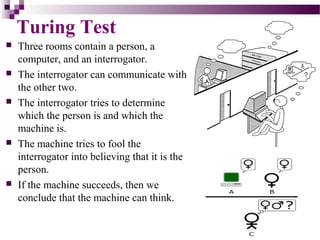
Turing Test
 Three rooms contain a person, a
computer, and an interrogator.
 The interrogator can communicate with
the other two.
 The interrogator tries to determine
which the person is and which the
machine is.
 The machine tries to fool the
interrogator into believing that it is the
person.
 If the machine succeeds, then we
conclude that the machine can think.
 Game Playing
 Automated Reasoning
 Theorem Proving
 Natural Language Processing
 Expert Systems
 Computer Vision
 Robotics
 Machine Learning
AI Application Areas
Practical AI tools used nowadays
On your phone:
Siri: Part of Apple’s iOS, watchOS, and tvOS. Intelligent
personal assistant.
Cortana: Microsoft’s intelligent personal assistant. Designed for
Windows Mobile but now on Android, and a limited version runs
on Apple iOS.
Google Now: Available within Google Search mobile app for
Android and iOS as well as the Google Chrome web browser on
other devices. Delegates requests to web services powered by
Google.
For personal and business use:
Gluru: Organize your online documents, calendars, emails and
other data and have AI present you with new insights and
actionable information.
x.ai: Let AI coordinate schedules for you. Your own personal
scheduler.
CrystalKnows: Using AI to help you know the best way to
communicate with others.
RecordedFuture: Leverages natural language processing at
massive scale in real time to collect and understand more than
700,000 web sources.
For developers:
Soar: a general cognitive architecture for developing systems that exhibit intelligent
behavior.
Jade: Java Agent Development Framework. Simplifies multi-agent system
development.
Protege: A free, open-source ontology editor and framework for building intelligent
systems.
h2o.ai: Build smarter machine learning/AI applications that are fast and scalable.
Seldon: An open, enterprise-grade machine learning platform that adds intelligence to
organizations.
OpenCV: Open-source computer vision, a library of programming functions aimed
mainly at computer vision.
Deepmind: combines the best techniques from machine learning and systems
neuroscience to build powerful general-purpose learning algorithms.
Microsoft cognitive services: lets you build apps with powerful algorithms using just
a few lines of code.
IBM Watson: It understands all forms of data, interact naturally with people, and
learn and reason, at scale.
For healthcare:
Enlitic: Deep learning for healthcare and data-driven medicine.
Metamind.io: Automatic image recognition with many use
cases, including medicine.
Zebra Medical Vision: Closing the gaps between research and
result for patients with data and AI.
Deep Genomics: Machine learning and AI transforming
precision medicine, genetic testing, diagnostics and therapies.
Atomwise: Using AI and analytics to predict medicines and
discover drugs.
Flatiron.com: AI and machine learning delivering insights on
treatments.

(Ch#1) artificial intelligence

  • 1.
    ARTIFICIAL INTELLIGENCE Concepts andTechniques Introduction
  • 2.
    Books to Refer: 1-Artificial Intelligence Illuminated By: Ben Coppin 2- Artificial Intelligence A Modern Approach By: Stuart Russell and Peter Norvig
  • 3.
    What is Intelligence? The exact definition of intelligence is complex and controversial. Psychologists have debated over an exact definition for years.  One could certainly define intelligence by the properties one exhibits, for instance the ability to: deal with new situation, solve problems, answer questions, devise plans, and so on.
  • 4.
    Intelligence or IntelligentBehavior can also be defined in terms of one’s capacity for:  Abstract thinking,  Self-awareness,  Communication,  Learning and understanding from experiences  Memory and Planning,  Creativity and problem solving.  Making sense out of ambiguous and contradictory messages  Responding effectively to and dealing with complex situations  Applying knowledge to manipulate the environment  Intelligence does not necessarily mean how fast information is processed, but it is the ability to demonstrate intelligence by communicating effectively (by any means) and by learning new concepts (by any means).
  • 5.
    Artificial Intelligence: Definition  Simulationof Intelligence in machines.  It is the science and engineering of making intelligent machines, especially intelligent computer programs.  Artificial intelligence is the study of systems that act in a way that to any observer would appear to be intelligent.
  • 6.
    Artificial Intelligence: Definition  Itis related to the similar task of using computers to understand human intelligence, but AI does not have to confine itself to methods that are biologically observable.
  • 7.
    Artificial Intelligence:  AIis a collection of hard problems which can be solved by humans and other living things, but for which we don’t have good algorithms for solving.  e. g., understanding spoken natural language, medical diagnosis, circuit design, learning, self-adaptation, reasoning, game playing, etc. • A computer program that  Acts like human (Turing test)  Thinks like human (human-like patterns of thinking steps)  Acts or thinks rationally (logically, correctly) • The art of creating machines that perform functions that require intelligence when performed by humans.
  • 8.
    Strong & WeakAI  Weak AI, an artificial intelligence system which is only intended to be applicable on a specific kind of problem (e.g. computer chess) and not intended to display human-like intelligence in general.  Siri is a good example of narrow intelligence. Siri operates within a limited pre-defined range, there is no genuine intelligence, no self-awareness, no life despite being a sophisticated example of weak AI.
  • 9.
    Strong and WeakAI  Strong AI is the intelligence of a machine that could successfully perform any intellectual task that a human being can. It is a primary goal of artificial intelligence research and an important topic for science fiction writers and futurists.  Strong AI also refers to as "full AI" or as the ability to perform "general intelligent action "  The followers of strong AI believe that by giving a computer program sufficient processing power, and by providing it with enough intelligence, one can create a computer that can literally think and is conscious in the same way that a human is conscious. - The Turing Test (Turing) - The Robot College Student Test (Goertzel) - The Coffee Test (Goertzel) - The Employment Test (Nilsson)
  • 10.
    What’s easy andwhat’s hard for AI?  It’s been easier to mechanize many of the high level cognitive tasks we usually associate with “intelligence” in people  e. g., symbolic integration, proving theorems, playing chess, some aspect of medical diagnosis, etc.  It’s been very hard to mechanize tasks that animals can do easily  catching prey  interpreting complex sensory information (visual, aural..)  modeling the internal states of other animals from their behavior  working as a team (ants, bees)
  • 11.
  • 12.
    Advantages of ArtificialIntelligence:  AI is more permanent. AI is permanent as long as the computer systems or programs remain unchanged.  AI offers ease of duplication and distribution. Transferring a body of knowledge from one person to another usually requires a lengthy process, yet fully expertise can never be transfer. However, knowledge embodied in computer systems can be copied or duplicated to another and so on.  AI can be less expensive that natural intelligence. Some times buying computer software costs less than having corresponding human power to carry out same task.  AI can be documented. Decisions made by a computer can be easily documented by tracing the activities of a system, while natural intelligence is difficult to trace out.
  • 13.
    Advantages of NaturalIntelligence:  Natural Intelligence is creative, while AI is uninspired. The ability to acquire knowledge is inherent in human mind, but with AI customized knowledge must be built into a carefully constructed system.  Natural intelligence enables people to benefit from and use sensory experience directly, while AI mostly works on symbolic inputs.  Natural intelligence is able to make reasons at all times by wide context of experience and bring it to bear on individual problems. While AI systems typically gain their power of knowledge by having a narrow focus of problem domain.  Natural Intelligence is powerful but has limitations. Humans are intellectual but have limited knowledge bases, and information processing is comparably slow in brain when done with computers.
  • 14.
    How AI Works: Think well  Act well  Think like humans  Act like humans
  • 15.
    Think well  Developformal models of knowledge representation, reasoning, learning, memory, problem solving that can be rendered in algorithms.  There is often an emphasis on systems that are provably correct, and guarantee finding an optimal solution.
  • 16.
    Act well  Fora given set of inputs, generate an appropriate output that is not necessarily correct but gets the job done.  A heuristic (heuristic rule, heuristic method) is a rule of thumb, strategy, trick, simplification, or any other kind of device which drastically limits search for solutions in large problem spaces.
  • 17.
     Heuristics donot guarantee optimal solutions; in fact, they do not guarantee any solution at all: all that can be said for a useful heuristic is that it offers solutions which are good enough most of the time. Act well
  • 18.
    Think like humans Cognitive science approach  Focus not just on behavior and I/O but also look at reasoning process.  Computational model should reflect “how” results were obtained.  Provide a new language for expressing cognitive theories and new mechanisms for evaluating them
  • 19.
     GPS (GeneralProblem Solver): Goal not just to produce humanlike behavior, but to produce a sequence of steps of the reasoning process that was similar to the steps followed by a person in solving the same task.  ELIZA: A program that simulated a psychotherapist interacting with a patient and successfully passed the Turing Test. Think like humans
  • 20.
    Act like humans Behaviorist approach.  Not interested in how you get results, just the similarity to what human results are.  Exemplified by the Turing Test (Alan Turing, 1950).
  • 21.
    Turing Test  Threerooms contain a person, a computer, and an interrogator.  The interrogator can communicate with the other two.  The interrogator tries to determine which the person is and which the machine is.  The machine tries to fool the interrogator into believing that it is the person.  If the machine succeeds, then we conclude that the machine can think.
  • 22.
     Game Playing Automated Reasoning  Theorem Proving  Natural Language Processing  Expert Systems  Computer Vision  Robotics  Machine Learning AI Application Areas
  • 23.
    Practical AI toolsused nowadays On your phone: Siri: Part of Apple’s iOS, watchOS, and tvOS. Intelligent personal assistant. Cortana: Microsoft’s intelligent personal assistant. Designed for Windows Mobile but now on Android, and a limited version runs on Apple iOS. Google Now: Available within Google Search mobile app for Android and iOS as well as the Google Chrome web browser on other devices. Delegates requests to web services powered by Google.
  • 24.
    For personal andbusiness use: Gluru: Organize your online documents, calendars, emails and other data and have AI present you with new insights and actionable information. x.ai: Let AI coordinate schedules for you. Your own personal scheduler. CrystalKnows: Using AI to help you know the best way to communicate with others. RecordedFuture: Leverages natural language processing at massive scale in real time to collect and understand more than 700,000 web sources.
  • 25.
    For developers: Soar: ageneral cognitive architecture for developing systems that exhibit intelligent behavior. Jade: Java Agent Development Framework. Simplifies multi-agent system development. Protege: A free, open-source ontology editor and framework for building intelligent systems. h2o.ai: Build smarter machine learning/AI applications that are fast and scalable. Seldon: An open, enterprise-grade machine learning platform that adds intelligence to organizations. OpenCV: Open-source computer vision, a library of programming functions aimed mainly at computer vision. Deepmind: combines the best techniques from machine learning and systems neuroscience to build powerful general-purpose learning algorithms. Microsoft cognitive services: lets you build apps with powerful algorithms using just a few lines of code. IBM Watson: It understands all forms of data, interact naturally with people, and learn and reason, at scale.
  • 26.
    For healthcare: Enlitic: Deeplearning for healthcare and data-driven medicine. Metamind.io: Automatic image recognition with many use cases, including medicine. Zebra Medical Vision: Closing the gaps between research and result for patients with data and AI. Deep Genomics: Machine learning and AI transforming precision medicine, genetic testing, diagnostics and therapies. Atomwise: Using AI and analytics to predict medicines and discover drugs. Flatiron.com: AI and machine learning delivering insights on treatments.