
Artificial Intelligence
(AI)
Hanif Ullah
Lecturer
hanifullah@live.com
Search strategies in
artificial intelligence
DIGITAL TEACHER lT
What we study today?
 search strategies in artificial intelligence
 Search Algorithm Terminologies
 Properties of Search Algorithms
 Types of search algorithms
 Uninformed Search Strategies
 informed Search Strategies
 Difference of informed and uninformed
search
2
DIGITAL TEACHER lT
search strategies in artificial
intelligence
 In Artificial Intelligence, Search techniques
are universal problem-solving methods.
 Rational agents or Problem-solving agents in
AI mostly used these search strategies or
algorithms to
 solve a specific problem
 provide the best result.
3
DIGITAL TEACHER lT
Search Algorithm Terminologies
 Search: Searching is a step by step procedure to solve a search-problem
in a given search space. A search problem can have three main factors:
 Search Space: It represents a set of possible solutions, which a system may
have.
 Start State: It is a state from where agent begins the search.
 Goal test: It is a function which observe the current state and returns
whether the goal state is achieved or not.
 Search tree: A tree representation of search problem is called Search
tree. The root of the search tree is the root node which is corresponding
to the initial state.
 Actions: It gives the description of all the available actions to the agent.
 Transition model: A description of what each action do, can be
represented as a transition model.
 Path Cost: It is a function which assigns a numeric cost to each path.
4
DIGITAL TEACHER lT
Properties of Search Algorithms
 Completeness: A search algorithm is said to be complete if it
guarantees to return a solution if at least any solution exists .
 Optimality: If a solution found for an algorithm is guaranteed to
be the best solution (lowest path cost) among all other solutions.
 Time Complexity: Time complexity is a measure of time for an
algorithm to complete its task.
 Space Complexity: It is the maximum storage space required at
any point during the search, as the complexity of the problem
5
DIGITAL TEACHER lT
Types of search algorithms
 Based on the search problems we can classify
the search algorithms into
 uninformed (Blind search) search and
 informed search (Heuristic search) algorithms.
6
DIGITAL TEACHER lT
uninformed search
 The uninformed search does not contain any domain knowledge
such as closeness, the location of the goal.
 It operates in a brute-force way as it only includes information
about how to traverse the tree and how to identify leaf and goal
nodes.
 Uninformed search applies a way in which search tree is searched
without any information about the search space like initial state
operators and test for the goal
 It examines each node of the tree until it achieves the goal node.
 E.g. Breadth-first search, Uniform cost search, Depth-first search
7
DIGITAL TEACHER lT
Informed Search (heuristic search)
 Informed search algorithms use domain knowledge.
 In an informed search, problem information is available
which can guide the search.
 it can find a solution more efficiently than an uninformed
search
 Informed search can solve much complex problem which
could not be solved in another way.
 E.g. .Greedy Search , A* Search
8
DIGITAL TEACHER lT
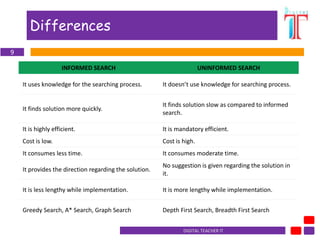
Differences
INFORMED SEARCH UNINFORMED SEARCH
It uses knowledge for the searching process. It doesn’t use knowledge for searching process.
It finds solution more quickly.
It finds solution slow as compared to informed
search.
It is highly efficient. It is mandatory efficient.
Cost is low. Cost is high.
It consumes less time. It consumes moderate time.
It provides the direction regarding the solution.
No suggestion is given regarding the solution in
it.
It is less lengthy while implementation. It is more lengthy while implementation.
Greedy Search, A* Search, Graph Search Depth First Search, Breadth First Search
9
That is all

search strategies in artificial intelligence

  • 1.
  • 2.
    DIGITAL TEACHER lT Whatwe study today?  search strategies in artificial intelligence  Search Algorithm Terminologies  Properties of Search Algorithms  Types of search algorithms  Uninformed Search Strategies  informed Search Strategies  Difference of informed and uninformed search 2
  • 3.
    DIGITAL TEACHER lT searchstrategies in artificial intelligence  In Artificial Intelligence, Search techniques are universal problem-solving methods.  Rational agents or Problem-solving agents in AI mostly used these search strategies or algorithms to  solve a specific problem  provide the best result. 3
  • 4.
    DIGITAL TEACHER lT SearchAlgorithm Terminologies  Search: Searching is a step by step procedure to solve a search-problem in a given search space. A search problem can have three main factors:  Search Space: It represents a set of possible solutions, which a system may have.  Start State: It is a state from where agent begins the search.  Goal test: It is a function which observe the current state and returns whether the goal state is achieved or not.  Search tree: A tree representation of search problem is called Search tree. The root of the search tree is the root node which is corresponding to the initial state.  Actions: It gives the description of all the available actions to the agent.  Transition model: A description of what each action do, can be represented as a transition model.  Path Cost: It is a function which assigns a numeric cost to each path. 4
  • 5.
    DIGITAL TEACHER lT Propertiesof Search Algorithms  Completeness: A search algorithm is said to be complete if it guarantees to return a solution if at least any solution exists .  Optimality: If a solution found for an algorithm is guaranteed to be the best solution (lowest path cost) among all other solutions.  Time Complexity: Time complexity is a measure of time for an algorithm to complete its task.  Space Complexity: It is the maximum storage space required at any point during the search, as the complexity of the problem 5
  • 6.
    DIGITAL TEACHER lT Typesof search algorithms  Based on the search problems we can classify the search algorithms into  uninformed (Blind search) search and  informed search (Heuristic search) algorithms. 6
  • 7.
    DIGITAL TEACHER lT uninformedsearch  The uninformed search does not contain any domain knowledge such as closeness, the location of the goal.  It operates in a brute-force way as it only includes information about how to traverse the tree and how to identify leaf and goal nodes.  Uninformed search applies a way in which search tree is searched without any information about the search space like initial state operators and test for the goal  It examines each node of the tree until it achieves the goal node.  E.g. Breadth-first search, Uniform cost search, Depth-first search 7
  • 8.
    DIGITAL TEACHER lT InformedSearch (heuristic search)  Informed search algorithms use domain knowledge.  In an informed search, problem information is available which can guide the search.  it can find a solution more efficiently than an uninformed search  Informed search can solve much complex problem which could not be solved in another way.  E.g. .Greedy Search , A* Search 8
  • 9.
    DIGITAL TEACHER lT Differences INFORMEDSEARCH UNINFORMED SEARCH It uses knowledge for the searching process. It doesn’t use knowledge for searching process. It finds solution more quickly. It finds solution slow as compared to informed search. It is highly efficient. It is mandatory efficient. Cost is low. Cost is high. It consumes less time. It consumes moderate time. It provides the direction regarding the solution. No suggestion is given regarding the solution in it. It is less lengthy while implementation. It is more lengthy while implementation. Greedy Search, A* Search, Graph Search Depth First Search, Breadth First Search 9
  • 10.