52.426 - 4th Year AI
     Game AI

           Luke Dicken
 Strathclyde AI and Games Group
Background

    • This is the 1st lecture in an 8 lecture series that
     constitutes the 2nd half of the course.
    • Target audience is a 4th year class that has had
     exposure to AI previously
       ‣ 3rd year - Agent-based systems
       ‣ 4th year (1st half) - Algorithms and Search, bin-packing
    • Although it is a Game AI module, the course itself is
     a general AI class, many non-games students.
2
The Prisoner's Dilemma


    • Imagine you and another person are arrested
    • Keep silent? Or betray the other person?
    • They have the same choice...


3
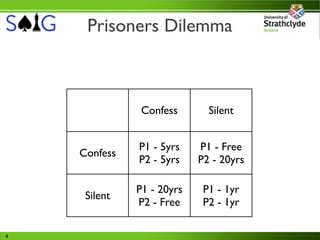
Prisoners Dilemma


               Confess       Silent


              P1 - 5yrs    P1 - Free
    Confess
              P2 - 5yrs    P2 - 20yrs

              P1 - 20yrs    P1 - 1yr
     Silent
              P2 - Free     P2 - 1yr

4
Questions


    • Does it help to know the other person?
    • Is it better to be ignorant of your opponent than incorrectly
     predict their actions?
    • Do you want to minimise total time in jail, or your time in
     jail?


5
The Odds/Evens Game


    • Player 1 picks up some number of marbles.
    • Player 2 guesses if amount is odd or even.


6
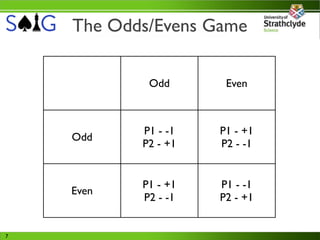
The Odds/Evens Game

            Odd       Even


           P1 - -1   P1 - +1
    Odd
           P2 - +1   P2 - -1


           P1 - +1   P1 - -1
    Even
           P2 - -1   P2 - +1


7
Questions


    • Player 1 played odd last time, what should Player 2 guess this
     time?
    • Can Player 1 vary their strategy such that Player 2 can never
     guess it?


8
Intro to Game Theory
Game Theory 101


     • What we've just seen are examples "games"
     • Anytime we are talking about competing with other people
      for a reward, we can call it a "game"
     • Game Theory is a branch of mathematics that formally
      defines how best to play these games.


10
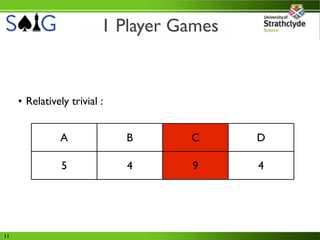
1 Player Games


     • Relatively trivial :


               A              B     C      D

                5             4     9      4


11
2 Player Games


     • Things get more complicated when there’s a second player.
     • How can you predict what that person will do?
     • Can you ensure that you will do well regardless of the other
      player?
     • This is the essence of Game Theory.


12
A Game's "Sum"


     • Games can be "zero-sum" or "non-zero sum"
     • If a game is zero-sum then the two players are directly
      competing - for one to win X, the other must lose X
     • Contrast this a game where the two players are not
      completely opposed.
        ‣ E.g. Prisoner's Dilemma
     • Zero-sum games allow us to make assumptions about how
      players will act but they are not the general case.

13
2 Player Zero-Sum Games


     • Although it's a special case, this comes up very very often in
      the real world.
        ‣ Elections, gambling, corporate competition
     • Previously shown payoff for both players - in zero-sum this
      isn’t necessary
        ‣ The more Player 1 wins, the more Player 2 loses


14
Equilibrium Points


     • A property of some games is that there is a single “solution”
     • If Player 1 changes strategy from their Equilibrium Strategy,
      they can only do worse (assuming Player 2 does not change)
     • Likewise Player 2 cannot change their strategy unilaterally
      and do any better either.
     • For both players, this is the best they can hope to achieve


15
The “Value” of a Game


     • The “Value” of a game is “the rationally expected outcome”
     • For games that have equilibrium points, the Value is the
      reward of the equilibrium strategies.
        ‣ Player 1 can’t do worse than this value.
        ‣ Player 2 can prevent Player 1 from doing better.


16
Political Example


     • Two candidates are deciding what position to take
      on an issue.
     • There are three options open to each of them
       ‣ Support X
       ‣ Support Y
       ‣ Duck the issue


17
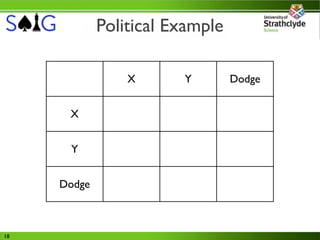
Political Example

                 X      Y        Dodge


      X


      Y


     Dodge


18
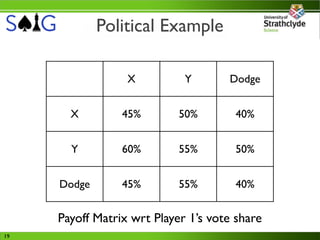
Political Example

                  X          Y       Dodge


       X         45%        50%       40%


       Y         60%        55%       50%


     Dodge       45%        55%       40%


     Payoff Matrix wrt Player 1’s vote share
19
Political Example


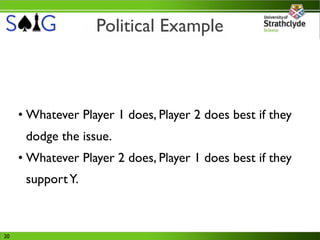
     • Whatever Player 1 does, Player 2 does best if they
      dodge the issue.
     • Whatever Player 2 does, Player 1 does best if they
      support Y.


20
Dominant Strategies

     • Sometimes, a potential strategy choice is just bad.
     • Recall the 1-player game - one strategy was ALWAYS better.
     • This can happen in 2-player games too.
     • More formally, Strategy A dominates Strategy B iff for every
      move the opponent might choose, A always gives a better
      result.
     • Dominated strategies can safely be ignored then.
        ‣ A rational opponent would never play them, so you
          needn’t consider situations where they would.
21
Domination

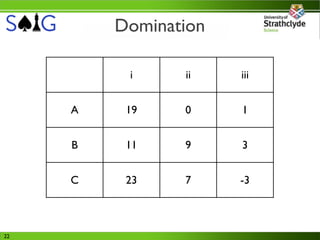
          i     ii    iii


     A    19    0     1


     B    11    9     3


     C    23    7     -3


22
Domination

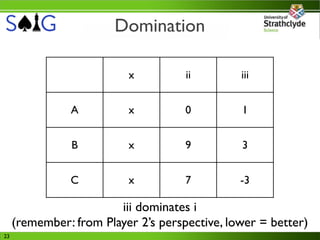
                          x          ii        iii


               A          x          0         1


                B         x          9         3


               C          x          7         -3

                        iii dominates i
     (remember: from Player 2’s perspective, lower = better)
23
Domination

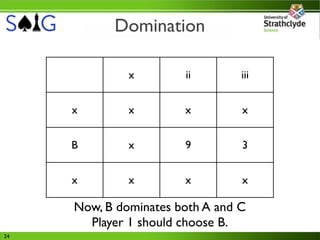
              x        ii        iii


     x        x        x         x


     B        x        9         3


     x        x        x         x

     Now, B dominates both A and C
       Player 1 should choose B.
24
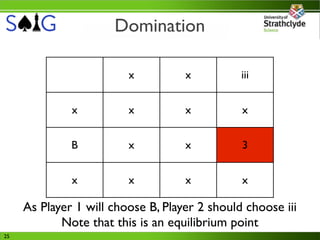
Domination

                         x          x          iii


              x          x          x          x


              B          x          x          3


              x          x          x          x

     As Player 1 will choose B, Player 2 should choose iii
            Note that this is an equilibrium point
25
Non-Zero Sum Games


     • Recall the Prisoner’s Dilemma problem.
     • In this game, the two players were not completely
      opposed
       ‣ Cooperation as well as competition
     • This means that a lot of the assumptions that we’ve
      made about what the players want to achieve don’t
      hold
26
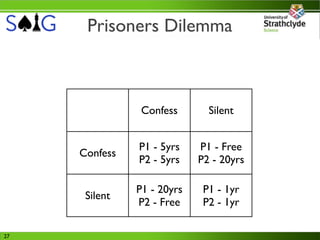
Prisoners Dilemma


                Confess       Silent


               P1 - 5yrs    P1 - Free
     Confess
               P2 - 5yrs    P2 - 20yrs

               P1 - 20yrs    P1 - 1yr
      Silent
               P2 - Free     P2 - 1yr

27
Some More Examples


     • Which would you prefer, a guaranteed £1 or an even chance
      at £3?


28
Some More Examples


     • Suppose you lose concert tickets that cost you £40 to buy.
      Would you replace them for another £40 or do something
      else that night?


29
Some More Examples


     • If 1% of people your age and health die in a given year, would
      you be prepared to pay £1,000 for £100,000 of life
      insurance?


30
Some More Examples


     • You go to the store to buy a new video game costing £40.
      You find you've lost some money, also totalling £40, but you
      still have enough left to buy the game - do you?


31
Some More Examples


     • Which would you prefer, a guaranteed £1,000,000 or an even
      chance at £3,000,000?


32
Some More Examples


     • If 0.1% of people your age and health die in a given year,
      would you be prepared to pay £10 for £10,000 of life
      insurance?


33
Something else is
  happening...
Utility Theory


     • "Utility" is an evaluation of how much use a particular result
      is.
     • It allows us to compare things "through the eyes of the
      player" rather than just mathematically.
        ‣ £1 and £3 are relatively interchangeable, and £1 is not significant.
        ‣ £1,000,000 is significant, and £3,000,000 is not three times as
            significant.


35
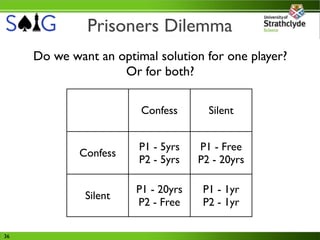
Prisoners Dilemma
     Do we want an optimal solution for one player?
                    Or for both?

                        Confess       Silent


                        P1 - 5yrs   P1 - Free
             Confess
                        P2 - 5yrs   P2 - 20yrs

                       P1 - 20yrs    P1 - 1yr
              Silent
                       P2 - Free     P2 - 1yr

36
Irrational Actions


     • Utility functions for humans is beyond the scope of
      this session.
     • Behavioural Economics
       ‣ “Predictably Irrational” Dan Ariely
     • Be aware that players may not be rational.
       ‣ And we can exploit this to beat them even more :D


37
Summary


     • Fundamentals of Game Theory
     • Rational play for 2 Player Zero Sum games
     • Difference of a Non-Zero Sum game
     • Introduction to irrational play


38
Next Lecture


     • Fun With Probability!
     • How Spam Filters Work (Sort of)
     • Mixed Strategies in Games
     • ...And More


39

Lecture 1 - Game Theory

  • 1.
    52.426 - 4thYear AI Game AI Luke Dicken Strathclyde AI and Games Group
  • 2.
    Background • This is the 1st lecture in an 8 lecture series that constitutes the 2nd half of the course. • Target audience is a 4th year class that has had exposure to AI previously ‣ 3rd year - Agent-based systems ‣ 4th year (1st half) - Algorithms and Search, bin-packing • Although it is a Game AI module, the course itself is a general AI class, many non-games students. 2
  • 3.
    The Prisoner's Dilemma • Imagine you and another person are arrested • Keep silent? Or betray the other person? • They have the same choice... 3
  • 4.
    Prisoners Dilemma Confess Silent P1 - 5yrs P1 - Free Confess P2 - 5yrs P2 - 20yrs P1 - 20yrs P1 - 1yr Silent P2 - Free P2 - 1yr 4
  • 5.
    Questions • Does it help to know the other person? • Is it better to be ignorant of your opponent than incorrectly predict their actions? • Do you want to minimise total time in jail, or your time in jail? 5
  • 6.
    The Odds/Evens Game • Player 1 picks up some number of marbles. • Player 2 guesses if amount is odd or even. 6
  • 7.
    The Odds/Evens Game Odd Even P1 - -1 P1 - +1 Odd P2 - +1 P2 - -1 P1 - +1 P1 - -1 Even P2 - -1 P2 - +1 7
  • 8.
    Questions • Player 1 played odd last time, what should Player 2 guess this time? • Can Player 1 vary their strategy such that Player 2 can never guess it? 8
  • 9.
  • 10.
    Game Theory 101 • What we've just seen are examples "games" • Anytime we are talking about competing with other people for a reward, we can call it a "game" • Game Theory is a branch of mathematics that formally defines how best to play these games. 10
  • 11.
    1 Player Games • Relatively trivial : A B C D 5 4 9 4 11
  • 12.
    2 Player Games • Things get more complicated when there’s a second player. • How can you predict what that person will do? • Can you ensure that you will do well regardless of the other player? • This is the essence of Game Theory. 12
  • 13.
    A Game's "Sum" • Games can be "zero-sum" or "non-zero sum" • If a game is zero-sum then the two players are directly competing - for one to win X, the other must lose X • Contrast this a game where the two players are not completely opposed. ‣ E.g. Prisoner's Dilemma • Zero-sum games allow us to make assumptions about how players will act but they are not the general case. 13
  • 14.
    2 Player Zero-SumGames • Although it's a special case, this comes up very very often in the real world. ‣ Elections, gambling, corporate competition • Previously shown payoff for both players - in zero-sum this isn’t necessary ‣ The more Player 1 wins, the more Player 2 loses 14
  • 15.
    Equilibrium Points • A property of some games is that there is a single “solution” • If Player 1 changes strategy from their Equilibrium Strategy, they can only do worse (assuming Player 2 does not change) • Likewise Player 2 cannot change their strategy unilaterally and do any better either. • For both players, this is the best they can hope to achieve 15
  • 16.
    The “Value” ofa Game • The “Value” of a game is “the rationally expected outcome” • For games that have equilibrium points, the Value is the reward of the equilibrium strategies. ‣ Player 1 can’t do worse than this value. ‣ Player 2 can prevent Player 1 from doing better. 16
  • 17.
    Political Example • Two candidates are deciding what position to take on an issue. • There are three options open to each of them ‣ Support X ‣ Support Y ‣ Duck the issue 17
  • 18.
    Political Example X Y Dodge X Y Dodge 18
  • 19.
    Political Example X Y Dodge X 45% 50% 40% Y 60% 55% 50% Dodge 45% 55% 40% Payoff Matrix wrt Player 1’s vote share 19
  • 20.
    Political Example • Whatever Player 1 does, Player 2 does best if they dodge the issue. • Whatever Player 2 does, Player 1 does best if they support Y. 20
  • 21.
    Dominant Strategies • Sometimes, a potential strategy choice is just bad. • Recall the 1-player game - one strategy was ALWAYS better. • This can happen in 2-player games too. • More formally, Strategy A dominates Strategy B iff for every move the opponent might choose, A always gives a better result. • Dominated strategies can safely be ignored then. ‣ A rational opponent would never play them, so you needn’t consider situations where they would. 21
  • 22.
    Domination i ii iii A 19 0 1 B 11 9 3 C 23 7 -3 22
  • 23.
    Domination x ii iii A x 0 1 B x 9 3 C x 7 -3 iii dominates i (remember: from Player 2’s perspective, lower = better) 23
  • 24.
    Domination x ii iii x x x x B x 9 3 x x x x Now, B dominates both A and C Player 1 should choose B. 24
  • 25.
    Domination x x iii x x x x B x x 3 x x x x As Player 1 will choose B, Player 2 should choose iii Note that this is an equilibrium point 25
  • 26.
    Non-Zero Sum Games • Recall the Prisoner’s Dilemma problem. • In this game, the two players were not completely opposed ‣ Cooperation as well as competition • This means that a lot of the assumptions that we’ve made about what the players want to achieve don’t hold 26
  • 27.
    Prisoners Dilemma Confess Silent P1 - 5yrs P1 - Free Confess P2 - 5yrs P2 - 20yrs P1 - 20yrs P1 - 1yr Silent P2 - Free P2 - 1yr 27
  • 28.
    Some More Examples • Which would you prefer, a guaranteed £1 or an even chance at £3? 28
  • 29.
    Some More Examples • Suppose you lose concert tickets that cost you £40 to buy. Would you replace them for another £40 or do something else that night? 29
  • 30.
    Some More Examples • If 1% of people your age and health die in a given year, would you be prepared to pay £1,000 for £100,000 of life insurance? 30
  • 31.
    Some More Examples • You go to the store to buy a new video game costing £40. You find you've lost some money, also totalling £40, but you still have enough left to buy the game - do you? 31
  • 32.
    Some More Examples • Which would you prefer, a guaranteed £1,000,000 or an even chance at £3,000,000? 32
  • 33.
    Some More Examples • If 0.1% of people your age and health die in a given year, would you be prepared to pay £10 for £10,000 of life insurance? 33
  • 34.
    Something else is happening...
  • 35.
    Utility Theory • "Utility" is an evaluation of how much use a particular result is. • It allows us to compare things "through the eyes of the player" rather than just mathematically. ‣ £1 and £3 are relatively interchangeable, and £1 is not significant. ‣ £1,000,000 is significant, and £3,000,000 is not three times as significant. 35
  • 36.
    Prisoners Dilemma Do we want an optimal solution for one player? Or for both? Confess Silent P1 - 5yrs P1 - Free Confess P2 - 5yrs P2 - 20yrs P1 - 20yrs P1 - 1yr Silent P2 - Free P2 - 1yr 36
  • 37.
    Irrational Actions • Utility functions for humans is beyond the scope of this session. • Behavioural Economics ‣ “Predictably Irrational” Dan Ariely • Be aware that players may not be rational. ‣ And we can exploit this to beat them even more :D 37
  • 38.
    Summary • Fundamentals of Game Theory • Rational play for 2 Player Zero Sum games • Difference of a Non-Zero Sum game • Introduction to irrational play 38
  • 39.
    Next Lecture • Fun With Probability! • How Spam Filters Work (Sort of) • Mixed Strategies in Games • ...And More 39