PREPARED BY: DHAVAL
 Introduction
 Thermodynamics System
 State and Property
 Thermodynamic Equilibrium
 Quasi-static Process
 What is THERMODYNAMICS?
 Thermodynamics is the science which deals with energy transfers and its effect on
the condition of a system.
 This study of science has led to the various laws of thermodynamics.
1. The zeroth law – concept of equality of temperature, thermal equilibrium.
2. The first law – law of conservation of energy, internal energy.
3. The second law – direction of flow of heat, concept of entropy.
4. The third law – absolute zero of entropy.
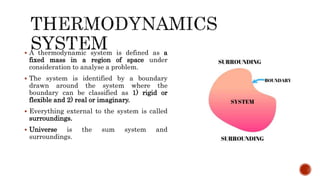
 A thermodynamic system is defined as a
fixed mass in a region of space under
consideration to analyse a problem.
 The system is identified by a boundary
drawn around the system where the
boundary can be classified as 1) rigid or
flexible and 2) real or imaginary.
 Everything external to the system is called
surroundings.
 Universe is the sum system and
surroundings.
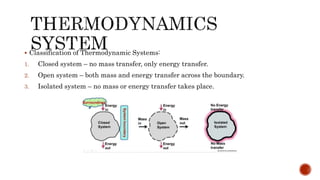
 Classification of Thermodynamic Systems:
1. Closed system – no mass transfer, only energy transfer.
2. Open system – both mass and energy transfer across the boundary.
3. Isolated system – no mass or energy transfer takes place.
 State – the identification of the system by observable or measurable
characteristics is called the state of the system.
 Property – thermodynamic co-ordinates representing a system are called
properties of the system.
 Properties are classified as,
1. Intensive properties – independent of mass e.g. pressure, temperature,
viscosity, etc.
2. Extensive properties – depends on mass e.g. length, volume, all forms of energy,
entropy.
 A system is said to be in thermodynamic equilibrium which is incapable of any
change of its macroscopic properties and is in complete balance with its
surroundings.
 A system will be in thermodynamic equilibrium if it satisfies the condition of
mechanical, thermal and chemical equilibrium.
 Mechanical equilibrium – no unbalanced forces
 Thermal equilibrium – uniform temperature
 Chemical equilibrium – absence of any chemical reaction
 Quasi means almost slow or infinitely slow.
 A quasi-static process is defined as a process in which the properties of the system
depart infinitesimally or extremely small from the thermodynamic equilibrium
path.
 A quasi-static process is also called a reversible process.
 It is a succession of equilibrium states.
Introduction to Engineering Thermodynamics.pptx

Introduction to Engineering Thermodynamics.pptx

  • 1.
  • 2.
     Introduction  ThermodynamicsSystem  State and Property  Thermodynamic Equilibrium  Quasi-static Process
  • 3.
     What isTHERMODYNAMICS?  Thermodynamics is the science which deals with energy transfers and its effect on the condition of a system.  This study of science has led to the various laws of thermodynamics. 1. The zeroth law – concept of equality of temperature, thermal equilibrium. 2. The first law – law of conservation of energy, internal energy. 3. The second law – direction of flow of heat, concept of entropy. 4. The third law – absolute zero of entropy.
  • 4.
     A thermodynamicsystem is defined as a fixed mass in a region of space under consideration to analyse a problem.  The system is identified by a boundary drawn around the system where the boundary can be classified as 1) rigid or flexible and 2) real or imaginary.  Everything external to the system is called surroundings.  Universe is the sum system and surroundings.
  • 5.
     Classification ofThermodynamic Systems: 1. Closed system – no mass transfer, only energy transfer. 2. Open system – both mass and energy transfer across the boundary. 3. Isolated system – no mass or energy transfer takes place.
  • 6.
     State –the identification of the system by observable or measurable characteristics is called the state of the system.  Property – thermodynamic co-ordinates representing a system are called properties of the system.  Properties are classified as, 1. Intensive properties – independent of mass e.g. pressure, temperature, viscosity, etc. 2. Extensive properties – depends on mass e.g. length, volume, all forms of energy, entropy.
  • 7.
     A systemis said to be in thermodynamic equilibrium which is incapable of any change of its macroscopic properties and is in complete balance with its surroundings.  A system will be in thermodynamic equilibrium if it satisfies the condition of mechanical, thermal and chemical equilibrium.  Mechanical equilibrium – no unbalanced forces  Thermal equilibrium – uniform temperature  Chemical equilibrium – absence of any chemical reaction
  • 8.
     Quasi meansalmost slow or infinitely slow.  A quasi-static process is defined as a process in which the properties of the system depart infinitesimally or extremely small from the thermodynamic equilibrium path.  A quasi-static process is also called a reversible process.  It is a succession of equilibrium states.