Canning
Syeda Rubeena Fatima
• Canning is a method of preservation of food in which the food is
processed and hermetically (air tight) sealed in containers (of metal,
glass, thermo-stable plastic, or a multi- layered flexible pouch)
through agency of heat.
• Canning provides a shelf life typically ranging from one to five years,
although under specific circumstances it can be much longer.
• Heating is the principle factor to destroy the microorganisms and the
permanent sealing is to prevent re-infection.
• A freeze-dried canned product, such as canned dried lentils, could
last as long as 30 years in an edible state.
• The high percentage of water in most fresh foods makes them very
perishable. They spoil or lose their quality for several reasons.
• Microorganisms live and multiply quickly on the surfaces of fresh
food and on the inside of bruised, insect-damaged, and diseased
food. Oxygen and enzymes are present throughout fresh food
tissues. Proper canning practices minimize the effects of these
microorganisms.
• However, the main objective of canning is to preserve the food by
the application of heat so that it can be safely eaten at a later time.
Safety of the consumer is the primary concern when food is canned.
History
• During the first years of the Napoleonic wars, the French government
offered a hefty cash award of 12,000 francs to any inventor who could
devise a cheap and effective method of preserving large amounts of food.
• The larger armies of that period required increased and regular supplies
of quality food. In 1809, Nicolas Appert , a French confectioner and
brewer, observed that food cooked inside a jar did not spoil unless the
seals leaked, and developed a method of sealing food in glass jars which
was referred to as APPERTIZATION and now known as CANNING.
Types of canned food
• Fruits and vegetables are canned in the season when the raw material is
available in plenty. The canned products are sold in off-season and give
better returns to the grower.
• (a) Low acid foods: Meat, fish, poultry, dairy fall into a pH range of 5.0 to
6.8. This large group is commonly referred to as the low acid group.
• (b) Acid foods: With pH values between 4.5 and 3.7. Fruits such as pear,
oranges, apricots and tomatoes fall in this class.
• (c) High acid foods: Such as pickled products and fermented foods. The pH
values range from 3.7 down to 2.3, also Jams and Jellies are in this
classification.
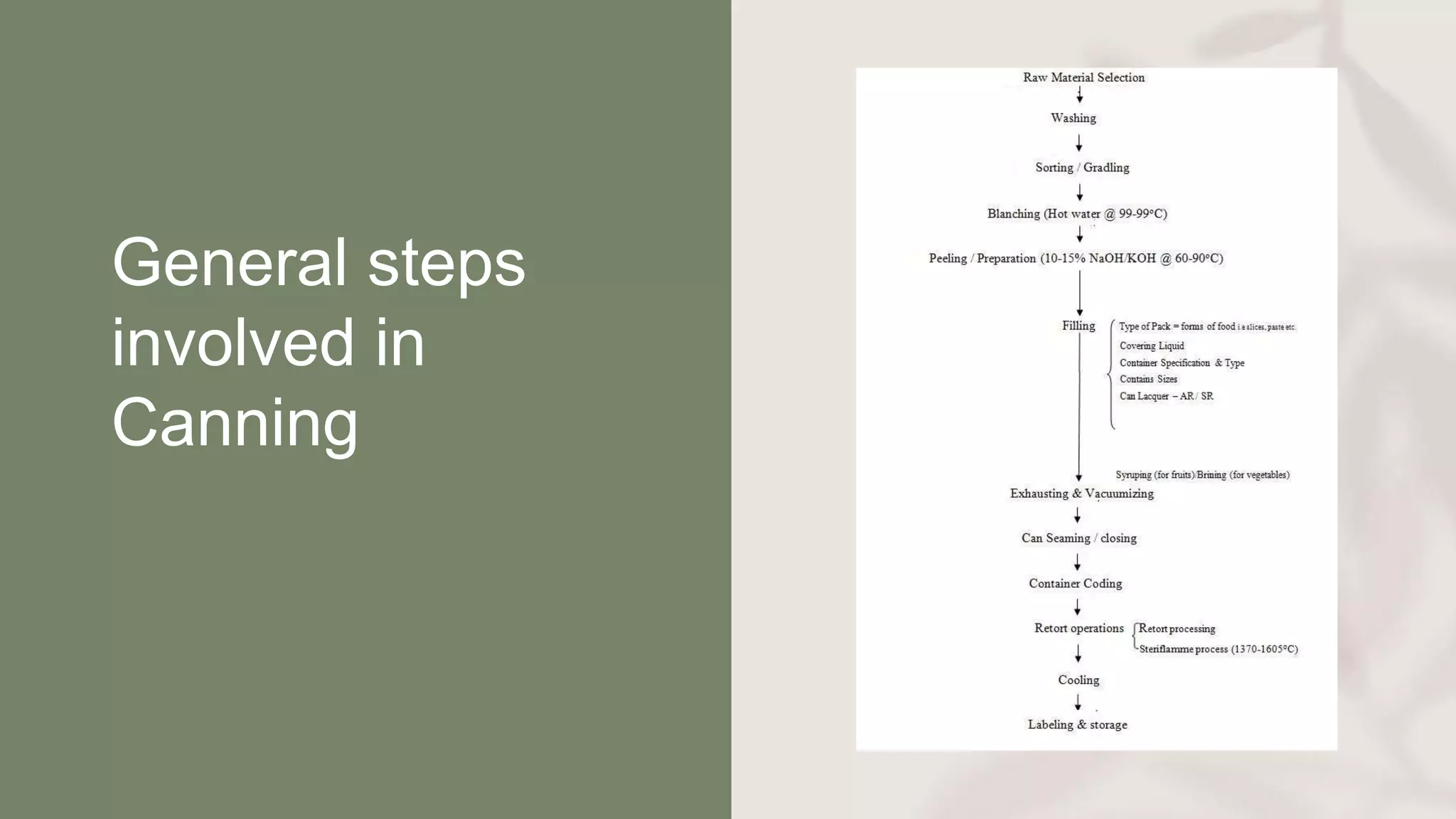
General steps
involved in
Canning
Process of canning
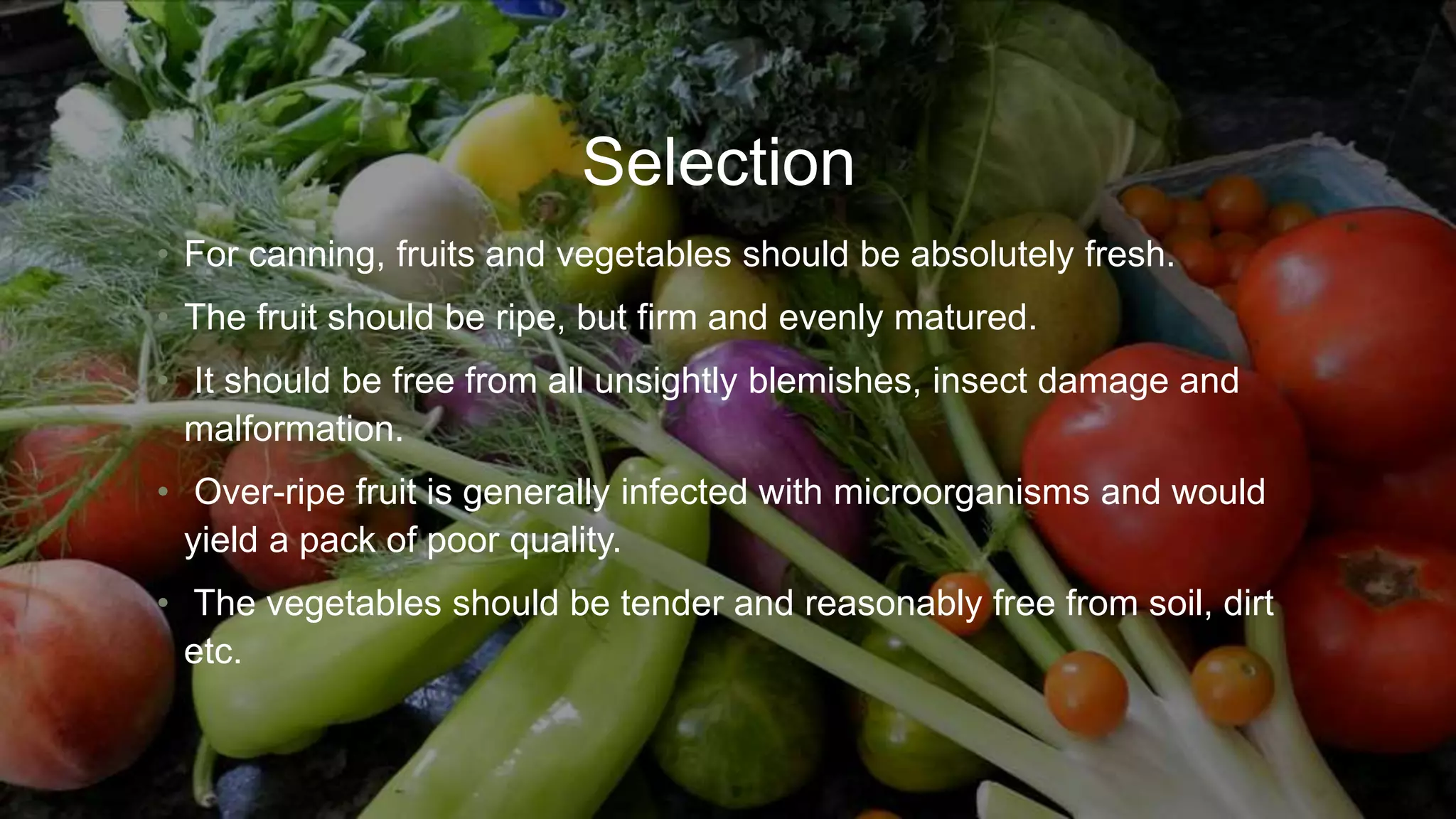
Selection
• For canning, fruits and vegetables should be absolutely fresh.
• The fruit should be ripe, but firm and evenly matured.
• It should be free from all unsightly blemishes, insect damage and
malformation.
• Over-ripe fruit is generally infected with microorganisms and would
yield a pack of poor quality.
• The vegetables should be tender and reasonably free from soil, dirt
etc.
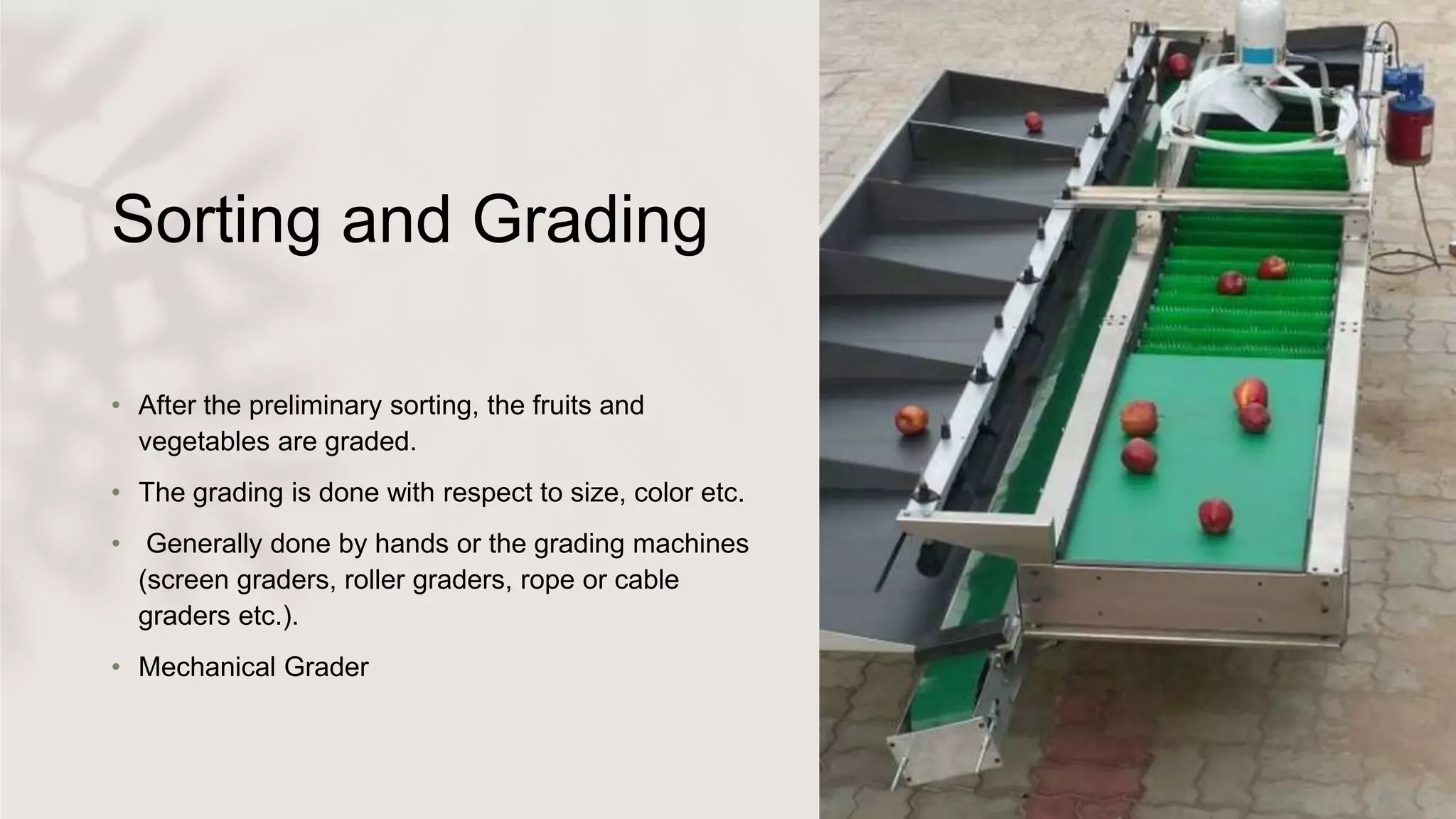
Sorting and Grading
• After the preliminary sorting, the fruits and
vegetables are graded.
• The grading is done with respect to size, color etc.
• Generally done by hands or the grading machines
(screen graders, roller graders, rope or cable
graders etc.).
• Mechanical Grader
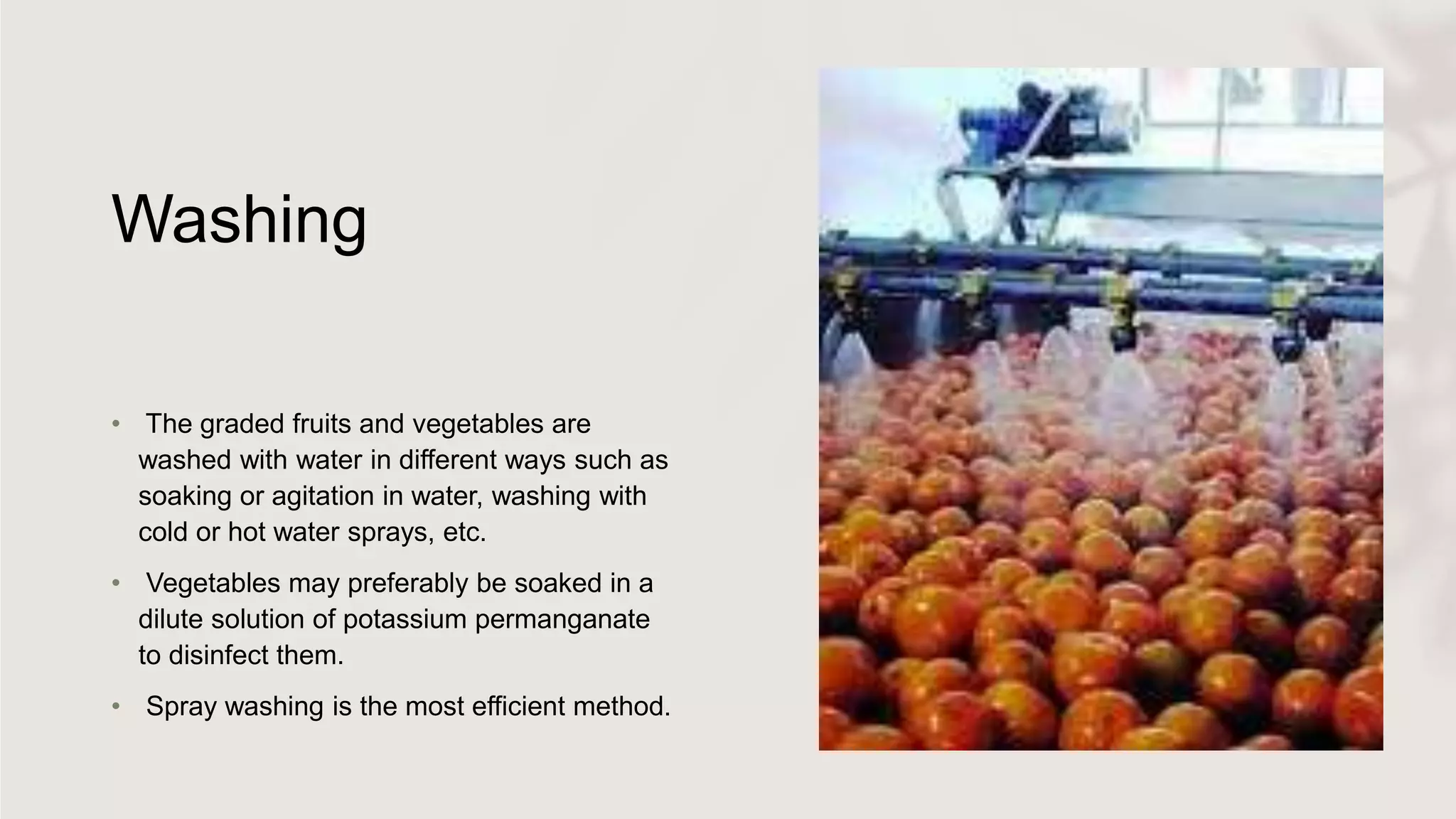
Washing
• The graded fruits and vegetables are
washed with water in different ways such as
soaking or agitation in water, washing with
cold or hot water sprays, etc.
• Vegetables may preferably be soaked in a
dilute solution of potassium permanganate
to disinfect them.
• Spray washing is the most efficient method.
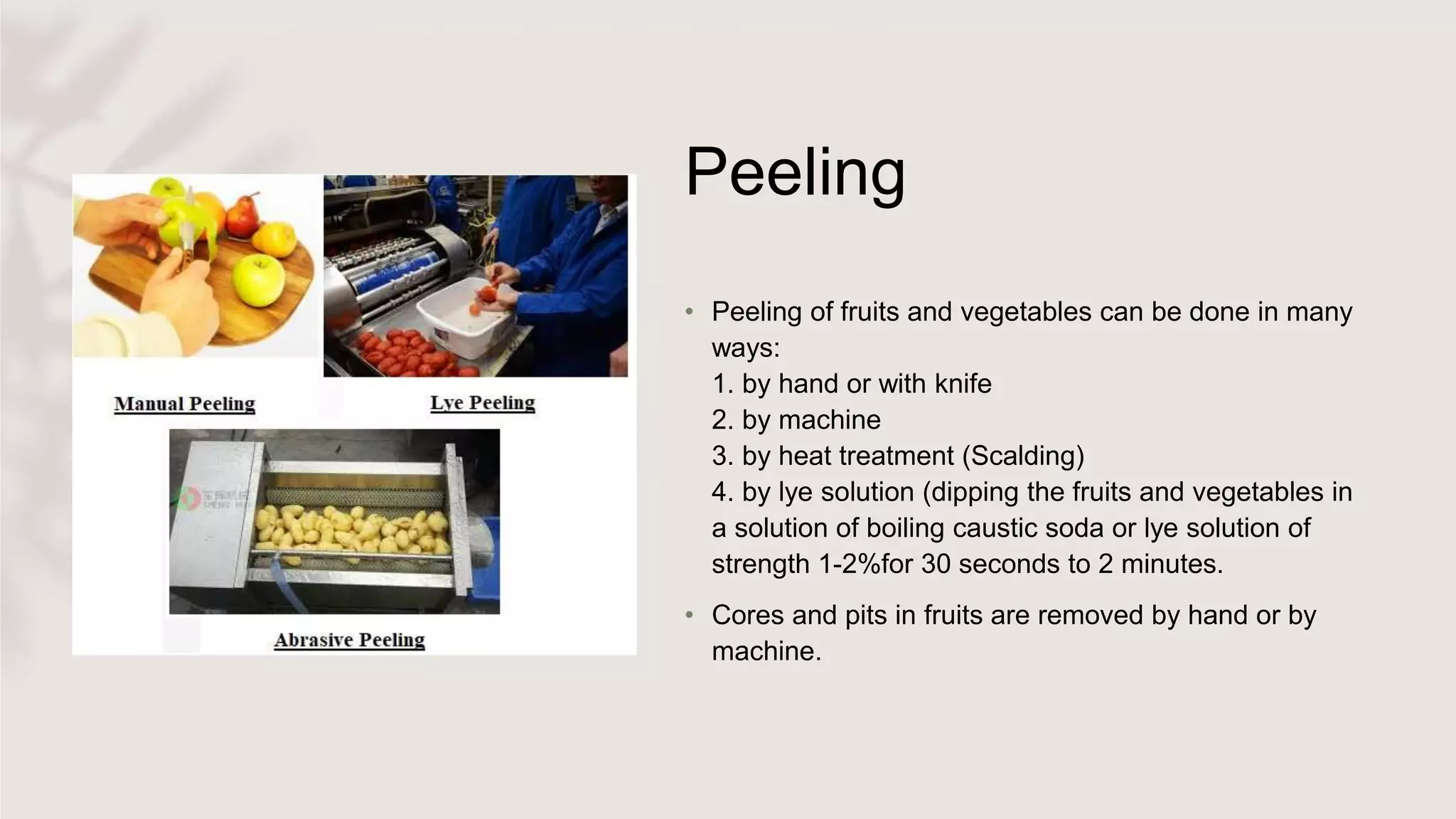
Peeling
• Peeling of fruits and vegetables can be done in many
ways:
1. by hand or with knife
2. by machine
3. by heat treatment (Scalding)
4. by lye solution (dipping the fruits and vegetables in
a solution of boiling caustic soda or lye solution of
strength 1-2%for 30 seconds to 2 minutes.
• Cores and pits in fruits are removed by hand or by
machine.
Blanching
• Blanching is done with the objective of:
• Loosening the skin of the fruit or
vegetable.
• Eliminate the no. of microorganisms.
• Inactivating the enzymes, thus
preventing the possibility of
discoloration.
• Improving the flavor by reducing the
astringency in some foods.
Can filling
• The cans are washed and subjected to a steam
jet remove any adhering dust or foreign matter.
• Before filling of the contents (fruits and
vegetables) a small amount of syrup (for fruits) or
brine (for vegetables) is poured in the can so as
to provide a medium to the contents.
• Can filling can be done by machine or hand filling
can be also employed.
• In India, filling by hand using rubber gloves is the
common practice.
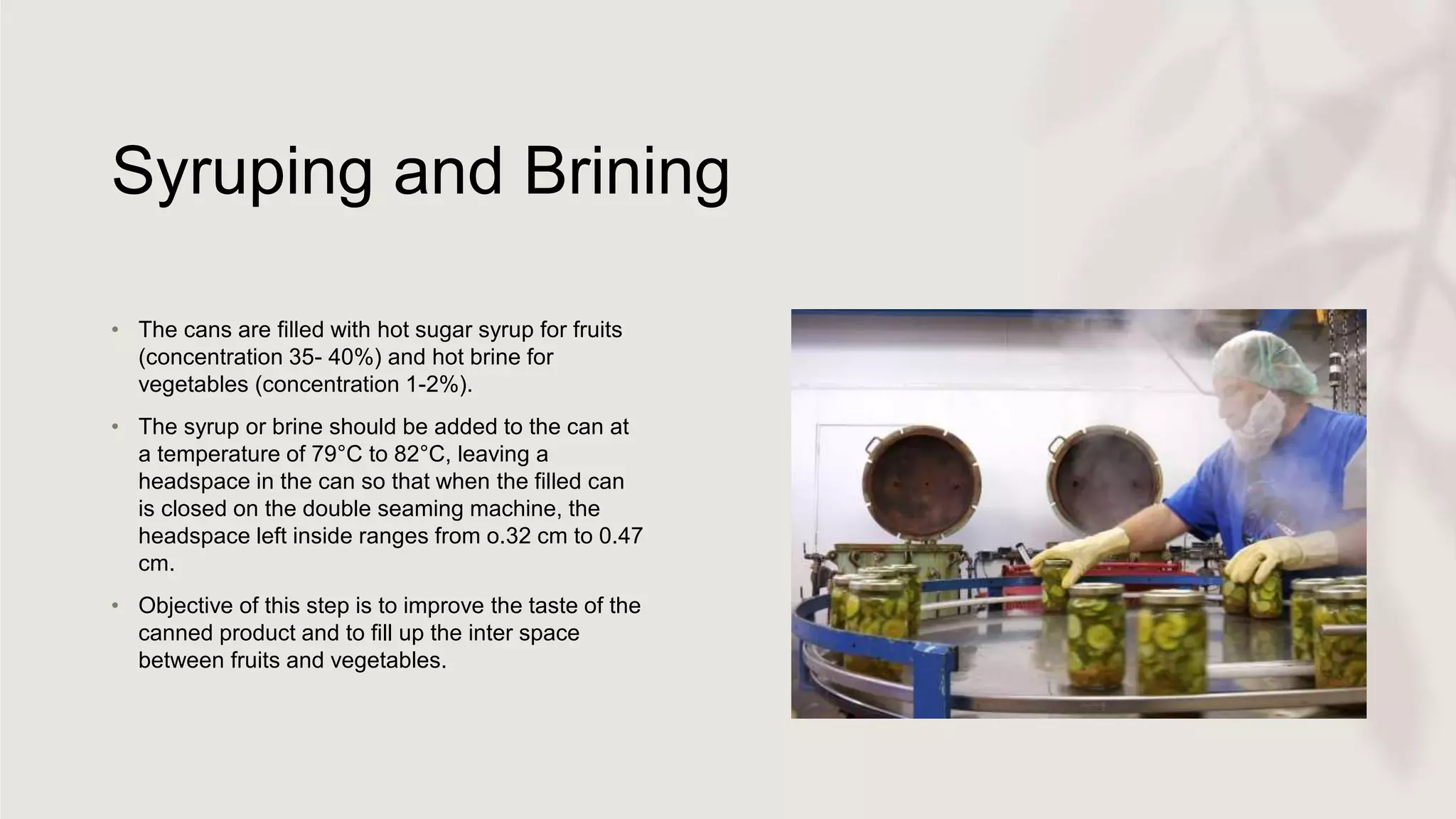
Syruping and Brining
• The cans are filled with hot sugar syrup for fruits
(concentration 35- 40%) and hot brine for
vegetables (concentration 1-2%).
• The syrup or brine should be added to the can at
a temperature of 79°C to 82°C, leaving a
headspace in the can so that when the filled can
is closed on the double seaming machine, the
headspace left inside ranges from o.32 cm to 0.47
cm.
• Objective of this step is to improve the taste of the
canned product and to fill up the inter space
between fruits and vegetables.
Lidding and Clinching
• Cans after being filled, are covered
loosely with lid and passed through the
exhaust box.
• Lidding is now replaced by CLINCHING
in which the lid is partially seamed to the
can by a single first roller action of double
seamer.
Exhausting
• By exhausting, risk of corrosion of tin plate and pin holing during the
storage and discoloration of the product is reduced as the oxidation
process is prevented.
• Cans are passed through a trough of water at 82-87°C or a moving
conveyor belt through a steam box. The time varies from 5-25 min.
on the nature of the substance.
• During exhausting, expelling of all the gases takes place which
prevents spoilage of the canned product by ceasing the chemical
reactions and also the bulging of can.
Sealing
• After exhausting, the cans are sealed by
special closing machines known as
double seamers.
• There is hand operated as well as semi-
automatic and fully automatic seamers.
Sterilization
• Processing consists of heat treatment which is
sufficient to eliminate the growth of spoilage
causing microorganisms.
• All fruits can be satisfactorily processed at 100°C
and vegetables at 116-120°C.
• The total time required to sterilize canned food is
largely depends on:
a) Size of can
b) Processing temperature
c) Rate of heat penetration at the center of the
can.
d) pH of the food
e) The type and number of organisms present
Washing and cooling
• After the cans are closed, they pass through a
detergent spray washer to remove grease and
other material. The washing should consist of
hot water (66°C) then by suitable pre-rinse,
detergent spray wash. Followed by a fresh
warm water rinse (66°C).
• Immediately after processing, the cans are
COOLING in water to a temperature of 36°C
to 42°C. to avoid thermophilic spoilage or can
rust. If the cans are cooled much below 36°C,
they may not dry thoroughly and rusting well
result. If the cans are cased at temperatures
much over 42°C, thermophilic spoilage may
occur.
Labelling and Storage
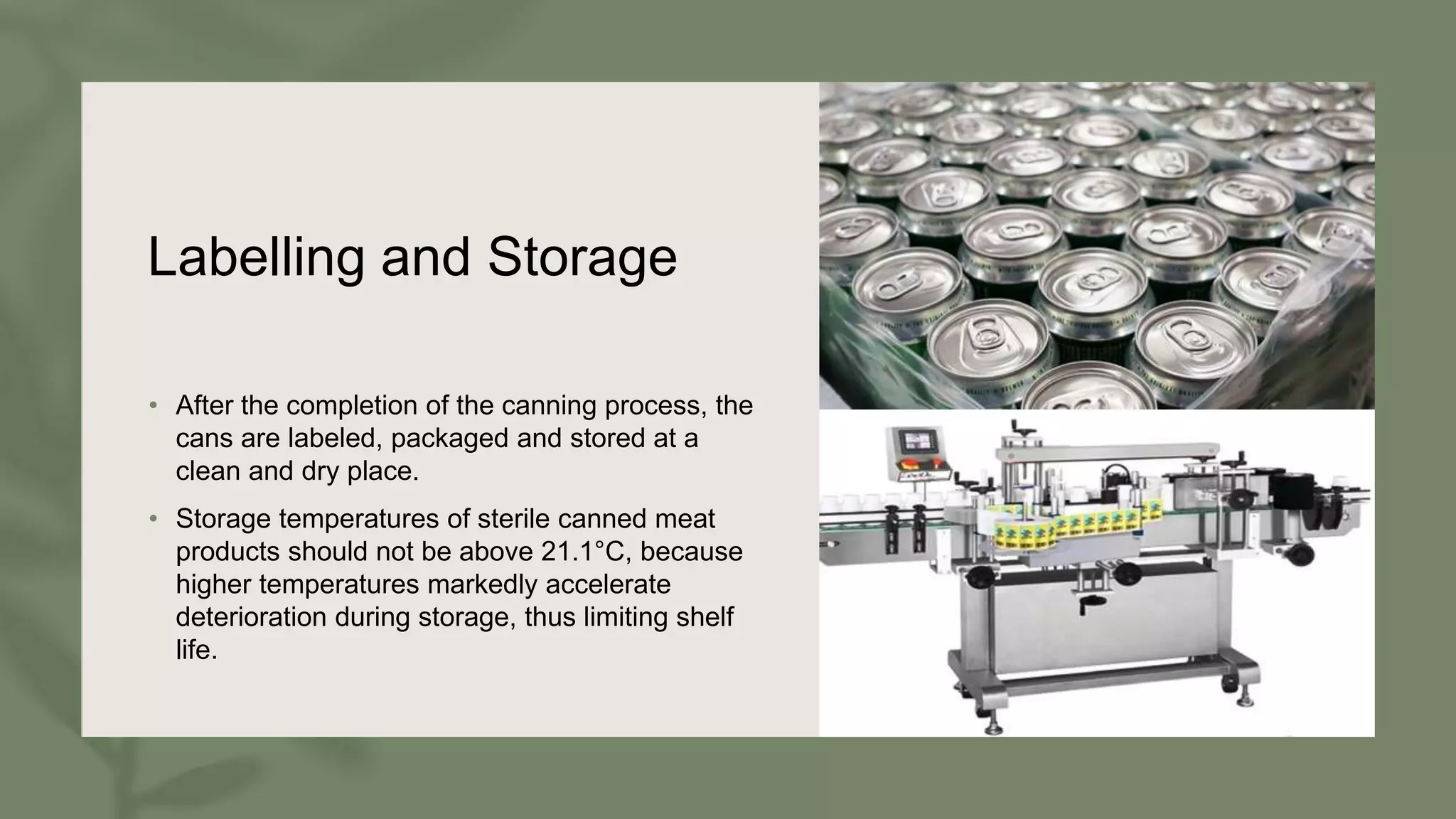
• After the completion of the canning process, the
cans are labeled, packaged and stored at a
clean and dry place.
• Storage temperatures of sterile canned meat
products should not be above 21.1°C, because
higher temperatures markedly accelerate
deterioration during storage, thus limiting shelf
life.
Canning material
• The container plays a vital role in food canning, it must be:
1-) Capable of being hermetically sealed to prevent entry of microorganisms.
2-) Impermeable to liquids and gases, including water vapor.
3-) Maintain the state of biological stability (i.e., commercial sterility) that was induced by the
thermal process alone or in combination with other chemical and physical processes.
4-) Physically protect the contents against damage during transportation, storage and
distribution.
• For canning the various materials used are tin, steel, plastic and glass containers with metal
closures. Although the wide variety of containers for canned foods, the metal ones are preferred
because:
1-) It has a high conductivity of heat.
2-) It cannot easily be broken.
3-) Being opaque, so any possible bad effects of light on food stuffs are avoided.
4-) Be able to withstand the stresses imposed during thermal processing and cooling.
5-) Be able to withstand the subsequent handling, which includes transportation, storage and
distribution.
Defects in canning
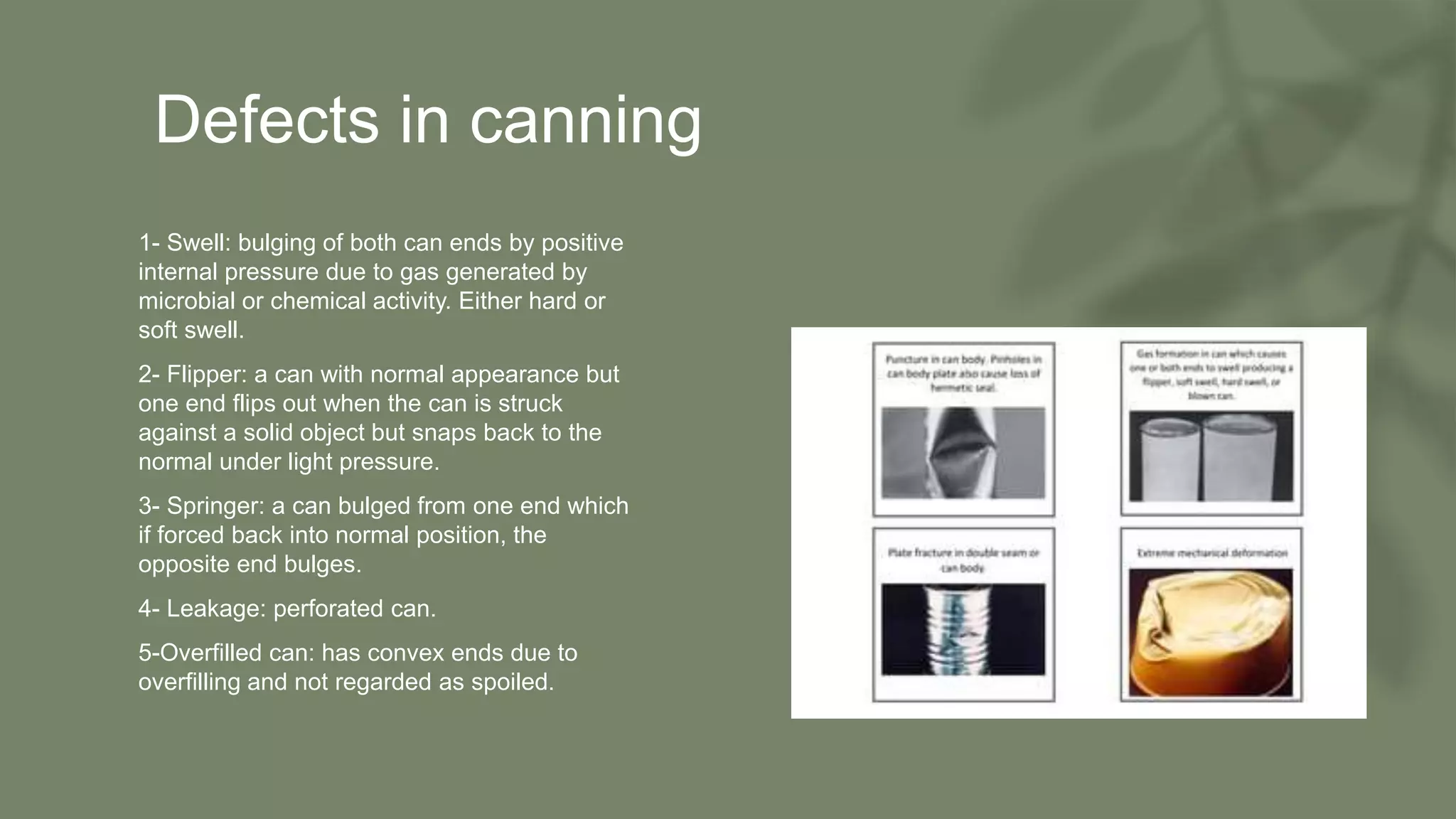
• 1- Swell: bulging of both can ends by positive
internal pressure due to gas generated by
microbial or chemical activity. Either hard or
soft swell.
• 2- Flipper: a can with normal appearance but
one end flips out when the can is struck
against a solid object but snaps back to the
normal under light pressure.
• 3- Springer: a can bulged from one end which
if forced back into normal position, the
opposite end bulges.
• 4- Leakage: perforated can.
• 5-Overfilled can: has convex ends due to
overfilling and not regarded as spoiled.

Canning.pptx

  • 1.
  • 2.
    • Canning isa method of preservation of food in which the food is processed and hermetically (air tight) sealed in containers (of metal, glass, thermo-stable plastic, or a multi- layered flexible pouch) through agency of heat. • Canning provides a shelf life typically ranging from one to five years, although under specific circumstances it can be much longer. • Heating is the principle factor to destroy the microorganisms and the permanent sealing is to prevent re-infection. • A freeze-dried canned product, such as canned dried lentils, could last as long as 30 years in an edible state.
  • 3.
    • The highpercentage of water in most fresh foods makes them very perishable. They spoil or lose their quality for several reasons. • Microorganisms live and multiply quickly on the surfaces of fresh food and on the inside of bruised, insect-damaged, and diseased food. Oxygen and enzymes are present throughout fresh food tissues. Proper canning practices minimize the effects of these microorganisms. • However, the main objective of canning is to preserve the food by the application of heat so that it can be safely eaten at a later time. Safety of the consumer is the primary concern when food is canned.
  • 4.
    History • During thefirst years of the Napoleonic wars, the French government offered a hefty cash award of 12,000 francs to any inventor who could devise a cheap and effective method of preserving large amounts of food. • The larger armies of that period required increased and regular supplies of quality food. In 1809, Nicolas Appert , a French confectioner and brewer, observed that food cooked inside a jar did not spoil unless the seals leaked, and developed a method of sealing food in glass jars which was referred to as APPERTIZATION and now known as CANNING.
  • 5.
    Types of cannedfood • Fruits and vegetables are canned in the season when the raw material is available in plenty. The canned products are sold in off-season and give better returns to the grower. • (a) Low acid foods: Meat, fish, poultry, dairy fall into a pH range of 5.0 to 6.8. This large group is commonly referred to as the low acid group. • (b) Acid foods: With pH values between 4.5 and 3.7. Fruits such as pear, oranges, apricots and tomatoes fall in this class. • (c) High acid foods: Such as pickled products and fermented foods. The pH values range from 3.7 down to 2.3, also Jams and Jellies are in this classification.
  • 6.
  • 7.
  • 8.
    Selection • For canning,fruits and vegetables should be absolutely fresh. • The fruit should be ripe, but firm and evenly matured. • It should be free from all unsightly blemishes, insect damage and malformation. • Over-ripe fruit is generally infected with microorganisms and would yield a pack of poor quality. • The vegetables should be tender and reasonably free from soil, dirt etc.
  • 9.
    Sorting and Grading •After the preliminary sorting, the fruits and vegetables are graded. • The grading is done with respect to size, color etc. • Generally done by hands or the grading machines (screen graders, roller graders, rope or cable graders etc.). • Mechanical Grader
  • 10.
    Washing • The gradedfruits and vegetables are washed with water in different ways such as soaking or agitation in water, washing with cold or hot water sprays, etc. • Vegetables may preferably be soaked in a dilute solution of potassium permanganate to disinfect them. • Spray washing is the most efficient method.
  • 11.
    Peeling • Peeling offruits and vegetables can be done in many ways: 1. by hand or with knife 2. by machine 3. by heat treatment (Scalding) 4. by lye solution (dipping the fruits and vegetables in a solution of boiling caustic soda or lye solution of strength 1-2%for 30 seconds to 2 minutes. • Cores and pits in fruits are removed by hand or by machine.
  • 12.
    Blanching • Blanching isdone with the objective of: • Loosening the skin of the fruit or vegetable. • Eliminate the no. of microorganisms. • Inactivating the enzymes, thus preventing the possibility of discoloration. • Improving the flavor by reducing the astringency in some foods.
  • 13.
    Can filling • Thecans are washed and subjected to a steam jet remove any adhering dust or foreign matter. • Before filling of the contents (fruits and vegetables) a small amount of syrup (for fruits) or brine (for vegetables) is poured in the can so as to provide a medium to the contents. • Can filling can be done by machine or hand filling can be also employed. • In India, filling by hand using rubber gloves is the common practice.
  • 14.
    Syruping and Brining •The cans are filled with hot sugar syrup for fruits (concentration 35- 40%) and hot brine for vegetables (concentration 1-2%). • The syrup or brine should be added to the can at a temperature of 79°C to 82°C, leaving a headspace in the can so that when the filled can is closed on the double seaming machine, the headspace left inside ranges from o.32 cm to 0.47 cm. • Objective of this step is to improve the taste of the canned product and to fill up the inter space between fruits and vegetables.
  • 15.
    Lidding and Clinching •Cans after being filled, are covered loosely with lid and passed through the exhaust box. • Lidding is now replaced by CLINCHING in which the lid is partially seamed to the can by a single first roller action of double seamer.
  • 16.
    Exhausting • By exhausting,risk of corrosion of tin plate and pin holing during the storage and discoloration of the product is reduced as the oxidation process is prevented. • Cans are passed through a trough of water at 82-87°C or a moving conveyor belt through a steam box. The time varies from 5-25 min. on the nature of the substance. • During exhausting, expelling of all the gases takes place which prevents spoilage of the canned product by ceasing the chemical reactions and also the bulging of can.
  • 17.
    Sealing • After exhausting,the cans are sealed by special closing machines known as double seamers. • There is hand operated as well as semi- automatic and fully automatic seamers.
  • 18.
    Sterilization • Processing consistsof heat treatment which is sufficient to eliminate the growth of spoilage causing microorganisms. • All fruits can be satisfactorily processed at 100°C and vegetables at 116-120°C. • The total time required to sterilize canned food is largely depends on: a) Size of can b) Processing temperature c) Rate of heat penetration at the center of the can. d) pH of the food e) The type and number of organisms present
  • 19.
    Washing and cooling •After the cans are closed, they pass through a detergent spray washer to remove grease and other material. The washing should consist of hot water (66°C) then by suitable pre-rinse, detergent spray wash. Followed by a fresh warm water rinse (66°C). • Immediately after processing, the cans are COOLING in water to a temperature of 36°C to 42°C. to avoid thermophilic spoilage or can rust. If the cans are cooled much below 36°C, they may not dry thoroughly and rusting well result. If the cans are cased at temperatures much over 42°C, thermophilic spoilage may occur.
  • 20.
    Labelling and Storage •After the completion of the canning process, the cans are labeled, packaged and stored at a clean and dry place. • Storage temperatures of sterile canned meat products should not be above 21.1°C, because higher temperatures markedly accelerate deterioration during storage, thus limiting shelf life.
  • 21.
    Canning material • Thecontainer plays a vital role in food canning, it must be: 1-) Capable of being hermetically sealed to prevent entry of microorganisms. 2-) Impermeable to liquids and gases, including water vapor. 3-) Maintain the state of biological stability (i.e., commercial sterility) that was induced by the thermal process alone or in combination with other chemical and physical processes. 4-) Physically protect the contents against damage during transportation, storage and distribution. • For canning the various materials used are tin, steel, plastic and glass containers with metal closures. Although the wide variety of containers for canned foods, the metal ones are preferred because: 1-) It has a high conductivity of heat. 2-) It cannot easily be broken. 3-) Being opaque, so any possible bad effects of light on food stuffs are avoided. 4-) Be able to withstand the stresses imposed during thermal processing and cooling. 5-) Be able to withstand the subsequent handling, which includes transportation, storage and distribution.
  • 22.
    Defects in canning •1- Swell: bulging of both can ends by positive internal pressure due to gas generated by microbial or chemical activity. Either hard or soft swell. • 2- Flipper: a can with normal appearance but one end flips out when the can is struck against a solid object but snaps back to the normal under light pressure. • 3- Springer: a can bulged from one end which if forced back into normal position, the opposite end bulges. • 4- Leakage: perforated can. • 5-Overfilled can: has convex ends due to overfilling and not regarded as spoiled.