Fishing gear (traps, hooks
and lines, spears etc.
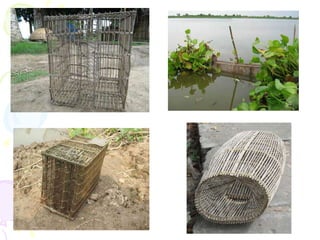
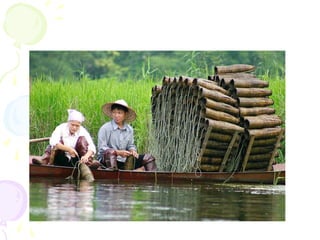
Traps are fishing devices into which fish or
shellfish are enticed by bait or shelter spaces
or enclosures where they are guided to
enter, because of an obstacle placed in their
normal migration path and from which their
escape is made difficult by constriction,
retarding valves or labyrinths.
Trap fishing is a passive fishing technique of
ancient origin. There is extraordinary variety
in their design, fabrication and operation.
Fish Traps
Traps of Bangladesh
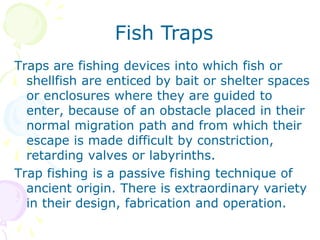
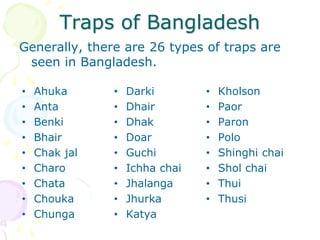
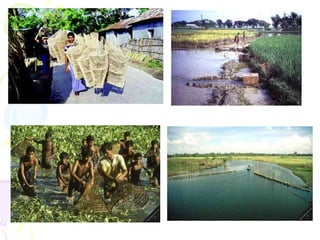
Generally, there are 26 types of traps are
seen in Bangladesh.
• Ahuka
• Anta
• Benki
• Bhair
• Chak jal
• Charo
• Chata
• Chouka
• Chunga
• Darki
• Dhair
• Dhak
• Doar
• Guchi
• Ichha chai
• Jhalanga
• Jhurka
• Katya
• Kholson
• Paor
• Paron
• Polo
• Shinghi chai
• Shol chai
• Thui
• Thusi
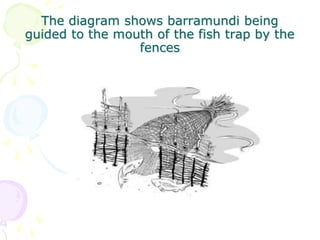
The diagram shows barramundi being
guided to the mouth of the fish trap by the
fences
Advantages of trap fishing
• High species and size selectivity
• High potential for survival of discarded non-
target species
• Low energy requirement in operation
• Low environmental impacts during operation
• Excellent condition of the catch which are usually
alive when caught
• High market value of the catch
• Traps can be made from locally available
materials
Disadvantages of trap fishing
• Traps are usually bulky and occupy
considerable space on board and are
relatively difficult to operate and haul
during rough weather
• High loss rate during operation
• Ghost fishing by lost traps leading to
unwanted fishing mortality
Line fishing
Fishing by means of hand or long lines with
baited hooks is known as line fishing. A
fishing line is a cord used or made for
angling. Important parameters of a fishing
line are its length, material and weight.
Principles of line fishing:
Fish are attracted by a natural/artificial bait
(lure) placed on a hook fixed to the end of
a line on which they may get
caught/hooked. When fish swallow the bait
including the hook then after dragging the
hook it is attached with the jaw of the fish.
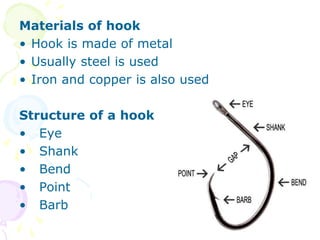
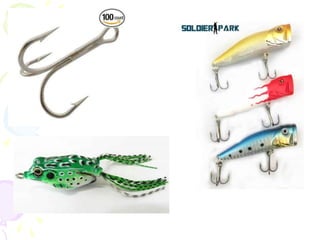
Materials of hook
• Hook is made of metal
• Usually steel is used
• Iron and copper is also used
Structure of a hook
• Eye
• Shank
• Bend
• Point
• Barb
Types of line fishing
1. Hand line
2. Short line
3. Long line
1. Hand line
Usually hand line is used for catching small
amount of fish.
 Structure (hook and fishing rod)
 Mode of operation
 Where placed
2. Short line (20-30 m))
 Structure (strong cord, snood with hooks,
float)
 Mode of operation
 Where placed
3. Long line (50-100 m)
 Structure (strong cord, snood with hooks,
float)
 Mode of operation
 Where placed
Classification of line fishing on the
basis of mode of placing
1. Floating line
2. Hand line
3. Drift line
4. Trawl line
5. Set line
1. Floating line
• Used for catching surface water fish
• Float is used for placing line
• Boat or bamboo pole may be used
• Nylon cord is used
Catchable species
Wallago attu, Bagarius bagarius,
Silonia silondia, Pangasius
pangasius, Channa straitus, Mystus
aor, Channa marulius, etc.
2. Hand line
This line is usually operated by hand.
a) Hand line without wheel
When fish get stuck with the hook it is pulled on by
hand. Mainly used in rural areas.
Catchable species: Puntius spp, Heteropneustis
fossilis, Clarius batrachus, Channa straitus, Mystus
tengra, Anabus testudineus, etc.
b) Hand line with wheel
This line is operated by wheel. When fish get stuck
with the hook, the wheel is operated to coil the
cord. The length of the cord may be 50-60 m.
Catchable species: Labeo rohita, Catla catla,
Cirrhinus mrigala, Labeo calbasu, etc.
3. Drift line
This line is used to catch fish from the bottom layer.
The length of main line may be hundreds meter.
The distance between the side line is 0.6 to 1 m. It
is used both in shallow and deep water and
operated by motor boat.
4. Trawl line
Hooks are placed in different depth with the help of
trawler. Float, anchor, marked flag, etc. used for
placing trawl line.
5. Set line
a) Surface water set line b) mid water set line c)
bottom water set line
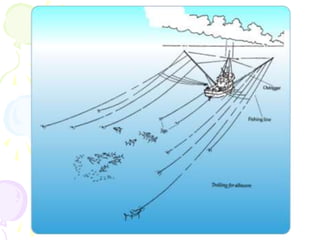
Trolling
• Trolling is a method of fishing where one or more
fishing lines baited with lures or bait fish are drawn
through water.
• This may be behind a moving boat or by slowly
winding the line in when fishing from a static
position or even sweeping the line from side to side.
• Trolling is used to catch pelagic fish such as salmon,
mackerel and king fish
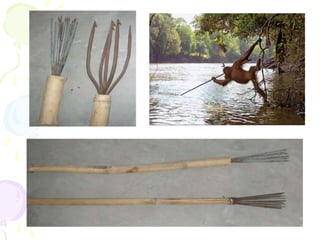
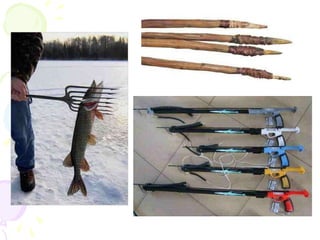
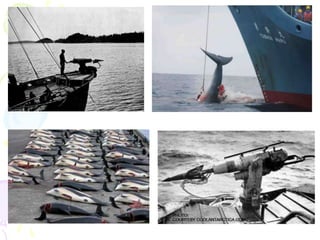
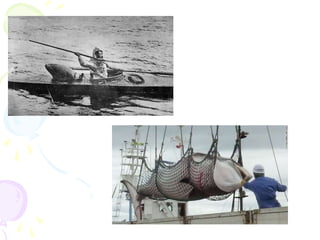
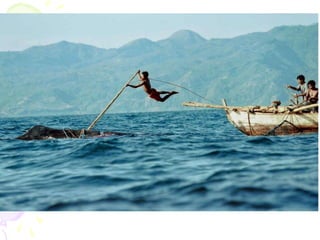
Spears
A spear tip is generally fitted on a bamboo
shaft of 1.50 to 2.0 m and operated by
throwing on the target from a boat or
standing on the bank.
8 types of spears are seen in Bangladesh
1. Aro
2. Chal
3. Ek-katya
4. Juti
5. Pecha konch
6. Tenta
7. Sat-pahla
8. Thur kunch
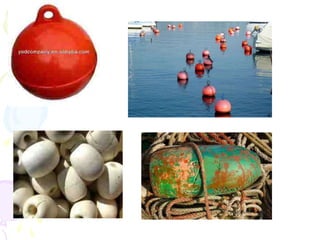
Float and Buoy
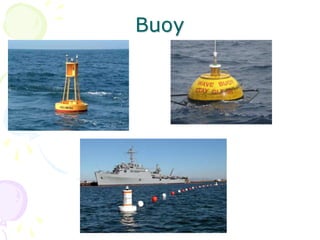
• Floats are used to keep a fishing net in a proper
shape in water, whereas, buoys are attached to
the fishing gear to show its location.
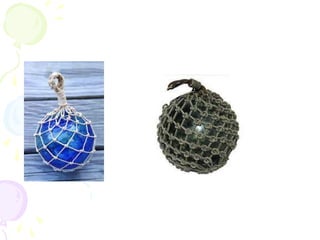
• Wood, cork, bamboo, glass ball, iron ball, rubber
ball have been used as material of float since old
age
• Now floats are made of synthetic resin; principal
material for floats and buoys are polyvinyl chloride
• Floats are cylindrical, globular or oval
• floats are mainly porous type and buoys are hollow
type or balloon type.
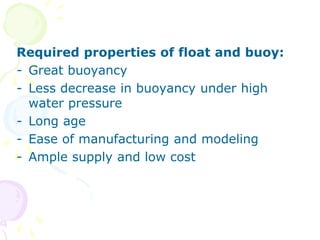
Required properties of float and buoy:
- Great buoyancy
- Less decrease in buoyancy under high
water pressure
- Long age
- Ease of manufacturing and modeling
- Ample supply and low cost
Buoy
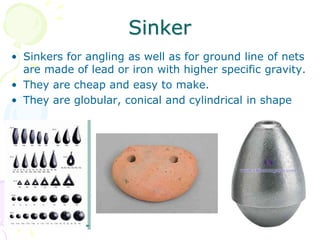
Sinker
• Sinkers for angling as well as for ground line of nets
are made of lead or iron with higher specific gravity.
• They are cheap and easy to make.
• They are globular, conical and cylindrical in shape
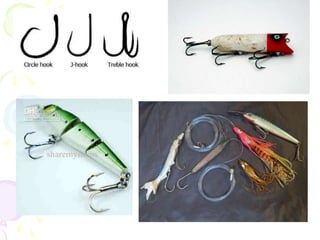
Fishing traps and hooks