AASR Authenticated Anonymous Secure 
Routing for MANETs in Adversarial 
Environments 
Guider 
Ms M. Nisha M.E; 
Assistant Professor 
Presented By 
SaravananAnnamalai 
(722013405016) 
II M.E Computer Science&Engineering 
9/8/2014 1
Introduction 
• A Mobile Ad hoc Network (MANET) is a continuously self-configuring, 
infrastructure-less network of mobile devices 
connected without wires. 
• Each device in a MANET is free to move independently in any 
direction, and will therefore change its links to other devices 
frequently. 
• Each must forward traffic unrelated to its own use, and 
therefore be a router. 
• The primary challenge in building a MANET is equipping 
each device to continuously maintain the information required 
to properly route traffic and security. 
9/8/2014 2
Objective 
• A routing protocol to provide anonymity and location privacy. 
• To defend the potential active attacks without unveiling the 
node identities using group signature. 
• To prevent intermediate nodes from inferring a real destination 
using onion routing. 
• Improve throughput in the presence of adversary attacks. 
• To reduce the packet loss. 
9/8/2014 3
On-demand Ad hoc Routing 
• Reactive protocols 
– Lower overhead since routes are determined on demand 
– Significant delay in route determination 
– Employ flooding (global search) 
– Control traffic may be difficult 
– Example: DSR, AODV etc 
9/8/2014 4
Trapdoor 
• A trapdoor is a common concept that defines a one-way 
function between two sets. 
• A global trapdoor is an information collection of mechanism in 
which intermediate nodes may add information elements, such 
as node IDs, into the trapdoor. 
• Only certain nodes, such as the source and destination nodes 
can unlock and retrieve the elements using pre-established 
secret keys. 
• The usage of trapdoor requires an anonymous end-to-end key 
agreement between the source and destination. 
9/8/2014 5
Group Signature 
• It provides authentication without disturbing the anonymity. 
• Every member in a group may have a pair of group public and 
private keys issued by the group trust authority (i.e., group 
manager). 
• The member can generate its own signature by its own private 
key, and such signature can be verified by other members in 
the group without revealing the signer’s identity. 
• Only the group trust authority can trace the signer’s identity 
and revoke the group keys. 
9/8/2014 6
Issues 
• The existing protocols are vulnerable to the attacks of fake 
routing packets or denial-of-service (dos) broadcasting. 
• Route anonymity for secure communication. 
• Location privacy for secure node movement. 
• Low throughput in the presence of adversaries. 
• Heavy packet loss 
9/8/2014 7
Literature Survey 
1) M. G. Reed, P. F. Syverson, and D. M. Goldschlag, 
“Anonymous Connections and Onion Routing,” IEEE Journal 
on Selcted Area in Comm., vol. 16, no. 4, pp. 482–494, May 
1998. 
2) D. Boneh, X. Boyen, and H. Shacham, “Short group 
signatures,” in Proc. Int. Cryptology Conf. (CRYPTO’04), 
Aug. 2004. 
3) J. Kong and X. Hong, “ANODR: ANonymous On Demand 
Routing with Untraceable Routes for Mobile Ad hoc 
networks,” in Proc. ACM MobiHoc’03, Jun. 2003, pp. 291– 
302. 
9/8/2014 8
Anonymous Connections and Onion Routing 
M. G. Reed, P. F. Syverson, and D. M. Goldschlag, “Anonymous 
Connections and Onion Routing,” IEEE Journal on Selcted Area in 
Comm., vol. 16, no. 4, pp. 482–494, May 1998. 
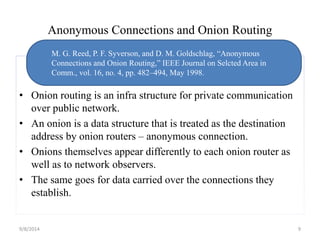
• Onion routing is an infra structure for private communication 
over public network. 
• An onion is a data structure that is treated as the destination 
address by onion routers – anonymous connection. 
• Onions themselves appear differently to each onion router as 
well as to network observers. 
• The same goes for data carried over the connections they 
establish. 
9/8/2014 9
Basic Configuration 
• Data stream never appears in the clear on the public network, 
this data may carry identifying information, but 
communication is still private. 
• The onion router at the originating protected site knows both 
the source and destination of a connection. 
• The use of anonymous connections between two sensitive sites 
that both control onion routers effectively hides their 
communication from outsiders. 
9/8/2014 10
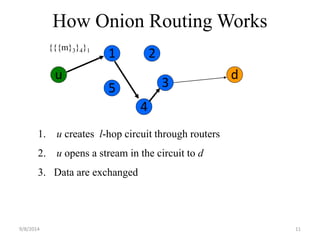
How Onion Routing Works 
{{{m}3}4}1 1 2 
u d 
3 
4 
5 
1. u creates l-hop circuit through routers 
2. u opens a stream in the circuit to d 
3. Data are exchanged 
9/8/2014 11
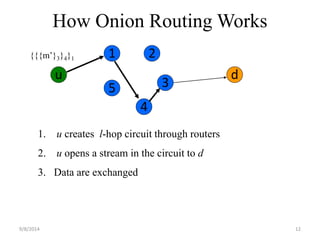
How Onion Routing Works 
{{{m’}3}4}1 1 2 
u d 
3 
4 
5 
1. u creates l-hop circuit through routers 
2. u opens a stream in the circuit to d 
3. Data are exchanged 
9/8/2014 12
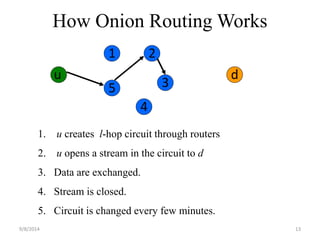
How Onion Routing Works 
u 
1 2 
3 
4 
5 
1. u creates l-hop circuit through routers 
2. u opens a stream in the circuit to d 
3. Data are exchanged. 
4. Stream is closed. 
5. Circuit is changed every few minutes. 
d 
9/8/2014 13
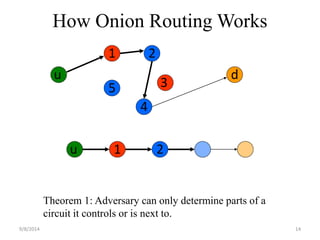
How Onion Routing Works 
u 
1 2 
3 
4 
5 
d 
u 1 2 
Theorem 1: Adversary can only determine parts of a 
circuit it controls or is next to. 
9/8/2014 14
Short Group Signatures 
D. Boneh, X. Boyen, and H. Shacham, “Short group signatures,” in Proc. 
Int. Cryptology Conf. (CRYPTO’04), Aug. 2004. 
• Group signatures provide anonymity for signers. 
• Signatures in our scheme are approximately the size of a 
standard RSA signature with the same security. 
• Security of our group signature is based on the Strong Diffie- 
Hellman assumption and a new assumption in bilinear groups 
called the Decision Linear assumption. 
• Proof of security of our system is given by the random oracle 
model 
9/8/2014 15
Strong Diffie-hellman Assumption 
• Let G1,G2 be cyclic groups of prime order p where possibly 
G1 = G2. 
• Let g1 be a generator of G1 and g2 a generator of G2. 
• Let say that the (q, t, )-SDH assumption holds in (G1,G2) if no 
t-time algorithm has advantage at least in solving the q-SDH 
problem in (G1,G2). 
• To gain confidence in the assumption prove that it holds in 
generic groups in the sense of Shoup. 
• The q-SDH assumption has similar properties to the Strong- 
RSA assumption. 
• Use these properties to construct our short group signature 
• scheme. 
9/8/2014 16
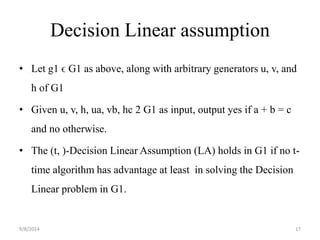
Decision Linear assumption 
• Let g1 ϵ G1 as above, along with arbitrary generators u, v, and 
h of G1 
• Given u, v, h, ua, vb, hc 2 G1 as input, output yes if a + b = c 
and no otherwise. 
• The (t, )-Decision Linear Assumption (LA) holds in G1 if no t-time 
algorithm has advantage at least in solving the Decision 
Linear problem in G1. 
9/8/2014 17
Group Signature Security 
Properties 
• Correctness, which ensures that honestly-generated signatures 
verify and trace correctly. 
• Full-anonymity, which ensures that signatures do not reveal 
their signer’s identity. 
• Full-traceability, which ensures that all signatures, even those 
created by the collusion of multiple users and the group 
manager, trace to a member of the forging coalition. 
9/8/2014 18
ANODR: ANonymous On Demand Routing with Untraceable 
Routes for Mobile Ad hoc networks 
J. Kong and X. Hong, “ANODR: ANonymous On Demand Routing with 
Untraceable Routes for Mobile Ad hoc networks,” in Proc. ACM 
MobiHoc’03, Jun. 2003, pp. 291–302. 
• The design of ANODR is based on - broadcast with trapdoor 
information 
• Un-traceability: ANODR dissociates ad hoc routing from the 
design of network member’s identity/pseudonym. 
• Intrusion tolerance: ANODR ensures there is no single point of 
compromise in ad hoc routing. 
• Un-linkability: Anonymity in terms of un-linkability is defined 
as un-linkability of an IOI and a pseudonym. 
9/8/2014 19
Routing Attacks in MANET 
• Location privacy attack 
– Correlate a mobile node with its locations (at the 
granularity of adversary’s adjustable radio receiving range) 
– Counting/analyzing mobile nodes in a cell 
• Route tracing attack 
– Visualizing ad hoc routes 
• Motion inference attack 
– Visualizing motion patterns of mobile nodes 
– Deducing motion pattern of a set of nodes 
• Other traffic analysis 
– Analyzing packet flow metrics (as in Internet traffic 
analysis) 
9/8/2014 20
Adversary in Mobile Ad Hoc 
Networks 
• External adversary: wireless link intruder 
– Eavesdropper 
– Traffic analyst (not necessary to break cryptosystem) 
– Unbounded interception: adversary can sniff anywhere 
anytime 
• Internal adversary: mobile node intruder 
– Capture, compromise, tamper 
– Passive internal adversary is hard to detect due to lack of 
exhibition of malicious behavior 
– Bounded: otherwise secure networking is impossible 
9/8/2014 21
Framework of Anonymous Route 
Discovery (between source and destination) 
• Similar to existing on demand routing schemes 
– Route-REQuest 
RREQ,seqnum,to_be_opened_by_destanonymous_trapdoor 
– Route-REPly 
RREP, presented_by_destanonymous_proof 
• A global trapdoor can only be opened by dest 
– Not required to know where dest is 
– destination can present an anonymous proof of door opening 
• Need more design to address per-hop 
9/8/2014 22
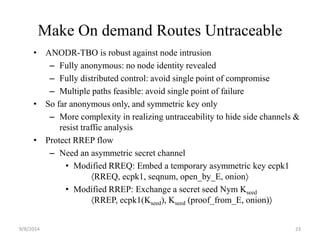
Make On demand Routes Untraceable 
• ANODR-TBO is robust against node intrusion 
– Fully anonymous: no node identity revealed 
– Fully distributed control: avoid single point of compromise 
– Multiple paths feasible: avoid single point of failure 
• So far anonymous only, and symmetric key only 
– More complexity in realizing untraceability to hide side channels & 
resist traffic analysis 
• Protect RREP flow 
– Need an asymmetric secret channel 
• Modified RREQ: Embed a temporary asymmetric key ecpk1 
RREQ, ecpk1, seqnum, open_by_E, onion 
• Modified RREP: Exchange a secret seed Nym Kseed 
RREP, ecpk1(Kseed), Kseed (proof_from_E, onion) 
9/8/2014 23
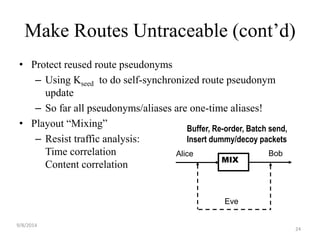
Make Routes Untraceable (cont’d) 
• Protect reused route pseudonyms 
– Using Kseed to do self-synchronized route pseudonym 
update 
– So far all pseudonyms/aliases are one-time aliases! 
• Playout “Mixing” 
– Resist traffic analysis: 
Time correlation 
Content correlation 
Buffer, Re-order, Batch send, 
Insert dummy/decoy packets 
Alice Bob 
MIX 
Eve 
9/8/2014 
24
Existing System 
• The existing protocols are vulnerable to the attacks of fake 
routing packets or denial-of-service (DoS) broadcasting, even 
the node identities are protected by pseudonyms. 
• A number of anonymous secure routing protocols have been 
proposed, the requirement is not fully satisfied.
Disadvantages 
• Many Anonymous routing protocols are available. But it does 
not detect the active attackers effectively. 
• Low Throughput in the presence of adversaries. 
• Heavy Packet Loss 
• High delay
Proposed Work 
• The route request packets are authenticated by a group 
signature, to defend the potential active attacks without 
unveiling the node identities. 
• The key-encrypted onion routing with a route secret 
verification message, is designed to prevent intermediate nodes 
from inferring a real destination.
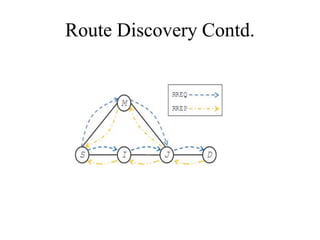
Route Discovery 
• The source node broadcasts an RREQ packet to every node in 
the network. 
• If the destination node receives the RREQ to itself, it will 
reply an RREP packet back along the incoming path of the 
RREQ. 
• In order to protect the anonymity when exchanging the route 
information, the packet formats are to be redesigned, and 
modify the related processes.
Route Discovery Contd. 
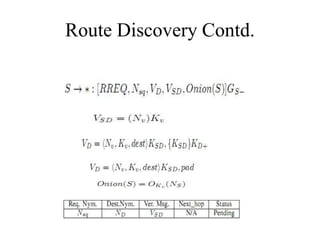
• Source Node: We assume that S initially knows the 
information about D, including its pseudonym, public key, and 
destination string. 
• The destination string dest is a binary string, which means 
“You are the destination” and can be recognized by D. 
• If there is no session key, S will generate a new session key 
KSD for the association between S and D.
Route Discovery Contd.
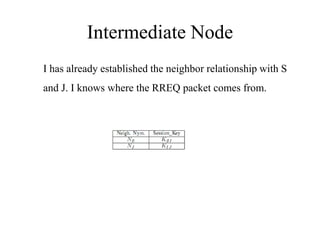
Intermediate Node 
I has already established the neighbor relationship with S 
and J. I knows where the RREQ packet comes from.
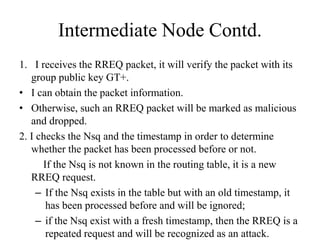
Intermediate Node Contd. 
1. I receives the RREQ packet, it will verify the packet with its 
group public key GT+. 
• I can obtain the packet information. 
• Otherwise, such an RREQ packet will be marked as malicious 
and dropped. 
2. I checks the Nsq and the timestamp in order to determine 
whether the packet has been processed before or not. 
If the Nsq is not known in the routing table, it is a new 
RREQ request. 
– If the Nsq exists in the table but with an old timestamp, it 
has been processed before and will be ignored; 
– if the Nsq exist with a fresh timestamp, then the RREQ is a 
repeated request and will be recognized as an attack.
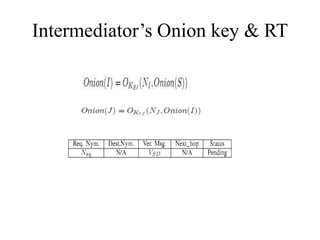
Intermediate Node contd 
• I tries to decrypt the part of VD with its own private key. 
• In case of decryption failure, I understands that it is not the 
destination of the RREQ. 
• I will assemble and broadcast another RREQ packet in the 
following format: 
• I → ∗ : [RREQ,Nsq, VD, VSD,Onion(I)]GI−
Intermediator’s Onion key & RT
Destination Node 
• When the RREQ packet reaches D, D validates it similarly to 
the intermediate nodes I or J. 
• Since D can decrypt the part of VD, it understands that it is the 
destination of the RREQ. 
• D can obtain the session key KSD, the validation nonce Nv, 
and the validation key Kv. Then D is ready to assemble an 
RREP packet to reply the S’s route request.
Advantages 
• It gives high anonymity protection 
• AASR provides higher throughput 
• Lower packet loss ratio in different mobile scenarios in the 
presence of adversary attacks. 
• It also provides better support for the secure communications.

AASR Authenticated Anonymous Secure Routing for MANETs in Adversarial Environments-First review

  • 1.
    AASR Authenticated AnonymousSecure Routing for MANETs in Adversarial Environments Guider Ms M. Nisha M.E; Assistant Professor Presented By SaravananAnnamalai (722013405016) II M.E Computer Science&Engineering 9/8/2014 1
  • 2.
    Introduction • AMobile Ad hoc Network (MANET) is a continuously self-configuring, infrastructure-less network of mobile devices connected without wires. • Each device in a MANET is free to move independently in any direction, and will therefore change its links to other devices frequently. • Each must forward traffic unrelated to its own use, and therefore be a router. • The primary challenge in building a MANET is equipping each device to continuously maintain the information required to properly route traffic and security. 9/8/2014 2
  • 3.
    Objective • Arouting protocol to provide anonymity and location privacy. • To defend the potential active attacks without unveiling the node identities using group signature. • To prevent intermediate nodes from inferring a real destination using onion routing. • Improve throughput in the presence of adversary attacks. • To reduce the packet loss. 9/8/2014 3
  • 4.
    On-demand Ad hocRouting • Reactive protocols – Lower overhead since routes are determined on demand – Significant delay in route determination – Employ flooding (global search) – Control traffic may be difficult – Example: DSR, AODV etc 9/8/2014 4
  • 5.
    Trapdoor • Atrapdoor is a common concept that defines a one-way function between two sets. • A global trapdoor is an information collection of mechanism in which intermediate nodes may add information elements, such as node IDs, into the trapdoor. • Only certain nodes, such as the source and destination nodes can unlock and retrieve the elements using pre-established secret keys. • The usage of trapdoor requires an anonymous end-to-end key agreement between the source and destination. 9/8/2014 5
  • 6.
    Group Signature •It provides authentication without disturbing the anonymity. • Every member in a group may have a pair of group public and private keys issued by the group trust authority (i.e., group manager). • The member can generate its own signature by its own private key, and such signature can be verified by other members in the group without revealing the signer’s identity. • Only the group trust authority can trace the signer’s identity and revoke the group keys. 9/8/2014 6
  • 7.
    Issues • Theexisting protocols are vulnerable to the attacks of fake routing packets or denial-of-service (dos) broadcasting. • Route anonymity for secure communication. • Location privacy for secure node movement. • Low throughput in the presence of adversaries. • Heavy packet loss 9/8/2014 7
  • 8.
    Literature Survey 1)M. G. Reed, P. F. Syverson, and D. M. Goldschlag, “Anonymous Connections and Onion Routing,” IEEE Journal on Selcted Area in Comm., vol. 16, no. 4, pp. 482–494, May 1998. 2) D. Boneh, X. Boyen, and H. Shacham, “Short group signatures,” in Proc. Int. Cryptology Conf. (CRYPTO’04), Aug. 2004. 3) J. Kong and X. Hong, “ANODR: ANonymous On Demand Routing with Untraceable Routes for Mobile Ad hoc networks,” in Proc. ACM MobiHoc’03, Jun. 2003, pp. 291– 302. 9/8/2014 8
  • 9.
    Anonymous Connections andOnion Routing M. G. Reed, P. F. Syverson, and D. M. Goldschlag, “Anonymous Connections and Onion Routing,” IEEE Journal on Selcted Area in Comm., vol. 16, no. 4, pp. 482–494, May 1998. • Onion routing is an infra structure for private communication over public network. • An onion is a data structure that is treated as the destination address by onion routers – anonymous connection. • Onions themselves appear differently to each onion router as well as to network observers. • The same goes for data carried over the connections they establish. 9/8/2014 9
  • 10.
    Basic Configuration •Data stream never appears in the clear on the public network, this data may carry identifying information, but communication is still private. • The onion router at the originating protected site knows both the source and destination of a connection. • The use of anonymous connections between two sensitive sites that both control onion routers effectively hides their communication from outsiders. 9/8/2014 10
  • 11.
    How Onion RoutingWorks {{{m}3}4}1 1 2 u d 3 4 5 1. u creates l-hop circuit through routers 2. u opens a stream in the circuit to d 3. Data are exchanged 9/8/2014 11
  • 12.
    How Onion RoutingWorks {{{m’}3}4}1 1 2 u d 3 4 5 1. u creates l-hop circuit through routers 2. u opens a stream in the circuit to d 3. Data are exchanged 9/8/2014 12
  • 13.
    How Onion RoutingWorks u 1 2 3 4 5 1. u creates l-hop circuit through routers 2. u opens a stream in the circuit to d 3. Data are exchanged. 4. Stream is closed. 5. Circuit is changed every few minutes. d 9/8/2014 13
  • 14.
    How Onion RoutingWorks u 1 2 3 4 5 d u 1 2 Theorem 1: Adversary can only determine parts of a circuit it controls or is next to. 9/8/2014 14
  • 15.
    Short Group Signatures D. Boneh, X. Boyen, and H. Shacham, “Short group signatures,” in Proc. Int. Cryptology Conf. (CRYPTO’04), Aug. 2004. • Group signatures provide anonymity for signers. • Signatures in our scheme are approximately the size of a standard RSA signature with the same security. • Security of our group signature is based on the Strong Diffie- Hellman assumption and a new assumption in bilinear groups called the Decision Linear assumption. • Proof of security of our system is given by the random oracle model 9/8/2014 15
  • 16.
    Strong Diffie-hellman Assumption • Let G1,G2 be cyclic groups of prime order p where possibly G1 = G2. • Let g1 be a generator of G1 and g2 a generator of G2. • Let say that the (q, t, )-SDH assumption holds in (G1,G2) if no t-time algorithm has advantage at least in solving the q-SDH problem in (G1,G2). • To gain confidence in the assumption prove that it holds in generic groups in the sense of Shoup. • The q-SDH assumption has similar properties to the Strong- RSA assumption. • Use these properties to construct our short group signature • scheme. 9/8/2014 16
  • 17.
    Decision Linear assumption • Let g1 ϵ G1 as above, along with arbitrary generators u, v, and h of G1 • Given u, v, h, ua, vb, hc 2 G1 as input, output yes if a + b = c and no otherwise. • The (t, )-Decision Linear Assumption (LA) holds in G1 if no t-time algorithm has advantage at least in solving the Decision Linear problem in G1. 9/8/2014 17
  • 18.
    Group Signature Security Properties • Correctness, which ensures that honestly-generated signatures verify and trace correctly. • Full-anonymity, which ensures that signatures do not reveal their signer’s identity. • Full-traceability, which ensures that all signatures, even those created by the collusion of multiple users and the group manager, trace to a member of the forging coalition. 9/8/2014 18
  • 19.
    ANODR: ANonymous OnDemand Routing with Untraceable Routes for Mobile Ad hoc networks J. Kong and X. Hong, “ANODR: ANonymous On Demand Routing with Untraceable Routes for Mobile Ad hoc networks,” in Proc. ACM MobiHoc’03, Jun. 2003, pp. 291–302. • The design of ANODR is based on - broadcast with trapdoor information • Un-traceability: ANODR dissociates ad hoc routing from the design of network member’s identity/pseudonym. • Intrusion tolerance: ANODR ensures there is no single point of compromise in ad hoc routing. • Un-linkability: Anonymity in terms of un-linkability is defined as un-linkability of an IOI and a pseudonym. 9/8/2014 19
  • 20.
    Routing Attacks inMANET • Location privacy attack – Correlate a mobile node with its locations (at the granularity of adversary’s adjustable radio receiving range) – Counting/analyzing mobile nodes in a cell • Route tracing attack – Visualizing ad hoc routes • Motion inference attack – Visualizing motion patterns of mobile nodes – Deducing motion pattern of a set of nodes • Other traffic analysis – Analyzing packet flow metrics (as in Internet traffic analysis) 9/8/2014 20
  • 21.
    Adversary in MobileAd Hoc Networks • External adversary: wireless link intruder – Eavesdropper – Traffic analyst (not necessary to break cryptosystem) – Unbounded interception: adversary can sniff anywhere anytime • Internal adversary: mobile node intruder – Capture, compromise, tamper – Passive internal adversary is hard to detect due to lack of exhibition of malicious behavior – Bounded: otherwise secure networking is impossible 9/8/2014 21
  • 22.
    Framework of AnonymousRoute Discovery (between source and destination) • Similar to existing on demand routing schemes – Route-REQuest RREQ,seqnum,to_be_opened_by_destanonymous_trapdoor – Route-REPly RREP, presented_by_destanonymous_proof • A global trapdoor can only be opened by dest – Not required to know where dest is – destination can present an anonymous proof of door opening • Need more design to address per-hop 9/8/2014 22
  • 23.
    Make On demandRoutes Untraceable • ANODR-TBO is robust against node intrusion – Fully anonymous: no node identity revealed – Fully distributed control: avoid single point of compromise – Multiple paths feasible: avoid single point of failure • So far anonymous only, and symmetric key only – More complexity in realizing untraceability to hide side channels & resist traffic analysis • Protect RREP flow – Need an asymmetric secret channel • Modified RREQ: Embed a temporary asymmetric key ecpk1 RREQ, ecpk1, seqnum, open_by_E, onion • Modified RREP: Exchange a secret seed Nym Kseed RREP, ecpk1(Kseed), Kseed (proof_from_E, onion) 9/8/2014 23
  • 24.
    Make Routes Untraceable(cont’d) • Protect reused route pseudonyms – Using Kseed to do self-synchronized route pseudonym update – So far all pseudonyms/aliases are one-time aliases! • Playout “Mixing” – Resist traffic analysis: Time correlation Content correlation Buffer, Re-order, Batch send, Insert dummy/decoy packets Alice Bob MIX Eve 9/8/2014 24
  • 25.
    Existing System •The existing protocols are vulnerable to the attacks of fake routing packets or denial-of-service (DoS) broadcasting, even the node identities are protected by pseudonyms. • A number of anonymous secure routing protocols have been proposed, the requirement is not fully satisfied.
  • 26.
    Disadvantages • ManyAnonymous routing protocols are available. But it does not detect the active attackers effectively. • Low Throughput in the presence of adversaries. • Heavy Packet Loss • High delay
  • 27.
    Proposed Work •The route request packets are authenticated by a group signature, to defend the potential active attacks without unveiling the node identities. • The key-encrypted onion routing with a route secret verification message, is designed to prevent intermediate nodes from inferring a real destination.
  • 28.
    Route Discovery •The source node broadcasts an RREQ packet to every node in the network. • If the destination node receives the RREQ to itself, it will reply an RREP packet back along the incoming path of the RREQ. • In order to protect the anonymity when exchanging the route information, the packet formats are to be redesigned, and modify the related processes.
  • 29.
    Route Discovery Contd. • Source Node: We assume that S initially knows the information about D, including its pseudonym, public key, and destination string. • The destination string dest is a binary string, which means “You are the destination” and can be recognized by D. • If there is no session key, S will generate a new session key KSD for the association between S and D.
  • 30.
  • 31.
  • 32.
    Intermediate Node Ihas already established the neighbor relationship with S and J. I knows where the RREQ packet comes from.
  • 33.
    Intermediate Node Contd. 1. I receives the RREQ packet, it will verify the packet with its group public key GT+. • I can obtain the packet information. • Otherwise, such an RREQ packet will be marked as malicious and dropped. 2. I checks the Nsq and the timestamp in order to determine whether the packet has been processed before or not. If the Nsq is not known in the routing table, it is a new RREQ request. – If the Nsq exists in the table but with an old timestamp, it has been processed before and will be ignored; – if the Nsq exist with a fresh timestamp, then the RREQ is a repeated request and will be recognized as an attack.
  • 34.
    Intermediate Node contd • I tries to decrypt the part of VD with its own private key. • In case of decryption failure, I understands that it is not the destination of the RREQ. • I will assemble and broadcast another RREQ packet in the following format: • I → ∗ : [RREQ,Nsq, VD, VSD,Onion(I)]GI−
  • 35.
  • 36.
    Destination Node •When the RREQ packet reaches D, D validates it similarly to the intermediate nodes I or J. • Since D can decrypt the part of VD, it understands that it is the destination of the RREQ. • D can obtain the session key KSD, the validation nonce Nv, and the validation key Kv. Then D is ready to assemble an RREP packet to reply the S’s route request.
  • 37.
    Advantages • Itgives high anonymity protection • AASR provides higher throughput • Lower packet loss ratio in different mobile scenarios in the presence of adversary attacks. • It also provides better support for the secure communications.